Joanne Dixon

Everyday Erinyes #206

 Posted by at 8:42 am  Politics
Feb 292020
 

Experts in autocracies have pointed out that it is, unfortunately, easy to slip into normalizing the tyrant, hence it is important to hang on to outrage. These incidents which seem to call for the efforts of the Greek Furies (Erinyes) to come and deal with them will, I hope, help with that. As a reminder, though no one really knows how many there were supposed to be, the three names we have are Alecto, Megaera, and Tisiphone. These roughly translate as “unceasing,” “grudging,” and “vengeful destruction.”

The Furies picked out this article themselves. They wanted us to get a better handle on how events of today are reflected in events of days when they were very young. They hope it will help.
==================================================================

The ancient Greeks had alternative facts too – they were just more chill about it
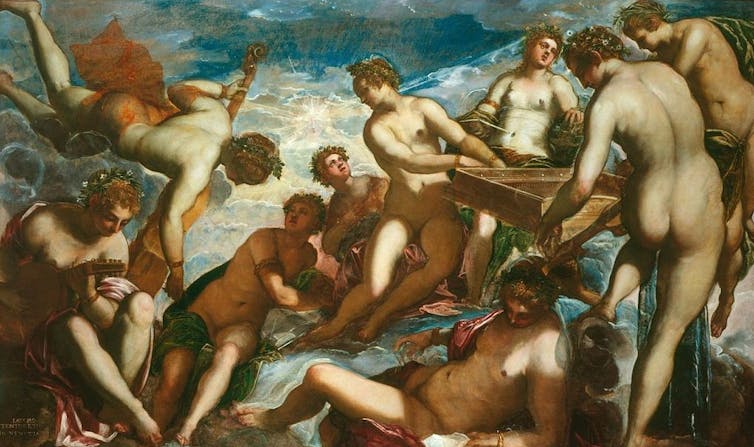
Understandings of truth may be found in the Muses’ words.
Jacopo Tintoretto’s The Muses/Wikpedia

Joel Christensen, Brandeis University

In an age of deepfakes and alternative facts, it can be tricky getting at the truth. But persuading others – or even yourself – what is true is not a challenge unique to the modern era. Even the ancient Greeks had to confront different realities.

Take the story of Oedipus. It is a narrative that most people think they know – Oedipus blinded himself after finding out he killed his father and married his mother, right?
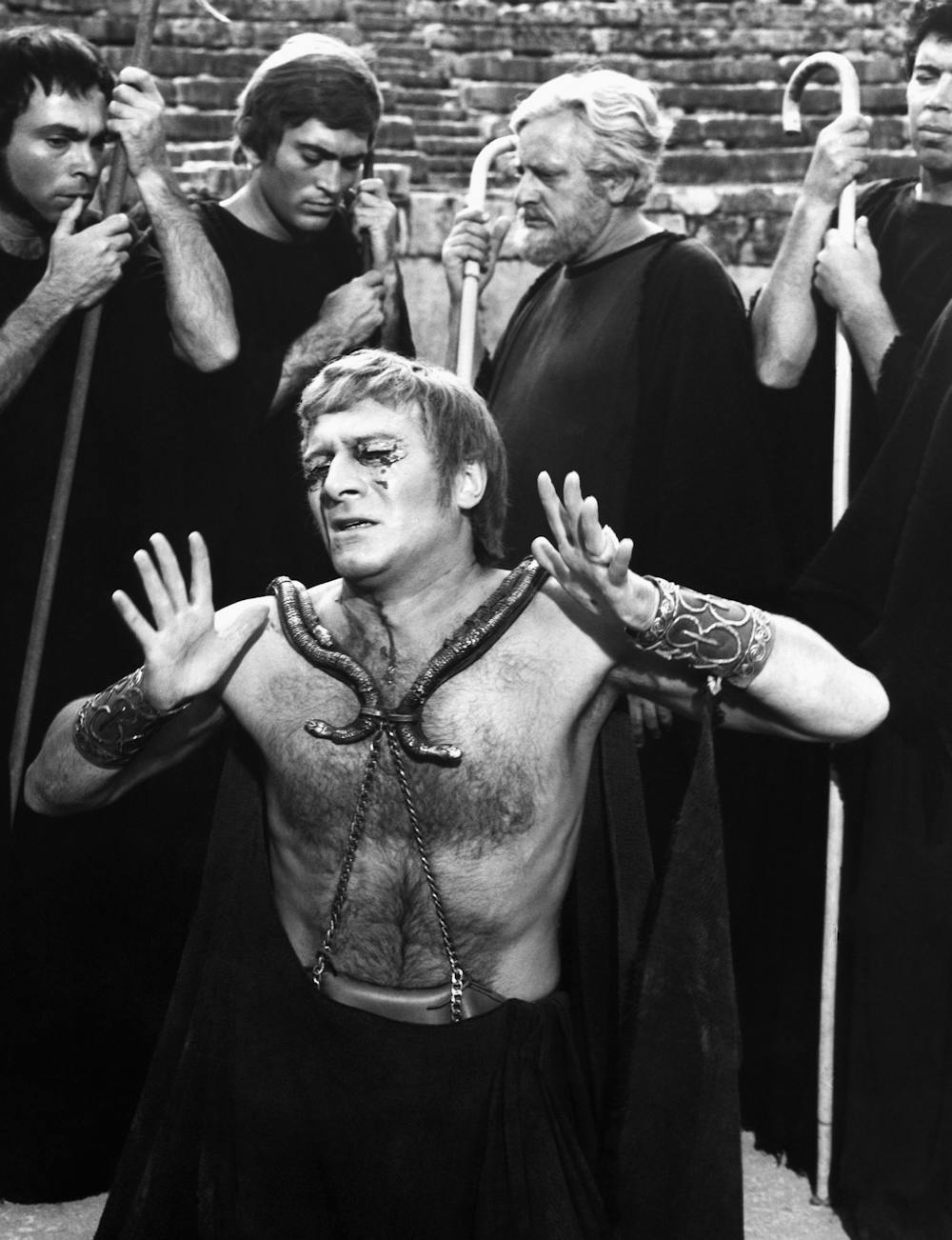
Actor Christopher Plummer in the 1967 film ‘Oedipus the King.’
AP Photo

But the ancient Greeks actually left us many different versions of almost every ancient tale. Homer has Oedipus living on, eyes intact after his mother Jocasta’s death. Euripides, another Greek dramatist, has Oedipus continue living with his mother after the truth is revealed.

A challenge I face when teaching Greek mythology is the assumption that my course will establish which version of the story is correct. Students want to know which version is “the right one.”

To help them understand why this isn’t the best approach, I use a passage from Hesiod’s “Theogony,” a story of the origin of the universe and the gods by the poet Hesiod. The narrator claims the Muses, inspirational goddesses of the arts, science and literature, appeared to him and declared “we know how to tell many false things (pseudea) similar to the truth (etumoisin) but we know how to speak the truth (alêthea) when we want to.”

Now, that is quite the disclaimer before going on to describe how Zeus came to rule the universe! But the Greeks had different ways of thinking about narrative and truth than we do today.

The truths are out there

One such approach focuses on the diversity of audiences hearing the story. Under this historical interpretation, the Muses’ caveat can be seen as a way to prepare audiences for stories that differ from those told in their local communities.

A theological interpretation might see a distinction between human beliefs and divine knowledge, reserving the ability to distinguish the truth for the gods alone. This approach anticipates a key tenet of later philosophical distinctions between appearance and reality.

The Muses also set out a metaphysical foundation: The truth exists, but it is hard to comprehend and only the gods can truly know and understand it. This formulation establishes “truth” as a fundamental feature of the universe.

The meanings of the words used are important here. “Pseudea,” used for “lies,” is the root of English compounds denoting something false – think pseudonym or pseudoscience. But notice that Hesiod uses two different words for “truth.” The first, “etumon” is where we get the English etymology from, but this Greek word can mean anything from “authentic” to “original.” The second, “alêthea” literally means “that which is not hidden or forgotten.” It is the root of the mythical river of forgetfulness, Lêthe, whose waters the souls of the dead sample to wash away their memories.

So to the Muses — who were the daughters of Zeus and Mnemosyne, the goddess of memory — “truth” is something authoritative because it is “authentic” in meaning and “revealed” or “unforgettable.”

The Muses’ implication is that truth is derived from ancient origins and is somehow unchanging and, ultimately, unknowable for human beings.

Indeed, this formulation becomes a bedrock of ancient philosophy when authors like Plato insist that truth and reality must be eternal and immutable. Such assumptions about the truth are also central to absolutist approaches to beliefs, whether we are talking about religion, literature or politics.

But what good is knowing about the nature of truth if it is ultimately inaccessible to mortal minds?

From teaching Greek texts I have become increasingly convinced that the Theogony’s narrator quotes the Muses not merely to evade responsibility for telling an unknown story nor to praise the wisdom of the gods. Instead, he is giving us advice for how to interpret myth and storytelling in general: Don’t worry about what it is true or not. Just try to make sense of the story as you encounter it, based on the details it provides.

Myth and memory

The treatment of “truth” in Greek myth can be informative when looking at modern research in cognitive science and memory.

The memory scientist Martin Conway, in studying how people construct stories about the world and themselves, has argued that two basic tendencies, correspondence and coherence, govern our memories.

Correspondence refers to how well our memory fits with verifiable facts, or what actually happened.

Coherence is the human tendency to select details which fit our assumptions about the world and who we are. Conway’s studies show that we tend to select memories about the past and make observations on the present which confirm our own narrative of what actually happened.

We already know that much of what we understand about the world is interpreted and “filled in” by our creative and efficient brains, so it should be of little surprise that we selectively pick memories to represent an absolute truth even as we continually revise it.

As individuals and groups, what we accept as “true” is conditioned by our biases and by what we want the truth to be.

With this in mind, the Muses’ warning not to obsess about whether the details in a myth are true seems appropriate – especially if a narrative making sense is more important than it being “true.”

A scene from Homer’s “Odyssey” strengthens the case for applying these ideas to early Greece. When Odysseus returns to his home island of Ithaca after 20 years, he dons a disguise to test the members of his household. A great deal of suspense arises from his conversations with his wife, Penelope, when he too is described as “someone speaking many lies (pseudea) similar to the truth (etumoisin).” Odysseus presents facts to his wife that have no counterpart in an objective reality, but his selection of details reveals much about Odysseus that is “true” about himself. He offers themes and anecdotes that give an insight into who he is, if we listen closely.

Ancient Greek epics emerged from a culture in which hundreds of different communities with separate traditions and beliefs developed shared languages and beliefs. Not unlike the United States today, this multiplicity created an environment for encountering and comparing differences. What Hesiod’s story tells his audience is that truth is out there, but it is hard work to figure out.

Figuring it out requires us to listen to the stories people tell and think about how they might seem true to them. That means not overreacting when we hear something unfamiliar that goes against what we think we know.

[ Deep knowledge, daily. Sign up for The Conversation’s newsletter.]The Conversation

Joel Christensen, Associate Professor of Classical Studies, Brandeis University

This article is republished from The Conversation under a Creative Commons license. Read the original article.

==================================================================
Now, I’m sure you are thinking that there is a major difference between truth in myth or religious belief, and truth in actual history. There is indeed. But historians of the times of the Erinyes didn’t see that the way we do. Herodotus, Thucydides, Livy, Tacitus, Pliny, Suetonius, Josephus – All of them included material which cannot be proven true, and material which can actually be proven false. Historians of that time didn’t really seem to care; if it was a good story, they told it.

To give just one example of the provably false, consider the story of Nero “fiddling while Rome burned,” in some accounts watching from the roof of his home. Certainly the great fire burned for several days, and it’s also apparently true that Nero didn’t want to be an Emperor so much as an actor and/or a singer. But fiddled? There was no such thing as a fiddle at the time. There were no bowed stringed instruments at all, and very few plucked ones. There were lyres, which are a sort of two-sided harp. But that’s a minor quibble. What really undercuts the story is that Nero was not in Rome when the fire started – and by the time he did get there, his house – roof and all – no longer existed. (And don’t get me started on the collapsible boat with which he is supposed to have murdered, or tried to murder, his mother Agrippina.) So what you think you know about historical figures may in reality be just as undependable as what you know or don’t know about mythology.

Alecto, Megaera, and Tisiphone, Thank you for sharing with us. Please help us, if you can, to hang onto respect for truth, and to hold on to truth which is knowable and provable, in the face of challenges.

The Furies and I will be back.

Share
Feb 252020
 

The following interview is a republication, with permission, of a post on Democratic Underground by user “H2Oman.” He also granted permission for yo to pass it on,and for anyone you pass it on to to pass it on, and so on. It was an exclusive to Democratic Underground, but it’s not meant to be hoarded. I’ll let him do his own intro first:

==================================================

Recently, I had a conversation with DU community member “Mike 03” about Yale Professor Bandy X. Lee’s book, “The Dangerous Case of Donald Trump.” Originally published in 2017, this important book featured the contributions of 27 psychiatrists and mental health experts. Last year, an updated and expanded version was published, which features contributions of 37 psychiatrists and mental health experts.

When my daughter Chloe gave me my copy of the book, she said that while she knew I did not want to have any books on Donald Trump in my library, she believed that this one was essential reading. From the moment I read the book’s dedication – to Dr. Lee’s Grandfather and Mother – I knew that I’d have difficulty putting the book down. And while I have since added a few other books that expose the madness of the Trump presidency to my library, I recognize “The Dangerous Case of Donald Trump” to be by far the most important.

During my conversation with Mike 03, , I decided to ask Dr. Lee if she might take part in an interview for this forum. For if you want something important done, ask a busy person. They are most likely to do important things. I would like to thank Dr. Lee ….for the book, her appearances in the media to discuss the topic, and for this interview. I hope that community members will thank her, and read and discuss her book.

And now the interview:

Q: Dr. Lee, as you would expect, there are people who feel depressed and discouraged about the process and outcome of the Senate’s impeachment trial. They are anxious about our country’s future. Others recognize that while the House impeachment was a significant victory, that the president is now more likely to engage in dangerous ways. In that context, can you please explain the “duty to warn” that has resulted in your speaking out?

A: It is entirely understandable that people are feeling depressed and discouraged; that he is more likely to engage dangerously is correct from our perspective, also. The error, from our view, has been in trying to solve a mental health problem through a purely political approach, which is why we petitioned the Congress to consult with us. We had cautioned that impeachment could go either way: psychologically, delaying impeachment was risky, because it would cause a sense of unlimited power and impunity to balloon. A rapid progression after delay then maximized the potential for paranoia and narcissistic rage, while the combination of impeachment and acquittal now has created conditions that would heighten the drive for revenge. With each failure to contain the president psychologically, there has been an expansion of dangers as well as worsening of symptoms. We can learn from this experience and recognize that a nuanced, psychological understanding of the situation is paramount—even if political processes are the only interventions we have for psychological limit setting and containment, which are still a lot.

Q: In 1973, Erich Fromm published “The Anatomy of Human Destructiveness.” In it, Fromm detailed how certain social factors, combined with specific personality types found in those in power at the time, create fertile ground for what he referred to as “malignant narcissists” to rise to the top. Do you see instances – saying, putting children in steel cages on the southern border – in our society that concern you?

A: Traumatizing children in a way that will breed injury and violence for society concerns me a great deal! Erich Fromm understood dynamically what I have been studying statistically and epidemiologically. I have always conceived of this presidency as a reflection of the poor state of collective mental health in our society. In fact, I have been fearing this result for about twenty years while watching public mental health decline and what I call “structural violence” increase. Structural violence, such as economic inequality, is one of the most potent causes of behavioral violence, be it homicides, suicides, or warfare, and when the groundwork is laid for a culture of violence, people will be attracted to a leader who does them violence. It was not time to be complacent because homicide rates were declining, even as suicides were rising. My research has been mostly about “connecting the dots,” which I am making great use of now. We have become locked in a vicious circle, where the more violence powerful people do to the population, the more vulnerable it becomes to manipulation and attraction to violence in ways that give violent people more power. It is an abusive relationship cycle at societal scale.

Q: Older people such as myself remember the publisher and an editor of “Fact” being sued for a story that questioned Senator Barry Goldwater’s stability during the 1964 presidential election. This was in spite of the Senator’s wife telling reporters that he had previously suffered a “nervous breakdown.” The “Goldwater Rule” kept this general topic from being reported upon for many years. There are potential dangers in diagnosing someone the clinician has not met. This raises a question: is it possible that what an expert sees in the media, including films of speeches and press conferences, and legal documents, might be more accurate sources of information than the self-reporting of those being evaluated with the Hare Checklist? (This is not to suggest that Senator Goldwater was in that group.)

A:This is absolutely correct. We must distinguish the quality and reliability of information, not just discount all media as a source. For certain impairments, such as personality disorders that cause others suffering but are not bothersome to the self, it is far more accurate to have reports from the person’s acquaintances, the sworn testimony of close associates, and external, direct observation of behavior. If the media presentation is not all staged but shows reasonably candid moments, actual interactions with other people, extensive coverage, and progression over prolonged periods of time, then it can be one of the best sources of information. Interviews, on the other hand, are known to be harmful in some cases, especially when a person is trying to present oneself in the best light and hiding important information. The most dangerous individuals are charming or manipulative, and even the most seasoned clinicians are fooled in a one-hour interview.
“The Goldwater rule” is problematic on many fronts: it should have been invalid since 1980, when our diagnostic system changed from reliance on introspection to observation of external behavior. It also treats the public figure like a patient, when our responsibility is to actual patients and to society, not to public figures we are not treating. Finally, currently it has no exceptions, which means it is the only rule in medicine where danger—an emergency—exception does not apply. This means you must violate the core tenets of medical ethics, and the humanitarian goals that all health professionals pledge to, in order to keep with this one “rule”.

Q: Do those people who are malignant narcissists, psychopaths, or sociopaths ever have periods of psychosis when under extreme pressure?

A: Psychosis is defined as detachment from reality, and since malignant narcissism, psychopathy, and sociopathy can be seen as defects in coping mechanisms, extreme pressure will make them more prone to psychotic spirals. For example, extreme narcissism can lead one to have such difficulty coping with normal human limitations, that one must create an alternative reality where one is superhuman, an expert in all fields, and even heaven-sent. Psychopathy or sociopathy can lead one to believe one is “the walking dead” to help explain the hollowness one feels inside.

Q: Do those referenced in prior question have the capacity for insights on how others view them? Are they capable of experiencing self-doubt or guilty feelings?

A: Insight and empathy are often what individuals with these disorders are missing. Because they have not developmentally gone beyond the stage of distinguishing between “me” and “not me,” other people are merely extensions of themselves or instruments to use for their purposes. They experience self-doubt or guilty feelings through projection: in other words, they perceive the anxiety they feel inside—such as doubt, confusion, and fear—as danger coming from the outside. Unfortunately, attempts to escape or to defeat that feeling translates into attack perceived enemies or, if they are lacking, to seek scapegoats.

Q: If such a person were to be found “not guilty” in a trial for a crime they definitely committed, are they more likely to engage in other anti-social behaviors in the future?

A: Absolutely. Because they are lacking in self-control, if the control does not come from the outside, they will keep pushing their limits. Setting firm boundaries of behavior, and consistently returning with immediate and commensurate consequences for behavior that violates those boundaries, is one of the most important ways to deal with such defects. Trying to elicit remorse, insight, or understanding about one’s behavior will not work. Trying to get them to understand objective laws or rules of fairness will not work, either, for everything will be predicated around the self and whether it benefits or pleases the self.

Q: It was reported that some of the contributors to “The Dangerous Case of Donald Trump” were scheduled to meet with elected officials in Washington, DC. When Democratic floor manager Adam Schiff spoke during the impeachment trial, he summed the president’s personality up quite well. Do you think elected officials fully recognize the threat the president poses?

A: We directly met with groups of lawmakers in December 2017 and January 2018, and they were already “fully on board,” as they told us then. In fact, they showed great concern, and many of them stated that the president’s access to nuclear weapons was of particular concern. Whereas we were looking to lawmakers for a solution, astonishingly, they seemed to be looking to us! Mostly Democrats, they said they could not do anything without being the majority party, while Republicans either would not express how they truly felt or would refuse to meet with us (even though their concerns seemed to be well-known behind the scenes). The lawmakers encouraged us to continue educating the public, for, if public opinion shifted, then they could act.

When we went to the media, however—and the media were extremely responsive at the time—the American Psychiatric Association stepped with press releases and articles, stating we were being unethical and practicing “armchair psychiatry,” using psychiatry as a “political tool” for “self-aggrandizing purposes.” It even mobilized the New York Times to state that psychiatrists need not be heard from, and, after this, press inquiries dried up instantly and almost permanently. Thus, by the time the Democrats had the majority in the House, the topic could no longer even be spoken about, and our situation was worse than before. Our book, however, was distributed by citizen groups to all members of the Senate and a substantial portion of the House. When members of the public approach lawmakers about the book, most say they have at least heard about it, if not read and have avidly recommended it to colleagues.

Q: On MSNBC’s “The 11th Hour with Brian Williams,” Columbia University’s John McWhorter told a story about Trump that he leaned from a reliable source. As a teen, Trump hung a small child out of a window by his ankles, and enjoyed the child’s suffering. Would such behaviors add to or reinforce your thoughts about him?

A: It is not a surprising anecdote, and consistent with the story of throwing rocks at an infant neighbor when he was a child, and punching a music teacher in the face while in primary school. Those with psychopathic or sociopathic tendencies enjoy others’ suffering, as they envy others for having something that they lack. The human ability to sense others’ feelings, to care about one another, and to do things that help rather than harm others, is something they do not have. Everyone has this, no matter one’s background, personality quirks, or lifestyle—unless one is a psychopath or a sociopath—and this exclusion from the communion of human beings can be very painful. Instead of facing this inner feeling, they transfer the pain onto others, which manifests as cruelty and pleasure at others’ suffering.

Q: In 2019, the updated edition of “The Dangerous Case of Donald Trump” was released, with insights from 37 psychiatrists and mental health experts. Has the year that followed changed your mind on the threat he poses?

A: Not at all. As expected, the psychological dangers we saw translated into social, cultural, political, and global dangers through the office of the presidency. He followed exactly the course we predicted, on the timeline we estimated. Not only that, we have gotten so good at predicting his actions, we sent in a letter of warning to the Congress three days before he withdrew troops from northern Syria and caused the massacre of our Kurdish allies. We sent in another warning about an impeachment proceeding without guardrails, and one month later there was the assassination of Qassim Soleimani of Iran. We warned of the continued need to contain the psychological dangers, and now the president is on a revenge spree against those who lawfully testified against him and pardoning criminals while declaring himself the law of the land. Because someone with his condition grows worse in a position of power, no matter what—whether you give into his pressures for more power or try to restrict him does not matter—we have not seen the worst yet.

Q: For those who are feeling depressed and anxious about current events, do you have any suggestions?

A: I have often said that “the Resistance” is like the immune system of the body: we must replenish ourselves, know our target, and keep healthy! We should take mental hygiene seriously and practice it regularly. It may sound strange, but this means setting boundaries to protect our personal and leisurely lives. Far from being selfish or complacent, doing the things we enjoy and giving time to our loved ones are all a part of responsible action. Allot in advance a reasonable time for the fight, and do not go beyond it. When in it, use the time intelligently and creatively—and this includes listening to the mental health experts! What is exhausting to others is what mental health professionals deal with on a daily basis, and we ourselves protect our mental health through boundaries while treating the sickest individuals! Correctly understanding what is happening is most of the battle, and there are proven techniques for managing the difficult behavior we see. Even if some methods cannot be applied to a president, the principles still apply, and there are lots of things that the public can do. In fact, if only one recognized that true power rests with the people, and the posturing and bullying are actually façades—or fake power, like the Wizard of Oz—the people could achieve a great deal.

Share

Everyday Erinyes #205

 Posted by at 8:45 am  Politics
Feb 222020
 

Experts in autocracies have pointed out that it is, unfortunately, easy to slip into normalizing the tyrant, hence it is important to hang on to outrage. These incidents which seem to call for the efforts of the Greek Furies (Erinyes) to come and deal with them will, I hope, help with that. As a reminder, though no one really knows how many there were supposed to be, the three names we have are Alecto, Megaera, and Tisiphone. These roughly translate as “unceasing,” “grudging,” and “vengeful destruction.”

There’s pretty well nothing in this article which couldn’t have already been written (and much of it actually was, regarding Bill O’Reilly) about Trump and Weinstein and a host of others. It’s relevant now – well, it’s relevant all the time, but it’s in the news now because Bloomberg is in the news. And it does clarify the difference between two categories of what are generally lumped together as “NDA”s, and also goes into what some state governments are attempting to to to minimize/mitigate unfairness.
==================================================================

Nondisclosure and secrecy laws protect Bloomberg – not the women who sued him

Billionaire Mike Bloomberg and Sen. Elizabeth Warren had a heated exchange.
AP Photo/John Locher

Elizabeth C. Tippett, University of Oregon

Billionaire and former New York City Mayor Michael Bloomberg received a lot of flak at the Feb. 19 Democratic debate for his refusal to release employees who sued his company from nondisclosure agreements.

He admitted to having a “few nondisclosure agreements,” after Sen. Elizabeth Warren challenged him over the issue. They are “agreements between two parties that wanted to keep it quiet and that’s up to them,” he added. “They signed those agreements, and we’ll live with it.”

These types of agreements, also known as NDAs, have been blamed for keeping women silent about sexual harassment and assault in the workplace, particularly in the #MeToo era.

Such contracts, written to keep business information or settlement terms confidential, have been targeted by state lawmakers in recent years, with varying degrees of success.

What exactly are nondisclosure agreements? And why haven’t legislatures been able to fix the problem?

Confidentiality agreements vs. settlements

Media accounts tend to refer to “nondisclosure” agreements as a generic label for any contract that requires someone to keep a secret.

But when I worked as an employment lawyer, we dealt with two different types of agreements containing nondisclosure provisions: standard confidentiality agreements, which aim to protect an employer’s business secrets; and settlement agreements, intended to resolve actual or potential legal claims.

Standard confidentiality agreements are quite common. Employers typically ask employees to sign them at the start of employment to protect the company’s research and development, trade secrets and other nonpublic information.

The problem is that an employee without legal training might believe that these agreements are more restrictive than they actually are. The contracts tend to define “confidential information” very broadly, and a worker might assume he or she can’t speak out about discrimination or harassment.

Legislatures like California have tried to address this problem by prohibiting employers from demanding confidentiality about “unlawful acts in the workplace” – like sexual harassment – as “term or condition” of employment.

This legislative approach can be effective in limiting nondisclosure provisions in standard employer agreements. Companies can comply with the statute by including a carve-out clarifying that employees are allowed to disclose harassment or other unlawful activity.

It’s an elegant legal fix. Companies can still protect their trade secrets through a standard confidentiality agreement. At the same time, the carve-out educates employees about their right to speak out or pursue legal action.

Employees might assume that standard confidentiality agreements extend beyond business information.
nito/Shutterstock.com

Settlement agreements are different

Settlement agreements are a lot less common. And they present more difficult questions when it comes to secrecy.

Settlement agreements tend to come about when an employee is leaving a job and the employer is paying him or her in exchange for waiving legal claims. They often arise if an employee has threatened to bring a lawsuit or actually filed one against the company. For example, in 2017 former Fox News host Bill O’Reilly reportedly secretly settled a sexual harassment claim by a network contributor for US$32 million.

The author and fellow law professor Jennifer Reynolds analyze secrecy provisions from a settlement involving O’Reilly.

And it would seem that at least some of the settlement agreements that Bloomberg has with the workers who have accused him or his company in the past of harassment or discrimination contain nondisclosure provisions. Of course, that doesn’t mean we can’t know anything about those cases; court filings and judicial decisions remain publicly available regardless of the terms of a settlement. But, depending on the terms of the agreement, it might prevent the plaintiff from speaking with a journalist about the lawsuit.

Thus far, states have been reluctant to impose an outright ban on nondisclosure provisions in settlement agreements, on the theory that workers might, in some cases, prefer confidentiality. As a result, they have added exceptions that allow secrecy in some circumstances.

In New York, where Bloomberg’s company is headquartered, a 2018 law limited secrecy provisions in sexual harassment settlements to situations where the plaintiff in the lawsuit prefers confidentiality and has been given 21 days to consider the deal and seven to change their minds.

In other words, the law is a speed bump to secrecy, not a stop sign.

Either way, this law applies only to contracts signed after the law went into effect. It is also limited to settlements involving “sexual harassment” claims, whereas some of the claims against Bloomberg’s company appear to arise from alleged sex and pregnancy discrimination and retaliation.

That may explain why Warren was pushing so hard for Bloomberg to release his former employees from their nondisclosure provisions: The law is not on their side. Ultimately, it’s up to Bloomberg.

This is an updated version of an article originally published on Nov. 21, 2017.

[Get the best of The Conversation, every weekend. Sign up for our weekly newsletter.]The Conversation

Elizabeth C. Tippett, Associate Professor, School of Law, University of Oregon

This article is republished from The Conversation under a Creative Commons license. Read the original article. ==================================================================
Are there any ways to protect oneself in advance? The website Glassdoor dot com used to be a truly helpful resource for people who wanted to know what working for a particular employer was really like. It appears to have turned into just another job search site. It was bought out from the original founders in 2016, although one of them is still acting as CEO; I can’t say how influential that purchase was, or how much of the changes were user-driven. Anonymous reviews of employers are still a part of the the site, but no longer its primary focus. Just looking quickly, I saw nothing about harassment.

Alecto, Megaera, and Tisiphone, The differences in the way these agreements are written can be mindboggling. While I certainly hope no one here will be in a position to have to cope with one, I can ask that you help anyone who is in such a position find really good lawyers.

The Furies and I will be back.

Share

Everyday Erinyes #204

 Posted by at 6:49 am  Politics
Feb 152020
 

Experts in autocracies have pointed out that it is, unfortunately, easy to slip into normalizing the tyrant, hence it is important to hang on to outrage. These incidents which seem to call for the efforts of the Greek Furies (Erinyes) to come and deal with them will, I hope, help with that. As a reminder, though no one really knows how many there were supposed to be, the three names we have are Alecto, Megaera, and Tisiphone. These roughly translate as “unceasing,” “grudging,” and “vengeful destruction.”

A few weeks ago (three, to be exact) I did a mammoth article on the IRS, with emphasis on why it’s so easy for Repubicans to cheat (and of course, when they cheat the IRS, it is ALL OF US who are getting cheated. I tend to take it personally.) Now, they have come up with yet a new wrinkle to cheat us all financially, and to combine it with straight-up misrepresentation by posing as actual churches when they aren’t.
==================================================================

What’s a church? That can depend on the eye of the beholder or paperwork filed with the IRS

This might be a church. Or not.
Rawpixel.com/Shutterstock.com

Samuel Brunson, Loyola University Chicago

In 2016, the Billy Graham Evangelistic Association told the Internal Revenue Service that it no longer wanted to be treated merely as a tax-exempt religious organization, free from the obligation to pay taxes on its income. Instead, the association – a Charlotte, North Carolina-based group that produces evangelical events, celebrates the legacy of Billy Graham and proselytizes about Jesus Christ – wanted the IRS to recognize it as a church.

The IRS complied with its request.

Similar religious groups lacking pews and parishioners are making the switch, too, including Focus on the Family, which promotes Christian heterosexual marriage; and the Navigators, an interdenominational Christian group active on college campuses.

In spite of being registered with the IRS as “churches,” these organizations and others like them don’t claim to be churches publicly. In fact, Gideons International – an association of businessmen and their wives who leave Bibles in hotel rooms – says on its website that it is neither a denomination nor a church. And yet, for tax purposes, Gideons claims to be a church.

Why would an already tax-exempt religious group want the government to treat it as a church? Because the rules governing churches are less strict.

501(c)(3) groups

While reasons for this growing trend vary, these groups may share one main goal: keeping their donor lists private to protect their donors from public criticism or backlash.

As a professor who studies how tax laws affect churches and other tax-exempt organizations, I believe these groups overestimate the benefits their donors will receive if the groups are treated as churches. Even so, I’m concerned that groups taking this step are reducing the flow of valuable information about these organizations to the public.

To see why I’m worried, here’s some background about what’s probably the best-known section of the U.S. tax code, section 501(c)(3). It provides two benefits to organizations that meet its requirements for tax exemption. First, these approximately 1.5 million groups – including everything from familiar nonprofits like the Red Cross to National Public Radio to the lesser-known First Church of Cannabis and the Satanic Temple – generally don’t have to pay taxes on their income.

Second, some of their donors can deduct their donations from their taxable income through the charitable deduction, creating an incentive to support those groups. While groups must be organized as nonprofits to qualify for the federal tax exemption, not every nonprofit is exempt.

Eligibility requires pursuing a specific purpose, such as religion, education or charity.

These organizations face obligations to maintain their exemptions, such as filing special paperwork with the IRS every year known as a Form 990. It requires disclosing some information, including who sits on its board of directors and the highest-paid employees. Tax-exempt groups also must share select financial information, including the value of their assets, their expenditures and their revenue.

As you may know, the IRS can’t violate your privacy by releasing your tax return. By contrast, it must make all 990 forms part of the public record.

An exception

As I explained in Dialogue: A Journal of Mormon Thought, an academic publication, no tax-exempt organization had to file any documentation with the IRS for the first 30 years following the modern federal income tax’s inception in 1913. That changed in 1943, when Congress decided to make all of these groups except the religious ones – whether or not they function as churches – file of annual tax returns.

By 1969, in the wake of the discovery of a number of organizations abusing their tax exemptions, Congress had begun to feel like the government needed more information. That year, the House of Representatives passed a bill that would have eliminated the filing exception for all religious organizations.

The House’s bill galvanized the religious community, which lobbied the Senate. Leaders like Ernest Wilkinson, the president of Brigham Young University, and the U.S. Catholic Conference argued against this legislation.

They claimed that the added paperwork would be burdensome and expensive for churches without generating additional tax dollars. They also asserted that disclosure was unnecessary because religious donors make charitable contributions based on religious obligations, not due to concern regarding the financial health of churches.

Ultimately, Congress split the proverbial baby. As of 1970, religious organizations were no longer exempt from filing 990 forms. The government did, however, exempt from this obligation churches, church associations and their “integrated auxiliaries” – that is, organizations associated with a church that receive financial support primarily from that church.

Today churches, synagogues, mosques and other houses of worship remain free from the obligation to file the forms the IRS makes all other tax-exempt organizations submit.

The IRS uses the term ‘church’ broadly, applying it to all faith traditions.
Crystal Eye Studio/Shutterstock.com

Let’s be a church!

To decide whether something really is a church, at least for tax purposes, the IRS considers 14 criteria.

The criteria include the existence of a congregation, the occurrence of religious services and the ownership of property where people pray.

These criteria are vague, at least partly because of the religious freedom granted by the Constitution. That vagueness lets some organizations meet the IRS definition of “church” even if they really aren’t.

For instance, Focus on the Family allegedly claimed its cafeteria was an “established place of worship” because the group’s members occasionally pray there. It also changed the job titles of all 600 of its employees to “minister.” Those steps most likely fail to meet the standards that guided the IRS when it laid out its 14 criteria.

But the federal tax agency lacks the funding and staff it would need to verify these claims, leaving the IRS with a limited ability to challenge Focus on the Family’s assertions. (The group has told The Washington Post that its main reason to become a “church” for tax purposes was “to protect the confidentiality of our donors.”)

If the IRS recognizes a religious organization as a church, the public loses access to significant information. The public does not, however, lose any information about the organization’s donors, notwithstanding these groups’ stated goals in transitioning to churches.

Currently, tax-exempt groups required to file 990 forms must tell the IRS about their “substantial contributors” – basically, donors who give more than US$5,000 annually. But the IRS can’t release these donor lists to the public.

That is, becoming a church for tax purposes eliminates an obligation to file 990 forms, but this newfound opaqueness does nothing additional to shield donors from public scrutiny because donors never faced public scrutiny in the first place.

As long as churches don’t have to share their financial details with the IRS, religious groups will have an incentive to act like churches for tax purposes. But the incentive doesn’t have to exist. I believe that if Congress were to heed its 1969 goals and eliminate the filing exemption for churches, other religious organizations would not feel pressure to act like churches.

And society would get more access to the information it needs to oversee tax-exempt organizations.

[ Get the best of The Conversation, every weekend. Sign up for our weekly newsletter. ]The Conversation

Samuel Brunson, Professor of Law, Loyola University Chicago

This article is republished from The Conversation under a Creative Commons license. Read the original article.

==================================================================
So, the biggest benefit of this scam is that, as churches, they can “protect the identity of their donors.” The other benefit is they can avoid filing paperwork, which is a financial benefit, as it saves time and money – how much depends on now much paper there is and how much you pay your staff – but probably minimal. However, not having to file adds to the secrecy. I kind of thought that, at least in principle, religions stopped keeping secrets about the time the Eleusinian Mysteries died out. But of course cons and grifters depend on secrecy and misdirection.

Alecto, Megaera, and Tisiphone, I absolutely realize that the IRS doesn’t even begin to have the funding and resources to investigate everything these groups are doing. So, if we are ever going to be able to enforce tax laws, the first step will be rebuilding the IRS. Please help us remember that if and when we ever get into a positon to do something about it.

The Furies and I will be back.

Share

Everyday Erinyes #203

 Posted by at 7:55 am  Politics
Feb 082020
 

Experts in autocracies have pointed out that it is, unfortunately, easy to slip into normalizing the tyrant, hence it is important to hang on to outrage. These incidents which seem to call for the efforts of the Greek Furies (Erinyes) to come and deal with them will, I hope, help with that. As a reminder, though no one really knows how many there were supposed to be, the three names we have are Alecto, Megaera, and Tisiphone. These roughly translate as “unceasing,” “grudging,” and “vengeful destruction.”

Now that the impeachment “trial” is over for now, and the election still a ways off, I thought maybe some of us might be looking for something else to worry about. (Just kidding, of course – I know there is plenty to worry about. But this is germane to some things we are already worrying about, and probably should not be ignored.)
==================================================================

100 years ago, Congress threw out results of the census

A “very small section’ of the Census Bureau, sometime between 1910 and 1930.
Library of Congress

Walter Reynolds Farley, University of Michigan

The 2020 Census hasn’t even started – but it has already kicked off spirited fights.

A Supreme Court case, decided last year, blocked a Trump administration proposal to ask every respondent if they were a citizen.

Meanwhile, there are three pending federal court suits in which plaintiffs for civil rights groups and one city claim that the administration has not done sufficient planning or provided enough funding for Census 2020.

Census 2020 is far from the first census to set off bitter political fights. One hundred years ago, results from Census 1920 initiated a decadelong struggle about how to allocate a state’s seats in Congress. The political arguments were so bitter that Congress eventually decided they would not use Census 1920 results.

Could this happen again?

Power in the census

The framers of the Constitution mandated a count of all people every ten years, in order to allocate seats in Congress and the Electoral College on the basis of each state’s population.

The results of the census shift political power and money. At present, US$1.5 trillion in federal spending is distributed to states and local governments every year on the basis of data gathered by the Census Bureau.

I am a demographer who has been teaching about the nation’s population trends since the early 1960s. I have analyzed census data for decades. In Census 2000, I was an enumerator and Census 2010, an address lister.

The 2020 Census asks just seven questions. Back in 1910, the census posed 32 questions, with an additional array of questions for farmers. One of those queries asked farmers the value of the products they sold during the previous year.

Since 1790, the official census start date had been either the first Monday of August or June 1. But, for the 1920 census, the Department of Agriculture presumed they would obtain more accurate information about the value of crops if the census were taken on Jan. 1. They feared farmers would forget financial details over the winter.

Congress approved the change without realizing the implications.

Taking the census in 1920.
Library of Congress

Immigration influx

Census 1920 results were released in December of that year, and they surprised the members of Congress.

At that time, there was vibrant opposition to foreigners coming into the U.S. The nation had already banned immigration from Asia, but many of those arrived after 1880 were Catholics and Jews who came from southern and eastern Europe. Many Americans feared they would never assimilate.

The 1920 census results showed that the Northeastern and industrial Midwestern states had grown rapidly, thanks to immigration from Europe. After an interruption for World War I, immigration spiked to 800,000 in 1920.

In response to census results and the unexpected “flood” of immigrants, Congress, in 1921, enacted an Emergency Immigration Quota Act, restricting immigration.

The lost census

That was just the first step in a decadelong controversy involving key issues that shaped the nation. Would there be continued immigration from eastern and southern Europe? Would political power shift to the states with the biggest cities?

The 1920 results would have shifted political power away from the South and away from the agricultural states of the Midwest, to the northeastern states and those states Americans now call the Rust Belt.

Representatives of farm states contended that the new Jan. 1 census date meant that many men who spent most of the year working on farms were counted in cities where they spent just a few winter months.

Southerners in Congress argued that congressional seats should be allocated on the number of citizens only, since this would protect their representation.

Congressmen from growing states emphasized that the Constitution said nothing about citizens. They argued that a constitutional amendment was required to limit congressional apportionment to citizens only.

Northeastern members also pointed to an obscure clause from the 14th Amendment that permitted Congress to diminish a state’s representation if they determined that a state abridged the right of male citizens to vote. Southern states attempted to accomplish that with poll taxes, literacy tests, grandfather clauses and refusal to register African Americans.

There was also controversy about which mathematical method to use to allocate seats to states. Different methods assigned different numbers of seats to states.

From 1800 to 1910, Congress had increased its membership after censuses, to prevent states from losing a seat. Vibrant controversy raged about the size of Congress, since different numbers favored different states.

Late in the 1920s, it became clear that Congress was so riven they would never use Census 1920 data to reapportion Congress. In 1929, they enacted legislation specifying which method would be used to allocate seats on the basis of the 1930 count.

Census 1920 is unique, since it was the only one not used for reapportionment.

The 1920 census captured a rapidly growing immigrant population.
U.S. Census Bureau

Echoes of the past

Is there any chance the census count of 2020 will be dismissed?

Just as in the 1920, there are conflicting views today about immigration and how much representation states should have in Congress and the Electoral College.

In the pending federal suits, plaintiffs contend that the administration’s lack of sufficient planning and funding will substantially undercount Americans, especially minority groups.

Should federal judges find in the plaintiff’s favor, members of Congress may be skeptical about data from Census 2020.

What’s more, at present, there are many individuals and several organizations arguing that congressional and Electoral College seats should be allocated according to the count of citizens or the count of voting age citizens, as opposed to all residents.

The state of Alabama has already filed suit contending that Alabama will likely lose a seat to Texas because aliens are included in the count used to apportion seats. If Congress were to apportion seats on the basis of citizens only, the Supreme Court may have to rule about what the framers of the Constitution meant when they defined the apportionment population.

Finally, the nation’s population is currently three times as large as in 1911, when Congress decided that 435 was the appropriate size of membership. On the basis of 2019 data, it seems likely that 10 states will lose a representative.

Some political analysts and advocates favor an expansion of Congress, since that would mean that members would represent fewer constituents. If Congress, next year, decided to increase its size to 460, no state would lose any of its current seats.

A new Congress will be elected this November and they will meet for the first time on Jan. 3, 2021. One of their first obligations will be reapportionment. Will this go smoothly – or will the controversies of the 1920s once again influence what use Congress makes of census counts?

[Like what you’ve read? Want more? Sign up for The Conversation’s daily newsletter.]The Conversation

Walter Reynolds Farley, Professor Emeritus of Sociology, University of Michigan

This article is republished from The Conversation under a Creative Commons license. Read the original article.

==================================================================
I really have nothing else to say. There are, of course, people and groups already working on the conduct of the census. At least this time the quantity of immigration should not come as a surprise to anyone – except maybe to those who have exaggerated it for reasons of spreading fear. It does make the 2020 elections – at all levels – at least down to and including state legislatures – loom even larger than it already does.

Alecto, Megaera, and Tisiphone, please help everyone who is on the ground (including the phones) working to get out the vote. And that goes double in states which have histories of making it more difficult for some people to vote than for others. And show us who are not able to be there and do that ways in which we can help those unsung heroes (and heroines) in their work.

The Furies and I will be back.

Share

Everyday Erinyes #202

 Posted by at 8:48 am  Politics
Feb 012020
 

Experts in autocracies have pointed out that it is, unfortunately, easy to slip into normalizing the tyrant, hence it is important to hang on to outrage. These incidents which seem to call for the efforts of the Greek Furies (Erinyes) to come and deal with them will, I hope, help with that. As a reminder, though no one really knows how many there were supposed to be, the three names we have are Alecto, Megaera, and Tisiphone. These roughly translate as “unceasing,” “grudging,” and “vengeful destruction.”

With Harvey Weinstein’s trial in progress (and boy, is he lucky that he is being tried more or less simultaneously along with Trump, because he’s been spared a lot – so far), and also having been recently reminded of Megyn Kelly, I thought it might be a good time to discuss clearing up some misconceptions about sexual assault. Many of these misconceptions come about because anyone, of any gender, of any cage, can be a target for, and a victim of, sexual assault. But there is not one person, of any gender or any age, who thinks beforehand that it might happen to him/her/them. And trying to imagine what we would do, in this as in so many aspects of life, is highly self-deceiving.

The article between the double-line barriers is republished, but I have taken the liberty of highlighting a few points which struck me. The words are republished – the teal color (and bolding) are mine.
==================================================================

Weinstein jurors must differentiate between consent and compliance – which research shows isn’t easy

The jury at the Weinstein trial will have to check their biases about consent.
Aleutie/Shutterstock.com

Vanessa K. Bohns, Cornell University

Did the women accusing Harvey Weinstein of sexual assault consent to his sexual advances of their own free will, or were they coerced?

Jurors’ answers to this question will be critical in determining the outcome of Weinstein’s trial, which began jury selection in New York on Jan. 7.

I’m a scholar of social influence, compliance and consent, and I’ve found that people often fail to fully appreciate the coercive dynamics of situations from the outside.

The jury’s task

Although more than 80 women have publicly accused Weinstein of sexual harassment and assault, the New York trial comes down to two accusers who say Weinstein sexually assaulted them.

Weinstein has argued that the encounters were consensual and claims as evidence emails and texts showing an ongoing, intimate relationship with one of his accusers following the alleged assault. Weinstein’s lawyer, Donna Rotunno, for her part, has stated, “I believe women are responsible for the choices they make.”

His defense team’s strategy, it appears, will be to cast doubt on the accusers’ accounts, depicting their actions as more autonomous and self-directed than the women claim their actions to have been.

To tease apart these competing accounts, jurors are likely to ask themselves, “Could these women have tried harder to avoid or remove themselves from these situations? Could they have said ‘no’ more forcefully?”

Unfortunately, research suggests that the answers people tend to come up with to these hypothetical questions don’t accurately capture how someone would actually behave in a such a situation.

We tend to imagine that people – including ourselves – would behave in bolder and more forceful ways in response to offensive and inappropriate behavior than people actually do when confronted with such behavior.

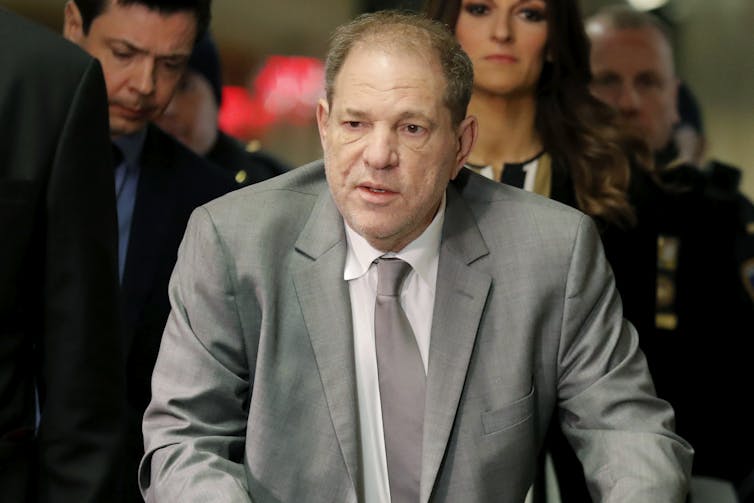
Harvey Weinstein arrives for jury selection.
AP Photo/Seth Wenig

What the research says

In a classic study, researchers asked one group of women how they would respond to being asked a number of sexually inappropriate questions in a job interview.

When these women thought about this situation hypothetically, 68% said they would refuse to answer at least one of the questions, 62% said they would tell the interviewer the question was inappropriate and 28% said they would walk out of the interview.

However, when the researchers invited another group of women to take part in what they believed to be a real job interview and actually subjected them to the same questions, not a single interviewee refused to answer even one question, and hardly any explicitly addressed the inappropriate nature of the questions with the interviewer.

Moreover, participants who contemplated being asked these questions hypothetically imagined feeling angry. However, participants who actually found themselves in this situation reported feeling more afraid. Instead of confronting the interviewer out of anger, as anticipated, participants facing the interviewer in reality instead tried to appease him by smiling.

My colleagues and I have similarly found that people fail to appreciate how hard it is for someone to refuse inappropriate, intrusive and romantic requests.

In one of our studies, 86% of participants believed a “reasonable person” would say “no” to an invasive request to unlock and hand over their phone to us to look through, and 72% said they themselves would refuse to do so. However, when we asked participants to do just that, only 3% actually refused.

In another study, participants overestimated by 56% the number of students on a college campus who would refuse to vandalize a library book when asked to do so, and in yet another, we found that targets of romantic advances felt more uncomfortable saying “no” than perpetrators of such advances realized.

Compliance versus consent

What all of this means is that while people frequently feel coerced into doing things they don’t want to do, others tend not to recognize these coercive pressures.

As a result, we tend to view others’ actions as freer and more autonomous than they experience them. We assume someone must have wanted to go along with something on some level; otherwise they would just have just said “no,” or said “no” more forcefully.

The jury selection process is supposed to uncover potential biases in the hopes of assembling an impartial jury. Much has been made of the difficulty of putting together an impartial jury due to jurors’ preexisting biases against Weinstein.

However, the widespread bias toward interpreting compliance as consent means that jurors are just as likely to have biases against his accusers’ version of events. Unfortunately, these more entrenched psychological biases are less likely to come out during jury selection.

[ Insight, in your inbox each day. You can get it with The Conversation’s email newsletter. ]The Conversation

Vanessa K. Bohns, Associate Professor of Organizational Behavior, Cornell University

This article is republished from The Conversation under a Creative Commons license. Read the original article.

==================================================================
If the discrepancies between what people think they would do and what they actually do are confusing to you, if they make you wonder what you or others probably should be doing to reduce the likelihood of injustice being done – and stubbornly defended – you are not alone. That’s why I had such a delightful “Eureka!” moment when I came across an article (“diary”) at Daily Kos called “The Big Dog Problem.

I’m not much of a dog person, but even the most intractable cat person must in honesty admit that some dogs do some things right. The author of this diary (user name “dogsbody”) uses his observations of canine behavior, as well as examples drawn from those observations by analogy, to illustrate how people who have privilege can learn to use that privilege to lift up people who have less privilege. Of course the more privilege one has, the more applicable it is. But it’s not that long, and it’s appealingly written. I recommend it highly.

Alecto, Megaera, and Tisiphone, I’d ask you to help all of us who think we are empathizing with survivors, or trying to, to realize that we probably don’t have a clue – that, if we think we wouldn’t have acted the way a survivor did, we are probably dead wrong. And to listen.

The Furies and I will be back.

Share

Pithy Progressive

 Posted by at 10:59 am  Politics
Jan 312020
 

I haven’t put up a “Pithy Progressive” for a while, but then, until now, Jeff Merkley hasn’t inspired me to.  So this one’s for Jeff.

I have a name I want you to remember, Joanne:

Raphael Warnock.

A community leader. A champion for civil rights, affordable health care, and a living wage.

He’s the senior pastor at Ebenezer Baptist, where he preaches from the same progressive pulpit as Rev. Dr. Martin Luther King Jr. did.

And today, he’s announcing that he’s running for the U.S. Senate in Georgia.

This is our chance to strike in a state Donald Trump narrowly won in 2016; to tip Georgia into the blue column.

Donate $3 right now. Let’s help launch Raphael Warnock’s campaign and mine to victory in 2020.

Mitch McConnell is in full panic mode: reports say Republicans and their allies are going to spend tens of millions of dollars in an attempt to save this seat.

That’s because we could legitimately win here in 2020. If we win in Georgia, we will almost certainly flip control of the Senate.

Want to sideline Mitch McConnell? Want to rebuild our democracy? Stand with Raphael and me as we take back our country and pave the way to a progressive future.

We need a change. We need leaders like Raphael Warnock in the Senate.

Jeff

Of course I realize not everyone is in a position to donate, and Jeff does too.  But Rev. Warnock’s is a name which deserves to be known.


Share
Jan 252020
 

Experts in autocracies have pointed out that it is, unfortunately, easy to slip into normalizing the tyrant, hence it is important to hang on to outrage. These incidents which seem to call for the efforts of the Greek Furies (Erinyes) to come and deal with them will, I hope, help with that. As a reminder, though no one really knows how many there were supposed to be, the three names we have are Alecto, Megaera, and Tisiphone. These roughly translate as “unceasing,” “grudging,” and “vengeful destruction.”

Some time ago I promised an IRS edition to explain in part why some organizations which manifestly should pay taxes, don’t. Part of what I was aware of was that at one point in the late nineties or early oughts, Congress passed a mammoth reorganization of the IRS, and in the process missed a detail – to make it short. the previous organization specified who can open an investigation into a non-profit, and the new organization eliminated that title. The IRS thought they knew the corresponding title, and attempted some investigations (of flagrant right wing violators of course), were taken to court, and lost. For several years there literally was NO ONE who was authorized to open such an investigation. The IRS was begging Congress for help, but you know what Congress was doing in the early and middle oughts – and helping the IRS wasn’t it. Apparently that loophole been fixed now, but no sooner did the IRS try to act than the RWNJs started crying “discrimination” (Bothsiderism, donchaknow)
==================================================================

This story was originally published by ProPublica.

How the IRS Gave Up Fighting Political Dark Money Groups

ProPublica is a Pulitzer Prize-winning investigative newsroom. Sign up for The Big Story newsletter to receive stories like this one in your inbox.

In the past decade, people, companies and unions have dispensed more than $1 billion in dark money, according to the Center for Responsive Politics. The very definition of that phrase, to many critics, epitomizes the problem of shadowy political influence: Shielded by the cloak of anonymity, typically wealthy interests are permitted to pass limitless pools of cash through nonprofits to benefit candidates or political initiatives without contributing directly to campaigns.

Such spending is legal because of a massive loophole. Section 501(c)(4) of the U.S. tax code allows organizations to make independent expenditures on politics while concealing their donors’ names — as long as politics isn’t the organization’s “primary activity.” The Internal Revenue Service has the daunting task of trying to determine when nonprofits in that category, known colloquially as C4s, violate that vague standard.

But the IRS’ attempts to police this class of nonprofits have almost completely broken down, a ProPublica investigation reveals. Since 2015, thousands of complaints have streamed in — from citizens, public interest groups, IRS agents, government officials and more — that C4s are abusing the rules. But the agency has not stripped a single organization of its tax-exempt status for breaking spending rules during that period. (A handful of groups have had their status revoked for failing to file financial statements for three consecutive years.)

Most cases do not even reach the IRS committee created to examine them. Between September 2017 and March 2019, the committee didn’t receive a single complaint to review according to one former and one current IRS employee who worked closely with the committee, even as at least 2,000 warranted its consideration. (The IRS disputes this.) The standards are almost as permissive when organizations apply for C4 status in the first place. In 2017, for example, the IRS rejected only three out of 1,487 applications.

The IRS’ abdication of oversight stems from a trio of causes. It started with a surge in the number of politically oriented C4s. That was exacerbated by the IRS’ almost comically cumbersome process for examining C4s accused of breaching political limits; the process requires a half-dozen layers of approvals and referrals merely to start an investigation. That is abetted by years of IRS staff attrition and loss of expertise that was then compounded by steady budget reductions by Congress starting in 2010. The division that oversees nonprofits, known as the “exempt organization” section, shrank from 942 staffers in 2010 to 585 in 2018, according to the IRS.

On top of that, the 2013 scandal in which the IRS was accused of targeting conservative nonprofits left the division seared by the vilification of the conservative politicians, media and the public, and by the resignation of Lois Lerner, who headed the division. Some IRS auditors say they were paralyzed. “I was scared of being pilloried, dragged to the Hill to testify, getting caught up in lawsuits, having to sink thousands of dollars in attorneys bills that I couldn’t afford, and having threats made against me or my family,” said one employee who worked in Lerner’s division at the time. “I locked down my Facebook page. I deleted all personal Twitter posts. I stopped telling people where I worked. I tried to become invisible.”

The IRS press office offered written responses to some of the questions submitted in writing by ProPublica. “The IRS administers the tax laws as enacted by Congress and maintains an active enforcement presence to promote equal application of the law to all taxpayers,” the statement noted four times, in response to questions about the adequacy of the agency’s enforcement and its resources.

The IRS is aware of the problems, but its attempts to address them have gone nowhere. A 2013 report by the IRS inspector general recommended changes for the agency. That included adopting a new, clear definition of what constitutes an organization’s “primary activity.” The IRS did that — only to have Congress shoot it down.

With the IRS ceding its oversight role, state authorities need to step in, said Jim Sheehan, chief of the charities bureau at the New York Attorney General’s Office, at an event on exempt organizations in February. Speaking broadly about what he described as the IRS’ failure to oversee political nonprofits, Sheehan said, “It’s the Wild West out there.”

The U.S. tax code has long offered nonprofits options for engaging in politics, each identified by the provision that governs it in the code. Each has trade-offs. For example, 501(c)(3) entities are tax exempt and allowed to lobby on a limited basis — but they’re barred from spending any money on political candidates. So-called 527s can spend all they want on elections — but they have to reveal their donors.

The C4s enjoy a lot of wiggle room. In that category, IRS regulations dictate that an organization that seeks tax-exempt status “must not be organized for profit and must be operated exclusively to promote social welfare. The regulations state that such an organization “may engage in some political activities, so long as that is not its primary activity.”

But how does one define an organization’s “primary activity”? For decades, the point was largely moot. Big funders used other means to funnel money to campaigns. Then came a series of Supreme Court rulings, the best known of which was the Citizens United decision in 2010, that loosened restrictions on political contributions. In that case, the court concluded that, like people, corporations and unions could spend unlimited funds for elections.

The Citizens United decision was followed by a surge in the formation of politically focused organizations seeking IRS approval as C4s. In 2012, at least $250 million passed through such groups and into efforts to elect candidates, an 80-fold increase from eight years prior.

That boom occurred at the same time that Congress began chipping away at the IRS budget. The combination left Lerner’s exempt organization unit overwhelmed. “My level of confidence that we are equipped to do this work continues to be shaken,” she wrote in an email in early 2013. “I don’t even know what to recommend to make this better.”

A handful of IRS employees in Lerner’s division had decided to improvise their own shortcut. If a group had a name that sounded political — for example, it had the words “Tea Party” in its name — they flagged it for extra attention.

Reporters eventually got wind of the tactic. Congressional interest followed and then a full-blown furor erupted in May 2013, when the IRS inspector general confirmed that IRS agents directed added scrutiny at groups with conservative-sounding words in the name.

The House convened hearings. Some Republican representatives claimed that Lerner was spearheading a partisan assault against conservative groups. “This is the most corrupt and deceitful IRS in history,” Rep. Kevin Brady, R-Texas, said in one hearing. Lerner declined to testify, citing her Fifth Amendment protections, and resigned.

Hearings on the subject continued intermittently for four years. The IRS ultimately spent 98,000 hours in staff time responding to the congressional investigations, according to testimony by the agency’s former commissioner, John Koskinen.

By the time the tumult abated, few people noticed that the inspector general had submitted another report. This one concluded that IRS staff had also used keywords such as “progressive” to target liberal organizations for further scrutiny.

Before determining that the IRS exempt organization division had displayed no anti-conservative bias, the inspector general had proposed fixing the way it scrutinizes nonprofits. “We believe [the targeting] could be due to the lack of specific guidance on how to determine the ‘primary activity’” of a social welfare nonprofit, the report stated.

The IRS responded by advocating a restrictive approach: C4s should be barred from any campaign-related activity. Those guidelines, released in late 2013, prompted 150,000 comments, the most public feedback in IRS history. Several Republican members of Congress circulated bills to block such a change.

In the wake of that opposition, the IRS backed away from its categorical approach and instead proposed a percentage-based definition of “primary activity.” Then-Commissioner Koskinen and his team held a series of meetings and came up with a working draft. “After a lot of discussion and review, the consensus was that social welfare nonprofits’ political activity had to be less than 50 percent for them to qualify,” Koskinen said in an interview with ProPublica.

Koskinen argued for this approach in one-on-one meetings with Democratic and Republican leaders. “I thought it was important for people on the Hill to realize that it wasn’t political,” he said, “but to make regulations more enforceable from the standpoint of the IRS.”

Ultimately, Congress disagreed. In December 2015, 17 lines were inserted into an 888-page appropriations bill: “None of the funds made available in this or any other Act may be used … to issue, revise, or finalize any regulation, revenue ruling, or other guidance … to determine whether an organization is operated exclusively for the promotion of social welfare.”

The House leadership, under then-Speaker Paul Ryan, inserted the ban in the final rounds of the bill’s negotiations, according to six people familiar with the rider. (Ryan did not respond to a request for comment.) Some of the language was borrowed from the previous Republican bills to restrain the IRS. And earlier in 2015, Ryan and then-Rep. Peter Roskam introduced the “Stop Targeting of Political Beliefs by the IRS Act of 2015.”

Koskinen told ProPublica he was surprised and disappointed. “The goal wasn’t to hamper anybody, but to help,” he said. “Leaving the situation murky is not doing any nonprofits any favors, and in fact is leaving more room for IRS employees to use their discretion and judgment.”

Since 2015, the lines have been carried over in each new appropriations bill. They remain in effect today.

Roger Vera was where congressional obstruction, the surge in C4s and the IRS’ Rube Goldberg oversight system all collided. As the referral manager for the exempt organizations division between 2013 and 2017, Vera ran the process through which citizens, IRS agents and others complained about groups they claimed had violated the tax code. (In IRS jargon, the complaints are called “referrals.”)

The IRS didn’t make it easy for him. It had adopted a convoluted system to handle those complaints after the increase in new applications that followed the Citizens United decision. It began with six steps: Complaints proceeded from a classifying agent, then to Vera, then to a research committee, then to one of three oversight committees, then back to Vera and then to a field agent. That was the process just to launch an investigation.

Each step was supposed to be documented in detail to demonstrate that politics had not infected the decision-making. There were more stages after that, of course, if the investigation revealed signs of a violation.

Between the high volume of complaints and the unwieldy process, Vera was overwhelmed. It was like “being in the middle of a hurricane,” he said. “You looked at 100% of the cases and researched 100% of them, but then you didn’t have time to do anything.” (Vera said he spoke to ProPublica without IRS approval because of the importance of transparency.)

The review process was so cumbersome, Vera said, that the three-year time limit for acting on each C4 complaint frequently expired before the IRS could take any action. “They made the system so complicated because they didn’t want the inspector general to come in and say, ‘Hey, you only looked at two or three cases and they’re all a certain political group,’” Vera said. Every complaint filed between 2010 and 2014 bogged down before field agents could begin investigating a C4 group, according to an investigation by the Senate Finance Committee in 2015.

The reports and reviews of Vera’s division — by the inspector general, by the Senate, by the Government Accountability Office — continued to mount. The scrutiny only seemed to make things worse. The division responded with periodic reorganizations, which kept staff off balance. The division also implemented a series of changes to the review process, such as shifting from rolling 12-month terms for review board members to fixed 24-month terms. It trimmed its pre-investigation process from six steps to five. The division also stopped accepting volunteers for the review board role and instead randomly assigned employees, who were already holding down full-time IRS jobs and received no extra compensation for serving on the board. In theory, the move away from volunteers would reduce the likelihood of politically motivated employees gaining seats. But compelling staffers to spend extra hours tackling complex cases where the tax code left significant latitude was not a formula for maximum efficiency.

The result was a continuing void in revoking the tax-exempt status of C4s. Between July 2015 and August 2016, the division received 6,539 complaints, according to an inspector general report. The report concluded that about 1,000 of them raised questions of rule violations relating to politics that should’ve been addressed by the special review committee. But Vera said he sent the committee only 19 cases — including both C4s and C3s each of them involving an organization prominent enough to draw significant media attention. The review committee forwarded 10 of those for investigation; as of early last year, half of those were being investigated and the other half were awaiting action. (The IRS statement noted that the agency “disagreed” with the inspector general’s “conclusion that allegations of political campaign intervention or excessive lobbying were not forwarded to the [review committee] for review as requested” and asserted that “some referrals may not contain all the elements required for the IRS to proceed.”)

Vera agreed with the inspector general’s view that there were more than 10 potential violators during that period. But between the vague language of the tax code and the agonizing review process, he had grown increasingly fatalistic. Even on the rare occasions when the review of a C4 made it through the pipeline and a field agent recommended revoking the organization’s tax-exempt status, Vera said, the IRS chief counsel would oppose the step on the grounds that the decision would likely be overturned in a court of law.

The situation has not improved since Vera shifted to another unit in 2017. The current review board, which began its two-year term in September 2017, had yet to receive any referrals as of March — despite at least 2,000 warranting the board’s expertise during that period — according to one former and one current IRS employee who worked closely with the review committee. (The IRS statement asserted that the committee did receive referrals, but “the data is not publicly available” and that reviews “are pending due to retirements on the committee.”)

Officials say they see reason for a few scintillas of optimism: The exempt organization unit is adding new staff. Margaret Von Lienen, who took over Lois Lerner’s post, announced in the fall of 2018 that the division hired 70 revenue agents and compliance officers, restoring its forces from a post-scandal low of 585 to 655, with plans to bring on an additional 70 in 2019. But even if the division hires those new employees, it will remain 200 employees below the count at the beginning of the decade.

“We’ve experienced so much attrition over the last few years that it’s a matter of having enough people to do the work,” Von Lienen said at a panel discussion in the closing weeks of 2018. In the short term, she said, the time required to train the new staff will slow the rate of review for C4 complaints. “We can probably expect in 2019 we’re going to do fewer exams,” she said. The division’s priority is to “stay on top of our application inventory, and probably the exam side of the house is going to suffer for that.”

While the IRS continues to try to dig out of its hole, made even deeper by the government shutdown this year, experts say new permutations of dark money are emerging. As Anna Massoglia, a researcher at the Center for Responsive Politics, put it, “There are new loopholes being exploited every day.”


==================================================================
Alecto, Megaera, and Tisiphone, of course there would be more 501(c)(4)’s being disqualified on the right than on the left, because, let’s face it, the right cheats. Of course there are some people on the left who cheat (descendant-of-vampires Rod Blagojevich leaps to mind), and there may even be some on the right who don’t, but those would be the exceptions on both sides.

For other examples about how blatant cheats get away with it, mostly by also being blatant bullies, see these stories:

The IRS Tried to Take on the Ultrawealthy. It Didn’t Go Well.

Americans Dodge $660 Billion in Taxes Each Year — And It’s Probably Getting Worse

The IRS Decided to Get Tough Against Microsoft. Microsoft Got Tougher.

IRS: Sorry, but It’s Just Easier and Cheaper to Audit the Poor

Just one more reason – but a big and critical one – why we need a strong Democratic Congress – in BOTH houses.  There are a lot of things the IRS is doing – and not doing – that I don’t like.  But it’s important to understand that the IRS itself is, and has been for decades, between a rock and a hard place.  Without more support than they are now getting, they will never be able to get it right.

The Furies and I will be back.

Share