Joanne Dixon

Everyday Erinyes #201

 Posted by at 6:23 am  Politics
Jan 182020
 

Experts in autocracies have pointed out that it is, unfortunately, easy to slip into normalizing the tyrant, hence it is important to hang on to outrage. These incidents which seem to call for the efforts of the Greek Furies (Erinyes) to come and deal with them will, I hope, help with that. As a reminder, though no one really knows how many there were supposed to be, the three names we have are Alecto, Megaera, and Tisiphone. These roughly translate as “unceasing,” “grudging,” and “vengeful destruction.”

I mentioned earlier this week that I had seen this as a headline, and that I had found it scary (an understatement). I gather that this is not something that has never been done before, but it has certainly not been on my radar before now, and here’s the thing: Orange Judas admires Putin – follows his lead – would most certainly do anything Putin directed him to do unless forcibly stopped from doing so. So I want to know more myself, and I don’t think it would hurt any of us to know more about what is going on.

=================================================================

Russia’s cabinet resigns and it’s all part of Putin’s plan
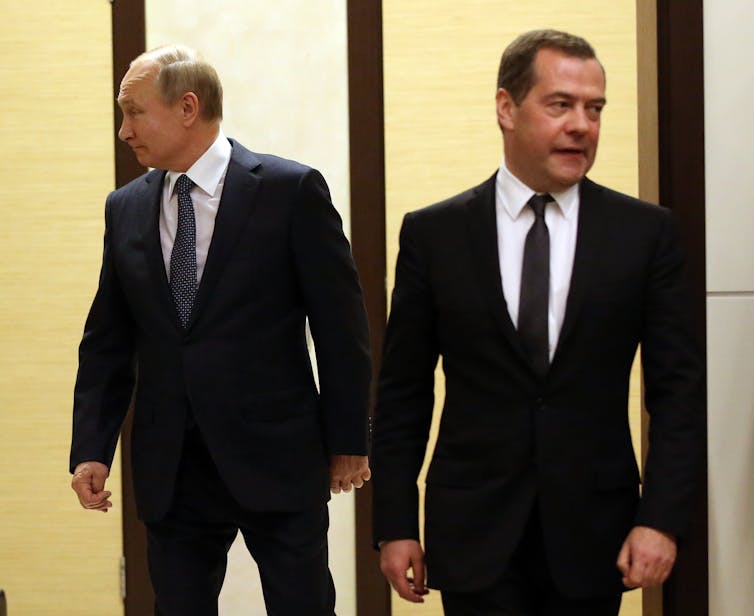
Russian President Vladimir Putin (L) and now-former Prime Minister Dmitry Medvedev (R) in Sochi, Russia, Dec. 7, 2019.
Mikhail Svetlov/Getty Images

Regina Smyth, Indiana University

Editor’s note: Russia’s prime minister, Dmitry A. Medvedev, and cabinet resigned on Jan. 15.

Russian politics are often not what they seem, especially to those in the West. We asked Regina Smyth, a Russia scholar at Indiana University, to help readers understand what’s going on.

1. What just happened?

Russian President Vladimir Putin, who has been in power for 20 years and faces term limits in 2024, has begun his effort to consolidate control and maintain his hold on power after the next elections. The cabinet and prime minister’s resignations are part of that effort.

Putin wants his majority in the parliament – the State Duma – to pass constitutional amendments that will allow him to remain in political control.

This move is not unexpected, at least among Kremlin watchers and scholars like me who have studied Russian elections over 30 years. Putin signaled the change in his annual press conference in December, where he spoke about the potential for constitutional reforms.

On Jan. 15, Putin gave his annual state of the nation address and unveiled “serious changes to the political system.” In response to the proposed constitutional amendments, which Putin is promoting as “reforms,” Prime Minister Medvedev and his government resigned.

Russian President Vladimir Putin delivers the annual state-of-the-nation address to the Federal Assembly of the Russian Federation in Moscow on Jan. 15, 2020.
Sefa Karacan/Anadolu Agency via Getty Images

This move should not be seen as protest, although it might be useful for Medvedev, a longtime ally of Putin’s, to feign independence and appear as if he made the move in dissent. He and Putin orchestrated similar actions in 2008 and again in 2011.

The goal of Putin and his allies is to forestall popular protest among those tired of Putin’s long reign.

Putin’s proposal to redefine the separation of power between the Duma, presidency and prime minister would allow parliament to select the prime minister, a power now in the hands of the president. Together with an agreement to impose strict two-term limits on future presidents, this change suggests that Putin will leave the presidency.

Future presidents would retain control of the security forces and the military but must consult the State Council.

The proposal is being touted in leading Russian newspapers as “democratic reform.” In fact, while appearing to redistribute power among the high-level players in the Kremlin, the details that will determine power relations remain vague.

On Monday, Putin’s spokesman stated that specifics will be developed in consultation with the Russian people. Given regime controls over voting and national campaigns, this nod to the people is a form of window dressing.

In making these changes and accepting the government’s resignation, President Putin is laying the groundwork for several paths to retain power, including as prime minister or head of a strengthened State Council, an advisory body to the president.

Putin’s proxies are already arguing that these reforms will prevent political crisis in 2024 and increase living standards.

2. Why did it happen?

President Putin faces two potential roadblocks if he wants to maintain political control through the next election cycle – parliamentary elections in 2021 and presidential elections in 2024.

The first problem is term limits that mandate he leave the presidency. In the face of growing urban protest and declining support for his regime’s policies, any political reforms that prolong Putin’s tenure are risky. Reform must be seen by the public as a step forward and not a step toward stagnation.

The second problem is that Putin and his United Russia party need to win large majorities in parliamentary and presidential elections. Russia’s sluggish economy and citizens’ frustration with poor government services will undermine support for regime candidates.

This plan, betting on the regime’s capacity to control elections, is risky. Outright electoral fraud will almost surely provoke protest.

Still, these so-called reforms are timed well before the election to allow Putin and his allies to rebuild support in the wake of any negative reaction. The Kremlin is preserving room to respond and correct course.

In accepting the government’s resignation, Putin blamed it for the country’s economic decline, and placed recovery and improved standards of living at the top of his political agenda.

3. What’s next?

Putin’s regime has successfully sold unpopular reforms to skeptical voters in the past. Earlier government attempts to promote pension and housing program changes provide a model for superficial responsiveness to popular demands.
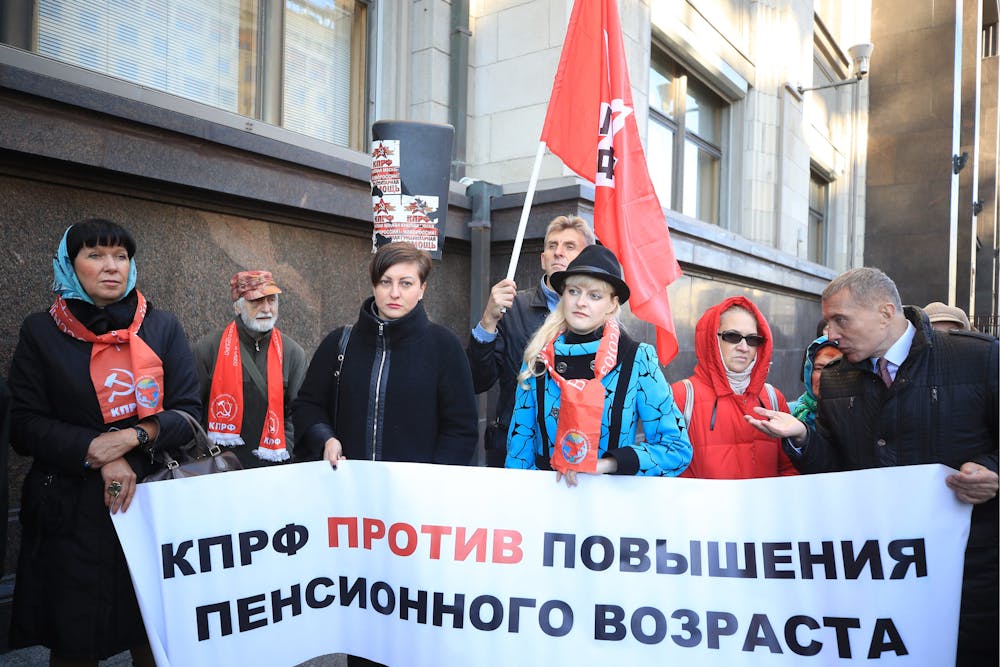
A rally in Moscow in September 2018 against a retirement age reform proposed by the Russian government.
Sergei Bobylev\TASS via Getty Images

To channel discontent Putin proposed a national referendum on the changes.

So Duma deputies will hold meetings in their districts. Party leaders will meet with constituents and hear their concerns. Officials will make amendments to the proposed changes that appear to address those concerns, but in ways that don’t fundamentally change their intent. The process will occur quickly to thwart any opposition organization.

The new prime minister will announce economic reforms and an infusion of state funds into the economy. These actions will also create an impression of responsiveness and win voter support.

As elections approach, the Kremlin will warn of potential crisis, offering Putin as the guarantor of stability. The message will be, as it has been in the past, that Putin is the bulwark against crisis.

4. What does this mean to the US?

While the Putin regime’s domestic policy is not popular, his ability to project Russian power abroad is. The U.S. can expect Putin to challenge its policies, as he has since the U.S. imposed sanctions on Russia for its invasion of eastern Ukraine.

I believe Putin will continue to meddle in U.S. politics and elections to prolong the country’s democratic crisis. This effort will serve both domestic and international agendas, by destabilizing the U.S. and making democracy look unappealing to ordinary Russians, who associate the dismal economic and political conflicts of the 1990s with Russian attempts at democratic reform.

The trajectory is clear in Russia’s newly revealed hack of the Ukrainian firm Burisma, where Joe Biden’s son Hunter served as a board member. This effort by Russia, presumably to unearth embarrassing information about the Biden family, is likely intended to inflame partisan tensions around the impeachment trial of President Donald Trump.

Distracting the U.S. with domestic strife also limits its capacity to challenge Russia abroad.

[ You’re smart and curious about the world. So are The Conversation’s authors and editors. You can get our highlights each weekend. ]The Conversation

Regina Smyth, Associate Professor of Political Science, Indiana University

This article is republished from The Conversation under a Creative Commons license. Read the original article.

=================================================================

AMT, certainly this qualifies as what some mystery writers call “a break in the pattern.” If you want to solve a mystery, you look at any deviation from “business as usual” in the life of everyone and anyone, because the chances are that there is some connection. Finding out exactly what the connection is another matter. I’m glad there are people who are knowledgable about Russia looking at it, and hope we will continue to be informed. I do like to be able to sleep at night.

The Furies and I will be back.

Share

Everyday Erinyes #200

 Posted by at 9:21 am  Politics
Jan 112020
 

Experts in autocracies have pointed out that it is, unfortunately, easy to slip into normalizing the tyrant, hence it is important to hang on to outrage. These incidents which seem to call for the efforts of the Greek Furies (Erinyes) to come and deal with them will, I hope, help with that. As a reminder, though no one really knows how many there were supposed to be, the three names we have are Alecto, Megaera, and Tisiphone. These roughly translate as “unceasing,” “grudging,” and “vengeful destruction.”

I commented last week that I cannot really cover the war in this column, since it’s bigger than the scope of the column. And that is still true. But one small and general aspect of war – namely, international law, including who writes it, who enforces it, why it works, and why it doesn’t when it doesn’t – that I can cover.
==================================================================

The US-Iran conflict and the consequences of international law-breaking

Mourners carry the coffins of slain Iraqi paramilitary chief Abu Mahdi al-Muhandis, Iranian military commander Qasem Soleimani and eight others during a funeral procession in Karbala, Iraq on Jan. 4, 2020.
MOHAMMED SAWAF/AFP via Getty Images

David Mednicoff, University of Massachusetts Amherst

Editor’s note: Iran’s missile attack on a U.S. base in Iraq in retaliation for the Trump administration’s killing of Iranian General Qassem Soleimani has dramatically escalated global tensions.

Dozens of questions have swirled around the events. Beyond the politics, international law and Middle Eastern scholar David Mednicoff from the University of Massachusetts Amherst addresses five key points about the legal status of those attacks and the larger conflict.

1. What role does international law play in this conflict?

The U.S. and other prominent countries established the contemporary system of international law after World War II with three broad goals.

First, and foremost, law should minimize global war.

Second, the only accepted justifications in international law for countries to wage war are obvious self-defense and collective security authorized by the United Nations.

Third, the international legal system expects national governments to pursue their own strategic interests, consistent with the first two goals of global peace and cooperation.

International law has fostered predictable procedures for the conduct of political and economic affairs among countries.

2. But who enforces international law?

International law is founded on the idea that nations have authority to run their countries and shouldn’t be coerced by a global government. This means that enforcement largely depends on governments accepting the importance of compliance.

Such acceptance happens in general because countries, like people, have diverse incentives to obey law. There is benefit to being known as reliable in one’s obligations. International law is made most often through treaties that countries negotiate and sign. They follow these treaties because they see them as helpful. Countries get used to and internalize some international law.

Finally, international organizations have large bureaucracies to exert pressure and resolve disputes around international law. The relatively new International Criminal Court can detain, charge and punish leaders who commit certain severe crimes.

Given its power, the U.S. has been willing to flout some international law. But such violations are noticed and have effects.

Major breaches of international law contribute to erratic and destructive behavior among nations as the norms of good behavior are degraded. The increasing influence of anti-democratic political systems across the globe is partially a result of the U.S., the world’s most powerful democracy, retreating openly from its ideals.

Still, the challenge of upholding international law is compelling with a country like Iran, which works against U.S. priorities in the Middle East and has threatened Americans.

3. Did the US attack that killed Soleimani violate international law?

It likely did. For the U.S. to kill another government’s official without a major attack or clear threat of attack to its basic autonomy is an illegal act of war.

Doing so on Iraqi territory without apparent Iraqi consent is an additional problem. U.S. activity within Iraq depends on following specific treaties between the two countries, which would not give Washington free rein to attack foreign government officials on Iraqi soil.

Pieces of missiles are seen at the site after Iran’s Islamic Revolutionary Guard Corps targeted Ain al-Asad airbase in Iraq, a facility jointly operated by U.S. and Iraqi forces, on Jan. 8, 2020.
Ahsan Mohammed Ahmed Ahmed/Anadolu Agency via Getty Images

U.S. officials have implied that killing Soleimani was self-defense, as he helped plan, or may have been planning, deadly acts against American citizens in the Middle East.

Yet the use of force in international law has to take account of issues of necessity, immediacy and proportionality. So far, the world has seen little evidence that killing a member of the Iranian government was necessary for basic American self-defense.

Indeed, Iran’s compliance and behavior under the 2015 nuclear treaty and evidence of limited cooperation between the U.S. and Soleimani to combat the Taliban and ISIS suggest that he and his government did not threaten the U.S. fundamentally.

4. Is the Iranian strike on US military bases in Iraq legal under international law?

International law does allow for defensive reprisals – which would probably cover Iran’s Jan. 8 missile attacks on U.S. bases based in Iraq, which killed nobody but did damage property.

It’s most logical to interpret Trump’s deliberate killing of an Iranian official as an act of war. The principle of self-defense allows reprisals, so long as they are proportional to the original attack and directed against military targets.

In light of the U.S. withdrawal from the nuclear deal, which Iran appeared to be respecting, and its act of war in killing Soleimani, the missile attacks seem a measured – even minimalist – justified response.

5. Why should Americans care if international law was broken?

I suspect a typical response in the U.S. to this is “So what.” Americans, including the president, may ignore when the U.S. acts against international law. Yet, law-breaking reduces other countries’ trust in the U.S. and increases the risk other countries will violate the rules in ways that harm Americans at home and abroad.

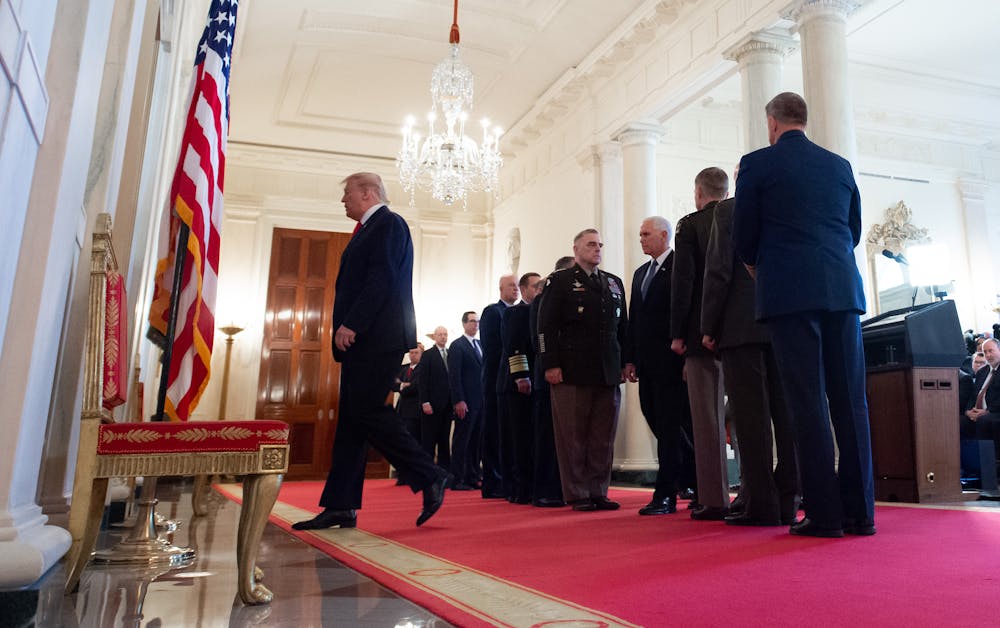
US President Donald Trump leaves after speaking about the situation with Iran in the White House in Washington, D.C., Jan. 8, 2020.
SAUL LOEB/AFP via Getty Images

There are already practical consequences developing from Trump’s violation of international laws about using force against another country. Illegal acts of war can enrage an opponent, solidifying its determination. Iranians of all stripes have come together to object to Soleimani’s killing. The last time Iranian streets saw this level of unified popular outrage against the U.S., it helped consolidate the 1979 Islamic revolution. Iran’s fury over a plausible narrative that the U.S. attacked its leaders illegally may yet help bring on devastating, full-scale war.

In addition, when one country violates international law, other nations often get upset. The system of international law requires mutual collaboration and trust.

If, as a result, other nations are reluctant to cooperate with U.S. efforts – say on immigration, trade or international crime – that hurts American interests. Trump’s Jan. 8 speech seeking to deescalate the conflict may have come in part because killing Soleimani illegally made U.S. allies reluctant to back Trump in further confrontations.

Some in the U.S. act as if only naked might matters in foreign policy. Yet, the peril of American policy in Iran and Iraq illustrates something different. Law, and the legitimacy it conveys, also count.

[ Deep knowledge, daily. Sign up for The Conversation’s newsletter. ]The Conversation

David Mednicoff, Chair, Department of Judaic and Near Eastern Studies, and Associate Professor of Middle Eastern Studies and Public Policy, University of Massachusetts Amherst

This article is republished from The Conversation under a Creative Commons license. Read the original article.

==================================================================
Alecto, Megaera, and Tisiphone, it leaps out that international law is only as good as the people and nations who care about it. If you don’t care about your country’s reputation, you won’t care about international law (and if you are dull enough not to see that the very survival of your country could depend on its international reputation, you may very well not care.) It’s not my purpose here to discuss why international reputation is important – but perhaps someone should – and soon.

The Furies and I will be back.
Share

Everyday Erinyes #199

 Posted by at 8:48 am  Politics
Jan 042020
 

Experts in autocracies have pointed out that it is, unfortunately, easy to slip into normalizing the tyrant, hence it is important to hang on to outrage. These incidents which seem to call for the efforts of the Greek Furies (Erinyes) to come and deal with them will, I hope, help with that. As a reminder, though no one really knows how many there were supposed to be, the three names we have are Alecto, Megaera, and Tisiphone. These roughly translate as “unceasing,” “grudging,” and “vengeful destruction.”

There are two areas which I can’t really cover with the Erinyes, because they are just too big, and because they are not stable but fluid in nature, and even one of those reasons would make either topic unmanageable. Those subjects are war and impeachment. They are also pretty much what is in the news at this point

But it’s never the wrong time for a little education So here is some.
==================================================================

What everyone should know about Reconstruction 150 years after the 15th Amendment’s ratification

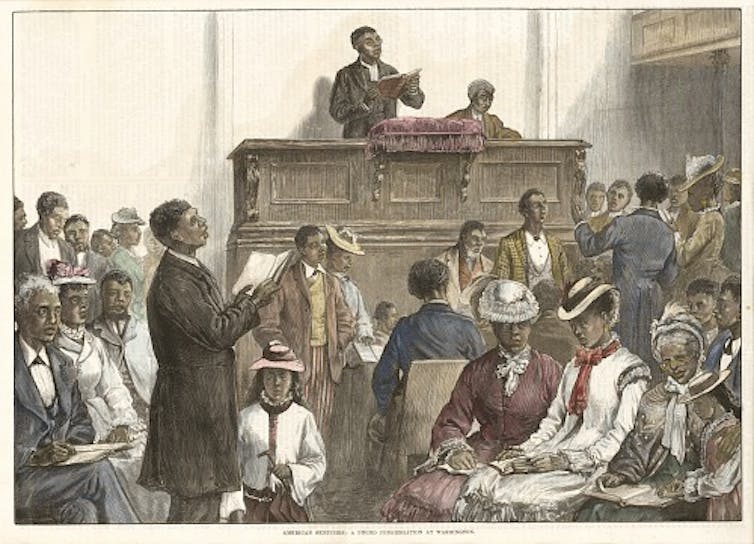
Many African Americans made education a high priority after the Civil War.
National Museum of African American History and Culture

Tiffany Mitchell Patterson, West Virginia University

I’ll never forget a student’s response when I asked during a middle school social studies class what they knew about black history: “Martin Luther King freed the slaves.”

Martin Luther King Jr. was born in 1929, more than six decades after the time of enslavement. To me, this comment underscored how closely Americans associate black history with slavery.

While shocked, I knew this mistaken belief reflected the lack of time, depth and breadth schools devote to black history. Most students get limited information and context about what African Americans have experienced since our ancestors arrived here four centuries ago. Without independent study, most adults aren’t up to speed either.

For instance, what do you know about Reconstruction?

I’m excited about new resources for teaching children, and everyone else, more about the history of slavery through The New York Times’ “1619 Project.” But based on my experience teaching social studies and my current work preparing social studies educators, I also consider understanding what happened during the Reconstruction essential for exploring black power, resilience and excellence.

During that complex period after the Civil War, African Americans gained political power yet faced the backlash of white supremacy and racial violence. I share the concerns many writers, historians and other scholars are raising about the shortcomings of what schoolchildren traditionally learn
about Reconstruction in school. Here are some suggestions for educators and others interested in learning more about that time period.

Reconstruction amendments

As most students do learn, the U.S. gained three constitutional amendments that extended civil and political rights to newly freed African Americans following the Civil War.

The 13th, ratified in 1865, banned slavery and involuntary servitude except for the punishment of a crime.

The 14th, ratified three years later, granted citizenship and equal protection under the law to all people born in the United States, as well as naturalized citizens – including all previously enslaved individuals.

Then, the 15th Amendment asserted that neither the federal government nor state governments could deny voting rights to any male citizen.

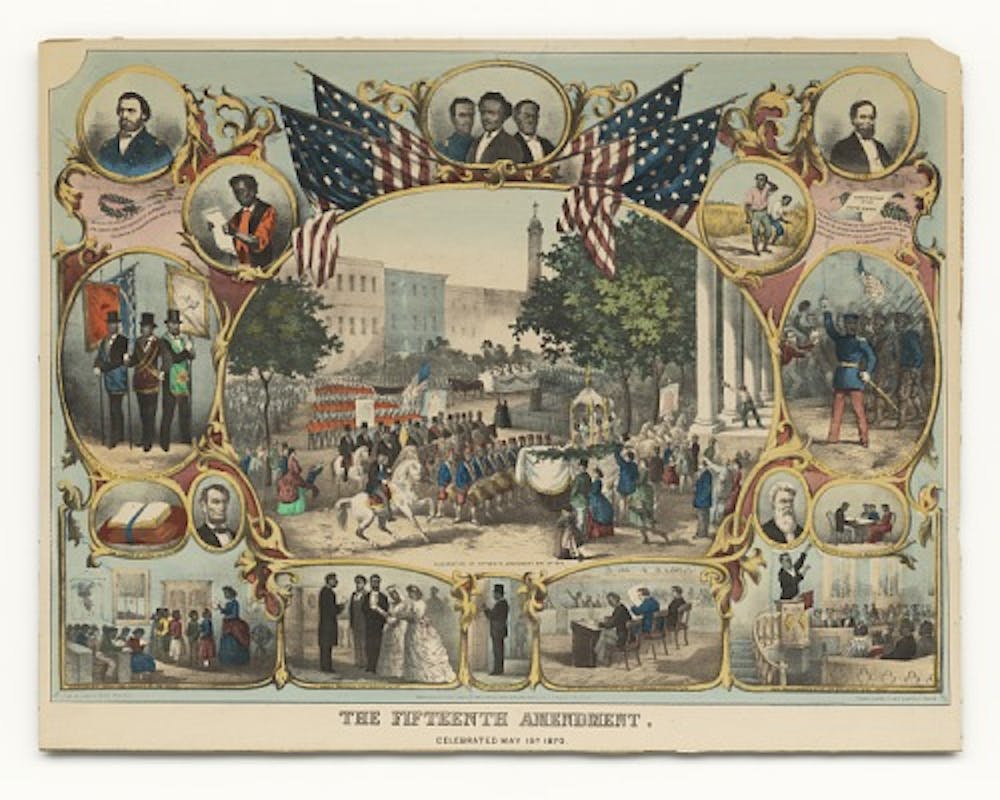
The year 2020 marks the 150th anniversary of the ratification of the 15th Amendment on Feb. 3, 1870. The anniversary is a good opportunity to learn about how the amendment was supposed to guarantee that the right to vote could not be denied based on “race, color, or previous condition of servitude.”

African Americans celebrated the 15th Amendment’s ratification.
Smithsonian National Museum of African American History and Culture

African American politicians

What few history and social studies classes explore is how these changes to the Constitution made it possible for African American men to use their newfound political power to gain representation.

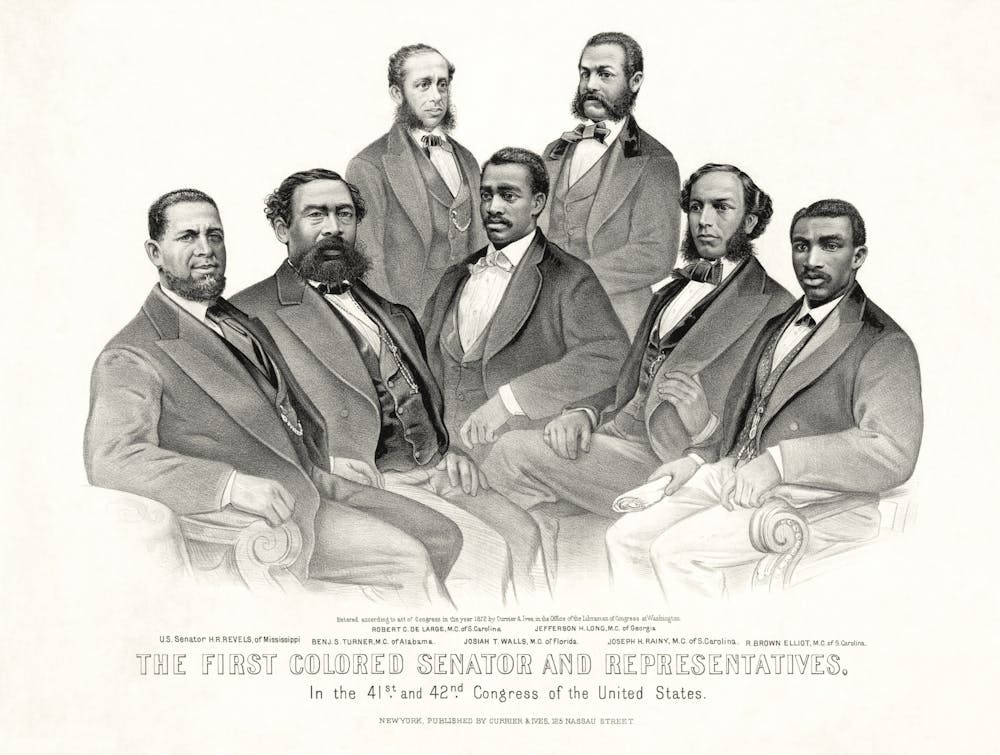
Hiram Rhodes Revels, the first African American senator, represented Mississippi in 1870 after the state’s Senate elected him. He was among the 16 black men from seven southern states who served in Congress during Reconstruction.

Revels and his colleagues were only part of the story. All told, about 2,000 African Americans held public office at some level of government during Reconstruction.

White supremacist groups like the Ku Klux Klan also formed following the Civil War. These terrorist groups engaged in violence and other racist tactics to intimidate African Americans, people of color, black voters and legislators. They thus made the accomplishments of African American politicians even more impressive as they served as public officials under the constant threat of racial violence.

The first African American members of Congress were elected after the Civil War.
Currier and Ives via the Library of Congress

Black activist women

African American women technically gained the right to vote in 1920, when the 19th Amendment passed. However, their constitutional right was limited in many states due to discriminatory laws.

Mary Church Terrell, an educator, fought for the rights of women of color.
National Archives Docs Teach collection

Many black women were activists and women’s suffrage movement leaders. Through public speaking, prolific writing and developing organizations dedicated to racial and and gender equality, they fought for equal rights and dignity for all.

Among the black women who were activists during Reconstruction were
the five Rollins sisters of South Carolina, who fought for female voting rights; Maria Stewart, an outspoken abolitionist before the Civil War and suffragist once it ended; and Mary Ann Shadd Cary, the first black woman in North America to edit and publish a newspaper, one of the first black female lawyers in the country and an advocate for granting women the right to vote.

Other women of color who played key roles in the suffrage movement included Ida B. Wells, the journalist and civil rights advocate who raised awareness of lynching, and Mary Church Terrell, founder of the National Association of Colored Women.

Higher education

Before the Civil War, many states made teaching enslaved individuals to read a crime. Education quickly became a top priority for black Americans once slavery ended.

While northern, largely white philanthropists and missionary groups and the U.S. Bureau of Refugees, Freedmen, and Abandoned Lands, better known as the Freedmen’s Bureau, did help create new educational opportunities, the African American public schools established after the Civil War ended were largely built and staffed by the black community.

Many new institutions of higher education, now called Historically Black Colleges and Universities or HBCUs, began to operate during Reconstruction.

These schools trained black people to become teachers and ministers, doctors and nurses. They also prepared African Americans for careers in industrial and agricultural fields.

Public and private HBCUs founded during Reconstruction and still operating today include Howard University in Washington, D.C., Hampton University in Virginia, Alabama State University, Morehouse College in Georgia and Morgan State University in Maryland. These colleges and universities train a disproportionate share of black doctors and other professionals even today.

Morehouse graduates from the class of 2013 celebrated in the rain when President Obama delivered their commencement address.
Official White House Photo by Pete Souza

Historical experiences

Storytelling, multimedia experiences and trips to historic sites and creative museums help get people of any age interested in learning about history.

Depending on where you live, you may want to embark on a family outing or school field trip.

The National Constitution Center in Philadelphia has a new permanent exhibit on the Civil War and Reconstruction.

The National Museum of African American History and Culture, which opened in Washington, D.C. in 2017, contains artifacts from the Reconstruction era. It’s also making the records of the Freedmen’s Bureau, including the names of formerly enslaved individuals following the Civil War, available online.

Another option is the Reconstruction Era National Historic Park in Beaufort County, South Carolina.

I also recommend watching the PBS documentaries about Reconstruction by the scholar and filmmaker Henry Louis Gates Jr. and reading the young adult book Gates co-authored with children’s nonfiction writer Tonya Bolden about the era. Gates has also compiled a Reconstruction reading list for adults.

In addition, the organization Teaching for Change curates a booklist on Reconstruction for middle and high school students. And the Zinn Education Project Teach Reconstruction Campaign offers a variety of resources including readings, primary sources and even lesson plans.

Henry Louis Gates Jr.‘s documentary series delves into the history of what happened in America after the Civil War.

An incomplete transition

As the renowned black scholar W.E.B. DuBois observed, racist laws and violent tactics in many states actively limited black freedom.

“The slave went free; stood for a brief moment in the sun; then moved back again toward slavery,” he explained.

This was by no means voluntary. Intimidated and threatened by black enfranchisement and excellence in the era of Reconstruction, white supremacists attempted to enforce subordination through violence, such as lynching; and in systemic ways through Jim Crow laws. African Americans continued to assert their civil and constitutional rights as activists, politicians, business owners, teachers and farmers in the midst of white supremacist backlash.

With the latest voter suppression efforts restricting access to the ballot box for voters of color and the resurgence of racist violence and vitriol today, DuBois’ words sound eerily familiar. At the same time it’s reassuring to recall how quickly formerly enslaved African Americans made their way to schoolhouses and public offices.

[ Deep knowledge, daily. Sign up for The Conversation’s newsletter. ]The Conversation

Tiffany Mitchell Patterson, Assistant Professor of Secondary Social Studies, West Virginia University

This article is republished from The Conversation under a Creative Commons license. Read the original article.

==================================================================
Alecto, Megaera, and Tisiphone, This overview just really scratches the surface. I have seen Dr. Gates’s documentary, and it goes deeper (and I’m delighted to know that it’s currently available to stream. Not everything always is. I may have to bite the bullet and purchase it.) But at least this overview will give anyone who wasn’t aware an idea of just how much we weren’t aware of. Especially since we appear currently to be paying a huge price for not knowing our full and accurate history. Perhaps you can lead us to more resources for deeper learning.

The Furies and I will be back.
Share

Everyday Erinyes #198

 Posted by at 8:44 am  Politics
Dec 282019
 

Experts in autocracies have pointed out that it is, unfortunately, easy to slip into normalizing the tyrant, hence it is important to hang on to outrage. These incidents which seem to call for the efforts of the Greek Furies (Erinyes) to come and deal with them will, I hope, help with that. As a reminder, though no one really knows how many there were supposed to be, the three names we have are Alecto, Megaera, and Tisiphone. These roughly translate as “unceasing,” “grudging,” and “vengeful destruction.”

Everyone seems to be taking a day off, for various reasons – more or less holiday-related, though not all directly. I think I need one too, and I am certain that the furies need one. They have been pretty overworked for the last – well – more than three years. Closing in on four years, actually.

So, not to belabor the point, I am just going to share a reprint of reprints – a short look at articles The Conversation has come to write because of questions sent to them from children – children as young as six. Relax and enjoy the ride.
==================================================================

We asked kids to send us their burning questions – here are 5 of our favorites from 2019

But why? But why?
Odua Images/Shutterstock.com

Maggie Villiger, The Conversation

Out of the mouths of babes… comes a never-ending stream of questions.

So this year, The Conversation US jumped on a great idea dreamed up by our colleagues in Australia and launched a series of articles meant to answer questions kids ask, but that everyone probably wonders about. The Conversation’s editors collect children’s questions and then look for scholars who can provide clear answers based on their own research and expertise.

Below are a few of our favorite “Curious Kids” articles from the past year. And whatever your age, if you have a question you’d like an expert to answer in 2020, send it to curiouskidsus@theconversation.com. Curiosity has no age limit!

Why is money green?

This one could only have come from an American kid. Marek, age 12, asked the question; history Ph.D. student Jonah Estess gave an answer.

It turns out that green ink is hard for counterfeiters to get right on their phony bills. And in the quirks-of-history department:

“Also, there was lots of green ink for the government to use when it started printing the money we have now. The green color also does not fade or decompose easily.”

What is this noise?
Victoria Brassey/Shutterstock.com

Why do old people hate new music?

Maybe Holly, age 14, got sick of adults yelling “turn that racket down” and decided to ask this question. Psychology researcher Frank McAndrew had some ideas for her.

As they age, brains get worse at telling apart chords, rhythms and melodies. Another factor: Grownups might gravitate to the music they listened to back when they were young and their emotions were more intense. Or it might come down to what’s called the “mere exposure effect” – just hearing something more tends to make you like it more.

“When you’re in your early teens, you probably spend a fair amount of time listening to music or watching music videos… For many people over 30, job and family obligations increase, so there’s less time to spend discovering new music.”

If you barely ever hear the latest bangers, you might not like them either.

What can you learn from an animal’s scat?

Verity Mathis from the University of Florida’s Florida Museum of Natural History confirmed that Cora, age 9, was onto something with this question. Poop is a window into animals’ hidden lives.

“Scat can tell us a lot about an animal’s diet, habits and movement, so scientists like to study it both in nature and in the lab. Outdoors, scat can identify what animals are present in an area. Then researchers take it to a lab, dry it out and dissect it for clues about the animal’s diet.”

Researchers can even extract DNA from scat, a hands-off way to learn more about what’s going on with a particular population.

When the stench is coming from inside your shoes….
aslysun/Shutterstock.com

Why do feet stink by the end of the day?

Our inbox suggests that kids are very interested in all things gross and smelly. Indiana University microbiologist Bill Sullivan took a stab at this question from Helen, age 6.

He points the finger (toe?) at a harmless type of bacteria that live all over people’s skin, happily eating up dead skin cells. The stinkiness problem arises inside your warm, moist shoes – conditions the bacteria love and take advantage of to chow down and multiply.

“Like anything else that eats, these bacteria make smelly waste. It is their waste that gives sweaty feet their funky odor: It contains stinky chemicals like those made by skunks and rotten eggs.”

Where does the sand on the beach come from?

Kids write in with big questions about how the Earth works, too. Sly, age 6, posed this one that many an adult relaxing at the shore might have wondered about.

University of Washington geomorphologist David Montgomery explained that there’s “more to beach sand than meets the eye.”

“It has stories to tell about the land, and an epic journey to the sea. That’s because mountains end their lives as sand on beaches.”

It’s a story of erosion. And the sizes, shapes and colors of the individual grains of sand you see can tell you about the kinds of rocks they originally came from.

What are you wondering?

Over the past year, we had a blast hunting down answers to about everything from stargazing with binoculars to why kids aren’t very patriotic these days to what makes pizza so infernally delicious. Thank you to all the kids who were curious enough to ask questions – and keep ‘em coming in the new year!

Editor’s note: This story is a roundup of articles from The Conversation’s archives.

[ Get the best of The Conversation, every weekend. Sign up for our weekly newsletter. ]The Conversation

Maggie Villiger, Senior Science + Technology Editor, The Conversation

This article is republished from The Conversation under a Creative Commons license. Read the original article.

==================================================================
Alecto, Megaera, and Tisiphone, the kids are all right. Anything you can do to help us keep it that way would be appreciated.

(Though, personally, I find that the older I get, the more I enjoy the work of 21st century classical composers, as well as some of the 20th century ones considered less “accessible.”  But then, it’s been a long time since I thought I had to like something in order to appreciate its worth.)

The Furies and I will be back.

Share

A Pun for Christmas

 Posted by at 3:11 pm  Politics
Dec 232019
 

Not that it isn’t also a pun for Hannukah, Solstice, Kwanzaa, or what have you.

I saw it on Car Talk.  If I am gong to suffer, I want friends to suffer with me.

It is old, and it is … pretty awful  Here goes:

Krusty the mechanic has been caught in a terrible snowstorm on his way home from one of his suspicious road trips that we know better than to ask about. It’s Christmas Eve, he’s hundreds of miles from home and the conditions are deteriorating, so he pulls into a diner parking lot, figuring some food and coffee wouldn’t hurt him while he waits out the storm a bit.

Predictably, the place is empty, so Krusty has his choice of tables. He picks a booth by the window. The waitress is festively decked out in a jingle-bell necklace, reindeer-antler headband, and ornament earrings, with a nametag that reads: Dolores. “What can I get for ya, hon?” Dolores asks.

“I’ll have a cup of coffee, and how are the Eggs Benedict?”

Dolores assures him they’re fantastic, and says the cook makes everything in-house, so Krusty puts in his order.

The food comes out pretty darn quick (hardly surprising since he’s the only customer in the place). As Dolores comes over with the tray, he notices something strange: The food looks fantastic, but his whole meal is resting on something shiny. As she gets closer, he sees it’s a hubcap. “I’m sorry to ask, but why are my eggs on that hubcap?”

Dolores smiles knowingly, “Well, it’s like they always say. There’s no plate like chrome for the Hollandaise.”

Share

Everyday Erinyes #197

 Posted by at 6:50 am  Politics
Dec 212019
 

Experts in autocracies have pointed out that it is, unfortunately, easy to slip into normalizing the tyrant, hence it is important to hang on to outrage. These incidents which seem to call for the efforts of the Greek Furies (Erinyes) to come and deal with them will, I hope, help with that. As a reminder, though no one really knows how many there were supposed to be, the three names we have are Alecto, Megaera, and Tisiphone. These roughly translate as “unceasing,” “grudging,” and “vengeful destruction.”

Now that we have Articles of Impeachment, everyone will start speculating about the trial in the Senate, although it’s not now even 100% certain that there will be one at all. The Senate, of course, wants it fast so they can kill it fast. The House, of course, wants to be certain that this trial will be fair – and not a circus. Perhaps it wouldn’t hurt to look back at a previous trial, including a previous analogy of Senators as jurors.

=================================================================

When a chief justice reminded senators in an impeachment trial that they were not jurors

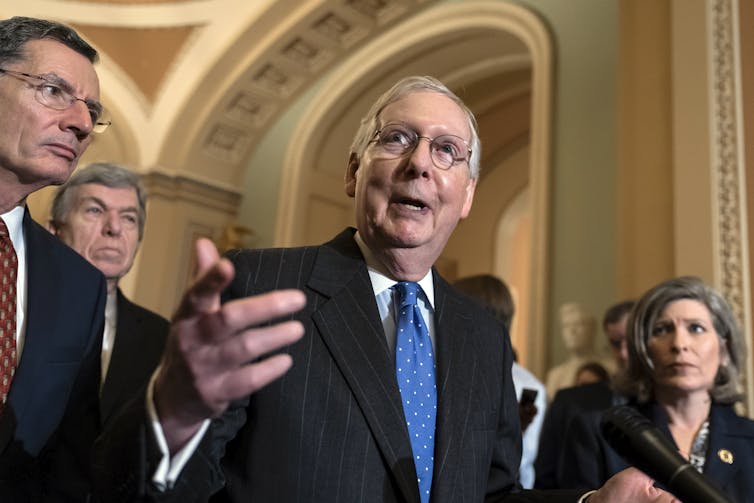
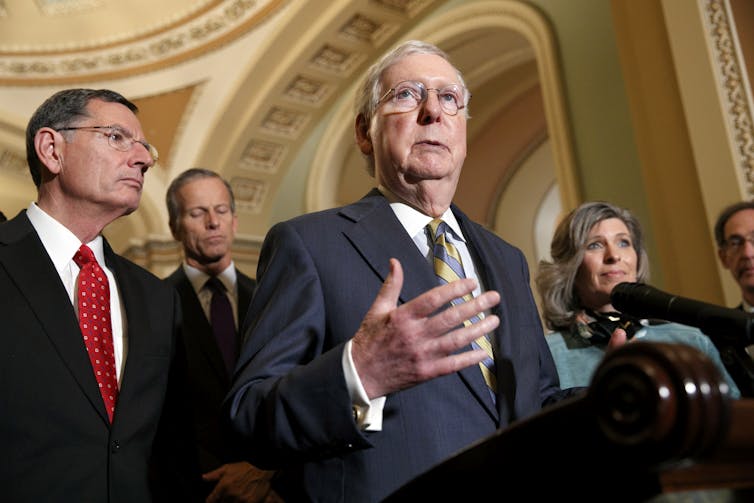
Senate Majority Leader Mitch McConnell, R-Ky., fields questions from reporters about an impeachment trial in the Senate, Dec. 10, 2019.
AP Photo/J. Scott Applewhite

Steven Lubet, Northwestern University

Senate Majority Leader Mitch McConnell created a predictable stir when he told Fox News host Sean Hannity that he would structure the impending impeachment trial of President Donald Trump in “total coordination with the White House counsel’s office.” He added, “There will be no difference between the president’s position and our position as to how to handle this.”

This outright rejection of neutrality drew immediate protests from Democrats. Rep. Val Demings, D-Fla., who may well be one of the House impeachment managers in the Senate trial, called for McConnell’s recusal, saying “No court in the country would allow a member of the jury to also serve as the accused’s defense attorney.”

House Judiciary Committee Chair Jerry Nadler, D-N.Y., likewise slammed “the foreman of the jury” for saying he would “work hand and glove with the defense attorney.”

Demings and Nadler made a valid point, but they used the wrong analogy. Senators at an impeachment trial are not the equivalent of a jury and they are not held to a juror’s standard of neutrality.

President Trump returns to the White House from a trip to Ft. Lauderdale, Fla., Dec. 8, 2019.
AP/J. Scott Applewhite

Harkin’s objection

The principle, that senators are not jurors in the traditional sense, was well established at the outset of the 1999 impeachment trial of President Bill Clinton.

Tasked with delivering an opening statement for the House managers – who present the House’s case to the Senate – Rep. Robert Barr, R-Ga., reminded the senators of Clinton’s tendency to “nitpick” over details or “parse a specific word or phrase of testimony.” To Barr, the conclusion was obvious: “We urge you, the distinguished jurors in this case, not to be fooled.”

That was the moment Sen. Tom Harkin, an Iowa Democrat, had been waiting for.

Mr. Chief Justice,” he said, addressing William Rehnquist, who was presiding over the trial, “I object to the use and the continued use of the word ‘jurors’ when referring to the Senate.”

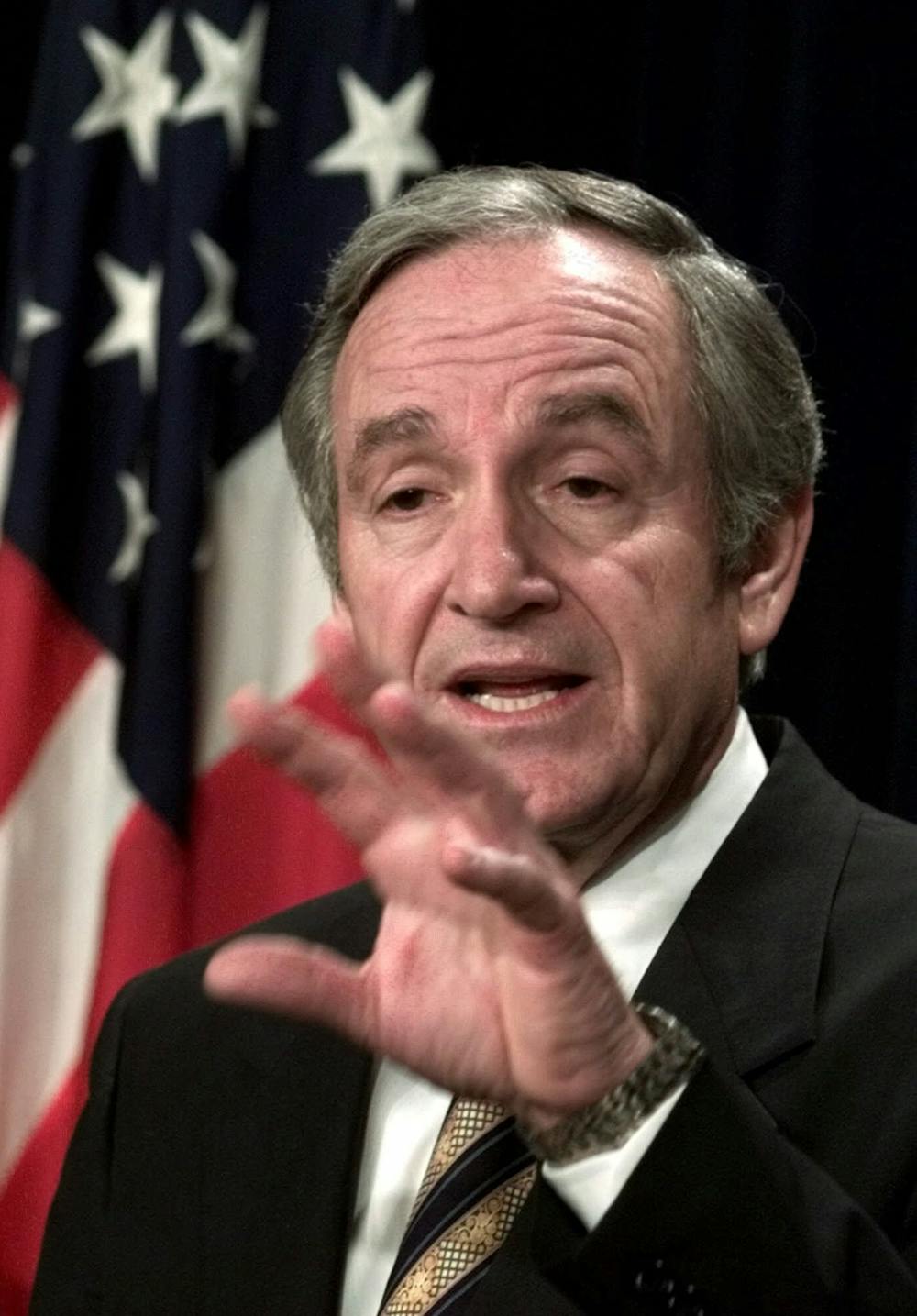
Sen. Tom Harkin, D-Iowa, raised a crucial point about senators’ roles in the impeachment trial of President Clinton in 1999.
AP/Joe Marquette

Harkin had prepared well, basing his argument on the text of the Constitution, the Federalist Papers and the rules of the Senate itself.

He explained that “the framers of the Constitution meant us, the Senate, to be something other than a jury.”

Instead, Harkin continued, “What we do here today does not just decide the fate of one man. … Future generations will look back on this trial not just to find out what happened, but to try to decide what principles governed our actions.”

Chief justice weighs in

The chief justice sustained the objection.

“The Senate is not simply a jury,” he ruled. “It is a court in this case.”

Rehnquist thus admonished the House managers “to refrain from referring to the Senators as jurors.” For the balance of the trial, they were called “triers of law and fact.”

Rehnquist and Harkin got it right. Article III of the Constitution provides that “Trial of all Crimes, except in Cases of Impeachment, shall be by Jury,” and for good reasons.

Chief Justice William H. Rehnquist, shown in this video image, presides in the impeachment trial of President Clinton on the Senate floor, Feb. 8, 1999, in Washington.
AP Photo/APTN)

In an ordinary trial, the jury’s role is generally limited to fact-finding, while the judge determines the scope and application of the law. In an impeachment trial, however, the Senate itself has the “sole power” to decide every issue.

Recognizing the Senate’s all-encompassing responsibility, and his own limited role, Chief Justice Rehnquist referred to himself throughout the proceeding only as “the Chair.”

As the U.S. Supreme Court has put it, impeachment presents a “political question,” in which all of the “authority is reposed in the Senate and nowhere else.”

Oath or affirmation required

McConnell, the Senate’s leader, has more leeway and far more power than any juror or even a jury foreperson.

The Constitution’s only procedural limitation is the requirement in Article I that the senators be placed under “oath or affirmation.”

Although the Constitution does not specify any particular wording (unlike the presidential oath, which is included word for word), the Senate adopted rules for impeachment trials in 1986 requiring each senator to affirm or swear to do “impartial justice according to the Constitution and laws.”

“Impartial justice” does not demand the enforced naiveté of jury service, which would be impossible in an impeachment trial. For example, the senators all have prior knowledge of at least some of the facts, and several of them are currently vying to run against Trump in 2020, while others are backing his reelection campaign.

But the Senate’s oath of impartiality clearly calls for at least some commitment to objectivity. Thus, the problem with McConnell’s announcement was not that he failed to behave like a juror.

Rather, he has declared an intention to disregard the Senate’s prescribed oath, which was fixed long ago by the very body that elected him its leader.

When Tom Harkin disclaimed a juror’s role at the Clinton trial, his purpose was not to affect the outcome of the case, but rather to underscore the full scope of the Senate’s decision-making responsibility. In contrast, Mitch McConnell appears to have boldly renounced open-mindedness itself on the impeachment court, whether as juror, judge or “trier of law and fact.”

[ Deep knowledge, daily. Sign up for The Conversation’s newsletter. ]The Conversation

Steven Lubet, Williams Memorial Professor of Law, Northwestern University

This article is republished from The Conversation under a Creative Commons license. Read the original article.

=================================================================

Alecto, Megaera, and Tisiphone, certainly Roberts is not Rehnquist, and that’s far from the only difference between then and now – or between now and when the Constitution was framed.  The framers were wise enough to foresee the possibility of a corrupt President.  They did not, however – how could they? – foresee the possibility of a corrupt President and a corrupt Senate at the same time.  If they had done so, they might have had some qualms at entrusting the Senate to be, not less than, but more than a simple jury.

When intelligent and knowledgeable people discuss things on the internet, the contents of those discussions reach the people responsible for acting in those areas, and things happen.  Perhaps we, especially with the help of the Furies, can help to create discussion of this subject all over the internet.  And then, things may happen.

The Furies and I will be back.

 

Share

Everyday Erinyes #196

 Posted by at 8:04 pm  Politics
Dec 132019
 

Experts in autocracies have pointed out that it is, unfortunately, easy to slip into normalizing the tyrant, hence it is important to hang on to outrage. These incidents which seem to call for the efforts of the Greek Furies (Erinyes) to come and deal with them will, I hope, help with that. As a reminder, though no one really knows how many there were supposed to be, the three names we have are Alecto, Megaera, and Tisiphone. These roughly translate as “unceasing,” “grudging,” and “vengeful destruction.”

As we get close to Christmas – and Impeachment is on the table – I thought it might be interesting to look at the Senate – no, not OUR Senate, but a Senate which existed around he same times as the events which (much later) became Christmas. Especially since, as long ago as that was, there are some lessons for us in the look back.
==================================================================

What the Roman senate’s grovelling before emperors explains about GOP senators’ support for Trump

Senate Majority Leader Mitch McConnell of Kentucky speaks to the media with members of the Senate Republican leadership, Oct. 29, 2019.
AP/Jacquelyn Martin

Timothy Joseph, College of the Holy Cross

Unhinged leaders, dynastic intrigue, devastation and plunder: For 15 years I have been researching and teaching the ancient historian Tacitus’ works on the history of the Roman Empire. It has rarely been difficult to find echoes of the history he describes in current events.

I’m not the first person to make this observation.

In a letter dated Feb. 3, 1812, retired President John Adams wrote to fellow retiree Thomas Jefferson about Tacitus and his fellow historian, Thucydides.

“When I read them,” wrote Adams, “I Seem to be only reading the History of my own Times and my own Life.”

Over the past three years the world depicted by Tacitus has seemed much more immediate. The U.S. political situation during the Trump presidency has led me to better appreciate the closeness of Tacitus’ observations to our times.

And while commentators have compared Trump with several Roman emperors, from Tiberius to Nero and Commodus, the comparison that has struck me – and may be most meaningful – is between other elected officials in the U.S. and members of the Roman senate described by Tacitus.

As Tacitus explores, the Roman senate declined from a long-held position of authority under the Roman Republic to become a body almost wholly reliant on the whims of a given emperor.

A modern statue of historian and senator Tacitus, outside the Austrian Parliament in Vienna.
Wikipedia, Pe-Jo photographer, CC BY

Erosion of senatorial sway

Tacitus (c. A.D. 55 – c. A.D. 120) was himself a Roman senator; his writing shows a particular interest in the conduct of senators.

Prior to Tacitus’ time, Rome had been a republic (509-27 B.C.). In that system magistrates were elected and alternated annually. Those who had served in elected office entered the senate in perpetuity. This body was, in essence, a collective of hundreds of members of the political class, who deliberated and voted on domestic and foreign policy.

During the period Tacitus writes about (A.D. 14-96), the Roman state remained a republic in name, with its institutions more or less intact. Yet one individual, the emperor – known as the princeps – held what were essentially emergency powers over domestic and foreign affairs. So the “republic” of this period was functionally an autocracy. This meant that government institutions other than the emperor had little power.

So in the period Tacitus describes, senators still formally convened, gave impassioned speeches and debated issues of the day. But most often resolutions would go nowhere without the “encouragement of the emperor,” as the historian puts it in one passage. The situation frequently left senators tongue-tied or, worse, “stooping to the most abject supplication.”

Their subservience could be seen in, for example, senatorial decrees to celebrate military victories that had not occurred; or, after the emperor Nero snuffed out a plot against him, in the senatorial motion to erect a Temple to the Divine Nero.

Senatorial fealty to the emperor was perhaps most apparent in the proliferation of prosecutions of other Romans for perceived acts of treason against the emperor. From a successful prosecution a senator could win the favor of the emperor, along with untold riches. Tacitus considered this rash of self-serving prosecutions to be “the gravest of destructive forces” under the empire.

Senatorial timidity

The writings of the senator-as-historian Tacitus continually explore this paradox of a republican system that was autocratic in practice, asking: What exactly had become of the senate’s role? What did senators understand it to be? What type of governmental system was this?

A revealing moment about the long-term consequences of senatorial dread of a given emperor’s whims takes place in Tacitus’ account of senatorial debate in A.D. 70, soon after the death of the infamous Nero.

The senator Curtius Montanus decries the culture of complacency and deference by senators toward emperors. Condemning their “greed of gain,” he says to his fellow senators, “Do you think that Nero was the last of our masters? Those who survived the reigns of (earlier emperors) Tiberius and Caligula thought the same thing.”

Montanus’ speech gets to the heart of the senate’s uncertain status. Assertion of independence was possible, and Tacitus’ works present a number of voices of senatorial independence. But many in the senate – aware of a given emperor’s power to end their political lives and damage their fortunes – were happy to wait it out and hope for a more temperate successor.

Tacitus attributes this very approach to the senator Eprius Marcellus, who managed to stay influential under a series of emperors. Marcellus, he writes, considered the best plan “to admire the past, but conform to the present; to pray for good emperors and tolerate whatever sort you got.” Marcellus’ conformity to his times came out most of all in his willingness to attack a given emperor’s enemies. His skill in this pursuit earned him both prestige and wealth – until, according to the later historian Cassius Dio, a successful prosecution against him spelled Marcellus’ end.

GOP Sen. Lindsey Graham, right, has shifted from a Trump critic to a Trump supporter. Here, he speaks at the White House, Nov. 6, 2019, as the president looks on.
AP/Patrick Semansky

Relevance or acquiescence?

There are countless differences between the Roman and American political systems. But Marcellus’ credo about “conforming to the present” and getting by in the face of a strong-willed executive has found resonances in the words and actions of U.S. senators of late.

Sen. Lindsey Graham, a Republican from South Carolina, said earlier this year that his about-face – from staunch Trump critic to frequent defender and now investigator of the president’s political rivals – reflects his concern “to be relevant” under changing political circumstances.

This fall, when a constituent brought up the House’s impeachment inquiry and asked Iowa Republican Sen. Joni Ernst, “When are you guys going to say, ‘Enough’?,” Ernst responded, “The president is going to say what the president is going to do.”

These comments are matched by more concrete demonstrations of the marginalizing of the Republican-led Senate. Trump has appointed a number of acting secretaries, bypassing the usual Senate confirmation vote. He has circumvented Congress’ power of the purse by using emergency powers to get money to build his border wall. He has evaded the requirement for congressional approval of arms sales to foreign states, and vetoed Congress’ attempt to block the sales.

In June he asserted that he does not need congressional support for war against Iran – much less to withdraw troops from northern Syria, as he did unilaterally this fall.

While we may chalk up senatorial inaction – in the first or 21st century – to fear of an individual leader’s powers, there is another underlying factor that may align political figures from these two periods: The rise of an autocrat was personally good for them.

New York Times columnist Jamelle Bouie recently described this as the “simplest explanation” behind the motivations of many Republican lawmakers. He notes that their independence still emerges in, for example, opposition to the withdrawal from Syria.

But since Trump has pushed for policies long wanted by Republicans, such as lower taxes on the wealthy and minimal regulations, as well as a conservative judiciary, Bouie asks, “Why would any of them stand against a president who has delivered on each count?”

Tacitus made a comparable diagnosis. Of the first princeps Augustus’ emergence in the 30s and 20s B.C., he writes:

“Slowly he rose, dragging to himself the guardrails of the senate, magistrates, and laws – with no one opposing, since the fiercest had died in battle or through proscription, and the rest of the prominent men preferred the security of the present to the dangers of the past. The readier one was for servitude, the more he would be lifted up in wealth and in prestige…”

The members of the political class that for hundreds of years had provided a guardrail for Rome’s republican system now gained both financial prosperity and status from their cooperation with Augustus.

This, Tacitus explains, is how autocracy comes about – and persists.

Is this same process playing out in the U.S.? Is the history of our own times, as John Adams put it, replaying the era that Tacitus describes? Or will political figures in the U.S. – or the U.S. electoral process – respond to a growing autocracy in ways that the ancient Romans did not?The Conversation

Timothy Joseph, Associate Professor of Classics, College of the Holy Cross

This article is republished from The Conversation under a Creative Commons license. Read the original article.

==================================================================
Alecto, Megaera, and Tisiphone, thankfully, we are not quite there yet (not that the roman Senate got there overnight, of course.) We still have direct election of our Senators by the people, for specific terms. They may end up Senators for life, but must face reelections in order to make that happen (And thank Ceiling Cat for the Seventeenth Amendment!) But no one should be under the illusion that we couldn’t possibly get there.

The Furies and I will be back.

Share

Everyday Erinyes #195

 Posted by at 8:08 am  Politics
Dec 072019
 

Experts in autocracies have pointed out that it is, unfortunately, easy to slip into normalizing the tyrant, hence it is important to hang on to outrage. These incidents which seem to call for the efforts of the Greek Furies (Erinyes) to come and deal with them will, I hope, help with that. As a reminder, though no one really knows how many there were supposed to be, the three names we have are Alecto, Megaera, and Tisiphone. These roughly translate as “unceasing,” “grudging,” and “vengeful destruction.”

I’m pretty sure that no one who is a regular here is a big Twitter user. I know all I ever see from Twitter is isolated tweets embedded by other people, and over have of those are sweet ones about cats and/or dogs, with occasional other animals. But there are progressive people who do use Twitter to communicate (passively or actively), and if you do happen to be one, or if you know one – or even if you just want to know what the latest thing is in disinformation detection, then you will be interested in this.
==================================================================

You can join the effort to expose Twitter bots

Help catch online bots.
maxuser/Shutterstock.com

Pik-Mai Hui, Indiana University and Christopher Torres-Lugo, Indiana University

In the lead-up to the 2018 midterm elections, more than 10,000 automated Twitter accounts got caught conducting a coordinated campaign of tweets to discourage people from voting. These automated accounts may seem authentic to some, but a tool called Botometer was able to identify them while they pretentiously argued and agreed, for example, that “democratic men who vote drown out the voice of women.” We are part of the team that developed this tool that detects the bot accounts on social media.

Our next effort, called BotSlayer, is aimed at helping journalists and the general public spot these automated social media campaigns while they are happening.

It’s the latest step in our research laboratory’s work over the past few years. At Indiana University’s Observatory on Social Media, we are uncovering and analyzing how false and misleading information spreads online.

One focus of our work has been to devise ways to identify inauthentic accounts being run with the help of software, rather than by individual humans. We also develop maps of how online misinformation spreads among people and how it competes with reliable information sources across social media sites.

However, we have also noticed that journalists, political campaigns, small businesses and even the public at large may have a better sense than we do of what online discussions are most likely to attract the attention of those who control automated propaganda systems.

We receive many requests from individuals and organizations who need help collecting and analyzing social media data. That is why, as a public service, we combined many of the capabilities and software tools our observatory has built into a free, unified software package, letting more people join our efforts to identify and combat manipulation and misinformation campaigns.

A dashboard shows how active – and how likely to be automated – Twitter accounts are about certain topics.
Observatory on Social Media, Indiana University, CC BY-ND

Combining different tools

Many of our tools allow users to retrospectively query and examine our collection of a 10% random sample of all Twitter traffic over a long period of time. A user can specify keywords, hashtags, user mentions, locations or user accounts they’re interested in. Our software then collects the matching tweets and looks more deeply at their content by extracting links, hashtags, images, movies, phrases and usernames those tweets contain.

Our trend analysis app looks at how closely that suspicious content trends together. Our network analysis app shows how ideas spread from user to user. Our map app checks the geographical pattern of suspicious activities around important topics.

Our Botometer app then detects how likely it is that elements of the online discussion are being coordinated by a group of automated accounts. Rather than reflecting an authentic discourse of real people, these accounts may in fact be controlled by a person or an organization. These accounts usually act together, with some of them tweeting propaganda or disinformation, and others agreeing and retweeting, forming an inauthentic discourse around them to attract attention and draw real people into the online discussion.

BotSlayer brings all the pieces together, letting a person using it do all those analyses with the entire flow of Twitter traffic.

BotSlayer’s system collects all matching tweets – not just a sample – and saves them in a database for any retrospective investigation. Its web interface, in one screen, shows users in real time the terms and keywords that are part of suspicious activity around their interests. Users can click on icons to search for related information on various websites and social media platforms to look for related malicious efforts elsewhere online.

For example, during the 2018 U.S. midterm election, many bot accounts that were reported on Twitter were also found to be related to Facebook bot accounts with similar profiles.

BotSlayer also provides links to our Hoaxy system, which shows how Twitter accounts interact over time, identifying which accounts are the most influential, and most likely to be spreading disinformation.

Proving useful already

On July 10, 2019, one of our BotSlayer systems, focusing on Twitter activity about U.S. politics, flagged suspicious activity for us to investigate. The system noticed the appearance of a large group of tweets, mostly from brand-new Twitter accounts whose names ended with a string of numbers – like @MariaTu34743110. Those are clues that their activity may be generated by a bot.

They were posting and retweeting links to a single YouTube video attacking a financier named Bill Browder, who has been at the center of a dispute between the United States and the Russian Federation. That shared focus is a clue that all the accounts were part of an interconnected system.

When we dug deeper, we identified more than 80 likely bots coordinating with each other to try to boost widespread attention to Browder’s alleged wrongdoing using the video on YouTube.

Visualization of the coordinated campaign against Bill Browder. At left, a timeline shows the volume of tweets spiking suddenly. At right, the accounts’ interactions are mapped, with likely bots in red, showing how closely interconnected they were.

Plenty of other uses

Other coordinated campaigns have promoted financial scams, often seeking to sell questionable investments in cryptocurrencies. Scammers have impersonated internet celebrities like entrepreneur Elon Musk or software magnate John McAfee.

These accounts are a bit more sophisticated than political-attack bots, with one lead account typically announcing that users can multiply their riches by transferring some of their cryptocurrency into the scammer’s digital wallet. Then other accounts retweet that announcement, in an effort to make the scheme seem legitimate. At times they reply with doctored screenshots claiming to show that the scheme works.

So far, several news, political and civic organizations have tested BotSlayer. They have been able to identify large numbers of accounts that publish hyperpolitical content at a superhuman pace.

The feedback from testers has helped us make the system more robust, powerful and user-friendly.

As our research advances, we will continue to improve on the system, fixing software bugs and adding new features. In the end, we hope that BotSlayer will become a sort of do-it-yourself toolkit enabling journalists and citizens worldwide to expose and combat inauthentic campaigns in social media.

[ Deep knowledge, daily. Sign up for The Conversation’s newsletter. ]The Conversation

Pik-Mai Hui, Ph.D. Student in Informatics and Network Science, Indiana University and Christopher Torres-Lugo, Ph.D. Student in Computer Science, Indiana University

This article is republished from The Conversation under a Creative Commons license. Read the original article.

==================================================================
Alecto, Megaera, and Tisiphone, if there is any way you can help get this software widely distributed into the hands of those who can use it to best advantage, then please, do so.  Also, since it’s sort of an exercise in futility to detect disinformation if you cannot correct it – and be believed – you might see what you can do to encourage research in that area as well.

The Furies and I will be back.

Share