Joanne Dixon

Everyday Erinyes #211

 Posted by at 8:07 am  Politics
Apr 042020
 

Experts in autocracies have pointed out that it is, unfortunately, easy to slip into normalizing the tyrant, hence it is important to hang on to outrage. These incidents which seem to call for the efforts of the Greek Furies (Erinyes) to come and deal with them will, I hope, help with that. As a reminder, though no one really knows how many there were supposed to be, the three names we have are Alecto, Megaera, and Tisiphone. These roughly translate as “unceasing,” “grudging,” and “vengeful destruction.”

COVID-19 has been called “the great equalizer.” When information (and misinformation) was just beginning to get around, there was a rumor that African Americans were immune, or possibly just less likely to get infected. This, to put it mildly, has turned out to be false. At this point, few jurisdictions are releasing information about COVID-19 statistics which include any reference to “race” or ethnicity. If it is impossible to identify underserved populations, it is also impossible to establish any compensatory practices. That’s why this article is ProPublica’s “Big Story” this week – a week, incidentally, during which Rev. Joseph Lowery and Ellis Marsalis have both died, though only one (apparently) as a result of complications of COVID-19.
==================================================================

Early Data Shows African Americans Have Contracted and Died of Coronavirus at an Alarming Rate

No, the coronavirus is not an “equalizer.” Black people are being infected and dying at higher rates. Here’s what Milwaukee is doing about it — and why governments need to start releasing data on the race of COVID-19 patients.

ProPublica is a Pulitzer Prize-winning investigative newsroom. Sign up for The Big Story newsletter to receive stories like this one in your inbox.

The coronavirus entered Milwaukee from a white, affluent suburb. Then it took root in the city’s black community and erupted.

As public health officials watched cases rise in March, too many in the community shrugged off warnings. Rumors and conspiracy theories proliferated on social media, pushing the bogus idea that black people are somehow immune to the disease. And much of the initial focus was on international travel, so those who knew no one returning from Asia or Europe were quick to dismiss the risk.

Then, when the shelter-in-place order came, there was a natural pushback among those who recalled other painful government restrictions — including segregation and mass incarceration — on where black people could walk and gather.

“We’re like, ‘We have to wake people up,’” said Milwaukee Health Commissioner Jeanette Kowalik.


As the disease spread at a higher rate in the black community, it made an even deeper cut. Environmental, economic and political factors have compounded for generations, putting black people at higher risk of chronic conditions that leave lungs weak and immune systems vulnerable: asthma, heart disease, hypertension and diabetes. In Milwaukee, simply being black means your life expectancy is 14 years shorter, on average, than someone white.

As of Friday morning, African Americans made up almost half of Milwaukee County’s 945 cases and 81% of its 27 deaths in a county whose population is 26% black. Milwaukee is one of the few places in the United States that is tracking the racial breakdown of people who have been infected by the novel coronavirus, offering a glimpse at the disproportionate destruction it is inflicting on black communities nationwide.

In Michigan, where the state’s population is 14% black, African Americans made up 35% of cases and 40% of deaths as of Friday morning. Detroit, where a majority of residents are black, has emerged as a hot spot with a high death toll. As has New Orleans. Louisiana has not published case breakdowns by race, but 40% of the state’s deaths have happened in Orleans Parish, where the majority of residents are black.

Illinois and North Carolina are two of the few areas publishing statistics on COVID-19 cases by race, and their data shows a disproportionate number of African Americans were infected.


“It will be unimaginable pretty soon,” said Dr. Celia J. Maxwell, an infectious disease physician and associate dean at Howard University College of Medicine, a school and hospital in Washington dedicated to the education and care of the black community. “And anything that comes around is going to be worse in our patients. Period. Many of our patients have so many problems, but this is kind of like the nail in the coffin.”

The U.S. Centers for Disease Control and Prevention tracks virulent outbreaks and typically releases detailed data that includes information about the age, race and location of the people affected. For the coronavirus pandemic, the CDC has released location and age data, but it has been silent on race. The CDC did not respond to ProPublica’s request for race data related to the coronavirus or answer questions about whether they were collecting it at all.

Experts say that the nation’s unwillingness to publicly track the virus by race could obscure a crucial underlying reality: It’s quite likely that a disproportionate number of those who die of coronavirus will be black.

The reasons for this are the same reasons that African Americans have disproportionately high rates of maternal death, low levels of access to medical care and higher rates of asthma, said Dr. Camara Jones, a family physician, epidemiologist and visiting fellow at Harvard University.

“COVID is just unmasking the deep disinvestment in our communities, the historical injustices and the impact of residential segregation,” said Jones, who spent 13 years at the CDC, focused on identifying, measuring and addressing racial bias within the medical system. “This is the time to name racism as the cause of all of those things. The overrepresentation of people of color in poverty and white people in wealth is not just a happenstance. … It’s because we’re not valued.”

Five congressional Democrats wrote to Health and Human Services Secretary Alex Azar, whose department encompasses the CDC, last week demanding the federal government collect and release the breakdown of coronavirus cases by race and ethnicity.

Without demographic data, the members of Congress wrote, health officials and lawmakers won’t be able to address inequities in health outcomes and testing that may emerge: “We urge you not to delay collecting this vital information, and to take any additional necessary steps to ensure that all Americans have the access they need to COVID-19 testing and treatment.”


Milwaukee, one of the few places already tracking coronavirus cases and deaths by race, provides an early indication of what would surface nationally if the federal government actually did this, or locally if other cities and states took its lead.

Milwaukee, both the city and county, passed resolutions last summer that were seen as important steps in addressing decades of race-based inequality.

“We declared racism as a public health issue,” said Kowalik, the city’s health commissioner. “It frames not only how we do our work but how transparent we are about how things are going. It impacts how we manage an outbreak.”

Milwaukee is trying to be purposeful in how it communicates information about the best way to slow the pandemic. It is addressing economic and logistical roadblocks that stand in the way of safety. And it’s being transparent about who is infected, who is dying and how the virus spread in the first place.

Kowalik described watching the virus spread into the city, without enough information, because of limited testing, to be able to take early action to contain it.

At the beginning of March, Wisconsin had one case. State public health officials still considered the risk from the coronavirus “low.” Testing criteria was extremely strict, as it was in many places across the country: You had to have symptoms and have traveled to China, Iran, South Korea or Italy within 14 days or have had contact with someone who had a confirmed case of COVID-19.

So, she said, she waited, wondering: “When are we going to be able to test for this to see if it is in our community?”

About two weeks later, Milwaukee had its first case.

Rev. Joseph E. Lowery receives Medal of Freedom from President Barack Obama

The city’s patient zero had been in contact with a person from a neighboring, predominately white and affluent suburb who had tested positive. Given how much commuting occurs in and out of Milwaukee, with some making a 180-mile round trip to Chicago, Kowalik said she knew it would only be a matter of time before the virus spread into the city.

A day later came the city’s second case, someone who contracted the virus while in Atlanta. Kowalik said she started questioning the rigidness of the testing guidelines. Why didn’t they include domestic travel?

By the fourth case, she said, “we determined community spread. … It happened so quickly.”

Within the span of a week, Milwaukee went from having one case to nearly 40. Most of the sick people were middle-aged, African American men. By week two, the city had over 350 cases. And now, there are more than 945 cases countywide, with the bulk in the city of Milwaukee, where the population is 39% black. People of all ages have contracted the virus and about half are African American.


The county’s online dashboard of coronavirus cases keeps up-to-date information on the racial breakdown of those who have tested positive. As of Thursday morning, 19 people had died of illness related to COVID-19 in Milwaukee County. All but four were black, according to the county medical examiner’s office. Records show that at least 11 of the deceased had diabetes, eight had hypertension and 15 had a mixture of chronic health conditions that included heart and lung disease.

Because of discrimination and generational income inequality, black households in the county earned only 50% as much as white ones in 2018, according to census statistics. Black people are far less likely to own homes than white people in Milwaukee and far more likely to rent, putting black renters at the mercy of landlords who can kick them out if they can’t pay during an economic crisis, at the same time as people are being told to stay home. And when it comes to health insurance, black people are more likely to be uninsured than their white counterparts.

African Americans have gravitated to jobs in sectors viewed as reliable paths to the middle class — health care, transportation, government, food supply — which are now deemed “essential,” rendering them unable to stay home. In places like New York City, the virus’ epicenter, black people are among the only ones still riding the subway.

“And let’s be clear, this is not because people want to live in those conditions,” said Gordon Francis Goodwin, who works for Government Alliance on Race and Equity, a national racial equity organization that worked with Milwaukee on its health and equity framework. “This is a matter of taking a look at how our history kept people from actually being fully included.”

Fred Royal, head of the Milwaukee branch of the NAACP, knows three people who have died from the virus, including 69-year-old Lenard Wells, a former Milwaukee police lieutenant and a mentor to others in the black community. Royal’s 38-year-old cousin died from the virus last week in Atlanta. His body was returned home Tuesday.

Royal is hearing that people aren’t necessarily being hospitalized but are being sent home instead and “told to self-medicate.”

“What is alarming about that,” he said, “is that a number of those individuals were sent home with symptoms and died before the confirmation of their test came back.”


Health Commissioner Kowalik said that there have been delays of up to two weeks in getting results back from some private labs, but nearly all of those who died have done so at hospitals or while in hospice. Still, Kowalik said she understood why some members in the black community distrusted the care they might receive in a hospital.

In January, a 25-year-old day care teacher named Tashonna Ward died after staff at Froedtert Hospital failed to check her vital signs. Federal officials examined 20 patient records and found seven patients, including Ward, didn’t receive proper care. The report didn’t reveal the race of those whose records it examined at the hospital, which predominantly serves black patients. Froedtert Hospital declined to speak to issues raised in the report, according to a February article from the Milwaukee Journal Sentinel, and it had not submitted any corrective actions to federal officials.

“What black folks are accustomed to in Milwaukee and anywhere in the country, really, is pain not being acknowledged and constant inequities that happen in health care delivery,” Kowalik said.

Ellis Marsalis performs during the 2018 New Orleans Jazz & Heritage Festival at Fair Grounds Racetrack in New Orleans Louisiana

The health commissioner herself, a black woman who grew up in Milwaukee, said she’s all too familiar with the city’s enduring struggles with segregation and racism. Her mother is black and her father Polish, and she remembers the stories they shared about trying to buy a house as a young interracial couple in Sherman Park, a neighborhood once off-limits to blacks.

“My father couldn’t get a mortgage for the house. He had to go to the bank without my mom,” Kowalik said.

It is the same neighborhood where fury and frustration sparked protests that, at times, roiled into riots in 2016 when a Milwaukee police officer fatally shot Sylville Smith, a 23-year-old black man.

And it is the same neighborhood that has a concentration of poor health outcomes when you overlay a heat map of conditions, be it lead poisoning, infant mortality — and now, she said, COVID-19.


Knowing which communities are most impacted allows public health officials to tailor their messaging to overcome the distrust of black residents.

“We’ve been told so much misinformation over the years about the condition of our community,” Royal, of the NAACP, said. “I believe a lot of people don’t trust what the government says.”

Kowalik has met — virtually — with trusted and influential community leaders to discuss outreach efforts to ensure everyone is on the same page about the importance of staying home and keeping 6 feet away from others if they must go out.


Police and inspectors are responding to complaints received about “noncompliant” businesses forcing staff to come to work or not practicing social distancing in the workplace. Violators could face fines.

“Who are we getting these complaints from?” she asked. “Many people of color.”

Residents have been urged to call 211 if they need help with anything from finding something to eat or a place to stay. And the state has set up two voluntary isolation facilities for people with COVID-19 symptoms whose living situations are untenable, including a Super 8 motel in Milwaukee.

Despite the work being done in Milwaukee, experts like Linda Sprague Martinez, a community health researcher at Boston University’s School of Social Work, worry that the government is not paying close enough attention to race, and as the disease spreads, will do too little to blunt its toll.

“When COVID-19 passes and we see the losses … it will be deeply tied to the story of post-World War II policies that left communities marginalized,” Sprague said. “Its impact is going to be tied to our history and legacy of racial inequities. It’s going to be tied to the fact that we live in two very different worlds.”


Update, April 3, 2020: This story has been updated to reflect that Illinois and North Carolina are breaking coronavirus cases down by race.


Doris Burke and Hannah Fresques contributed reporting.


==================================================================
Alecto, Megaera, and Tisiphone, for far too long many of us thought it was a good idea to be “colorblind.” It turns out it wasn’t. It turns out “colorblindness” causes people to fail to see real differences which must be addressed if we are ever going to achieve the dream of “liberty and justice for all” (h/t Francis Bellamy). Help us to truly see reality – including kicks in the pants for those who are recalcitrant. Or whatever it takes.

The Furies and I will be back.

Share

Everyday Erinyes #210

 Posted by at 10:40 am  Politics
Mar 282020
 

Experts in autocracies have pointed out that it is, unfortunately, easy to slip into normalizing the tyrant, hence it is important to hang on to outrage. These incidents which seem to call for the efforts of the Greek Furies (Erinyes) to come and deal with them will, I hope, help with that. As a reminder, though no one really knows how many there were supposed to be, the three names we have are Alecto, Megaera, and Tisiphone. These roughly translate as “unceasing,” “grudging,” and “vengeful destruction.”

Heaven knows there’s plenty to worry about. At this point there’s no need for me of the Furies to help us keep our outrage – the outrage is evident and overwhelming. What we need is information to help keep us from burning out. I’ve already alluded to, and shared some links to, some of the arts and music and books which are being made available free of charge by people and organizations, just to help us keep going. Then I found this article – about something I hadn’t even thought of.
==================================================================

Why people need rituals, especially in times of uncertainty

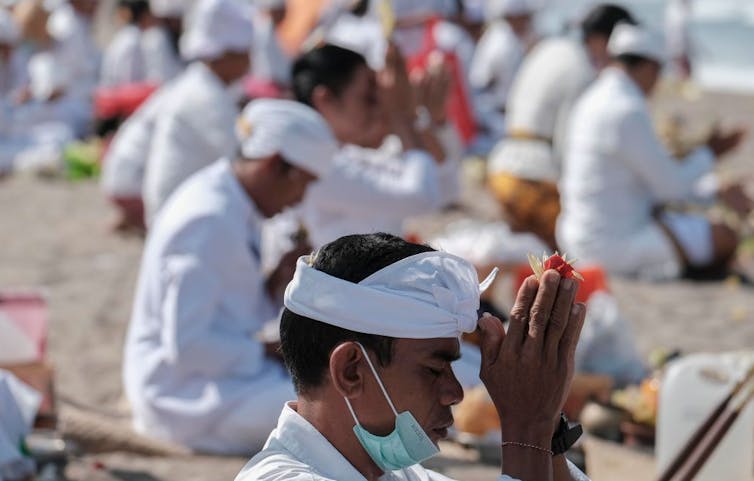
People wear a protective mask as they attend a Hindu ritual, known as Melasti, in Bali, Indonesia, on March 22.
Agoes Rudianto/NurPhoto via Getty Images

Dimitris Xygalatas, University of Connecticut

Responding to the coronavirus pandemic, most American universities have suspended all campus activities. Like millions of people all around the world, the lives of students all over the U.S. has changed overnight.

When I met my students for what was going to be our last in-class meeting of the academic year, I explained the situation and asked whether there were any questions. The first thing my students wanted to know was: “Will we be able to have a graduation ceremony?”

The fact that the answer was no was the most disappointing news for them.

As an anthropologist who studies ritual, hearing that question from so many students did not come as a surprise. The most important moments of our lives – from birthdays and weddings to college graduations and holiday traditions are marked by ceremony.

Rituals provide meaning and make those experiences memorable.

Ritual as a response to anxiety

Anthropologists have long observed that people across cultures tend to perform more rituals in times of uncertainly. Stressful events such as warfare, environmental threat and material insecurity are often linked with spikes in ritual activity.

In a laboratory study in 2015, my colleagues and I found that under conditions of stress people’s behavior tends to become more rigid and repetitive – in other words, more ritualized.

The reason behind this propensity lies in our cognitive makeup. Our brain is wired to make predictions about the state of the world. It uses past knowledge to make sense of current situations. But when everything around us is changing, the ability to make predictions is limited. This causes many of us to experience anxiety.

That is where ritual comes in.

Rituals are highly structured. They require rigidity, and must always be performed the “right” way. And they involve repetitition: The same actions are done again and again. In other words, they are predictable.

So even if they have no direct influence over the physical world, rituals provide a sense of control by imposing order on the chaos of everyday life.

It is of little importance whether this sense of control is illusory. What matters is that it is an efficient way of relieving anxiety.

This is what we found in two soon-to-be-published studies. In Mauritius, we saw that Hindus experienced lower anxiety after they performed temple rituals, which we measured using heart rate monitors. And in the U.S., we found that Jewish students who attended more group rituals had lower levels of the stress hormone cortisol.

Rituals provide connection

Collective rituals require coordination. When people come together to perform a group ceremony, they may dress alike, move in synchrony or chant in unison. And by acting as one, they feel as one.

When people come together for a ritual, they build more trust with each other.
Neal Schneider?flickr, CC BY-NC-ND

Indeed, my colleagues and I found that coordinated movement makes people trust each other more, and even increases the release of neurotransmitters associated with bonding.

By aligning behavior and creating shared experiences, rituals forge a sense of belonging and common identity which transforms individuals into cohesive communities. As field experiments show, participating in collective rituals increases generosity and even makes people’s heart rates synchronize.

Tools for resilience

It is not surprising then that people around the world are responding to the coronavirus crisis by creating new rituals.

Some of those rituals are meant to provide a sense of structure and reclaim the sense of control. For example, comedian Jimmy Kimmel and his wife encouraged those in quarantine to hold formal Fridays, dressing up for dinner even if they were alone.

Others have found new ways of celebrating age-old rituals. When the New York City Marriage Bureau shut down due to the pandemic, a Manhattan couple decided to tie the knot under the fourth-floor window of their ordained friend, who officiated the ceremony from a safe distance.

While some rituals celebrate new beginnings, others serve to provide closure. To avoid spreading the disease, families of coronavirus victims are holding virtual funerals. In other cases, pastors have administered the last rites over the phone.

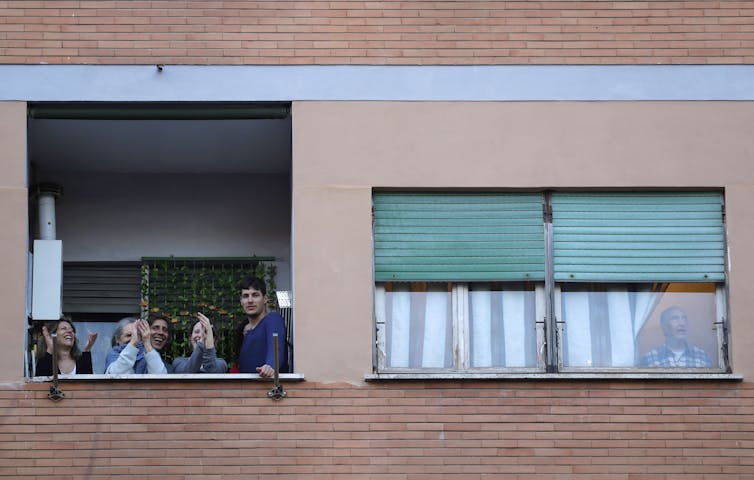
People are coming up with a host of rituals to maintain a broader sense of human connection. In various European cities, people have started to go to their balconies at the same time every day to applaud health care workers for their tireless service.

People in Rome gather on their balconies at certain hours, to give each other a round of applause.
AP Photo/Alessandra Tarantino

In Mallorca, Spain, local policemen gathered to sing and dance in the streets for the people in lockdown. And in San Bernardino, California, a group of high school students synchronized their voices remotely to form a virtual choir.

Ritual is an ancient and inextricable part of human nature. And while it may take many forms, it remains a powerful tool for promoting resilience and solidarity. In a world full of ever-changing variables, ritual is a much-needed constant.

[You’re too busy to read everything. We get it. That’s why we’ve got a weekly newsletter. Sign up for good Sunday reading. ]The Conversation

Dimitris Xygalatas, Assistant Professor in Anthropology, University of Connecticut

This article is republished from The Conversation under a Creative Commons license. Read the original article.

==================================================================
Considering the extent to which most ritual involves being with other people, it is truly impressive how may people are finding ways to have ritual in spite of out public-health-imposed isolation. Maybe some of our readers can think of more examples of people developing new ritual that they have read about or seen – please feel free to share in comments. Maybe you have even devised some kind of ritual for yourself – if so, tell us about that too.

One thing I am doing is terribly obvious to me and probably to anyone who knows me – but until reading this, I didn’t realize how much about it was actually ritual. Up until a couple of years ago, I made a ritual of watching the Met’s filmed operas on public television. Then my local station stopped carrying them. But now that the Met is streaming them, I am making rituals of them – checking the calendar in advance, deciding which ones to watch at what time of day, getting all set in from of the screen, and then lovingly watching. And it does feel like in that way some ritual has returned to me.

Alecto, Megaera, and Tisiphone, you were born in a culture in which ritual was important and respected. The annual plays in honor of the gods (particularly Dionysus IIRC) were so important that laborers were compensated by the state for their day’s wages so they could attend – which makes attendance at least as societally important as jury duty is today. So you know all about it. Help us get the hang of it too.

The Furies and I will be back.

Share

A Letter from Doug

 Posted by at 8:02 pm  Politics
Mar 262020
 

I mentioned in a comment on the open thread that I had received an email, and that it was too long to quote.    But Alabama is now pursuing me the way Australia did a week ago (Carrie sends love by the way), and it has, besides highlights of the bill, some interesting allusions to negotiations, and after all, this is the guy who nailed the killers of those four little girls, and he’s worth a listen/look-see, so here it is:

=================================================================

Friends,

The Senate just passed the largest rescue bill in American history, and it’s going to help a lot of the people who are struggling right now.

I have done everything I could to build bipartisan consensus and get this done. That’s not easy up in Washington under the best of times. Mitch McConnell’s draft bill that the Senate voted down Sunday would have left a lot of people in the cold. At times over the last 72 hours, negotiations were heated, with five of my colleagues out due to the virus and its impact, but I believe we were all looking out for the long-term best interests of our country, our families, and the economy. We know the Coronavirus presents a challenge like none we have seen in our lifetimes.

But we got there and passed with a big bipartisan majority – a bill that will do the following to help those in need:

  • $130 billion in funds for hospitals, almost double what Mitch McConnell was proposing a few days ago. This will help them make sure they have the supplies they need to protect our doctors and nurses who are on the front lines.
  • $150 billion in funds for states. Mitch McConnell had provided them with no direct aid despite the fact that they have been forced to spend millions of dollars to make up for the inadequate federal response.
  • Unemployment benefits that leave no one behind. Senate Democrats won concessions that will provide unprecedented protections for our workers including four full months of unemployment benefits including full salaries. Benefits are also extended to self-employed workers AND workers in the gig economy.
  • Direct cash payments to most Americans. If you make under $75,000, you will receive $1200. The amount will phase out for those making more.
  • Protection for renters and homeowners. The aid package includes protections that prevent evictions during the crisis.
  • Loans for small businesses affected by Coronavirus. Senate Democrats worked to add direct grants that will help small businesses avoid red tape and get the money they need right away.
  • We were also able to remove Mitch McConnell’s “anonymous bailout” language. After stories about members profiting off of stock sales in the midst of this crisis, I thought it was important that we prohibit elected officials, including the President, from receiving loans under this package.

This is a good start to get Americans the help they need right now.

Now it’s up to the House to pass this bill so we can keep rebuilding. But this crisis will demand more of each of us. This bill didn’t do everything I wanted, and I believe we will have to do more – and as this virus unfolds across our country, I have no doubt we will be back to add to the protections and support this bill provides.

We have more than four times the number of confirmed COVID-19 cases in the U.S than we did when this bill was introduced Thursday.

I know I keep quoting Smokey the Bear, but it’s really important to remember that while we are going to do everything we can in the Senate to ease the economic burden and keep you safe, YOU are the front lines of the fight against Coronavirus. But no vote in Washington is going to stop this virus. Only you can do that.

This is especially not the time to let up. I’m concerned that I am hearing talk of backsliding and even some of our public officials still underestimating the crisis we are in and the number of Americans that are at risk.

The experts keep saying that the only way we are going to drastically “flatten the curve” and reduce the number of critical cases is to continue social distancing. We all still have to do our part. The good news is that social distancing works. It’s up to you and every other American to do what the medical professionals are telling us.

We can and will beat this if we all do our part. We will make it through this together. The number of cases will continue to rise, but they will go down over time, and this will be over sooner if all of us do our part. I am doing everything I can to bring that day closer for all of us.

We are all in this together.

– Doug Jones

PS: On a personal note, I am so happy to be headed home to Louise and my family. Stay safe everyone.

=================================================================

I was glad to hear Carrie says the he seems to be quite popular personally, though a Democrat.  Hopefully we can keep him.  And, by the way, don’t forget to pray (or however, as TC says, you communicate with the universe) for Katie Porter.

Share

Everyday Erinyes #209

 Posted by at 9:04 am  Politics
Mar 212020
 

Experts in autocracies have pointed out that it is, unfortunately, easy to slip into normalizing the tyrant, hence it is important to hang on to outrage. These incidents which seem to call for the efforts of the Greek Furies (Erinyes) to come and deal with them will, I hope, help with that. As a reminder, though no one really knows how many there were supposed to be, the three names we have are Alecto, Megaera, and Tisiphone. These roughly translate as “unceasing,” “grudging,” and “vengeful destruction.”

Last weekend, it seemed that every time I turned around Australia was being brought to my attention in some way. I told Lona about it, and she said perhaps Australia was trying to tell me something. I think she’s right … and I think it was this article I had been holding for a while.  It must be time.
==================================================================

What US election officials could learn from Australia about boosting voter turnout

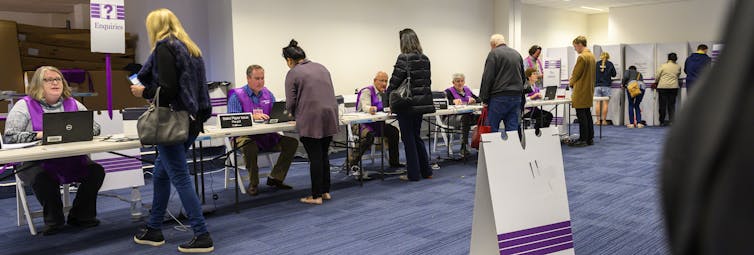
Australian voters check in and cast their ballots in a September 2019 federal election.
Australian Electoral Commission

Steven Mulroy, University of Memphis

Not every country is plagued by rules that limit voters’ participation in elections, as is common in the United States.

In the past five years, restrictions on voting and voter registration purges have limited the number of Americans eligible to cast ballots.

In addition, the U.S. is the only major democracy that still allows politicians to draw their own district lines, an often-criticized conflict of interest in which public officials essentially pick their voters, rather than the voters picking their officials. That computer-aided gerrymandering of electoral districts reduces the number of districts with competitive races, contributing to low voter turnout.

Perhaps the fundamental problem, though, is that the system yields results the people don’t actually want. Twice in the last two decades, U.S. voters chose a president, George W. Bush and Donald Trump, who got fewer votes than his rival, Al Gore and Hillary Clinton.

All these problems are avoidable and don’t happen in countries that have different voting laws. Perhaps the best example is Australia, a country which is culturally, demographically and socioeconomically similar to the U.S. In my book “Rethinking U.S. Election Law,” written while I lived and studied their system Down Under, I outline many of the ways Australia has solved voting quandaries that persist in the U.S.

Mandatory voting, made easy

Not voting in Australia? Prepare to part with this.
Screenshot from Royal Bank of Australia, CC BY-ND

Australia’s most strikingly different law requires voting. All Australians must register to vote and actually cast a ballot. Not voting means a small fine (AU$20, or about US$14) will be imposed.

Australians don’t have to actually vote for a candidate: They can leave it blank, write in “none of the above” or even draw a picture – but they do have to turn in a ballot. As a result, Australia enjoys voter registration and turnout rates over 90%.

Voting is easier in Australia than in the U.S.. All voters can cast their ballots by mail, vote in person ahead of Election Day or show up to the polls on Election Day itself – which is always on a Saturday, when most people are off from work.

A different way of counting

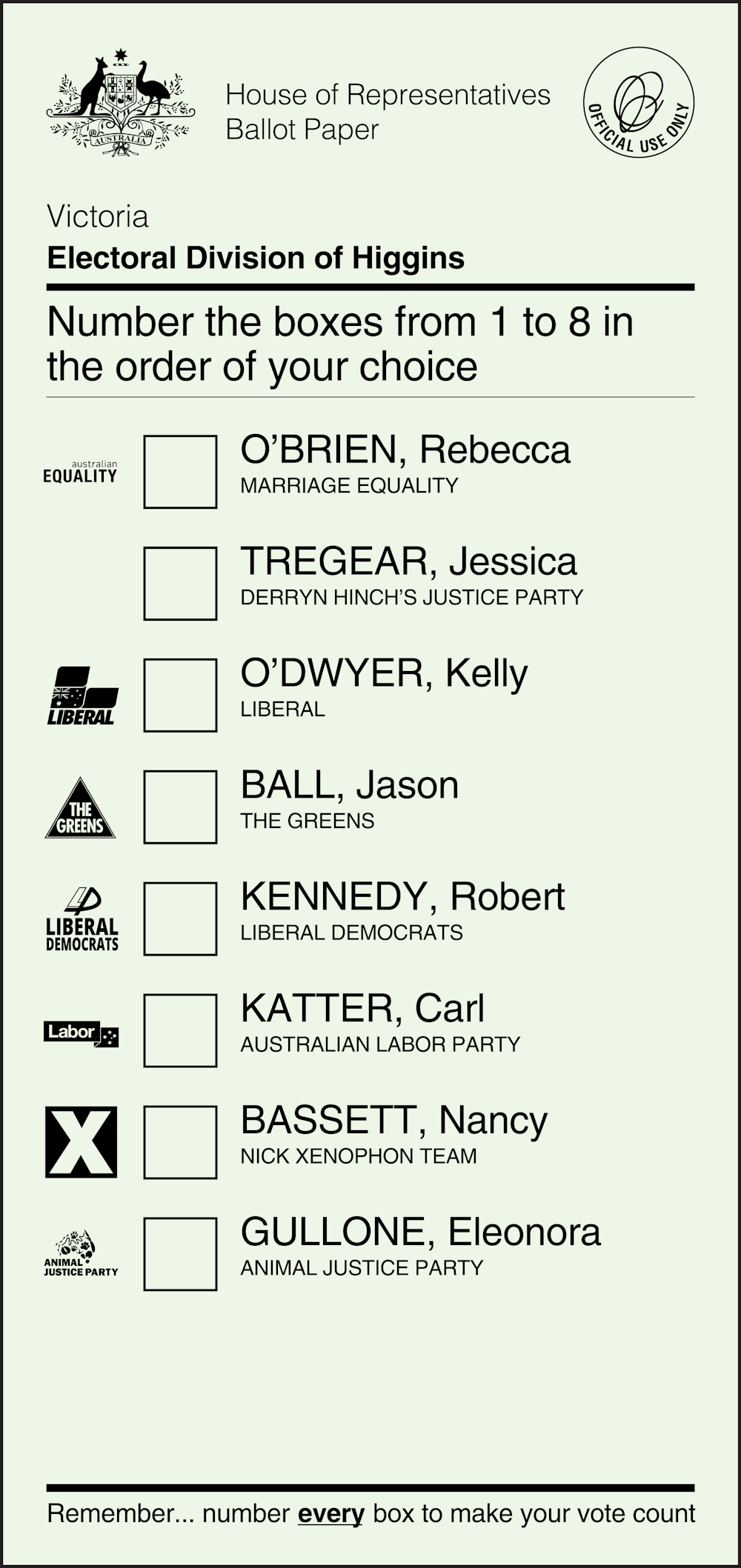
Australian voters get to rank the candidates by order of preference.
Hshook/Wikimedia Commons, CC BY-SA

Australia’s vote-counting rules are also different in important ways.

For its House elections, Australia uses what is called “preferential voting,” a form of ranked-choice voting.

Voters are allowed to rank their candidates in order of preference – 1st, 2nd, 3rd and so on. If a candidate’s first-choice votes add up to a majority of the overall ballots cast, that candidate wins, just like in any other system.

If no one wins a majority of the votes cast, the candidate with the fewest first-choice votes is eliminated and their supporters’ votes are redistributed according to these voters’ second choices. This process of eliminating candidates and redistributing those candidates’ supporters continues until one candidate has a majority.

This system eliminates what is at times called the “spoiler” problem in U.S. elections, where too many similar candidates split the majority’s vote, allowing a less-preferred candidate to win with a minority of the votes cast. For instance, in 2000, people could have voted for Ralph Nader while also showing that they would have preferred either of the other two candidates for president, Al Gore or George W. Bush.

Independent redistricting

Even with ranked-choice voting, any system where a single representative is elected for each district is vulnerable to gerrymandering. The lines can be drawn to give one party more seats than its mathematical vote share warrants.

To reduce that problem, Australia’s election districts are drawn by the Australian Electoral Commission, a politically independent commission of nonpartisan technical experts.

It’s well respected for being nonpartisan, with a good track record of keeping politics out of the redistricting process.

But even the Australian Electoral Commission isn’t perfect. As I detail in my book, like-minded people naturally cluster together in communities. That creates what some scholars have called “unintentional gerrymandering.” In the U.S., for example, Democratic voters overconcentrated in urban areas are unavoidably consolidated into districts with large Democratic supermajorities. That partially explains why, until recently, Republicans controlled the Virginia state legislature for years, even as Democrats won all the statewide and presidential elections.

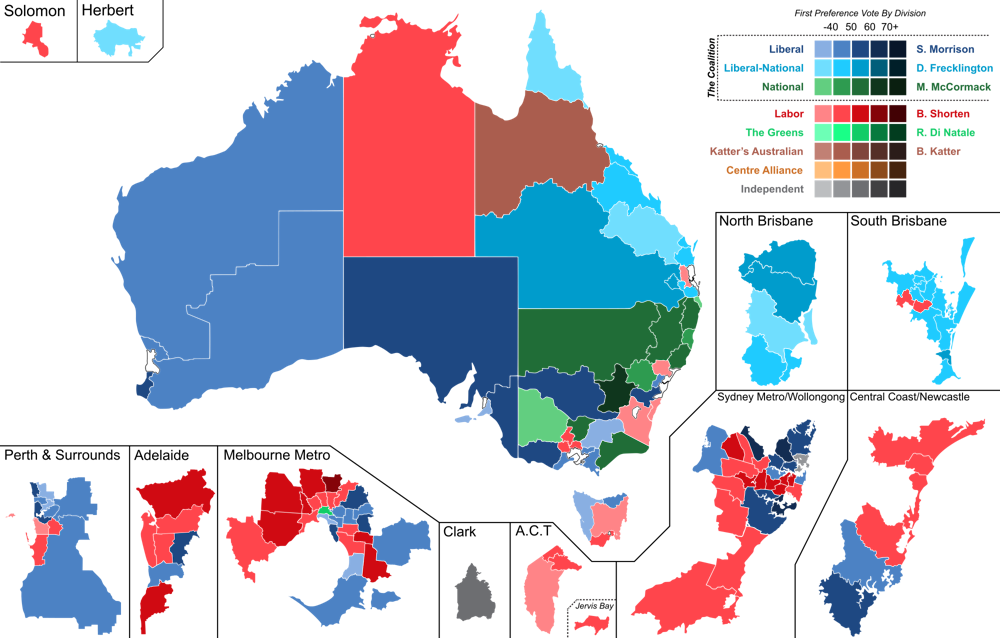
This map of 2019 Australian presidential election results shows the shapes of electoral districts are fairly compact.
Erinthecute/Wikimedia Commons, CC BY-SA

Proportional representation

One way to fix the problem of gerrymandering – whether intentional or otherwise – is to move away from the concept of “winner-take-all” elections, in which 51% of the votes yields 100% of the power. In that system, significant minority voting blocs end up with no representation, leading to frustration and alienation.

For legislative elections, one potential solution could be proportional representation, in which a party earning 30% of the vote receives approximately 30% of the seats available. Rather than “winner take all,” this is “majority takes most, and minorities take their fair share.”

Proportional representation systems don’t have single-member districts, like having one congressperson per congressional district. Rather, representatives are elected either at-large or in multi-member districts. With districting eliminated, gerrymandering becomes impossible. Australia uses this system for its Senate, using a different form of ranked-choice voting called the single transferable vote.

Like the single-winner ranked-choice voting used in Australia’s House, if no candidate wins enough first-place votes to get a seat, weaker candidates are eliminated and their votes transferred to others based on second and third choices. But single transferable vote systems also reallocate what might be called “surplus” votes of winning candidates – extra votes beyond what candidates need to actually win – to ensure a more proportionate result.

Proportional representation allows third parties to thrive, giving voters more choices. Australia offers a natural experiment between methods: For the last half-century, Australian voters nationwide have chosen single-member House representatives and used proportional representation to elect its Senate.

The result is that the Green Party consistently gets about 10% of the national vote, but zero seats in the House. However, in the Senate it gets about 10% of the seats, giving it a voice in the legislative debate. The difference is the move from winner-take-all in the House to proportional representation in the Senate. In addition, major parties vie to get second-choice support from Green Party backers, so the Greens’ concerns have real influence over national policies.

All these ideas – voting by mail, early voting, Saturday voting, ranked-choice voting, an independent redistricting commission and proportional representation – make Australia’s democracy more inclusive and representative than in the U.S.

[ You’re smart and curious about the world. So are The Conversation’s authors and editors. You can read us daily by subscribing to our newsletter. ]The Conversation

Steven Mulroy, Law Professor in Constitutional Law, Criminal Law, Election Law, University of Memphis

This article is republished from The Conversation under a Creative Commons license. Read the original article.

==================================================================
Of course, just at the moment, it isn’t actual physical turnout that we want. But we do want participation, and plenty of it. One thing that some of us are pushing it for the Federal Government to require all states to provide some form of voting by mail. Here is Colorado, as in Oregon and Washington, we had no idea we were preparing for a pandemic – we just thought we were improving participation and providing better service to all our citizens (and especially the disabled). But lo, here we are. There’s a petition here – I’m not familiar with the site, but Jeff Merkley is a co-sponsor – that has to count for something. There’s one here, sponsored by Daily Kos. This one is from the “Stop Republicans” PAC (they ask, but it’s not necessary to donate to sign.) There are probably others – please share them if you see them.

Alecto, Megaera, and Tisiphone, I don’t know whether it is even possible to get voting by mail to be at least an option in all states. But please help us try. And don’t let us forget all the other ideas from OZ when – I’ll say when – we return to what passes for normal.

The Furies and I will be back.

Share
Mar 172020
 

This is both too short and specialized to bother the Erinyes with, but also too important to wait.  So I’m putting it up today

Since we can assume we will not be able to get tested if we suspect we have COVID symptoms (and I don’t think any of us is a lead attorney from the impeachment proceedings), no matter how well they match, we are in the position of needing to be able to self-diagnose, as well as possibly to self quarantine.  It would appear to be helpful to have concise advice from an actual immunologist.  So here is some.

=================================================================

What coronavirus symptoms should I look for, and when do I call the doctor? A doctor answers 4 questions

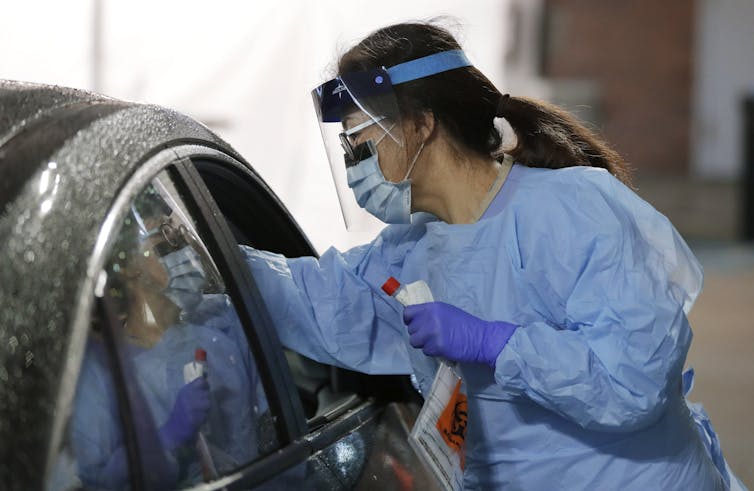
A nurse at a drive-up coronavirus testing station set up by the University of Washington Medical Center on Friday, March 13, 2020.
AP Photo/Ted S. Warren

William Petri, University of Virginia

As the nation adjusts to the threat of COVID-19, the illness caused by the coronavirus, it’s only natural to worry whether a cough or aches and pains could be signs you have become infected by the virus. Dr. William Petri, a professor of medicine and immunologist at the University of Virginia Medical Center, explains when you need to call your doctor.

1. What symptoms should I look for?

People should suspect that they might have COVID-19 if they are experiencing fever, cough and/or shortness of breath. These symptoms, however, are also symptoms of other illnesses. For example, the nation is still in the middle of a flu epidemic, and fever and cough are also symptoms of flu. It is most likely that you have flu or other respiratory illness. So, it is important to pay attention to symptoms but to also know they will not necessarily mean that you have COVID-19.

2. When should I see a doctor?

If your have fever, cough and/or shortness of breath, call your doctor. Do not just show up; it is very important to call first. Most doctors’ offices will have ways to isolate someone who potentially has COVID-19. Your doctor’s office will likely ask screening questions on the phone and will provide instructions about what to do when you arrive.

3. I’ve have a runny nose and sniffles. Could this coronavirus?

A runny nose or nasal congestion would not be likely to be COVID-19.

4. What can I expect at the doctor’s office?

The Centers for Disease Control and Prevention recommends that you put on a face mask before you enter your doctor’s office or other health care facility.

Your doctor or health care provider would likely test for flu first, because the country is in the middle of a flu epidemic. If the flu test is negative then you will be tested for COVID-19, especially if you have risk factors. That would include having traveled to a country or area of the U.S. with sustained person-to-person transmission, or having been in contact with someone with COVID-19.

This likely will change as soon as COVID-19 tests are more available – at that time everyone with a fever and cough will be tested.

[Expertise in your inbox. Sign up for The Conversation’s newsletter and get a digest of academic takes on today’s news, every day.]The Conversation

William Petri, Professor of Medicine, University of Virginia

This article is republished from The Conversation under a Creative Commons license. Read the original article.

Share

Everyday Erinyes #208

 Posted by at 7:17 am  Politics
Mar 142020
 

Experts in autocracies have pointed out that it is, unfortunately, easy to slip into normalizing the tyrant, hence it is important to hang on to outrage. These incidents which seem to call for the efforts of the Greek Furies (Erinyes) to come and deal with them will, I hope, help with that. As a reminder, though no one really knows how many there were supposed to be, the three names we have are Alecto, Megaera, and Tisiphone. These roughly translate as “unceasing,” “grudging,” and “vengeful destruction.”

So, back to history one more time. This period – the first century CE – is even closer to their youth than the Middle Ages. But human nature really doesn’t change. Our understanding of it, of course, may change. But the behavior of humans in large groups was and remains predictable.
==================================================================

Why a Roman philosopher’s views on the fear of death matter as coronavirus spreads

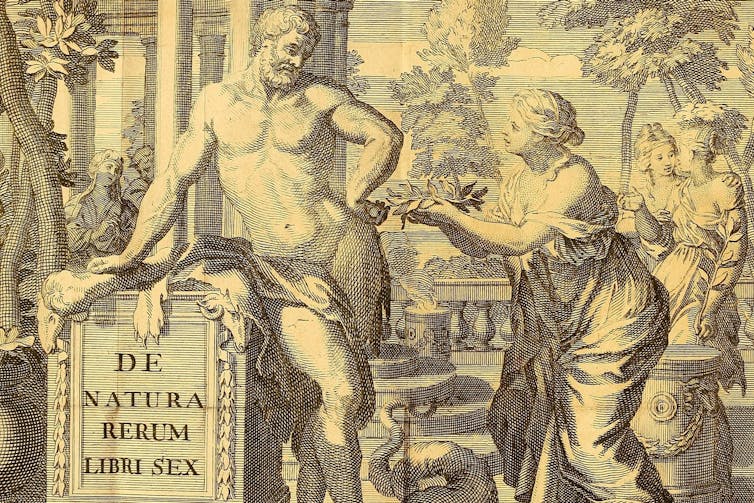
Lucretius Carus.
Internet Archive Book Images/Flickr

Thomas Nail, University of Denver

With the global spread of the new coronavirus, fears about illness and death weigh heavily on the minds of many.

Such fears can often result in a disregard for the welfare of others. All over the world, for example, essential items such as toilet paper and hand sanitizer have been sold out, with many people stockpiling them.

A first-century B.C. Roman poet and philosopher, Lucretius was worried that our fear of death could lead to irrational beliefs and actions that could harm society. As a philosopher who has just published a book on Lucretius’ ethical theory, I cannot help but notice how his predictions have come true.

Lucretius and his beliefs

Lucretius was a materialist who did not believe in gods or souls. He thought that all of nature was made of continually changing matter.

Since nothing in nature is static, everything eventually passes away. Death, for Lucretius, allowed for new life to emerge from the old.

When there is no immediate danger of dying, people are less afraid of death, Lucretius says in “The Nature of Things.” But when illness or danger strike, people get scared and begin to think of what comes after death.

Some people might make themselves feel better by imagining that they have immaterial souls that shed their bodies or that there is a benevolent God, Lucretius writes. Others might imagine an eternal afterlife, as the philosopher Todd May argues in his 2014 book, “Death.”

The fear of death may lead people to seek comfort in the idea that there is an immortal soul that is more important than the body and the material world.

Fear and social divisions

However, an ethical danger of such beliefs, Lucretius argues, is that people may become preoccupied with something that literally does not matter at all.

This fear and anxiety, Lucretius says, stains everything in life. It “leaves no pleasure clear and pure” and it could even lead to “a great hatred of life.” Studies show that anxiety about death can lower one’s immune system and make it more vulnerable to infections.

Additionally, Lucretius says, the fear of death can also lead people to create social divisions. When people are afraid of dying, they might think that withdrawing from others will help keep danger, disease and death away.

“This is why people, attacked by false fears, desire to escape far away and to withdraw themselves,” Lucretius says.

This phenomenon is well documented in terror management studies. The fear of death results in a desire to escape from disadvantaged groups.

In China, for example, rural migrant workers were blocked from quarantined cities, kicked out of apartments and turned away by factory owners, as authorities tried to control the spread of the coronavirus.

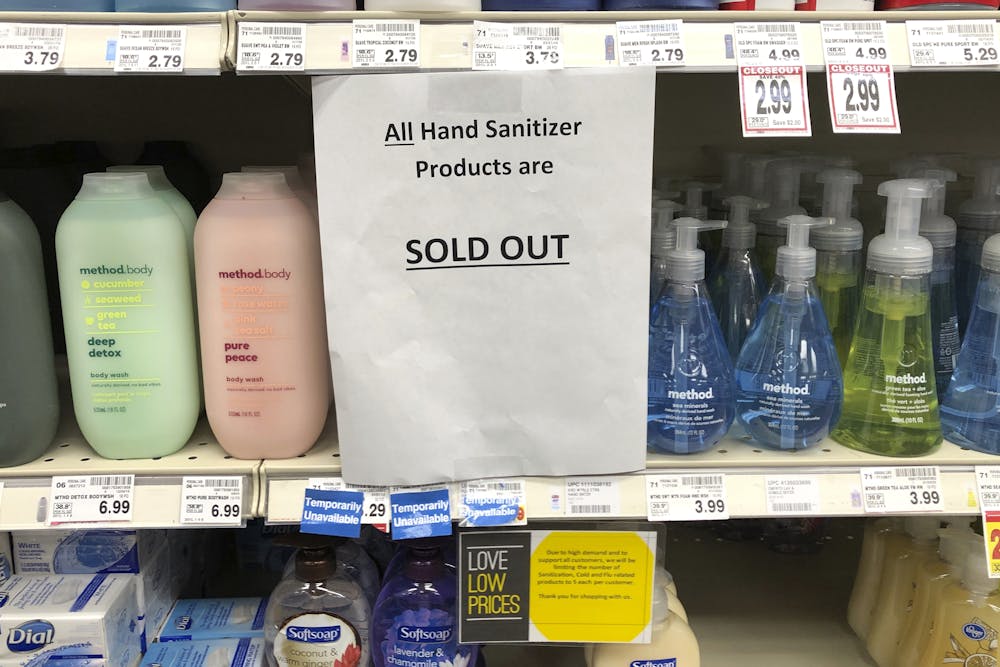
A sign on a grocery store in Kirkland, Washington, says all hand sanitizer products have been sold out.
AP Photo/Ted S. Warren, File

In the U.S., poorer workers do not have the luxury to work from home when schools close, and cannot afford to take sick days or see a doctor. They are thus more vulnerable compared to those who can afford to isolate themselves.

Asian Americans are also experiencing increased discrimination following the coronavirus spread. Fewer people are going to Chinese restaurants out of fear of being infected. Asian American schoolchildren too have been targets of racist comments.

Focus on staying healthy

The fear of death is irrational, according to Lucretius, because once people die they will not be sad, judged by gods or pity their family; they will not be anything at all. “Death is nothing to us,” he says.

Not fearing death is easier said than done. That is why, for Lucretius, it is the most important ethical challenge of our life.

Instead of worrying about what may happen after death, Lucretius advises people to focus on keeping their bodies healthy and helping others do the same.

[Expertise in your inbox. Sign up for The Conversation’s newsletter and get a digest of academic takes on today’s news, every day.]The Conversation

Thomas Nail, Associate Professor of Philosophy, University of Denver

This article is republished from The Conversation under a Creative Commons license. Read the original article.

==================================================================
Alecto, Megaera, and Tisiphone, I believe it would be helpful if those of us who can reason and learn do our best to adopt patience with those who can’t and don’t. A little understanding can go a long way.  Beyond that, we need to stay strong and keep up our resistance – now in multiple senses.

The Furies and I will be back.

Share

Everyday Erinyes #207

 Posted by at 9:38 am  Politics
Mar 072020
 

Experts in autocracies have pointed out that it is, unfortunately, easy to slip into normalizing the tyrant, hence it is important to hang on to outrage. These incidents which seem to call for the efforts of the Greek Furies (Erinyes) to come and deal with them will, I hope, help with that. As a reminder, though no one really knows how many there were supposed to be, the three names we have are Alecto, Megaera, and Tisiphone. These roughly translate as “unceasing,” “grudging,” and “vengeful destruction.”

Any time I can’t think of anything else to say, I tend to look at history. And, of course, the Furies are just fine with that, predating history as they do. Just because the COVID-19 is new doesn’t mean that pandemics are new, and we can certainly look at history to see what other forms of collateral damage there might be besides the obvious illness and possible death.
==================================================================

What can the Black Death tell us about the global economic consequences of a pandemic?

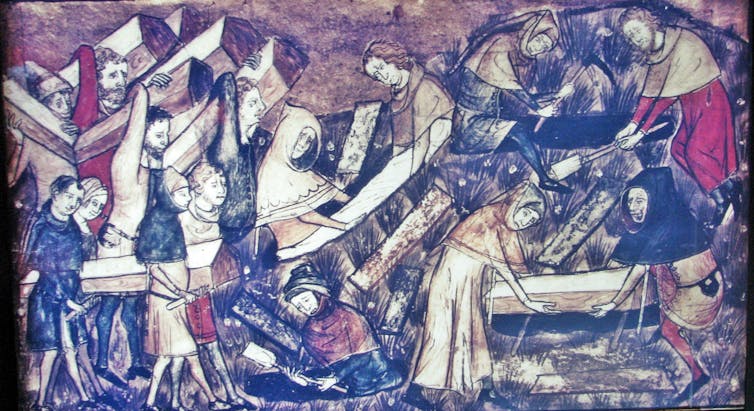
Miniature by Pierart dou Tielt

Adrian R. Bell, University of Reading; Andrew Prescott, University of Glasgow, and Helen Lacey, University of Oxford

Concerns over the spread of the novel coronavirus have translated into an economic slowdown. Stock markets have taken a hit: the UK’s FTSE 100 has seen its worst days of trading for many years and so have the Dow Jones and S&P in the US. Money has to go somewhere and the price of gold – seen as a stable commodity during extreme events – reached a seven-year high.

A look back at history can help us consider the economic effects of public health emergencies and how best to manage them. In doing so, however, it is important to remember that past pandemics were far more deadly than coronavirus, which has a relatively low death rate.

Without modern medicine and institutions like the World Health Organization, past populations were more vulnerable. It is estimated that the Justinian plague of 541 AD killed 25 million and the Spanish flu of 1918 around 50 million

By far the worst death rate in history was inflicted by the Black Death. Caused by several forms of plague, it lasted from 1348 to 1350, killing anywhere between 75 million and 200 million people worldwide and perhaps one half of the population of England. The economic consequences were also profound.

‘Anger, antagonism, creativity’

It might sound counter-factual – and this should not minimise the contemporary psychological and emotional turmoil caused by the Black Death – but the majority of those who survived went on to enjoy improved standards of living. Prior to the Black Death, England had suffered from severe overpopulation.

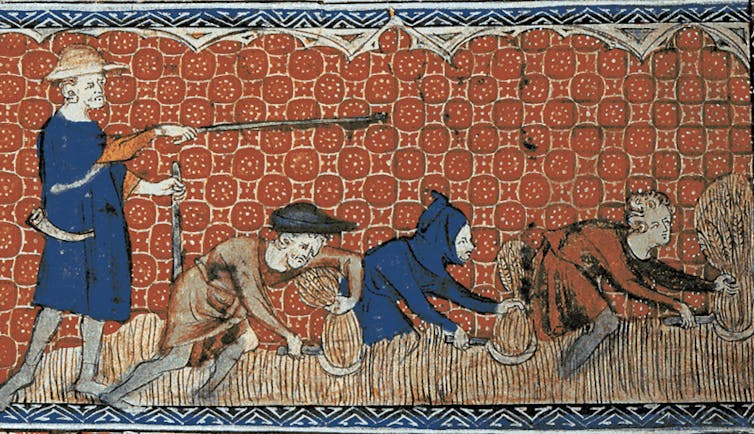
Following the pandemic, the shortage of manpower led to a rise in the daily wages of labourers, as they were able to market themselves to the highest bidder. The diets of labourers also improved and included more meat, fresh fish, white bread and ale. Although landlords struggled to find tenants for their lands, changes in forms of tenure improved estate incomes and reduced their demands.

But the period after the Black Death was, according to economic historian Christopher Dyer, a time of “agitation, excitement, anger, antagonism and creativity”. The government’s immediate response was to try to hold back the tide of supply-and-demand economics.

Life as a labourer in the 14th century was hard.
British Library

This was the first time an English government had attempted to micromanage the economy. The Statute of Labourers law was passed in 1351 in an attempt to peg wages to pre-plague levels and restrict freedom of movement for labourers. Other laws were introduced attempting to control the price of food and even restrict which women were allowed to wear expensive fabrics.

But this attempt to regulate the market did not work. Enforcement of the labour legislation led to evasion and protests. In the longer term, real wages rose as the population level stagnated with recurrent outbreaks of the plague.

Landlords struggled to come to terms with the changes in the land market as a result of the loss in population. There was large-scale migration after the Black Death as people took advantage of opportunities to move to better land or pursue trade in the towns. Most landlords were forced to offer more attractive deals to ensure tenants farmed their lands.

A new middle class of men (almost always men) emerged. These were people who were not born into the landed gentry but were able to make enough surplus wealth to purchase plots of land. Recent research has shown that property ownership opened up to market speculation.

The dramatic population change wrought by the Black Death also led to an explosion in social mobility. Government attempts to restrict these developments followed and generated tension and resentment.

Meanwhile, England was still at war with France and required large armies for its campaigns overseas. This had to be paid for, and in England led to more taxes on a diminished population. The parliament of a young Richard II came up with the innovative idea of punitive poll taxes in 1377, 1379 and 1380, leading directly to social unrest in the form of the Peasants’ Revolt of 1381.

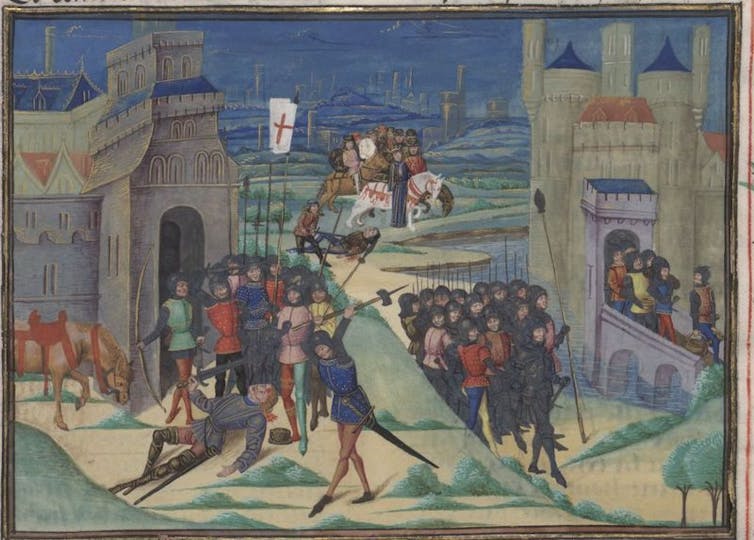
Peasants revolting in 1381.
Miniature by Jean de Wavrin

This revolt, the largest ever seen in England, came as a direct consequence of the recurring outbreaks of plague and government attempts to tighten control over the economy and pursue its international ambitions. The rebels claimed that they were too severely oppressed, that their lords “treated them as beasts”.

Lessons for today

While the plague that caused the Black Death was very different to the coronavirus that is spreading today, there are some important lessons here for future economic growth. First, governments must take great care to manage the economic fallout. Maintaining the status quo for vested interests can spark unrest and political volatility.

Second, restricting freedom of movement can cause a violent reaction. How far will our modern, mobile society consent to quarantine, even when it is for the greater good?

Plus, we should not underestimate the knee-jerk, psychological reaction. The Black Death saw an increase in xenophobic and antisemitic attacks. Fear and suspicion of non-natives changed trading patterns.

There will be winners and losers economically as the current public health emergency plays out. In the context of the Black Death, elites attempted to entrench their power, but population change in the long term forced some rebalancing to the benefit of labourers, both in terms of wages and mobility and in opening up the market for land (the major source of wealth at the time) to new investors. Population decline also encouraged immigration, albeit to take up low skilled or low-paid jobs. All are lessons that reinforce the need for measured, carefully researched responses from current governments.The Conversation

Adrian R. Bell, Chair in the History of Finance and Research Dean, Prosperity and Resilience, Henley Business School, University of Reading; Andrew Prescott, Professor of Digital Humanities, University of Glasgow, and Helen Lacey, Lecturer in Late Medieval History, University of Oxford

This article is republished from The Conversation under a Creative Commons license. Read the original article.

==================================================================
“All are lessons that reinforce the need for measured, carefully researched responses from current governments.” Well, we can pretty much rule out receiving that from our current regime – certainly another reason why the current regime has to go, just as soon as it can possibly be managed.

Alecto, Megaera, and Tisiphone, You are already helping us work on getting the regime changed. But if you get a spare moment to do something that helps build morale for public health workers, both in and out of government, it would be appreciated.

The Furies and I will be back.

Share

Everyday Erinyes #206

 Posted by at 8:42 am  Politics
Feb 292020
 

Experts in autocracies have pointed out that it is, unfortunately, easy to slip into normalizing the tyrant, hence it is important to hang on to outrage. These incidents which seem to call for the efforts of the Greek Furies (Erinyes) to come and deal with them will, I hope, help with that. As a reminder, though no one really knows how many there were supposed to be, the three names we have are Alecto, Megaera, and Tisiphone. These roughly translate as “unceasing,” “grudging,” and “vengeful destruction.”

The Furies picked out this article themselves. They wanted us to get a better handle on how events of today are reflected in events of days when they were very young. They hope it will help.
==================================================================

The ancient Greeks had alternative facts too – they were just more chill about it

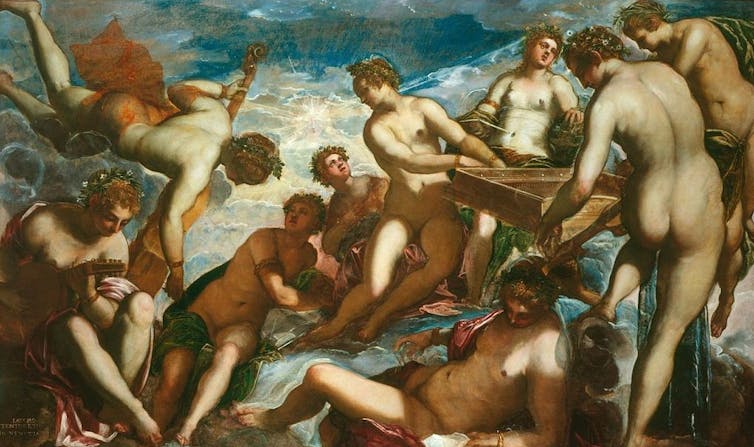
Understandings of truth may be found in the Muses’ words.
Jacopo Tintoretto’s The Muses/Wikpedia

Joel Christensen, Brandeis University

In an age of deepfakes and alternative facts, it can be tricky getting at the truth. But persuading others – or even yourself – what is true is not a challenge unique to the modern era. Even the ancient Greeks had to confront different realities.

Take the story of Oedipus. It is a narrative that most people think they know – Oedipus blinded himself after finding out he killed his father and married his mother, right?

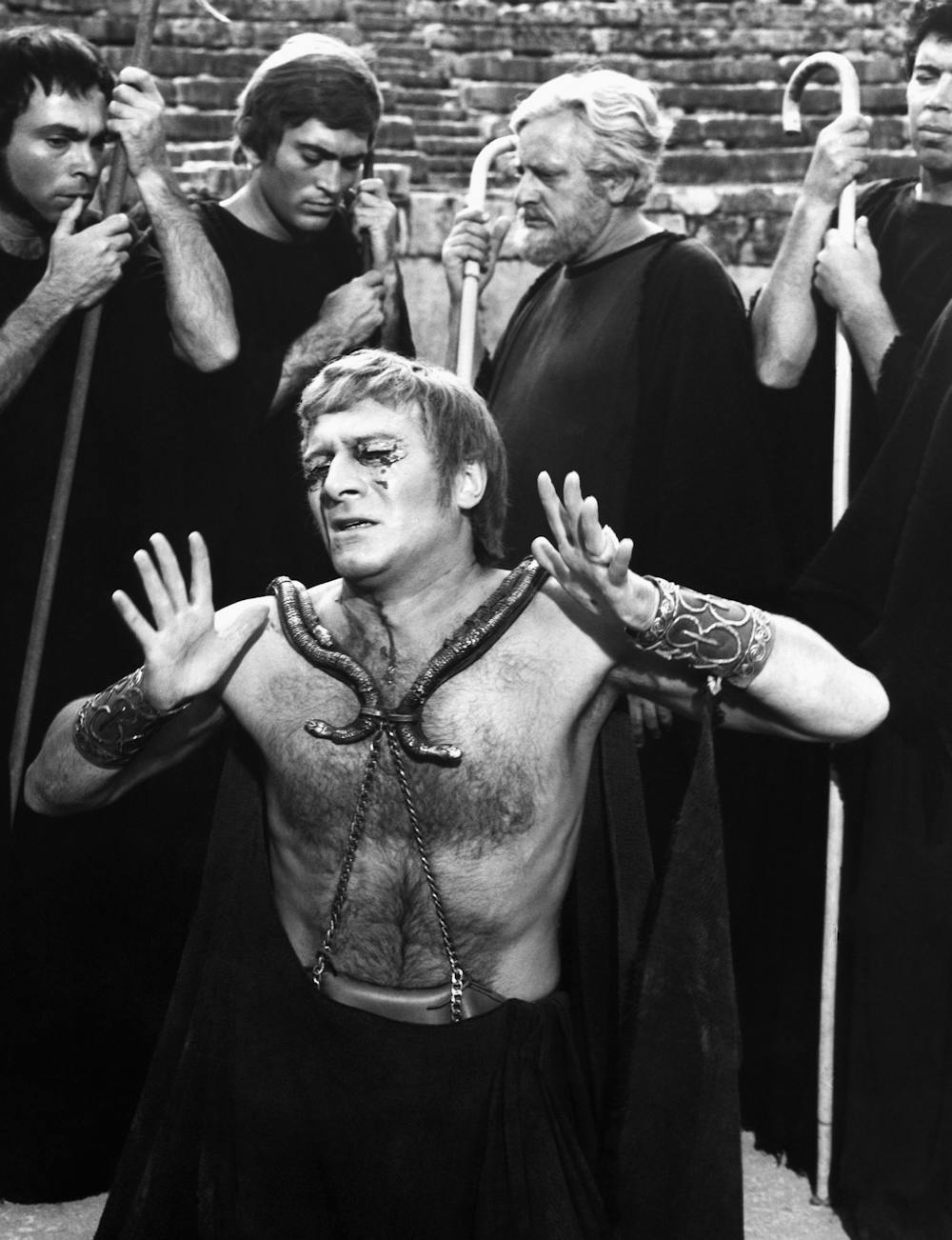
Actor Christopher Plummer in the 1967 film ‘Oedipus the King.’
AP Photo

But the ancient Greeks actually left us many different versions of almost every ancient tale. Homer has Oedipus living on, eyes intact after his mother Jocasta’s death. Euripides, another Greek dramatist, has Oedipus continue living with his mother after the truth is revealed.

A challenge I face when teaching Greek mythology is the assumption that my course will establish which version of the story is correct. Students want to know which version is “the right one.”

To help them understand why this isn’t the best approach, I use a passage from Hesiod’s “Theogony,” a story of the origin of the universe and the gods by the poet Hesiod. The narrator claims the Muses, inspirational goddesses of the arts, science and literature, appeared to him and declared “we know how to tell many false things (pseudea) similar to the truth (etumoisin) but we know how to speak the truth (alêthea) when we want to.”

Now, that is quite the disclaimer before going on to describe how Zeus came to rule the universe! But the Greeks had different ways of thinking about narrative and truth than we do today.

The truths are out there

One such approach focuses on the diversity of audiences hearing the story. Under this historical interpretation, the Muses’ caveat can be seen as a way to prepare audiences for stories that differ from those told in their local communities.

A theological interpretation might see a distinction between human beliefs and divine knowledge, reserving the ability to distinguish the truth for the gods alone. This approach anticipates a key tenet of later philosophical distinctions between appearance and reality.

The Muses also set out a metaphysical foundation: The truth exists, but it is hard to comprehend and only the gods can truly know and understand it. This formulation establishes “truth” as a fundamental feature of the universe.

The meanings of the words used are important here. “Pseudea,” used for “lies,” is the root of English compounds denoting something false – think pseudonym or pseudoscience. But notice that Hesiod uses two different words for “truth.” The first, “etumon” is where we get the English etymology from, but this Greek word can mean anything from “authentic” to “original.” The second, “alêthea” literally means “that which is not hidden or forgotten.” It is the root of the mythical river of forgetfulness, Lêthe, whose waters the souls of the dead sample to wash away their memories.

So to the Muses — who were the daughters of Zeus and Mnemosyne, the goddess of memory — “truth” is something authoritative because it is “authentic” in meaning and “revealed” or “unforgettable.”

The Muses’ implication is that truth is derived from ancient origins and is somehow unchanging and, ultimately, unknowable for human beings.

Indeed, this formulation becomes a bedrock of ancient philosophy when authors like Plato insist that truth and reality must be eternal and immutable. Such assumptions about the truth are also central to absolutist approaches to beliefs, whether we are talking about religion, literature or politics.

But what good is knowing about the nature of truth if it is ultimately inaccessible to mortal minds?

From teaching Greek texts I have become increasingly convinced that the Theogony’s narrator quotes the Muses not merely to evade responsibility for telling an unknown story nor to praise the wisdom of the gods. Instead, he is giving us advice for how to interpret myth and storytelling in general: Don’t worry about what it is true or not. Just try to make sense of the story as you encounter it, based on the details it provides.

Myth and memory

The treatment of “truth” in Greek myth can be informative when looking at modern research in cognitive science and memory.

The memory scientist Martin Conway, in studying how people construct stories about the world and themselves, has argued that two basic tendencies, correspondence and coherence, govern our memories.

Correspondence refers to how well our memory fits with verifiable facts, or what actually happened.

Coherence is the human tendency to select details which fit our assumptions about the world and who we are. Conway’s studies show that we tend to select memories about the past and make observations on the present which confirm our own narrative of what actually happened.

We already know that much of what we understand about the world is interpreted and “filled in” by our creative and efficient brains, so it should be of little surprise that we selectively pick memories to represent an absolute truth even as we continually revise it.

As individuals and groups, what we accept as “true” is conditioned by our biases and by what we want the truth to be.

With this in mind, the Muses’ warning not to obsess about whether the details in a myth are true seems appropriate – especially if a narrative making sense is more important than it being “true.”

A scene from Homer’s “Odyssey” strengthens the case for applying these ideas to early Greece. When Odysseus returns to his home island of Ithaca after 20 years, he dons a disguise to test the members of his household. A great deal of suspense arises from his conversations with his wife, Penelope, when he too is described as “someone speaking many lies (pseudea) similar to the truth (etumoisin).” Odysseus presents facts to his wife that have no counterpart in an objective reality, but his selection of details reveals much about Odysseus that is “true” about himself. He offers themes and anecdotes that give an insight into who he is, if we listen closely.

Ancient Greek epics emerged from a culture in which hundreds of different communities with separate traditions and beliefs developed shared languages and beliefs. Not unlike the United States today, this multiplicity created an environment for encountering and comparing differences. What Hesiod’s story tells his audience is that truth is out there, but it is hard work to figure out.

Figuring it out requires us to listen to the stories people tell and think about how they might seem true to them. That means not overreacting when we hear something unfamiliar that goes against what we think we know.

[ Deep knowledge, daily. Sign up for The Conversation’s newsletter.]The Conversation

Joel Christensen, Associate Professor of Classical Studies, Brandeis University

This article is republished from The Conversation under a Creative Commons license. Read the original article.

==================================================================
Now, I’m sure you are thinking that there is a major difference between truth in myth or religious belief, and truth in actual history. There is indeed. But historians of the times of the Erinyes didn’t see that the way we do. Herodotus, Thucydides, Livy, Tacitus, Pliny, Suetonius, Josephus – All of them included material which cannot be proven true, and material which can actually be proven false. Historians of that time didn’t really seem to care; if it was a good story, they told it.

To give just one example of the provably false, consider the story of Nero “fiddling while Rome burned,” in some accounts watching from the roof of his home. Certainly the great fire burned for several days, and it’s also apparently true that Nero didn’t want to be an Emperor so much as an actor and/or a singer. But fiddled? There was no such thing as a fiddle at the time. There were no bowed stringed instruments at all, and very few plucked ones. There were lyres, which are a sort of two-sided harp. But that’s a minor quibble. What really undercuts the story is that Nero was not in Rome when the fire started – and by the time he did get there, his house – roof and all – no longer existed. (And don’t get me started on the collapsible boat with which he is supposed to have murdered, or tried to murder, his mother Agrippina.) So what you think you know about historical figures may in reality be just as undependable as what you know or don’t know about mythology.

Alecto, Megaera, and Tisiphone, Thank you for sharing with us. Please help us, if you can, to hang onto respect for truth, and to hold on to truth which is knowable and provable, in the face of challenges.

The Furies and I will be back.

Share