Robert Reich – Corporations as guardians of democracy?
Corey from WellRed, playing a press secretary, with Brent Terhune asking questions (Brent did those MAGAt parodies that were so real many people thought he was a MAGAt.)
SNL – Blue Georgia
And you thought you’d seen every possible take on Bernie’s mittens.
Beau – This could be funny if weren’t so true. “Travesty” is the word, all right.
Experts in autocracies have pointed out that it is, unfortunately, easy to slip into normalizing the tyrant, hence it is important to hang on to outrage. These incidents which seem to call for the efforts of the Greek Furies (Erinyes) to come and deal with them will, I hope, help with that. As a reminder, though no one really knows how many there were supposed to be, the three names we have are Alecto, Megaera, and Tisiphone. These roughly translate as “unceasing,” “grudging,” and “vengeful destruction.”
I have a number of articles saved regarding how white supremacy thinks, when it increases, how it expresses itself, and so on. I hope to get to all of them eventually, but in looking them over, that this one stood out as being more related to “what can we do about it” than the others. A couple are about preventing it, but it’s a little late for that now, and a little early for future generations. So let’s look at one potential solution and see how effective it is – or isn’t.
================================================================
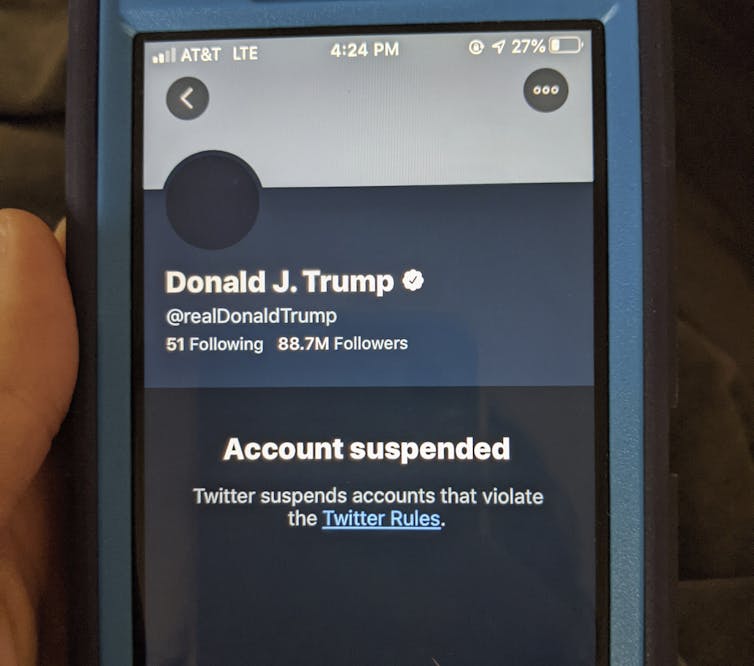
Does ‘deplatforming’ work to curb hate speech and calls for violence? 3 experts in online communications weigh in
Twitter’s suspension of Donald Trump’s account took away his preferred means of communicating with millions of his followers. AP Photo/Tali Arbel
The Conversation U.S. asked three experts in online communications whether deplatforming works and what happens when technology companies attempt it.
Sort of, but it’s not a long-term solution
Jeremy Blackburn, assistant professor of computer science, Binghamton University
The question of how effective deplatforming is can be looked at from two different angles: Does it work from a technical standpoint, and does it have an effect on worrisome communities themselves?
Does deplatforming work from a technical perspective?
Gab was the first “major” platform subject to deplatforming efforts, first with removal from app stores and, after the Tree of Life shooting, the withdrawal of cloud infrastructure providers, domain name providers and other Web-related services. Before the shooting, my colleagues and I showed in a study that Gab was an alt-right echo chamber with worrisome trends of hateful content. Although Gab was deplatformed, it managed to survive by shifting to decentralized technologies and has shown a degree of innovation – for example, developing the moderation-circumventing Dissenter browser.
From a technical perspective, deplatforming just makes things a bit harder. Amazon’s cloud services make it easy to manage computing infrastructure but are ultimately built on open source technologies available to anyone. A deplatformed company or people sympathetic to it could build their own hosting infrastructure. The research community has also built censorship-resistant tools that, if all else fails, harmful online communities can use to persist.
Does deplatforming have an effect on worrisome communities themselves?
Whether or not deplatforming has a social effect is a nuanced question just now beginning to be addressed by the research community. There is evidence that a platform banning communities and content – for example, QAnon or certain politicians – can have a positive effect. Platform banning can reduce growth of new users over time, and there is less content produced overall. On the other hand, migrations do happen, and this is often a response to real world events – for example, a deplatformed personality who migrates to a new platform can trigger an influx of new users.
Another consequence of deplatforming can be users in the migrated community showing signs of becoming more radicalized over time. While Reddit or Twitter might improve with the loss of problematic users, deplatforming can have unintended consequences that can accelerate the problematic behavior that led to deplatforming in the first place.
Ultimately, it’s unlikely that deplatforming, while certainly easy to implement and effective to some extent, will be a long-term solution in and of itself. Moving forward, effective approaches will need to take into account the complicated technological and social consequences of addressing the root problem of extremist and violent Web communities.
Yes, but driving people into the shadows can be risky
Ugochukwu Etudo, assistant professor of operations and information management, University of Connecticut
Does the deplatforming of prominent figures and movement leaders who command large followings online work? That depends on the criteria for the success of the policy intervention. If it means punishing the target of the deplatforming so they pay some price, then without a doubt it works. For example, right-wing provocateur Milo Yiannopoulos was banned from Twitter in 2016 and Facebook in 2019, and subsequently complained about financial hardship.
If it means dampening the odds of undesirable social outcomes and unrest, then in the short term, yes. But it is not at all certain in the long term. In the short term, deplatforming serves as a shock or disorienting perturbation to a network of people who are being influenced by the target of the deplatforming. This disorientation can weaken the movement, at least initially.
However, there is a risk that deplatforming can delegitimize authoritative sources of information in the eyes of a movement’s followers, and remaining adherents can become even more ardent. Movement leaders can reframe deplatforming as censorship and further proof of a mainstream bias.
There is reason to be concerned about the possibility that driving people who engage in harmful online behavior into the shadows further entrenches them in online environments that affirm their biases. Far-right groups and personalities have established a considerable presence on privacy-focused online platforms, including the messaging platform Telegram. This migration is concerning because researchers have known for some time that complete online anonymity is associated with increased harmful behavior online.
In deplatforming policymaking, among other considerations, there should be an emphasis on justice, harm reduction and rehabilitation. Policy objectives should be defined transparently and with reasonable expectations in order to avoid some of these negative unintended consequences.
Yes, but the process needs to be transparent and democratic
Robert Gehl, associate professor of communication and media studies, Louisiana Tech University
Deplatforming not only works, I believe it needs to be built into the system. Social media should have mechanisms by which racist, fascist, misogynist or transphobic speakers are removed, where misinformation is removed, and where there is no way to pay to have your messages amplified. And the decision to deplatform someone should be decided as close to democratically as is possible, rather than in some closed boardroom or opaque content moderation committee like Facebook’s “Supreme Court.”
In other words, the answer is alternative social media like Mastodon. As a federated system, Mastodon is specifically designed to give users and administrators the ability to mute, block or even remove not just misbehaving users but entire parts of the network.
For example, despite fears that the alt-right network Gab would somehow take over the Mastodon federation, Mastodon administrators quickly marginalized Gab. The same thing is happening as I write with new racist and misogynistic networks forming to fill the potential void left by Parler. And Mastodon nodes have also prevented spam and advertising from spreading across the network.
Moreover, the decision to block parts of the network aren’t made in secret. They’re done by local administrators, who announce their decisions publicly and are answerable to the members of their node in the network. I’m on scholar.social, an academic-oriented Mastodon node, and if I don’t like a decision the local administrator makes, I can contact the administrator directly and discuss it. There are other distributed social media system, as well, including Diaspora and Twister.
The danger of mainstream, corporate social media is that it was built to do exactly the opposite of what alternatives like Mastodon do: grow at all costs, including the cost of harming democratic deliberation. It’s not just cute cats that draw attention but conspiracy theories, misinformation and the stoking of bigotry. Corporate social media tolerates these things as long as they’re profitable – and, it turns out, that tolerance has lasted far too long.
================================================================ Alecto, Megaera, and Tisiphone, there you have it. The clear consensu answer is “yes, but.” I am certainly intrigued by the type of social network described by Professor Gehl, but it does appear to require participants to accept facts and be willing to enter into rational discourse, which kind of eliminates the categories of people who need deplatforming the most. I don’t know what the solution actually is. It probably involves getting social media platforms not to function as profit-making activities, and good luck with that. But at least this is a start.
The Lincoln Project – “One of the people who organized this is well known for having worked with The Lincoln Project in the past. So – let’s have trial by combat!”
Now This News – AOC on present GOP House caucus
Really American
Puppet Regime
From Twitter (The 11th hour) No CC and I hate to spolt the punch line – I’ll email you, Nameless.
Really American – The one I posted yesterday had no CC when I posted it. I went back later in the evening to get a transcript, and then it did have CC. So my advice on this one is to wait 6 or so hours and then view it on YouTube.
Now This News – the GameStop affair – explained simply
Robert Reich – very short and very accurate.
Mrs. Betty Bowers, America’s Best Christian
A Philip Markle parody
Beau on how the impeachment trial “should” go. He makes excellent points. ACCOUNTABILITY
F*ck The Pandas: Ugly Animals Deserve Your Attention Too
That link is SamanthaBee.com/TakeAction. It’s real, all right. But Google won’t find it for you, and I assume other search engines won’t either, so if yu want the calendar, take note.
Yes, this is 53+ minutes. Bookmark it to watch when you have time. It is the PBS Frontline documentary “American Carnage” about the Trump** regime and how it ultimately led to the insurrection. No, Ken Burns didn’t make it, but the Frontline team is that good too.
Meidas Touch
Now This News – Holocaust Remembrance Day (possible trigger)
Really American “The Eunuchs” – limited CC, I’ll try to get a transcript
Savage Attack – by kitten – on Golden retriever. (no dialog)
Beau on Climate Change – and Yesterday’s Drew video is pertinent here – (“invest in the American Death Machine!”)