Glenn Kirschner – Federal Judges Say Trump is Responsible for Directing his “Pawns” on Jan. 6; Reject Bannon Delay
Reuters – Biden ‘knew he was making history’ with Harris as VP: WH
Thom Hartmann – Why Getting Pregnant Increases Your Chance of Being Murdered By 16% (No, Thom, it’s not amazing. Horrifying, yes. Amazing, not so much.)
MSNBC – Why Biden’s Build Back Better Bill Won’t Add To Inflation
Rescued Goose, Mini Horse Are Inseparable — Watch Them Get Adopted Together
Beau – Let’s talk about CRT and thanksgiving dinner….
Experts in autocracies have pointed out that it is, unfortunately, easy to slip into normalizing the tyrant, hence it is important to hang on to outrage. These incidents which seem to call for the efforts of the Greek Furies (Erinyes) to come and deal with them will, I hope, help with that. As a reminder, though no one really knows how many there were supposed to be, the three names we have are Alecto, Megaera, and Tisiphone. These roughly translate as “unceasing,” “grudging,” and “vengeful destruction.”
I am not a professional historian, or even all that much of an amateir one, but I have, over the years, picked up bits and pieces. And I’m pretty sure there was a time in England – probably before the Civil War (theirs, not ours), when being “armigerous” was absolutely connected to a title or deed of nobility – that if you were a knight, or a baron (viscount,earl, marquis, or duke – or a royal), you had the right to “bear arms” in public – and if you weren’t, you didn’t. I actually hope the “originalists” on the bench never get hold of this. Because if they wanted to argue that the point of the Bill of Rights was to give everyone rights (including those rights only the nobility previously had), I for one could certainly not argue against that.
================================================================
Why are medieval weapons laws at the center of a US Supreme Court case?
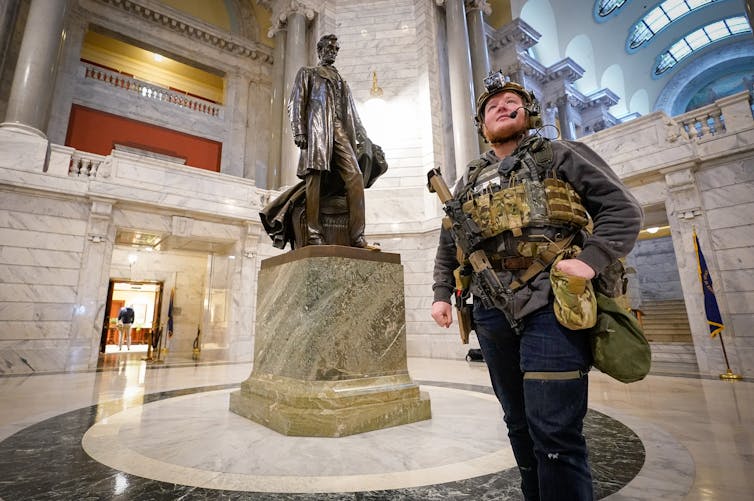
A gun rights advocate walks through the rotunda of the Kentucky Capitol. Some lawyers argue that the 1689 English Bill of Rights created the legal basis for public carry of weapons in the U.S. Bryan Woolston/Getty Images
In the opening scene of “The Last Duel,” the new film set in 14th-century France, a herald announces the rules for conduct at a tournament to the death. He declares that no members of the public – whatever their social background – are allowed to bring weapons to the event.
This scene might seem far removed from 21st-century America. But medieval weapons laws – including a 1328 English statute prohibiting the public carry of edged weapons without royal permission – are at the center of dueling legal opinions in a case now before the U.S. Supreme Court, New York State Rifle and Pistol Association v. Bruen.
The plaintiffs are challenging New York’s “proper cause” gun law, which tightly restricts public carry of firearms. If they win, similar laws in several other states will be called into question. That means that concealed carry licensing laws could be broadly liberalized for millions of Americans currently living in those more restrictive jurisdictions.
The book explores how courts in the United States have turned to history for instruction in how guns should be treated – decrees, laws and interpretations of the past that are at the forefront of the case before the Supreme Court today.
Scalia points to the English Bill of Rights
The United States legal system grew out of the English legal tradition. This connection – which is often referenced by originalists – is crucial to making sense of the arguments around gun rights in America today.
Originalism is a legal philosophy that attempts to interpret legal texts, including the Constitution, based on what lawyers think is their original meaning.
An important victory for gun rights advocates took place in District of Columbia v. Heller. In that 2008 decision, the Supreme Court for the first time ruled that the Second Amendment protects an individual right to possess a firearm for personal self-defense in the home.
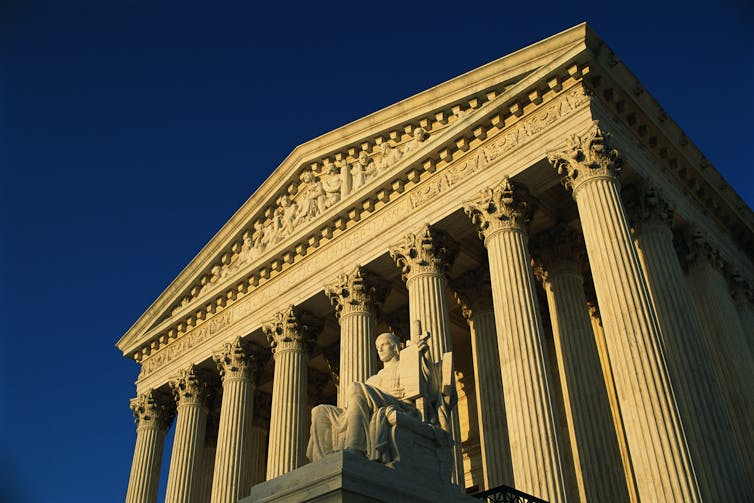
New York State Rifle and Pistol Association v. Bruen is the most significant gun rights case before the Supreme Court since 2008. Ron Watts/The Image Bank via Getty Images
Justice Antonin Scalia, author of the 5-4 majority Heller opinion, claimed that there was a long tradition of the English state’s granting freedom to possess weapons dating back to the 1689 English Bill of Rights, which includes a clause that reads “the subjects which are Protestant may have arms for their defence suitable to their conditions and as allowed by law.”
Scalia’s argument relied heavily on the work of historian Joyce Malcolm, the author of “To Keep and Bear Arms: The Origins of an Anglo-American Right” and a Second Amendment scholar at the Antonin Scalia Law School at George Mason University. Malcolm and lawyers who support the expansion of gun rights argue that this clause created the legal basis for having weapons for personal self-defense in Colonial America.
Having prevailed in Heller, gun rights activists are seeking the liberalization of restrictions on public carrying of guns outside the home. In the New York case, some lawyers and other parties are now arguing that medieval statutes restricted only public carry that “terrified” the public, and that such statutes were never actually enforced to prevent “normal” public carry.
Historians object
However, most scholars of English and American history vigorously dispute the accuracy of this claim. In fact, since the Heller decision, the history of firearms regulation in England and the U.S. has been the focus of what Fordham University law professor Saul Cornell has called an “explosion of empirical research.”
Many of these findings appear in an amicus brief presented to the Court in New York State Rifle and Pistol Association v. Bruen.
Signed by 17 professors of law, English history and American history – including me – the brief demonstrates through a review of historical evidence that “neither English nor American history supports a broad Second Amendment right to carry firearms or other dangerous weapons in public based on a generic interest in self-defense.”
Early royal proclamations dating as far back as the 13th century regularly prohibited going armed in public without special permission. In 1328, the Statute of Northampton banned the public carry of swords and daggers, open or concealed – this was before the invention of firearms – without express permission from the authorities.
As legal scholar and historian Geoffrey Robertson, an expert on the English Bill of Rights, put it: “There was never any absolute ‘right’ to carry guns. As the Bill of Rights (1689) made clear, this was only ‘as allowed by law.’”
The English tradition of broad public carry restrictions continued across the Atlantic into the Colonies.
During periods of heightened risk of attack, some Colonies required certain individuals to carry guns to church or when working in fields away from fortified or populated areas. However, this obligation was not understood as establishing a right to carry firearms in public.
After the American Revolution, states continued to adopt regulations echoing the Statute of Northampton. Recent scholarship has uncovered that early-to-mid-19th-century firearms regulations varied considerably by jurisdiction and geography, but 19 states had restrictions for public carry on the books.
By 1900, there was a legal consensus that states and localities generally had the authority to limit public carry. While the American approach to public carry restriction was fluid – varying across time and jurisdiction based on social and political changes – there is a consistent history and tradition of many American Colonies, states, territories and municipalities imposing broad prohibitions on carrying dangerous weapons in public, particularly without a specific need for self-defense.
An invented tradition?
So how did a 1689 English Bill of Rights that never gave any absolute right to carry guns turn into a key justification for that very right in the U.S.?
[Over 115,000 readers rely on The Conversation’s newsletter to understand the world.Sign up today.]
“Invented traditions,” a concept highlighted in the 1983 book “The Invention of Tradition,” which was edited by historians Eric Hobsbawm and Terence Ranger, are cultural practices that are thought to have emerged from long ago but actually are grounded in a much more recent past. A classic example is the Scottish tartan kilt, once believed to derive from the ancient garb of the Scottish Highlanders but actually invented in the 18th century by an Englishman.
================================================================ Alecto, Megaera, and Tisiphone, fortunately, the history is far more complicated than my picked-up bits and pieces would suggest. Even so, I personally would want to pay more attention to the beliefs of (now long retired) Justice Stevens, I believe it was, who recommended that the Second Amendment be abolished on account of the enormous increase in destructiveness of weapons developed since the Amendment was written. Of course, I don’t see that ever happening. But then, I don’t see universal love for each other ever happening either, and that doesn’t prevent me from supporting it.
Glenn Kirschner – Email From Trump Team Lawyer John Eastman Further Proves Conspiracy to Overturn Election Results
Thom Hartmann – Why FDR Didn’t Expose The Business Man Coup SUCH a difference between Butler and Flynn!
Ring of Fire – Fox Host Gets Death Threats After Encouraging Audience To Get Vaccinated
Rebel HQ – Greg Abbott Reveals His Sick & Twisted Plan For Immigrants (Watch sitting down so you don’t get dizzy from the spin.)
Armageddon Update – They Aren’t Victims, They’re DEAD!
Yes, this is a commercial for Doritos – and yes, it has people grabbing hankies.
Nunca Es Tarde Para Ser Quien Eres (It’s never too late to be who you are)
VERY rough transcript translation: Grandma – My brother, how I miss you!
Family – gasps in surprise to see Albert
Albert – My family, how are you doing?
Father – Who is he?
Albert – He is Mario – my wunderful partner.
Grandma – It’s a miracle! I was afraid you would be alone forever!
Beau – Let’s talk about a Sputnik moment and it not being one….
Glenn Kirschner – More Indictments Coming From NY DA Vance, Per Today’s Hearing in Weisselberg/Trump Org. Court Case
The Lincoln Project – Brian Kemp Laugh Track
politicsrus – Afghanistan Truth HD
RepresentUs – The Freedom to Vote Act Summary and Explanation. This is not the JohnLewis Act – it is the one which originates in the Senate … and therefore has a chance of passing. And it’s likely the best we are going to get. Ask yourself would we be better off with it or without it before picking at what it doesn’t do.
Robert Reich – 10 Years Since Occupy – What Did We Learn?
Armageddon Update – 9-11: We Forgot to Never Forget
Founders Sing – Here They Come Again
Beau – Let’s talk about Biden, mistakes, and the 1950s…. I rest my case (I’m blue in the face from repeating it myself, though nit as well as this presentation.)
Yesterday, I piddled around with a bunch of small household tasks. Can’t say as I really accomplished much, but sometimes getting a bunch of little stuff out of the way does feel like accomplishment.
Cartoon – Incidentally, I own a framed copy of the print made from this rendition by Bryan Moon of that occasion. I love his work.
Short Takes –
Crooks and Liars – Pathetic Arizona Manbabies Cosplay Gomer Pyle At Elementary School
Quote – Now, I could write a normal article, citing The Washington Post and Daily Beast, outlining the absurd and outrageous details of this dangerous nonsense. Frankly, these three don’t deserve the national attention or my resultant rise in blood pressure. Instead, I shall vent my spleen, and open a good, old-fashioned can of Brooklyn whoop-ass on them, as god and my DNA intended. In case you missed this, click through. The principal is physically fine, as is the other staff member, but both were naturally terrified. Since, she has received so much support from the community, she can’t talk about it without tearing up with gratitude
CNN (H/T Carrie B) – Like Washington and Jefferson, he championed liberty. Unlike the founders, he freed his slaves
Quote – It was 230 years ago Sunday that Robert Carter III, the patriarch of one of the wealthiest families in Virginia, quietly walked into a Northumberland County courthouse and delivered an airtight legal document announcing his intention to free, or manumit, more than 500 slaves. He titled it the “deed of gift.” It was, by far, experts say, the largest liberation of Black people before President Abraham Lincoln signed the District of Columbia Emancipation Act and Emancipation Proclamation more than seven decades later. Click through for the full (and virtually unknown) story. It deserves to be known far and wide. (Without going into detail, it appears possible that Carter Burwell, composer of the music for many films, especially Coen Brothers films, is a descendant.)