Glenn Kirschner – More Indictments Coming From NY DA Vance, Per Today’s Hearing in Weisselberg/Trump Org. Court Case
The Lincoln Project – Brian Kemp Laugh Track
politicsrus – Afghanistan Truth HD
RepresentUs – The Freedom to Vote Act Summary and Explanation. This is not the JohnLewis Act – it is the one which originates in the Senate … and therefore has a chance of passing. And it’s likely the best we are going to get. Ask yourself would we be better off with it or without it before picking at what it doesn’t do.
Robert Reich – 10 Years Since Occupy – What Did We Learn?
Armageddon Update – 9-11: We Forgot to Never Forget
Founders Sing – Here They Come Again
Beau – Let’s talk about Biden, mistakes, and the 1950s…. I rest my case (I’m blue in the face from repeating it myself, though nit as well as this presentation.)
Yesterday, I piddled around with a bunch of small household tasks. Can’t say as I really accomplished much, but sometimes getting a bunch of little stuff out of the way does feel like accomplishment.
Cartoon – Incidentally, I own a framed copy of the print made from this rendition by Bryan Moon of that occasion. I love his work.
Short Takes –
Crooks and Liars – Pathetic Arizona Manbabies Cosplay Gomer Pyle At Elementary School
Quote – Now, I could write a normal article, citing The Washington Post and Daily Beast, outlining the absurd and outrageous details of this dangerous nonsense. Frankly, these three don’t deserve the national attention or my resultant rise in blood pressure. Instead, I shall vent my spleen, and open a good, old-fashioned can of Brooklyn whoop-ass on them, as god and my DNA intended. In case you missed this, click through. The principal is physically fine, as is the other staff member, but both were naturally terrified. Since, she has received so much support from the community, she can’t talk about it without tearing up with gratitude
CNN (H/T Carrie B) – Like Washington and Jefferson, he championed liberty. Unlike the founders, he freed his slaves
Quote – It was 230 years ago Sunday that Robert Carter III, the patriarch of one of the wealthiest families in Virginia, quietly walked into a Northumberland County courthouse and delivered an airtight legal document announcing his intention to free, or manumit, more than 500 slaves. He titled it the “deed of gift.” It was, by far, experts say, the largest liberation of Black people before President Abraham Lincoln signed the District of Columbia Emancipation Act and Emancipation Proclamation more than seven decades later. Click through for the full (and virtually unknown) story. It deserves to be known far and wide. (Without going into detail, it appears possible that Carter Burwell, composer of the music for many films, especially Coen Brothers films, is a descendant.)
Glenn Kirschner – 3 Judicial Fixes: Increase Justices; Accelerated Docket for Inter-Branch Disputes; Court Watching. I do think maybe if we increase the number of Federal Judges in the Districys and in Appeals,we might have a better chance of getting consensus on increasing the Supreme Court as well. Maybe not … but it couldn’e hurt.
Don Winslow Films – #KevinMcCarthyScandal
Now This News – Jen Psaki on U.S-Made Weapons Falling Into Hands of Taliban. She has a lot more patience than I have.
Really American – Rand Paul Pushes Horse Medication
Liberal Redneck – Ivermectin (I know – not in accordance with medical ethics – but so tempting!)
Thomas Benjamin Wild Esq – Stop Being An Arsehole (Live At Bedfringe)
Yesterday, I got my grocery deliviery and managed to get it all put away – not just the perishables. They were out of some things, but they didn’t attempt to substitute, for which I am most grateful. And i won’t run low on anything they didn’t have – I was ordering ahead.While I was in the living room waitig at the laptop, I decided to start going through TC’s old cartoons for September, and I found about 2/3 of the are usable. The ones which, for one reason or another, aren’t, I went theough a history site and found events to use to make new ones (a few days I am spoiled for choice.) That is quite a relief actually – getting that done, I mean. It was unbelievably humid here – for a while I thought I was back in the tropics. But it stared raining and cooled down. i wish that meant we were not in drought conditions, but alas, it doesn’t.
Cartoon –
Short Takes –
I normally feature a video clip daily by “Beau of the Fifth Column,” and I have one today. It’s factual, and timely, and good information. But I also wanted to share a second one, and decided to do so here. This one is also relevant and factual, but it also pokes well deserved fun at MAGAts, anti-vaxxers, who don’t liev in really rural areas – I’m afraid it cracked me up. Click through to watch.
Wonkette – Massachusetts Schoolchildren Saw Goody Johnson … Wait, No, They’re Calling For Her Pardon
Quote – Elizabeth Johnson Jr. was 22 when she was among those convicted of being in league with the devil and sentenced to death. She was never executed, but her conviction for being a witch remains on the books in Massachusetts. More than 300 years later, an eighth-grade civics class and a state senator are trying to do right by Johnson and finally get her an official exoneration. Of the 30 people convicted of witchcraft, Johnson is the only one the state of Massachusetts still legally classifies as a convicted felon and a witch. Click through for the story It always makes me happy when a school class or group takes on an injustice.I realize not all the kids are all right, but many more are than not, and the experience of this accomplishment is a wonderful thing for them to have to prepare for the responsibilities of adult citizenship.
Democratic Underground – David Rothkopf: The reality of what we’re getting from our government right now.
I’m going to quote heavily from this because it’s from an (unrolled) Twitter thread, which makes it hard to see how heavy quoting would violate copyright. And also because the vastness of what it covers is such a big part of the message. But I cant quote it all. So you may still want to cleck through.
Quote – Right now, the administration is conducting a massive operation in Kabul that has resulted in the evacuation of 50,000 people in eight days. It is also overseeing a life and death battle against COVID that has already resulted in over 200,000,000 Americans receiving the vaccine.
It is also in the midst of negotiations in support of the passage of a vitally needed $1 trillion infrastructure bill, the biggest the US has passed in decades. It is also, at the same time on Capitol Hill involved in negotiations to pass a $3.5 trillion budget package. Taken together these two congressional initiatives would lead to the biggest investment America has made in itself and in projects vital to our national security and well-being in more than half a century.
The Department of Justice is working on hundreds of cases related to the attempted coup against the United States government on January 6th while actively conducting programs to reduce the future risk of domestic violent extremism. DoJ has also made it a priority to combat a nationwide voter suppression campaign by the GOP and abuses in the country’s police departments. Elsewhere the government has mounted an unprecedented campaign to battle the climate crisis, its consequences and to undo widespread efforts to put our environment at risk. Part of the effort to get out of Afghanistan involves ramping up programs to help Afghans who aided us find refuge in our country–programs that were shut down, stopped cold, under the Trump Administration.
At the same time, the administration is also trying to undo the damage done by their predecessors at the southern border and the Vice President has been instrumentally involved in seeking to restore programs that would reduce migrant flows at their sources in Central America.
in addition, the administration has been appointing judges at a faster clip than its predecessors and doing so in way that is bringing unprecedented diversity to the nation’s courts after years of efforts by the opposition to pack those courts.
What is more it is not just doing all these things–all these big, complex, urgent, essential things–at once, but it is doing them against scorched earth opposition that does not care who dies, whether they tell truth or lies, or whether the national interest is protected.
Because you likely have never seen this kind of display of government management virtuosity before. It’s hard to see the big picture sometimes for all the headlines…but this is the reality of what we’re getting from our government right now.
Yesterday kind of flirted with being too hot. Today and tomorrow are supposed to go past flirtation, darn it. I received an emaied receipt for my visitation app – only a receipt, no request for more infom so I assume it’s complete. Well, it should be. Besides my own I’ve helped friends fill this app out three or four times and all were approved – and besides that, I can read directions. So, we’ll see how long it takes.
Cartoon – I had planned to re-run an older one of TC’s about the heat, but I came across this anniversary and thought it needed to be featured.
Crooks and Liars – Fox News Hosts Promote Voting Ban On ‘Childless’ Liberals
Quote – Campos-Duffy said. “But I will say that I agree with the premise of it, that it is absolutely true that people like [Rep. Alexandria Ocasio-Cortez], Pete Buttigieg — you can name the left-wing politicians, people who think that we should legalize marijuana because they don’t have kids and they don’t really have a stake in what that looks like.” Click through for the discussion. So far discussion is all this is. (And they seem to have left out the part about counting cildren as 3/5 of a person.)
Law and Crime – Former Trump Inaugural Chair Jeered as ‘Traitor’ Before Pleading Not Guilty to Acting as Illegal Agent of UAE
Quote – Before entering federal court in Brooklyn, Barrack was pursued by a man holding a placard with the word “TRAITOR” in black block caps. Hecklers carried the same message for fellow Trump loyalists Paul Manafort and Roger Stone during their trials, CNBC noted. As noted in the Mueller Report, that is not all that trio has in common. Barrack and Stone are the men credited with recommending Manafort to Trump’s campaign team. Click through for full article. This story is everywhere, but I liked this version.
Experts in autocracies have pointed out that it is, unfortunately, easy to slip into normalizing the tyrant, hence it is important to hang on to outrage. These incidents which seem to call for the efforts of the Greek Furies (Erinyes) to come and deal with them will, I hope, help with that. As a reminder, though no one really knows how many there were supposed to be, the three names we have are Alecto, Megaera, and Tisiphone. These roughly translate as “unceasing,” “grudging,” and “vengeful destruction.”
I had bookmarked an article on critical race theory as a possible source for the Furies, but on looking at it more closely, I found it too vague and generalized to be very effective – and, really, that’s as it should be. Critical race theory was designed to be studied in law school, after having completed a regular bachelor’s degree and pre-law, and while in pursuit of a Doctorate of Jurisprudence. It shouldn’t be possible to boil it down or make it crystal clear in a single short article. So I turned instead to the following article, which does address how children, including young children, can learn the darker sides of our actual history.
================================================================
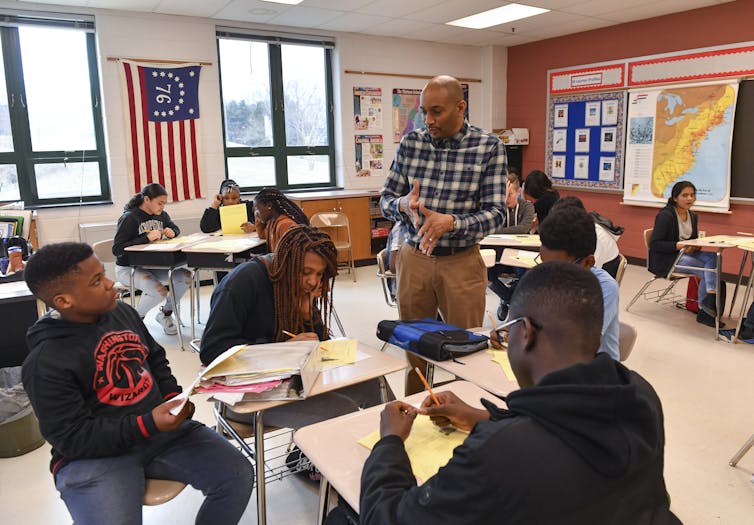
Here’s what I tell teachers about how to teach young students about slavery
This is how middle and high school teachers have told me they have felt over the past few years when it comes to teaching the troublesome topic of slavery.
Although I work with teachers in Massachusetts, their reaction to teaching about slavery is common among teachers throughout the U.S.
Fortunately, in recent years there have been a growing number of individuals who have weighed in with useful advice.
Some, such as history professors Hasan Kwame Jeffries and Kenneth Greenberg, have advocated for helping students see the ways in which enslaved people fought back against the brutality of slavery. Whether through a focus on the fight to maintain family and culture, resistance at work, running away, physical confrontation or revolt, students get a deeper understanding of slavery when the lessons include the various ways that enslaved people courageously fought against their bondage.
Heeding some of these recommendations, in my work with teachers we have sought to come up with lessons that students like Ailany Rivas, a junior at Claremont Academy in Worcester, Massachusetts, say have helped them to become “more informed and educated about the brutal history of slavery and its legacy.” These lessons that I have developed take a variety of approaches but are all rooted in taking a look at the realities of slavery using historical evidence.
Many students have echoed Ailany in feedback that I have collected from nine different classes where I have helped design lessons about slavery.
And the teachers whom I have worked with have all shared informally that they are now confident in taking on the challenge of teaching the complex history of slavery.
Much of this confidence, in my opinion, is due to four things that I believe are mandatory for any teacher who plans to deal with slavery.
1. Explore actual records
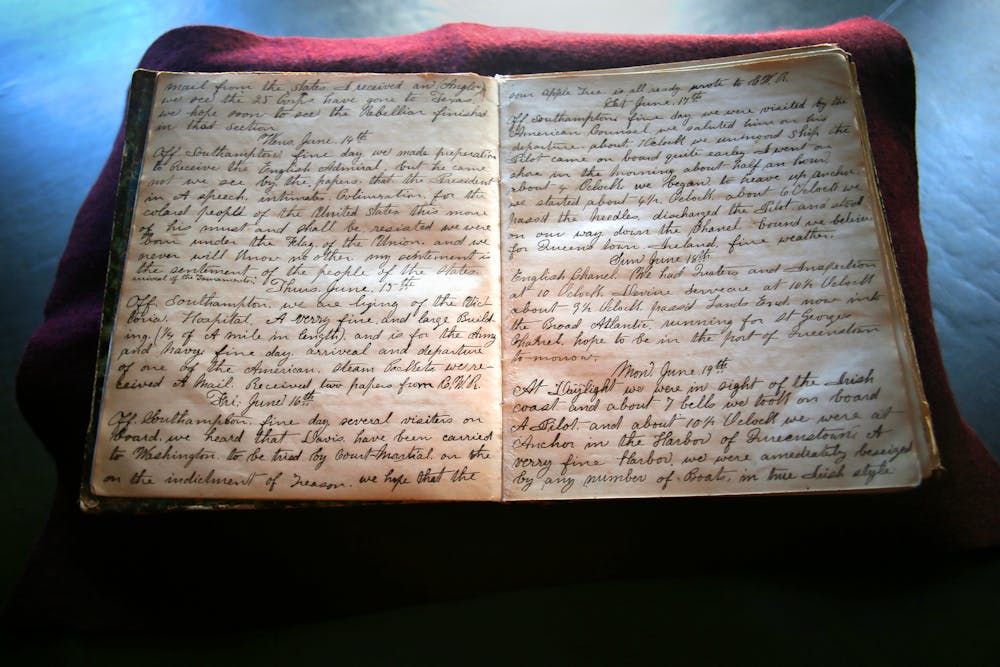
Few things shine the light on the harsh realities of slavery like historical documents. I’m talking about things such as plantation records, slave diaries and letters penned by plantation owners and their mistresses.
It also pays to examine wanted advertisements for runaway slaves. These ads provided details about those who managed to escape slavery. In some cases, the ads contain drawings of slaves.
These materials can help teachers guide students to better understand the historical context in which slavery existed. Educators may also wish to look at how people such as historian Cynthia Lynn Lyerly, who wrote a chapter in “Understanding and Teaching American Slavery,” have used historical documents to teach about slavery.
2. Examine historical arguments
In order to better understand different perspectives on slavery, it pays to examine historical arguments about how slavery developed, expanded and ended.
Students can read texts that were written by abolitionists like Frederick Douglass and pro-slavery advocates like George Fitzhugh.
They should wade through the newspaper advertisements that provided details about those who managed to escape slavery.
Looking at these different arguments will show students that history is filled with disagreement, debate and interpretations based on different goals.
For instance, in examining arguments about slavery, teachers can show students how early 20th-century historians like Ulrich Bonnell Phillips
sought to put forth ideas about kind masters and contented slaves, while others from the 1990s, such as John Hope Franklin, co-author of “Runaway Slaves: Rebels on the Plantation,” focused on how Black people resisted slavery.
Seeing these starkly different portrayals of slavery gives students a chance to examine how things such as choice, context, racism and bias might affect the way slavery is seen or viewed.
3. Highlight lived experiences
In my 11 years of teaching history, many students entered my classes with a great deal of misinformation about what life was like for those who lived under slavery. In pre-unit surveys, some stated that the enslaved worked only in the cotton fields and were not treated that badly. We know the historical records tell a different story. While many worked as field hands, there were others who were put into service as blacksmiths, carpenters, gunsmiths, maids and tailors.
To combat misconceptions like this, I advise teachers to use historical sources that feature details about the lived experiences of enslaved people.
For instance, teachers should have students read Harriet Jacobs’ memoir – “Incidents in the Life of a Slave Girl” – alongside diaries written by white plantation owners.
Ask students to examine various historical sources to gain a better understanding of how people lived through their bondage over time.
4. Consider the relevance
It is also crucial for teachers to consider the various ways in which slavery is relevant to the present with their students. I advise them to ask questions like: How has the history of slavery influenced the status of Black people in the United States today? Why are there so many movies about slavery?
We asked students to draw on what they had learned about slavery to consider and then share their perspectives about the historical accuracy, classroom appropriateness and relevance of a selected picture book. Students always have much to say about all three.
[Over 100,000 readers rely on The Conversation’s newsletter to understand the world.Sign up today.]
Teaching slavery has been and will continue to be challenging. To teachers who are asked or required to take on this challenge, the four things discussed above can serve as strong guideposts for creating lessons that should make the challenge easier to navigate.
================================================================ Alecto, Megaera, and Tisiphone, “there were others who were put into service as blacksmiths, carpenters, gunsmiths, maids and tailors.” Yeah. And artists and musicians and other fine craftspeople. If a slave could do something, an owner could find a way to exploit it. Regular viewers of Antiques Roadshow will recall episodes featuring slave-produced arts and crafts. Regular listeners of Performance Today (produced by American Public Media and often carried by NPR but can also be streamed free) will remember having heard about a piano-playing slave who toured and gave concerts, from which his master received every penny. Viewers of Finding Your Roots will have seen many a slave schedule, slave auction announcement, runaway slave advertisement, census record or inventory or probate list with no names.
The historical documents and other resources exist. Getting them into the hands of teachers and assisting them to use them effectively is another matter. May everything possible be done to make it happen.