Yesterday, I did take some time to disengageshort sessions with a couple of games just to relax. And deal with a package. And even to stream a movie (“The Canterville Ghost” with Patrick Stewart.) It’s a wonder I got both posts up.
Cartoon – (I’m pretty sure no one ever too TC up on this offer.)
Short Takes –
Here’s where election-denying candidates are running to control voting
Quote – An NPR analysis of 2022 secretary of state races across the country found at least 15 Republican candidates running who question the legitimacy of President Biden’s 2020 win, even though no evidence of widespread fraud has been uncovered about the race over the last 14 months. In fact, claims of any sort of fraud that swung the election have been explicitly refuted in state after state, including those run by Republicans. Click through for states and names. These may be the most important elections of 2022. As Beau says, “If you live in one of these dtates, and you have ever desired to get interested in electoral politics, now is your time.” (Pass it on.)
Mother Jones – The Jan. 6 Insurrectionists Begging for Pardons Sound an Awful Lot Like Confederate Soldiers
Quote – Radical Republicans feared Lincoln’s 10 percent plan was too lenient. They were proved right when, after Lincoln’s assassination, President Andrew Johnson—who not a year earlier gave a speech saying, “I am for a white man’s government, and in favor of free white qualified voters controlling this country, without regard to negroes”—began undermining Reconstruction. He started by pardoning high-ranking Confederates. Among them was Harry T. Hayes, a former Confederate general who led the rebels at Gettysburg. Click through for full story. I truly hope we can learn from their mistakes.
The Guardian – Why is so little known about the 1930s coup attempt against FDR?
Quote – The putsch called for [retired US Marine Corps Maj Gen Smedley Darlington Butler] to lead a massive army of veterans – funded by $30m from Wall Street titans and with weapons supplied by Remington Arms – to march on Washington, oust Roosevelt and the entire line of succession, and establish a fascist dictatorship backed by a private army of 500,000 former soldiers. Click through for details. Those who follow the video thread know that Beau of the Fifth Column has spoken about the United States’ long history of choosing to “protect the Office of the Presidency,” and I expect that had a hand in hiding this history, though of course the rich and powerful were also prime movers. In my view, the best way to protect the Office of the Presidency is to ensure that anyone who defules that Office is held accountable.
Glenn Kirschner – Time for the Military Leadership to Return Mike Flynn to Active Duty and Court-Martial Him (I might just add that retirees and active duty military are paid out of the same budget. I’m not saying that that [Dod] budget is not inflated – just that retireepay is a huge chunk of it, and why DoD doesn’t use that fact as a public selling point is beyond me. But it does bolster the military’s ability to recall retirees to active duty at will.))
Don Winslow – #JoeManchinsBrotherSuedHim
Robert Reich – The Oligarchy’s Ultimate Political Weapon
VoteVets – Maj.Gen.(Ret.) Paul Eaton Discusses WaPo Op-Ed & 2024 Insurrection Threat With Wolf Blitzer on CNN
Experts in autocracies have pointed out that it is, unfortunately, easy to slip into normalizing the tyrant, hence it is important to hang on to outrage. These incidents which seem to call for the efforts of the Greek Furies (Erinyes) to come and deal with them will, I hope, help with that. As a reminder, though no one really knows how many there were supposed to be, the three names we have are Alecto, Megaera, and Tisiphone. These roughly translate as “unceasing,” “grudging,” and “vengeful destruction.”
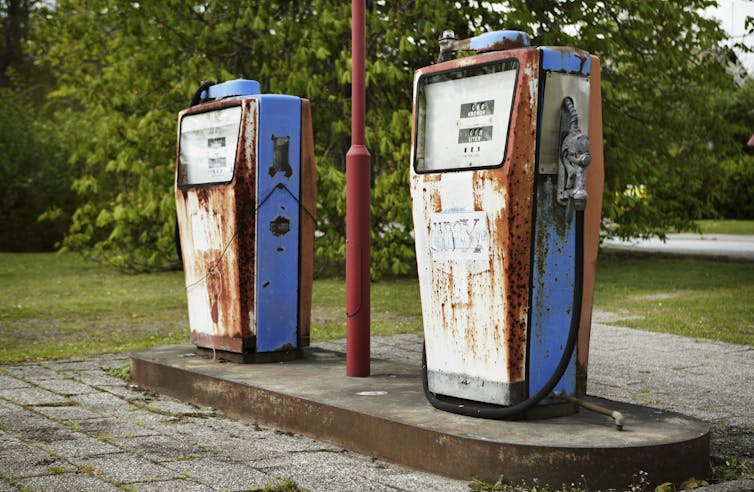
In 1929, “Ellery Queen” began “his”* mystery-novel-writing career with “The Roman Hat Mystery,” just eight years after tetrsethyl lead started to be used in fuel for automobiles. The weapon his villain used to kill his victims in this book was tetraethyl lead. The deaths were quite gruesome. If “Queen” expected the novel to draw people’s attention to the dangers of using the stuff in gasoline and having it come out of the exhaust, it didn’t work. Ethanol existed then, but could not be patented, whereas tetraethyl lead could. It was not until the 1970’s that “Unleaded” gas appeared on the market, and “regular” was available alongside it for quite a while. I don’t currently have a source for this, but I remember reading that studies sone around this time and a bit later showed a direct correlation between the amount of ethyl gas used in an area and the amount of violent crime taking place in the same area. Big corporations making big money simply do not have the best interests of their customers in mind. But we are partly to blame for not forcing them to.
================================================================
A century of tragedy: How the car and gas industry knew about the health risks of leaded fuel but sold it for 100 years anyway
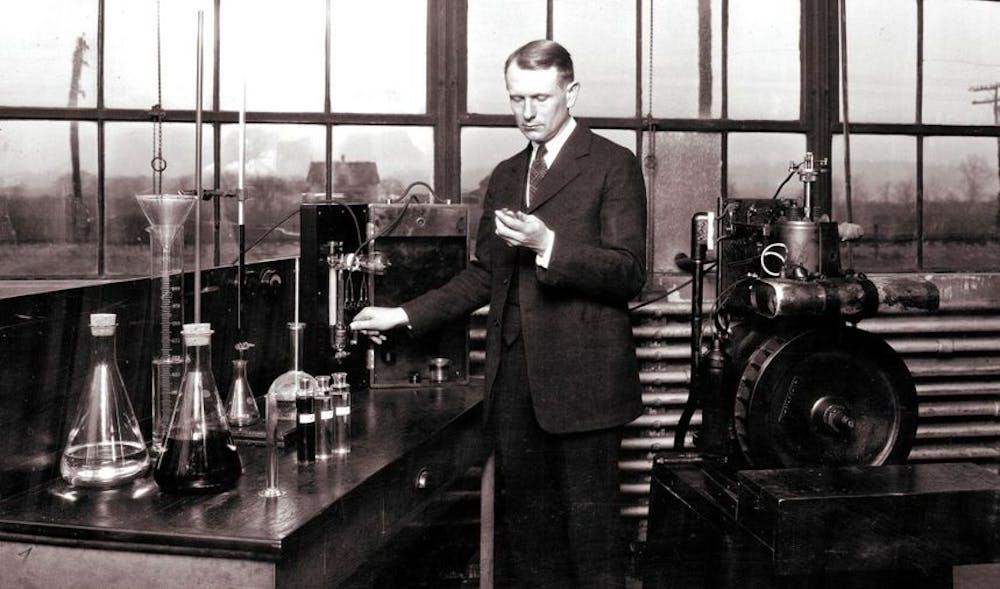
On the frosty morning of Dec. 9, 1921, in Dayton, Ohio, researchers at a General Motors lab poured a new fuel blend into one of their test engines. Immediately, the engine began running more quietly and putting out more power.
The new fuel was tetraethyl lead. With vast profits in sight – and very few public health regulations at the time – General Motors Co. rushed gasoline diluted with tetraethyl lead to market despite the known health risks of lead. They named it “Ethyl” gas.
It has been 100 years since that pivotal day in the development of leaded gasoline. As a historian of media and the environment, I see this anniversary as a time to reflect on the role of public health advocates and environmental journalists in preventing profit-driven tragedy.
Scientists working for General Motors discovered that tetraethyl lead could greatly improve the efficiency and longevity of engines in the 1920s. Courtesy of General Motors Institute
Lead and death
By the early 1920s, the hazards of lead were well known – even Charles Dickens and Benjamin Franklin had written about the dangers of lead poisoning.
When GM began selling leaded gasoline, public health experts questioned its decision. One called lead a serious menace to public health, and another called concentrated tetraethyl lead a “malicious and creeping” poison.
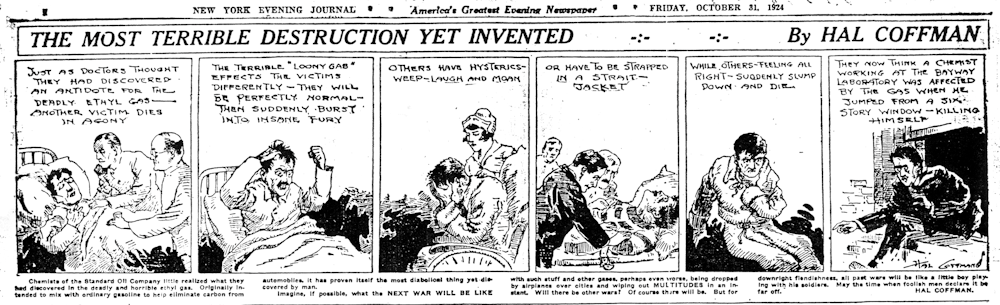
General Motors and Standard Oil waved the warnings aside until disaster struck in October 1924. Two dozen workers at a refinery in Bayway, New Jersey, came down with severe lead poisoning from a poorly designed GM process. At first they became disoriented, then burst into insane fury and collapsed into hysterical laughter. Many had to be wrestled into straitjackets. Six died, and the rest were hospitalized. Around the same time, 11 more workers died and several dozen more were disabled at similar GM and DuPont plants across the U.S.
The news media began to criticize Standard Oil and raise concerns over Ethyl gas with articles and cartoons. New York Evening Journal via The Library of Congress
Fighting the media
The auto and gas industries’ attitude toward the media was hostile from the beginning. At Standard Oil’s first press conference about the 1924 Ethyl disaster, a spokesman claimed he had no idea what had happened while advising the media that “Nothing ought to be said about this matter in the public interest.”
More facts emerged in the months after the event, and by the spring of 1925, in-depth newspaper coverage started to appear, framing the issue as public health versus industrial progress. A New York World article asked Yale University gas warfare expert Yandell Henderson and GM’s tetraethyl lead researcher Thomas Midgley whether leaded gasoline would poison people. Midgley joked about public health concerns and falsely insisted that leaded gasoline was the only way to raise fuel power. To demonstrate the negative impacts of leaded fuel, Henderson estimated that 30 tons of lead would fall in a dusty rain on New York’s Fifth Avenue every year.
Industry officials were outraged over the coverage. A GM public relations history from 1948 called the New York World’s coverage “a campaign of publicity against the public sale of gasoline containing the company’s antiknock compound.” GM also claimed that the media labeled leaded gas “loony gas” when, in fact, it was the workers themselves who named it as such.
In May 1925, the U.S. Public Health Service asked GM, Standard Oil and public health scientists to attend an open hearing on leaded gasoline in Washington. The issue, according to GM and Standard, involved refinery safety, not public health. Frank Howard of Standard Oil argued that tetraethyl lead was diluted at over 1,000 to 1 in gasoline and therefore posed no risk to the average person.
Public health scientists challenged the need for leaded gasoline. Alice Hamilton, a physician at Harvard, said, “There are thousands of things better than lead to put in gasoline.” And she was right. There were plenty of well-known alternatives at the time, and some were even patented by GM. But no one in the press knew how to find that information, and the Public Health Service, under pressure from the auto and oil industries, canceled a second day of public hearings that would have discussed safer gasoline additives like ethanol, iron carbonyl and catalytic reforming.
By 1926, the Public Health Service announced that they had “no good reason” to prohibit leaded gasoline, even though internal memos complained that their research was “half baked.”
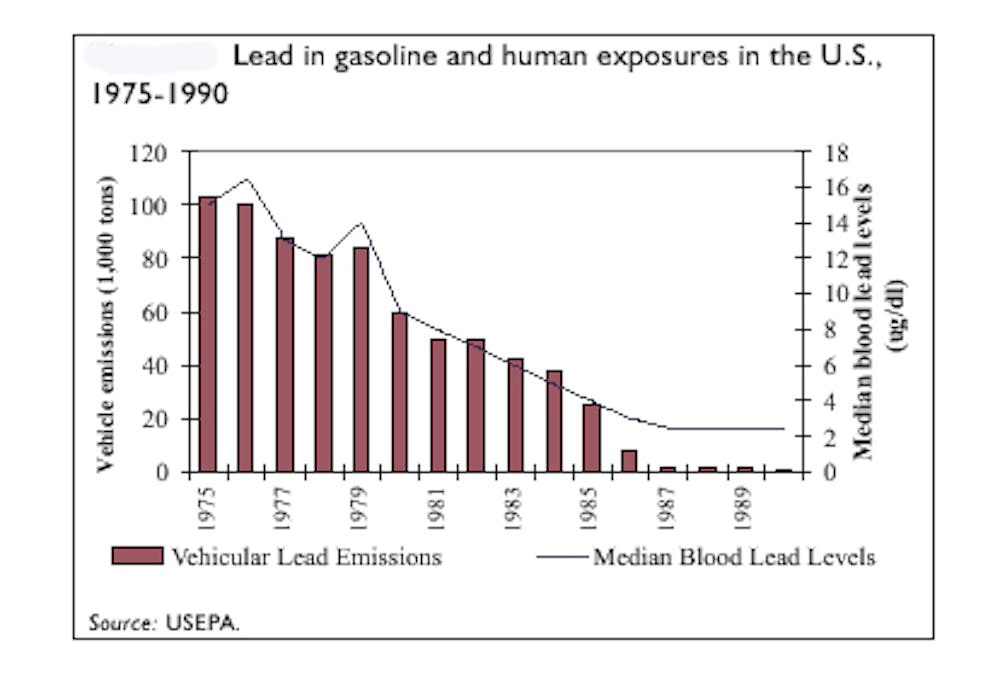
As leaded gasoline fell out of use, lead levels in people’s blood fell as well. U.S. EPA
In the 1960s and 1970s, the public health case against leaded gasoline reemerged. A California Institute of Technology geochemist, Clair Cameron Patterson, was finding it difficult to measure lead isotopes in his laboratory because lead from gasoline was everywhere and his samples were constantly being contaminated. Patterson created the first “clean room” to carry on his isotope work, but he also published a 1965 paper, “Contaminated and Natural Lead Environments of Man,” and said that “the average resident of the U.S. is being subjected to severe chronic lead insult.”
In parallel, by the 1970s, the U.S. Environmental Protection Agency decided that leaded gasoline had to be phased out eventually because it clogged catalytic converters on cars and led to more air pollution. Leaded gasoline manufacturers objected, but the objections were overruled by an appeals court.
The public health concerns continued to build in the 1970s and 1980s when University of Pittsburgh pediatrician Herbert Needleman ran studies linking high levels of lead in children with low IQ and other developmental problems. Both Patterson and Needleman faced strong partisan attacks from the lead industry, which claimed that their research was fraudulent.
Both were eventually vindicated when, in 1996, the U.S. officially banned the sale of leaded gasoline for public health reasons. Europe was next in the 2000s, followed by developing nations after that. In August 2021, the last country in the world to sell leaded gas, Algeria, banned it.
A century of leaded gasoline has taken millions of lives and to this day leaves the soil in many cities from New Orleans to London toxic.
The leaded gasoline story provides a practical example of how industry’s profit-driven decisions – when unsuccessfully challenged and regulated – can cause serious and long-term harm. It takes individual public health leaders and strong media coverage of health and environmental issues to counter these risks.
================================================================ Alecto, Megaera, and Tisiphone, as a race, we humans are not terribly good at doing what is best for us. Up until the 1920’s, for instance, arsenic was still used in skin lotions. And before that it was white lead (lead carbonate), which still shows up in some paints and some ceramics. People did not want to give them up. Women did not want to give their cosmetics up. I’m not old enought o remember the pushback on arsenic or white lead, but I am definitely old enough to remember the pushback on unleaded gas. If people are so terrified of change that they become violently opposed to giving up poisons, I guess we shouldn’t be surprised at the lengths they will go to in order not to take a vaccine. Well, give us long enough and we will make ourselves extinct – and maybe more sensible creatures will evolve to take our place.
The Furies and I will be back.
*”Ellery Queen” was actually two dudes, Frederic Dannay and Manfred B. Lee – hence the two cross strokes in the “Q” on the book titles, at least the early ones. There’s no unicode for it so I can’t use it here.)
Glenn Kirschner – House Postpones Flynn & Luna Testimony; Flynn Should be Returned to Active Duty and Court-Martialed (I’ll bet Miles Taylor could tell us what a “body man”s duties were – and I’ll bet it had something to do with adult diapers.)
The Lincoln Project – Pearl Harbor Rememberance Day
CNN – Meadows SPOOKED, Subpoena Coming Next? (If he thought he could “make a deal,” he has no idea who the committe members are.)
RepresentUs – This Is What Corporate Welfare Looks Like
politicsrus – Democracy Is Hard Earned
Six13 a capella – West Side Chanukah Story (I really do think Lenny must be smiling down. BTW you can close it when they start talking – pitching – at the end.)
Glenn Kirschner – Federal Judges Say Trump is Responsible for Directing his “Pawns” on Jan. 6; Reject Bannon Delay
Reuters – Biden ‘knew he was making history’ with Harris as VP: WH
Thom Hartmann – Why Getting Pregnant Increases Your Chance of Being Murdered By 16% (No, Thom, it’s not amazing. Horrifying, yes. Amazing, not so much.)
MSNBC – Why Biden’s Build Back Better Bill Won’t Add To Inflation
Rescued Goose, Mini Horse Are Inseparable — Watch Them Get Adopted Together
Beau – Let’s talk about CRT and thanksgiving dinner….
Experts in autocracies have pointed out that it is, unfortunately, easy to slip into normalizing the tyrant, hence it is important to hang on to outrage. These incidents which seem to call for the efforts of the Greek Furies (Erinyes) to come and deal with them will, I hope, help with that. As a reminder, though no one really knows how many there were supposed to be, the three names we have are Alecto, Megaera, and Tisiphone. These roughly translate as “unceasing,” “grudging,” and “vengeful destruction.”
I am not a professional historian, or even all that much of an amateir one, but I have, over the years, picked up bits and pieces. And I’m pretty sure there was a time in England – probably before the Civil War (theirs, not ours), when being “armigerous” was absolutely connected to a title or deed of nobility – that if you were a knight, or a baron (viscount,earl, marquis, or duke – or a royal), you had the right to “bear arms” in public – and if you weren’t, you didn’t. I actually hope the “originalists” on the bench never get hold of this. Because if they wanted to argue that the point of the Bill of Rights was to give everyone rights (including those rights only the nobility previously had), I for one could certainly not argue against that.
================================================================
Why are medieval weapons laws at the center of a US Supreme Court case?
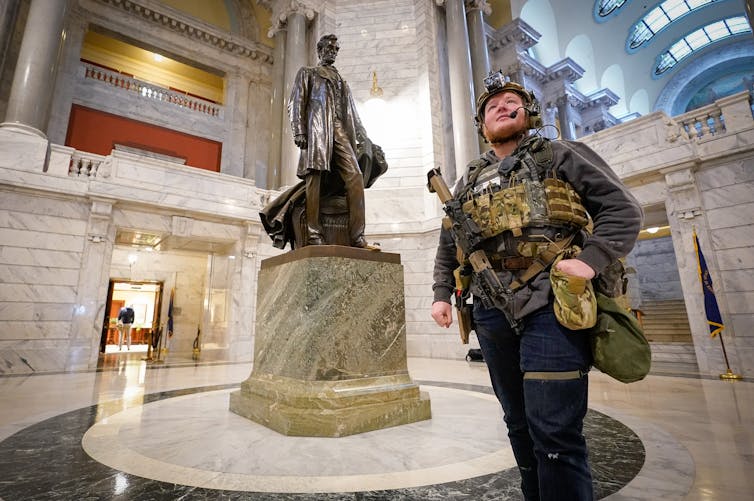
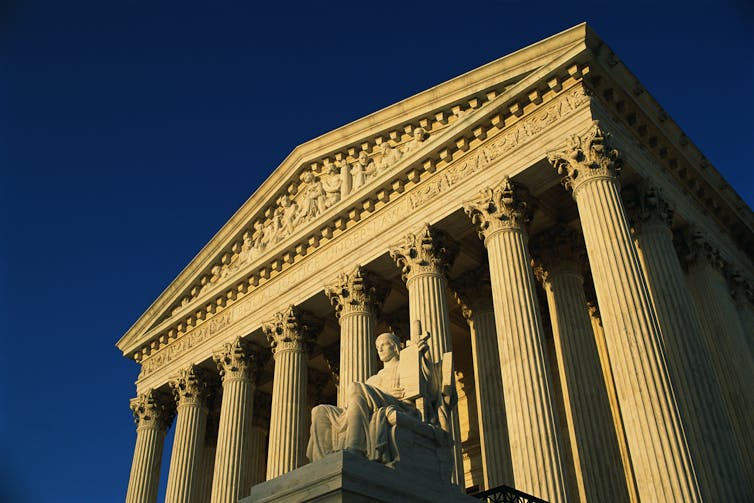
A gun rights advocate walks through the rotunda of the Kentucky Capitol. Some lawyers argue that the 1689 English Bill of Rights created the legal basis for public carry of weapons in the U.S. Bryan Woolston/Getty Images
In the opening scene of “The Last Duel,” the new film set in 14th-century France, a herald announces the rules for conduct at a tournament to the death. He declares that no members of the public – whatever their social background – are allowed to bring weapons to the event.
This scene might seem far removed from 21st-century America. But medieval weapons laws – including a 1328 English statute prohibiting the public carry of edged weapons without royal permission – are at the center of dueling legal opinions in a case now before the U.S. Supreme Court, New York State Rifle and Pistol Association v. Bruen.
The plaintiffs are challenging New York’s “proper cause” gun law, which tightly restricts public carry of firearms. If they win, similar laws in several other states will be called into question. That means that concealed carry licensing laws could be broadly liberalized for millions of Americans currently living in those more restrictive jurisdictions.
The book explores how courts in the United States have turned to history for instruction in how guns should be treated – decrees, laws and interpretations of the past that are at the forefront of the case before the Supreme Court today.
Scalia points to the English Bill of Rights
The United States legal system grew out of the English legal tradition. This connection – which is often referenced by originalists – is crucial to making sense of the arguments around gun rights in America today.
Originalism is a legal philosophy that attempts to interpret legal texts, including the Constitution, based on what lawyers think is their original meaning.
An important victory for gun rights advocates took place in District of Columbia v. Heller. In that 2008 decision, the Supreme Court for the first time ruled that the Second Amendment protects an individual right to possess a firearm for personal self-defense in the home.
New York State Rifle and Pistol Association v. Bruen is the most significant gun rights case before the Supreme Court since 2008. Ron Watts/The Image Bank via Getty Images
Justice Antonin Scalia, author of the 5-4 majority Heller opinion, claimed that there was a long tradition of the English state’s granting freedom to possess weapons dating back to the 1689 English Bill of Rights, which includes a clause that reads “the subjects which are Protestant may have arms for their defence suitable to their conditions and as allowed by law.”
Scalia’s argument relied heavily on the work of historian Joyce Malcolm, the author of “To Keep and Bear Arms: The Origins of an Anglo-American Right” and a Second Amendment scholar at the Antonin Scalia Law School at George Mason University. Malcolm and lawyers who support the expansion of gun rights argue that this clause created the legal basis for having weapons for personal self-defense in Colonial America.
Having prevailed in Heller, gun rights activists are seeking the liberalization of restrictions on public carrying of guns outside the home. In the New York case, some lawyers and other parties are now arguing that medieval statutes restricted only public carry that “terrified” the public, and that such statutes were never actually enforced to prevent “normal” public carry.
Historians object
However, most scholars of English and American history vigorously dispute the accuracy of this claim. In fact, since the Heller decision, the history of firearms regulation in England and the U.S. has been the focus of what Fordham University law professor Saul Cornell has called an “explosion of empirical research.”
Many of these findings appear in an amicus brief presented to the Court in New York State Rifle and Pistol Association v. Bruen.
Signed by 17 professors of law, English history and American history – including me – the brief demonstrates through a review of historical evidence that “neither English nor American history supports a broad Second Amendment right to carry firearms or other dangerous weapons in public based on a generic interest in self-defense.”
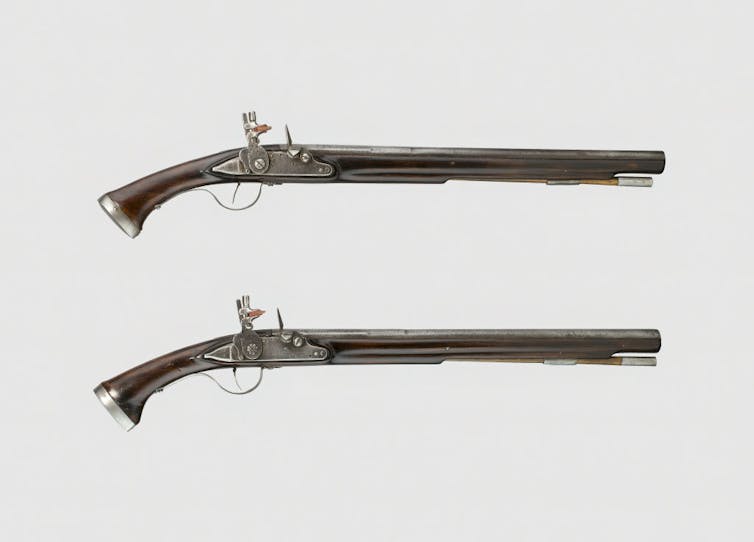
Early royal proclamations dating as far back as the 13th century regularly prohibited going armed in public without special permission. In 1328, the Statute of Northampton banned the public carry of swords and daggers, open or concealed – this was before the invention of firearms – without express permission from the authorities.
As legal scholar and historian Geoffrey Robertson, an expert on the English Bill of Rights, put it: “There was never any absolute ‘right’ to carry guns. As the Bill of Rights (1689) made clear, this was only ‘as allowed by law.’”
The English tradition of broad public carry restrictions continued across the Atlantic into the Colonies.
During periods of heightened risk of attack, some Colonies required certain individuals to carry guns to church or when working in fields away from fortified or populated areas. However, this obligation was not understood as establishing a right to carry firearms in public.
After the American Revolution, states continued to adopt regulations echoing the Statute of Northampton. Recent scholarship has uncovered that early-to-mid-19th-century firearms regulations varied considerably by jurisdiction and geography, but 19 states had restrictions for public carry on the books.
By 1900, there was a legal consensus that states and localities generally had the authority to limit public carry. While the American approach to public carry restriction was fluid – varying across time and jurisdiction based on social and political changes – there is a consistent history and tradition of many American Colonies, states, territories and municipalities imposing broad prohibitions on carrying dangerous weapons in public, particularly without a specific need for self-defense.
An invented tradition?
So how did a 1689 English Bill of Rights that never gave any absolute right to carry guns turn into a key justification for that very right in the U.S.?
[Over 115,000 readers rely on The Conversation’s newsletter to understand the world.Sign up today.]
“Invented traditions,” a concept highlighted in the 1983 book “The Invention of Tradition,” which was edited by historians Eric Hobsbawm and Terence Ranger, are cultural practices that are thought to have emerged from long ago but actually are grounded in a much more recent past. A classic example is the Scottish tartan kilt, once believed to derive from the ancient garb of the Scottish Highlanders but actually invented in the 18th century by an Englishman.
================================================================ Alecto, Megaera, and Tisiphone, fortunately, the history is far more complicated than my picked-up bits and pieces would suggest. Even so, I personally would want to pay more attention to the beliefs of (now long retired) Justice Stevens, I believe it was, who recommended that the Second Amendment be abolished on account of the enormous increase in destructiveness of weapons developed since the Amendment was written. Of course, I don’t see that ever happening. But then, I don’t see universal love for each other ever happening either, and that doesn’t prevent me from supporting it.
Glenn Kirschner – Email From Trump Team Lawyer John Eastman Further Proves Conspiracy to Overturn Election Results
Thom Hartmann – Why FDR Didn’t Expose The Business Man Coup SUCH a difference between Butler and Flynn!
Ring of Fire – Fox Host Gets Death Threats After Encouraging Audience To Get Vaccinated
Rebel HQ – Greg Abbott Reveals His Sick & Twisted Plan For Immigrants (Watch sitting down so you don’t get dizzy from the spin.)
Armageddon Update – They Aren’t Victims, They’re DEAD!
Yes, this is a commercial for Doritos – and yes, it has people grabbing hankies.
Nunca Es Tarde Para Ser Quien Eres (It’s never too late to be who you are)
VERY rough transcript translation: Grandma – My brother, how I miss you!
Family – gasps in surprise to see Albert
Albert – My family, how are you doing?
Father – Who is he?
Albert – He is Mario – my wunderful partner.
Grandma – It’s a miracle! I was afraid you would be alone forever!
Beau – Let’s talk about a Sputnik moment and it not being one….