Yesterday, the opera house was dark. Not because anything newsworthy happend, but as part of a scheduled five week winter break The radio broadcast was a program of arias and duets recorded from Mat broadcasts during the period 1931-1941. No, the sound quality wasn’t what it is today, but compared to old 78 records, it was superb. The greatest stars of that decade were all retired (or dead) by the time I came to opera – and the greatest stars when I came to opera are all retired or dead now. Of course the same is true of theater and movies. Think “Little Caesar” (1931), “King Kong” (1933), “Camille” (1936), and 1939 with “Goodbye Mr. Chips,” “Gone with the Wind,” and “Thw Wizard of Oz” all in the same year. Remembering history may not be quite as important in the arts as it is in politics, but it doesn’t hurt either.
Also yesterday, I finished cleaning out TomCat’s Inbox … and also the “Sent” folder, the only other one which had anything in it except for the “Archive”, which is where I ave been putting any emails with information on accounts on other sites, or subscriptions, or any friends we may not have been aware of. That will be slower.
Cartoon –
Short Takes –
Letters from an American – February 4, 2022
Quote: For a long time, the idea that that economy thrives when the government supports ordinary Americans was not controversial. Democrats began to make it the centerpiece of our system in the 1930s when, after a decade in which the government worked only for the wealthy, they offered a “New Deal” for the American people. Over time, lawmakers from both major parties embraced it, believing they had finally figured out a truly American system that would serve everyone…. But in the 1980s, Republicans argued that this system stifled economic development by hampering the ability of producers to put their money where they thought it would do the most good. Instead of supporting workers, they argued, government should cut taxes to enable those at the top of the economic ladder to accumulate capital and invest in the economy. Tax cuts became their go-to solution for any sort of economic crisis. The government should support the “supply side” of the economy. Any attempt to use the government to help the “demand side” was, they said, “socialism.” Click through for the full article. The problem is that seeing is NOT believing. Messaging is believing, and the false econimic message has been so powerful that even overwhelming evidence has not been able to dislodge it.
HuffPost – Unexpectedly Strong Jobs Report Caps A Better Week For Joe Biden
Quote – This week’s good breaks: the strong jobs report (which came with corrections making the past two jobs reports look far better than they did at the time), bipartisan backing for his strategy to counter Russia, a small step toward passage of a bipartisan economic package designed to counter China and a successful operation to assassinate a terrorist leader. Click through for further discussion. This is very much tied in to the previous short take. Messaging is still the biggest problem.
Axios – HBCU presidents: Black history lessons are being “stifled”
Quote – What they’re saying: Some educators also want to reduce the focus on the usual high-profile figures. [Howard University president Wayne] Frederick told Axios that Black history lessons should include education about everyday Black heroes throughout the years — not just a handful of iconic Black figures. The lessons should include “men and women who’ve had the African American experience and who’ve done amazing things,” he said, pointing to the late Dr. LaSalle Leffall Jr. — the first Black president of the American Cancer Society. Click through for a helping of truth. What president Frederick says has also occurred to me – and I may just feature some invisible Black people in fields I happen to know about. Anyone who is aware of invisible black people in fields I don’tknow much about is welcome to send me suggestions.
Yesterday, I got TC’s old emails down to just over 3,000, which brought me to mid-July. I’m sure I won’t be doing almost 2000 everyday, but I decided I wanted to be more than half done.
Cartoon –
Short Takes –
NM Political Report – Luján recovering after stroke, surgery
Quote – The statement from Carlos Sanchez, Luján’s chief of staff, said the 49-year-old senator experienced dizziness and fatigue Thursday morning and checked himself into Christus St. Vincent Regional Hospital in Santa Fe. It was there that medical staff determined he had a stroke in his cerebellum, which affected his balance. Click through for details. Why is this important? Because we can’t hold a comfirmation vote for SCOTUS without him. Thankfully he is smart, and checked himself in.
Crooks and Liars – Texas Parent Demands School District Ban Michelle Obama’s Book
Quote – “Another parent in Katy, a Houston suburb, asked the district to remove a children’s biography of Michelle Obama, arguing that it promotes “reverse racism” against white people, according to the records obtained by NBC News,” the report said. Click through. It’s not very long. You can’t make this stuff up. (Kafka, Sartre, Beckett, Ionesco actually tried … and could not reach this level.)
The Nib – The Myth of the Strong Black Woman
Quote – But what about the issue we do not talk about enough: How the reality of being a black woman in America can wear away at even the most resilient and privileged of us? A few months ago, amidst struggling with my own depression and anxiety, I learned of three well-known black women who died by suicide in the past year. Click through for article, including hard numbers. As “Maus” has shown (in case anyone had missed it), material presented graphically can have an impact as strong as, maybe even stronger than,mor conventional writing.
Food For Thought:
And Ruth Bader Ginsburg’s dream. Considering the fact that our three-branck govermnet was inspired by the Haudenosaunee Confederacy governmen (whose equivalemt to our judicial branch comprised the respected elder woman of the tribes), I believe it would be extremely appropriate.
Yesterday, I got rid of another thousand emails from TC’s PP Email. Only about 5000 to go. It got me back to the end of August last year. Also, I note that February is Black History Month, and while I don’t plan on ignoring all other news, I will be trying to include at least one Black History story in the Open Thread every day. Incidentally, the Met Opera put up a video which I expected to be like a trailer – but turned out to be just about an hour, featuring full arias and scenes from complete productions, performed by singers from as well known as Leontyne Price down to as little known as Ryan Speedo Green – and completely unrestricted. Incidentally, if you are ever looking for an impressinve story of overcoming obstacles, google “Ryan Speedo Green”
Cartoon –
Short Takes –
Huff Post – Bomb Threats Reported At Historically Black Colleges For Second Day
Quote – For the second day in a row, historically Black colleges and universities (HBCUs) were the target of bomb threats across the country, with this latest wave coming on the first day of Black History Month. Campuses were shut down and classes moved to remote learning following the threats impacting more than a dozen schools as of Tuesday morning. Click through for details. This is what American Naziism looks like. I got back to my inbox and saw this just after streaming the hour of operatic black history I mentioned in the intro. What a letdown. But not nearly so much for me as for students whose education is being threatened.
The 19th – The 19th Explains: Biden prepares to nominate a Black woman to the Supreme Court. What’s next?
Quote – There’s a lot we don’t know: who Biden’s choice will be, the speed at which this whole process will work, or what questions will emerge as senators consider the nomination. But we do know this Supreme Court confirmation will largely work the same as others. Here’s a guide on what to expect and what we’ll be looking at for potential nominees and the months ahead. Click through. If I had to name a group with no lawyers and no politicians which didn’t need this explanation, the readers ot Politics Plus would be that group. But it could come in handy to share with others who are less attentive. Also, it has bckground on some names being floated.
Today is Twos-day (although we have an even bigger one coming on the 22nd.) Yesterday, I got the emails in TC’s PP email inbox down below 6000, which took me back into mid-November. I can only delete 23 at a time max, and skipping isn’t possible, so it’s not as fast as it could be … but I do think I can do up to a thousand a day most days. Fortunately, out of that over-a-thousand I kept less than 20, and 6 of those are backups. So it isn’t requiring too much thought.
Cartoon –
Short Takes –
Mother Jones – School Boards Have Long Been a Tool of White Supremacy
Quote – This is the “local control” that Gov. Parson favors, where a “select” group is given legal authority to rebuke the evils they are convinced critical race theory will impart on white society. Throughout history, the “unpardonable sin” of educators moving toward racial progress without white consent has been atoned for in the same way: disgruntled white people band together on a school board or committee to erase unwanted Black people, texts, and consciousness. Click through for history and background. Mother Jones also has an article on the Tennessee meeting at which “Maus” was banned. And a recent Antiaues Roadshow featured a collector whp is cllecting the books which belonged to Prudence Crandall, just to keep her memory alive. The segment starts at 35:22 and it’s only a few minutes.
NM Political Report – Bill would prosecute parents for allowing kids access to guns
Quote – The Bennie Hargrove Gun Safety Act, named after the student killed in the shooting at his downtown Albuquerque school, would make it illegal for a gun owner to allow a minor unauthorized access to their weapon. The proposed law doesn’t specify how a gun should be stored but says gun owners could be fined $1,000 for storing a weapon in such a way that would allow a minor to gain unauthorized access. If the child used the weapon to commit a crime, the owner could also be found guilty of a misdemeanor punishable by up to a year in jail. Click through for story. It sounds more than reasonable to me. I hope it passes.
About Dr. Yadira Caraveo
Quote from Katie Porter – “I know that Dr. Yadira Caraveo is the best candidate to represent Colorado’s new 8th Congressional District. As a pediatrician, a former union representative, and a two-term state legislator, Dr. Caraveo is a trusted leader and a true reformer. In Congress, Dr. Caraveo will be a strong fighter for families and a critical voice to protect the future of our democracy.” Click through to Caraveo’s personal info page. Unfortunately I do not live in the 8th District, which is in/around Adams County. But I wish her the best. Anyone supported by Katie Porter has my support too.
Experts in autocracies have pointed out that it is, unfortunately, easy to slip into normalizing the tyrant, hence it is important to hang on to outrage. These incidents which seem to call for the efforts of the Greek Furies (Erinyes) to come and deal with them will, I hope, help with that. As a reminder, though no one really knows how many there were supposed to be, the three names we have are Alecto, Megaera, and Tisiphone. These roughly translate as “unceasing,” “grudging,” and “vengeful destruction.”
Science. Science deniers. This is not new. The two kinds of people have existed side by side for literally thousands of years. Taking one fact as an example, consider the “flat earth.” Scientests have known the earth ws not flat, but instead a more of less spherical shape, as early as the 5th century B.C.E. I say scientists have known, not that everyone has known. Galileo ws threatened with excommunication and improsonment as recently as the 1600s C.E. for suggesting that the earth mpved around the sun. (Yet 200 years earlier, Dante’s Inferno/ Purgatorio/ Paradiso was based on the premise of a spherical earth, through which he descended to the lowest levels of Hell at the center (he did get the temperature wrong – he pictured it as frozen – he wasn’t a scientist himself, but he must have listened to some) and then ascended through the levels of purgatory to come out into paradise on the other side. Today most people have grasped at least the concept of the solar system, and yet some still have not, and consider th earth to be flat.
Medical advances have a bad name in some circles because testing advances can be problematic. Of course no one would consider trying an idea on humans before doing animal testing, which brings up the question of how do you get informed consent from a frog? There might be a way, but we certainly don’t know what it is.
But I really find it exciting what this particular group of scientests is trying to do – and I have to believe that TC also would be excited – peersonally. Of course they are not going to get results usable by humans in my lifetime – nor in the lifetime of anyone here – and, discouraging as it is I have to wonder if the human race itself will last long enough to get results usable by humans.
But it’s still exciting.
================================================================
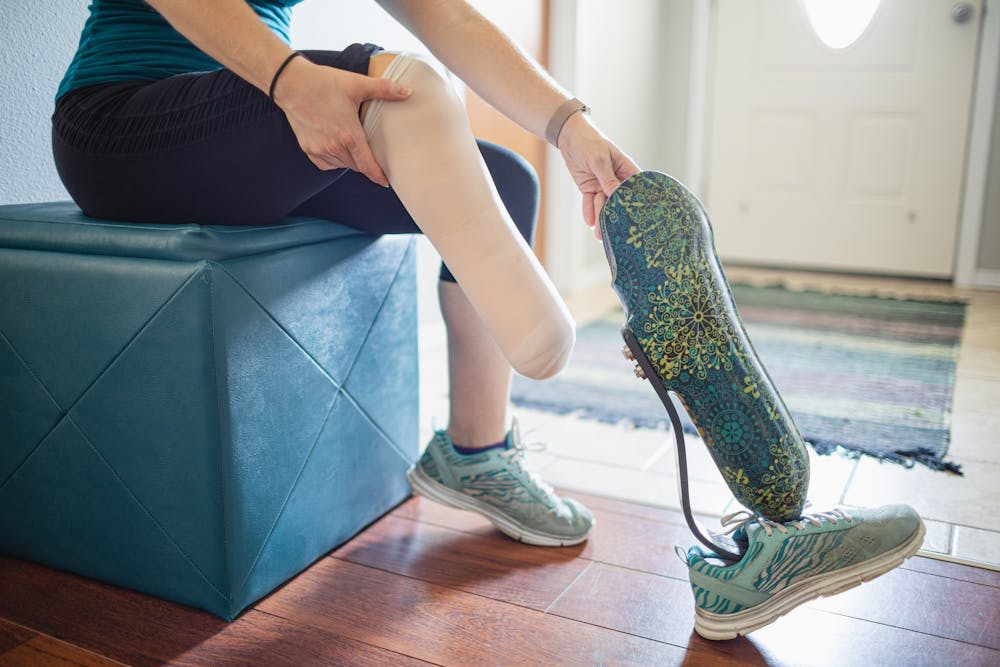
A new treatment helped frogs regenerate their amputated legs – taking science one step closer to helping people regrow their body parts, too
Our bodies connect us to the world. When people lose parts of their bodies to disease or traumatic injury, they often feel that they’ve lost a part of who they are, even experiencing a grief akin to losing a loved one. Their sense of personal loss is justified because unlike salamanders or snarky comic book characters like Deadpool, adult human tissues generally do not regenerate – limb loss is permanent and irreversible.
Or is it?
While there have been significant advances in prosthetic and bionic technologies to replace lost limbs, they cannot yet restore a sense of touch, minimize the sensation of phantom pains or match the capabilities of natural limbs. Without reconstructing the limb itself, a person won’t be able to feel the touch of a loved one or the warmth of the sun.
During very early development, cells that will eventually become limbs and organs arrange themselves into precise anatomical structures using a set of chemical, biomechanical and electrical signals. In considering ways to regenerate limbs, we reasoned that it would be much easier to ask cells to repeat what they already did during early development. So we looked for ways to trigger the “build whatever normally was here” signal for cells at the site of a wound.
One of the major challenges in doing this, however, is figuring out how to create an environment that encourages the body to regenerate instead of forming scars. While scars help protect injured tissue from further damage, they also change the cellular environment in ways that prevent regeneration.
Axolotls are known for their powerful regenerative abilities.
Some aquatic animals such as the axolotl have mastered regeneration without scar formation. And even in early human development, the amniotic sac provides an environment that can facilitate regenerative mechanisms. We hypothesized that developing a similar environment could override scar formation at the time of injury and allow the body to reactivate dormant regenerative signals.
To implement this idea, we developed a wearable device made of a silk hydrogel as a way to create an isolated chamber for regeneration by blocking other signals that would direct the body to develop scars or undergo other processes. We then loaded the device with a cocktail of five drugs involved in normal animal development and tissue growth.
We chose to test the device using African clawed frogs, a species commonly used in animal research which, like humans, does not regenerate limbs in adulthood. We attached the device onto one leg stump for 24 hours. We then removed the device and observed how the site of the lost limb changed over time. Over the course of 18 months, we were amazed to find that the frogs were able to regenerate their legs, including fingerlike projections with significant nerve, bone and blood vessel regrowth. The limbs also responded to light pressure, meaning that they had a restored sense of touch, and allowed the frog to return to normal swimming behavior.
Frogs that were given the device but without the drug cocktail had limited limb regrowth without much functional restoration. And frogs that weren’t treated with the device or the drug cocktail did not regrow their limbs, leaving stumps that were insensitive to touch and functionally impaired.
Interestingly, the limbs of the frogs treated with the device and the drug cocktail weren’t perfectly reconstructed. For example, bones were sometimes fragmented. However, the incompleteness of the new limb tells us that other key molecular signals may be missing, and many aspects of the treatment can still be optimized. Once we identify these signals, adding them to the drug treatment could potentially fully reverse limb loss in the future.
Traumatic injury is one of the leading causes of death and disability in Americans. And limb loss from severe injury is the most frequent source of lifelong disability. These traumatic injuries are often caused by automobile accidents, athletic injury, side effects of metabolic diseases such as diabetes and even battlefield injuries.
[Over 140,000 readers rely on The Conversation’s newsletters to understand the world.Sign up today.]
The possibility of decoding and awakening dormant signals that enable the body to regenerate parts of itself is a transformative frontier in medical science. Beyond regrowing lost limbs, regenerating heart tissue after a heart attack or brain tissue after a stroke could extend life and dramatically increase its quality. Our treatment is far from being ready to use in humans, and we only know that it works when applied immediately after injury. But uncovering and understanding the signals that allow cells to regenerate means that patients may not have to wait for scientists to really understand all the intricacies of how complex organs are constructed before they can get treated.
Making a person whole again means more than just replacing their limb. It also means restoring their sense of touch and ability to function. New approaches in regenerative medicine are now beginning to identify how that may be possible.
================================================================ Alecto, Megaera, and Tisiphone, perhaps unleashing your fury on the science deniers – even if only those in denial cults who are destroying science and truth for the rest of us – that might help. I don’t know what else could.
Glenn Kirschner – NY Subpoenas, GA Special Grand Jury Subpoenas, Congressional Subpoenas: All Subpoenas Are Not Equal
The Guardian – Tonga: new footage shows aftermath of volcano eruption and tsunami
Meidas Touch – A Coup in Plain Sight
The Lincoln Project – What Are They For?
The Ring of Fire – January 6th Committee Targets Social Media Companies With Subpoenas
MSNBC’s Tiffany Cross explains Mitch McConnell –
In this week’s essay, @TiffanyDCross discusses Mitch McConnell’s message to voters of color who were concerned that they wouldn’t be able to vote during this year’s midterm elections #CrossConnectionpic.twitter.com/HKV9Sjtuhy
— The Cross Connection with Tiffany Cross (@CrossConnection) January 22, 2022
Beau – Let’s talk about executive orders, doubt, and machinery….