Everyday Erinyes #275

 Posted by at 12:10 am  Politics
Jul 182021
 

Experts in autocracies have pointed out that it is, unfortunately, easy to slip into normalizing the tyrant, hence it is important to hang on to outrage. These incidents which seem to call for the efforts of the Greek Furies (Erinyes) to come and deal with them will, I hope, help with that. As a reminder, though no one really knows how many there were supposed to be, the three names we have are Alecto, Megaera, and Tisiphone. These roughly translate as “unceasing,” “grudging,” and “vengeful destruction.”

I had bookmarked an article on critical race theory as a possible source for the Furies, but on looking at it more closely, I found it too vague and generalized to be very effective – and, really, that’s as it should be. Critical race theory was designed to be studied in law school, after having completed a regular bachelor’s degree and pre-law, and while in pursuit of a Doctorate of Jurisprudence. It shouldn’t be possible to boil it down or make it crystal clear in a single short article. So I turned instead to the following article, which does address how children, including young children, can learn the darker sides of our actual history.
================================================================

Here’s what I tell teachers about how to teach young students about slavery
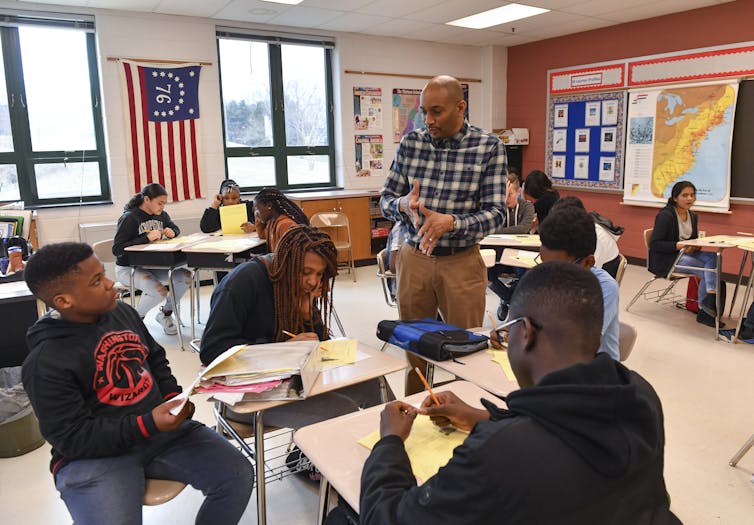
U.S. teachers often struggle to depict the realities of slavery in America.
Ricky Carioti/The Washington Post via Getty Images

Raphael E. Rogers, Clark University

Nervous. Concerned. Worried. Wary. Unprepared.

This is how middle and high school teachers have told me they have felt over the past few years when it comes to teaching the troublesome topic of slavery.

Although I work with teachers in Massachusetts, their reaction to teaching about slavery is common among teachers throughout the U.S.

Fortunately, in recent years there have been a growing number of individuals who have weighed in with useful advice.

Some, such as history professors Hasan Kwame Jeffries and Kenneth Greenberg, have advocated for helping students see the ways in which enslaved people fought back against the brutality of slavery. Whether through a focus on the fight to maintain family and culture, resistance at work, running away, physical confrontation or revolt, students get a deeper understanding of slavery when the lessons include the various ways that enslaved people courageously fought against their bondage.

Others, like James W. Loewen, the author of the popular book “Lies My Teacher Told Me,” have argued for a focus on how slavery has deeply influenced our popular culture through movies, television series, historical fiction and music.

There are also those who recommend the use of specific resources and curriculum materials, like the Harriet Jacobs Papers Project, the four-part documentary series “Africans in America” and the Freedom on the Move database, which features thousands of runaway slave advertisements.

Heeding some of these recommendations, in my work with teachers we have sought to come up with lessons that students like Ailany Rivas, a junior at Claremont Academy in Worcester, Massachusetts, say have helped them to become “more informed and educated about the brutal history of slavery and its legacy.” These lessons that I have developed take a variety of approaches but are all rooted in taking a look at the realities of slavery using historical evidence.

Many students have echoed Ailany in feedback that I have collected from nine different classes where I have helped design lessons about slavery.

And the teachers whom I have worked with have all shared informally that they are now confident in taking on the challenge of teaching the complex history of slavery.

Much of this confidence, in my opinion, is due to four things that I believe are mandatory for any teacher who plans to deal with slavery.

1. Explore actual records

Few things shine the light on the harsh realities of slavery like historical documents. I’m talking about things such as plantation records, slave diaries and letters penned by plantation owners and their mistresses.
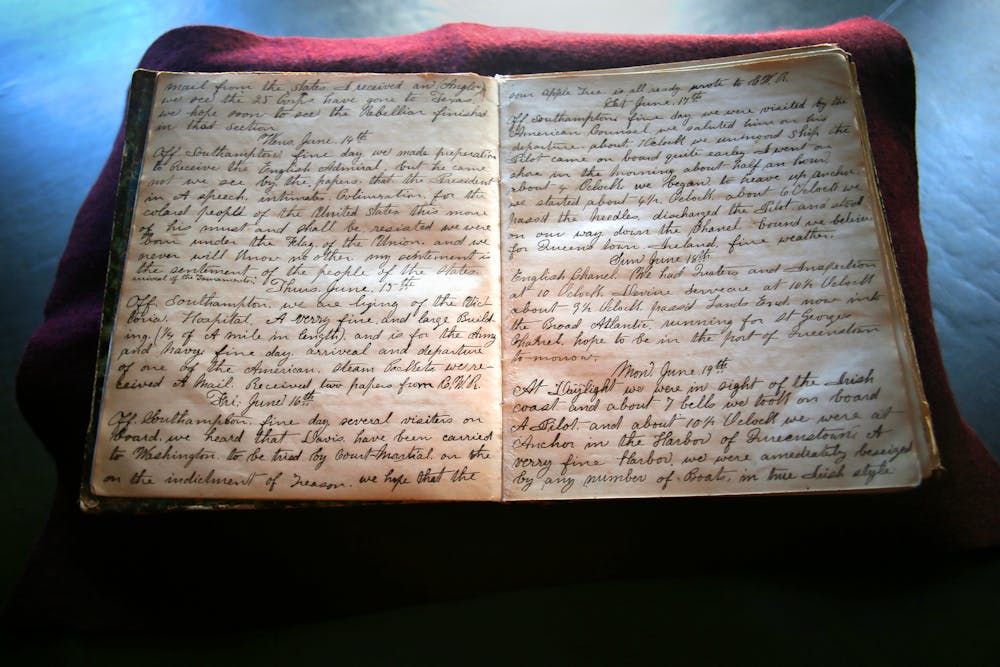
Pages of a diary written in black ink.
A former enslaved Black person, W. B. Gould, escaped the South during the Civil War and began writing in a diary.
Lane Turner/The Boston Globe via Getty Images

It also pays to examine wanted advertisements for runaway slaves. These ads provided details about those who managed to escape slavery. In some cases, the ads contain drawings of slaves.

These materials can help teachers guide students to better understand the historical context in which slavery existed. Educators may also wish to look at how people such as historian Cynthia Lynn Lyerly, who wrote a chapter in “Understanding and Teaching American Slavery,” have used historical documents to teach about slavery.

2. Examine historical arguments

In order to better understand different perspectives on slavery, it pays to examine historical arguments about how slavery developed, expanded and ended.

Students can read texts that were written by abolitionists like Frederick Douglass and pro-slavery advocates like George Fitzhugh.

They should wade through the newspaper advertisements that provided details about those who managed to escape slavery.

Looking at these different arguments will show students that history is filled with disagreement, debate and interpretations based on different goals.

For instance, in examining arguments about slavery, teachers can show students how early 20th-century historians like Ulrich Bonnell Phillips
sought to put forth ideas about kind masters and contented slaves, while others from the 1990s, such as John Hope Franklin, co-author of “Runaway Slaves: Rebels on the Plantation,” focused on how Black people resisted slavery.

Seeing these starkly different portrayals of slavery gives students a chance to examine how things such as choice, context, racism and bias might affect the way slavery is seen or viewed.

3. Highlight lived experiences

In my 11 years of teaching history, many students entered my classes with a great deal of misinformation about what life was like for those who lived under slavery. In pre-unit surveys, some stated that the enslaved worked only in the cotton fields and were not treated that badly. We know the historical records tell a different story. While many worked as field hands, there were others who were put into service as blacksmiths, carpenters, gunsmiths, maids and tailors.

To combat misconceptions like this, I advise teachers to use historical sources that feature details about the lived experiences of enslaved people.

For instance, teachers should have students read Harriet Jacobs’ memoir – “Incidents in the Life of a Slave Girl” – alongside diaries written by white plantation owners.

Scrutinize photographs of slave quarters and excerpts from the Born in Slavery: Slave Narratives from the Federal Writers’ Project, which contains more than 2,300 first-person accounts of slavery.

Ask students to examine various historical sources to gain a better understanding of how people lived through their bondage over time.

4. Consider the relevance

It is also crucial for teachers to consider the various ways in which slavery is relevant to the present with their students. I advise them to ask questions like: How has the history of slavery influenced the status of Black people in the United States today? Why are there so many movies about slavery?

In Ailany’s class, we ended our unit by providing students with a chance to read and think about the relevance of recent picture books about slavery like Patricia Polacco’s “January’s Sparrow,” Ann Turner and James Ransome’s “My Name Is Truth: The Life of Sojourner Truth” and Frye Gallard, Marti Rosner and Jordana Haggard’s “The Slave Who Went to Congress.”

We asked students to draw on what they had learned about slavery to consider and then share their perspectives about the historical accuracy, classroom appropriateness and relevance of a selected picture book. Students always have much to say about all three.

[Over 100,000 readers rely on The Conversation’s newsletter to understand the world. Sign up today.]

Teaching slavery has been and will continue to be challenging. To teachers who are asked or required to take on this challenge, the four things discussed above can serve as strong guideposts for creating lessons that should make the challenge easier to navigate.The Conversation

Raphael E. Rogers, Associate Professor of Practice, Clark University

This article is republished from The Conversation under a Creative Commons license. Read the original article.

================================================================
Alecto, Megaera, and Tisiphone, “there were others who were put into service as blacksmiths, carpenters, gunsmiths, maids and tailors.” Yeah. And artists and musicians and other fine craftspeople. If a slave could do something, an owner could find a way to exploit it. Regular viewers of Antiques Roadshow will recall episodes featuring slave-produced arts and crafts. Regular listeners of Performance Today (produced by American Public Media and often carried by NPR but can also be streamed free) will remember having heard about a piano-playing slave who toured and gave concerts, from which his master received every penny. Viewers of Finding Your Roots will have seen many a slave schedule, slave auction announcement, runaway slave advertisement, census record or inventory or probate list with no names.

The historical documents and other resources exist. Getting them into the hands of teachers and assisting them to use them effectively is another matter. May everything possible be done to make it happen.

The Furies and I will be back.

Share
Jul 122021
 

Glenn Kirschner – AG Garland Said This Country Protected HIS Family. It’s now Time For Him To Protect OUR Families

Meidas Touch – Former SDNY Asst. US Attorney: The Trumps Will Turn on Weisselberg—and EACH OTHER

The Lincoln Project

Don Winslow – Don Winslow Films – #LaurenBoebertIsAMonster

CNN – [John Dean] says he’d pay to handle Trump’s deposition. I have a very sift spot forpeople who have made mistakes, including extremely stupid ones, and LEARNED from than and turned around. John is one. Another is Monica Lewinsky.

Liberal Redneck – I’m from TN and LAWD I CAN’T STAND MARSHA BLACKBURN. (Taylor Swift is acually a liberal.)

Beau – Boebert is no Einstein, but I have administered GED testing and read the tests and getting it is NOT easy. And, yes, apparently it took her several tries to get it. However, it still is not that easy (and it certainly is not the same questions every time one tries) and Istill assert that GEDs are respectable and arw to be respected by Democrats, among others. And certaily by the military. I don’t know whether the military is accepting GED students now, but at the time I was working with it they weren’t. I have advised GED grads nterested in the military to go to the nearest and cheapest community college and take and pass one course – any course. Then, their educational level becomes “some college” and bypasses the GED question altogether. And I still consider that good advice. (But I hope Boebert doesn’t take it.)

Share
Jun 222021
 

Yesterday a friend’s young adult son came by to mow the weeds in my front yard. I guess I should say “use a weedwhacker) rather than “mow” because they are were just that tall. At any rate, that should keep the county off my back for a while. I also received news of the death of someone who was a close friend in high school. There were four of us … now there are only three. I need to realize that this will continue to happen from time to time. I am hanging in.

Cartoon

Short Takes

The Hill – Supreme Court rules against NCAA in dispute over student-athlete compensation
Quote – Justice Brett Kavanaugh agreed with the judgment but wrote a separate concurring opinion that contained a blistering critique of the NCAA’s business model, which generates considerable revenue, particularly from Division I football and basketball. “Nowhere else in America can businesses get away with agreeing not to pay their workers a fair market rate on the theory that their product is defined by not paying their workers a fair market rate,” Kavanaugh wrote. “And under ordinary principles of antitrust law, it is not evident why college sports should be any different. The NCAA is not above the law.”
Click through for story. I had to pick my jaw up off the floor. On the principle of “never trust a Republican,” there;s probably some ulterior motive, possibly a setup to do future harm to colleges and universities(?). But it’s still amazing.

So, Al Franken is going on tour. It’s called “The Only Former U.S. Senator Currently on Tour Tour”.
Quote from email: Tickets for The Only Former U.S. Senator Currently on Tour Tour go on presale Wednesday at 10am in every time zone with the code word SENATOR. Just click HERE to find out when I’ll be in a city near you. I hope to see you there. My promise is that you’ll laugh, you’ll think, and you’ll leave hopeful about our future. Unless I’m in a bad mood that night.
Click through for full dates and venues, and don’t forget to use the code word if interested.

The NM Political Report – The Great disconnect
Quote – On May 18, a judge overseeing the historic Yazzie-Martinez case ordered the New Mexico Public Education Department to take stock of the massive digital divide in the state and finally identify the roughly 76,000 students who lacked Internet connections they desperately needed for school. One of PED’s responses was to create a Google survey for students and staff to fill out online, an action that left advocates and school leaders mystified.
Click through for the details. I really thought people in New Mexico were smarter than that … after they fired Susanna Martinez and elected Deb Haaland …

Food for Thought

Share

Everyday Erinyes #270

 Posted by at 9:41 am  Politics
Jun 122021
 

Experts in autocracies have pointed out that it is, unfortunately, easy to slip into normalizing the tyrant, hence it is important to hang on to outrage. These incidents which seem to call for the efforts of the Greek Furies (Erinyes) to come and deal with them will, I hope, help with that. As a reminder, though no one really knows how many there were supposed to be, the three names we have are Alecto, Megaera, and Tisiphone. These roughly translate as “unceasing,” “grudging,” and “vengeful destruction.”

This is so counterintuitive I thought it was worth a closer look – a much closer look. More on the other side
================================================================

Civics education isn’t boosting youth voting or volunteerism

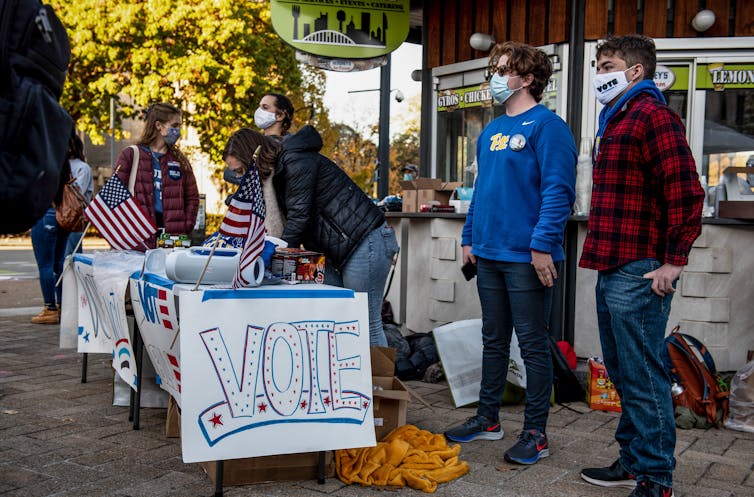
These students at the University of Pittsburgh urged their peers to vote in the 2020 presidential election.
Aaron Jackendoff/SOPA Images/LightRocket via Getty Images

John A. Tures, LaGrange College

After the insurrection, the impeachment, the trial and ongoing partisanship in 2021, many Americans are looking to civics education as a source of hope, according to George Washington University’s Center on Education Policy, which reports that “Nearly all Americans (97%) agree that public schools should be teaching civics.”

According to the Center for American Progress, civics classes teach students about how the U.S. government works, history about how it was designed and information about how to participate, including voting. After those sorts of courses, it seems reasonable to expect that students should be voting more and engaging in community service.

But my research shows that states that require civics courses do not necessarily have better test scores, more youth voting or young people volunteering at higher rates than other states. And there may be a connection to QAnon support as well.

I’m a political science professor who also teaches government, history, geography and economics classes to college students who major in education. So I strongly believe that civics education is a good thing.

Unfortunately, though, my research has found that civics education isn’t making the grade. In states that require students to take a civics course, young voters have slightly lower average voting rates – 29.9% – than states without such a requirement – 31.9%.

I analyzed data from the latest study by the Center for American Progress, which provides information on which states require a civics test, and the voting rates for 18-to-24-year-olds, volunteer rates for 16-to-24-year-olds and average scores on the College Board’s Advanced Placement civics and U.S. government test.

Civics class requirements

Washington, D.C., and 39 states – including California, Iowa and South Carolina – have a civics class requirement. These same places also have lower percentages of youth volunteer rates – 22.7% on average – than states without such a civics course requirement. In states that do not have a civics class requirement, including New Jersey, Kentucky and Nebraska, the average youth volunteer rate is 23.5%.

States which require a civics course also have slightly lower scores on the Advanced Placement test about U.S. government and politics – 2.75 out of 5 – than states that do not make their students take a civics course – 2.84. A score of 4 or 5 is often accepted for college credit in political science, though some schools may accept a 3 on the AP test, which covers subjects such as the foundations of American democracy, civil liberties and civil rights, as well as American political ideologies and beliefs, according to The College Board.

Passing a civics exam

Nineteen states require passage of a civics exam for graduation, including Kentucky, which does not have a specific course requirement. But that doesn’t seem to make a difference in boosting youth civic engagement or knowledge. States with the requirement have roughly similar youth voting rates – 30% – as states that do not require passage of a civics exam – 30.6%.

States demanding a civics exam be passed before receiving a high school diploma also have average test scores on AP exams related to civics or government – 2.80 – similar to those states without such a requirement – 2.75.

There is one bright spot, though: States with a civics exam have higher volunteer rates among younger people – 22.2% on average – than those states that do not – 17.5%.

Community service requirements

Nearly half of all states, plus the District of Columbia, require some sort of community service requirement or provide high school credit for students who volunteer, according to the Center for American Progress.

But I was dismayed to find that states without such a requirement had higher rates of volunteerism among younger people – an average of 24.4% – than among those states with a community service mandate – 21.3%.

And states requiring high school students to do community service have lower youth voting rates – 29.3% – than states where schools did not require volunteering – 31.4%.

Countering QAnon?

Failure to provide an adequate civics education doesn’t just mean lower numbers of young people voting, volunteering and scoring a little lower on AP test scores. It could open the door for QAnon, a wide-ranging conspiracy theory that claims former President Donald Trump is helping the late John F. Kennedy Jr. battle a secret cabal of cannibalistic pedophiles.

States with lower levels of youth volunteering, youth voting and youth civics test scores are also more likely to have QAnon sympathizers active in politics, or politicians who oppose criticism of QAnon.

To determine this, I looked at states which had a congressional candidate who openly espoused some or all of the QAnon philosophy. I also examined which states had a representative who voted against a congressional resolution denouncing QAnon,

The 24 states with QAnon-supporting politicians had lower average youth voting rates – 38.5% – than states without them – 42.4%. They also had lower average youth volunteering rates – 21.8% – than states without major politicians supporting QAnon – 24%.

There was no significant difference in AP test scores between the two groups of states.

Our country’s civics education may not help solve the nation’s current political crises. But reform efforts touted by the Center for American Progress are under way in several states to help replace memorizing facts and figures with active learning designed to engage students in real-life problems in and out of the classroom.

[You need to understand the coronavirus pandemic, and we can help. Read The Conversation’s newsletter.]The Conversation

John A. Tures, Professor of Political Science, LaGrange College

This article is republished from The Conversation under a Creative Commons license. Read the original article.

================================================================
Alecto, Megaera, and Tisiphone, I suspect the problem here is less the existence of civics classes than the content and quality. We know – we all know – that Americans are very good at sugar coating history. And sugar coating hisory is not going togive students any sense of the importance of voting. I was brought up to believe that “If you don’t vote, you have no right to complain about government.” I, and many others, find that highly motivating. But not as motivating as “If you don’t vote, and American government is destroyed and America becomes a fascist state, it’s your fault.” Granted, we have not had quite as much evidence of that as we do now (and also that the evidence we did have was always sugar coated out of existence.) But that doesn’t have to be.

Volunteering I don’t care as much about. Frankly, I believe there are some people who should never volunteer – but if they do, it had better not be anywhere around me. Additionally, the better government is doing its job, the less need there is for volunteers. Well, maybe except for getting out the vote – which I’m not convinced government should be involved in anyway. But that’s a-whole-nother discussion.

The Furies and I will be back.

Share
Apr 052021
 

IMPORTANT This is long, but if you watch even a little, you are likely to learn something you didn’t know (but may have suspected.) There’s even more news available because, of all people, archaeologists have been telling some tales. Google “Dimona” (or “archaeologists Dimona”) for that. I apologize that the CC is less than perfect, but it’s pretty close.

Georgia Voting Law – unbelievable.

From yesterday – no one is more moving to me than the King family members. (And there’s no ad at the end, so it’s all good)

My bestie in Florida is probably beating her head against the wall in frustration – she knew all this for years At least she says she’s safe (her home)

VoteVets – held over from yesterday because the last thing we needed on Easter was more Gaetzgate.

Teachers and students …

13 Things My Black Cat’s Good At…

Share
Feb 232021
 

Meidas Touch (podcast)

Now This News – No comment.

Really American – We all know this by now, but the “shock” is kind of fun.

“End notes” to “The Alt-Right Playbook” I haven’t seen enough yet to decide whether I should intersperse them orlistthem separately when I make the compendium … so that will be delayed somewhat. End note 1:

After the first meeting, and before they got used to each other, Cole and Marmalade did this.

Beau – Teaching and learning history – the Scooby-Doo method.

Share

Everyday Erinyes #249

 Posted by at 10:37 am  Politics
Jan 162021
 

Experts in autocracies have pointed out that it is, unfortunately, easy to slip into normalizing the tyrant, hence it is important to hang on to outrage. These incidents which seem to call for the efforts of the Greek Furies (Erinyes) to come and deal with them will, I hope, help with that. As a reminder, though no one really knows how many there were supposed to be, the three names we have are Alecto, Megaera, and Tisiphone. These roughly translate as “unceasing,” “grudging,” and “vengeful destruction.”

Now that a teacher has been caught on video telling students last week’s rioters were Antifa (I keep wanting to say “I am not making this up”), it might be a good time to start thinking about how this history should be taught in schools, now and in the future. Well, we do have some expert guidance with suggestions.
================================================================

How should schools teach kids about what happened at the US Capitol on Jan. 6? We asked 6 education experts

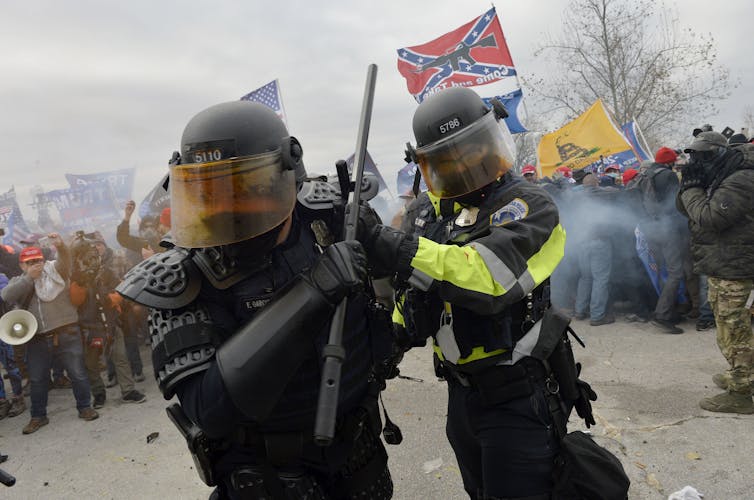
Trump supporters clash with police and security forces as they storm the U.S. Capitol.
Joseph Prezioso/AFP via Getty Images

David Schonfeld, University of Southern California; Kei Kawashima-Ginsberg, Tufts University; Kyle Greenwalt, Michigan State University; Paula McAvoy, North Carolina State University; Sarah Stitzlein, University of Cincinnati , and Tiffany Mitchell Patterson, West Virginia University

Teachers scrambled to create lesson plans to help students make sense of the Jan. 6 siege of the U.S. Capitol right after it happened.

It’s a fraught task. Even the news media wasn’t sure what to call this unprecedented attack on U.S. democracy. Was it a coup? A riot? An act of domestic terrorism?

Likewise, it’s not clear where lessons should begin.

The Conversation U.S. asked six education experts how teachers – and parents – can help young people comprehend, analyze and process what happened.

Don’t avoid the topic

Dr. David Schonfeld, director of the National Center for School Crisis and Bereavement, Children’s Hospital Los Angeles and professor of clinical pediatrics, University of Southern California

Educators may worry they don’t know the right thing to say and will unnecessarily upset students. But saying nothing can say a lot to children – that adults are unaware, unconcerned, unable or unwilling to provide support in difficult times.

Teachers and parents can begin by asking students what they have heard and understand about the event. As kids explain it, it’s important to look for misunderstandings and ask about worries and concerns.

Children often have very different fears than adults. Some may be based on limited information or misunderstandings. For example, children might fear that it’s unsafe to go into any government building and worry about a parent who works in a post office. The goal of these conversations is to help children understand what happened in order to address their worries and concerns.

Especially in the midst of a pandemic, when children and adults are worried about illness and death and many families are dealing with financial concerns and other sources of stress, it’s not a time for teachers to introduce their personal take on what elected officials did right or wrong or to speculate about potential future dangers.

The events of Jan. 6 are a harsh reminder that even in the U.S. people are never completely safe from violence. But adults can use this opportunity to express a hopeful perspective for the future and reassure children that what happened at the Capitol should not make them feel unsafe in their home, at school or in their community.

No business as usual

Paula McAvoy, assistant professor of social studies education, North Carolina State University

I believe that social studies teachers should not return to business as usual in early 2021. Instead, they should spend ample time helping students understand what happened on Jan. 6, what precipitated the mayhem and what should happen going forward.

Once students have had space to process, the priority is to help them become more informed. When engaging in this work, teachers must not treat the question, “Did Joe Biden legitimately win the 2020 election?” as open to interpretation. He most definitely did. Likewise, teachers should not give any credence to the idea that the election was stolen, as the angry mob that wreaked havoc in the Capitol alleged. Instead, teachers should affirm each state’s certification. They should be clear that over 80 judges – including some appointed by Trump – rejected the baseless claim that fraud affected the outcome. They should do this because it is true.

The question, “Should President Trump be impeached again?” is, however, open for interpretation. Engaging students in an extended inquiry into this question as members of Congress grapple with it in real time creates an opportunity to closely read parts of the Constitution, including the 25th Amendment, parse out the difference between a violent insurrection and a protest, and evaluate Trump’s words and actions.

This moment is an opportunity for everyone to deepen their understanding about democracy. And social studies teachers should not let it slip away.

Focus on white supremacy

Tiffany Mitchell Patterson, assistant professor of secondary social studies, West Virginia University

White supremacy has always been violent, protected and upheld in America’s institutions. This is well documented and we must teach it. The world witnessed yet another example on Jan. 6, 2021.

I believe it’s a good idea for teachers to devote some class time to allow students to share their thoughts, feelings and questions on what they have seen and heard about the insurrection in a way that does not harm students of color. This is also an opportunity to engage students in spotting many racial double standards by having students analyze the media coverage, political rhetoric and law enforcement responses to the Black Lives Matter protests across the nation in 2020, and this unprecedented attack that followed smaller-scale operations at some state capitols.

I do understand that some teachers may be reluctant to address what happened. Those educators need to be honest with themselves about why that is and do the necessary self-reflective work needed to overcome their hesitation.

Teachers also must resist the urge to view what I consider a coup attempt as an isolated incident. Instead, they should place it in a historical context.

Many resources are available. The Zinn Education Project and the Southern Policy Law Center’s Teaching Tolerance initiative, among others, provide lesson plans and resources to learn and teach about racism and white supremacy. For some teachers this is ongoing work, and for others this siege is sure to be a catalyst for change. But progress toward the goal of dismantling white supremacy can happen in K-12 classrooms – if teachers choose to do the critical work that it requires.

Kids are, sadly, familiar with violence

Kyle Greenwalt, associate director of teacher preparation and associate professor of education, Michigan State University

School curriculum and children’s own life experiences both oblige teachers to discuss with their students events like those that happened at the U.S. Capitol.

In Michigan, for example, state standards for kindergarteners require them to consider several important civic ideals. These include the notion that “people do not have the right to do whatever they want” and that democracy requires cooperation as well as “individual responsibility.”

But it’s not only educational standards that make it necessary to teach kids about such events and engage them in related discussions. The reality children face in their daily lives also demands it.

Children and teens are no strangers to disagreement, questions of fairness and, unfortunately, scenes of violence like those we saw in the Capitol. For example, schools commonly have active-shooter drills that can leave children feeling confused, scared or angry. I believe that teachers have a moral responsibility to help students process these experiences.

In a truly democratic society, students are not only taught about democracy but are encouraged to practice it. That is, students are empowered to use what they have learned to engage in civic life outside of the classroom walls.

That’s what happened when students led the March for Our Lives after the mass shooting at Marjory Stoneman Douglas High School in Parkland, Florida. A youthful passion for engagement is also what inspired the Swedish teen Greta Thunberg and a wave of climate strikes.

Young people are capable of showing their elders what it means to live democratically and take care of the common good.

Connect events to the past and the future

Kei Kawashima-Ginsberg, director of the Center for Information & Research on Civic Learning and Engagement, the Jonathan M. Tisch College of Civic Life at Tufts University

Most students today have never seen our elected leaders and political systems work well, let alone live up to America’s constitutional ideals. Many are confused by what they’ve seen, if not angry and traumatized. It’s important for teachers to communicate that all kinds of emotional reactions are valid.

Let students express and process what they feel safely. Do not dehumanize any student because of their opinion – but teach them to always consider the intent and impact of their response. If appropriate, encourage methods like journaling that allow for reflection without sharing.

This is also an opportunity to connect current events with other moments in American history when the nation’s institutions were tested or our leaders fell short in their commitment to core American values.

[Get facts about coronavirus and the latest research. Sign up for The Conversation’s newsletter.]

Even with younger students, I don’t believe educators should shy away from the fact that some people violated not just social norms but their professional, political and moral duties – and why their actions threaten the health of our republic.

These conversations can enhance students’ understanding of the past and present and inspire a passion to build a better future for all Americans.

Explain what ‘dissent’ is

Sarah Stitzlein, professor of education and affiliate professor of philosophy at University of Cincinnati

I believe teachers should teach students what political dissent is, why it matters to a healthy democracy and how to engage in it.

Ideally with the support of their school administrators and local community, teachers should help students distinguish justified protest from the violent siege that occurred at the Capitol. They should explain how good dissent seeks to understand problems, critiques injustice, sparks discussion between people with different views, bases claims on evidence and employs democratic processes.

Teachers should empower students with the skills of dissent. These include raising awareness, forming persuasive arguments, building coalitions and using critical thinking to challenge misinformation. Students should practice putting forward solutions that can be discussed and tested. Young people should be encouraged to imagine how life can be better in America as a way to build hope with their peers.

It’s important that they realize how dissent and hope together can help strengthen U.S. democracy.The Conversation

David Schonfeld, Director, National Center for School Crisis and Bereavement, University of Southern California; Kei Kawashima-Ginsberg, Director, Center for Information and Research on Civic Learning and Engagement in the Jonathan M. Tisch College of Civic Life, Tufts University; Kyle Greenwalt, Associate Professor of Education, Michigan State University; Paula McAvoy, Assistant Professor of Social Studies Education, North Carolina State University; Sarah Stitzlein, Professor of Education and Affiliate Faculty in Philosophy, University of Cincinnati , and Tiffany Mitchell Patterson, Assistant Professor of Secondary Social Studies, West Virginia University

This article is republished from The Conversation under a Creative Commons license. Read the original article.

================================================================
Alecto, Megaera, and Tisiphone, there’s a Tweet quoting Speaker Pelosi in today’s Video Thread which refers to the fact that kids are familiar with violence – a lot more familiar than we give them credit for, and a lot more familiar than is best for them. And that is only one way in which kids are well equipped to handle the truth – and in fact, likely better equipped than many teachers. Any assistance we can get in bringing the truth to our children would be greatly appreciated.

The Furies and I will be back

Share
Oct 072020
 

It’s a very tired day, here in the CatBox.  WWWendy and I got home safely last night, after my infusion.  We are scheduling another infusion, which we may cancel.  In around three weeks I’ll have a CAT-Scan or a PET-Scan to judge whether the immunotherapy is working and go from there.  I did research early this morning and took a long nap.  I’m ready to go back to bed.  Tomorrow is a grocery delivery day.  This evening I plan to try to stay up to watch the slaughter.  You guys had better do so too, in case I don’t make it.  Happy Hump Day!

Jig Zone Puzzle:

Today’s took me 3:31 (average 5:29).  To do it, click here.  How did you do?

Cartoon:

Trump* Virus Update:

1007TrumpVirusMap

Click for interactive maps and charts

US Cases: 7,726,635
US Deaths: 215,915
Plus all the Trump*/GOP plague murders Republicans are hiding from us

Short Takes:

From The New Yorker: Mike Pence said that he was “extremely grateful” that the organizers of Wednesday night’s Vice-Presidential debate would be providing a plexiglass shield to protect him from a woman.

Speaking to reporters, Pence said that the Commission on Presidential Debates had taken “appropriate measures” to shield him from exposure to a female during the Salt Lake City face-off.

“I’ve read all the relevant literature, and from what I’ve learned a plexiglass shield provides adequate protection from a woman,” he said. “Knowing that this barrier exists between me and a member of the opposite sex, I feel comfortable about moving forward with the debate.”

Dang, Andy! Nothing can protect that lying Nazi pseudo-Christian! Kamala is going to tear Mr. Karen a new sphincter!  RESIST!!

From YouTube (MSNBC Channel): List Of Positive Covid Cases At White House Grows At Alarming Rate


I know I don’t need to ask, but who is the super-spreader?  RESIST!!

From YouTube (a blast from the past): Pink Floyd – Another Brick In The Wall (HQ)


Ah… the memories! We want schools to teach kids HOW to think! Republicans want schools to teach kids WHAT to think! Protest like the 60s!   RESIST!!

Vote Blue No Matter Who Top to Bottom!!

Share