To be honest, after yesterday’s horrific mass shootings in El Paso and Dayton, I really didn’t feel like posting what I had put together because it wasn’t appropriate. But it will keep.
But I did feel I just put up something, so it was back to my notes on ideas that I keep for “Friday Fun” possibilities to see what I could find.
Maybe kids can point the way to showing us grown-ups how to get along, because lord knows we’re doing a piss-poor job of it. So I thought a fitting tribute to honor the people of El Paso is to celebrate a recent event watching kids and their parents playing together on hot pink Teeter Totters.
But this playground was like no other, because these custom-built sees-saws are between the border wall slats separating Ciudad Juárez, Mexico and El Paso. So the Border Wall becomes the literal fulcrum joining people from Mexico and the USA.
Digging into this project I was surprised to learn that the concept actually began a decade ago when two professors (Ronald Rael, a professor of architecture at the University of California, Berkeley, and Virginia San Fratello, an associate professor of design at San José State University) came up with the idea.
Rael published a book called “Borderwall As Architecture”. In fact his concept drawings are part of the permanent collection at the Museum of Modern Art (MOMA) in New York.
Rael said the event was about bringing “joy, excitement and togetherness at the border wall”. Adding it was also about finding “meaningful ways on both sides with the recognition that the actions that take place on one side have a direct consequence on the other side”.
Prof. San Fratello said that it is “also a place where people come together. We wanted to create scenarios that would celebrate togetherness. And also highlight the ridiculousness of the border wall.” She explained that the see-saws are made of light-weight steel and designed to be easily installed. “We could literally set [them] up in one minute.”
But unfortunately, they did not have permission. Surprisingly when the US Customs and Border Patrol (CBP) arrived, they permitted the sharing of joy across the border, using the Wall as a literal fulcrum, to continue unimpeded for quite a while. Maybe laughter is truly infectious. We can hope!
But as is frequently the case, all good things must come to an end. Let’s close on an upbeat note enjoying the Instagrams Rael posted of the event – and hope it can be reprised on a much larger scale..
[Editor’s Note: Sorry, I don’t know how to resize Instagrams]
I woke up after sleeping three hours last night, and I could not get back to sleep. I feel exhausted.
Jig Zone Puzzle:
Today’s took me 5:56 (average 7:34). To do it, click here. How did you do?
Hard at work:
Short Take:
From, YouTube (MSNBC Channel): Beto O’Rourke Calls For Gun Control, Says We Need To Confront Hate
I pray, but that is not enough. We need gun control. We need more resources targeting white nationalists, and we need to put racist Republican politicians into unemployment lines. RESIST!!
I had a night’s sleep, but I still feel extremely tired. Why won’t the litter from tiny old CatBox fit in the bigger new CatBox? Tomorrow please expect no more than a Personal Update. It’s a WWWendy day, and we still have a shitload of work to do.
Jig Zone Puzzle:
Today’s took me 4:07 (average 5:52). To do it, click here. How did you do?
Madrona pics
This is my first sunset, taken while the movers were on the way here.
This is the breakfast I cooked on my stove and ate this morning.
Every Republican in office is one Republican too many. RESIST!!
From YouTube: Heatwave melts Greenland ice sheet into 10 billion tonnes of water
There is no global climate change, the Pope is not Catholic, bears never ever shit in the woods, and Republicans do not have their heads up their asses! RESIST!!
Experts in autocracies have pointed out that it is, unfortunately, easy to slip into normalizing the tyrant, hence it is important to hang on to outrage. These incidents which seem to call for the efforts of the Greek Furies (Erinyes) to come and deal with them will, I hope, help with that. As a reminder, though no one really knows how many there were supposed to be, the three names we have are Alecto, Megaera, and Tisiphone. These roughly translate as “unceasing,” “grudging,” and “vengeful destruction.”
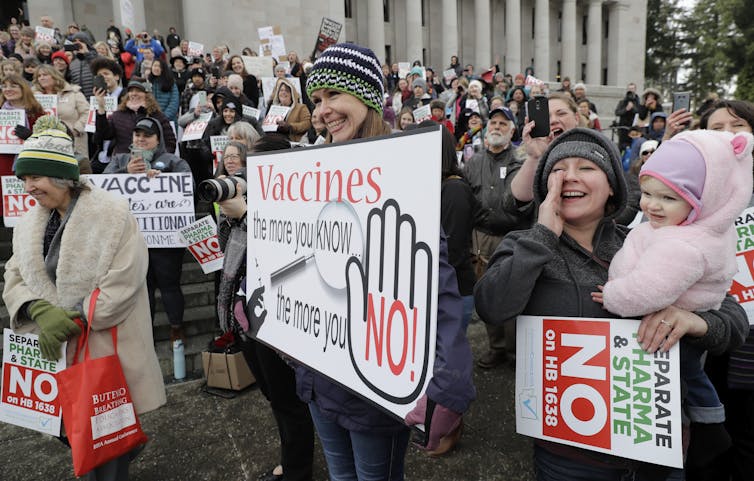
Serious as the problem is of Americans being resistant to vaccinate their children, I haven’t previously asked the Erinyes to weigh in on it. That’s because, serious as it is, I found it somewhat amorphous – difficult to know what to do or how to approach. However, Timothy Callaghan and Matt Motta tie this issue to all other issues on a way that really got my attention, and will probably get yours too. More on that point after the article.
==================================================================
Conspiracy theories and fear of needles contribute to vaccine hesitancy for many parents
Over 1,160 cases of measles have been confirmed in the U.S. in 2019. That is more measles cases in just seven months than any full year this decade, and, more problematically, more than all U.S. measles cases from 2010-2013 and 2015-2017 combined.
Lawmakers in some states, such as Washington and New York, are already stepping in to combat the outbreak by eliminating certain exemptions from vaccination. We will soon know whether these new policies produce higher vaccination rates.
However, a fundamental question remains: Why are some parents – despite the scientific community’s conclusions that childhood vaccines are safe – putting their children at risk by not vaccinating them in the first place? Public health experts and health behavior scholars like us have been trying to solve this mystery for years.
Why don’t some parents vaccinate?
Religious beliefs or barriers to accessing health services certainly explain the actions of some, but these factors do not explain the behavior of most parents who choose not to vaccinate. Instead, recent academic research
suggests that most parents who display vaccine hesitancy – by either refusing to vaccinate their children or delaying vaccination past recommended vaccine schedules – do so because of misinformation about vaccine safety, their political ideology, the influence of social media, and other factors like economic circumstances and trust.
As important as these factors are, we wondered if the behavior of vaccine-hesitant parents might also have deeper, psychological origins. For that reason, in a new paper published in Social Science and Medicine, we analyzed the possibility that parental decisions to delay vaccinating children could be driven by three underlying psychological factors: conspiratorial thinking, needle sensitivity and moral purity.
Facts don’t matter when people don’t trust them
People with conspiratorial styles of thinking tend to believe that the government, businesses and other powerful actors conspire to influence a wide range of social and political events in the world around us. They don’t necessarily believe any one particular conspiracy theory – such as the belief that NASA faked the Moon landing, or that someone other than Lee Harvey Oswald killed President John F. Kennedy. Still, because many conspiracy theories involve collusion between powerful actors, these people are more likely than the typical American to belief in conspiracy theories generally.
Given the variety of conspiracy theories surrounding vaccine safety, including disproven theories that vaccines cause autism or that pharmaceutical companies are hiding the dangers of vaccines, we wanted to test whether parents with tendencies toward conspiratorial styles of thought may be more likely to delay vaccinating their children because they have internalized these conspiracies.
Needle fear and vaccine behavior
In addition, we also wanted to see whether parents who are afraid of or are otherwise averse to needles themselves – what psychologists call “needle sensitivity” – are less likely to vaccinate their children when they are supposed to. Prior research suggests that as many as 24% of adults have a fear of needles and that up to 90% of 15-18 month old children and 45% of children aged 4 to 6 are seriously distressed by injections.
Given these statistics, we wanted to see whether some parental decisions not to vaccinate weren’t necessarily because they thought vaccines were dangerous, but because the parents were afraid of needles and didn’t want to put their children through something that causes them so much distress.
The role of bodily sanctity
Finally, we wanted to test whether a notion called moral purity – an aversion to actions that violate bodily sanctity – might also explain parental anti-vax behavior.
Individuals with high levels of moral purity try to avoid experiences that induce disgust, violate sanctity or corrupt the body. While vaccines are widely regarded as safe, we, like some other scholars studying related topics, hypothesized that some might see the injection of the disease antigens found in vaccines as a violation of the body’s purity that should be avoided in their children.
Psychological predictors of parental vaccine behavior
To test our hypotheses, we asked more than 4,000 American parents in a September 2018 survey about the vaccination decisions they made for their children and why they made those decisions. Specifically, we asked parents if they had ever delayed vaccinating their children, if they had only vaccinated their children because they had to for school, if they had chosen their child’s doctor based on their willingness to delay vaccinating, and if they would be willing to relocate their families so their child could attend a school that does not require vaccination.
Before asking these questions, we also gave survey respondents a series of questions designed to measure conspiratorial thinking, needle sensitivity and moral purity, as well as standard demographic questions.
In support of our expectations, we found that parents with high levels of conspiratorial thinking were 15% more likely to report delaying their children’s vaccinations. They were also 11% more likely to report having chosen their doctors based on their willingness to delay, 25% more likely to report only vaccinating their children so they can enroll in school, and 18% more likely to claim that they would be willing to relocate to a new school district.
We also found that parents’ psychological dispositions toward needles influenced reported anti-vaccination behavior. Parents in our study with high levels of sensitivity toward needles were between 14-16% more likely to engage in the each of the delay behaviors included in our study. This would suggest that if needle-free vaccine delivery mechanisms were more widespread, we might get many of these children their vaccines on time. Inconsistent with our predictions, we found no evidence that parents’ beliefs in moral purity altered their vaccine decision-making for their children, broadly speaking.
A difficult process
Our research suggests that anti-vaccine attitudes have deeply grounded psychological origins, which may be quite difficult to change. Consequently, our work identifies an important challenge for medical professionals, health departments and scientists: How can they convince vaccine hesitant parents to vaccinate their children, when it is unlikely that they’ll be able to make parents stop fearing needles, or to stop endorsing a conspiratorial way of thinking?
One possibility is to present information about vaccines to parents strategically, using the psychological factors identified here as important determinants of anti-vaccine behavior as a guide. For example, if we know that parents who are prone to thinking in conspiratorial ways are less likely to want to vaccinate their children, efforts to encourage childhood vaccination may be more successful if we avoid making mention of scientific studies, which parents might see as motivated by ulterior motives, or tying information to health departments (which these parents might find untrustworthy).
Figuring out which communication strategies are most effective for different audiences is something academics and science communicators still need to test. We hope, however, that our work offers a useful starting point for doing precisely this.
This simple statement is so much bigger than just vaccinations – important though those are. It speaks to everything that is wrong with our nation, indeed with the world, particularly today.
Alecto, Megaera, and Tisiphone, if you can come up with a solution, or even one or more partial solutions, to this, you will save the world. That’s the bottom line.
The move yesterday was horrid. The movers arrived a 7:45 PM. WWWendy left and I went to bed at 12:45 AM. Not used to the shiny new CatBox, I slept poorly, and I feel exhausted. The cable installation was as professional as the move was inexcusable. His service was above and beyond the call. This is my only article today. I should have more tomorrow.
Jig Zone Puzzle:
Today’s took me 3:49 (average 5:51). To do it, click here. How did you do?
I’m heading to the walk-in clinic. Think I have another episode of cellulitis of my L leg – but NOT from the cat. It’s from a chair tipping over w/ me in it.
(I just hope I don’t have anterior compartment syndrome.)
Well, here I go. It’s moving day. Bye bye crappy old CatBox. Hello shiny new CatBox. If everything goes as planned, I’ll be back tomorrow, I hope, but it may take mw a few says to be fully up to speed. Keep on resisting!!
Jig Zone Puzzle:
Today’s took me 3:31 (average 4:51). To do it, click here. How did you do?