
Experts in autocracies have pointed out that it is, unfortunately, easy to slip into normalizing the tyrant, hence it is important to hang on to outrage. These incidents which seem to call for the efforts of the Greek Furies (Erinyes) to come and deal with them will, I hope, help with that. As a reminder, though no one really knows how many there were supposed to be, the three names we have are Alecto, Megaera, and Tisiphone. These roughly translate as “unceasing,” “grudging,” and “vengeful destruction.”
Now that we have Articles of Impeachment, everyone will start speculating about the trial in the Senate, although it’s not now even 100% certain that there will be one at all. The Senate, of course, wants it fast so they can kill it fast. The House, of course, wants to be certain that this trial will be fair – and not a circus. Perhaps it wouldn’t hurt to look back at a previous trial, including a previous analogy of Senators as jurors.
=================================================================
When a chief justice reminded senators in an impeachment trial that they were not jurors
AP Photo/J. Scott Applewhite
Steven Lubet, Northwestern University
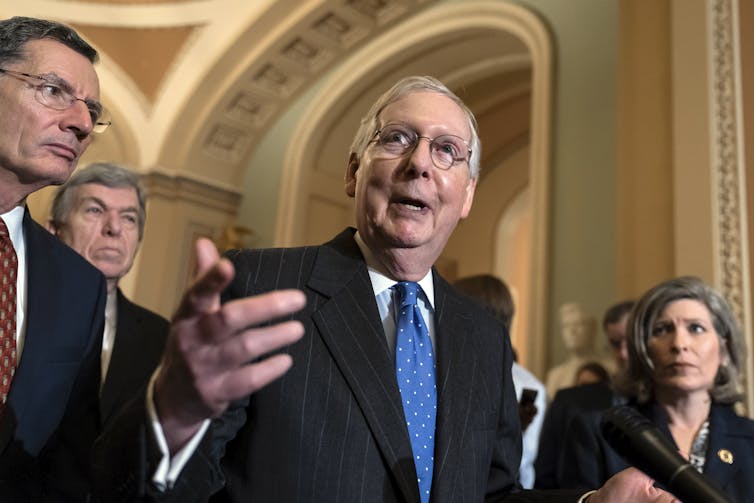
Senate Majority Leader Mitch McConnell created a predictable stir when he told Fox News host Sean Hannity that he would structure the impending impeachment trial of President Donald Trump in “total coordination with the White House counsel’s office.” He added, “There will be no difference between the president’s position and our position as to how to handle this.”
This outright rejection of neutrality drew immediate protests from Democrats. Rep. Val Demings, D-Fla., who may well be one of the House impeachment managers in the Senate trial, called for McConnell’s recusal, saying “No court in the country would allow a member of the jury to also serve as the accused’s defense attorney.”
House Judiciary Committee Chair Jerry Nadler, D-N.Y., likewise slammed “the foreman of the jury” for saying he would “work hand and glove with the defense attorney.”
Demings and Nadler made a valid point, but they used the wrong analogy. Senators at an impeachment trial are not the equivalent of a jury and they are not held to a juror’s standard of neutrality.
AP/J. Scott Applewhite
Harkin’s objection
The principle, that senators are not jurors in the traditional sense, was well established at the outset of the 1999 impeachment trial of President Bill Clinton.
Tasked with delivering an opening statement for the House managers – who present the House’s case to the Senate – Rep. Robert Barr, R-Ga., reminded the senators of Clinton’s tendency to “nitpick” over details or “parse a specific word or phrase of testimony.” To Barr, the conclusion was obvious: “We urge you, the distinguished jurors in this case, not to be fooled.”
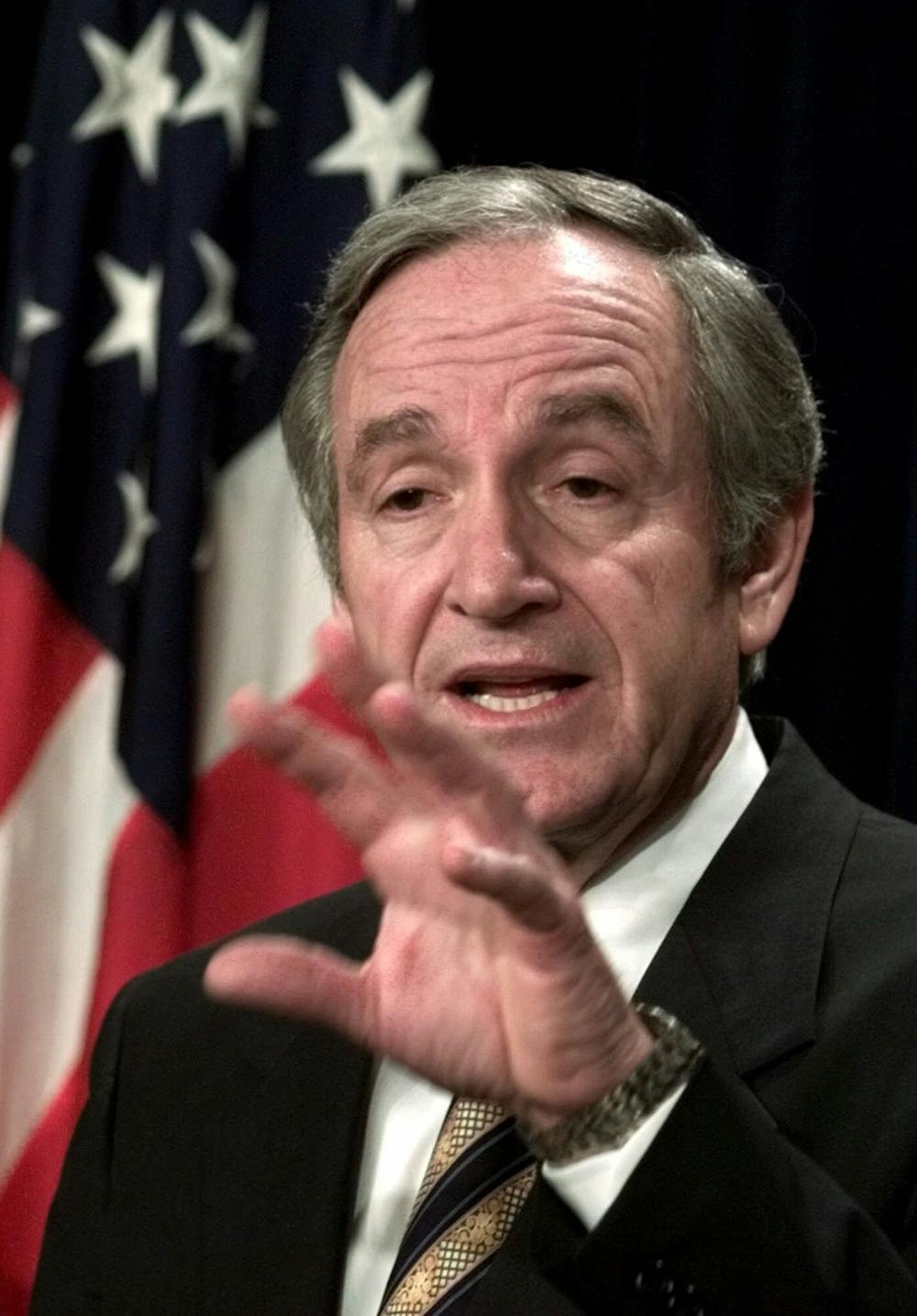
That was the moment Sen. Tom Harkin, an Iowa Democrat, had been waiting for.
“Mr. Chief Justice,” he said, addressing William Rehnquist, who was presiding over the trial, “I object to the use and the continued use of the word ‘jurors’ when referring to the Senate.”
AP/Joe Marquette
Harkin had prepared well, basing his argument on the text of the Constitution, the Federalist Papers and the rules of the Senate itself.
He explained that “the framers of the Constitution meant us, the Senate, to be something other than a jury.”
Instead, Harkin continued, “What we do here today does not just decide the fate of one man. … Future generations will look back on this trial not just to find out what happened, but to try to decide what principles governed our actions.”
Chief justice weighs in
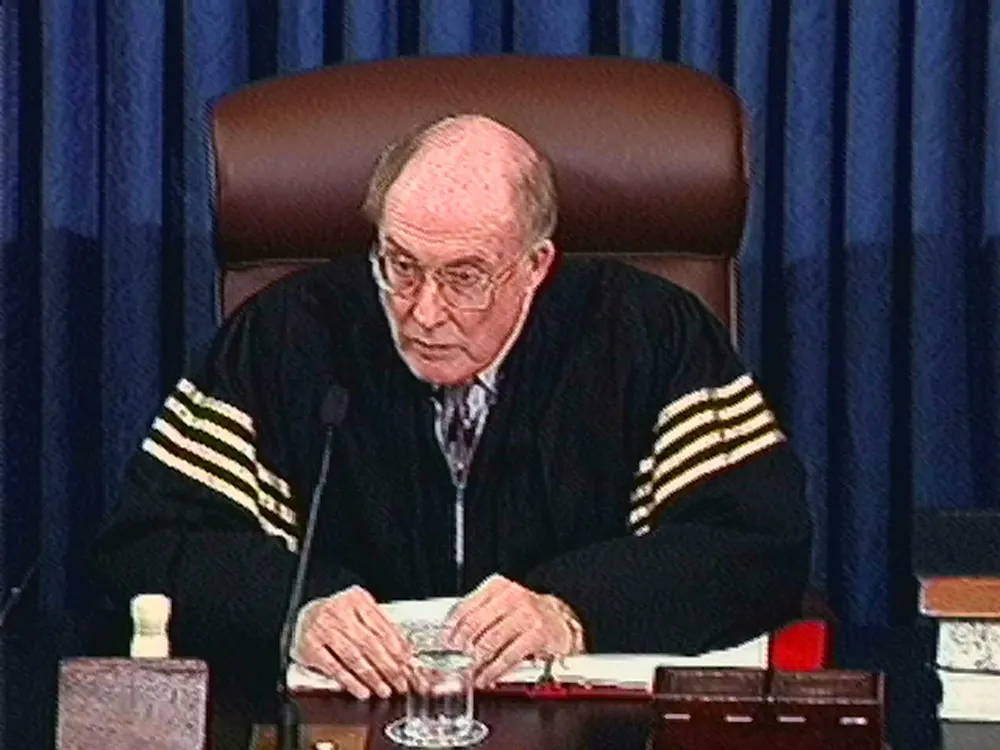
The chief justice sustained the objection.
“The Senate is not simply a jury,” he ruled. “It is a court in this case.”
Rehnquist thus admonished the House managers “to refrain from referring to the Senators as jurors.” For the balance of the trial, they were called “triers of law and fact.”
Rehnquist and Harkin got it right. Article III of the Constitution provides that “Trial of all Crimes, except in Cases of Impeachment, shall be by Jury,” and for good reasons.
AP Photo/APTN)
In an ordinary trial, the jury’s role is generally limited to fact-finding, while the judge determines the scope and application of the law. In an impeachment trial, however, the Senate itself has the “sole power” to decide every issue.
Recognizing the Senate’s all-encompassing responsibility, and his own limited role, Chief Justice Rehnquist referred to himself throughout the proceeding only as “the Chair.”
As the U.S. Supreme Court has put it, impeachment presents a “political question,” in which all of the “authority is reposed in the Senate and nowhere else.”
Oath or affirmation required
McConnell, the Senate’s leader, has more leeway and far more power than any juror or even a jury foreperson.
The Constitution’s only procedural limitation is the requirement in Article I that the senators be placed under “oath or affirmation.”
Although the Constitution does not specify any particular wording (unlike the presidential oath, which is included word for word), the Senate adopted rules for impeachment trials in 1986 requiring each senator to affirm or swear to do “impartial justice according to the Constitution and laws.”
“Impartial justice” does not demand the enforced naiveté of jury service, which would be impossible in an impeachment trial. For example, the senators all have prior knowledge of at least some of the facts, and several of them are currently vying to run against Trump in 2020, while others are backing his reelection campaign.
But the Senate’s oath of impartiality clearly calls for at least some commitment to objectivity. Thus, the problem with McConnell’s announcement was not that he failed to behave like a juror.
Rather, he has declared an intention to disregard the Senate’s prescribed oath, which was fixed long ago by the very body that elected him its leader.
When Tom Harkin disclaimed a juror’s role at the Clinton trial, his purpose was not to affect the outcome of the case, but rather to underscore the full scope of the Senate’s decision-making responsibility. In contrast, Mitch McConnell appears to have boldly renounced open-mindedness itself on the impeachment court, whether as juror, judge or “trier of law and fact.”
[ Deep knowledge, daily. Sign up for The Conversation’s newsletter. ]
Steven Lubet, Williams Memorial Professor of Law, Northwestern University
This article is republished from The Conversation under a Creative Commons license. Read the original article.
=================================================================
Alecto, Megaera, and Tisiphone, certainly Roberts is not Rehnquist, and that’s far from the only difference between then and now – or between now and when the Constitution was framed. The framers were wise enough to foresee the possibility of a corrupt President. They did not, however – how could they? – foresee the possibility of a corrupt President and a corrupt Senate at the same time. If they had done so, they might have had some qualms at entrusting the Senate to be, not less than, but more than a simple jury.
When intelligent and knowledgeable people discuss things on the internet, the contents of those discussions reach the people responsible for acting in those areas, and things happen. Perhaps we, especially with the help of the Furies, can help to create discussion of this subject all over the internet. And then, things may happen.
The Furies and I will be back.



