Oct 312020
 

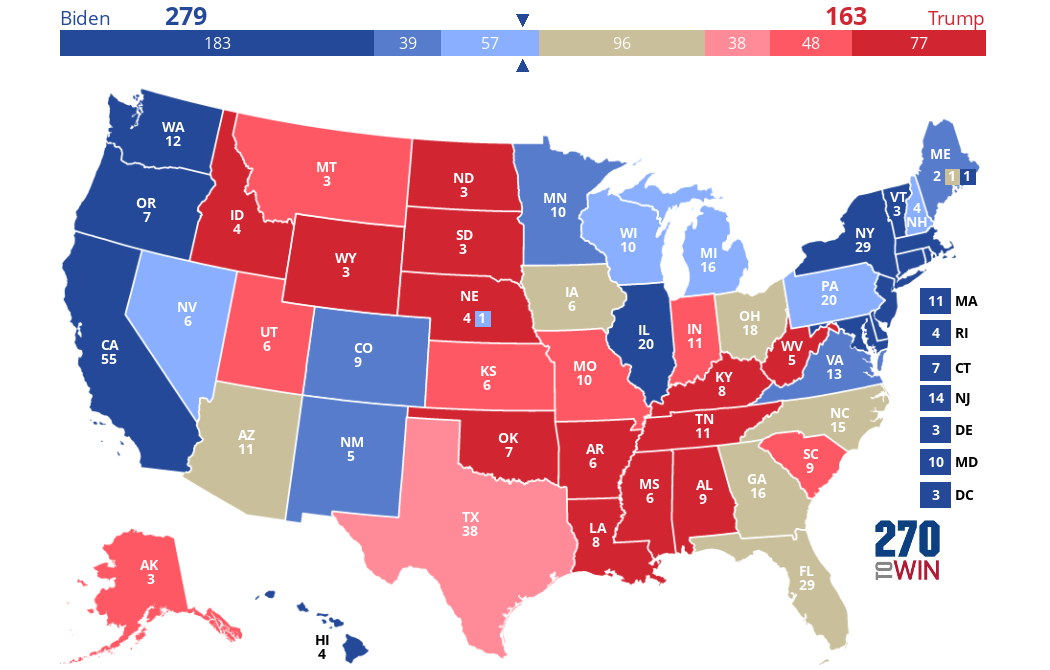
Three days from now we’ll start counting votes.  Here are the 270 to Win projections for the Presidency, the US Senate, the US House of Representatives, and Governor races.

2020 President: Consensus Electoral Map


Click the map to create your own at 270toWin.com


States to Watch most closely are Texas, Florida, Pennsylvania and Ohio.  If Biden wins either of the first two or both of the second two, it’s over.  I see no way Trump* can win in either case.

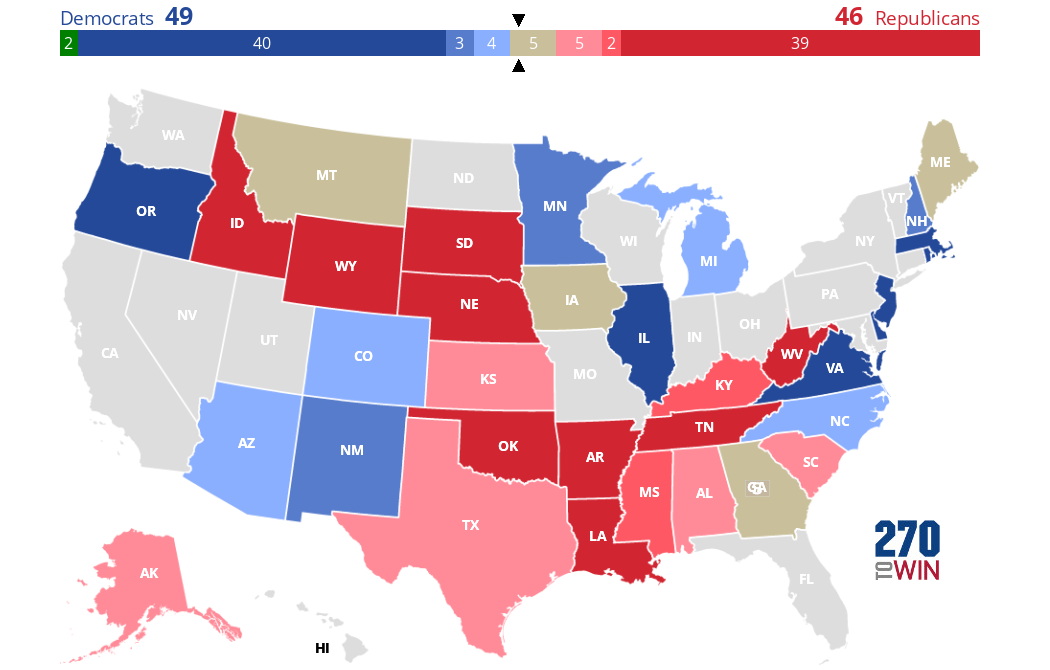
2020 Senate Election Interactive Map


Click the map to create your own at 270toWin.com


Which races are most familiar to you, and what can you tell us about them?  In Oregon, Jeff Merkley should clobber Jo Rae Perkins, an Ammosexual QAnon nut-case, in a landslide.  The problem we face is is that even if we win the blue projections and all five toss-ups, we’ll have only 54, Republicans will be able to block most of our agenda, UNLESS we nuke the the filibuster.  We need to be every bit as willing to use our power as Republicans have been to use theirs.  That’s how they have screwed us for the last eight years.

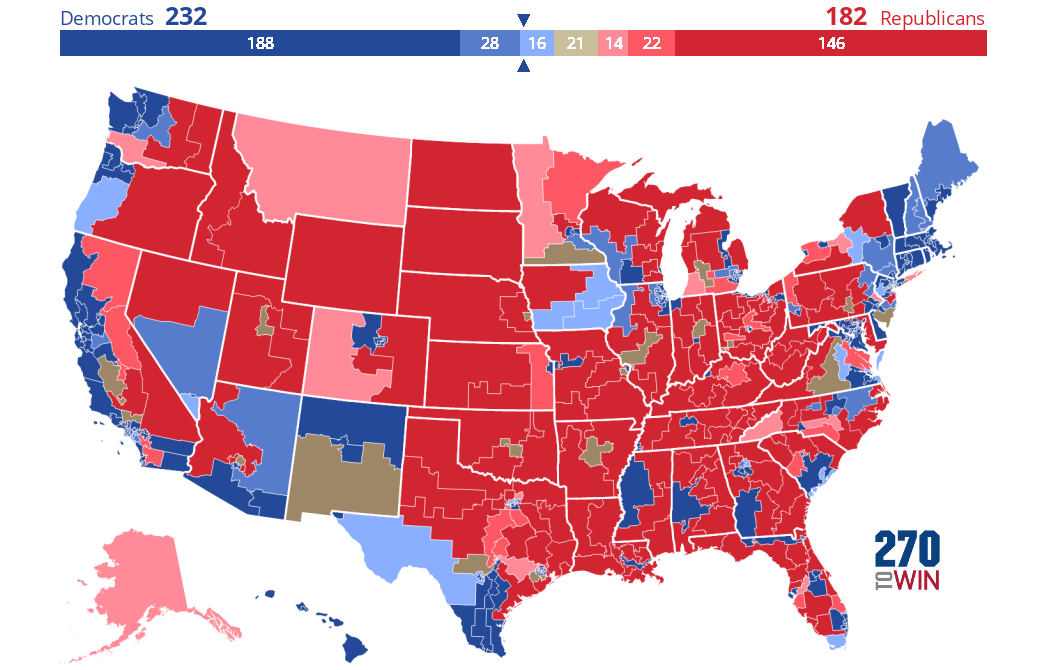
2020 House Election Interactive Map


Click the map to create your own at 270toWin.com


In the House we are doing well, but unless the corporate wing of the party is willing to put the people’s need over the 1%’s greed, we will not be able to hold onto power.

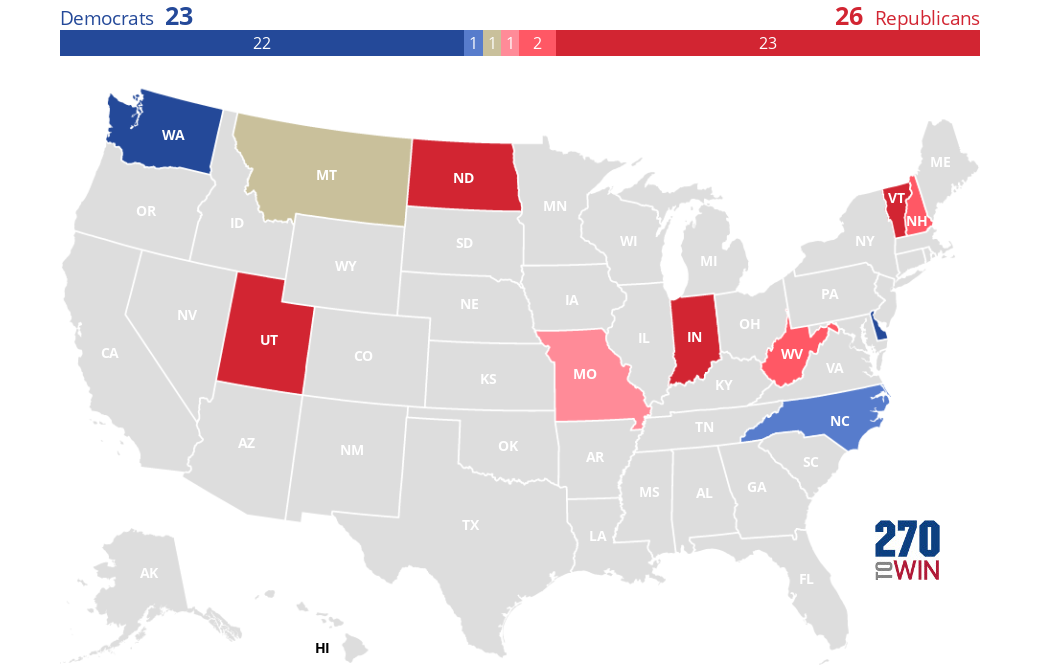
2020 Gubernatorial Elections Map


Click the map to create your own at 270toWin.com


Getting control at the state and local levels is as important as, if not more important than the national level.  Click through to the site for excellent maps of State Houses ans State Senates that I cannot embed here.

I know you’ve seen this before, but here it is again:

RESIST!!

Vote Blue No Matter Who Top to Bottom!!

Share
Oct 312020
 

It’s a spooky day here in the CatBox.  The Republicosis still plagues me, but I have it under control.  Tomorrow is a WWWendy day day.  Then she is going to the coast until Thursday.  She needs a vacation.  Tomorrow is also a holy day in the Church of the Ellipsoid Orb.  My Broncos play the Chargers, but it won’t be televised locally.  In honor of the day, Boo2U2!

Jig Zone Puzzle:

Today’s took me 3:21 (average 5:01).  To do it, click here.  How did you too?

Cartoon:

Trump* Virus Update:

1031TrumpVirusMap

This map measures daily deaths per capita

US Cases: 9,324,833
US Deaths: 235,264
Plus all Trump*/GOP plague murders Republicans are hiding

Short Takes:

From The New Yorker: Democratic voters are anxiously awaiting Election Day in the hope that Democratic candidates and activists will finally stop texting them, a new poll shows.

In conversations with Democratic voters across the country, “No longer being texted by Democrats” has emerged as one of the most important issues to them in the 2020 campaign.

Dang, Andy! That isn’t satire; it’s gospel! If I had a nickel for every text, email, and/or phone call I’ve received from an organization dunning me that the future of our nation depends solely on my donation to that organization, I could damn near pay off the national debt!  RESIST!!

From YouTube (MSNBC Channel): Take Heart That Americans Still Believe In Democracy; Early Vote Numbers Prove It


I trust that you won’t mind if I pray like hell that Rachel is right. The early voting numbers are the best cause for hope I have seen! RESIST!!

From YouTube (a blast from the past): Fleetwood Mac – The Chain (Official Audio)


Ah… the memories!  We’ve been so long under a Republican Reich we nees some beauty in our lives.  RESIST!!

Vote Blue No Matter Who Top to Bottom!!

Share
Oct 312020
 

I’ve enabled CC where available – it’s not consistent.

Monologue – The Final Countdown

Al Franken – Do Something!

24 Things you don’t know about Amy Coney Barrett

The Party of White Grievance (possibly from overtime? NoCC) – I sure hope they’re wrong.

New Rule – Skip the Civil War

Share

Everyday Erinyes #238

 Posted by at 10:00 am  Politics
Oct 312020
 

Experts in autocracies have pointed out that it is, unfortunately, easy to slip into normalizing the tyrant, hence it is important to hang on to outrage. These incidents which seem to call for the efforts of the Greek Furies (Erinyes) to come and deal with them will, I hope, help with that. As a reminder, though no one really knows how many there were supposed to be, the three names we have are Alecto, Megaera, and Tisiphone. These roughly translate as “unceasing,” “grudging,” and “vengeful destruction.”

Quot homines, tot sententiae.” (Or in other words, “Opinions are like [fill in NSFW blank]; everybody has one.”) I have another election article I was ready to use, but it can wait. I suspect everyone’s nerves are as shredded as mine about, not the election itself, but the Trump* response to it, and this article addresses contested elections directly, and may (or, of course, not) be a calming influence, or at the very least give us ideas on how to be ready for anything.
================================================================

A contested election: 5 essential reads

What happens when an election is contested?
Gorilla Studio/Getty

Naomi Schalit, The Conversation

Democracy in America could hit a rough patch soon, as election officials tally votes in the presidential race. More than 350 lawsuits have already been filed this year across the country over how, where and when voters could cast ballots. One presidential candidate – Donald Trump – has refused to commit to accepting the election’s results.

All that sets up the country for a disputed presidential election, with recounts and court battles in key states and a nation left wondering both who will lead it and whether they should have faith in the election’s integrity. We asked five scholars to provide a history of contested elections in the United States and to explain what happens when an election is disputed. Here are those stories, from our archives.

1. Things should be OK

“If Trump refuses to accept defeat in November, the republic will survive intact, as it has 5 out of 6 times in the past.” That’s the headline on political scientist Alexander Cohen’s story.

Cohen lays out what elections normally do: They “generate legitimacy because citizens contribute to the selection of leadership.” And even in contested elections of the past, he continues, that legitimacy has been sustained because those disputes have been handled according to the rules. Politicians and citizens may have “howled” about the unfairness of the outcome, but, Cohen reports, they accepted it.

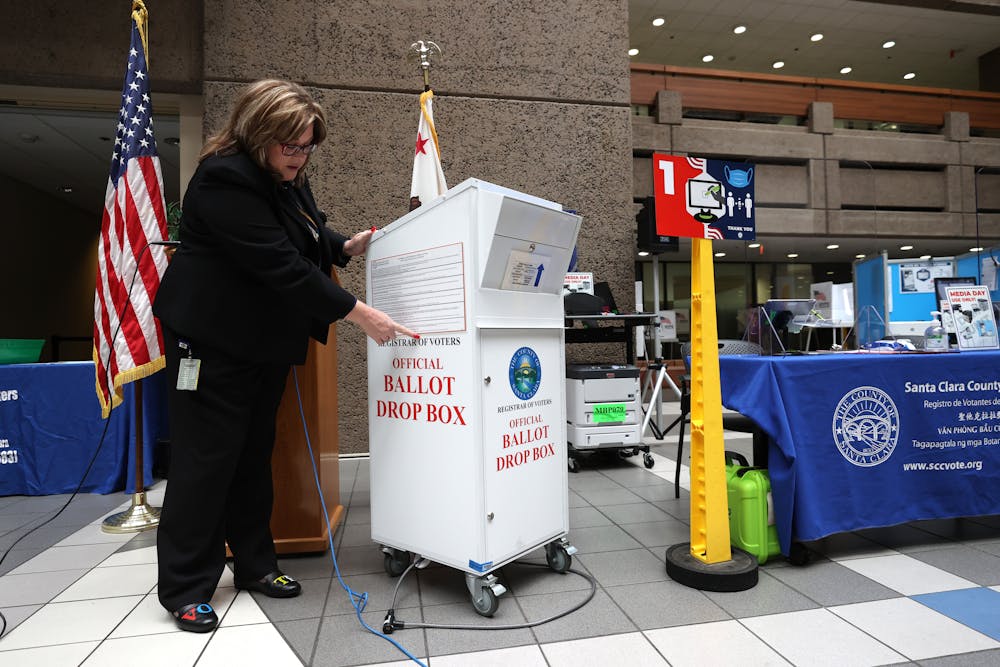
Santa Clara County Registrar of Voters' Shannon Bushey shows an official county ballot collection box
Santa Clara County Registrar of Voters’ Shannon Bushey shows an official county ballot collection box on Oct. 13, 2020 in San Jose, California.
Justin Sullivan/Getty Images

2. How to get to the Supreme Court

State law controls almost every aspect of voting, so if there’s an election dispute, then it will go to a state court, writes constitutional scholar John Finn. “A candidate who wants to challenge the result in any particular state must first identify what provision of state law the election did not satisfy.” Most of the time, a state court decision will determine which presidential candidate gets the state’s electoral votes, with a final decision made by the state’s supreme court.

But then there is Bush v. Gore, the case that settled the 2000 election, which demonstrated that an election dispute can end up being heard by the Supreme Court if someone charges that a federal constitutional right has been violated. It’s possible, Finn writes, that several challenges similar to Bush v. Gore could arise in the 2020 election. “And where the lawsuits involved in Bush v. Gore all originated in Florida,” he writes, “this time the chaos may reach across several states.”

3. Throw the vote to Congress

There is another way that an election can end up being decided by others than the voters and the Electoral College. Not when it’s a disputed election, but when the Electoral College members are tied or don’t give any candidate a straight majority. That throws the election to the House of Representatives.

Political scientist Donald Brand writes that this method of determining a winner was not exactly the first choice of the framers, who “sought to avoid congressional involvement in presidential elections.” But if the Electoral College couldn’t provide a majority vote for one candidate, the election would wind up in the House, “presumably because as the institution closest to the people, it could bestow some democratic legitimacy on a contingent election.”

The front of the US Supreme Court building.
Could the presidential election be decided by the Supreme Court?
Astrid Riecken For The Washington Post via Getty Images

4. Stolen elections leave bitterness

The republic may survive, but some disputed elections have “divided the nation, in ways that were hard to heal, or perhaps never healed.”

Political scientist Sarah Burns says that the election of 1824, which was resolved with what was then called a “corrupt bargain,” and the disputed 2000 election, which was effectively ended by the Supreme Court, both caused such anger that they poisoned national politics for some time. Critics of the court’s decisive role in 2000 pointed out that “Bush had failed to win the popular vote, and that the Supreme Court vote was split 5-4, with the conservative justices in the majority delivering an outcome favorable to their political leanings.”

5. Judicial credibility

Judges like to stay in their branch of government – the judiciary – and leave the politics to politicians. Supreme Court Justice Felix Frankfurter warned his fellow jurists to avoid “embroilment” in “the political thicket” of “party contests and party interests.” But a disputed election will be fought in the courts, and that’s dangerous for the standing of any court, especially the U.S. Supreme Court. Voters will see judges’ actions and ascribe political intent to them, even if that’s not the case.

Austin Sarat, a legal scholar and political scientist, rakes into a pile the hundreds of lawsuits that have already been mounted over how the election is conducted this year, describing what they aim to do. He believes that the election’s outcome is likely to end up in court – and he says there’s danger ahead, for the lower courts as well as the Supreme Court.

“Whatever decisions judges make this year, the rush to the courthouse to shape the 2020 election will pose real challenges for their legitimacy, which ultimately depends on the public’s belief that they are not simply political actors.”

Editor’s note: This story is a roundup of articles from The Conversation’s archives.The Conversation

Naomi Schalit, Senior Editor, Politics + Society, The Conversation

This article is republished from The Conversation under a Creative Commons license. Read the original article.

================================================================
AMT, anything you can do to help ensure that we don’t have to worry about this will be deeply appreciated by all.

The Furies and I will be back

Share
Oct 302020
 

Biden campaign – almost 5 minutes, bilingual (CC both languages), could help with Latinx voters.

Meidas Touch

Really American – Simple minded maybe, but the number of people ignorant onthis point is appalling.

The Lincoln Project (Puerto Rico)

Win American Back PAC – the name is ungrammatical, but the ad is amusing.

New Randy Rainbow !!!

Keith (in case you missed it yesterday, he was out Wednesday taking a CoViD test, which turned out negative, thank God.)

Share
Oct 302020
 

It’s a tired day here in the CatBox.  My Republicosis last night was severe enough that I had to get up, pop on George, and make the mad dash three times.  Sadly, ice cream before bed was a bad idea.  I’m waiting for Diana to come.  She is due momentarily.  Tomorrow I hope to post a series of election maps.  TGIF!  (Diana just came.)

Jug Zone Puzzle:

Today’s took me 5:29 (average 9:21).  To do it, click here.  How did you do?

Cartoon:

Trump* Virus Update:

1030TrumpVirusMap

Click for more maps

US Cases: 9,220,428
US Deaths: 234,262
Plus all Trump*/GOP plague murders Republicans are hiding

Short Takes:

From Daily Kos: According to a just-released study, the risk of interference in the coming election by far-right “Patriot” militiamen heavily aligned with Donald Trump is not only real, it’s growing intense in over half the states in the nation, with five states in particular likely to see disruptive behavior and perhaps violence: Georgia, Michigan, Pennsylvania, Wisconsin, and Oregon.

Compiled by the Armed Conflict Location & Event Data Project (ACLED), the study gathered and examined “the latest data on right-wing militia organizations across the country, identifying the most active groups and mapping the locations most likely to experience heightened militia activity before, during, and after the election.” What it found should send up warning flares to officials at all levels concerned about election security, as well as among law enforcement officers who seem to be currently preoccupied with election-related civic violence coming from the left.

Pennsylvania is the tipping-point battleground state that should give Joe Biden his 270th electoral vote, and Republicans are doing all they can to suppress the vote. No matter where you live, click here to volunteer for a virtual get-out-the-vote activity in Pennsylvania.

As strongly as I support GOTV activity, I urge lefties to avoid confrontations with Republican Nazis. Every time one unarmed left winger defends herself or himself against 50 heavily armed Republican Nazi Gestapo, it will be reported as a left-wing assault.  RESIST!!

From YouTube (MSNBC Channel): Jocelyn: Voters Have Right To Cast Ballot ‘Free From Intimidation And Harassment’


The notion that Republican Ammosexuals are allowed to display their guns at a polling place boggles my mind. The best weapons for self defense are ballots, not bullets!  RESIST!!

From YouTube (CNN Channel): They say they are married to ‘deplorables’. So they formed a support group


God! Those poor women! Can you imagine the horror of being married to a deplorable Ammosexual idiot who measures penis size in caliber? RESIST!!

From YouTube (a blast from the past): The Beatles – Here Comes The Sun (2019 Mix)


Ah… the memories! Protest like the 60s!  RESIST!!

Vote Blue No Matter Who Top to Bottom!!

Share
Oct 292020
 

The world is dealing with an unprecedented health crisis caused by a new virus. With new insights in the way COVID19 spreads, in the way the virus behaves and in the way to deal with the pandemic every day, it is now more important than ever to safeguard the information we share is accurate and fact-based. We have to inoculate ourselves against the fake news and misinformation that infect our newsfeeds and timelines at this crucial moment by fact-checking.*

This inoculation against misinformation is a special US election edition, put together by Ellen McCutchan, RMIT ABC Fact Check, touching on as many false coronavirus claims from both presidential candidates that could fit into this article – from the first uses of the word “pandemic” to the politically charged hydroxychloroquine debate – and weighed the facts around voting by mail.


Donald Trump’s most egregious false coronavirus claims

Reuters: Tom Brenner

Since assuming office in January 2017, US President Donald Trump has served up more than 22,000 false claims, according to the Washington Post Fact Checker, of which more than 13,000 have been related to the coronavirus pandemic.

Fact Checker uses a system of “Pinocchios” by which to judge claims – the more Pinocchios a claim is awarded, the less factual it is considered.

So, which of Mr Trump’s coronavirus claims have been deemed his biggest whoppers?

While Fact Checker usually caps the number of Pinocchios it awards to four, in cases where a false statement is repeated more than 20 times “bottomless” Pinocchios come into play, as is the case with Mr Trump’s claim (repeated 42 times) that hydroxychloroquine is a cure for COVID-19.”On June 15, [the Food and Drug Administration] withdrew its emergency use authorisation for hydroxychloroquine, concluding that it ‘is no longer reasonable to believe’ that hydroxychloroquine and chloroquine are effective in treating the disease,” the Post noted.

A claim that former President Barack Obama left behind no ventilators when he left office was awarded bottomless Pinocchios by the Post team – in fact, 16,600 working ventilators were part of the national stockpile of healthcare equipment when Mr Trump became president.

Another suggestion from Mr Trump that the Obama administration left the US unprepared for a pandemic due to “red tape” and regulations which slowed efforts to roll out testing was awarded four Pinocchios, as were comments about Mr Obama’s handling of the 2009 outbreak of swine flu.

Also earning the Post’s four Pinocchio rating was a claim – repeated 12 times in various guises by Mr Trump – that the wall being built on the Mexico border had prevented a larger outbreak of COVID-19 in the US.

“Public health experts said [the wall] made no difference because travellers from China and Europe brought the virus to the United States and it spread over following months due to lax and inconsistent public health measures inside the country,” the fact-checkers said.


Some of Joe Biden’s coronavirus claims were wide of the mark also

Reuters: Brian Snyder

While Mr Trump’s false coronavirus claims may number in the thousands, his opponent hasn’t been immune from spreading a few falsehoods of his own.

Fact checkers at PolitiFact found, for instance, that despite a claim from Democratic challenger Joe Biden to the contrary, Mr Trump could not have prevented every COVID-19 death in the US had he “done his job from the beginning”.

“A more robust handling of the pandemic would likely have seen the country’s death count significantly reduced, but not to zero,” public health experts told PolitiFact.

The publication also found Mr Biden had exaggerated remarks made by Mr Trump in regards to curing COVID-19. While Mr Biden claimed Mr Trump had told Americans infected with the virus they “may be OK” if they drank bleach, the fact -heckers reported that the President was less explicit in his suggestion.

“Trump did not specifically recommend ingesting disinfectants, but he did express interest in exploring whether disinfectants could be applied to the site of a coronavirus infection inside the body, such as the lungs,” they reported.

FactCheck.org, meanwhile, delved into the archives in order to revisit Mr Biden’s early statements on the coronavirus pandemic.

In one example, the fact-checkers found that a claim made by Mr Biden in September, that he had labelled the coronavirus crisis a pandemic as early as January, was an exaggeration of a warning he issued that the virus could turn into a pandemic.

According to FactCheck.org, Mr Biden also exaggerated how early he had taken a stance on the use of face masks to curb the spread of the virus.

“We couldn’t find any instances of Biden ‘all the way back in March … calling for the need for us to have masks’, as he claimed.”

Finally, the fact-checkers found that a claim made by Mr Biden during the Democratic National Convention that the US response to the pandemic was “by far the worst performance of any nation on Earth” was missing context. Using figures available at the time of the claim in August, FactCheck.org concluded that while Mr Biden’s claim was “true based on the raw totals of COVID-19 cases and deaths, the US is not the worst when adjusted for population or on other metrics”.

The facts on mail-in voting

AP: Rich Pedroncelli

Elections in the midst of a global pandemic are a fraught exercise, perhaps especially in the US, where the notion of swathes of voters attending polling stations while the country records more than 60,000 new daily cases of COVID-19 seems downright dangerous.

Voting by mail might seem like an obvious solution, but for many states it’s not that clear cut.

Some states, such as Arizona, will allow anyone to vote by mail, should they request to do so. Others, including California, have sent a mail-in ballot to all registered voters, regardless of whether they requested one. In states like Indiana, however, voters must provide a reason, such as illness, as to why they can’t make it to the polling booth on election day, while in Wisconsin, a witness is required for voters marking their mail-in ballot.

With up to 50 per cent of votes expected to be cast by mail in next week’s election, Mr Trump has, throughout his campaign, issued a steady stream of claims as to the validity and security of such voting. But what do the fact checkers say?

Back in September, FactCheck.org compiled a list of Mr Trump’s repeated false claims about mail-in voting.

They ruled as false a claim that “millions of mail-in ballots will be printed by foreign countries” leading to a “rigged” election, given the “numerous logistical hurdles”, such as bar codes and signature checks, that would need to be jumped in order to get large numbers of fake ballots past the scrutiny of election officials.

“After [FactCheck.org’s] story, US intelligence officials in a background briefing with reporters said they have not seen any foreign attempts to counterfeit mail-in ballots,” the fact checkers said.

Another Trump claim, that the Democratic Party had sent out 80 million unsolicited ballots in order to “harvest” votes, was likewise found to be false.

“Mail ballots will be sent automatically to eligible registered voters in only nine states and the District of Columbia,” FactCheck.org said. “That’s about 44 million ballots – not 80 million – and they will be going to Republicans as well as Democrats and independents.”

More recently, a tweet from Mr Trump claiming there had been “big problems and discrepancies with mail-in ballots all over the US” was this week labelled by Twitter as containing “disputed” content which may be “misleading”.

“While mail-in ballots have proved to be secure and are already used broadly in several states, the President has issued false and misleading information about the process,” Politico reported, in reference to the label.

Meanwhile, a Facebook post claiming Mr Trump had already voted twice in the election was deemed false by PolitiFact.

“Trump voted in person at a library in Palm Beach County Oct. 24,” the fact checkers said. “The Supervisor of Elections said he did not vote twice in the general election.”

compiled by gaming website Polygon


*The facts in this article are derived from the Australian RMIT ABC Fact-check newsletters which in turn draw on their own resources and those of their colleagues within the International Fact-Checking Network (IFCN), of which RMIT ABC Fact-check is a member.
Share