Joanne Dixon

Everyday Erinyes #194

 Posted by at 9:00 am  Politics
Nov 302019
 

Experts in autocracies have pointed out that it is, unfortunately, easy to slip into normalizing the tyrant, hence it is important to hang on to outrage. These incidents which seem to call for the efforts of the Greek Furies (Erinyes) to come and deal with them will, I hope, help with that. As a reminder, though no one really knows how many there were supposed to be, the three names we have are Alecto, Megaera, and Tisiphone. These roughly translate as “unceasing,” “grudging,” and “vengeful destruction.”

About the last thing I am is a social media expert – well, in fact, it’s not even on the list. I am aware that a “tag” is not the same thing as a “hashtag,” and that’s about as far as my knowledge goes. But since we got into the subject of tags this week, I thought this information might be interesting – even if you never use, or at least never create, either one.
==================================================================

Political hashtags like #MeToo and #BlackLivesMatter make people less likely to believe the news

News outlets sometimes use hashtags to promote their stories.
13_Phunkod/Shutterstock.com

Eugenia Ha Rim Rho, University of California, Irvine

Whether you’re a conservative or a liberal, you have most likely come across a political hashtag in an article, a tweet or a personal story shared on Facebook.

A hashtag is a functional tag widely used in search engines and social networking services that allow people to search for content that falls under the word or phrase, followed by the # sign.

First popularized by Twitter in 2009, the use of hashtags has become widespread. Nearly anything political with the intent of attracting a wide audience is now branded with a catchy hashtag. Take for example, election campaigns (#MAGA), social movements (#FreeHongKong) or calls for supporting or opposing laws (#LoveWins).

Along with activists and politicians, news companies are also using political hashtags to increase readership and to contextualize reporting in short, digestible social media posts. According to Columbia Journalism Review, such practice is a “good way to introduce a story or perspective into the mainstream news cycle” and “a way to figure out what the public wants to discuss and learn more about.”

Is this really true?

Our experiment

To find out, we conducted a controlled online experiment with 1,979 people.

We tested whether people responded differently to the presence or absence of political hashtags – particularly the most widely used #MeToo and #BlackLivesMatter – in news articles published on Facebook by major news outlets, such as The New York Times and NPR.

We randomly showed each person a news post that either contained or excluded the political hashtag. We then asked them to comment on the article and answer a few questions about it.
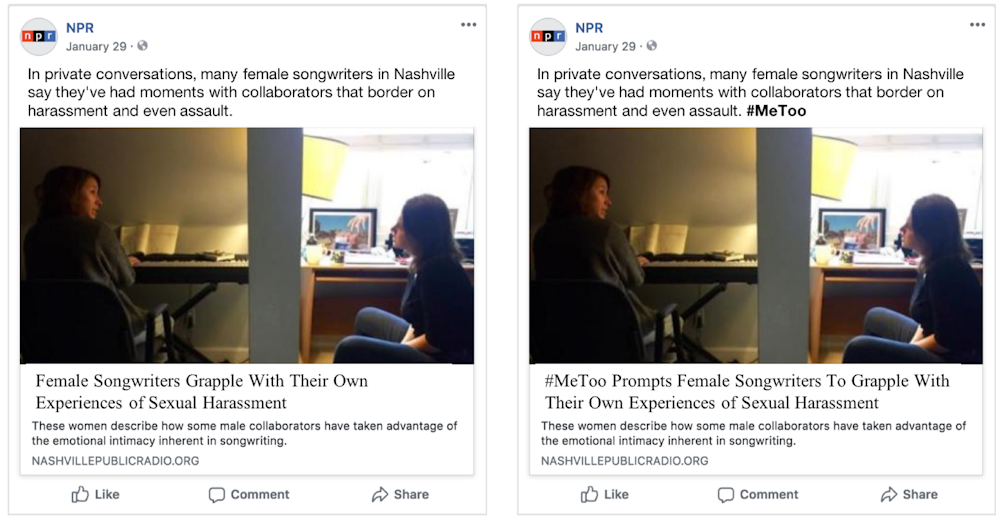
The original news post was identical to the one the right, except for the bolded #MeToo followed by the text description. For the control condition (left), we excluded the hashtag in the post text, as well as the phrase ‘#MeToo Prompts’ in the headline.
Eugenia Ha Rim Rho

We discovered that political hashtags are not a good way for news outlets to engage readers.

In fact, when the story included a hashtag, people perceived the news topic to be less important and were less motivated to know more about related issues.

Some readers were also inclined to view news stories with hashtags as more politically biased. This was especially true for more conservative readers, who were more likely to say a news post was extremely partisan when it included a hashtag.

Similarly, hashtags also negatively affected liberal readers. However, readers who identified themselves as “extremely liberal” did not perceive social media news content about gender and racial issues as partisan, regardless of hashtag presence.

Political moderates

What really interested me was the reaction from people in the middle. People who identified as politically moderate perceived news posts to be significantly more partisan when the posts included hashtags.

In fact, in their comments, politically moderate respondents who saw news posts with hashtags were more suspicious about the credibility of the news and focused more on the politics of the hashtag.
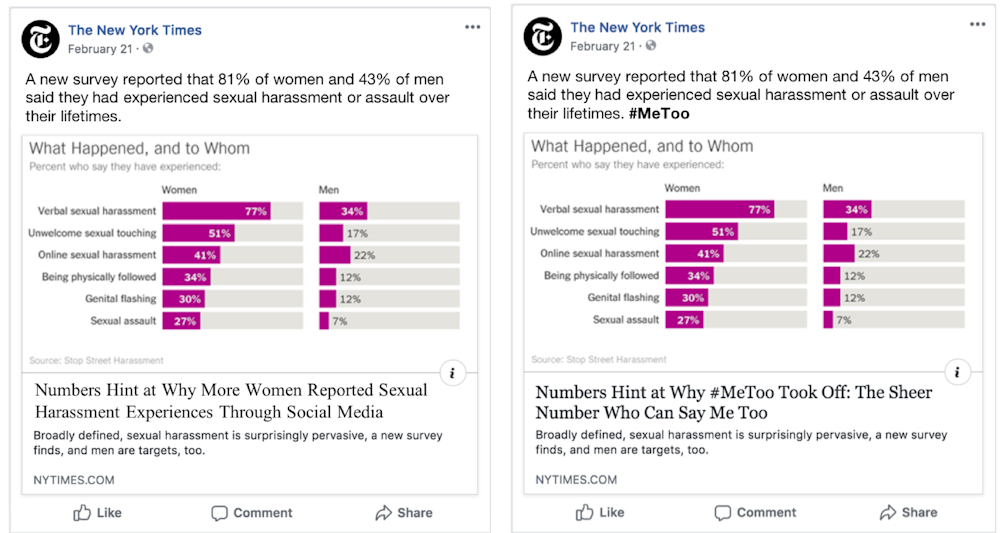
The news post on the right is identical to the original news post published on Facebook, except for the bolded #MeToo hashtag in the post text, which was not included in the original version.
Eugenia Ha Rim Rho

For example in the hashtag group, politically moderate people repeatedly mention the hashtag without substantially engaging with relevant social issues:

“The #MeToo topic is turning into something like the Kardashians. You can’t look at the news without both of them headlining things. It is an important issue, but I am getting tired of seeing it over and over.”

By contrast, when hashtags were absent, readers were more likely to discuss the core ideas and values the hashtag was originally meant to represent.

“Giving a platform and voice to victims via social media is a great way to share one’s experience when one is to uncomfortable to do so publicly. Some people are too afraid to report any harassment or assaults due to being labeled a liar so I’m glad there’s a way to keep track of these instances without them going unheard.”

The language used by participants from the hashtag group in their comments was more emotionally extreme. Even those who seemed to be in favor of the hashtag movement used aggressive language to convey support of the movement and referred to those against it as “You idiots,” claiming, “there’s a reason why [#MeToo] f****-ing exists, dimwits!!”

Fostering better online discourse

These findings show that politicians, activists, news organizations and tech companies cannot take common social media practices for granted.

Even a simple practice, like branding a social topic with a catchy hashtag, can give off the impression to the public that hashtagged content, even news content published by major news companies, is hyper-partisan or untrue.

If we want to build and sustain healthy discussions online, then we need to start questioning how such practices influence the democratic health of the internet.

Using a hashtag can rapidly draw audience attention to pressing social issues. However, as our study shows, such viral momentum may be detrimental to online discussion around pressing social topics in the long run.

[ You’re smart and curious about the world. So are The Conversation’s authors and editors. You can read us daily by subscribing to our newsletter. ]The Conversation

Eugenia Ha Rim Rho, Ph.D. Candidate in Information and Computer Sciences, University of California, Irvine

This article is republished from The Conversation under a Creative Commons license. Read the original article.

==================================================================
Alecto, Megaera, and Tisiphone, perhaps this information is more useful to those who are “influencers” or even wannabe influencers, than to ordinary people. On the other hand, we who are the “influenced” are, I believe, assisted to make better decision when we are aware exactly how we get influenced – what those who want to influence us are hoping to achieve with various techniques. Help us stay alert.

The Furies and I will be back.

And P. S. I realize I posted at odd times last weekend, since I was traveling. But if you missed either or both of these two links, you owe it to yourself to look now:


“Grab Life …”

Latest Randy Rainbow

Share

Everyday Erinyes #193

 Posted by at 6:52 am  Politics
Nov 232019
 

Experts in autocracies have pointed out that it is, unfortunately, easy to slip into normalizing the tyrant, hence it is important to hang on to outrage. These incidents which seem to call for the efforts of the Greek Furies (Erinyes) to come and deal with them will, I hope, help with that. As a reminder, though no one really knows how many there were supposed to be, the three names we have are Alecto, Megaera, and Tisiphone. These roughly translate as “unceasing,” “grudging,” and “vengeful destruction.”

Well, this is scary. I have known about Candida albicans for quite some time – 40-60% of us have some somewhere in our gut, but our immune systems generally keep it in check. In the mid-eighties, when DH and I both started allergy treatment, we were routinely tested for it; because of allergies tying up the immune system, it can get out of control if you have some, and especially food allergies. It was then treated with nystatin or some similar drugs,

I certainly never knew that, or why, it’s so hard to come up with antifungal drugs that aren’t as bad as the fungus itself. Candida albicans, the Candida which causes “thrush,” used to be considered annoying, but controllable. No one knew about these other strains of Candida Boy, have things changed! And rapidly!

=================================================================

Why the CDC warns antibiotic-resistant fungal infections are an urgent health threat

This is a medical illustration of an drug-resistant fungus, Aspergillus fumigatus.
Stephanie Rossow/CDC

Cornelius (Neil) J. Clancy, University of Pittsburgh

In 2013 I took care of a gentleman who underwent surgery for what all his physicians, including me, thought was liver cancer. Surgery revealed that the disease was a rare but benign tumor, rather than cancer. As you might imagine, he and his family were overjoyed and relieved.

However, two weeks after this surgery, he developed a liver abscess – an encapsulated tissue infection. Surgeons operated to remove the abscess. Two days later, test results revealed that the abscess was caused by a fungus called Candida that was resistant to echinocandins, our most powerful drugs against this fungus.

The patient underwent multiple surgeries and received various antibiotics thereafter, but his abscess kept growing back. He died four weeks after the first surgery to remove the abscess. The cause of death was sepsis due to his echinocandin-resistant Candida infection, which, at the time, was uncommon in the U.S. This tragic case demonstrated to me firsthand the devastating impact of drug-resistant fungal infections.

In the years since, I have cared for over a dozen patients who have died due to antibiotic-resistant fungal infections. On Nov. 13, 2019, the Centers for Disease Control and Prevention released a report on antibiotic resistance threats in the U.S., warning that drug-resistant fungi have become major public health problems.

The new report revealed that 18 microorganisms cause almost 3 million antibiotic resistant infections and 35,000 deaths annually. For the first time, this report includes several antibiotic resistant fungi: Candida auris, other drug-resistant Candida (as in my patient above) and azole-resistant Aspergillus fumigatus. These resistant fungi are especially threatening because only three classes of antifungal medicines are currently available.

Antibiotic-resistant fungi?

We have heard a lot in recent years about the public health crisis of antibiotic-resistant bacteria, but less attention has been paid to antibiotic-resistant fungi. In part, this is because fungi became common causes of disease only over the past 30 years. During this time, the risk for serious fungal infections rose as more people suffered weakened immune systems stemming from increased bone marrow and organ transplantation, new drugs to treat cancer and other diseases, and complex surgeries. The widespread use of more potent antibiotics to treat resistant bacterial infections also has contributed by creating less competition for fungi to grow in human tissues.

Candida auris cultured in a petri dish. Some strains are resistant to all three major classes of antifungal drugs.
Shawn Lockhart/ CDC/ NCEZID; DFWED; MDB

Fungi include yeasts, which grow as spherical cells; and molds, which grow as elongated, tubular cells. Both yeasts and molds are more closely related genetically to humans than they are to bacteria. Therefore, it is hard to develop antibiotics that attack fungi without damaging human cells.

Candida are yeasts that commonly cause skin rashes, urinary tract infections and vaginal infections. However, they are also the third-leading cause of sepsis and other life-threatening infections in U.S. hospitals.

Candida auris was discovered in 2009, but it was almost never encountered in a medical setting until 2015, when numerous infections suddenly occurred on multiple continents. It is now one of CDC’s five most “urgent threats” for two principal reasons.

First, it demonstrates very high-level antifungal resistance. Ninety percent of strains are resistant to fluconazole, the frontline antifungal in many countries; 30% are resistant to two antifungal classes; and between 3% and 5% to all antifungals.

Another reason that the CDC is concerned about C. auris is that it has the unique ability to spread from person to person through contact with hands and clothes of health-care workers or contaminated medical devices. It also persists outside of humans in health-care environments, and causes large, long-standing infectious outbreaks. C. auris is a remarkably robust organism that can survive standard disinfection methods, high temperatures and salt solutions that kill other microbes.

Since the first U.S. case in 2016, C. auris has caused more than 800 infections in 13 states. CDC and local health departments currently are working to contain numerous health-care outbreaks. It is unclear why this fungus has arisen now, although climate and other environmental changes may have played a role. Likewise, it is unclear how widely C. auris will expand in the U.S. or globally.

It’s not just C. auris we need to worry about

Aspergillus fumigatus grown from a soil sample.
Dr. David Midgley., CC BY

Other drug-resistant fungi in the Candida family are also considered “serious threats” by CDC. These strains cause more than 34,000 infections annually, more than are caused by C. auris, but they are less likely to spread from person to person and cause outbreaks. Nevertheless, deeply invasive C. auris and other drug-resistant Candida infections are similar in severity, resulting in the death of 40% of patients.

Another dangerous fungus species the CDC singled out is Aspergillus fumigatus, which is a mold found in soil and vegetation that releases spores that most people inhale daily without problems. However, people with weakened immune systems – especially cancer patients or transplant recipients – can develop lung or other organ infections that kill between 50% and 75% of infected patients.

Azole antifungals are the only drugs that kill A. fumigatus without causing serious side effects. Azoles also are used widely in agriculture. Azole-resistant A. fumigatus infections are most common in Europe, where they have been linked to agricultural and patient use. Although these infections still are uncommon in the U.S., CDC has placed azole-resistant A. fumigatus on its “resistance watch list” because azole use is so widespread in this country and vulnerable patient populations are large.

Tackling antibiotic-resistant fungi requires many strategies

How is the U.S. fighting antibiotic-resistant fungi? CDC and health departments are leading the way in surveillance for resistance and, in the case of C. auris, outbreak containment and prevention. Containment involves rapid and accurate diagnosis of C. auris infections, and the use of hospital gowns, gloves, equipment and cleaning materials that reduce the likelihood of spreading the fungus.

Various U.S. government agencies have funded research that is leading to new antifungal drugs and improved diagnostic tests.

Organizations that grade the quality of medical care for the public now require health-care facilities to have antibiotic stewardship programs that reduce inappropriate prescribing and development of resistance.

Efforts are underway also to control antibiotic use in agriculture and animals, since resistance cannot be tackled by only focusing on human medicine. CDC and other U.S. agencies are working closely with international partners, because antibiotic-resistant microbes do not recognize geographic borders. Finally, the crucial first step in tackling a problem is to recognize it, which is why the CDC report on antibiotic resistance threats is so important.

[ Deep knowledge, daily. Sign up for The Conversation’s newsletter. ]The Conversation

Cornelius (Neil) J. Clancy, Associate Professor of Medicine and Director of Mycology, University of Pittsburgh

This article is republished from The Conversation under a Creative Commons license. Read the original article.

=================================================================

Alecto, Megaera, and Tisiphone, this is an area which demonstrates quite vividly why we need to fund medical research – despite the machinations of all those who would defund it completely.Please! Help!

The Furies and I will be back.

Share

Everyday Erinyes #192

 Posted by at 10:00 am  Politics
Nov 162019
 

Experts in autocracies have pointed out that it is, unfortunately, easy to slip into normalizing the tyrant, hence it is important to hang on to outrage. These incidents which seem to call for the efforts of the Greek Furies (Erinyes) to come and deal with them will, I hope, help with that. As a reminder, though no one really knows how many there were supposed to be, the three names we have are Alecto, Megaera, and Tisiphone. These roughly translate as “unceasing,” “grudging,” and “vengeful destruction.”

OK, I admit it – I’m a fan of Harry Potter, and even a bigger fan of his creator (and proud to share a first name with her.) I’m proud of her when I read her political tweets – not as many as some people’s but always witty and telling. I’m a proud of her when I read that she makes sure to give enough to charity to prevent her from becoming a billionaire. But I’ve never been prouder of her than when I read about this campaign she is launching against one aspect of human trafficking I never considered – “voluntourism.”

Sure, there’s a need for child care in the world. Stuff happens. But it turns out that 8 out of every 10 children in orphanages have parents (and in some countries, the percentage is even higher – 9 to 9.5 out of 10.) And when those parents are living in poverty, someone who has started an orphanage in order to exploit the good will of volunteers (and foundations, and universities, and travel arrangers) who will pour money and services into them, can make those parents some tempting offers. And that leads to trafficking. Not necessarily the kind you probably were expecting, but trafficking nonetheless.

Here’s the hype – the website of “Projects Abroad,” one of the companies which will set up anyone 16 or over with a project, for a fee – shows lots of opportunities … starting at $1,770 for a week (there are a couple which are less expensive per week, but you have to do a minimum of two weeks to get them.) Looks like fun and a way to do something good, right? And some may be (but more about that below). But here’s where it gets glaringly problematic: some of these projects involve orphanages.

According to a report by Lumos, a London-based group founded by JK Rowling that seeks to end institutionalisation of children, one orphanage in Haiti, established by a US religious organisation after the earthquake in 2010, kept children malnourished and living in filth, with no stimulation. Yet it collected donations averaging $10,000 (£7,700) a year per child – much of which ended up in the director’s bank account, a former staff member alleged. That institution, which Lumos believes was engaged in trafficking and selling children for adoption to families in wealthy countries, recruited children using a baby-finder, who convinced poor parents their children would be better off in the institution. “We’ve seen it in Kenya, Uganda, Cambodia – eerily similar patterns,” says Alex Christopolous, deputy chief executive of Lumos. “Child-finders go into communities. They are paid $50 to $100 to identify [needy] families.” 

so what does it feel like to be a child living in one of these orphanages?

You can imagine how many people came to Africa to see the giraffes. So they would go the giraffe centre [adjacent to the orphanage] and take photos of the giraffes; come to the orphanage and take photos of me. We should never let children look like tourist attractions. 

said one young woman who grew up in one of these orphanages.

Certainly there is poverty world wide, and needs that are real. But in wealthy countries, orphanages have all but disappeared, because in these countries, resources go to families and communities. Child development experts will tell you that there is “no such thing” as a “good orphanage.”

Says Rowling,

If that money and that energy was repurposed into charities and projects that are supporting community services, or families, we could solve this problem within decades.

Her campaign, hashtag #HelpingNotHelping, is addressing the problem on two fronts. Her organization (named “Lumos,” because of course it is) is calling on businesses, schools, and universities to stop donating to orphanages and ensure they do not promote or take part in orphanage trips.

On the other end of the problem the effort is aimed at steering young travelers who want to make a difference to look for projects which tackle poverty, and/or support communities – communities of real families.

Even aside from orphanages, voluntourism can be problematic.

Voluntourism may be fuelled by noble feelings, but it is built on perverse economics. Many organisations offer volunteers the chance to dig wells, build schools and do other construction projects in poor villages. It’s easy to understand why it’s done this way: if a charity hired locals for its unskilled work, it would be spending money. If it uses volunteers who pay to be there, it’s raising money. 

And, of course, another thing that voluntourism does to some degree not only in orphanages, is that it gives the voluntourists the impression that poorer countries are filled with people who are too incompetent to do anything for themselves without help from “the West” – including people from “the West” who are pretty incompetent themselves. That is a stereotype believed by far too many people – of course, many who believe that have never in their lives given a dime or an hour to help someone else. The last thing the world needs is for people who really want to help make a difference thinking that way too.

Alecto, Megaera, and Tisiphone, please help young people, and their parents, and for that matter, their grandparents, realize that not everything is always as it seems, and that it pays to look for the deeper stories.

The Furies and I will be back.

Share

Everyday Erinyes #191

 Posted by at 9:54 am  Politics
Nov 092019
 

Experts in autocracies have pointed out that it is, unfortunately, easy to slip into normalizing the tyrant, hence it is important to hang on to outrage. These incidents which seem to call for the efforts of the Greek Furies (Erinyes) to come and deal with them will, I hope, help with that. As a reminder, though no one really knows how many there were supposed to be, the three names we have are Alecto, Megaera, and Tisiphone. These roughly translate as “unceasing,” “grudging,” and “vengeful destruction.”

Just when you thought it couldn’t get any worse …
==================================================================

The forgotten mass destruction of Jewish homes during ‘Kristallnacht’

A looted Jewish shop in Aachen, Germany on the day after Kristallnacht, Nov. 10, 1938.
Wolf Gruner and Armin Nolzen (eds.). ‘Bürokratien: Initiative und Effizienz,’ Berlin, 2001., Author provided

Wolf Gruner, University of Southern California – Dornsife College of Letters, Arts and Sciences

Every November, communities around the world hold remembrances on the anniversary of the Nazis’ brutal assault on the Jews during “Kristallnacht.”

Also known as “the Night of Broken Glass,” it’s one of the most closely scrutinized events in the history of Nazi Germany. Dozens of books have been published about the hours between Nov. 9 and 10, 1938, when Adolf Hitler and his propaganda minister, Joseph Goebbels, decided to unleash violence against Jews across Germany and the annexed territory of Austria with the aim of driving them out of the Third Reich.

Most accounts tend to emphasize the attacks on synagogues and shops, along with the mass arrests of 30,000 men. A few note the destruction of Jewish schools and cemeteries.

Attacks on Jewish homes, however, are barely mentioned.

It’s an aspect of the story that has rarely been researched and written about – until now.

A pattern emerges in survivor accounts

In 2008, when I arrived at the University of Southern California from Germany, I had been researching Nazi persecution of the German Jews for 20 years. I had published more than six books on the topic and thought I knew just about everything there was to know about Kristallnacht.

The university happened to be the new home of the Shoah Foundation and its Visual History Archive, which today includes over 55,000 survivor testimonies. When I started to watch interviews with German-Jewish survivors of the Holocaust, I was surprised to hear many of them talk about the destruction of their homes during Kristallnacht.

Details from their recollections sounded eerily similar: When Nazi paramilitary troops broke the doors of their homes, it sounded as though a bomb had gone off; then the men cut into the featherbeds, hacked the furniture into pieces and smashed everything inside.

In an interview recorded by USC’s Shoah Foundation that’s now in their Visual History Archive, Kaethe Wells explains how her family home was attacked by stormtroopers wielding axes during Kristallnacht.

Yet none of these stories appeared in traditional accounts of Kristallnacht.

I was perplexed by this disconnect. Some years later, I found a document from Schneidemühl, a small district in the East of Germany, that listed the destruction of a dozen synagogues, over 60 shops – and 231 homes.

These surprising numbers piqued my interest further. After digging into unpublished and published materials, I unearthed an abundance of evidence in administrative reports, diaries, letters and postwar testimonies.

A fuller picture of the brutal destruction of Jewish homes and apartments soon emerged.

For example, a Jewish merchant named Martin Fröhlich wrote to his daughter that when he arrived home the afternoon of that fateful November day, he noticed his door had been broken down. A tipped-over wardrobe blocked the entrance. Inside, everything had been hacked into pieces with axes: glass, china, clocks, the piano, furniture, chairs, lamps and paintings. Realizing that his home was now uninhabitable, he broke down and – as he confessed in the letter – started sobbing like a child.

A systematic campaign of destruction

The more I discovered, the more astonished I was by the scale and intensity of the attacks.

Using address lists provided by either local party officers or city officials, paramilitary SA and SS squads and Hitler Youth, armed with axes and pistols, attacked apartments with Jewish tenants in big cities like Berlin, as well as private Jewish homes in small villages. In Nuremberg, for example, attackers destroyed 236 Jewish flats. In Düsseldorf, over 400 were vandalized.

In the cities of Rostock and Mannheim, the attackers demolished virtually all Jewish apartments.

Documents point to Goebbels as the one who ordered the destruction of home furnishings. Due to the systematic nature of the attacks, the number of vandalized Jewish homes across Greater Germany must have been in the thousands, if not tens of thousands.

Then there are devastating details about the intensity of the destruction that emerge from letters and testimonies from postwar trials.

In Euskirchen, a house was burned to the ground.

In the village of Kamp, near the Rhineland town of Boppard, attackers broke into the house of the Kaufmann family, destroyed furniture and lamps, ripped out stove pipes, and broke doors and walls. When parts of the ceiling collapsed, the family escaped to a nearby monastery.

In the small town of Großauheim, located in the state of Hesse, troops used sledgehammers to destroy everything in two Jewish homes, including lamps, radios, clocks and furniture. Even after the war, shards of glass and china were found impressed in the wooden floor.

In an interview recorded by USC’s Shoah Foundation that’s now in their Visual History Archive, Ruth Winick recalls how men in green uniforms burst into her family’s home, destroying just about everything inside.

‘Everything ravaged and shattered’

The documents I found and interviews I listened to revealed how sexual abuse, beatings and murder were commonplace. Much of it happened during the home intrusions.

In Linz, two SA men sexually assaulted a Jewish woman. In Bremen, the SA shot and killed Selma Zwienicki in her own bedroom. In Cologne, as Moritz Spiro tried to stop two men from destroying his furniture, one of the intruders beat him and fractured his skull. Spiro died days later in the Jewish hospital.

In a letter dated Nov. 20, 1938, a Viennese woman described her family’s injuries to a relative:

“You can’t imagine, how it looked like at home. Papa with a head injury, bandaged, I with severe attacks in bed, everything ravaged and shattered… When the doctor arrived to patch up Papa, Herta and Rosa, who all bled horribly from their heads, we could not even provide him with a towel.”

The brutality of the attacks didn’t go unnoticed. On Nov. 15, the U.S. consul general in Stuttgart, Samuel Honaker, wrote to his ambassador in Berlin:

“Of all the places in this section of Germany, the Jews in Rastatt, which is situated near Baden-Baden, have apparently been subjected to the most ruthless treatment. Many Jews in this section were cruelly attacked and beaten and the furnishings of their homes almost totally destroyed.”

These findings make clear: The demolition of Jewish homes was an overlooked aspect of the November 1938 pogrom.

Why did it stay in the shadows for so long?

In the immediate aftermath of Kristallnacht, most newspaper articles and photographs of the violent event exclusively focused on the destroyed synagogues and stores – selective coverage that probably influenced our understanding.

Yet, it was the destruction of the home – the last refuge for the German Jewish families who found themselves facing heightened public discrimination in the years leading up to the pogrom – that likely extracted the greatest toll on the Jewish population. The brutal attacks rendered thousands homeless and hundreds beaten, sexually assaulted or murdered.

The brutal assaults also likely played a big role in the spate of Jewish suicides that took place in the days and weeks after Kristallnacht, along with the decision that tens of thousands of Jews made to flee Nazi Germany.

While this story speaks to decades of scholarly neglect, it is, at the same time, a testament to the power of survivor accounts, which continue to change the way we understand the Holocaust.The Conversation

Wolf Gruner, Shapell-Guerin Chair in Jewish Studies and Professor of History; Founding Director, USC Shoah Foundation Center for Advanced Genocide Research, University of Southern California – Dornsife College of Letters, Arts and Sciences

This article is republished from The Conversation under a Creative Commons license. Read the original article.

==================================================================
This knowledge isn’t really new; it’s been in public records since it happened. But it has been “lost” by so much more emphasis being placed on the destruction of shops, synagogues, and other public buildings (possibly because those places are where the glass is.) So it’s probably new to many readers here, as it is to me.

But this adds in the imagination a new insight into how many people were actually involved, and the organization which went into it. Half a dozen crazies, no matter how motivated, cannot do that much to 231 homes in one night, to use a figure from one area. Further, those records kept by the SS which were used to find the homes to destroy must have been painstakingly collected over a goodly period of time. Well – today we have Facebook. Oh, yes, and voters’ records databases.

Alecto, Megaera, and Tisiphone, not to be paranoid, but what should we do when we see this as a possibility under the current regime? Besides what we are already doing – fighting the regime with whatever skills and talents that we have.

The Furies and I will be back.

Share

Everyday Erinyes #190

 Posted by at 7:44 am  Politics
Nov 022019
 

Experts in autocracies have pointed out that it is, unfortunately, easy to slip into normalizing the tyrant, hence it is important to hang on to outrage. These incidents which seem to call for the efforts of the Greek Furies (Erinyes) to come and deal with them will, I hope, help with that. As a reminder, though no one really knows how many there were supposed to be, the three names we have are Alecto, Megaera, and Tisiphone. These roughly translate as “unceasing,” “grudging,” and “vengeful destruction.”

I’m staying away from the impeachment except to throw in details (mostly ones that stand out to me but are presented in the background), since it’s being so well covered by TC and his sources.

El Día de los Muertos is an important holiday here in the Southwest, and here we have the Colorado Springs Philharmonic presenting (I don’t think anyone else but me calls it this, but it feels right) a karaoke concert – the movie “Coco” will be screened with the musical score removed and replaced by a live performance of it by the orchestra – something that is gaining in popularity in classical music, and not just with silent films, obviously ( think the last one the CSP did was “Star Wars.”) But I digress.

There’s a lot of misunderstanding about El Día de los Muertos, even here, and especially about its history and roots. As Ms. Farah points out, we don’t really know that it was “Aztec,” just that its roots come from an area conquered by Aztecs (Not everything in the Roman Empire was Roman. More recently, not everything in the Austrian Empire was Austrian.) So I thought it might be a good day to look at it, and think about it, along with lost knowledge in general.
==================================================================

Day of the Dead: From Aztec goddess worship to modern Mexican celebration

Kirby Farah, University of Southern California – Dornsife College of Letters, Arts and Sciences

Day of the Dead might sound like a solemn affair, but Mexico’s famous holiday is actually a lively commemoration of the departed.

The nationwide festivities, which include a massive parade in Mexico City, typically begin the night of Oct. 31 with families sitting vigil at grave sites. Mexican tradition holds that on Nov. 1 and 2, the dead awaken to reconnect and celebrate with their living family and friends.

Given the timing, it may be tempting to equate Day of the Dead with Halloween, a ghost-themed U.S. holiday. But the two holidays express fundamentally different beliefs.

While Halloween has its origins in pagan and Christian traditions, Day of the Dead has indigenous roots as a celebration of the Aztec goddess of death.

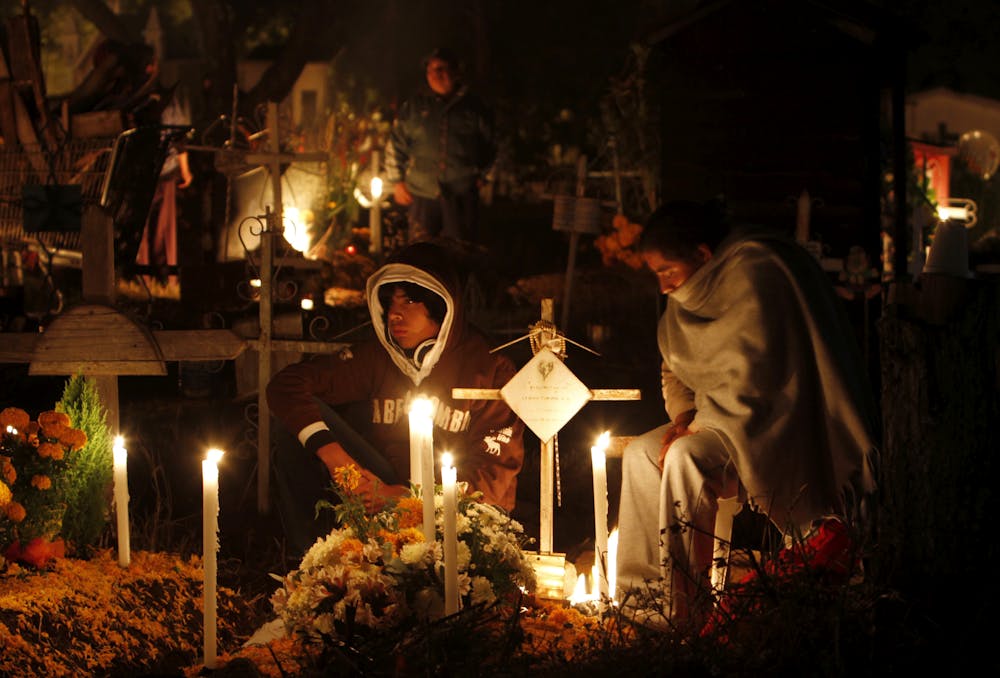
Mexico’s Day of the Dead begins with an overnight graveside vigil on Oct. 31.
AP Photo/Marco Ugarte

Mictecacihuatl, goddess of death

Day of the Dead can be traced back to the native peoples of central and southern Mexico, the regions where I conduct my archaeological research.

When the Spanish arrived in central Mexico 500 years ago, the region had millions of indigenous inhabitants. The conquistadores largely characterized them as Aztecs because, at the time, they were united under the expansive Aztec empire.

According to colonial period records, the Aztec empire was formed in A.D. 1427, only about a century before the arrival of Spanish . But the celebration that Mexicans now call Día de los Muertos almost certainly existed many centuries earlier, perhaps originating with the Toltec people of central Mexico.

In any case, by the time the Spanish conquistadors invaded in 1519, the Aztecs recognized a wide pantheon of gods, which included a goddess of death and the underworld named Mictecacihuatl. She was celebrated throughout the entire ninth month of the Aztec calendar, a 20-day month that corresponded roughly to late July and early August.

Mictecacihuatl’s underworld husband, Mictlantecuhtli, was also depicted in skeletal form.
Anagoria/National Museum of Anthropology of Mexico, CC BY-SA

Aztec mythology tells that Mictecacihuatl was sacrificed as a baby and magically grew to adulthood in the underworld, where she married. With her husband, she presided over the underworld.

Mictecacihuatl – who is often depicted with flayed skin and a gaping, skeletal jaw – was linked to both death and resurrection. According to one myth, Mictecacihuatl and her husband collected bones so that they might be returned to the land of the living and restored by the gods.

The Aztecs appeased these fearsome underworld gods by burying their dead with food and precious objects.

Archaeologists and historians know relatively little about the details of the month-long celebration of Mictecacihuatl, but say it likely involved burning incense, song and dance, and blood sacrifice – customary practices in many Aztec rituals.

Blending cultures

The Spanish invaders of Mexico were Catholic, and they worked hard to evangelize native peoples. To stamp out lingering indigenous beliefs, they demolished religious temples, burned indigenous idols and destroyed Aztec books.

But indigenous people in Mexico, as across the Americas, resisted Spanish efforts to eradicate their culture. Instead, they often blended their own religious and cultural practices with those imposed on them by the Spanish.

A calavera – Day of the Dead skeleton – all dressed up for that afterlife party.
Alfonso Martorell/Culture and Tourism Secretary of Morelia

Perhaps the best-known symbol of the ethnic and cultural mixing that defines modern Mexico is La Virgen de Guadalupe, a uniquely Mexican Virgin Mary.

Many Mexican Catholics believe that in 1531 the Virgin appeared to Juan Diego, an indigenous Mexican farmer, and in his native language of Nahuatl told him to build a shrine to her. Today the Basilica of Our Lady of Guadalupe in Mexico City is among the world’s most visited holy sites.

Day of the Dead is almost certainly a similar case of blended cultures.

Spanish conquerors faced difficulty in convincing native peoples to give up their rituals honoring death goddess Mictecihuatl. The compromise was to move these indigenous festivities from late July to early November to correspond with Allhallowtide – the three-day Christian observance of All Saints’ Eve, All Saints’ Day and All Souls’ Day.

With this move, the holiday was nominally connected to Catholicism. But many practices and beliefs associated with the worship of the dead remained deeply indigenous.

Día de los Muertos today

Contemporary Day of the Dead rituals were featured prominently in the 2017 Disney/Pixar film “Coco.” These include homemade sugar skulls, decorated home altars, the fantastical spirit animals called alebrijes and images of convivial calaveras – skeletons – enjoying the afterlife in their finest regalia.

The use of Mexican marigolds to adorn altars and graves on Day of the Dead probably has indigenous origins. Called cempasúchil by the Aztecs, the vibrant Mexican marigold grows during the fall. According to myth, the sweet smell of these flowers awaken the dead.

Mexico City’s annual Day of the Dead parade features floats of alebrijes, or spirit animals.
Juancho Lorant/Wikimedia, CC BY-SA

The elaborately decorated shrines to deceased loved ones, which usually contain offerings for the dead, may also have pre-Hispanic origins. Many indigenous peoples across Mesoamerica had altars in their houses or patios. These were used to perform household rituals, worship gods and communicate with ancestors.

The bones, skulls and skeletons that are so iconic of Day of the Dead are fundamentally indigenous, too. Many Aztecs gods were depicted as skeletal. Other deities wore bones as clothing or jewelry.

The Aztecs, who engaged in ritual human sacrifice, even used human bones to make musical instruments. The Aztec capital city of Tenochtitlan had a large bone rack, called a tzompantli, that stored thousands of human skulls.

And when Aztec commoners buried deceased family members under their own houses to keep them close, Mictecacihuatl became the formidable guardian of their bones.

That’s good reason, the Aztecs would say, to celebrate this goddess of death with breads, flowers and a killer three-day party.

This story has been updated to more accurately characterize the origins of Halloween.The Conversation

Kirby Farah, Lecturer of Anthropology, University of Southern California – Dornsife College of Letters, Arts and Sciences

This article is republished from The Conversation under a Creative Commons license. Read the original article.

==================================================================
One person in the comments was excited, having long seen parallels between El Día de los Muertos and the Japanese festival O-bon, to learn that the pre-Columbian festival was longer than a day or three, and was originally in late summer – both characteristics of O-bon. (This leads to the question, when exactly did people from Asia cross that no-longer-existing land bridge, and from where in Asia?) I’m not qualified to go there, so I won’t, but it makes one think.

Alecto, Megaera, and Tisiphone, help us to stay open to learning about other people, and about their history and customs – when we do, we so often find how much more alike we are than different.

The Furies and I will be back.

Share

Everyday Erinyes #189

 Posted by at 7:37 am  Politics
Oct 262019
 

Experts in autocracies have pointed out that it is, unfortunately, easy to slip into normalizing the tyrant, hence it is important to hang on to outrage. These incidents which seem to call for the efforts of the Greek Furies (Erinyes) to come and deal with them will, I hope, help with that. As a reminder, though no one really knows how many there were supposed to be, the three names we have are Alecto, Megaera, and Tisiphone. These roughly translate as “unceasing,” “grudging,” and “vengeful destruction.”

In looking around for something to share with the Furies, I was mostly – well, pretty well exclusive,y – finding articles that are unrelated to current events and just “interesting.” Not a bad thing, of course, especially now. And this is one of them. But this one stood out as requesting action which maybe someone could take if you’ve ever spent any part of an autumn in New England. Bet you never thought any autumn leaf tour photos could some day be useful.
==================================================================

Leaf peep for science – I want your old photos of fall foliage

What can your vacation pix tell scientists?
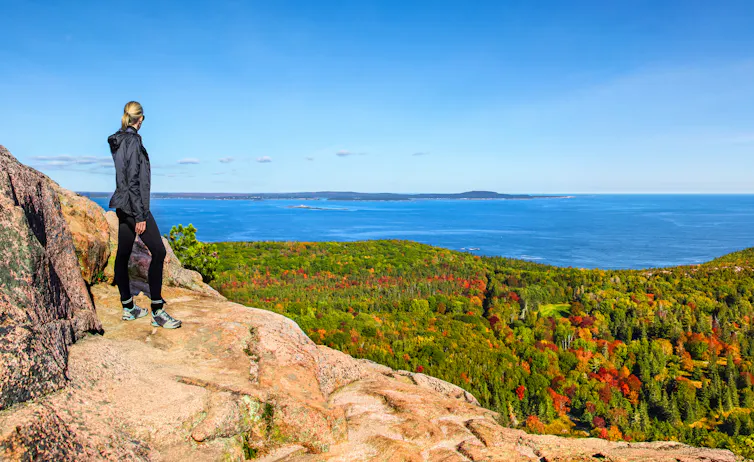
Try Media/Shutterstock.com

Stephanie Spera, University of Richmond

Every October, when I was growing up in Massachusetts, my parents would check out the fall foliage reports and determine where we were going to drive to see the colorful leaves. And they still do. In New England, leaf peeping, as it’s called, is a billion dollar industry and millions of people travel to the region during foliage season.

In Maine’s Acadia National Park, visitation has more than doubled in September and October since the early 1990s. Tourists book leaf peeping cruises, bus trips and lodging packages, all scheduled to coincide with what’s traditionally been the somewhat predictable fall foliage season.

But Earth’s climate is changing. A big question is how climate change’s impacts on the timing, duration and vibrancy of fall foliage will affect the tourist season.

Pulling together all kinds of data

Untangling the relationship between climate, fall foliage and visitorship in Acadia National Park – the goal of my research – requires a variety of data, including meteorological observations, park visitor surveys and knowledge of when fall foliage starts, peaks and ends every year.

As an environmental scientist, one of the primary ways I study changes in vegetation phenology – that is, the timing of biological events like flowering, leaf out, or onset and duration of fall foliage – is through the use of satellite data. Every day, dozens of satellites circle the Earth collecting data on everything from land cover to weather to sea surface temperatures to ground water to the chemical composition of the atmosphere.

These data are crucial in teasing apart environmental changes. Scientists have used satellite data of land cover and vegetation to show that as global temperatures increase, trees are flowering earlier and earlier.

But like all technology, the farther back in time you go, the lower the quality of the data. Even worse, there isn’t any reliable satellite data over Acadia National Park before the year 2000 at all. So my team needs to get creative.

Science behind the seasonal display

Here’s what biologists do know. As summer turns to autumn, the days get shorter and colder, both of which are signals to trees to stop photosynthesizing and producing the chlorophyll that makes their leaves green. With green chlorophyll out of the picture, the orange and yellow carotenoid pigments in the leaves that are masked by all the chlorophyll production all summer have their moment to shine.

In some trees, cooler weather cues the production of a chemical called anthocyanin, which helps trees pull the nutrients from their leaves into their trunk and roots. Anthocyanin is responsible for those gorgeous red and purple leaves on trees like red maples and dogwoods.

While every tree is different, studies have found that earlier spring bud burst, warmer temperatures and a dry fall are linked to a later fall foliage season. A shorter foliage season can result from a hot summer and wet fall. Additionally, the concentration of nitrogen in the atmosphere – which humans are releasing into the atmosphere on faster time scales than nature does – affects just how red those gorgeous maples get.

The northeastern U.S. has gotten warmer and wetter over the last century. How have these climate changes affected the timing, vibrancy and duration of fall foliage in Acadia National Park? Have tourists, in turn, changed how and when they visit the park?

Looking in new places for old foliage records

To answer this question, my team is using historical data on temperature and precipitation in Acadia National Park. What we’re missing, though, is information about when fall foliage has started and peaked, going back through the decades.

Most historical records of phenology, like those of Henry David Thoreau, are focused on the spring season. Historical documentation of fall foliage is harder to come by.

My colleagues and I are mining National Park reports and old newspapers, like this article in the Oct. 12, 1893 Bar Harbor Times, which is local to Acadia National Park:

“The autumn foliage on Mount Desert was never more brilliant than this year. The hills are ablaze with crimson and yellow, and the woodbine embowered cottages are resplendent with opalescent tints. But, alas ‘tis but the beetie glow in the consumptive’s cheek. A few weeks and winter’s white pail will cover all the autumn glories.”

But the records are few and far between.

We’ve found one continuous record of fall foliage since 1975, although it’s not focused on the Acadia area. Polly’s Pancake Parlor in Sugar Hill, New Hampshire has been collecting data on onset and peak of fall foliage since the mid-1970s. Interestingly, their data show that since 1975 fall foliage gets going earlier in the year, but peak fall foliage occurs later.

Maybe you have the selfies we seek

This lack of data is why we need citizen scientists to help us fill in the gaps.

With apps and programs like Nature’s Notebook, iNaturalist, BudBurst and eBird, it’s never been easier for anyone to share their observations of the world around them. Scientists have recently been trawling social media sites like Twitter, Flickr and Instagram for data to estimate park visitation rates, map monarch butterfly and snowy owl sightings and understand the various ways people value different landscapes.

Collecting photos from people who’ve traveled to Acadia is helping us validate the satellite data we do have. My team is able to make sure what we see in the satellite images actually represents of what is happening on the ground in the park. We are so appreciative of all the photos we’ve received from people who have visited Acadia this year. And we have received a bunch, 907 to be exact, of submitted photos from the post-cellphone camera era.

That doesn’t get us back to before the advent of continuous satellite data, though. We need leaf peepers to dig deeper into their personal photo albums to help us figure out the timing of fall foliage before the year 2000.

Those earlier photos – from a time of yore when you actually had to remove film from a camera and take it to get developed – are proving much harder to come by. So far we have two data points from before 2010, one from 1987 and one from 1981.

We’re asking for your help. We know those awkward family photos of you or your parents in their 1970s bell bottoms standing in front of Acadia’s Jordan Pond exist. And we want them. If you have any old vacation photos taken in the park during the fall, scan them and send them our way.

Understanding the relationships between climate change, fall foliage and park visitorship have important implications for park management, the local economies of towns on and around Mount Desert Island, and those of us who love visiting Acadia in the fall. So leaf peep – for science.

Stephanie Spera is a member of the American Association of Geographers. The Conversation

The association is a funding partner of The Conversation US.

Stephanie Spera, Assistant Professor of Climate Change & Remote Sensing, University of Richmond

This article is republished from The Conversation under a Creative Commons license. Read the original article.

==================================================================
I’m afraid I’m no help. I have autumn pictures back to the eighties, but they’re all in Colorado. But I certainly will be sure to hang on to them now, in case someone here decides to so a similar study. We do have a dependency on tourists here, certainly.

Alecto, Megaera, and Tisiphone, I don’t see how it could hurt to inspire people in other areas of the nation, and the world, to look into something similar It could even really help.

The Furies and I will be back.

Share

Everyday Erinyes #188

 Posted by at 3:00 pm  Politics
Oct 192019
 

Experts in autocracies have pointed out that it is, unfortunately, easy to slip into normalizing the tyrant, hence it is important to hang on to outrage. These incidents which seem to call for the efforts of the Greek Furies (Erinyes) to come and deal with them will, I hope, help with that. As a reminder, though no one really knows how many there were supposed to be, the three names we have are Alecto, Megaera, and Tisiphone. These roughly translate as “unceasing,” “grudging,” and “vengeful destruction.”

I came across this article which addresses the “cruel” in “cruel and unusual punishment” as regards the death penalty Of course we all realize there are certainly many more objections to the death penalty than simply its cruelty. However, many challenges to that penalty, or even just the the way it is being administered, are founded on our Constitutional (Eighth Amendment) prohibition of cruelty. And I thought the article had an interesting take on the subject.
==================================================================

Why the guillotine may be less cruel than execution by slow poisoning

Could using the guillotine be more humane than execution by lethal injection?
AlexLMX/Shutterstock

Janine Lanza, Wayne State University

Concerns about the drugs used for executions are being raised again after the federal government announced it will once again execute inmates convicted of capital crimes almost 16 years after the last execution was carried out.

International drug companies will no longer sell drugs for use in lethal injections in the United States. But Attorney General William Barr has authorized the federal justice system to use the widely available drug pentobarbital, despite concerns about whether that method violates the Eighth Amendment, which prohibits cruel and unusual punishment. In common use, the drug controls seizures in humans and is often used to euthanize pets.

In 2014, several executions carried out by states with untested methods using a mixture of drugs caused suffering and took hours to end prisoners’ lives.

One of the three drugs used in the botched execution of Clayton Lockett in 2014.
AP/File photo

Among them was the botched execution of Oklahoma inmate Clayton Lockett, who thrashed around in pain for 43 minutes before dying, prompted President Obama to call for a moratorium on the death penalty for federal inmates.

While the death penalty is the ultimate punishment meted out by the state, it is not meant to be torture.

From the stake to the rope to the firing squad to the electric chair to the gas chamber and, finally, to the lethal injection, over the centuries the methods of execution in the United States have evolved to make execution quicker, quieter and less painful, both physically and psychologically.

It wasn’t always so. And there are, perhaps, lessons in history that could provide an answer to current concerns about the unusual cruelty of execution methods in the U.S.

Spectacles of physical torment

Under the French monarchy in the 17th and 18th centuries, execution was meant to be painful. That would purify the soul of the condemned before his final judgment, deter others from committing crime, and showcase the power of the king to impose unbearable suffering on his subjects.

Public executions were spectacles that were part public holiday, part grim warning. Crowds gathered to watch the prisoner endure physical torments almost too dreadful to imagine: hot pokers, boiling lead poured into wounds, dismembering hooks, and of course, the horses readied to draw and quarter.

Not everybody suffered so terribly, however. This parade of horrors was the fate of commoners. For nobles, a quick, relatively painless, and more dignified beheading replaced an hours-long public display.

One of the many goals of the French Revolution, which took place from 1789 to 1815, was to level society, to take away the privileges of the nobility, who lorded over commoners.

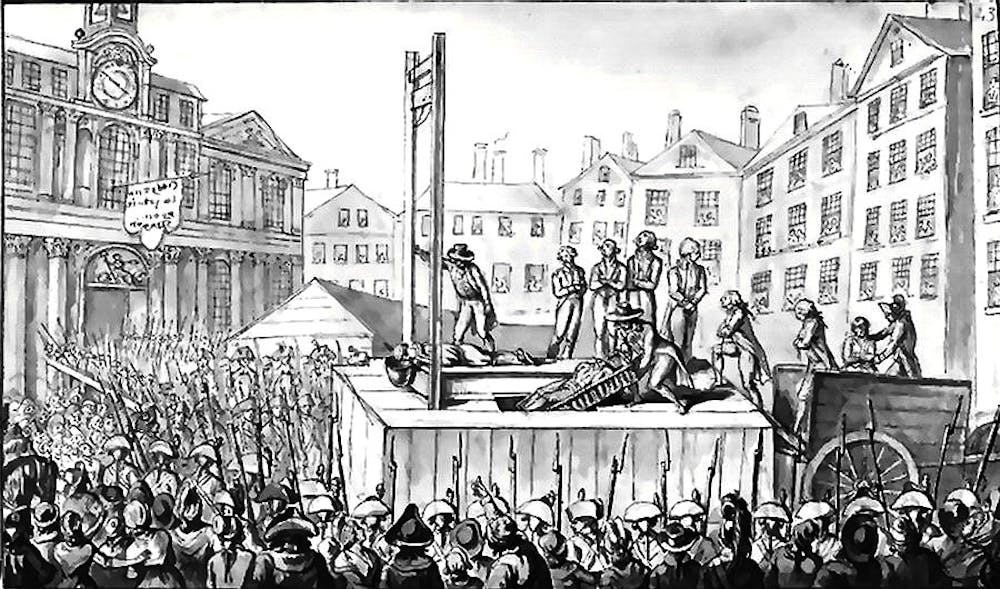
Execution by guillotine in France, 1793.
La Guillotine en 1793 by H. Fleischmann (1908), Wikimedia

Medium is the message

The solution to disparate forms of execution and social equality was first presented to the French National Assembly on Oct. 10, 1789 by Dr. Joseph Guillotin, who presented plans for a bladed machine to execute criminals.

It would be easy to use, work quickly and offer the same treatment to all condemned, regardless of social standing. His ideas finally became law in March 1791 and the guillotine was used for an execution the following year.

The so-called “national razor” took off the heads of the royal family as well as the humblest thief. It leveled bodies and society, with all citizens subject to the same punishment. And it ended the capricious torment of the condemned by the monarchy as well as the privilege that nobles had, even regarding the manner of their deaths.

The guillotine was a killing machine that provided not just a convenient method of execution but the proper political and ideological message for the Revolution.

Less cruel and unusual?

Eventually, the French Revolution became more politically radical, moving from a system where the king would continue to govern within a constitutional system to a republic where the people’s representatives would wield political power to a de facto dictatorship. As the Revolution became more radical, and politicians saw plots everywhere, increasing numbers of citizens were sentenced to death.

With the need to execute many prisoners the guillotine was pressed into greater use. The most careful estimate for the number of French executed during the Terror, the height of the radical Revolution, was 17,000. This number included almost exclusively those charged with political crimes.

It was the guillotine’s plummeting blade that took off head after head with just a bit of cleaning and sharpening in between, answering the need of the moment. Thus it came to symbolize state terrorism but also swift and equal justice.

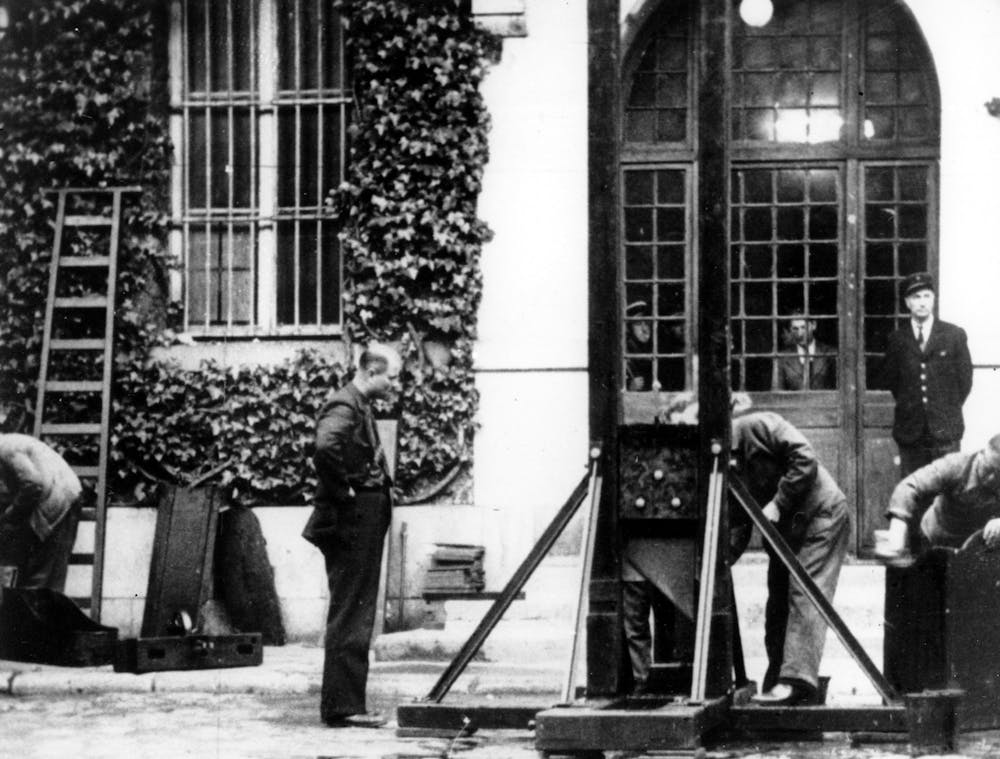
The guillotine remained in use in France well into the 20th century. Here, workmen in the Sante Prison clean and dismantle a guillotine in Paris on May 25, 1946, after the execution of Dr. Marcel Petiot, who was convicted of mass murder during World War II.
AP

Terrifying – but brief

The guillotine remains a quick method of execution – it takes about half a second for the blade to drop and sever a prisoner’s head from his body.

While the moment of execution could be nothing but terrifying, that second of suffering was brief in comparison to the 43 minutes it took for Lockett to die after lethal drugs were administered.

In the same year, 2014, convicted double murderer Joseph Rudolph Wood of Arizona suffered for two hours before succumbing to the jerry-built drug cocktail dreamed up in a warden’s office. In 2018, an Alabama execution had to be halted after 12 attempts to place an IV line in Doyle Hamm failed.

The current technology of execution does not reliably provide the humane death demanded by the Constitution. In requiring an IV line and medical personnel to administer drugs it also involves medical practice with the death penalty.

Although the guillotine may be the bloodiest of deaths – the French used sand bags to soak up the blood – it does not cause the prolonged physical torment increasingly delivered by lethal injections.

Should the U.S. consider using the guillotine to administer capital punishment?

It has advantages – no secret recipes for lethal injections, no botched placement of IV needles, no conflation of medicine and execution.

While the guillotine provides a death that is not easy to witness, the death it delivers to the condemned is quick and does not cause the extended pain of bespoke lethal injections.

Could such a death, as bloody as it is, pass muster with the Eighth Amendment’s mandate against cruel and unusual punishment?The Conversation

Janine Lanza, Associate Professor of History, Wayne State University

This article is republished from The Conversation under a Creative Commons license. Read the original article.

==================================================================
Professor Lanza does not go into any detail about the background and intentions of Dr Joseph-Ignace Guillotin. Perhaps she didn’t feel that it was germane, and maybe it isn’t, but I am also interested in persons from history who have reputations different who who they actually were. Sometimes the impression attached to them is unfairly unfavorable (Nero, Richard III, Marie Antoinette), sometimes it is unfairly favorable (Christopher Columbus), but unfair is unfair. Dr. Guillotin is associated in many minds with blood and death. It may surprise you to know that he was a lifelong opponent of capital punishment – or that he didn’t even invent the machine which bears his name. A medical doctor did work with the actual inventor (a fellow named Tobias Schmidt), but that doctor was not Dr. Guillotin. He did propose that such a machine be invented – “a machine that beheads painlessly.” He hoped that a more humane and less painful method of execution would be a first step toward complete abolition of the death penalty. If it did (and it may have done, as many nations today have prohibited it), it was a very small and slow step indeed. Totally unrelated, Dr. Guillotin was also one of the first physicians to support vaccination.

Would the guillotine be less painful for the person being executed than any other method of execution for which we have the technology? You bet. Will it ever be re-adopted, or adopted for the first time here? Of course not. Because the feelings of the condemned are far less important to the public than the feelings of the public. And executions by guillotine might make the public uncomfortable. Especially the Republican “pro-life” public. And we couldn’t have that.

Alecto, Megaera, and Tisiphone, it would be wonderful if you could arouse our collective conscience to abolish the death penalty once and for all. But I fear that even you cannot rouse a conscience in a person who has none.

The Furies and I will be back.

Share

Everyday Erinyes #187

 Posted by at 8:56 am  Politics
Oct 122019
 

Experts in autocracies have pointed out that it is, unfortunately, easy to slip into normalizing the tyrant, hence it is important to hang on to outrage. These incidents which seem to call for the efforts of the Greek Furies (Erinyes) to come and deal with them will, I hope, help with that. As a reminder, though no one really knows how many there were supposed to be, the three names we have are Alecto, Megaera, and Tisiphone. These roughly translate as “unceasing,” “grudging,” and “vengeful destruction.”

So, the House of Representatives is full-on investigating Donald John Trump with the intent of impeachment. If you, or someone you know, hasn’t noticed, that’s because Trump is stonewalling on allowing either documents or testimony to be provided to the committees concerned (in itself an impeachable offense, of course. All this is quite frustrating. It won’t, of course, derail the investigation, but it may – it is intended to – delay it substantially So when I found this Creative Commons article which discusses the effect of delay, along with other factors, I thought it was well worth sharing.

There are many who are clamoring for immediate, or at least speedy, results. My take is that, to be blunt, if there may end up being face-eating leopards around, we should at the very least be aware that we also have faces which could be eaten.
====================================================================

Investigations usually hurt a president’s public reputation – but Trump isn’t usual

Douglas L. Kriner, Cornell University and Eric Schickler, University of California, Berkeley

Will the House impeachment inquiry of President Donald Trump ultimately have any effect?

Democratic Speaker Nancy Pelosi had long resisted calls for impeachment, arguing that it is “just not worth it.” However, the Trump administration’s initial refusal to release to Congress documents concerning the intelligence community whistleblower’s complaint about the administration’s treatment of Ukraine encouraged the Speaker to cross that line.

We have explored the relationship between hearings into alleged executive branch misconduct and public opinion in our 2016 book, “Investigating the President: Congressional Checks on Presidential Power.”

Investigations often damage a president’s reputation in the public eye – but that may not matter to a historically unpopular president like Trump.

A check on the presidency

The power to oversee the executive branch is among Congress’ most important powers. Investigations have historically afforded Congress a meaningful check on an increasingly powerful presidency.

Perhaps the most important way that investigations check presidential power is by lowering public support for the president. By eroding the president’s reserve of political capital, investigators can change how politicians behave, both in Congress and in the White House.

This can create momentum for new legislation, encourage presidential concessions, or simply weaken the president’s political position with broad consequences.

In our book, we built a comprehensive data set of all congressional investigations of the executive branch from 1898 through 2014.

We then merged it with presidential approval data, which first became regularly available in 1953, to see how investigations affected approval ratings from Eisenhower to Obama.

Even after statistically accounting for the possibility that low approval ratings might also encourage Congress to investigate an administration more aggressively, we found that investigations systematically eroded public support for the president.

Historically, every 20 additional days of investigative hearings cost the president roughly 2.5% in the polls.

So a short-term investigation is survivable. But a long-term investigation could seriously diminish the president’s political capital and even threaten his or his party’s electoral fortunes.

How Trump is different

Will the current impeachment inquiry have the same corrosive effect on support for President Trump? The allegations of abuse of power are more serious than those driving many of the investigations in our historical data.

However, there are reasons to believe that support for Trump may be more resilient.

President Trump’s approval rating has been remarkably stable over the past three years. This suggests to us that the power of events to move public opinion has diminished substantially.

President Trump has had both a lower ceiling -– his first term approval ratings were historically low, given the strength of the economy – and a higher floor than his predecessors.

What’s more, partisan lines have hardened to an extent that is arguably unparalleled in the past century.

Here’s how that partisanship is relevant: There is nothing unusual about the members of a president’s party defending him in the face of accusations of wrongdoing. But in past cases, there generally was a reasonably sized faction of members of the same party in Congress who were willing to take on the president when his administration’s actions were particularly egregious.

In today’s intensely polarized Congress, it is unlikely that there is any revelation that would persuade more than a small handful of Republicans to turn on President Trump. Absent this, public opinion is unlikely to move.

At the same time, many congressional Republicans are standing by Trump because they believe that is what their voters want. Staunchly partisan voters encourage elites to toe the party line and use more inflammatory language. That, in turn, only reinforces voters’ inclination to stick with their party.

Checks and balances

Investigations offer Congress a tool to push back against presidential power when it cannot legislate.

However, for investigations to succeed and produce meaningful political or policy change, they usually must be able to shine a light on administration misdeeds and move the needle of public opinion. To do so, investigators must have access to the information they require.

The Trump administration has refused to cooperate with congressional subpoenas and requests for information, and continues to receive the unconditional support of most Republicans for the president. That suggests that the impeachment inquiry, like other investigative efforts of the 116th Congress, faces severe obstacles that earlier investigations had not confronted.

The kinds of revelations that in the past surely would have been sufficient to move the public and elected officials may no longer be sufficient. The question is whether the revelations in Trump’s case will surpass the barriers imposed by today’s intensely polarized politics.

[ Expertise in your inbox. Sign up for The Conversation’s newsletter and get a digest of academic takes on today’s news, every day. ]The Conversation

Douglas L. Kriner, Clinton Rossiter Professor in American Institutions, Cornell University and Eric Schickler, Co-Director of the Institute of Governmental Studies, University of California, Berkeley

This article is republished from The Conversation under a Creative Commons license. Read the original article.

====================================================================

Alecto, Megaera, and Tisiphone, you probably know even better than we do that every enterprise which involves human beings is more or less a crap shoot. An action designed to accomplish one goal can have that effect, or it can have the opposite effect, or it can just fizzle. I think we can be pretty sure that House Democrats, particularly our Democratic leadership, are considering all of the factors above. We do not even have the opportunity of jury selection. The jury for this trial is the United States Senate, and it’s already been selected. There have been a few hopeful signs, but there are no guarantees. And we must have hard evidence.

The Furies and I will be back.

Share