
This ad aired during Game 1 of the World Series on Fox
Really American
RVAT
Robert Reich
PCCC is promoting this, for good and obvious reasons.
Mel Brooks first ever political video
Keith
SCOTUS petitions update
DLCC (one more time)


This ad aired during Game 1 of the World Series on Fox
Really American
RVAT
Robert Reich
PCCC is promoting this, for good and obvious reasons.
Mel Brooks first ever political video
Keith
SCOTUS petitions update
DLCC (one more time)
Sorry I’m a little late. It’s a very busy day.
American Bridge Qanon
Biden campaign (hanky alert)
Meidas Touch – the voice is Trump*’s. The point is irony.
Not Our Faith (as always, they target Evangelicals)
Now This News has 18 new videos up in the last 24 hours, coverin a breadth of subjects. This one is probably not needed her, but some of us may have people to share it with.
Sound and Fury
The Lincoln Project
Keith
SCOTUS petitions update
DLCC “last chance”
Biden campaign (more of a PSA than an ad?)
Really American
RVAT Shining City
Sound and Fury Messaging – “Quaranteenies” for “Red, Wine, and Blue”
The Lincoln Project – aimed at Ohio but applicable all over (The CC is squirrely by aaccurate.)
Beau on polling
Keith – speaks for himself.
SCOTUS petitions update
DLCC
From the Biden campaign
Meidas Touch (hanky alert)
The LincolnProject – the CC duplicates a lot, but there are gaps when it’s needed.
One from Beau
Now This News – six and a half minutes on Police Unions – if you don’t have time today, bookmark it.
I don’t know whence, but it’s Beauty-ful.
OMG! Who did this?!?! Best 2 minutes of your day, week, month, maybe year. #WearAMask #SleepingBeauty #COVID19 #Masks #MasksSaveLives pic.twitter.com/ArgUIL77B3
— Eric Feigl-Ding (@DrEricDing) October 18, 2020
It’s not all that slow a day, but it’s so busy lately I don’t know when else I’s get this parody in (and not everyone will care for it anyway.) (NSFW)
SCOTUS petitions update
Daily Kos (disability rights)
These two tweets from the Biden campaign are both adorable, in diferent ways.
We’ve got to come together to defeat Donald Trump –– Democrats, Independents, Republicans, and yes, even Demo-cats. pic.twitter.com/LtsTWy7MmI
— Joe Biden (@JoeBiden) October 17, 2020
Wow these Biden ads are getting easy. pic.twitter.com/ofyvBFLEu2
— Keith Edwards 🏴☠️ (@keithedwards) October 17, 2020
Meidas Touch
From America’s Voice
Sound and Fury for the Democratic Coalition (from Thursday)
Beau on Amy Wild Hare Barrett
Beau on the soggy laptop. Link to his prior video
SCOTUS petitions update
Daily Kos

Experts in autocracies have pointed out that it is, unfortunately, easy to slip into normalizing the tyrant, hence it is important to hang on to outrage. These incidents which seem to call for the efforts of the Greek Furies (Erinyes) to come and deal with them will, I hope, help with that. As a reminder, though no one really knows how many there were supposed to be, the three names we have are Alecto, Megaera, and Tisiphone. These roughly translate as “unceasing,” “grudging,” and “vengeful destruction.”
It’s no secret and should be no surprise to anyone here that I don’y think we should be talking about “packing the court” but rather about “UNpacking the court,” and I’m glad and grateful that Senator Schumer and Speaker Pelosi are heading toward phrasing it this way (“packing the courts is something Republicans do” – Speaker Pelosi.) So I’m not crazy about this title. But the content here is highly educational, and definitely thought provoking.
================================================================
Calvin Schermerhorn, Arizona State University
As a political battle over the Supreme Court’s direction rages in Washington with President Donald Trump’s nomination of Amy Coney Barrett, history shows that political contests over the ideological slant of the Court are nothing new.
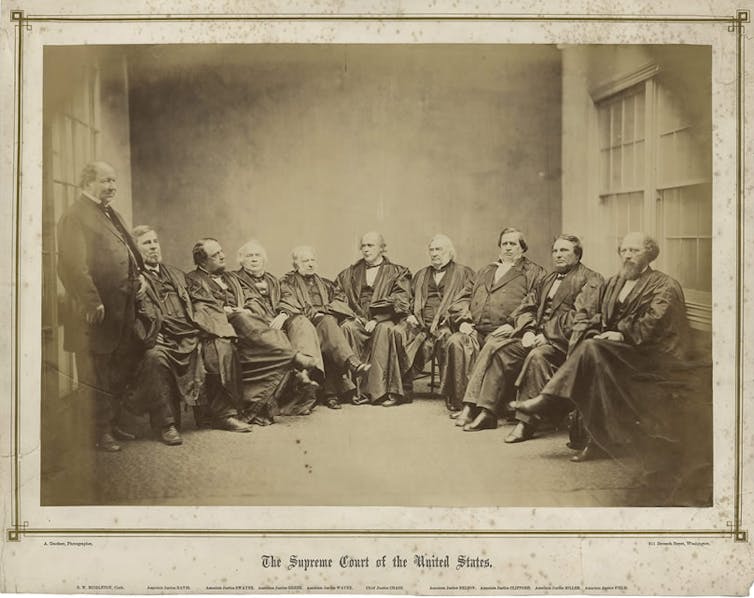
In the 1860s, President Abraham Lincoln worked with fellow Republicans to shape the Court to carry out his party’s anti-slavery and pro-Union agenda. It was an age in which the court was unabashedly a “partisan creature,” in historian Rachel Shelden’s words.
Justice John Catron had advised Democrat James K. Polk’s 1844 presidential campaign, and Justice John McLean was a serial presidential contender in a black robe. And in the 1860s, Republican leaders would change the number of justices and the political balance of the Court to ensure their party’s dominance of its direction.
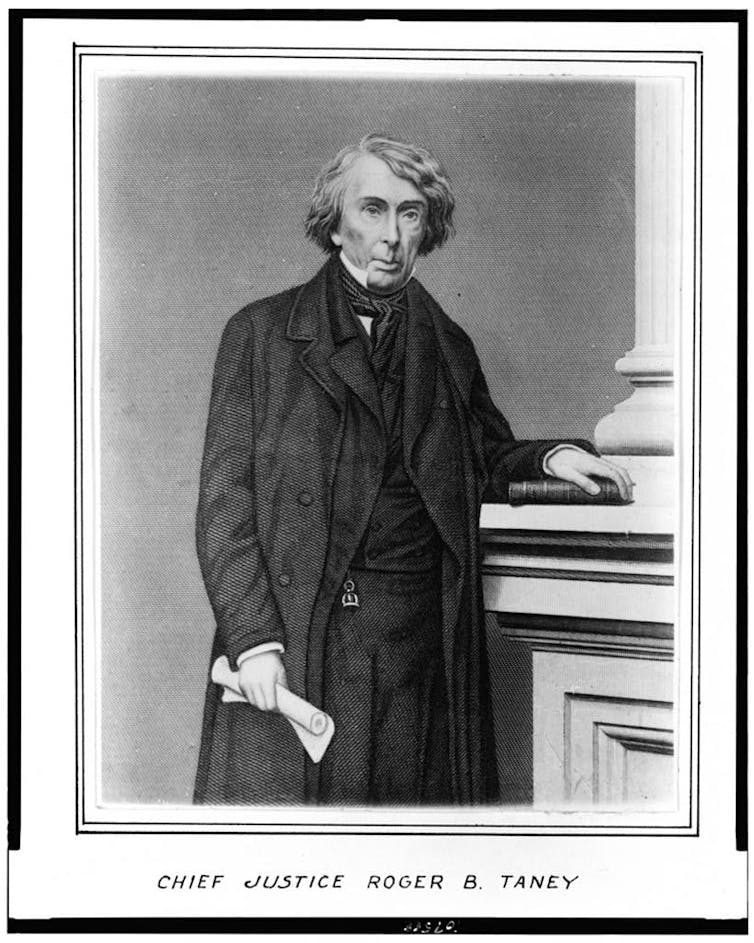
When Lincoln became president in 1861, seven Southern states had already seceded from the Union, yet half of the Supreme Court justices were Southerners, including Chief Justice Roger B. Taney of Maryland. One other Southern member had died in 1860, without replacement. All were Democratic appointees.
The Court was “the last stronghold of Southern power,” according to one Northern editor. Five sitting justices were among the court’s 7-2 majority in the racist 1857 Dred Scott v. Sandford ruling, in which Taney wrote that Black people were “so far inferior that they had no rights which the white man was bound to respect, and that the negro might justly and lawfully be reduced to slavery for his benefit.”
Some Republicans declared it “the duty of the Republican Party to reorganize the Federal Court and reverse that decision, which … disgraces the judicial department of the Federal Government.”
After Lincoln called in April, 1861 for 75,000 volunteers to put down the Southern rebellion, four more states seceded. So did Justice John Archibald Campbell of Georgia, who resigned on April 30.
Chief Justice Taney helped the Confederacy when he tried to restrain the president’s power. In May 1861, he issued a writ of habeas corpus in Ex Parte Merryman declaring that the president couldn’t arbitrarily detain citizens suspected of aiding the Confederacy. Lincoln ignored the ruling.
To counter the court’s southern bloc, Republican leaders used judicial appointments to protect the president’s power to fight the Civil War. The Lincoln administration was also looking ahead to Reconstruction and a governing Republican majority.
Nine months into his term, Lincoln declared that “the country generally has outgrown our present judicial system,” which since 1837 had comprised nine federal court jurisdictions, or “circuits.” Supreme Court justices rode the circuit, presiding over those federal courts.
Republicans passed the Judiciary Act of 1862, overhauling the federal court system by collapsing federal circuits in the South from five to three while expanding circuits in the North from four to six. The old ninth circuit, for example, included just Arkansas and Mississippi. The new ninth included Missouri, Kansas, Iowa and Minnesota instead. Arkansas became part of the sixth, and Mississippi, the fifth.
In 1862, after Campbell’s resignation and McLean’s death, Lincoln filled three open Supreme Court seats with loyal Republicans Noah H. Swayne of Ohio, Samuel Freeman Miller of Iowa and David Davis of Illinois. The high court now had three Republicans and three Southerners.
The 1863 Prize cases tested whether Republicans had managed to secure a friendly court. At issue was whether the Union could seize American ships sailing into blockaded Confederate ports. In a 5-4 ruling, the high court – including all three Lincoln appointees – said yes.
Congressional Republicans spied a way to expand the court while solving what amounted to a geopolitical judicial problem. In 1863, Congress created a new tenth circuit by adding Oregon, which had become a state in 1859, to California’s circuit. The Tenth Circuit Act also added a tenth Supreme Court justice. Lincoln elevated pro-Union Democrat Stephen Field to that seat.
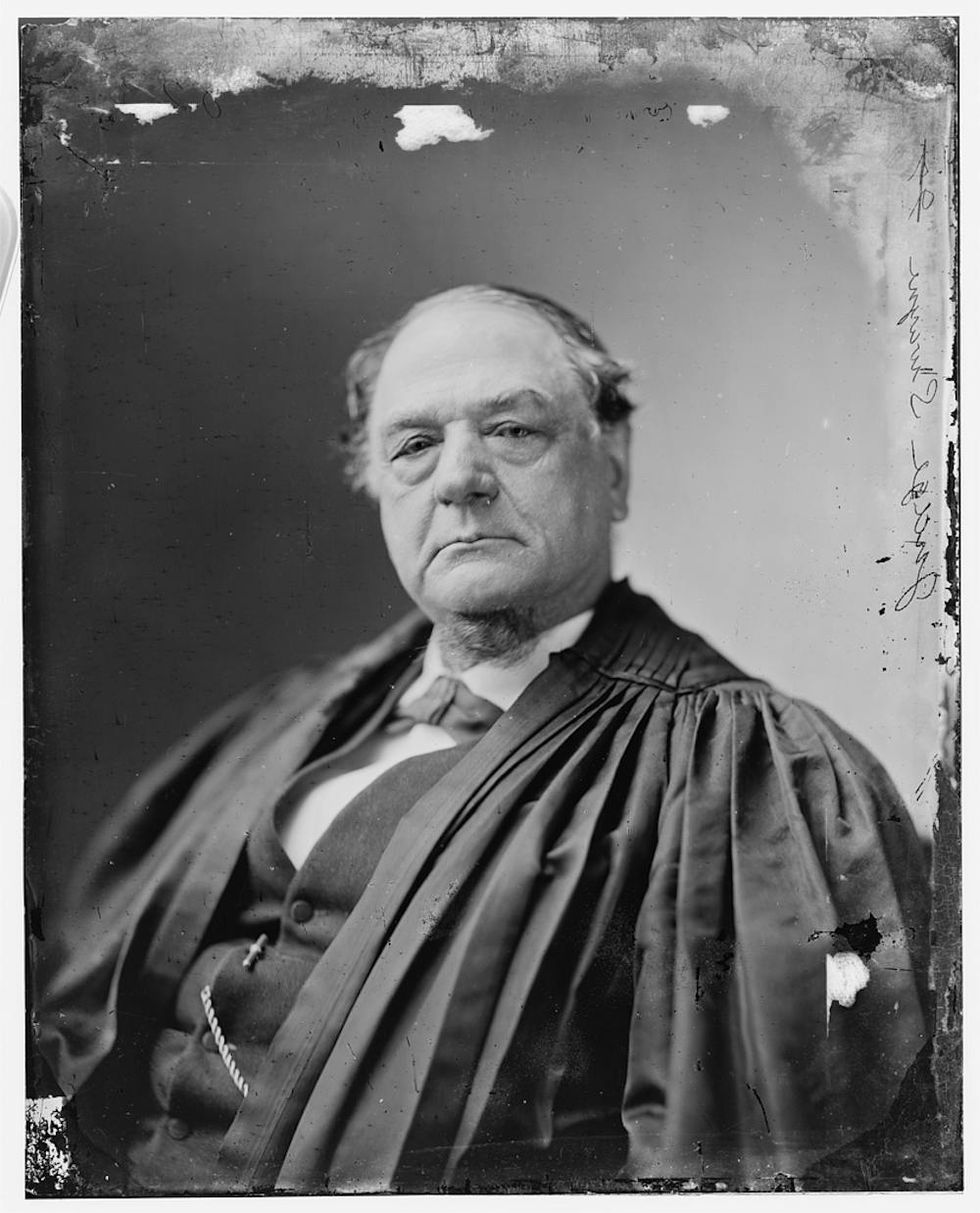
And after Chief Justice Taney died in 1864, Lincoln selected his political rival, Treasury Secretary Salmon P. Chase, an architect of national monetary policy, to replace him. With Chase, Lincoln succeeded in creating a pro-administration high court.
After Lincoln’s assassination in April 1865, President Andrew Johnson of Tennessee, who succeeded him, soon began undoing Lincoln’s achievements. He was a Unionist Democrat given the vice presidency as an olive branch to the South. He rewarded that gesture in part by pardoning rank and file Confederates. Johnson also opposed civil rights for newly-freed African Americans.
He also threatened to appoint like-minded judges. But the Republican-dominated Congress blocked Johnson from elevating unreconstructed Rebels to the high court. The Judicial Circuits Act of 1866 shrank the number of federal circuits to seven and held that no Supreme Court vacancies would be filled until just seven justices remained.
The Philadelphia Evening Telegraph’s Democratic editor sighed that at least Republicans “cannot pack the Supreme Court at this moment.”
Republicans refused to consider nominating Johnson in 1868, picking General Ulysses S. Grant instead. He won, and after President Grant’s inauguration, Congress passed the Circuit Judges Act of 1869, raising back to nine the number of Supreme Court justices.
Shortly after, Republicans faced a financial problem of their own making.
Beginning in 1862, Congress had passed three Legal Tender Acts – initially to help finance the war, authorizing debt payments using paper money not backed by gold or silver. Then-Treasury Secretary and current Chief Justice Salmon P. Chase had crafted the legislation.
But in an 1870 case, Hepburn v. Griswold, Chase reversed himself in a 4-3 decision, ruling the Legal Tender Acts unconstitutional. That threatened national monetary policy and Republicans’ cozy relationship with industries reliant on government sponsorship.
President Grant, preparing for Chase’s ruling, was already working on a political solution. On the day of the Hepburn decision, he appointed two pro-paper-money Supreme Court nominees, William Strong of Pennsylvania and Joseph P. Bradley of New York. Comparing the Republican administration to “a brokerage office,” a Democratic newspaper howled that “the attempt to pack the supreme court to secure a desired judicial decision … (has) brought shame and humiliation to an entire people.”
It also brought a Republican majority to the high court for the first time.
Chief Justice Chase opposed revisiting the paper money issue. But the Supreme Court about-faced, ruling 5-4 in the 1871 cases Knox v. Lee and Parker v. Davis that the government could indeed print paper money to pay debts. Chase died in 1873, and his successor Morrison Waite championed the Republican pro-business agenda.
Republican transformation of the federal judiciary in the 1860s and 1870s served the party well in the Civil War and constructed a legal framework for a modernizing industrial economy.
[Deep knowledge, daily. Sign up for The Conversation’s newsletter.]
But in the end Lincoln and Grant’s high court appointments ended up being disastrous for civil rights. Justices Bradley, Miller, Strong and Waite tended to constrain civil rights protections like the Fourteenth Amendment, which guarantees equal protection of laws. Their rulings in United States v. Cruikshank in 1876 and Civil Rights Cases in 1883 both sounded the retreat on Black civil rights.
In remaking the court in Republicans’ image, the party got what it wanted – but not what was needed to fulfill the promise of “a new birth of freedom.”
Calvin Schermerhorn, Professor of History, Arizona State University
This article is republished from The Conversation under a Creative Commons license. Read the original article.
================================================================
Alecto, Megaera, and Tisiphone, of course our issue at this point is not merely the Supreme Court, but all the lower federal coourts as well. There have been some mighty unqualified people pushed into positions where they have no business. At any level, I definitely would not, myself, put impeachment off the table. At SCOTUS, I believe we have two justices now (and will have three soon barring a miracle) who have pretty demonstrably lied at their confirmation hearings (and as much as I dislike him, Gorsuch is not one of them.) For obvious reasons, I’m not that conversant of the other benches, but that doesn’t mean there aren’t unqualified and vulnerable people there. In fact, there certainly are. I hope you ladies are willing to help find them and get them out to the maximum extent possible.
The Furies and I will be back.

Monologue – Unfortunately none of these has CC. (Yes, Mary Trump did have a word or two to say about the “crazy uncle” tweet.) We haven’t talked about the soggy laptop here, but there is plenty of substantiation elsewhere that the story is a typical Russian disinformation project.
Fareed Zakaria – I’m sure ine doesn’t have to be an expert to see a relationship between CoViD (and other potential pandemics) and climate change, but you do need at least two brain cells to rub together, and be willing to rub them. Too many people don’t.
New Rule – Good grief, I had no idea there were that many Catholics on the court – I’m Catholic but that’s ridiculous. The word “catholic” means “universal,” and if you look even just at the court at who is catholic and how far apart their views are, you can get a glimpse of why that still has some validity, but not enough for that kind of over-representation. Damn.
Don Winslow
Meidas Touch – a new Quaranteenies
Now This News – Not exactly an ad and not exactly news but I think important
Really American
Lincoln Project – Two – and I must make both available (VoteVets partnered on the first one).
Keith
SCOTUS petitions update
Faithful America
And one USPS petition
Daily Kos Ben Franklin project