Experts in autocracies have pointed out that it is, unfortunately, easy to slip into normalizing the tyrant, hence it is important to hang on to outrage. These incidents which seem to call for the efforts of the Greek Furies (Erinyes) to come and deal with them will, I hope, help with that. As a reminder, though no one really knows how many there were supposed to be, the three names we have are Alecto, Megaera, and Tisiphone. These roughly translate as “unceasing,” “grudging,” and “vengeful destruction.”
The Furies and I have discussed “deepfakes” before. it’s a highly technical subject, but olnly at our peril do we dismiss it as bening “too hard.” Because we are all vulnerable, and the more we know, the better we can defend ourselves against – whatever.
================================================================
In a battle of AI versus AI, researchers are preparing for the coming wave of deepfake propaganda
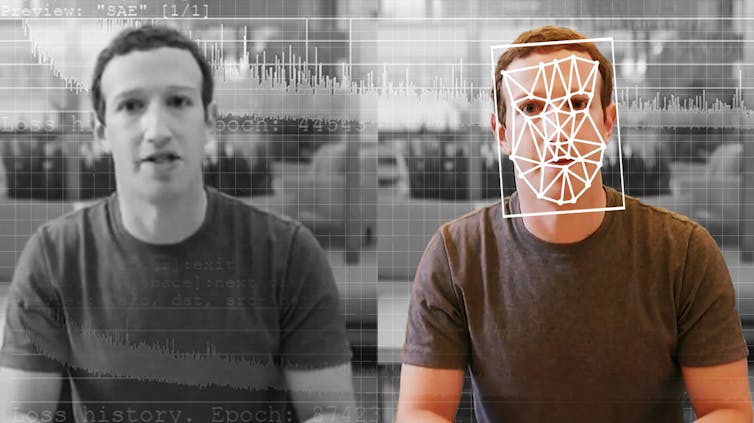
An investigative journalist receives a video from an anonymous whistleblower. It shows a candidate for president admitting to illegal activity. But is this video real? If so, it would be huge news – the scoop of a lifetime – and could completely turn around the upcoming elections. But the journalist runs the video through a specialized tool, which tells her that the video isn’t what it seems. In fact, it’s a “deepfake,” a video made using artificial intelligence with deep learning.
Journalists all over the world could soon be using a tool like this. In a few years, a tool like this could even be used by everyone to root out fake content in their social media feeds.
As researcherswho have been studying deepfake detection and developing a tool for journalists, we see a future for these tools. They won’t solve all our problems, though, and they will be just one part of the arsenal in the broader fight against disinformation.
The problem with deepfakes
Most people know that you can’t believe everything you see. Over the last couple of decades, savvy news consumers have gotten used to seeing images manipulated with photo-editing software. Videos, though, are another story. Hollywood directors can spend millions of dollars on special effects to make up a realistic scene. But using deepfakes, amateurs with a few thousand dollars of computer equipment and a few weeks to spend could make something almost as true to life.
Deepfakes make it possible to put people into movie scenes they were never in – think Tom Cruise playing Iron Man – which makes for entertaining videos. Unfortunately, it also makes it possible to create pornography without the consent of the people depicted. So far, those people, nearly all women, are the biggest victims when deepfake technology is misused.
Deepfakes can also be used to create videos of political leaders saying things they never said. The Belgian Socialist Party released a low-quality nondeepfake but still phony video of President Trump insulting Belgium, which got enough of a reaction to show the potential risks of higher-quality deepfakes.
University of California, Berkeley’s Hany Farid explains how deepfakes are made.
Given these risks, it would be extremely valuable to be able to detect deepfakes and label them clearly. This would ensure that fake videos do not fool the public, and that real videos can be received as authentic.
Spotting fakes
Deepfake detection as a field of research was begun a little over three years ago. Early work focused on detecting visible problems in the videos, such as deepfakes that didn’t blink. With time, however, the fakes have gotten better at mimicking real videos and become harder to spot for both people and detection tools.
There are two major categories of deepfake detection research. The first involves looking at the behavior of people in the videos. Suppose you have a lot of video of someone famous, such as President Obama. Artificial intelligence can use this video to learn his patterns, from his hand gestures to his pauses in speech. It can then watch a deepfake of him and notice where it does not match those patterns. This approach has the advantage of possibly working even if the video quality itself is essentially perfect.
SRI International’s Aaron Lawson describes one approach to detecting deepfakes.
Other researchers, including our team, have been focused on differences that all deepfakes have compared to real videos. Deepfake videos are often created by merging individually generated frames to form videos. Taking that into account, our team’s methods extract the essential data from the faces in individual frames of a video and then track them through sets of concurrent frames. This allows us to detect inconsistencies in the flow of the information from one frame to another. We use a similar approach for our fake audio detection system as well.
These subtle details are hard for people to see, but show how deepfakes are not quite perfect yet. Detectors like these can work for any person, not just a few world leaders. In the end, it may be that both types of deepfake detectors will be needed.
Recent detection systems perform very well on videos specifically gathered for evaluating the tools. Unfortunately, even the best models do poorly on videos found online. Improving these tools to be more robust and useful is the key next step.
Ideally, a deepfake verification tool should be available to everyone. However, this technology is in the early stages of development. Researchers need to improve the tools and protect them against hackers before releasing them broadly.
At the same time, though, the tools to make deepfakes are available to anybody who wants to fool the public. Sitting on the sidelines is not an option. For our team, the right balance was to work with journalists, because they are the first line of defense against the spread of misinformation.
Before publishing stories, journalists need to verify the information. They already have tried-and-true methods, like checking with sources and getting more than one person to verify key facts. So by putting the tool into their hands, we give them more information, and we know that they will not rely on the technology alone, given that it can make mistakes.
Can the detectors win the arms race?
It is encouraging to see teams from Facebook and Microsoft investing in technology to understand and detect deepfakes. This field needs more research to keep up with the speed of advances in deepfake technology.
Journalists and the social media platforms also need to figure out how best to warn people about deepfakes when they are detected. Research has shown that people remember the lie, but not the fact that it was a lie. Will the same be true for fake videos? Simply putting “Deepfake” in the title might not be enough to counter some kinds of disinformation.
Deepfakes are here to stay. Managing disinformation and protecting the public will be more challenging than ever as artificial intelligence gets more powerful. We are part of a growing research community that is taking on this threat, in which detection is just the first step.
================================================================ Alecto, Megaera, and Tisiphone, ss Mr. Sohrawardi and Prof. Wright say above, “Sitting on the sidelines is not an option.” that doesn’t mean we all need to be technical experts, but it does mean we need at least to be broadly aware of how technology is progressing and what it can do both for truth and for lies.
Monologue (no CC) – “From Russia with Yuck” pretty well covers it.
Ben Sheehan OMG WTF – A scholar on the narrow field of what the Constitution says about elections – and the much wider subject of states’ election laws.
Matthew McConaughey (no CC) – Interesting conversation – I wouldn’t call it deep.
New Rule – “American Ninja Warrior” – We could have used some of this honesty long before now. Bill is not as fast a learner as he thinks he is. This, granted, is point for point on the money.
New Words – from overtime – and very funny
I tried to enable CC wherever it existed. Hope it works.
I know I was not up to watching last night’s debate, and I doubt TC was either (unless that was why he overslept – probably not, it airs earlier the farther west one lives.) So I’m grateful The Conversation came to my rescue (to the rescue of us all) with this article.
President Donald Trump and former Vice President Joe Biden met on Oct. 22 for the final debate in the 2020 election and, like the first debate, it was unusual.
COVID-19 forced social distancing and largely took the studio audience, with their laughter, cheering and booing out of the equation.
What’s more, with norm-breaking interruptions and stealing of speaking time an inherent part of Donald Trump’s debate strategy, the contentious crosstalk between the two candidates and the moderator made long sections of the candidates’ first debate nearly impossible to hear or follow. The threat of having the microphone cut off effectively muted this aggression.
But is what they say as important as we think?
Although news coverage generally focuses on what the candidates say, as a political psychologist who studies nonverbal behavior, I focus less on the rehearsed answers and more on the space between talking points. These moments, when candidates nonverbally – and largely involuntarily – respond to their opposition can be enormously revealing.
In other words, how people listen and react may speak louder than what they say.
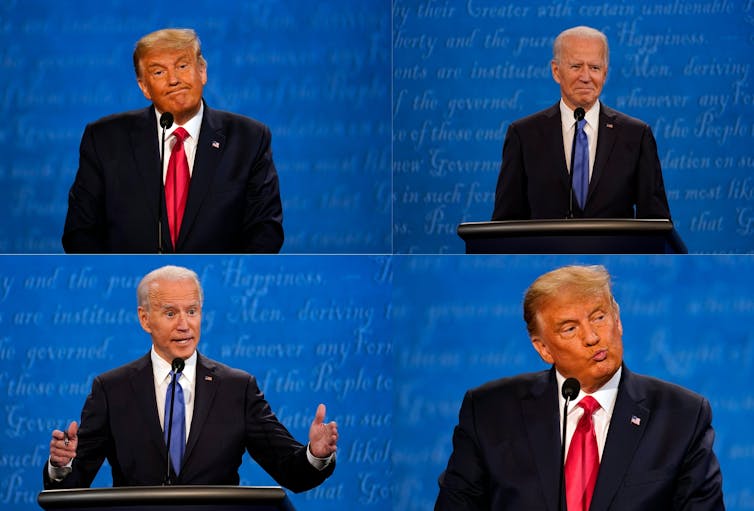
During this debate Joe Biden reacted as the emotionally expressive politician he has been throughout his career.
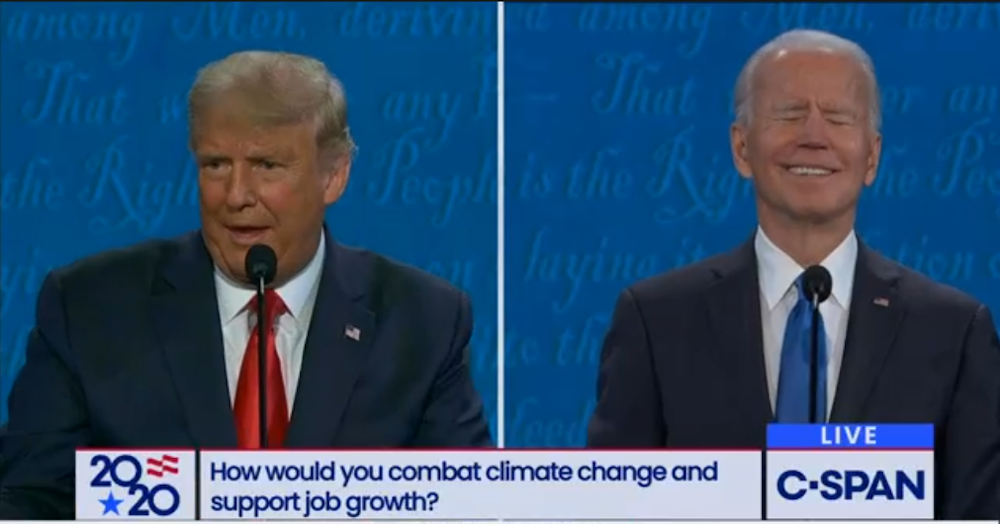
Even when directly dealing with attacks from Trump, whether aimed at his family or his record, Biden often smiled, laughed and shook his head while closing his eyes. That made him appear bemused, if not jovial.
Laughter when under attack likely signals that Biden feels positive enough to be playful and that he is subtly taking control of the conversation.
Trump
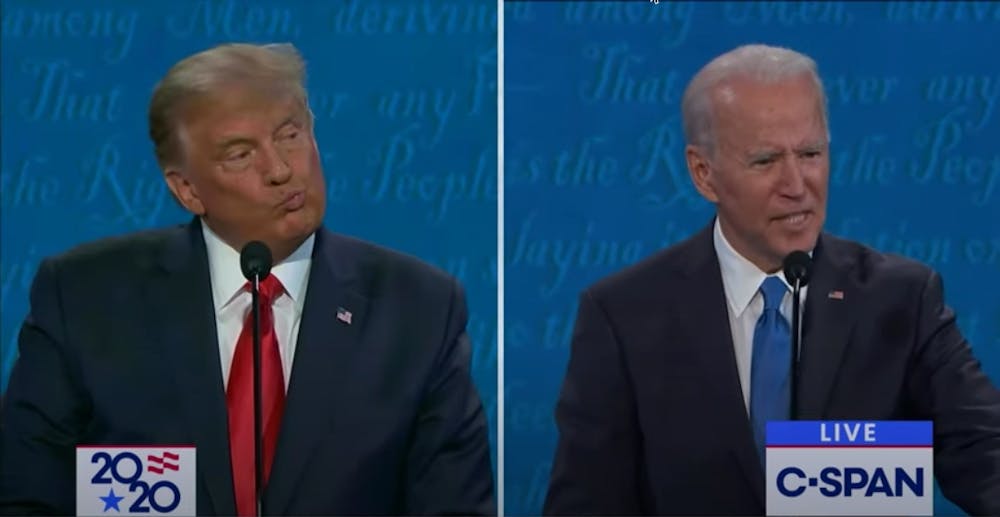
A signature Trump expression known as the ‘lip funneler.’ C-SPAN
Trump presented a much less aggressive and more thoughtful face to the American public during this second debate, especially when compared to the first one.
Instead of directly attacking Biden when his assertions were questioned, Trump responded with what may best be termed a controlled-posed smile, in which his lower lip is pressed up while his lip corners were pulled up in a smile. This type of smile is often used to mask negative emotions or to signal positive emotions when they are not felt.
Perhaps Trump’s signature facial display is his protruding funneled lips. This lip funneler – as it is referred to by facial display researchers – can often be seen while Trump is listening and preparing to interrupt or respond to Biden. The research that exists about this behavior in humans suggests it is a primal display often occurring during intense emotional situations and is associated with anger and threats while engaging in dominance-seeking behavior.
Much can be learned about each candidate with the noise turned down and the attention placed squarely on their distinct nonverbal behavior styles.
This is especially the case when focusing on how the candidates respond to their opposition’s assertions and attacks. Public figures can often control how they act. However, they often do not have as much control over how they react in the heat of the moment.
Sound and Fury – “He Reminds me of my Ex-Husband” sounds funny … but it’s not.
The Lincoln Project – Two today on YouTube, probably more on Twitter
A guitar for Jimmy
Beau on the 500 children Keith spoke about yesterday
Keith
SCOTUS update – Amy Wild Hare Barrett has been sent to the full Senate for a vote. There may be more petitions, especially to Senators not on the Committee. But I don’t have any right now.
Of course, some states will assist you to be sure your vote counts – that’s my experience and Colleen’s, and probably others of us too.
The Nightmare before Election Day, Part II
Yes, I realize there are ridiculous likes, and particularly in communities of color. Frankly, black voters are heroes (as if they aren’t always.) Some states are making it clear, though, that law enforcement persons in uniform are ONLY allowed in polling places in order to cast their own ballots.
Apparently thiese are the only ones going up. I gave it a good two hours past the end of the show. If I’m wrong, and one or two more go up later, I’ll add in.