Experts in autocracies have pointed out that it is, unfortunately, easy to slip into normalizing the tyrant, hence it is important to hang on to outrage. These incidents which seem to call for the efforts of the Greek Furies (Erinyes) to come and deal with them will, I hope, help with that. As a reminder, though no one really knows how many there were supposed to be, the three names we have are Alecto, Megaera, and Tisiphone. These roughly translate as “unceasing,” “grudging,” and “vengeful destruction.”
“Quot homines, tot sententiae.” (Or in other words, “Opinions are like [fill in NSFW blank]; everybody has one.”) I have another election article I was ready to use, but it can wait. I suspect everyone’s nerves are as shredded as mine about, not the election itself, but the Trump* response to it, and this article addresses contested elections directly, and may (or, of course, not) be a calming influence, or at the very least give us ideas on how to be ready for anything.
================================================================
All that sets up the country for a disputed presidential election, with recounts and court battles in key states and a nation left wondering both who will lead it and whether they should have faith in the election’s integrity. We asked five scholars to provide a history of contested elections in the United States and to explain what happens when an election is disputed. Here are those stories, from our archives.
Cohen lays out what elections normally do: They “generate legitimacy because citizens contribute to the selection of leadership.” And even in contested elections of the past, he continues, that legitimacy has been sustained because those disputes have been handled according to the rules. Politicians and citizens may have “howled” about the unfairness of the outcome, but, Cohen reports, they accepted it.
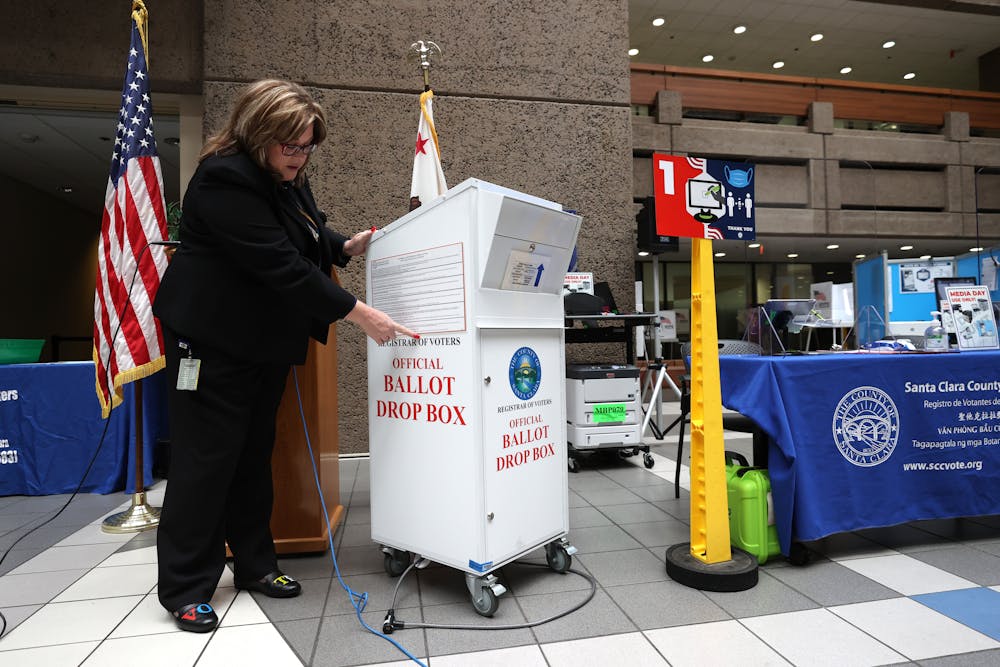
Santa Clara County Registrar of Voters’ Shannon Bushey shows an official county ballot collection box on Oct. 13, 2020 in San Jose, California. Justin Sullivan/Getty Images
2. How to get to the Supreme Court
State law controls almost every aspect of voting, so if there’s an election dispute, then it will go to a state court, writes constitutional scholar John Finn. “A candidate who wants to challenge the result in any particular state must first identify what provision of state law the election did not satisfy.” Most of the time, a state court decision will determine which presidential candidate gets the state’s electoral votes, with a final decision made by the state’s supreme court.
But then there is Bush v. Gore, the case that settled the 2000 election, which demonstrated that an election dispute can end up being heard by the Supreme Court if someone charges that a federal constitutional right has been violated. It’s possible, Finn writes, that several challenges similar to Bush v. Gore could arise in the 2020 election. “And where the lawsuits involved in Bush v. Gore all originated in Florida,” he writes, “this time the chaos may reach across several states.”
3. Throw the vote to Congress
There is another way that an election can end up being decided by others than the voters and the Electoral College. Not when it’s a disputed election, but when the Electoral College members are tied or don’t give any candidate a straight majority. That throws the election to the House of Representatives.
Political scientist Donald Brand writes that this method of determining a winner was not exactly the first choice of the framers, who “sought to avoid congressional involvement in presidential elections.” But if the Electoral College couldn’t provide a majority vote for one candidate, the election would wind up in the House, “presumably because as the institution closest to the people, it could bestow some democratic legitimacy on a contingent election.”
Political scientist Sarah Burns says that the election of 1824, which was resolved with what was then called a “corrupt bargain,” and the disputed 2000 election, which was effectively ended by the Supreme Court, both caused such anger that they poisoned national politics for some time. Critics of the court’s decisive role in 2000 pointed out that “Bush had failed to win the popular vote, and that the Supreme Court vote was split 5-4, with the conservative justices in the majority delivering an outcome favorable to their political leanings.”
5. Judicial credibility
Judges like to stay in their branch of government – the judiciary – and leave the politics to politicians. Supreme Court Justice Felix Frankfurter warned his fellow jurists to avoid “embroilment” in “the political thicket” of “party contests and party interests.” But a disputed election will be fought in the courts, and that’s dangerous for the standing of any court, especially the U.S. Supreme Court. Voters will see judges’ actions and ascribe political intent to them, even if that’s not the case.
Austin Sarat, a legal scholar and political scientist, rakes into a pile the hundreds of lawsuits that have already been mounted over how the election is conducted this year, describing what they aim to do. He believes that the election’s outcome is likely to end up in court – and he says there’s danger ahead, for the lower courts as well as the Supreme Court.
“Whatever decisions judges make this year, the rush to the courthouse to shape the 2020 election will pose real challenges for their legitimacy, which ultimately depends on the public’s belief that they are not simply political actors.”
Editor’s note: This story is a roundup of articles from The Conversation’s archives.
================================================================
AMT, anything you can do to help ensure that we don’t have to worry about this will be deeply appreciated by all.
The Last Free and Fair Election? – Won’t be this election. If this one is stolen, it will have been the previous election which deserves that title.
Family Separation Vol. 279 – As Beau pointed out, some of those parents will only have an address that is a row and plot number. “Could you bear it?” Plus, people seek asylum because someone wants to kill them, Sending them back to that ….
Pennsylvania Voter Values – Well, this is scary. But then any deep dive into the minds (by courtesy) of Trump* supporters is scary.
When you fill out your ballot, ask yourself: Who will best restore decency and civility to the White House. Who can I be proud to tell my children and grandchildren I voted for. pic.twitter.com/dwZ1YH25QL
Biden campaign – a lot, but curated down from 20. They’re all good. The last one is 3+ minutes, but I couldn’t resist (what the CC say is naval is Navajo.)
Really American
RVAT
The Lincoln Project – “Fairy Tale”
Founders Sing (This should make it clear where The Boss stands!)