OK, so I’m a little giddy today. Aren’t you? Be honest!
This was last night, which is why it is so dark. I wanted something upbeat for today, and neither Biden not Harris is much of a grandstander, but they are both caring.
Robert Reich
Now This News – I missed it at the time, but now I wonder if it could help if seen by Trump** supporters.
“The Damage Report” I have no comment.
Beau on inauguration Security (which will basically be completed by the time this goes up – let’s hope he is right – he taped it Monday.)
Music – “Jubilee” by G. W. Chadwick – because it’s my personal favorite feel-good piece.
MSNBC – Sigh. (I read elsewhere the laptop in question was used only for presenations and contains no sensitive information whatever. You have to get upp very early in the morning to be ahead of Nancy Pelosi – and preferably the night before.)
The Lincoln Project – I don’t know whether this is actually part of a series or just one-off, but it’s very well done.
A New Roy Zimmerman! (Sorry it was necessary, but it’s delightful.)
WellRED Comedy parody Zoom meeting to plan next insurrection
Randy Rainbow’s Final Trump parody – Seasons of Trump**””
Now This News – The Importance of MLK Day. Yes, that’s MLK III.
The New Yorker – 12-minute video from the Capitol Coup. H/T Nameless https://www.democraticunderground.com/emoticons/hattip.gif
This video, or I should say group of videos, from ProPublica was curated from video clips downloaded from Parler before it went dark. It’s designed to provide an immersive experience (which I consider a trigger warning – and they also provide one.) The way it is presented, I really can’t embed it, but I give the link. It is ordered into a timeline and grouped based on general location the videos were taken from. You can pick a location, or click anywhere in the timeline, or scroll down (it’s a very long scroll.) You may have to take some of them off of mute (or vice versa.)
https://action.lakotalaw.org/action/biden-pipelines
This video on Standing Rock features Deb Haaland and Alexandria Ocasio-Cortez. It’s also linked to a petition.
Jamie Raskin on CNN – Hanky alert. We need more like him.
Experts in autocracies have pointed out that it is, unfortunately, easy to slip into normalizing the tyrant, hence it is important to hang on to outrage. These incidents which seem to call for the efforts of the Greek Furies (Erinyes) to come and deal with them will, I hope, help with that. As a reminder, though no one really knows how many there were supposed to be, the three names we have are Alecto, Megaera, and Tisiphone. These roughly translate as “unceasing,” “grudging,” and “vengeful destruction.”
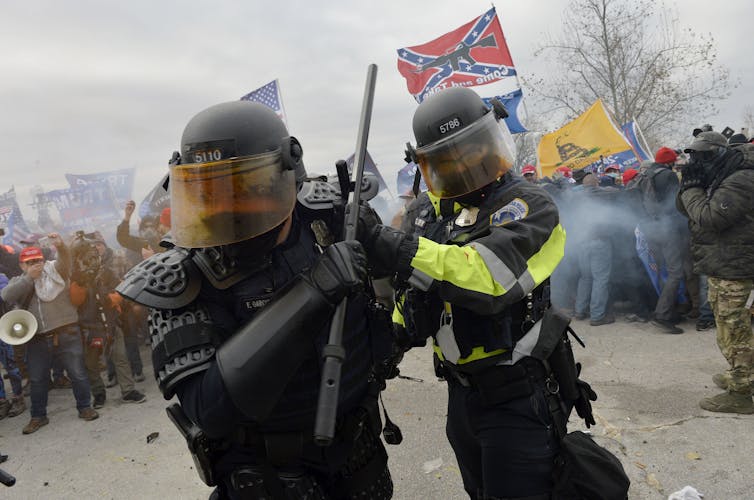
Now that a teacher has been caught on video telling students last week’s rioters were Antifa (I keep wanting to say “I am not making this up”), it might be a good time to start thinking about how this history should be taught in schools, now and in the future. Well, we do have some expert guidance with suggestions.
================================================================
How should schools teach kids about what happened at the US Capitol on Jan. 6? We asked 6 education experts
Likewise, it’s not clear where lessons should begin.
The Conversation U.S. asked six education experts how teachers – and parents – can help young people comprehend, analyze and process what happened.
Don’t avoid the topic
Dr. David Schonfeld, director of the National Center for School Crisis and Bereavement, Children’s Hospital Los Angeles and professor of clinical pediatrics, University of Southern California
Educators may worry they don’t know the right thing to say and will unnecessarily upset students. But saying nothing can say a lot to children – that adults are unaware, unconcerned, unable or unwilling to provide support in difficult times.
Teachers and parents can begin by asking students what they have heard and understand about the event. As kids explain it, it’s important to look for misunderstandings and ask about worries and concerns.
Children often have very different fears than adults. Some may be based on limited information or misunderstandings. For example, children might fear that it’s unsafe to go into any government building and worry about a parent who works in a post office. The goal of these conversations is to help children understand what happened in order to address their worries and concerns.
Especially in the midst of a pandemic, when children and adults are worried about illness and death and many families are dealing with financial concerns and other sources of stress, it’s not a time for teachers to introduce their personal take on what elected officials did right or wrong or to speculate about potential future dangers.
The events of Jan. 6 are a harsh reminder that even in the U.S. people are never completely safe from violence. But adults can use this opportunity to express a hopeful perspective for the future and reassure children that what happened at the Capitol should not make them feel unsafe in their home, at school or in their community.
No business as usual
Paula McAvoy, assistant professor of social studies education, North Carolina State University
I believe that social studies teachers should not return to business as usual in early 2021. Instead, they should spend ample time helping students understand what happened on Jan. 6, what precipitated the mayhem and what should happen going forward.
Once students have had space to process, the priority is to help them become more informed. When engaging in this work, teachers must not treat the question, “Did Joe Biden legitimately win the 2020 election?” as open to interpretation. He most definitely did. Likewise, teachers should not give any credence to the idea that the election was stolen, as the angry mob that wreaked havoc in the Capitol alleged. Instead, teachers should affirm each state’s certification. They should be clear that over 80 judges – including some appointed by Trump – rejected the baseless claim that fraud affected the outcome. They should do this because it is true.
The question, “Should President Trump be impeached again?” is, however, open for interpretation. Engaging students in an extended inquiry into this question as members of Congress grapple with it in real time creates an opportunity to closely read parts of the Constitution, including the 25th Amendment, parse out the difference between a violent insurrection and a protest, and evaluate Trump’s words and actions.
This moment is an opportunity for everyone to deepen their understanding about democracy. And social studies teachers should not let it slip away.
Focus on white supremacy
Tiffany Mitchell Patterson, assistant professor of secondary social studies, West Virginia University
I believe it’s a good idea for teachers to devote some class time to allow students to share their thoughts, feelings and questions on what they have seen and heard about the insurrection in a way that does not harm students of color. This is also an opportunity to engage students in spotting many racial double standards by having students analyze the media coverage, political rhetoric and law enforcement responses to the Black Lives Matter protests across the nation in 2020, and this unprecedented attack that followed smaller-scale operations at some state capitols.
I do understand that some teachers may be reluctant to address what happened. Those educators need to be honest with themselves about why that is and do the necessary self-reflective work needed to overcome their hesitation.
Teachers also must resist the urge to view what I consider a coup attempt as an isolated incident. Instead, they should place it in a historical context.
Many resources are available. The Zinn Education Project and the Southern Policy Law Center’s Teaching Tolerance initiative, among others, provide lesson plans and resources to learn and teach about racism and white supremacy. For some teachers this is ongoing work, and for others this siege is sure to be a catalyst for change. But progress toward the goal of dismantling white supremacy can happen in K-12 classrooms – if teachers choose to do the critical work that it requires.
Kids are, sadly, familiar with violence
Kyle Greenwalt, associate director of teacher preparation and associate professor of education, Michigan State University
School curriculum and children’s own life experiences both oblige teachers to discuss with their students events like those that happened at the U.S. Capitol.
In Michigan, for example, state standards for kindergarteners require them to consider several important civic ideals. These include the notion that “people do not have the right to do whatever they want” and that democracy requires cooperation as well as “individual responsibility.”
But it’s not only educational standards that make it necessary to teach kids about such events and engage them in related discussions. The reality children face in their daily lives also demands it.
Children and teens are no strangers to disagreement, questions of fairness and, unfortunately, scenes of violence like those we saw in the Capitol. For example, schools commonly have active-shooter drills that can leave children feeling confused, scared or angry. I believe that teachers have a moral responsibility to help students process these experiences.
In a truly democratic society, students are not only taught about democracy but are encouraged to practice it. That is, students are empowered to use what they have learned to engage in civic life outside of the classroom walls.
Young people are capable of showing their elders what it means to live democratically and take care of the common good.
Connect events to the past and the future
Kei Kawashima-Ginsberg, director of the Center for Information & Research on Civic Learning and Engagement, the Jonathan M. Tisch College of Civic Life at Tufts University
Most students today have never seen our elected leaders and political systems work well, let alone live up to America’s constitutional ideals. Many are confused by what they’ve seen, if not angry and traumatized. It’s important for teachers to communicate that all kinds of emotional reactions are valid.
Let students express and process what they feel safely. Do not dehumanize any student because of their opinion – but teach them to always consider the intent and impact of their response. If appropriate, encourage methods like journaling that allow for reflection without sharing.
This is also an opportunity to connect current events with other moments in American history when the nation’s institutions were tested or our leaders fell short in their commitment to core American values.
Even with younger students, I don’t believe educators should shy away from the fact that some people violated not just social norms but their professional, political and moral duties – and why their actions threaten the health of our republic.
These conversations can enhance students’ understanding of the past and present and inspire a passion to build a better future for all Americans.
Explain what ‘dissent’ is
Sarah Stitzlein, professor of education and affiliate professor of philosophy at University of Cincinnati
Ideally with the support of their school administrators and local community, teachers should help students distinguish justified protest from the violent siege that occurred at the Capitol. They should explain how good dissent seeks to understand problems, critiques injustice, sparks discussion between people with different views, bases claims on evidence and employs democratic processes.
Teachers should empower students with the skills of dissent. These include raising awareness, forming persuasive arguments, building coalitions and using critical thinking to challenge misinformation. Students should practice putting forward solutions that can be discussed and tested. Young people should be encouraged to imagine how life can be better in America as a way to build hope with their peers.
It’s important that they realize how dissent and hope together can help strengthen U.S. democracy.
================================================================ Alecto, Megaera, and Tisiphone, there’s a Tweet quoting Speaker Pelosi in today’s Video Thread which refers to the fact that kids are familiar with violence – a lot more familiar than we give them credit for, and a lot more familiar than is best for them. And that is only one way in which kids are well equipped to handle the truth – and in fact, likely better equipped than many teachers. Any assistance we can get in bringing the truth to our children would be greatly appreciated.