Starting with two that were put up after I posted last week … all three relate to Asian-Americans
Pandemic Video Diaries: When the Pandemic Ends, Work Begins
Sam’s Love Letter To Chinatown
And now, four new ones, put up tonight. I will not guarantee that more won’t show up during the week. I’ll get to them when they appear.
Reality Winner: The Story of an NSA Whistleblower as told by Samantha Bee (Director’s Cut)
Sam Gives Full Frontal the Presidential Treatment (“Cold Open”)
Washington D.C. Needs to (Puff Puff) Pass Marijuana Legalization Pt. 1
Washington D.C. Needs to (Puff Puff) Pass Marijuana Legalization Pt. 2
Tweet – POTUS and VPOTUS call to Floyd family after vrdict
President Biden and VP Harris call the Floyd family after the GUILTY verdict! Thank you @POTUS & @VP for your support! We hope that we can count on you for the police reform we NEED in America! ✊🏾 pic.twitter.com/cg4V2D5tlI
I do apologize for being late. I thought it was worth waiting for the verdict, which I immediately posted on the Personal Update. And was it ever worth while! I can’t stop crying but they are good tears.
The Lincoln Project
Glann Kirschner on Chauvin closing arguments. As of 4 pm EDT, there is a verdict. The Washington Post is covering it live. It is so fast that I am hopeful. And – YES
File under “No s***, Sherlock” – except that so many are ignorant of it.
Now This News – This happened in India. The mother is blind. It happened so fast, it loops four time in this one minute video (with no words.)
Beau exceeded 600K supporters yesterday, but still found time to post about the KKKaucus and its implications.
The Lincoln Project – Another reminder video. Well, that’s what we need. Otherwise people forget.
Now This News generally has CC both enabled and built in. This has neither. I can only imagine the person who posted it needed a hanky too – so much so as to forget CC
Ring of Fire – Interesting news from Texas
Corey Ryan Forrester (not shouty for once) – Boilerplate Conservative Campaign Ad
Beau – Questions about Chicago (Adam Toledo). Credit to Beau for being able to speak in a controlled manner. I think I’d be shrieking. (Ck CC)
Experts in autocracies have pointed out that it is, unfortunately, easy to slip into normalizing the tyrant, hence it is important to hang on to outrage. These incidents which seem to call for the efforts of the Greek Furies (Erinyes) to come and deal with them will, I hope, help with that. As a reminder, though no one really knows how many there were supposed to be, the three names we have are Alecto, Megaera, and Tisiphone. These roughly translate as “unceasing,” “grudging,” and “vengeful destruction.”
The trial of Derek Chauvin is scheduled to go to closing arguments Monday. While I doubt if anyone here watched every minute of the stream, we have probably sll been following it So I won’t comment much What I do have to say will be after the end of the article.
================================================================
Derek Chauvin trial: 3 questions America needs to ask about seeking racial justice in a court of law
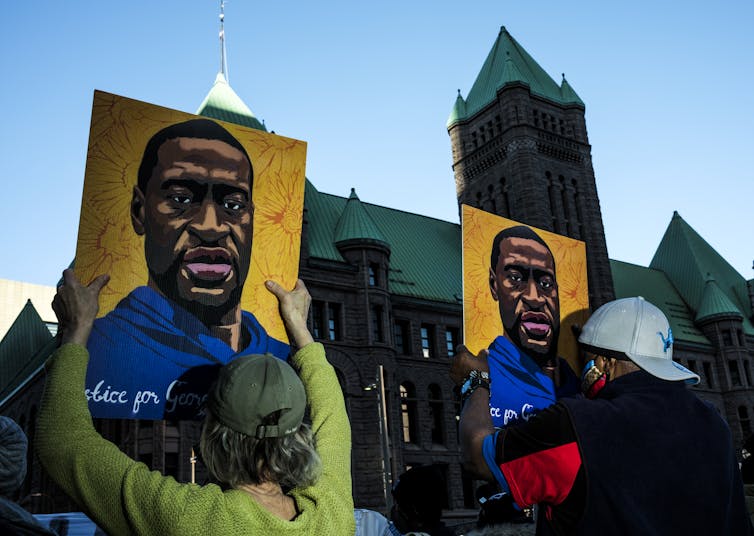
A demonstration outside the Hennepin County Government Center in Minneapolis on March 29, 2021, the day Derek Chauvin’s trial began on charges he murdered George Floyd. Stephen Maturen/Getty Images
There is a difference between enforcing the law and being the law. The world is now witnessing another in a long history of struggles for racial justice in which this distinction may be ignored.
Derek Chauvin, a 45-year-old white former Minneapolis police officer, is on trial for second-degree murder, third-degree murder, and second-degree manslaughter for the May 25, 2020, death of George Floyd, a 46-year-old African American man.
There are three questions I find important to consider as the trial unfolds. These questions address the legal, moral and political legitimacy of any verdict in the trial. I offer them from my perspective as an Afro-Jewish philosopher and political thinker who studies oppression, justice and freedom. They also speak to the divergence between how a trial is conducted, what rules govern it – and the larger issue of racial justice raised by George Floyd’s death after Derek Chauvin pressed his knee on Floyd’s neck for more than nine minutes. They are questions that need to be asked:
1. Can Chauvin be judged as guilty beyond a reasonable doubt?
The history of the United States reveals, however, that these two conditions apply primarily to white citizens. Black defendants tend to be treated as guilty until proved innocent.
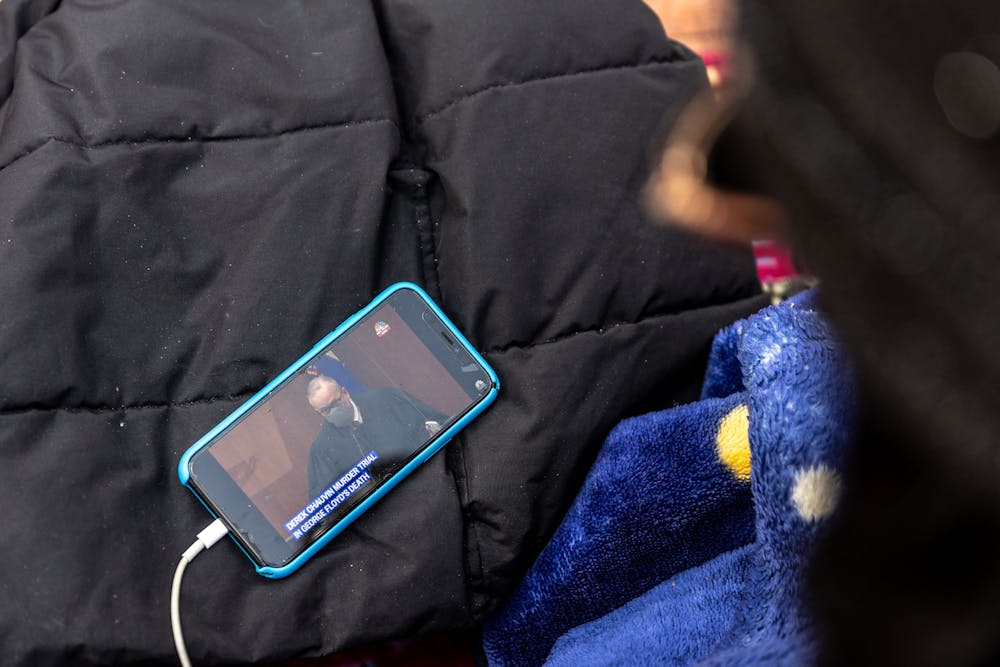
An activist watches the murder trial of former Minneapolis police officer Derek Chauvin outside the Hennepin County Government Center in Minneapolis on March 30, 2021. Kerem Yucel / AFP/via Getty Images
Violence, however, is the use of illegitimate force. As a result of racism, Black people are often portrayed as preemptively guilty and dangerous. It follows that the perceived threat of danger makes “force” the appropriate description when a police officer claims to be preventing violence.
Floyd, who was suspected of purchasing items from a store with a counterfeit $20 bill, was handcuffed and complained of not being able to breathe when Chauvin pulled him from the police vehicle and he fell face down on the ground.
If force under the circumstances is unwarranted, then its use would constitute violence in both legal and moral senses. Where force is legitimate (for example, to prevent violence) but things go wrong, the presumption is that a mistake, instead of intentional wrongdoing, occurred.
An important, related distinction is between justification and excuse. Violence, if the action is illegitimate, is not justified. Force, however, when justified, can become excessive. The question at that point is whether a reasonable person could understand the excess. That understanding makes the action morally excusable.
Sgt. David Pleoger, Chauvin’s former supervisor, stated in the trial: “When Mr. Floyd was no longer offering up any resistance to the officers, they could have ended their restraint.”
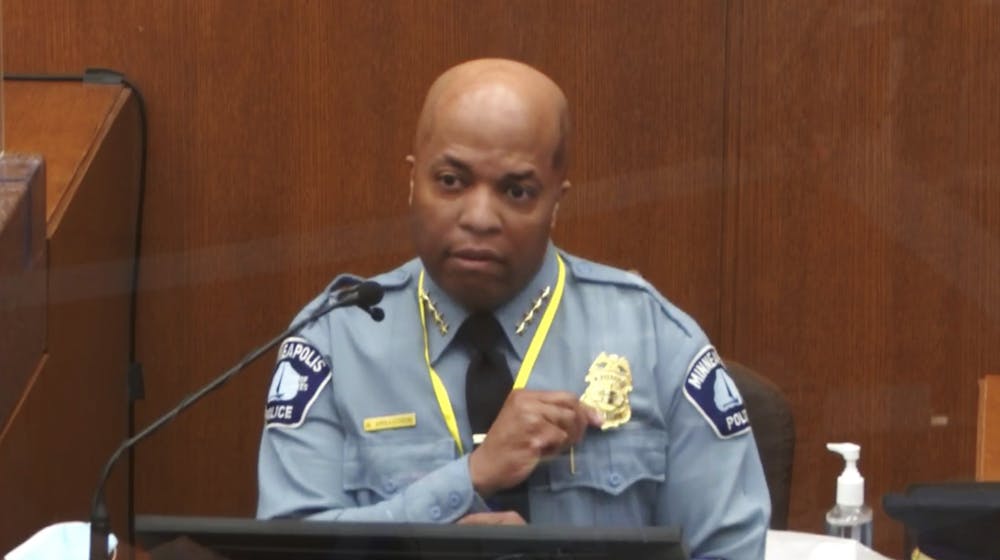
Minneapolis Police Chief Medaria Arradondo testified, “To continue to apply that level of force to a person proned-out, handcuffed behind their back, that in no way, shape or form is anything that is by policy.” He declared, “I vehemently disagree that that was an appropriate use of force.”
The Chauvin case, like so many others, leads to the question: What is the difference between enforcing the law and imagining being the law? Enforcing the law means one is acting within the law. That makes the action legitimate. Being the law forces others, even law-abiding people, below the enforcer, subject to their actions.
If no one is equal to or above the enforcer, then the enforcer is raised above the law. Such people would be accountable only to themselves. Police officers and any state officials who believe they are the law, versus implementers or enforcers of the law, place themselves above the law. Legal justice requires pulling such officials back under the jurisdiction of law.
The purpose of a trial is, in principle, to subject the accused to the law instead of placing him, her, or them above it. Where the accused is placed above the law, there is an unjust system of justice.
This article has been updated to correct the charges Chauvin is facing.
================================================================ Alecto, Megaera, and Tisiphone, to me one of the best moments in the trial was during the cross examination of the defense’s final expert witness, who cied an expert who “used to” believe in “positionary asphyxiation, but has retracted his statements.” The prosecution was ready for that. They had an affadavidt from the cited expert which included “many people have said that I retracted [my statements on positionary asphyxiation, but in fact I have never retracted and do not retract any of my statements on the matter.” How can you not love a trial attorney on either side who does his homework in anticipation of it beeing needed to ensure that truth gets told?
There is no guarantee exactly how a jury will vote, but I am feeling some hope … tempered by finding it difficult to trust a jury. We shall see. We shall all see.