Meidas Touch – Depressing – nothing that we didn’t know (or strongly suspect), but now, confirmation.
Really American
The Republican Accountability Project – and here’s the link to the Report Card – https://accountability.gop/report-card/ (Mine got an “F” – no surprise)
The Damage Report – The lying is no surprise, though the apology is
Now This News – Super (Pink) Moon At least this is not depressing. (It also isn’t pink, and the brightness is not due to air pollution.)
Robert Reich – Voting Rights
Beau on Montana’s new law and a Republican “change of heart”
The Republican Accountability Project – THAT press conference
Really American – “Tough Guys” (I really don’t know what this trend with no CC is here)
Meidas Touch – This is the first of three from Roland, all three of which I will eventually wor in. And of course he is right about this. And it is no excuse to call it the fault of black people. It is anything but that.
Experts in autocracies have pointed out that it is, unfortunately, easy to slip into normalizing the tyrant, hence it is important to hang on to outrage. These incidents which seem to call for the efforts of the Greek Furies (Erinyes) to come and deal with them will, I hope, help with that. As a reminder, though no one really knows how many there were supposed to be, the three names we have are Alecto, Megaera, and Tisiphone. These roughly translate as “unceasing,” “grudging,” and “vengeful destruction.”
The trial of Derek Chauvin is now over. The verdict was on one level expectable (God knows there was more than enough evidence and it was very clear), and yet, in our unwell society, unexpected. Let’s look at some takeaways while it is fresh in our minds.
================================================================
Why this trial was different: Experts react to guilty verdict for Derek Chauvin
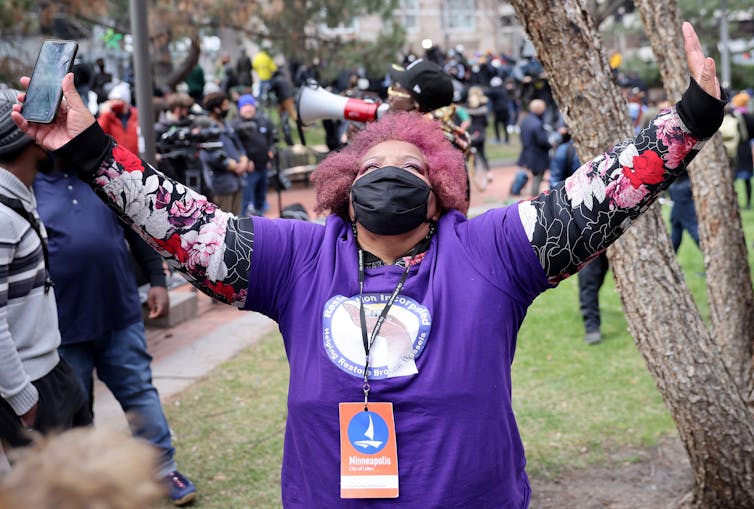
A woman reacts to the news that Derek Chauvin was found guilty on all three counts in the murder of George Floyd. Scott Olson/Getty Images
Scholars analyze the guilty verdicts handed down to former Minneapolis police officer Derek Chauvin in the 2020 murder of George Floyd. Outside the courthouse, crowds cheered and church bells sounded – a collective release in a city scarred by police killings. Minnesota’s attorney general, whose office led the prosecution, said he would not call the verdict “justice, however” because “justice implies restoration” – but he would call it “accountability.”
Race was not an issue in trial
Alexis Karteron, Rutgers University – Newark
Derek Chauvin’s criminal trial is over, but the work to ensure that no one endures a tragic death like George Floyd’s is just getting started.
This should not be surprising, because the criminal legal system writes race out at virtually every turn. When I led a lawsuit as a civil rights attorney challenging the New York Police Department’s stop-and-frisk program as racist, the department’s primary defense was that it complied with Fourth Amendment standards, under which police officers need only “reasonable suspicion” of criminal activity to stop someone. Presence in what police say is a “high-crime area” is relevant to developing reasonable suspicion, as is a would-be subject taking flight when being approached by a police officer. But the correlation with race, for a host of reasons, is obvious to any keen observer.
Different communities across the country will follow different paths in their efforts to prevent another tragic death like George Floyd’s. Some will do nothing at all. But progress will be made only when America as a whole gets real about the role of race – something the legal system routinely fails to do.
Derek Chauvin had his knee on George Floyd for 9 minutes, 29 seconds.
Why this trial was different
Ric Simmons, The Ohio State University
The guilty verdicts in the Chauvin trial are extraordinary, if unsurprising, because past incidents of police lethal use of force against unarmed civilians, particularly Black civilians, have generally not resulted in criminal convictions.
In many cases, the prosecuting office has been reluctant or halfhearted in pursuing the case. Prosecutors and police officers work together daily; that can make prosecutors sympathetic to the work of law enforcement. In the Chauvin case, the attorney general’s office invested an overwhelming amount of resources in preparing for and conducting the trial, bringing in two outside lawyers, including a prominent civil rights attorney, to assist its many state prosecutors.
Usually, too, a police officer defendant can count on the support of other police officers to testify on his behalf and explain why his or her actions were justified. Not in this case. Every police officer witness testified for the prosecution against Chauvin.
Finally, convictions after police killings are rare because, evidence shows, jurors are historically reluctant to substitute their own judgment for the split-second decisions made by trained officers when their lives may be on the line. Despite the past year’s protests decrying police violence, U.S. support for law enforcement remains very high: A recent poll showed that only 18% of Americans support the “defund the police” movement.
But Chauvin had no feasible argument that he feared for his life or made an instinctive response to a threat. George Floyd did nothing to justify the defendant’s brutal actions, and the overwhelming evidence presented by the prosecutors convinced 12 jurors of that fact.
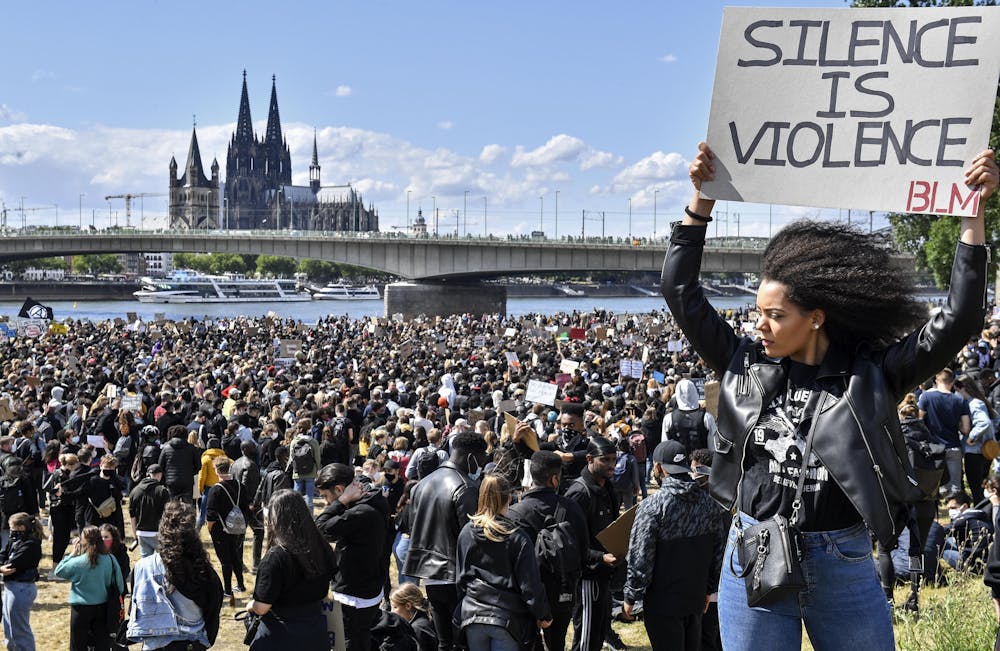
The death of George Floyd sparked protests around the U.S. and across the world, including this June 2020 rally in Germany. AP Photo/Martin Meissner
The ‘thin blue line’ kills
Jeannine Bell, Indiana University
Like other high-profile police killings of African Americans, the murder of George Floyd revealed a lot about police culture – and how it makes interactions with communities of color fraught.
Derek Chauvin used prohibited tactics – keeping his knee on Floyd’s neck when he had already been subdued – to suffocate a man, an act the jury recognized as murder. Three fellow Minneapolis Police Department officers watched as Chauvin killed Floyd. Rather than intervene themselves, they helped him resist the intervention of upset bystanders and a medical professional. They have been charged with aiding and abetting a murder.
The police brotherhood – that intense and protective “thin blue line” – enabled a public murder. Police Chief Medaria Arradondo, unusually, broke this code of silence when he testified against Chauvin.
Research shows that even if officers see a fellow officer mistreating a suspect and want to intervene, they need training to teach them how to do so effectively. The city of New Orleans is now training officers to intervene. Once training is in place, police departments could also make intervention in such situations mandatory.
When some officers stand by as other officers ignore their training, the consequences can be dangerous – and potentially lethal – for civilians.
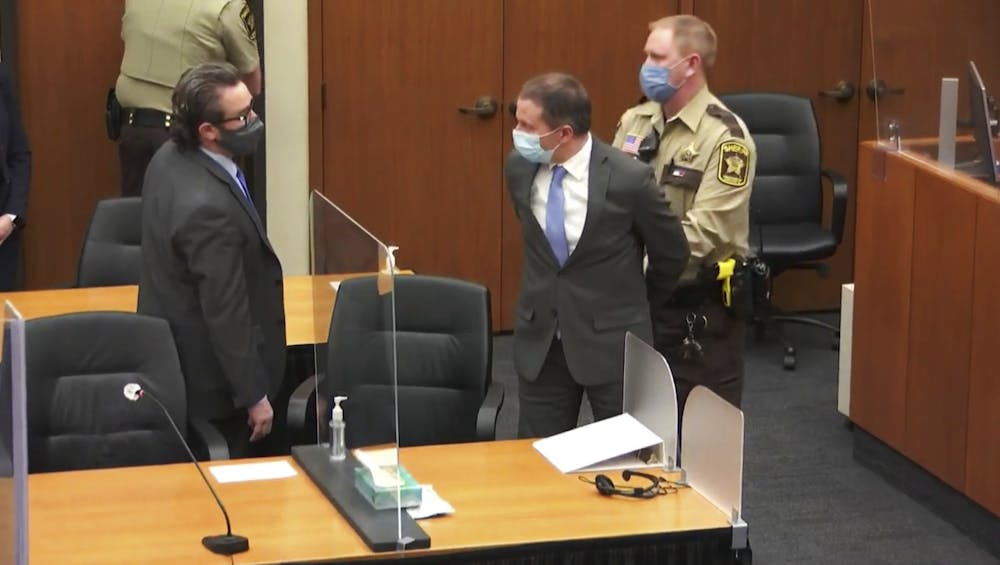
After the verdicts were read, Derek Chauvin was taken into police custody to await sentencing. Court TV via AP, Pool
Minnesota faces its racism
Rashad Shabazz, Arizona State University
This verdict reflects a little-known truth about Minneapolis: As the city and metro region have become Blacker and more diverse, police violence against Black people has intensified. This is not to suggest that things have always been good for Black Minneapolis residents. Indeed, Minneapolis’ Black population – a group without political power or visibility – has faced segregation, police violence and Northern Jim Crow policies in its downtown music venues for decades.
White Minnesotans and Minneapolitans developed a false belief that somehow they were above racism; that their form of neighborliness known as “Minnesota nice” was an antidote to anti-Blackness and that – most of all – race didn’t matter in a place as nice as Minnesota.
================================================================ Alecto, Megaera, and Tisiphone, I can’t agree with Alexas Karteron. Race may not have been used as an issue, but it was still very much an issue. Ric Simmons is right on about the attorney general’s involvement making a difference – and especially whan that AG is Keith Ellison. Jeannine Bal is not only right but has put her finger at or close to the heart of our biggest problem in the US. I hope Rashad Shabazz is right … but I’ll believe it when I see it.
I don’t see a monologue … but I do see a new rule.I’ll just put up what there is in the order in which it was posted to YouTube. I don’t know why they don’t all have CC tonight, and can only hope someone there enables it soon.
The Lincoln Project – Well, this is interesting. I believe it’s called “stiring the s***.”
Meidas Touch – “Impressed?
Really American – Mo Brooks
https://actionnetwork.org/petitions/sign-the-petition-fire-postmaster-general-louis-dejoy
Glenn Kirschner – I’m glad he’s taking this up … and has information on a petition (which I’ll spare you tracking down through Twitter)
Earth Day – “Trash TV” – Every time this video is watched, it will fund the removal of one piece of plastic from the ocean. I don’t know for sure if that is true for embeds, but you can always click through just in case.
LPLP – “Welcome home, Rattler! Michael “Rattler” Markus, “who served during the NoDAPL protests as an Akicita (defender), positioned between police and water protectors to keep everybody safe, was arrested in February of 2017. He subsequently accepted a plea to a civil disorder charge stemming from his presence on Oct. 27, 2016 — when law enforcement assaulted unarmed water protectors with sound cannons, tasers, bean bags, rubber bullets, and pepper spray.” Sprry about the spring plains wind, which can be heard throughiut.
Yes, i have one for today. But I thought , after forgetting to post this one yesterday, I’d get it up first.
Glenn Kirschner was on TV all day on 4/20 – he did post this on 4/20, but quite late.
Then yesterday he did this video – so, in case anyone was wondering.
This video is over 12 minutes, but it’s a twelve minutes well spent. Apparently Karma knows better that we do exactly whenand where is the right time and place for a person to be – first Merrick Grland, now Keith Ellison.
(I can already hear Republicans screaming “Sharia Law !!”
Meidas Touch – I wish every Republican voter could see this.
Really American
Republican Accountability Project
Orange Acres Episode 4 Part 3
Beau on “We write the report.” I actually read the reprt, which required a magnifier (and was then blurry.) This will spare you that, I hope.