Bill Maher from 2/28

 Posted by at 10:32 am  Politics
Feb 292020
 

It’s that time of week again, so here are 4 fine video clips, from Bill’s show last night.  Enjoy!

Monologue: The Flus Will Not Replace Us!

Anyone who can make us laugh at COVID-19 [R-CH], while telling the truth about it has to be a damn good comedian.

Dr. Anne Rimoin: Going Viral

She knows her stuff. For that reason I’m certain that she will have no input on whatever response criminal Fuhrer Trump and Vice Fuhrer Mike “The HIV Guy” Pence enact.

Nicholas Kristof: Tightrope

A good drug policy is the opposite of Republican policy. It’s a public health problem, not a criminal justice problem.

New Rule: My Way or the Die Way

My Way or the Die Way is an attitude Republicans welcome and encourage routinely. The vast majority of Democrats won’t tolerate it. And we should not!  I do not!

I liked this show!

RESIST!!

Share
Feb 292020
 

It’s become a busy day here in the CatBox, as two days missed has me way behind in research.  I was also sick most of the night, and today, and I have thrown up four times since breakfast.  I really think it’s pills blocking the passage.  Then food and saliva collect and fill the esophagus.  ARGH!  Tomorrow is a WWWendy day, and normally I would publish only a Personal Update, but I’ll try to add a piece on the SC primary.  Have a great weekend.

Jig Zone Puzzle:

Today’s took me 2:57 (average 4:51).  To do it, click here.  How did you do?

Cartoon:

0229Cartoon

That is the machine I was in yesterday.

Short Takes:

From Alternet: According to a report from the Star-Telegram, a senior member of the rightwing paramilitary group Oath Keepers who moved to Texas in 2015 is actively recruiting local law enforcement employees while telling them a “bloody civil war” against the U.S. government is on the horizon.

The report states that John D. Shirley, the national director of the Las Vegas-based Oath Keepers finagled himself a job as a county constable in Hood County which provided him with access to other police officers and now he is using his position to recruit.

According to the Southern Poverty Law Center, the Oath Keepers organization is “one of the largest radical antigovernment groups in the U.S. today” with, reportedly, thousands of members made up of former law enforcement officials and military veterans.

The Oath Keepers are Republican Supply-side pseudo-Christian terrorists.  Because of the group’s treasonous activities, membership in Oath Keepers ought to be a court martial offence for military personnel and cause for termination for other government employees, especially those in law enforcement. RESIST!!

From NY Times: President Trump announced on Friday that he intended to nominate Representative John Ratcliffe, Republican of Texas, as his director of national intelligence, choosing someone he considered last summer before senior Republicans in Congress deemed him unqualified for the job.

When even Bought Bitch Midnight Moscow Mitch’s prime lackeys consider this bozo unqualified,it shows that he’s only sycophant that criminal Fuhrer Trump* can find to be his  Barrf in the DNI position.  RESIST!!

From YouTube (a blast from the past): Moody Blues – Tuesday Afternoon (1970)

Ah… the memories!  RESIST!!

Vote Blue!!

Share

Everyday Erinyes #206

 Posted by at 8:42 am  Politics
Feb 292020
 

Experts in autocracies have pointed out that it is, unfortunately, easy to slip into normalizing the tyrant, hence it is important to hang on to outrage. These incidents which seem to call for the efforts of the Greek Furies (Erinyes) to come and deal with them will, I hope, help with that. As a reminder, though no one really knows how many there were supposed to be, the three names we have are Alecto, Megaera, and Tisiphone. These roughly translate as “unceasing,” “grudging,” and “vengeful destruction.”

The Furies picked out this article themselves. They wanted us to get a better handle on how events of today are reflected in events of days when they were very young. They hope it will help.
==================================================================

The ancient Greeks had alternative facts too – they were just more chill about it

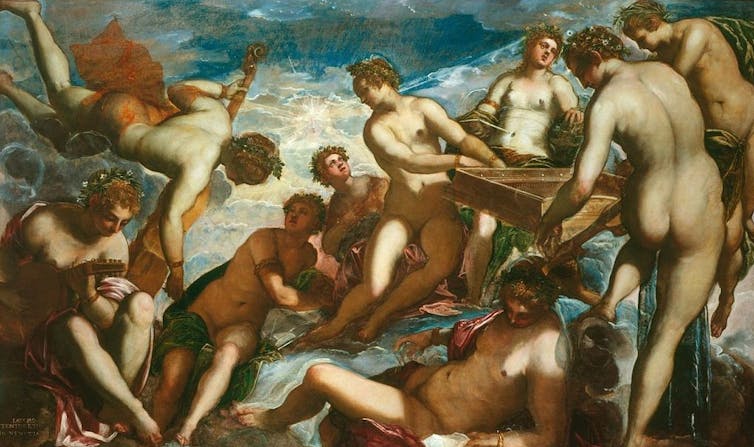
Understandings of truth may be found in the Muses’ words.
Jacopo Tintoretto’s The Muses/Wikpedia

Joel Christensen, Brandeis University

In an age of deepfakes and alternative facts, it can be tricky getting at the truth. But persuading others – or even yourself – what is true is not a challenge unique to the modern era. Even the ancient Greeks had to confront different realities.

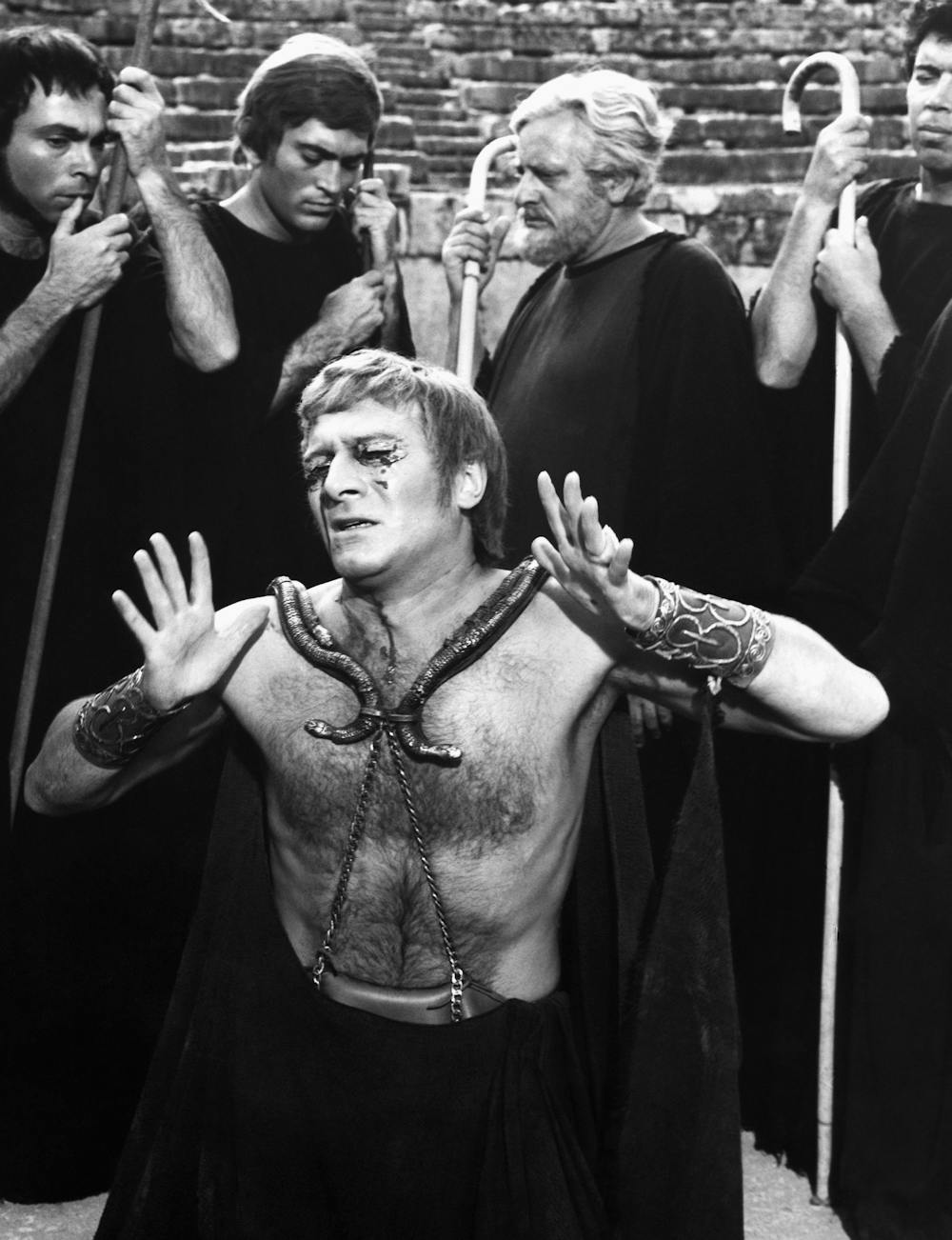
Take the story of Oedipus. It is a narrative that most people think they know – Oedipus blinded himself after finding out he killed his father and married his mother, right?

Actor Christopher Plummer in the 1967 film ‘Oedipus the King.’
AP Photo

But the ancient Greeks actually left us many different versions of almost every ancient tale. Homer has Oedipus living on, eyes intact after his mother Jocasta’s death. Euripides, another Greek dramatist, has Oedipus continue living with his mother after the truth is revealed.

A challenge I face when teaching Greek mythology is the assumption that my course will establish which version of the story is correct. Students want to know which version is “the right one.”

To help them understand why this isn’t the best approach, I use a passage from Hesiod’s “Theogony,” a story of the origin of the universe and the gods by the poet Hesiod. The narrator claims the Muses, inspirational goddesses of the arts, science and literature, appeared to him and declared “we know how to tell many false things (pseudea) similar to the truth (etumoisin) but we know how to speak the truth (alêthea) when we want to.”

Now, that is quite the disclaimer before going on to describe how Zeus came to rule the universe! But the Greeks had different ways of thinking about narrative and truth than we do today.

The truths are out there

One such approach focuses on the diversity of audiences hearing the story. Under this historical interpretation, the Muses’ caveat can be seen as a way to prepare audiences for stories that differ from those told in their local communities.

A theological interpretation might see a distinction between human beliefs and divine knowledge, reserving the ability to distinguish the truth for the gods alone. This approach anticipates a key tenet of later philosophical distinctions between appearance and reality.

The Muses also set out a metaphysical foundation: The truth exists, but it is hard to comprehend and only the gods can truly know and understand it. This formulation establishes “truth” as a fundamental feature of the universe.

The meanings of the words used are important here. “Pseudea,” used for “lies,” is the root of English compounds denoting something false – think pseudonym or pseudoscience. But notice that Hesiod uses two different words for “truth.” The first, “etumon” is where we get the English etymology from, but this Greek word can mean anything from “authentic” to “original.” The second, “alêthea” literally means “that which is not hidden or forgotten.” It is the root of the mythical river of forgetfulness, Lêthe, whose waters the souls of the dead sample to wash away their memories.

So to the Muses — who were the daughters of Zeus and Mnemosyne, the goddess of memory — “truth” is something authoritative because it is “authentic” in meaning and “revealed” or “unforgettable.”

The Muses’ implication is that truth is derived from ancient origins and is somehow unchanging and, ultimately, unknowable for human beings.

Indeed, this formulation becomes a bedrock of ancient philosophy when authors like Plato insist that truth and reality must be eternal and immutable. Such assumptions about the truth are also central to absolutist approaches to beliefs, whether we are talking about religion, literature or politics.

But what good is knowing about the nature of truth if it is ultimately inaccessible to mortal minds?

From teaching Greek texts I have become increasingly convinced that the Theogony’s narrator quotes the Muses not merely to evade responsibility for telling an unknown story nor to praise the wisdom of the gods. Instead, he is giving us advice for how to interpret myth and storytelling in general: Don’t worry about what it is true or not. Just try to make sense of the story as you encounter it, based on the details it provides.

Myth and memory

The treatment of “truth” in Greek myth can be informative when looking at modern research in cognitive science and memory.

The memory scientist Martin Conway, in studying how people construct stories about the world and themselves, has argued that two basic tendencies, correspondence and coherence, govern our memories.

Correspondence refers to how well our memory fits with verifiable facts, or what actually happened.

Coherence is the human tendency to select details which fit our assumptions about the world and who we are. Conway’s studies show that we tend to select memories about the past and make observations on the present which confirm our own narrative of what actually happened.

We already know that much of what we understand about the world is interpreted and “filled in” by our creative and efficient brains, so it should be of little surprise that we selectively pick memories to represent an absolute truth even as we continually revise it.

As individuals and groups, what we accept as “true” is conditioned by our biases and by what we want the truth to be.

With this in mind, the Muses’ warning not to obsess about whether the details in a myth are true seems appropriate – especially if a narrative making sense is more important than it being “true.”

A scene from Homer’s “Odyssey” strengthens the case for applying these ideas to early Greece. When Odysseus returns to his home island of Ithaca after 20 years, he dons a disguise to test the members of his household. A great deal of suspense arises from his conversations with his wife, Penelope, when he too is described as “someone speaking many lies (pseudea) similar to the truth (etumoisin).” Odysseus presents facts to his wife that have no counterpart in an objective reality, but his selection of details reveals much about Odysseus that is “true” about himself. He offers themes and anecdotes that give an insight into who he is, if we listen closely.

Ancient Greek epics emerged from a culture in which hundreds of different communities with separate traditions and beliefs developed shared languages and beliefs. Not unlike the United States today, this multiplicity created an environment for encountering and comparing differences. What Hesiod’s story tells his audience is that truth is out there, but it is hard work to figure out.

Figuring it out requires us to listen to the stories people tell and think about how they might seem true to them. That means not overreacting when we hear something unfamiliar that goes against what we think we know.

[ Deep knowledge, daily. Sign up for The Conversation’s newsletter.]The Conversation

Joel Christensen, Associate Professor of Classical Studies, Brandeis University

This article is republished from The Conversation under a Creative Commons license. Read the original article.

==================================================================
Now, I’m sure you are thinking that there is a major difference between truth in myth or religious belief, and truth in actual history. There is indeed. But historians of the times of the Erinyes didn’t see that the way we do. Herodotus, Thucydides, Livy, Tacitus, Pliny, Suetonius, Josephus – All of them included material which cannot be proven true, and material which can actually be proven false. Historians of that time didn’t really seem to care; if it was a good story, they told it.

To give just one example of the provably false, consider the story of Nero “fiddling while Rome burned,” in some accounts watching from the roof of his home. Certainly the great fire burned for several days, and it’s also apparently true that Nero didn’t want to be an Emperor so much as an actor and/or a singer. But fiddled? There was no such thing as a fiddle at the time. There were no bowed stringed instruments at all, and very few plucked ones. There were lyres, which are a sort of two-sided harp. But that’s a minor quibble. What really undercuts the story is that Nero was not in Rome when the fire started – and by the time he did get there, his house – roof and all – no longer existed. (And don’t get me started on the collapsible boat with which he is supposed to have murdered, or tried to murder, his mother Agrippina.) So what you think you know about historical figures may in reality be just as undependable as what you know or don’t know about mythology.

Alecto, Megaera, and Tisiphone, Thank you for sharing with us. Please help us, if you can, to hang onto respect for truth, and to hold on to truth which is knowable and provable, in the face of challenges.

The Furies and I will be back.

Share
Feb 282020
 

It’s a busy day, here in the CatBox.  I was able to keep the last three meals down.  I usually have the most trouble at breakfast and wonder if my morning pills are blocking the tiny opening around the tumor.  I have my Medicare Advantage company researching liquid prescription alternatives.  Today is my PET Scan.  I’ll get the results sometime next week.  I’ll get home at around 1:00 PM, and by the time I change clothes, put everything away, and prepare and eat lunch, I’ll have a very short nap at best, so you may not hear from me until tomorrow.  Hopefully, I’ll be back in the saddle then.    Remember: Democrats debate, Republicans masdebate!  TGIF to all!

Jig Zone Puzzle:

Today’s took me 3:35 (average 5:49).  To do it, click here.  How did you do?

Cartoon:

Short Take:

From YouTube (a blast from the past): Dion The Wanderer

Ah… the memories!  RESIST!!

Vote Blue!!

Share
Feb 272020
 

I’m sorry, but I need to go back to bed.  I tried to eat soft boiled eggs for supper and have had very severe heartburn ever since.  To make matters worse, I have a grocery delivery this afternoon,  Tomorrow please expect no more than a Personal Update.  I have to go out for my PET Scan.  Painful Hugs to all.

Jig Zone Puzzle:

I could not do today’s puzzle (average 5:02).  To do it, click here.  How did you do?

Cartoon:

RESIST!!

Vote Blue!!

Share

The SC Debate

 Posted by at 9:47 am  Politics
Feb 262020
 

The performance that I liked best in the SC debate was that of Elizabeth Warren, but I’m sure my own bias enters into that.  I think that Bernie, Joe and Liz did well.  Amy and Pete barely held their own, at best.  Bloomberg was weak, and Steyer did not belong on the stage at all.  Other losers were the boo birds that the Biden campaign planted in the audience to scream BOO every time Bernie opened his mouth.

0226democraticdebate

Seven Democratic presidential candidates took the stage Tuesday night in Charleston, S.C., for a fiery debate days before the state’s primary on Saturday.

The showdown in the Palmetto State also marked the final debate before Democrats battle in the biggest day on the primary calendar — Super Tuesday — next week.

Who won and lost in the latest debate?

WINNERS

Former Vice President Joe Biden

Biden kept his hopes alive with one of his strongest debate performances.

Sen. Elizabeth Warren (D-Mass.)

Warren is the most consistent debater left in the race.

She went after former New York City Mayor Michael Bloomberg once again in this debate. She did not eviscerate him as thoroughly as she did last week in Las Vegas, but she again raised questions about his treatment of women in the workplace….

Sen. Bernie Sanders (I-Vt.)

Sanders won on Tuesday by not obviously losing.

He came under the kind of sustained attack that any front-runner faces…

Inserted from <The Hill>

The biggest loser in the debate was CBS News.  Here’s an excerpt from an email from Marcos Moulitsas of Daily Kos.

0226markosWe went from perhaps the best debate ever, last week, to one of the worst ever, Tuesday night. What a disaster, from the questions, to the moderation, to the way they shoehorned one last commercial break at the end, without nothing but a “goodbye!” on the other side, Taking ad money from both Mike Bloomberg and Tom Steyer for commercials was an added insult.

It was insulting that in a DEMOCRATIC debate, moderators spent valuable time asking about North Korea, China, Syria, and other issues that fail to inform the vote of a single Democratic primary voter. As a result, climate change, choice, unions, and other key progressive priorities were ignored.

This was the worst moderation and production of any debate this season.

South Carolina debate wrap: Rivals take aim at Sanders

I disagree that Liz’ statement that she would be a better President was an attack.  She was saying something good about herself, not something bad about Bernie. Everyone else on the stage attacked Bernie. Bernie’s honest statement that, over his long career, he has made some bad votes was honest. Kudos. He defused all the attacks well.

Elizabeth Warren: People Want to Hear From the Women Who Worked for Mayor Bloomberg


Mike “Kill It” Bloomberg [R-NY] had to buy that woman’s silence with an out of court settlement. The establishment media attacked Liz for attacking Bloomberg. They said she should have gone after Bernie, because Bloomberg isn’t even on the SC ballot. I disagree. That debate may have in SC, but it was also the debate for Super Tuesday, where Bloomberg hopes to excel and replace Biden as the establishment alternative to Bernie.

I look forward to Saturday and Tuesday with fingers crossed

RESIST!!

Share
Feb 262020
 

It’s a tired day here in the CatBox, but I did stomach the last three meals with minimal pain.  Tonight is a WWWendy night.  Happy Hump Day to all.

Jig Zone Puzzle:

Today’s took me 3:43 (average 5:25).  To do it, click here.  How did you do?

Cartoon:

Yesterday was soup and crackers.  This is the chili and rice.

0226Chili

Short Takes:

From Crooks and Liars: At the last debate, Bernie Sanders defended his supporters while also condemning anyone who exhibited the culture of bullying that many who claim to support him display online. Earlier tonight, reporter Scott Bixby of The Daily Beast reported that one of Bernie Sanders staffers was using a private Twitter account to trash the other Democratic candidates.

Using the account @perma_ben, Ben Mora, a regional field director for Sanders’ campaign based in Michigan, has attacked other Democrats in the field—as well as their family members, surrogates, journalists, and politically active celebrities—in deeply personal terms, mocking their physical appearance, gender, and sexuality, among other things.

Sen. Amy Klobuchar (D-MN), Mora has tweeted, “looks like her name: pained, chunky, [and] confused origin/purpose.” Former South Bend Mayor Pete Buttigieg “is what happens when the therapist botches the conversion,” and his husband, Chasten, Mora predicts, will be “busted for running a meth racket” in 10 years. Sen. Elizabeth Warren (D-MA), a frequent subject of Mora’s private account, is called a “dumb Okie,” “an adult diaper fetishist” who “looks like shit” and who lied about having Native American ancestry “to get into Harvard.”

The thing is, this is a thing. This is exactly what other candidates were complaining about. It’s what many of us experienced online in 2016, and it’s an acknowledged problem by the Sanders campaign despite his disavowal of the attitudes and sentiments expressed by these guys.

So it was encouraging — very encouraging — to hear that Mora had been fired. Unfortunately, that’s not the end of the story. Since Mora was fired, the reporter has been doxed and is being harassed.

Kudos to Bernie for canning the SOB. I think Bernie supporters are great, but some Bernie Bros are just stinking Republicans!  RESIST!!

From The Borowitz Report: Asserting that his personal interests put him in direct conflict with the interests of the United States of America, Supreme Court Justice Ruth Bader Ginsburg has demanded that Donald Trump recuse himself from all decisions involving the future of the U.S.

Speaking from her office at the Supreme Court, Ginsburg said that Trump’s oft-stated allegiance to himself makes it impossible for him to render unbiased decisions on issues affecting people other than himself.

“Since the United States is populated by three hundred and thirty-one million people who are not him, any decision regarding their fates would, by definition, ensnare Trump in an insoluble conflict of interest,” she said.

Ginsburg enumerated a list of issues about which Trump should immediately recuse himself, including immigration, trade, taxes, the social safety net, women’s reproductive rights, health care, the economy, the military, the environment, “and any other issues related to domestic or foreign policy not listed above.”

Amen Andy! What else is there to say?  RESIST!!

From YouTube (Trae Crowder Channel): Liberal Redneck – Super Tuesday Smorgasboard [sic]

As usual, Trae is funny as hell, but realistically, only two choices are best for America: Liz or Bernie!  RESIST!!

From YouTube (a blast from the past): The Turtles – Happy together (video/audio edited & remastered) HQ


Ah… the memories!  RESIST!!

Vote Blue!!

Share
Feb 252020
 

The following interview is a republication, with permission, of a post on Democratic Underground by user “H2Oman.” He also granted permission for yo to pass it on,and for anyone you pass it on to to pass it on, and so on. It was an exclusive to Democratic Underground, but it’s not meant to be hoarded. I’ll let him do his own intro first:

==================================================

Recently, I had a conversation with DU community member “Mike 03” about Yale Professor Bandy X. Lee’s book, “The Dangerous Case of Donald Trump.” Originally published in 2017, this important book featured the contributions of 27 psychiatrists and mental health experts. Last year, an updated and expanded version was published, which features contributions of 37 psychiatrists and mental health experts.

When my daughter Chloe gave me my copy of the book, she said that while she knew I did not want to have any books on Donald Trump in my library, she believed that this one was essential reading. From the moment I read the book’s dedication – to Dr. Lee’s Grandfather and Mother – I knew that I’d have difficulty putting the book down. And while I have since added a few other books that expose the madness of the Trump presidency to my library, I recognize “The Dangerous Case of Donald Trump” to be by far the most important.

During my conversation with Mike 03, , I decided to ask Dr. Lee if she might take part in an interview for this forum. For if you want something important done, ask a busy person. They are most likely to do important things. I would like to thank Dr. Lee ….for the book, her appearances in the media to discuss the topic, and for this interview. I hope that community members will thank her, and read and discuss her book.

And now the interview:

Q: Dr. Lee, as you would expect, there are people who feel depressed and discouraged about the process and outcome of the Senate’s impeachment trial. They are anxious about our country’s future. Others recognize that while the House impeachment was a significant victory, that the president is now more likely to engage in dangerous ways. In that context, can you please explain the “duty to warn” that has resulted in your speaking out?

A: It is entirely understandable that people are feeling depressed and discouraged; that he is more likely to engage dangerously is correct from our perspective, also. The error, from our view, has been in trying to solve a mental health problem through a purely political approach, which is why we petitioned the Congress to consult with us. We had cautioned that impeachment could go either way: psychologically, delaying impeachment was risky, because it would cause a sense of unlimited power and impunity to balloon. A rapid progression after delay then maximized the potential for paranoia and narcissistic rage, while the combination of impeachment and acquittal now has created conditions that would heighten the drive for revenge. With each failure to contain the president psychologically, there has been an expansion of dangers as well as worsening of symptoms. We can learn from this experience and recognize that a nuanced, psychological understanding of the situation is paramount—even if political processes are the only interventions we have for psychological limit setting and containment, which are still a lot.

Q: In 1973, Erich Fromm published “The Anatomy of Human Destructiveness.” In it, Fromm detailed how certain social factors, combined with specific personality types found in those in power at the time, create fertile ground for what he referred to as “malignant narcissists” to rise to the top. Do you see instances – saying, putting children in steel cages on the southern border – in our society that concern you?

A: Traumatizing children in a way that will breed injury and violence for society concerns me a great deal! Erich Fromm understood dynamically what I have been studying statistically and epidemiologically. I have always conceived of this presidency as a reflection of the poor state of collective mental health in our society. In fact, I have been fearing this result for about twenty years while watching public mental health decline and what I call “structural violence” increase. Structural violence, such as economic inequality, is one of the most potent causes of behavioral violence, be it homicides, suicides, or warfare, and when the groundwork is laid for a culture of violence, people will be attracted to a leader who does them violence. It was not time to be complacent because homicide rates were declining, even as suicides were rising. My research has been mostly about “connecting the dots,” which I am making great use of now. We have become locked in a vicious circle, where the more violence powerful people do to the population, the more vulnerable it becomes to manipulation and attraction to violence in ways that give violent people more power. It is an abusive relationship cycle at societal scale.

Q: Older people such as myself remember the publisher and an editor of “Fact” being sued for a story that questioned Senator Barry Goldwater’s stability during the 1964 presidential election. This was in spite of the Senator’s wife telling reporters that he had previously suffered a “nervous breakdown.” The “Goldwater Rule” kept this general topic from being reported upon for many years. There are potential dangers in diagnosing someone the clinician has not met. This raises a question: is it possible that what an expert sees in the media, including films of speeches and press conferences, and legal documents, might be more accurate sources of information than the self-reporting of those being evaluated with the Hare Checklist? (This is not to suggest that Senator Goldwater was in that group.)

A:This is absolutely correct. We must distinguish the quality and reliability of information, not just discount all media as a source. For certain impairments, such as personality disorders that cause others suffering but are not bothersome to the self, it is far more accurate to have reports from the person’s acquaintances, the sworn testimony of close associates, and external, direct observation of behavior. If the media presentation is not all staged but shows reasonably candid moments, actual interactions with other people, extensive coverage, and progression over prolonged periods of time, then it can be one of the best sources of information. Interviews, on the other hand, are known to be harmful in some cases, especially when a person is trying to present oneself in the best light and hiding important information. The most dangerous individuals are charming or manipulative, and even the most seasoned clinicians are fooled in a one-hour interview.
“The Goldwater rule” is problematic on many fronts: it should have been invalid since 1980, when our diagnostic system changed from reliance on introspection to observation of external behavior. It also treats the public figure like a patient, when our responsibility is to actual patients and to society, not to public figures we are not treating. Finally, currently it has no exceptions, which means it is the only rule in medicine where danger—an emergency—exception does not apply. This means you must violate the core tenets of medical ethics, and the humanitarian goals that all health professionals pledge to, in order to keep with this one “rule”.

Q: Do those people who are malignant narcissists, psychopaths, or sociopaths ever have periods of psychosis when under extreme pressure?

A: Psychosis is defined as detachment from reality, and since malignant narcissism, psychopathy, and sociopathy can be seen as defects in coping mechanisms, extreme pressure will make them more prone to psychotic spirals. For example, extreme narcissism can lead one to have such difficulty coping with normal human limitations, that one must create an alternative reality where one is superhuman, an expert in all fields, and even heaven-sent. Psychopathy or sociopathy can lead one to believe one is “the walking dead” to help explain the hollowness one feels inside.

Q: Do those referenced in prior question have the capacity for insights on how others view them? Are they capable of experiencing self-doubt or guilty feelings?

A: Insight and empathy are often what individuals with these disorders are missing. Because they have not developmentally gone beyond the stage of distinguishing between “me” and “not me,” other people are merely extensions of themselves or instruments to use for their purposes. They experience self-doubt or guilty feelings through projection: in other words, they perceive the anxiety they feel inside—such as doubt, confusion, and fear—as danger coming from the outside. Unfortunately, attempts to escape or to defeat that feeling translates into attack perceived enemies or, if they are lacking, to seek scapegoats.

Q: If such a person were to be found “not guilty” in a trial for a crime they definitely committed, are they more likely to engage in other anti-social behaviors in the future?

A: Absolutely. Because they are lacking in self-control, if the control does not come from the outside, they will keep pushing their limits. Setting firm boundaries of behavior, and consistently returning with immediate and commensurate consequences for behavior that violates those boundaries, is one of the most important ways to deal with such defects. Trying to elicit remorse, insight, or understanding about one’s behavior will not work. Trying to get them to understand objective laws or rules of fairness will not work, either, for everything will be predicated around the self and whether it benefits or pleases the self.

Q: It was reported that some of the contributors to “The Dangerous Case of Donald Trump” were scheduled to meet with elected officials in Washington, DC. When Democratic floor manager Adam Schiff spoke during the impeachment trial, he summed the president’s personality up quite well. Do you think elected officials fully recognize the threat the president poses?

A: We directly met with groups of lawmakers in December 2017 and January 2018, and they were already “fully on board,” as they told us then. In fact, they showed great concern, and many of them stated that the president’s access to nuclear weapons was of particular concern. Whereas we were looking to lawmakers for a solution, astonishingly, they seemed to be looking to us! Mostly Democrats, they said they could not do anything without being the majority party, while Republicans either would not express how they truly felt or would refuse to meet with us (even though their concerns seemed to be well-known behind the scenes). The lawmakers encouraged us to continue educating the public, for, if public opinion shifted, then they could act.

When we went to the media, however—and the media were extremely responsive at the time—the American Psychiatric Association stepped with press releases and articles, stating we were being unethical and practicing “armchair psychiatry,” using psychiatry as a “political tool” for “self-aggrandizing purposes.” It even mobilized the New York Times to state that psychiatrists need not be heard from, and, after this, press inquiries dried up instantly and almost permanently. Thus, by the time the Democrats had the majority in the House, the topic could no longer even be spoken about, and our situation was worse than before. Our book, however, was distributed by citizen groups to all members of the Senate and a substantial portion of the House. When members of the public approach lawmakers about the book, most say they have at least heard about it, if not read and have avidly recommended it to colleagues.

Q: On MSNBC’s “The 11th Hour with Brian Williams,” Columbia University’s John McWhorter told a story about Trump that he leaned from a reliable source. As a teen, Trump hung a small child out of a window by his ankles, and enjoyed the child’s suffering. Would such behaviors add to or reinforce your thoughts about him?

A: It is not a surprising anecdote, and consistent with the story of throwing rocks at an infant neighbor when he was a child, and punching a music teacher in the face while in primary school. Those with psychopathic or sociopathic tendencies enjoy others’ suffering, as they envy others for having something that they lack. The human ability to sense others’ feelings, to care about one another, and to do things that help rather than harm others, is something they do not have. Everyone has this, no matter one’s background, personality quirks, or lifestyle—unless one is a psychopath or a sociopath—and this exclusion from the communion of human beings can be very painful. Instead of facing this inner feeling, they transfer the pain onto others, which manifests as cruelty and pleasure at others’ suffering.

Q: In 2019, the updated edition of “The Dangerous Case of Donald Trump” was released, with insights from 37 psychiatrists and mental health experts. Has the year that followed changed your mind on the threat he poses?

A: Not at all. As expected, the psychological dangers we saw translated into social, cultural, political, and global dangers through the office of the presidency. He followed exactly the course we predicted, on the timeline we estimated. Not only that, we have gotten so good at predicting his actions, we sent in a letter of warning to the Congress three days before he withdrew troops from northern Syria and caused the massacre of our Kurdish allies. We sent in another warning about an impeachment proceeding without guardrails, and one month later there was the assassination of Qassim Soleimani of Iran. We warned of the continued need to contain the psychological dangers, and now the president is on a revenge spree against those who lawfully testified against him and pardoning criminals while declaring himself the law of the land. Because someone with his condition grows worse in a position of power, no matter what—whether you give into his pressures for more power or try to restrict him does not matter—we have not seen the worst yet.

Q: For those who are feeling depressed and anxious about current events, do you have any suggestions?

A: I have often said that “the Resistance” is like the immune system of the body: we must replenish ourselves, know our target, and keep healthy! We should take mental hygiene seriously and practice it regularly. It may sound strange, but this means setting boundaries to protect our personal and leisurely lives. Far from being selfish or complacent, doing the things we enjoy and giving time to our loved ones are all a part of responsible action. Allot in advance a reasonable time for the fight, and do not go beyond it. When in it, use the time intelligently and creatively—and this includes listening to the mental health experts! What is exhausting to others is what mental health professionals deal with on a daily basis, and we ourselves protect our mental health through boundaries while treating the sickest individuals! Correctly understanding what is happening is most of the battle, and there are proven techniques for managing the difficult behavior we see. Even if some methods cannot be applied to a president, the principles still apply, and there are lots of things that the public can do. In fact, if only one recognized that true power rests with the people, and the posturing and bullying are actually façades—or fake power, like the Wizard of Oz—the people could achieve a great deal.


Share