Yesterday, I mostly rested. Did some crocheting. I had finished the top I was making for my friend, and started another one for another friend. Ordinarily I vastly prefer knitting to crocheting, but this was an unusual pattern and the structure of it hooked me (pun intended.) I may be able to figure out how to translate that look to knitting, but I’ll want to try it doll-size before attempting anything bigger.
Cartoon –
Short Takes –
The Hill – Biden allies say media missing the mark on Afghanistan
Quote – “Every Biden misstep or setback is treated like Trump said COVID will just go away, windmills cause cancer, or that he won re-election,” [Philippe] Reines [a media aficionado and longtime senior adviser to Hillary Clinton] said. “If the goal is to be truly honest, accurate, and fair when covering Biden, there are thousands of adjectives and countless degrees of indignation for the media to choose from. This isn’t hard.” Click through for other statements. Personally, I would file this under “No shit, Sherlock.” (and I would criticize the media a little more harshly than some), but apparently it needs to be said.
CBS News – Veteran dies of treatable illness as COVID fills hospital beds, leaving doctors “playing musical chairs”
Quote – [Belville emergency room physician Dr. Hasan] Kakli told [“CBS This Morning” lead national correspondent David] Begnaud that if it weren’t for the COVID crisis, the procedure for Wilkinson would have taken 30 minutes, and he’d have been back out the door. I’ve never lost a patient from this diagnosis, ever,” Kakli said. “We know what needs to be done and we know how to treat it, and we get them to where they need to go. I’m scared that the next patient that I see is someone that I can’t get to where they need to get to go. We are playing musical chairs, with 100 people and 10 chairs,” he said. “When the music stops, what happens? People from all over the world come to Houston to get medical care and, right now, Houston can’t take care of patients from the next town over. That’s the reality.” Click through for story and video. This, along with one other case in Kansas, is the first confirmed case I am aware of where someone died specifically because of unvaccinated CoViD patients. And it’s heartbreaking.
Dem Underground – From the sane Kennedys
Quote – Our father’s death impacted our family in ways that can never adequately be articulated and today’s decision by a two-member parole board [committee] has inflicted enormous additional pain. But beyond just us, six of Robert Kennedy’s nine surviving children, Sirhan Sirhan committed a crime against our nation and its people. He took our father from our family and he took him from America. Click through to read full statement. I admit this makes me nervous at best.
Food for Thought – kind of related to yesterday’s Furies.
Glenn Kirschner appears to have taken a day off. He’s entitled.
Don Winslow Films – #TrumpHasAmnesia
Armageddon Update – CoViD-19
Really American – Republicans Terrified of Jen Psaki And Strong Women
Ring of Fire – Even Republicans Are Starting To Realize Arizona’s Ballot Audit Is A Scam
NewsNation Now – RFK-assassin Sirhan Sirhan granted parole (still needs to be approved by full board and governor). Will follow up on this in the Open Thread.
Liberal Redneck – “Spoiled” Little Poor Kids
Beau – Let’s talk about Kennedy, Malcom Nance, and criticism….
Experts in autocracies have pointed out that it is, unfortunately, easy to slip into normalizing the tyrant, hence it is important to hang on to outrage. These incidents which seem to call for the efforts of the Greek Furies (Erinyes) to come and deal with them will, I hope, help with that. As a reminder, though no one really knows how many there were supposed to be, the three names we have are Alecto, Megaera, and Tisiphone. These roughly translate as “unceasing,” “grudging,” and “vengeful destruction.”
Renewable energy is, by definition, renewable. If you harvest energy from the sun or from the wind, and the sun sets or the wind stops blowing, there will always be more. But in order to make it through the night, or through the calm days, you need to be able to store the energy you harvested while the sun was up and the wind blowing. And, while we do have a lot of ways to store it, we are not as far along as I had hoped in making those ways last long enough and be dependable enough to leave fossil fuels behind just yet. So maybe we need to take stock of the situation.
================================================================
These 3 energy storage technologies can help solve the challenge of moving to 100% renewable electricity
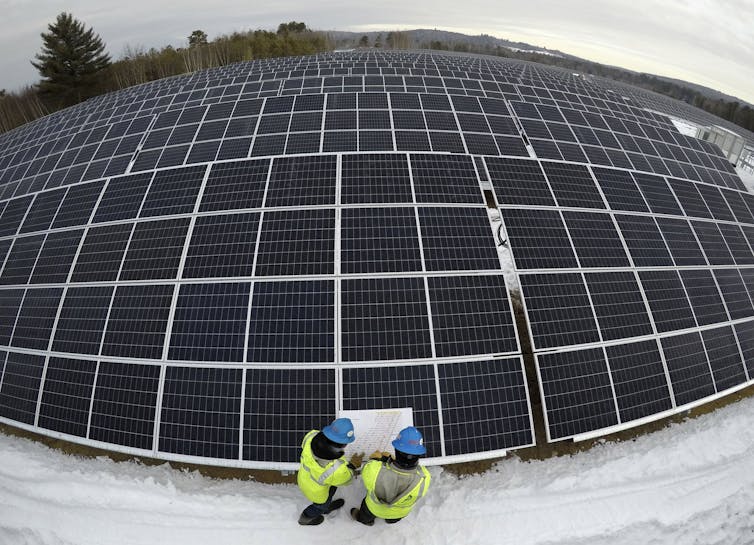
Energy storage can make facilities like this solar farm in Oxford, Maine, more profitable by letting them store power for cloudy days. AP Photo/Robert F. Bukaty
In recent decades the cost of wind and solar power generation has dropped dramatically. This is one reason that the U.S. Department of Energy projects that renewable energy will be the fastest-growing U.S. energy source through 2050.
However, it’s still relatively expensive to store energy. And since renewable energy generation isn’t available all the time – it happens when the wind blows or the sun shines – storage is essential.
Here are three emerging technologies that could help make this happen.
Longer charges
From alkaline batteries for small electronics to lithium-ion batteries for cars and laptops, most people already use batteries in many aspects of their daily lives. But there is still lots of room for growth.
For example, high-capacity batteries with long discharge times – up to 10 hours – could be valuable for storing solar power at night or increasing the range of electric vehicles. Right now there are very few such batteries in use. However, according to recent projections, upwards of 100 gigawatts’ worth of these batteries will likely be installed by 2050. For comparison, that’s 50 times the generating capacity of Hoover Dam. This could have a major impact on the viability of renewable energy.
Batteries work by creating a chemical reaction that produces a flow of electrical current.
One of the biggest obstacles is limited supplies of lithium and cobalt, which currently are essential for making lightweight, powerful batteries. According to some estimates, around 10% of the world’s lithium and nearly all of the world’s cobalt reserves will be depleted by 2050.
Furthermore, nearly 70% of the world’s cobalt is mined in the Congo, under conditions that have long been documented as inhumane.
Scientists are working to develop techniques for recycling lithium and cobalt batteries, and to design batteries based on other materials. Tesla plans to produce cobalt-free batteries within the next few years. Others aim to replace lithium with sodium, which has properties very similar to lithium’s but is much more abundant.
Safer batteries
Another priority is to make batteries safer. One area for improvement is electrolytes – the medium, often liquid, that allows an electric charge to flow from the battery’s anode, or negative terminal, to the cathode, or positive terminal.
When a battery is in use, charged particles in the electrolyte move around to balance out the charge of the electricity flowing out of the battery. Electrolytes often contain flammable materials. If they leak, the battery can overheat and catch fire or melt.
Scientists are developing solid electrolytes, which would make batteries more robust. It is much harder for particles to move around through solids than through liquids, but encouraging lab-scale results suggest that these batteries could be ready for use in electric vehicles in the coming years, with target dates for commercialization as early as 2026.
While solid-state batteries would be well suited for consumer electronics and electric vehicles, for large-scale energy storage, scientists are pursuing all-liquid designs called flow batteries.
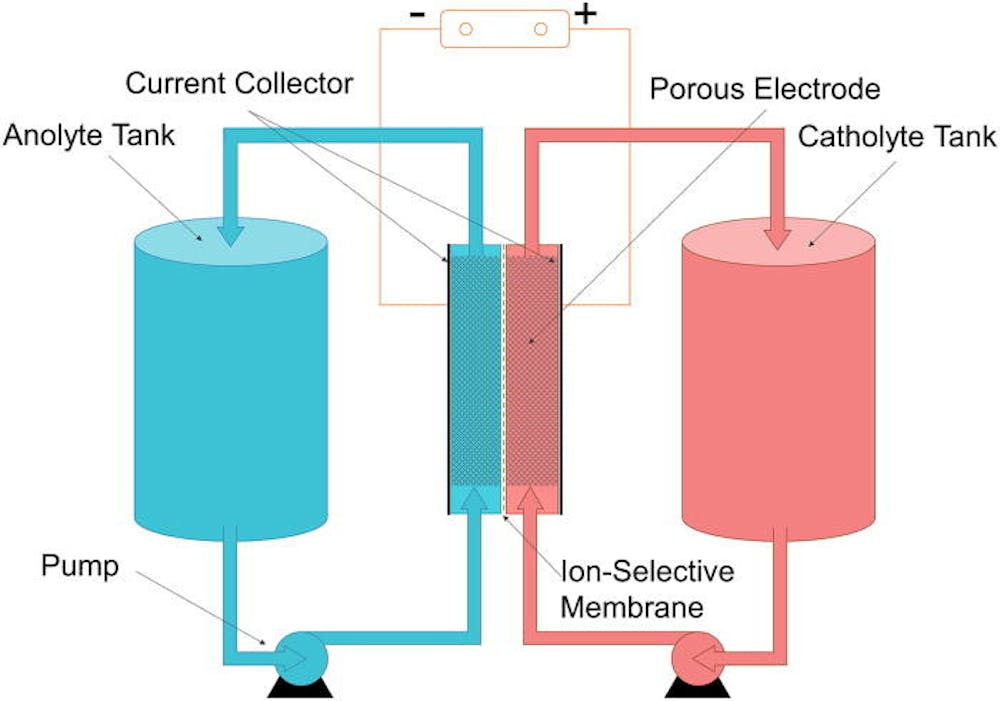
A typical flow battery consists of two tanks of liquids that are pumped past a membrane held between two electrodes. Qi and Koenig, 2017, CC BY
In these devices both the electrolyte and the electrodes are liquids. This allows for super-fast charging and makes it easy to make really big batteries. Currently these systems are very expensive, but research continues to bring down the price.
Storing sunlight as heat
Other renewable energy storage solutions cost less than batteries in some cases. For example, concentrated solar power plants use mirrors to concentrate sunlight, which heats up hundreds or thousands of tons of salt until it melts. This molten salt then is used to drive an electric generator, much as coal or nuclear power is used to heat steam and drive a generator in traditional plants.
These heated materials can also be stored to produce electricity when it is cloudy, or even at night. This approach allows concentrated solar power to work around the clock.
This idea could be adapted for use with nonsolar power generation technologies. For example, electricity made with wind power could be used to heat salt for use later when it isn’t windy.
Concentrating solar power is still relatively expensive. To compete with other forms of energy generation and storage, it needs to become more efficient. One way to achieve this is to increase the temperature the salt is heated to, enabling more efficient electricity production. Unfortunately, the salts currently in use aren’t stable at high temperatures. Researchers are working to develop new salts or other materials that can withstand temperatures as high as 1,300 degrees Fahrenheit (705 C).
One leading idea for how to reach higher temperature involves heating up sand instead of salt, which can withstand the higher temperature. The sand would then be moved with conveyor belts from the heating point to storage. The Department of Energy recently announced funding for a pilot concentrated solar power plant based on this concept.
Advanced renewable fuels
Batteries are useful for short-term energy storage, and concentrated solar power plants could help stabilize the electric grid. However, utilities also need to store a lot of energy for indefinite amounts of time. This is a role for renewable fuels like hydrogen and ammonia. Utilities would store energy in these fuels by producing them with surplus power, when wind turbines and solar panels are generating more electricity than the utilities’ customers need.
Today these fuels are mostly made from natural gas or other nonrenewable fossil fuels via extremely inefficient reactions. While we think of it as a green fuel, most hydrogen gas today is made from natural gas.
Scientists are looking for ways to produce hydrogen and other fuels using renewable electricity. For example, it is possible to make hydrogen fuel by splitting water molecules using electricity. The key challenge is optimizing the process to make it efficient and economical. The potential payoff is enormous: inexhaustible, completely renewable energy.
================================================================ Alecto, Megaera, and Tisiphone, we all know that only an idiot would say “if you just have solar power you have no light at night,” or “you only have wind energy when the wind is blowing.” And that is because these technologies utilize storage. And I guess I thought we were farther along in storage than we in fact are. We need better storage, and we need it cheaper – both in terms of the money it costs consumers, and also in terms of how resources are used. Any help from you ladies wold be deeply appreciated.
Yesterday, I listened to the opera on the radio. WFMT Chicago fills in the weeks when the NY Met is dark. They collect recordings of performances all over the world. Today it was Wagner’s “Parsifal,” in German, recorded in Toulouse, France. Wagner was a sexist along with his other failings, like being anti-Semitic and a grifter. But the music is lovely (I swear, though, if I hear one more time someone spout that “Music is ennobling,” I think I may scream.) I also put my meds together for the next two weeks, morning and night both. I can see Virgil again on Friday September 3, so I won’t want to be dealing with pills that weekend.
Cartoon –
Short Takes –
Dem Underground – New CDC: Anatomy of a school superspreader event
Quote – Unvaxed Marin County, Calif. elementary school teacher continues to work for 2 days with symptoms, reading out loud to class unmasked (contra school policy). 50% of class gets covid — with risk highest in front rows near teacher. Click through for more links to more evidence. Insanity is everywhere. Sigh.
Crooks and Liars – AR Jail Treating COVID Inmates With Horse Dewormer Ivermectin
Quote – The Daily Beast also reported that [the jail’s head doctor, Robert] Karas has cited a discredited study to support his use of ivermectin. When Schnekloth exposed the doctor on Facebook, he pushed back, saying “I got experience and don’t really need more studies.” Click through for story, and through again to Daily Beast if you like. Can you imagine what TC would have said about this! “Crooks and Liars” is going to have to change its name to “Crooks, Liars, and Maniacs” if there’s much more of this.
When Trump announced his run for president in 2015, he (in)famously boasted:
“I will build a great wall—and nobody builds walls better than me, believe me—and I’ll build them very inexpensively. I will build a great, great wall on our southern border, and I will make Mexico pay for that wall. Mark my words.”
Sadly, the courts had allowed Trump to ignore environmental laws during the wall’s construction, and that mistake proved to be its undoing. As the old Chiffon margarine ad goes: “It’s not nice to fool Mother Nature.”
Trump’s US-Mexico border wall was no match for the heavy rains and accompanying flooding that happened this past week in Southern Arizona. They destroyed a large section of TFG’s wall along the San Bernardino National Wildlife Refuge.
Rain measurements near Douglas, AZ (closest town to the wall) showed 290 cubic-feet of water moving through the area every second – that’s equivalent to 112,200 gallons of water every minute. And it was calculated the storm surge could have reached a height of 25 feet!
Flood gates are common across sections of the wall along the Arizona-Mexico border. Agents must manually raise the gates to protect the steel barriers from thousands of gallons of floodwater laden with sediment, rocks, and tree limbs that can otherwise pile up to create a dam, with the power of the water overwhelming and toppling parts of the border wall.
I want to close on an upbeat note. While things have not gone as well with our exit from Afghanistan as we would have hoped, there were some bright notes.
America’s men and women in uniform have, once again, covered themselves in glory with displays of care and compassion – particularly with Afghani children.
I could not find attributions for these – but I want to include them anyway:
Of course it wasn’t only with children that they displayed their compassion. And I’m sure you join me in thanking them for their service – they did us proud!
Yesterday, I mostly rested. And thought. And crocheted some. I do have a small tip to share – if you are looking for a product and want to order online, either because of CoViD or any other reason, and would really rather not give money to amazon, consider Chewy. Yes, they’re for pets. But there are products which are needed or useful for pet care but which also have household uses completely unrelated to pets. Like, for instance, a “rug rake.” I am the only one who is shedding around here – but the rug rake I got from them is great and came fast. Other things too – cleaning items – you might be surprised. And they are the customer service polar opposite of amazon. I’ve heard stories of their going above and beyond what anyone might think of, let alone expect – like refunding for an automatic delivery upon the death of a pet -and then also sending flowers! They aren’t going to stock everything under the sun … but what they do stock can be surprising.
The Hill – Supreme Court blocks Biden’s eviction moratorium
Quote – Some 15 million people are currently behind on rent in the U.S., according to one recent estimate, though it was not immediately clear how many tenants could be placed at greater risk of eviction as a result of the court’s move. A patchwork of state and local eviction freezes were unaffected by Thursday’s ruling…. The measure aimed in part to provide an additional layer of protection while emergency federal rental aid made its way to tenants. But the Treasury Department on Wednesday said only some $5 billion of the roughly $46 billion allocated for emergency rental aid had been distributed by state governments. Click through for more. What I think pisses me off the most is that the moratorium might not even be necessary if the states government would get off their posteriors and distribute the over $40 BILLION on rental aid which they are still sitting on.
Wonkette – Texas’s Law Against Critical Race Theory Is Why Kids In One District Can’t Have Nice Things
Quote – Texas’s dumb law forbidding the teaching of “critical race theory” has led the school district in McKinney, Texas, to eliminate a popular elective program that gave students the chance to participate in a mock legislature and learn how bills are written. The district’s Youth and Government program had been a matter of pride for the schools, touted by the district as a “perennial standout” in its middle and high schools. But an attorney for the district advised that the program might fall afoul of the new law, House Bill 3979, which will go into effect September 1. Beyond banning anything that might make white parents uncomfortable about America’s history, HB 3979 also bars classes that require “political activism” or awarding grades or course credit for any classes “involving social or public policy advocacy,” and puts strict limits on classroom discussion of current events, requiring that “both” sides of any issue be presented equally and “fairly.” That must make science classes a load of fun, too. Click through for story. Look, I’m not trying to dog on Texas (or Florida or Missouri or Alamaba or any other state where readers live). But some things really can’t be ignored. Or shouldn’t.