Yesterday was another pretty quiet day. I’ll take all of those that I can get. Incidentally, as it is now a new week, maybe Nameless can get a tech out to look at his computer. I surely hope so. But it’s also the first workday after a holiday week, so it might not be today.
Cartoon –
Short Takes –
Crooks and Liars – The New Face Of The GOP?
Quote – So try to imagine what will happen if Rittenhouse is acquitted. Trump will issue a statement somehow taking credit for it. Fox News will fly Rittenhouse to New York for triumphant interviews. Social media will erupt with joy, as millions of conservatives cry “Suck it, libs!” He’ll appear on T-shirts and bumper stickers; maybe he’ll speak at the next Conservative Political Action Conference. And don’t be surprised if Trumpist candidates start seeking Rittenhouse’s endorsement and asking him to appear on the campaign trail with them. Click through for more, including (paywalled) link to Washington Post. The only light I can see at the end of this tunnel is that George Zimmerman eventually got into enough non-political trouble to get dropped like a hot potato, and it’s probably safe to expect that to happen to Rittenhouse also (and maybe even his mother, God willing).
AP News – Workers at federal prisons are committing some of the crimes
Quote – More than 100 federal prison workers have been arrested, convicted or sentenced for crimes since the start of 2019, including a warden indicted for sexual abuse, an associate warden charged with murder, guards taking cash to smuggle drugs and weapons, and supervisors stealing property such as tires and tractors. Click through for details. I’d file this under “No shit, Sherlock.” No prison is any better than its warden … and in 2019, the warden was Bill Barr (and before him, Jeff Sessions.) Not that that is an excuse, of course.
The 19th – The word missing from the vast majority of anti-trans legislation? Transgender
Quote – More anti-trans bills were introduced in state legislatures in 2021 than in any previous year on record. The 19th reviewed the text of 102 bills in seven states that were primarily designed to restrict access to sports or gender-affirming care for trans youth, like hormones and puberty blockers, and only seven bills mentioned the word “transgender.” Only eight passed, primarily those focused on sports, although legal battles in several states have barred most from going into effect. Click through for story. Granted there are (probably) fewer transgendered people than just about any other minority group, there are certainly enough to account for a large (and disproportionate) number of suicide and murder victims. And no one is free until and unless we are all free.
Yesterday, I managed to sleep in. I hadn’t slept well Thursday night, not even all that well Wednesday, so I was hoping I could … while also knowing from experience that someyimes needing sleep that much makes it harder to get. But I now feel quite rested. Now I just need to get some stuff done.
Cartoon –
Short Takes –
Crooks and Liars – New Lawsuit Could Put Murdochs On The Hook For Fox Election Lies
Quote – Dominion is already suing Fox News for defamation to the tune of $1.6 billion. But this week it filed a new lawsuit in the matter against Fox Corp., the parent company of Fox News, apparently to combat stonewalling about the Murdochs’ role(s) in promoting the lie that Dominion voting machines rigged the election. Click through for a more setailed explanation, and a link to the full suit. I can’t tell you how glad I am that Dominion has attorneys who could not only see through this but also come up with a way to fight it.
Engadget – FBI email servers were hacked to target a security researcher
Quote – The FBI appears to have been used as a pawn in a fight between hackers and security researchers. According to Bleeping Computer, the FBI has confirmed intruders compromised its email servers early today (November 13th) to send fake messages claiming recipients had fallen prone to data breaches. The emails tried to pin the non-existent attacks on Vinny Troia, the leader of dark web security firms NightLion and Shadowbyte. Click through for more. I saw this first at Reuters, in an un-embeddable (probably) video, and chased it around a bit. Engadget is the only source which states as fact the reason for the hack was to target a particular person, so it may be wrong, but it’s interesting – and scary – anyway
Experts in autocracies have pointed out that it is, unfortunately, easy to slip into normalizing the tyrant, hence it is important to hang on to outrage. These incidents which seem to call for the efforts of the Greek Furies (Erinyes) to come and deal with them will, I hope, help with that. As a reminder, though no one really knows how many there were supposed to be, the three names we have are Alecto, Megaera, and Tisiphone. These roughly translate as “unceasing,” “grudging,” and “vengeful destruction.”
I am not a professional historian, or even all that much of an amateir one, but I have, over the years, picked up bits and pieces. And I’m pretty sure there was a time in England – probably before the Civil War (theirs, not ours), when being “armigerous” was absolutely connected to a title or deed of nobility – that if you were a knight, or a baron (viscount,earl, marquis, or duke – or a royal), you had the right to “bear arms” in public – and if you weren’t, you didn’t. I actually hope the “originalists” on the bench never get hold of this. Because if they wanted to argue that the point of the Bill of Rights was to give everyone rights (including those rights only the nobility previously had), I for one could certainly not argue against that.
================================================================
Why are medieval weapons laws at the center of a US Supreme Court case?
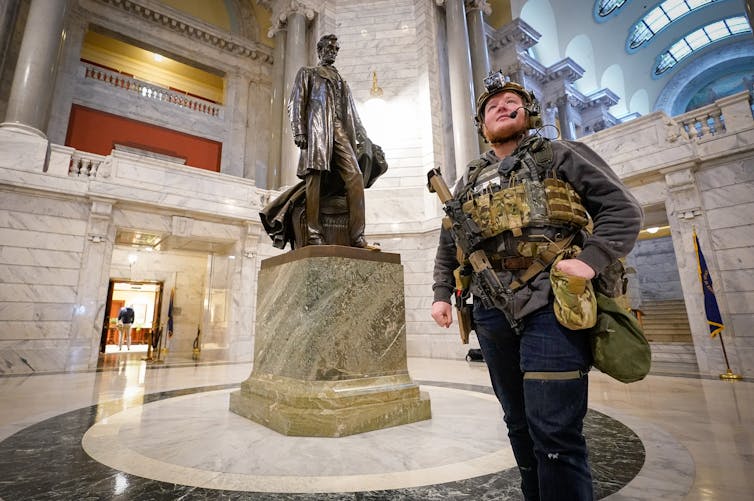
A gun rights advocate walks through the rotunda of the Kentucky Capitol. Some lawyers argue that the 1689 English Bill of Rights created the legal basis for public carry of weapons in the U.S. Bryan Woolston/Getty Images
In the opening scene of “The Last Duel,” the new film set in 14th-century France, a herald announces the rules for conduct at a tournament to the death. He declares that no members of the public – whatever their social background – are allowed to bring weapons to the event.
This scene might seem far removed from 21st-century America. But medieval weapons laws – including a 1328 English statute prohibiting the public carry of edged weapons without royal permission – are at the center of dueling legal opinions in a case now before the U.S. Supreme Court, New York State Rifle and Pistol Association v. Bruen.
The plaintiffs are challenging New York’s “proper cause” gun law, which tightly restricts public carry of firearms. If they win, similar laws in several other states will be called into question. That means that concealed carry licensing laws could be broadly liberalized for millions of Americans currently living in those more restrictive jurisdictions.
The book explores how courts in the United States have turned to history for instruction in how guns should be treated – decrees, laws and interpretations of the past that are at the forefront of the case before the Supreme Court today.
Scalia points to the English Bill of Rights
The United States legal system grew out of the English legal tradition. This connection – which is often referenced by originalists – is crucial to making sense of the arguments around gun rights in America today.
Originalism is a legal philosophy that attempts to interpret legal texts, including the Constitution, based on what lawyers think is their original meaning.
An important victory for gun rights advocates took place in District of Columbia v. Heller. In that 2008 decision, the Supreme Court for the first time ruled that the Second Amendment protects an individual right to possess a firearm for personal self-defense in the home.
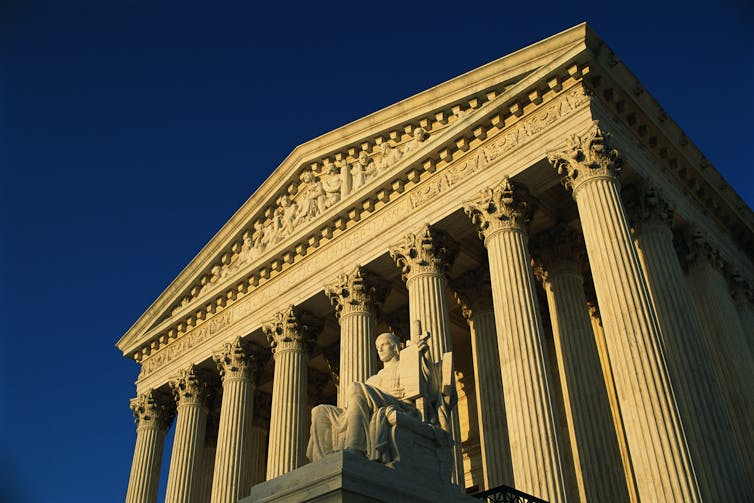
New York State Rifle and Pistol Association v. Bruen is the most significant gun rights case before the Supreme Court since 2008. Ron Watts/The Image Bank via Getty Images
Justice Antonin Scalia, author of the 5-4 majority Heller opinion, claimed that there was a long tradition of the English state’s granting freedom to possess weapons dating back to the 1689 English Bill of Rights, which includes a clause that reads “the subjects which are Protestant may have arms for their defence suitable to their conditions and as allowed by law.”
Scalia’s argument relied heavily on the work of historian Joyce Malcolm, the author of “To Keep and Bear Arms: The Origins of an Anglo-American Right” and a Second Amendment scholar at the Antonin Scalia Law School at George Mason University. Malcolm and lawyers who support the expansion of gun rights argue that this clause created the legal basis for having weapons for personal self-defense in Colonial America.
Having prevailed in Heller, gun rights activists are seeking the liberalization of restrictions on public carrying of guns outside the home. In the New York case, some lawyers and other parties are now arguing that medieval statutes restricted only public carry that “terrified” the public, and that such statutes were never actually enforced to prevent “normal” public carry.
Historians object
However, most scholars of English and American history vigorously dispute the accuracy of this claim. In fact, since the Heller decision, the history of firearms regulation in England and the U.S. has been the focus of what Fordham University law professor Saul Cornell has called an “explosion of empirical research.”
Many of these findings appear in an amicus brief presented to the Court in New York State Rifle and Pistol Association v. Bruen.
Signed by 17 professors of law, English history and American history – including me – the brief demonstrates through a review of historical evidence that “neither English nor American history supports a broad Second Amendment right to carry firearms or other dangerous weapons in public based on a generic interest in self-defense.”
Early royal proclamations dating as far back as the 13th century regularly prohibited going armed in public without special permission. In 1328, the Statute of Northampton banned the public carry of swords and daggers, open or concealed – this was before the invention of firearms – without express permission from the authorities.
As legal scholar and historian Geoffrey Robertson, an expert on the English Bill of Rights, put it: “There was never any absolute ‘right’ to carry guns. As the Bill of Rights (1689) made clear, this was only ‘as allowed by law.’”
The English tradition of broad public carry restrictions continued across the Atlantic into the Colonies.
During periods of heightened risk of attack, some Colonies required certain individuals to carry guns to church or when working in fields away from fortified or populated areas. However, this obligation was not understood as establishing a right to carry firearms in public.
After the American Revolution, states continued to adopt regulations echoing the Statute of Northampton. Recent scholarship has uncovered that early-to-mid-19th-century firearms regulations varied considerably by jurisdiction and geography, but 19 states had restrictions for public carry on the books.
By 1900, there was a legal consensus that states and localities generally had the authority to limit public carry. While the American approach to public carry restriction was fluid – varying across time and jurisdiction based on social and political changes – there is a consistent history and tradition of many American Colonies, states, territories and municipalities imposing broad prohibitions on carrying dangerous weapons in public, particularly without a specific need for self-defense.
An invented tradition?
So how did a 1689 English Bill of Rights that never gave any absolute right to carry guns turn into a key justification for that very right in the U.S.?
[Over 115,000 readers rely on The Conversation’s newsletter to understand the world.Sign up today.]
“Invented traditions,” a concept highlighted in the 1983 book “The Invention of Tradition,” which was edited by historians Eric Hobsbawm and Terence Ranger, are cultural practices that are thought to have emerged from long ago but actually are grounded in a much more recent past. A classic example is the Scottish tartan kilt, once believed to derive from the ancient garb of the Scottish Highlanders but actually invented in the 18th century by an Englishman.
================================================================ Alecto, Megaera, and Tisiphone, fortunately, the history is far more complicated than my picked-up bits and pieces would suggest. Even so, I personally would want to pay more attention to the beliefs of (now long retired) Justice Stevens, I believe it was, who recommended that the Second Amendment be abolished on account of the enormous increase in destructiveness of weapons developed since the Amendment was written. Of course, I don’t see that ever happening. But then, I don’t see universal love for each other ever happening either, and that doesn’t prevent me from supporting it.
Yesterday, On the morning trip, there was enough cloud cover I didn’t have to use the visor much, though it was very helpful when I did. Coming home – well, let me back up a little. First, the visit was good and Virgil returns all greetings.OK. I already said the package with the visor contained some other things. What they were was clear-plastic-lined fabric screens, each about 16″x 20″, stretched with a wire frame flexible enough to fold them into about a 9″ circle if you’re smart enough – I’m not, but they came that way. I opened two and didn’t touch the second two. They came with little suction cups but there’s not an obvious place to put them. I clipped a couple of binder clips to one and took it and a second one to the car. As much as we talk about the sun moving from East to West, we often ignore in our speech the effect of the earth’s axis on that. Here in Colorado, the axis is so skewed at this time of year that the sun sets virtually due South – to the left of the car from Las Animas to Pueblo, and left and behind me when I’m heading north to Springs. As I got to Pueblo and the dangerous-due-to glare turns, I stopped, and clipped one of the scrrens to the driver’s window, far enough back not to interfere with the left rear view mirror. When I started going north, that screen was far enough back to slow down the sun – not strong enough to stop it, which itself coul have been dangerous, just effectively enough for it not to hurt my eyes and drive me nuts. So I guess now I know what they are for. Between them and the visor extender, driving is now a lot easier and feels much safer. Mission accomplished.
Cartoon –
Short Takes –
Common Dreams – ‘Arrogant Insensitivity’: Defense Lawyer in Arbery Murder Trial Ripped for Bid to Bar Black Pastors
Quote – Gough, referring to the founder and marketing mascot of the fast-food chain Kentucky Fried Chicken, curiously added that “if a bunch of folks came in here dressed like Colonel Sanders with white masks sitting in the back,” before trailing off. Click through for story, which is all over but this is a good take on it. Personally, I think the prosecution should give Sojourners a call (and possible also ask the black pastors) to look for white pastors to put on the stand who will really shame the defendants with both barrels.
DHS Sounds Alarm On RW Terror Against School, Health Officials And Congress
Quote – DHS issued a bulletin Wednesday warning that the holiday season ushers in a “diverse and challenging threat environment” with threats “posed by individuals and small groups engaged in violence, including domestic violent extremists (DVEs) and those inspired or motivated by foreign terrorists and other malign foreign influences.” You can substitute the term “right-wing extremists” for “domestic violent extremists.” Probably not all DVEs are right-wing but it’s clear from the DHS bulletin that the ones it’s most worried about are: Click through for more. My, it’s nice to have a DHS that actually cares about our secuity,not just bashing people of color and other minorities.
Wonkette – What’s In The Infrastructure Bill? What’s In Build Back Better? Which Is Which? Wonkette Gets Servicey!
Quote – On the off chance you may have missed it, the House passed the Bipartisan Infrastructure Framework (BIF) late Friday [11/5], with the second, much larger part of Joe Biden’s first term agenda, the Build Back Better reconciliation bill, likely to be passed the week prior to Thanksgiving, as long as Joe Manchin doesn’t decide it needs to include tax credits for diesel pickup trucks that “roll coal” on bicyclists and drivers of Prii. In Monday’s White House presser, Principal Deputy Press Secretary Karine Jean-Pierre said Biden would sign the infrastructure bill into law sometime next week…. Obviously, Biden wants to use the passage of the BIF as leverage to move Build Back Better to completion, which seems like a pretty sound strategy, and if your House or Senate critter is doing town halls this week, let ’em know you want Build Back Better to pass, yes, even if they’re Republicans. Click through for what we got. There is also a companion article, What’s In The Build Back Better Bill? Your Servicey Wonkette SUPER MEGA-LISTICLE!, which details what we hope to get. Wonkette may have a frivolous attitude, but it also has facts.
Glenn Kirschner – Insurrection Defendant Gets 41 Months in Prison. But What of the Cases that are Set for Trial?
Thom Hartmann – Why Is The Judge Hiding Rittenhouse’s Ties To White Supremacy? (Shades of Zimmerman)
Rebel HQ – Crooked Judge In Kyle Rittenhouse Trial EXPOSED
PBS – Amanpour & Co – Chase and Takota Iron Eyes. Yes, this is almost 20 minutes.
RepresentUs – Limp Democracy
Cracked – If Dating Apps Were Honest
Beau – Let’s talk about a message from a small government conservative…. [This is the video which contains Beau’s method for predicting what Republicans will do.]