I didn’t even take time to watch these (just to make sure they hadn”t been posted previously. I’ll make my comments in the comments eventually. But at least I can give us our Sam Bee fix.
Yes, that’s a lot. But it seemed to all go together.


I didn’t even take time to watch these (just to make sure they hadn”t been posted previously. I’ll make my comments in the comments eventually. But at least I can give us our Sam Bee fix.
Yes, that’s a lot. But it seemed to all go together.
Wendy called me about 11 am PDT to let me know that TC is in hospital, critical care, but in good spirits. He was very weak but perked up quickly upon being hydrated (he is good about drinking water as a rule, but sometimes dehydration sneaks up on him.) He may be there a couple of days. Wendy says hello to everyone, and says she is doing everything she can (I told her we know that, but promised to spell it out.)
The blog is his number one priority … so please comment, including with news. Thanks everyone.

If you thought that, now that you have input your data to the 2020 census, we are through with it … well, you were mistaken. Although the Census greatly ramps up its hiring during years ending in zero, it actively functions all the time. not just with a skeleton crew, either, but with a whole lot of the best and brightest experts on data available. Because one of its missions is to make data – up to date and accurate data – available to anyone who needs it most. That’s how I was able to inform you all and the Furies that, within the United States, there exist over 90,000 separate governments. Not government agencies (which must far outnumber that figure) – but actual governments. As of 2017. Because the Census compiled that information and Professor Swindell researched and cited it. Professor Swindell first hand, and I (at this point second hand) are Census Data Products users.
Would you like to become a Census Data Products User? Well, that’s easy. You can sign up right here to receive the Census Data Products Newsletter (and also, if you like, their Operational Updates Newsletter), and they will send you all the scoop. Here’s a sample of the kind of information available.
I must note at this point that the Census Bureau has all kinds of data – and it is very concerned about differentiating public data from private data. Theft of personal data is a huge issue, and made even more critical by digitalization and hacking. But the Census Bureau is on it, and their Data newsletters will also contain up to the minute information on what they are doing to oppose it, including developing a Disclosure Avoidance System
Blessings upon them, they have made an introduction in comic strip form available to journalists under a Creative Commons license to freely republish. It is available as a PDF here, and you can print it, keep it, share it, whatever you like. I am reproducing it below under that license in three JPG files, one for each page of the PDF.


As you can see, the basis of their program is the concept of Differential Privacy. I suspect we will be hearing the word a lot. Of course at this point it is a work in progress, but progress is being made, as quickly and carefully as possible.

Experts in autocracies have pointed out that it is, unfortunately, easy to slip into normalizing the tyrant, hence it is important to hang on to outrage. These incidents which seem to call for the efforts of the Greek Furies (Erinyes) to come and deal with them will, I hope, help with that. As a reminder, though no one really knows how many there were supposed to be, the three names we have are Alecto, Megaera, and Tisiphone. These roughly translate as “unceasing,” “grudging,” and “vengeful destruction.”
I have another project which i am not going to be able to finish this week, but when I found this, I thought it was a great opportunity to reinforce a point I have been trying to make for years now. People talk constantly about the American justice system, how it works, how to reform it, when in fact there is no such thing. No single thing. Besides the Federal government, there fifty states, and, oh yeah, 7 territories (some of which are uninhabited), but any or all of which have or could have theoir own systems. I sometimes nod to counties and cities – but I would never have guessed that in the United States, we have more than 90,000 governments, had not Professor Swindell researched it – through the Census Bureau, no less – and cited it here (another reason the Census is so very important.) When one wants to talk about reforming justice system(s), this is a number to be reckoned with.
But it’s also pertinent to everyday, and not-so-everyday occurrences, such as pandemics. And I hope this article will give each of us, in our own separate circumstances, better insight into just who is in charge here.
================================================================

David Swindell, Arizona State University
In a nation with more than 90,000 governments, responses to the coronavirus pandemic have highlighted the challenges posed by the United States’ system of federalism, where significant power rests with states and local governments. Wisconsin’s Supreme Court just overturned their governor’s order for residents to stay at home – and then several cities and counties imposed their own restrictions, very similar to the governor’s rules.
So who’s running the show?
I am a scholar of how different levels of government interact and work together to deliver public services, and my answer is: It depends.
At the national level, President Donald Trump has both told the 50 states to fend for themselves, and also claimed to have the authority to force states to “reopen.”
In the absence of nationwide coordination and leadership, governors have made their own decisions about how to contain the spread of the virus. Their decisions apply only to their own states, making the country a patchwork of varying efforts.
And as state governments start to lift their lockdown restrictions to varying degrees, the patchwork gets even more complicated. Then factor in the powers and responsibilities of more than 3,000 counties, nearly 20,000 municipalities and almost 13,000 public school districts around the country, and it becomes clear that the answer to “Who’s in charge?” is not so simple.
Who actually has the power to make binding decisions mostly depends on two factors. First, there’s what’s being decided: Is it about public health, police, hospitals, schools, barbershops or other businesses? Second: It depends on the state.

Historically, the U.S. has divided responsibilities for different services and functions across levels of government, so they could be tailored to regional preferences where possible.
For instance, jails are run locally or by counties; businesses get municipal and state licenses. Similarly, animal control laws, zoning and pothole repairs are typically handled by local governments, not at state or federal levels. States typically regulate businesses and industries, oversee welfare programs and manage major highways.
The national government handles things where widespread coordination and standards are important, like national defense, Social Security, space exploration and trade between states.
Before the Great Depression, state and national government duties were more clearly differentiated. But since the 1930s, this system has evolved, and the distinctions between which levels do what have blurred and blended.
For instance, states are in charge of public K-12 schools and public universities, but the federal government ensures school districts comply with rules about equal access for all students, and provides grants to support needy children and university research.
Likewise, state governments build and maintain the interstate highways, but the federal government pays many of the costs.
Today, this mixing of responsibilities has made difficult a nationally coordinated response to a pandemic whose effects are mostly local. State and local officials have tried to respond as best as possible, but they do not have the information or buying power of the federal government.
The federal government may claim to be able to shut down the economy, but the truth is that states are the ones responsible for regulating the businesses that operate within their boundaries. So the federal government can’t order states to close down or reopen their businesses.
On the other hand, the president or Congress can decide to give more money to states that go along with federal requests, and potentially cut funding to states that don’t.
States depend on federal money for a wide range of programs related to criminal justice, education and highways, so this type of influence can be very effective.
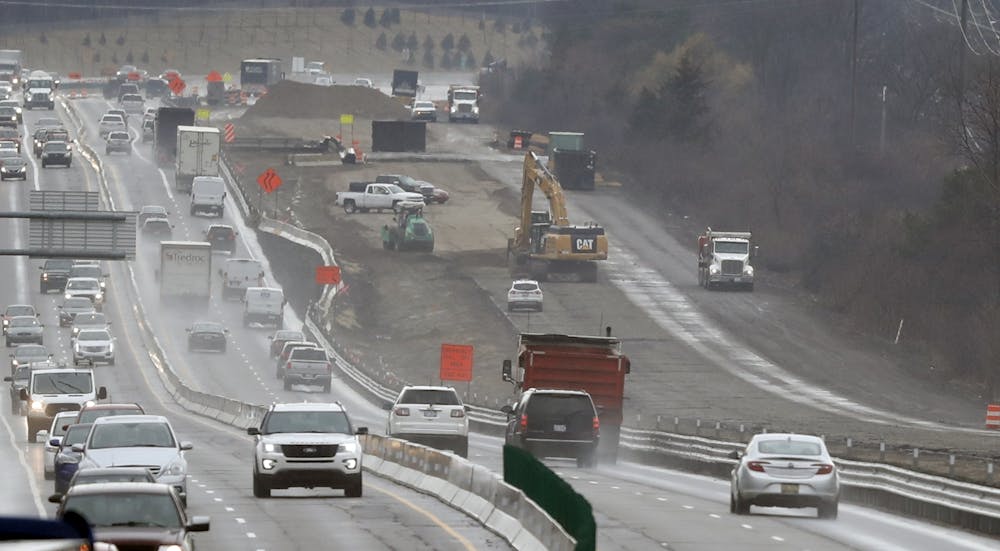
The second important element comes from another aspect of American federalism: The Constitution ensures that states not only retain powers beyond the federal government’s; they are also very independent from each other. Each state can develop its own policies and systems for delivering the services its residents need.
That means there could be 50 different approaches to combating a pandemic that does not stop at state boundaries. And therefore, the state with the most lax standards may be the one setting the protection level for the whole nation. For instance, the state of Arizona is rapidly relaxing its stay-at-home rules, even allowing restaurant customers to dine inside. Hair salons and theaters are also reopening. Neighboring California is remaining mostly closed, though people can travel freely across the state lines.
As if that weren’t muddy enough, each state relates differently to its local governments. Constitutionally speaking, there are only two levels of government in the U.S.: the national level and the states. Courts and lawmakers have determined that local governments are extensions of states, with varying levels of independence.
In most states, local governments must seek permission from their state legislature before making new regulations, like governing drone flights, or creating a new tax, such as on short-term home rentals. Other states take a different approach and allow municipal governments to take on whatever responsibilities are not expressly reserved to the state government by that state’s constitution.
All this means that responses to the pandemic vary not just from state to state, but also within states.
The way these overlapping authorities play out is relatively easy to see when looking at how school districts, one of several types of local governments, responded to the coronavirus outbreak. In most states, local districts acted on their own. In general, it took a week or two before state departments of education ordered statewide school closures, which affected those local districts that hadn’t already shut their doors.
It took as much as three weeks for states to issue general orders or recommendations for residents to shelter in place – though in some states those instructions never came, even though all the nation’s schools were closed.

As states begin to reopen, similarly confusing processes are happening in reverse.
While many state governments have now begun to loosen restrictions, some communities within those states have wanted to keep their local shelter-in-place orders in effect because they remain concerned about public health. In Georgia, local efforts to maintain restrictions have been overruled by the governor’s office. The Texas Republican governor has relaxed the statewide rules and explicitly said his reopen orders override any local restrictions.
Utah never established a shelter-in-place order and relied only on recommendations. Urban communities in the state set their own restrictions, and the legislature responded with efforts to limit the ability of local governments to put such measures in place.
Colorado is taking a different approach as the state relaxes its restrictions by explicitly allowing local governments to determine if they want their restrictions to differ from the state standard.
This diversity of precautions and actions can also be seen as one of the strengths of federalism, because it allows the public to see how different responses may affect how quickly the virus spreads. The local and state decisions are creating experimental laboratories for finding different ways to move back into a fully operational economy.
And that’s why your barbershop is still closed while the one in the next town or next state over is already open again.
[Deep knowledge, daily. Sign up for The Conversation’s newsletter.]
David Swindell, Associate Professor of Public Affairs, Arizona State University
This article is republished from The Conversation under a Creative Commons license. Read the original article.
=>================================================================
Alecto, Megaera, and Tisiphone, it’s a sad thing to be a Democrat in a state with a Republican governor who is willing to let the whole state die rather than displease Trump*. But it’s almost equally sad to be a Democrat in a state with a Democratic Governor (who has brains), yet live in a Republican-dominated county which thinks it knows best. At least my county knows enough to apply for a waiver before re-opening every restaurant – but I guess I won’t be eating out for many, many months (not that I did much – but I did like knowing it was an option.) And heaven help our high school graduates.
The Furies and I will be back.

Experts in autocracies have pointed out that it is, unfortunately, easy to slip into normalizing the tyrant, hence it is important to hang on to outrage. These incidents which seem to call for the efforts of the Greek Furies (Erinyes) to come and deal with them will, I hope, help with that. As a reminder, though no one really knows how many there were supposed to be, the three names we have are Alecto, Megaera, and Tisiphone. These roughly translate as “unceasing,” “grudging,” and “vengeful destruction.”
I was thinking recently how this column has morphed over 214 (can you believe that?) versions. And that it started out sharing incidents of unbearable injustice. And asking the Furies for retribution (not revenge, but earned retribution.) I’ve gotten away from that, and lately have been concentrating more on general interest – and how to survive in this world long enough for this terrible regime to be gone.
But today, I’m going back to my original focus. The difference is I am not writing it myself. I will be quoting in full a Facebook post (delinked) made by a candidate for Sheriff in a different county but the same state in which Ahmaud Arbery was brutally murdered. A public Facebook post is just that – public – and I can’t imagine that Mr. Herndon would be unhappy to get wider publicity in his campaign. I do include a link, here, to the Democratic Underground Post which quoted it yesterday, in case anyone wants to chase it back. Otherwise, here it ism unvarnished and unedited.
================================================================
This FB post is from James Herndon who is running for Sheriff in Cobb County (which is just north of Atlanta).
I know most people running for office will not dare touch on the subject of Ahmaud Arbery being shot to death in Brunswick, GA. As many of you know, I am not like most candidates.
With that, let’s address this head on. You may agree with what I have to say, you may not. But you will at least know where I stand and why.
I have watched the video of Mr. Arbery being shot to death probably 20 times now. I have listened closely. I have watched parts of it frame by frame. I have listened to the 911 calls. I have researched the background of Mr. Arbery (to defend the further assassination of his character) I have researched Georgia law. I bring this from the perspective of a man wanting to be your next sheriff, a man with years of experience in CSI and actually personally arresting dozens of men for murder.
What we have in this case is almost identical to the shooting of Trayvon Martin by George Zimmerman in Florida. In this case we have two men in Glynn County, Georgia attempting to intervene as if they are law enforcement when they are not. In both cases such a low level event should have been handled by law enforcement.
Not idiots with firearms.
In both cases I believe the armed men were the determining and driving factor in the deaths of the two men. In both cases I believe these men wanted to escalate the situations so the law would “allow” them to use deadly force. Both were escalated to the point of firearms being discharged by the armed men, not the victims.
As I watched this I noticed some things that will likely enrage people more once I explain it.
You see, I am from South Georgia myself. I recognized something in the video many people likely will not. When you see a truck parked in the middle of the road with an armed man standing on top of his tool box or in the bed of the truck armed with a gun, it indicates to me, that he is hunting an animal that is running. It is a common technique used to hunt running game in the Georgia flatwoods. It is actually unlawful to even hunt animals in this manner.
Deer hunters in southern Georgia often use dogs to chase deer through the forest until they pop out onto a road, exhausted with limited physical ability and clouded mental ability as they are run to exhaustion before the hunter kills the deer with his gun. The hunter stands on the truck tool box or in the truck bed to obtain a commanding view of the area to easily spot his prey and direct other shooters where the deer is and the optimal time to shoot.
This is what pushed me to seeing this as the hunting of a man and not any form of self defence or lawful act. It is disgusting in a visceral manner I can not put into words. When I saw the man on the truck and the other man with a shotgun I knew what was in store for Ahmaud. This was not something he could survive.
I know this will enrage many readers for various reasons. But to deal with such an issue means we must deal with the ugly, nasty things human being are capable of doing head on.
Here we have two men, just like in the Martin shooting in Florida, who called 911 first and still  chose to hunt their prey down, Mr. Ahmaud Arbery, a man. They did not see him as their fellow man. They saw him as something to hunt down using tactics they used to hunt wild game in the south Georgia flatwoods. In both cases we are talking about misdemeanors. In this case we are talking about the offense of Criminal Trespass – a very low level misdemeanor. It is so low level that 99% of the time at most – a warning is given by police. Your kid can get this for throwing an egg at a house, that’s the type of crime this is. In this case a person allegedly walked through a yard of a building under construction. That’s it. Thats what we have here, if anything. We likely have two jackasses that think every black man looks alike.
The two perpetrators are claiming they were making a citizen’s arrest. Under GA law, OCGA 17-4-60 it states “A private person may arrest an offender if the offense is committed in his presence or within his immediate knowledge. If the offense is a felony and the offender is escaping or attempting to escape, a private person may arrest him upon reasonable and probable grounds of suspicion”.
After listening to the 911 call and reading the police report it is clear no crime was committed in their presence and they had no right to run this man down like an animal they were hunting. The defense of a citizen’s arrest is not a valid one under Georgia law in my view. (Police report is here: https://int.nyt.com/data/documenthelper/6915-arbery-shooting/b52fa09cdc974b970b79/optimized/full.pdf#page=1 ) You will note in the report Ahmaud Arbery is the victim and the other idiots are the suspects, at least that’s how the responding officer saw it.
In the report, the shooter tells the officers that arrived on scene that Ahmaud did try to run away from them. That he actually went in the opposite direction trying to get away but they continued to pursue him trying to find the right angle to cut off his path of escape. These were not cops hunting down an armed fleeing danger to society. These were two idiots chasing a man they alleged to tresspass by walking onto propety they didn’t even own.
Being the hunters I believe they are, they stated they decided to cut him off on another street to confront him as their experience as hunters allowed them to calculate his path in his attempted escape. As Ahmaud attempted to run around the truck the shooter gets out of the vehicle immediately armed with a shot gun. I believe the very first shot hit Ahmaud in the right side of his chest.
He is then in a fight for his life. You can’t out run a shotgun. I honestly have no idea how he stayed on his feet. I have never seen anyone survive a shotgun blast to the chest. It is disarm or die for Ahmaud at this point. The only option is to disarm your attacker. In this case he was already fatally wounded in my opinion. He likely had numerous sucking chest wounds, massive blood loss and the exertion to defend his life caused him to lose his life even faster. He grapples for the gun with the shooter, delivering several punches as the shooter fires at least two more times. Aumaud disengages turns, steps, collapses and dies. No aid was given by the shooters as they likely knew a shotgun blast to the chest would be 100% fatal.
I often explain to people that just because something is legal doesn’t make it right. Just because you can rarely means you should. I have watched many shootings, many from law enforcement. Most are justified. Some are NOT. You see as a cop or any other person, you can in fact provoke others to violence or cause them to play into situations where you can legally kill another human being “justifiably”. We referred to these people as “shit stirrers”. These are the type of people that could disrupt and escalate almost any situation to violence if they wanted. They want physical violence and set up situations so they can lawfully use it. These people very much exist in all walks of life. It is foul and it is disgusting. These people are monsters. I despise these types of people. Many people think there are no such thing as monsters. There are monsters. They are very real. Only human beings are monsters. We are the only species on the planet that will hurt one another for pleasure as sick and twisted as that sounds.
To be clear, when you hunt a person down, crime committed or not (especially a non violent alleged crime), you confront them with a firearm when you have no lawful right to do so, you trap them, block their path of escape then shoot and kill them when you provoked the situation to a violent confrontation…well, I believe you need to go to jail.
With all of that said these guys could very well walk if the prosecutor purposefully indicts them on charges that are too aggressive. Again, some of you are like wtf is he talking about?
 I will explain.
In the Zimmerman case, the prosecutors purposefully over charged him with murder. With the facts given in that case I knew immediately that a jury could never find him guilty for murder, the facts didn’t match a premeditated act as they could not prove Zimmerman set out to kill Martin before the confontation. Nor could they prove his intent. Confront, fight, pretend to be a cop, but not kill. Zimmerman did in fact cause the deadly situation that he started then used a firearm to kill. See, Martin also confronted a man with a gun and found himself fighting for his life before he was shot at close quarters. The jury was left without options as they did not have any other charges they could choose from as the prosecution only gave them one option.
In Glynn county Georgia, I am hoping a grand jury is presented with the following charges: Felony Murder under the right circumstances but this is very dependent on what is secretly presented to the grand jury that we can never hear. But at the very least Manslaughter, Aggravated Assault, False Imprisonment, possession of a fire arm during the commission of a crime, terroristic threats and acts and the traffic offenses. Why? A life sentence for murder in Georgia is currently 33 years before parole is considered. These charges I have listed will carry over 60 years that must be served before parole can even be considered (you currently must serve 90% of any crime of violence). See, you have to know how the legal system actually works to make it work for the people.
These men have no right to confront another person, provoke the situation into a deadly encounter, then use deadly force to end a situation they started and caused in the middle of a city street. That is not the way the law is intended to be enforced. You have no right to shoot a man in a mere fist fight or wrestling match. You have no right to kill a man for walking through a yard that doesn’t even belong to you. They presented the guns which caused this situation to turn deadly. They in turn should be held to account for their actions before a jury.
Right, wrong or otherwise, this is my opinion and where I stand. I think you need to know where I stand on such issues and why. I am not one to shy away from tough topics and felt I should address this head on.
================================================================
Wow. just wow.
Alecto, Megaera, and Tisiphone, I’m asking you, first, to find the grand jury in Glynn County, GA, which will be presented with the evidence in this case. Second, please get into their heads and push them in the direction of Mr. Herndon’s suggested charge list and prosecutorial approach. Third, please follow up for the trial and get into the heads of the jury to get them to see this he right way. To see the truth. And on the way, any boost you can give to Mr. Herndon’s campaign in Cobb County would be deeply appreciated.
I don’t suppose you can clone him and get the clones elected as Sheriffs in some of the counties who need this approach to law enforcement the most, but I trust there’s no harm in asking.
The Furies and I will be back.
Experts in autocracies have pointed out that it is, unfortunately, easy to slip into normalizing the tyrant, hence it is important to hang on to outrage. These incidents which seem to call for the efforts of the Greek Furies (Erinyes) to come and deal with them will, I hope, help with that. As a reminder, though no one really knows how many there were supposed to be, the three names we have are Alecto, Megaera, and Tisiphone. These roughly translate as “unceasing,” “grudging,” and “vengeful destruction.”
I have been maintaining that we – by which I guess I mean people who are sane – are never going to understand Trump supporters and other RWNJs simply because our brains are wired so differently. By that I don’t necessarily mean hard wired (heredity) but also soft wired by experiences and now pretty well frozen (environment). I think G. K. Chesterton or C. S. Lewis or both might have said something about it not being possible for a normal sized mind to fit into a space which is that small. In any case, it is something which is very visible today because so many of the people with those minds have so much power. But it isn’t a new problem.
(Uh oh, there she goes, she’s going to cite history again.) Yup. May as well. Truth and error have always been with us, so why not look at history for an analysis far enough removed in time that it could possibly help? So, here goes.
================================================================
Richard Gunderman, Indiana University
It seems that science has been taking a beating lately. From decades of denial by the tobacco industry that smoking causes cancer to more recent attempts to use the COVID-19 pandemic to score political points, a presumption seems to have taken root that it is okay to seek and speak the truth only when it suits personal interest.
In times like these, we urgently need leaders who know what they are talking about and whose commitment to truth exceeds their loyalty to party or person – among them, the sort of people long known as scientists (“those who know,” the literal meaning of scientist). COVID-19 is a kind of plague, but so is ignorance, and only by addressing the latter can society tackle the former.
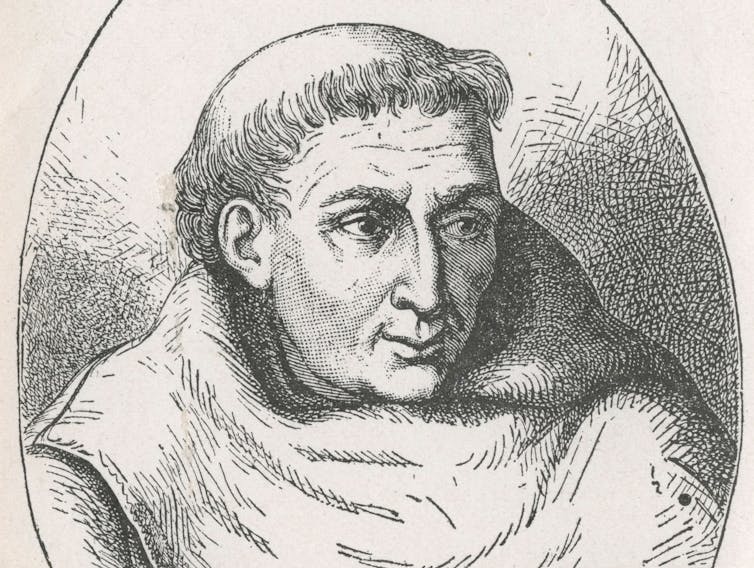
This year marks what is believed by many to be the 800th birthday of an especially courageous truth seeker, the English polymath Roger Bacon. Though other scientists came before him, his breadth of study has led many to call him “the first scientist.” Were he alive today, Bacon would likely be pursuing the truth about such matters as the coronavirus and its effects on society, as well as the need for personal and political virtues to overcome it.
Because Bacon lived so long ago, we know more about his ideas than his life. Born in Somerset, England, his family appears to have been well off, and he studied and taught at two of Europe’s oldest universities, beginning at Oxford. After earning his master of arts degree, he accepted an invitation to teach at the University of Paris for about a decade before eventually returning to Oxford.
Bacon was one of those remarkable human beings who seem to know just about everything. An expert on the thought of the ancient philosopher Aristotle, he also taught mathematics, astronomy, music, optics, alchemy (a forerunner of chemistry), moral philosophy and theology. Because of the depth and breadth of learning reflected in his Opus Majus (“Great Work”), composed at the Pope’s request to describe his studies, he became known as Doctor Mirabilis or “Wonderful Teacher.”
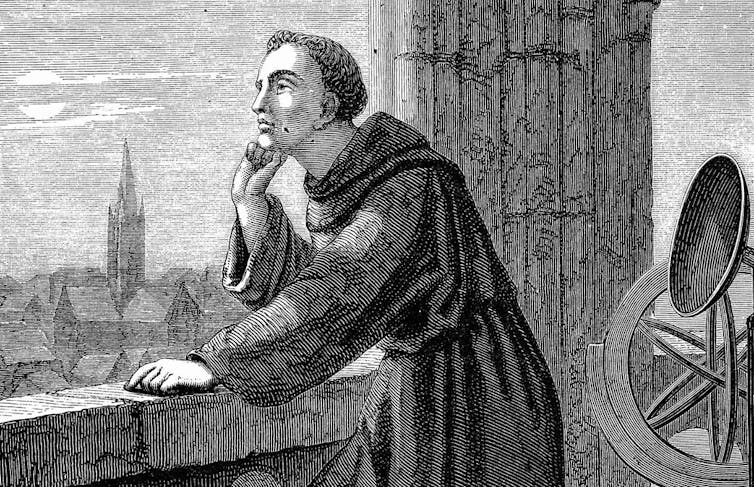
Bacon believed that the improvement of human life, both personally and socially, depends on the eradication of error. To correct what ails society, it is necessary to restore respect for learning, real-world experience and the pursuit of truth. So long as people go forth with a false map of reality, they will lose their way and never reach their true destination.
Bacon argued that there are four causes of error: 1) weak and unworthy authority, 2) longstanding customs, 3) the opinions of ignorant crowds, and 4) the hiding of ignorance through displays of apparent knowledge.
What people often lack, Bacon believed, are not correct answers but the best questions. To advance knowledge, people must subject authorities to scrutiny, winnowing away the unreliable. Who is speaking the truth, and on what basis, and who is merely mouthing what people want to hear?
In Bacon’s view, too many people lapse into a credulity of habit, simply accepting what they have been told over and over. To combat this tendency, he called for experimentation, but not only in the sense of a scientific laboratory. He believed that people should put their ideas on trial, seeing how well they fare when tested in the real world of experience. What doesn’t hold up should be rejected.
Bacon gave the example of fire, writing, “Reasoning draws a conclusion and makes us grant the conclusion, but does not make the conclusion certain, nor does it remove doubt so that the mind may rest on the intuition of truth, unless the mind discovers it by the path of experience.” Only someone who actually sees fire burn will understand what it can do.
Without proper habits of mind, Bacon argued, society would be mired in ignorance and failure. Only if institutions of learning such as universities fulfill their proper function can society find and stick to its proper course. And all persons, he believed, have both the capacity and the responsibility to think for themselves and keep their community on track.
Bacon expressed deep antipathy toward those who merely pretend to know, such as magicians who pretend to use scientific methods. Princeton philosopher Harry Frankfurt more recently referred to such pretenders as “bullshitters.” Ignorance is bad, but pretending to know is even worse, because it undermines trust.
Bacon treated ignorance so harshly partly because he saw that it sowed the seeds of corruption.
Extrapolating from Bacon, regular scrutiny is necessary if political leaders are to act responsibly. The last thing any good political leader needs is to be surrounded by yes men. It is through the contest between differing points of view that people are most likely to arrive at the truth.
This perspective helps to explain both Bacon’s promotion of the science he called “perspective” and his lifelong dedication to the study of languages such as Greek and Hebrew. To determine the best perspective from which to understand something, it is first necessary to look at it from multiple points of view.
Above all, Bacon promoted humility. People must seek to know the truth and cling to what they have proved by experience to be valid. But they must also recognize the limits of their own knowledge, seek out the advice of experts, and pursue deeper understanding.
This was Bacon’s life’s work. “No one,” he wrote, “worked in so many sciences and languages as I did, nor so much as I. And yet I did not work that much, since in the pursuit of wisdom no work” – of the sort one might resent – “was required.”
Like Aristotle, he believed that it is human nature to desire to know. There is, he held, nothing more natural and also more necessary and beneficial to humanity than pursuing the truth.
This article has been updated to remove a quote that cannot be confirmed as Roger Bacon’s.
[You need to understand the coronavirus pandemic, and we can help. Read The Conversation’s newsletter.]
Richard Gunderman, Chancellor’s Professor of Medicine, Liberal Arts, and Philanthropy, Indiana University
This article is republished from The Conversation under a Creative Commons license. Read the original article.
================================================================
This, in my opinion, presents a very good attitude to maintain about truth and untruth in general. Unfortunately, it does not answer the question of how to you deal with, work with, relate with people who don’t get it that fire burns, even after having seen and lived through it. And that’s what we all want to know.
Alecto, Megaera, and Tisiphone, even the much maligned St. Paul said “Prove [test] all things, hold fast that which is good.” I Thess 5:21 Is this the first appearance in history of the scientific method? Probably not. But don’t we all wish we could get the Branch Covidians to read, understand, and practice THAT verse, instead of all the ones they think they know which don’t in fact exist?
If you haven’t already, then before you do anything else, scroll back one post (or open this URL: https://www.7thstep.org/blog/2020/04/25/a-note-about-tom-from-wendy/)
Your admnistrators/editors cannot guarantee an update every day, for reasons which are obvious in the situation. But we will do what we can and will all pitch in.
Here is some weekend stuff:
First, here’s a reminder to all of us not to dismiss everyone in red states – not even in the red state that Kris Kobach calls home.
Then, here is what sounds like an episode of The Twilight Zone – but it is real.
Also, I put Auntie Maxine’s mailing address in Friday’s open thread, under Pat’s TJI on her (Maxine’s) sister. But Elizabeth Warren has also lost a sibling – her oldest, funny and charimg, brother. Here is her addess:
Senator Elizabeth Warren
309 Hart Senate Office Building
Washington, DC 20510
Finally, with everything else, I managed to miss THREE new Randy Rainbows
The oldest is from March 22:
Then there was one one on April 6:
And the neeset (and in my opinion the best, though I won’t be dogmatic about that) came out just yesterday:
That is all I have, except my strong feeling that WWWendy WW deserves extra pay (which should also include hazard pay) .
We will be here – well, we will ALL be here for each other. No one needed this, least of all TomCat. And don’t forget to

(Just don’t do it like those idiots.)
Experts in autocracies have pointed out that it is, unfortunately, easy to slip into normalizing the tyrant, hence it is important to hang on to outrage. These incidents which seem to call for the efforts of the Greek Furies (Erinyes) to come and deal with them will, I hope, help with that. As a reminder, though no one really knows how many there were supposed to be, the three names we have are Alecto, Megaera, and Tisiphone. These roughly translate as “unceasing,” “grudging,” and “vengeful destruction.”
Yippee! We are back up!
I thought about posting this Wednesday when we got back on line, but I was feeling a little dizzy myself. (Whatever it was, it wasn’t COVID-19. I checked that out six ways from Sunday. I suspect it was something I ate Tuesday.) In any case, I’m glad I chose not to. I hope this way it will be easier to stay out of all the other great minds’ ditches. It’s in the category of “News You Can Use.” And I’ve added a couple of videos which Nameless found (and I am assuming he won’t mind me posting them here since he hasn’t done so here yet.)
==================================================================

Susan L. Sokolowski, University of Oregon and Karen L. LaBat, University of Minnesota
The recent Centers for Disease Control and Prevention recommendation to use cloth face coverings to help slow the spread of COVID-19 has generated numerous how-to articles and videos. As academics who focus on personal protective equipment (PPE) research and development, we are concerned about the lack of information about two critical features of home mask design: fit and fabric selection.
Virus particles are tiny, ranging from 0.1 to 0.3 micron. A size 40 micron particle is visible with the naked eye – anything smaller, you need specialized equipment to see it.

Protective masks like the N95 are designed to prevent virus particles from flowing in and out of the mask. Due to current shortages, N95 masks should be reserved for COVID-19 health care workers only.
Homemade masks cannot block or filter the SARS-CoV-2 virus, because it can easily flow through every common material people have at home. However, a homemade mask is still better than none at all. If made correctly, a homemade mask can reduce the transmission of the virus from the wearer to others by impeding large droplets and spray produced by a cough or sneeze. It can also reduce the transmission of the virus from others to the wearer.
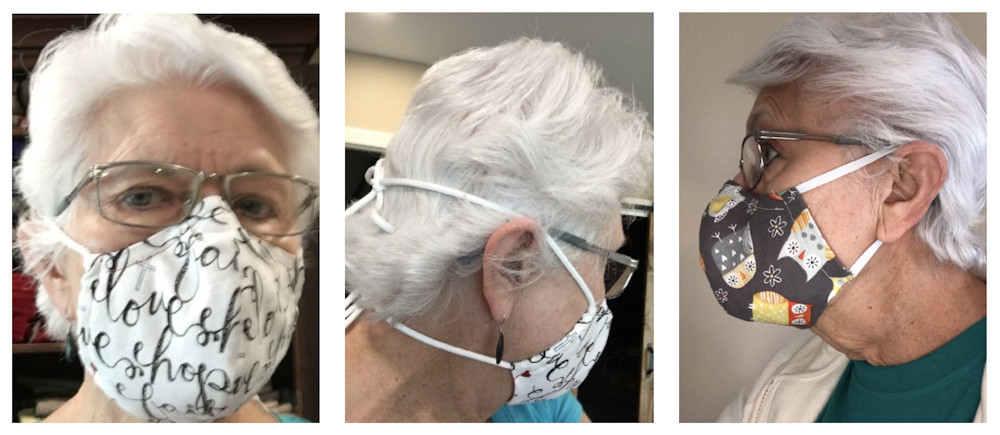
Masks should completely cover the nose and mouth. When measuring for a mask pattern, make sure it extends from the top of the nose – as close as possible to the eyes without obstructing sight – to under the chin. Masks should cover the face side-to-side, well past the opening of the mouth.
When developing prototypes, check around all edges of the mask for gaps. If you see any, close them up by pinching the fabric together, and stitch or tape or staple edges together to create a pleat or dart. A thin metal wire or paper clip placed along the top edge of the mask can stabilize and shape it along the bridge of the nose and cheekbone for a closer fit.
Masks should stay securely in position and fit comfortably with ties or elastic ear loops. If the mask is too tight or loose, the wearer may continuously adjust the mask forgetting the admonition – “Don’t touch your face!”
The ties and loops should also be the mechanism for taking off the mask, as the front of the mask might be contaminated.
People have varying access to different fabrics at home. Masks should incorporate fabrics that:
Reduce virus transmission to and from the nose and mouth
Wrap around the face and are comfortable next to the skin
Are easy to wash and sanitize.
Fabric is comprised of four variables that must be considered for mask making: fiber, yarn, structure and finish. Change a variable – and mask performance changes.

Fibers are the smallest component of a fabric. They cannot be identified by sight or touch. Look for a fiber content label on the products or fabrics you might use for your mask. Alternately, a “burn test” can be used as a crude method to determine if a fabric is a natural fiber, human-made fiber, or a blend of natural and man made fibers. If you choose this method be careful.
There are three important fiber characteristics to consider for mask making. The first is micron size – the diameter of a fiber. The SARS-CoV-2 virus particle is 0.1 to 0.3 micron, so small-sized fibers allow for more compact fabric structures to reduce transmission. The second is how the fiber feels next to skin – this will indicate how comfortable a mask may feel next to your face. The third is moisture regain – how well the fiber absorbs moisture. A higher number means more absorbency; low regain gives a sense of how well the fiber might repel moisture.
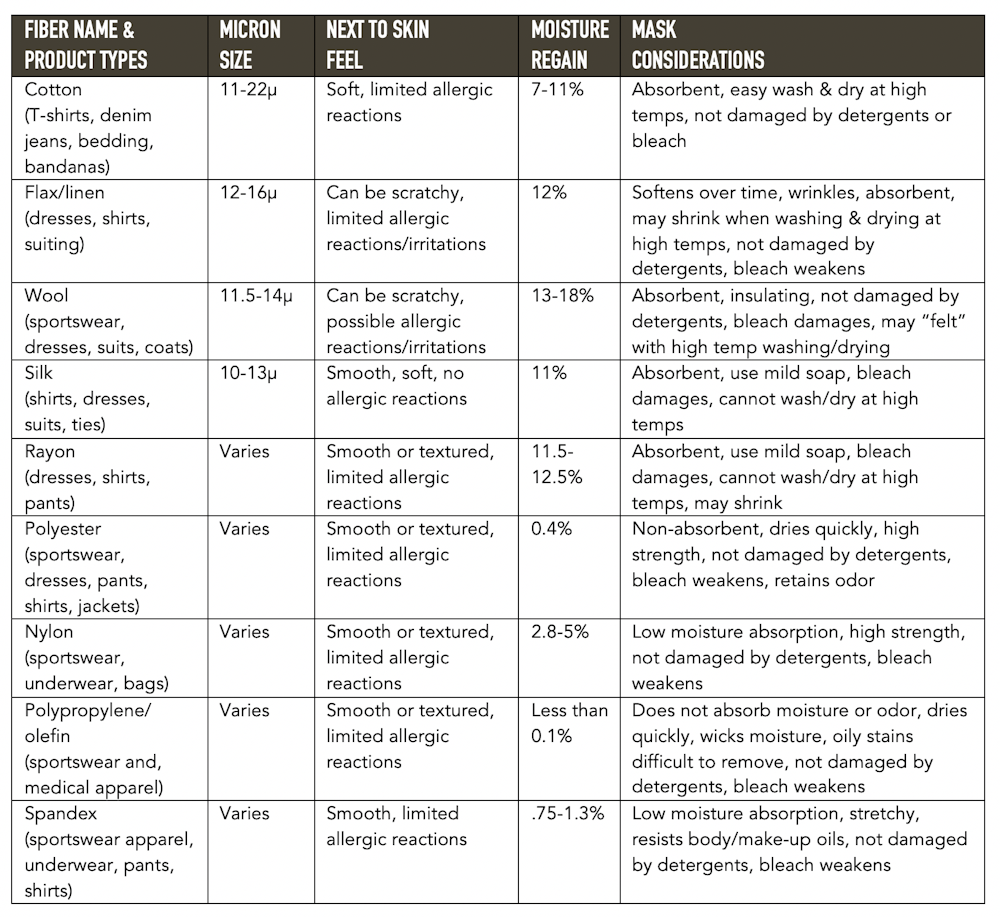
Fibers are twisted together to form yarns. Yarns vary in size affecting fabric thickness and breathability. “Yarn count” is the number of yarns in a 1-inch square of woven fabric. A high yarn count fabric indicates a dense fabric with droplet blocking potential. Yarns with different properties can be blended to combine characteristics.
Yarns are then structured into the physical fabric.

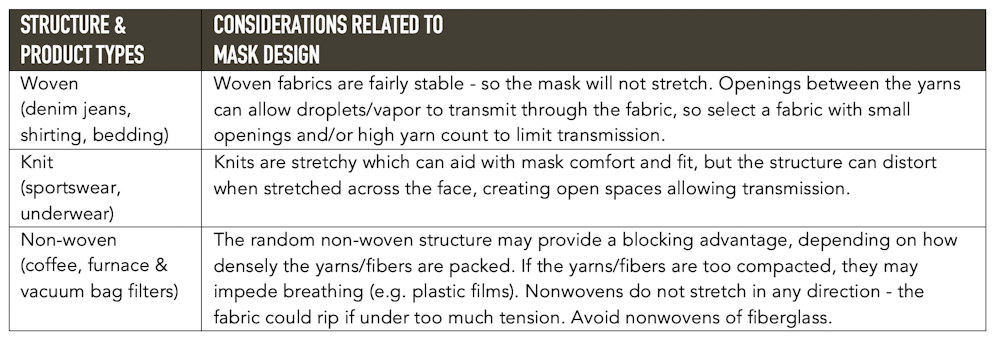
Performance finishes, like water repellency and antimicrobials, are not visible but could be helpful. Detect water repellency or moisture wicking by using an eye dropper to place a drop of water on a fabric to see how it moves across the fabric. Aesthetic finishes like graphics and batik are not so useful.
There are many fabric variables to reckon with for a homemade mask. Consider building a three-layer system.

This three-layer system includes a space between the inner and outer layers for a removable middle layer. A replaceable “filter” is inserted in that space. If one fabric layer is too thin, add additional layers for protection.
Homemade masks will not filter the SARS-CoV-2, however, masks may prevent droplets and spray from transmitting between individuals. When wearing a mask, remember to continue social distancing, wash hands frequently and wipe down surfaces and packages.
[Get facts about coronavirus and the latest research. Sign up for The Conversation’s newsletter.]
Susan L. Sokolowski, Director & Associate Professor of Sports Product Design, University of Oregon and Karen L. LaBat, Professor Emerita of Design, University of Minnesota
This article is republished from The Conversation under a Creative Commons license. Read the original article.
/>================================================================
Knowing how masks are made helps in choosing and using them, even if you aren’t making them yourself. Notice how everything you’ve seen here, and just about everywhere else, is about making or getting them, and putting and keeping them on. But taking PPE off matters too. These are the videos which Nameless found:
AMT, we are a community here. As TC said, “The notion that Trump may … kill one of us makes me want to puke!” and if there is anything he doesn’t need, it’s more puking. So please, chide all of us to take care of ourselves, and encourage us to share any information which can help with that.
The Furies and I will be back.

