Joanne Dixon

Everyday Erinyes #228

 Posted by at 9:00 am  Politics
Aug 152020
 

Experts in autocracies have pointed out that it is, unfortunately, easy to slip into normalizing the tyrant, hence it is important to hang on to outrage. These incidents which seem to call for the efforts of the Greek Furies (Erinyes) to come and deal with them will, I hope, help with that. As a reminder, though no one really knows how many there were supposed to be, the three names we have are Alecto, Megaera, and Tisiphone. These roughly translate as “unceasing,” “grudging,” and “vengeful destruction.”

Back to history this week. It has been obvious for a long time that the Versailles Treaty got the world into World War II. I learned that in school. But it’s less obvious how much of a factor it was in getting us into the mess we are in today. Let’s look.
================================================================

How the failures of the 1919 Versailles Peace Treaty set the stage for today’s anti-racist uprisings
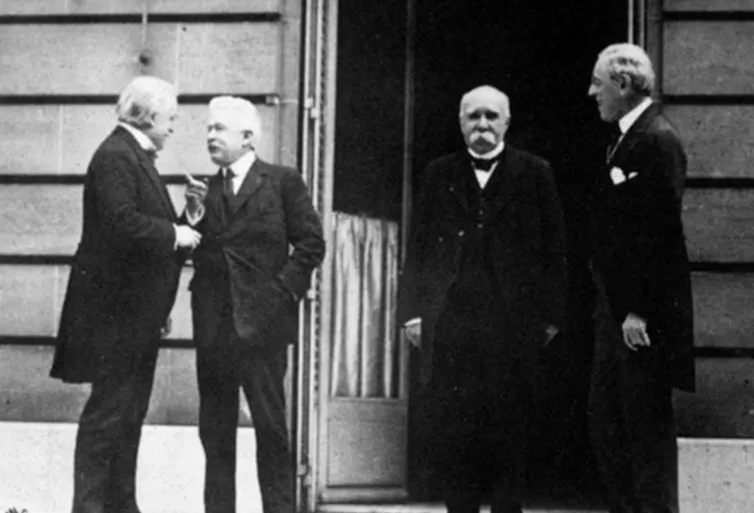
On May 27, 1919, British Prime Minister Lloyd George, Italian President Vittorio Orlando, French Prime Minister Georges Clemenceau and American President Woodrow Wilson met May 27, 1919, during the Paris Peace Conference. Lee Jackson/Topical Press Agency/Getty Images)

Elizabeth Thompson, American University School of International Service

The racism that is now the target of protest across the globe is rooted in the tragic choices of leaders seeking to roll back change a century ago.

Nearly all historians now agree that at the end of World War I, the choice to return to an imperialist world order by the victorious Allied, or Entente, powers – France, Britain, Russia, Italy, Japan and the United States – was a historic error. It not only prepared the ground for the rise of fascism in Europe, but also sparked decades of political violence in Asia and Africa by people denied their rights and humanity.

As World War I ended in November 1918, the Spanish Flu pandemic swept across the globe, killing more than 50 million people. Most vulnerable were soldiers living in crowded barracks and their families back home, where hunger weakened immunity.

Like today, the effect of pandemic was aggravated by economic recession and unemployment. Worse, the people of the defeated German, Austro-Hungarian, Russian and Ottoman empires suffered chaos under political collapse.

Amid these multiple crises, the Paris Peace Conference opened in January 1919. American President Woodrow Wilson personally traveled to Paris to ensure that the conference would make the world “safe for democracy.”

Wilson had promised a new era of peace and justice in his famous Fourteen Points statement of war aims, which included an end to secret treaties, the curtailment of colonial empires, the right of all people to choose their own government and a League of Nations to adjudicate international conflicts.

In 1920, like 2020, race became the pivot of a historic turning point. In both moments, world leaders faced a choice: to restore the previous status quo that had produced the crisis – or to embrace the need for a new world order.

The European members of the Entente powers at Paris – Britain, France, and Italy – ignored Wilson’s call for world order based on law and rights. With the implementation of the Treaty of Versailles in January 1920, they chose to restore a racial hierarchy across the globe, extending their colonial rule over territories once held by the defeated German and Ottoman empires in Africa, Asia and the Middle East.

The treaty, which included establishment of the League of Nations, betrayed not only Wilson’s ideals, but also the Entente’s nonwhite allies and the colonial soldiers who fought in the “war to end all wars.” The racial injustice of the 1919-20 peace settlement sparked decades of political violence – not only in the colonized Middle East, Africa and Asia, but also in the United States.
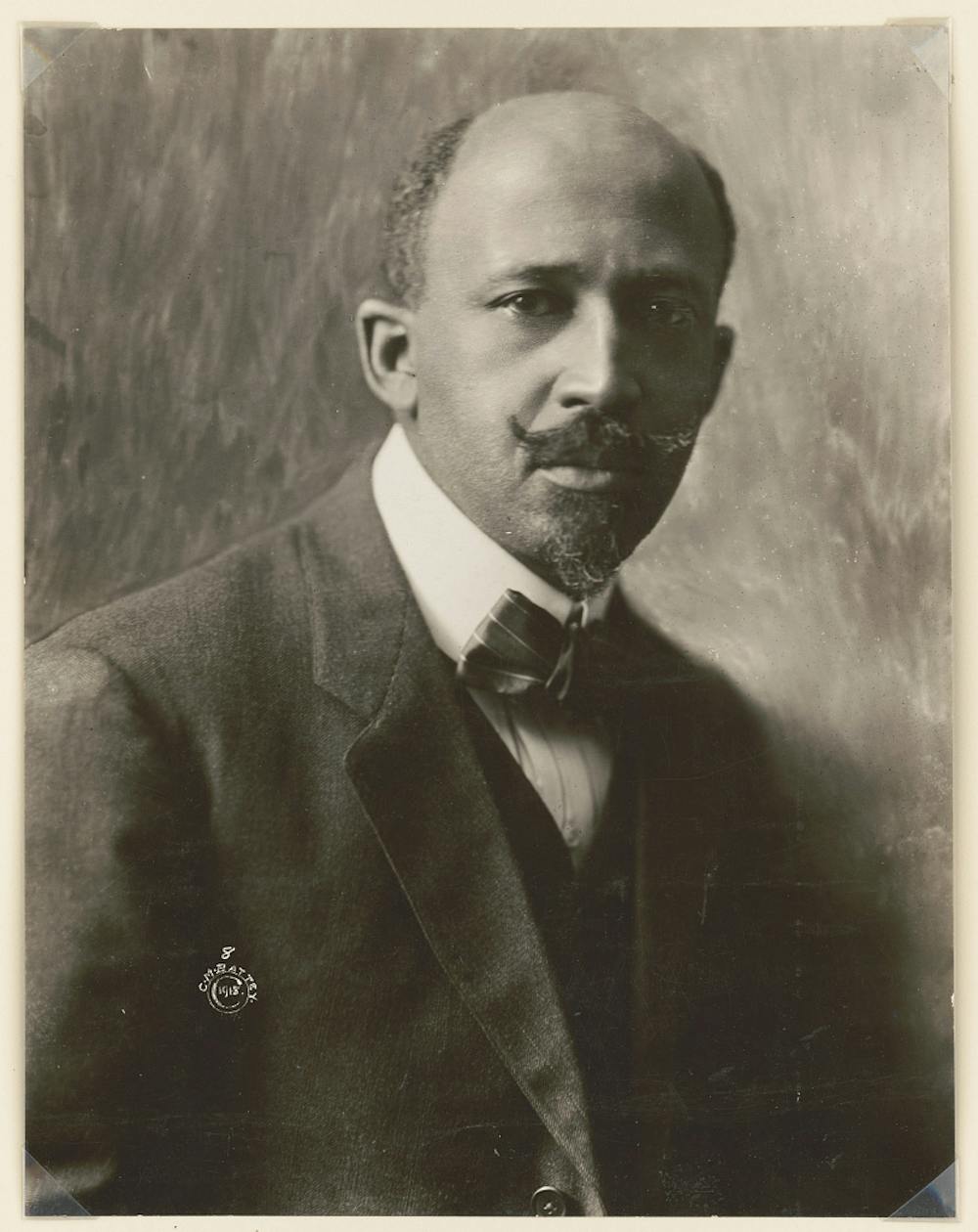
Portrait of NAACP leader W.E.B. Du Bois
NAACP leader W.E.B. Du Bois went to Paris to try to ensure that racist laws like the U.S. had would not be imposed in Africa to the detriment of African rights. Library of Congress Prints and Photographs Division

Journey to Paris

In January 1919, activists from around the world traveled to Paris despite risks to their health. They embraced Wilson’s Fourteen Points as a chance to remake a broken world system of imperial rivalry that had led to World War I and the deaths of 10 million soldiers and 50 million civilians.

Among those activists was NAACP leader W.E.B. Du Bois, who had fought against the spread of racist, segregationist Jim Crow laws from southern states to the North. He now feared that a similar legal double standard might be imposed in international law, to the detriment of African rights.

Du Bois asked to join the American delegation at Paris, but the Wilson administration refused him. Wilson feared that Du Bois’ call for racial equality might spoil his negotiations with the other conference leaders – prime ministers of Britain, France and Italy – who ruled most of Africa as colonies.

Claiming rights

Undeterred, Du Bois organized a Pan African Congress to defend Africans’ rights. He understood, as others did in Paris, that racial inequality was the foundation of the old imperial world order.

Like Du Bois and his African allies, Arabs and Egyptians claimed their right to sovereignty. But they found that the Entente leaders also considered Arab Muslims a lower species of human, unfit for self-rule.

Prince Faisal of Mecca gained entry to the conference because his Arab army had fought against the Ottoman Turks alongside Britain, with the understanding that Arabs would gain an independent state. But the British broke their promise and denied independence to Faisal’s Syrian Arab Kingdom. They instead joined French colonialists to divide Arab lands between them.

Asians, too, were regarded as an inferior race. Japan had fought alongside the victorious Allies and had won a leading role at the conference.

But when the Japanese delegation proposed a racial equality clause for the Covenant of the new League of Nations, the conference’s white leaders rejected it.

The five members of the Japanese delegation to the Paris peace conference.
The Japanese delegation, shown here, proposed a racial equality clause for the charter of the new League of Nations. The leading powers rejected it. Library of Congress Prints and Photographs Division

Racial inequality codified

The Covenant of the League of Nations, drafted by those same leaders at Paris in 1919, codified the inequality of races in international law. Article 22 denied independence to Arabs, Africans and Pacific Islanders once ruled by the Ottomans and Germans.

In the condescending language of moral uplift, the article designated them as “peoples not yet able to stand by themselves under the strenuous conditions of the modern world.” Therefore, they would be placed under temporary European rule as “a sacred trust of civilisation.”

In other words, the League of Nations would administer temporary colonies, called mandates, to tutor uncivilized (nonwhite) people in politics. Racial inequality was enshrined in the very institution, the League of Nations, that was to ensure the governance of international law.

The mandates were imposed by gunpoint, with no pretense to respect self-determination. In July 1920, the French army occupied Damascus, destroyed the Syrian Arab Kingdom and sent Faisal into exile. Likewise, the British battled mass opposition to claim its mandates in Iraq and Palestine. Meanwhile, South Africa imposed a brutal racist regime upon southwest Africa.

Racial exclusion from the club of so-called civilized nations provoked anti-colonial movements for the rest of the 20th century.

The president of the Syrian Arab Kingdom’s Congress, Sheikh Rashid Rida, foresaw violent consequences in his 1921 appeal to the League of Nations.

“It does not befit the honor of this League, which President Wilson proposed to include all civilized nations for the good of all human beings,” he wrote, “for it to be used as a tool by two colonial states. These states seek to use this Assembly to guarantee … the subjugation of peoples.”
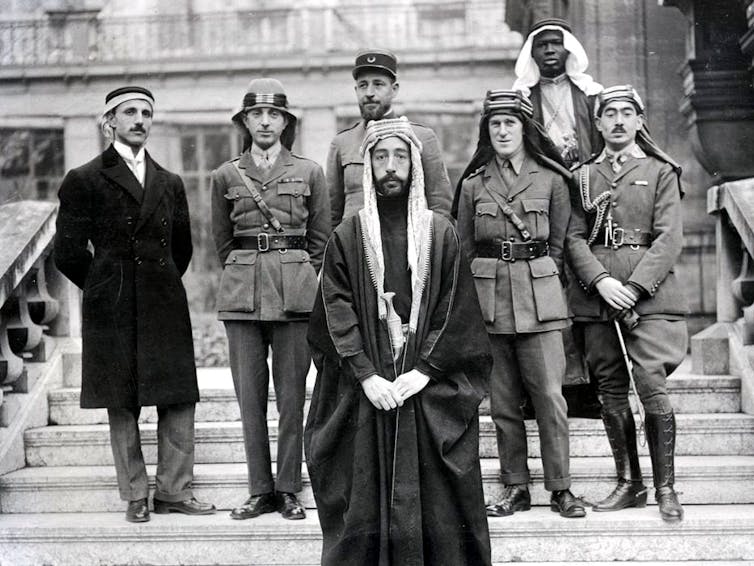
Prince Faisal of Mecca with his delegation at the Peace Conference.
Prince Faisal of Mecca with his delegation at the Peace Conference. Wikipedia

Rida prophetically warned that “Syria, Palestine, and other Arab countries will ignite the fires of war in both the West and the East.” The bitter sheikh turned against European liberalism and inspired the founding of the Muslim Brotherhood in Egypt in 1928.

In the later 20th century, this racial exclusion of Arab Muslims inspired the violent Islamist movements that drew the United States into seeming endless conflict in Afghanistan, Iraq and Syria.

Jim Crow stays

In the United States, racial hierarchy was similarly reimposed by violence. Black veterans returned from Europe to confront lynching and race riots.

[The Conversation’s newsletter explains what’s going on with the coronavirus pandemic. Subscribe now.]

The link between the American racial order and the new world order was made explicit by President Wilson’s adviser, Colonel Edward M. House. He advised Wilson that racial equality would cost him votes in the South and California. Worse, such a clause could empower the League of Nations to intervene in the United States against Jim Crow laws.

In March 1920, the U.S. Senate rejected American membership in the League of Nations precisely because clauses on transnational law enforcement and collective security threatened U.S. sovereignty.

It is no accident that the current crisis in the U.S. has come to focus on racial injustice. Among its several sources are the decisions made 100 years ago by white men from powerful countries who believed maintaining their dominance was more important than seeking peace through justice.The Conversation

Elizabeth Thompson, Professor and Mohamed S. Farsi Chair of Islamic Peace, American University School of International Service

This article is republished from The Conversation under a Creative Commons license. Read the original article.

================================================================
Alecto, Megaera, and Tisiphone, Wilson (a racist himself) probably did not envision what we would envision today as a “world order based on law and rights.” That’s nothing new. When the Magna Carta was signed, the barons who forced it did not envision a world in which anyone other than the nobility would have the rights it prescribes. When the Constitution was written and adopted, our founding fathers almost certainly did not envision a world without slavery. Even after we abolished slavery, few envisioned a eorld in which women had rights. Historically, freedom has a tendency to spread and to embrace groups those writing the rules never considered. It would be most interesting if we were able to follow the history of a parallel world which did rally behind Wilson’s Fourteen Points, and see what would have been different.

On the other hand, I was looking at some numbers – I cannot call what I did crunching because I wasn’t rigorous, and made adjustments based on guesses. I took as a starting point the premise that 30% of Americans still support Trump. I made an assumption that, while we all know that black racists, and female misogynists, and Jewish anti-Semites exist, their actual numbers would be small enough to disregard. I looked up the percentage of non-Hispanic whites in America, and learned it was a little under two-thirds. Well, 30% is almost one-third. I concluded that, as a very rough estimate, half of all the whites in the United States are racist. And we will be stuck with them long after Trump* is gone. And they vote, and they reproduce. On the bright side, without doing any math, I feel strongly that 50% is a lower percentage of racists among whites than it was in the fifties So I think there is hope. Dear Furies, help us build it better.

The Furies and I will be back.

Share

Bill Maher from 8/7/2020

 Posted by at 12:35 pm  Politics
Aug 082020
 

The monologue was the only clip I could find, and it took me almost two hours to even find a full show video. I bring that to you with brief notes on who is in it, and what the discussion was about, and the starting point in minutes and seconds so you can find them. You can tell roughly how long each is by looking at the start time of the segment and the start time of the next segment.  There is CC. (when there isn’t, it’s because there are no words.)

Monologue – “The Incredible Sulk” “President Shrugemoji” Good ones. You know, it used to be bad form for nominees to go to the conventions.  We may end up going back to that.

3:42 Col. Lawrence Wilkerson on Trump not leaving

13:36 Panel – Paul Begala, Meghan Daum on voting by mail and progressive lack of enthusiasm

34:06 Satire magazine “Better Homes and Kindergartens”

35:32 Chris Evans – His new website “A Starting Point” – for people who know absolutely nothing about politics. I provide the link, but haven’t really looked at it. Bill used the term “bipartisan,” which, sadly, makes me wonder about its factuality – a sad comment on America today.

45:26 New Rules: Some people should be out of work. “Goldilocks Bread.” A British man lost his penis and is growing a new one on his arm. Ellen. If even dead people hate you… (satire eulogy for Trump* – with no sound, because there’s nothing good to say. Sound starts again at approx 52:00)

Sorry – but at least it’s all here somehow, and hopefully won’t be too hard to navigate.

UPDATE

Sunday morning – I see they’ve taken the full one down.  However, short videos are now available for three of the five<

Monologue

Evans

New Rule

Share

Everyday Erinyes #227

 Posted by at 9:00 am  Politics
Aug 082020
 

Experts in autocracies have pointed out that it is, unfortunately, easy to slip into normalizing the tyrant, hence it is important to hang on to outrage. These incidents which seem to call for the efforts of the Greek Furies (Erinyes) to come and deal with them will, I hope, help with that. As a reminder, though no one really knows how many there were supposed to be, the three names we have are Alecto, Megaera, and Tisiphone. These roughly translate as “unceasing,” “grudging,” and “vengeful destruction.”

Once again, in connection with CoViD-19, the word “epithelial” comes up, and it is associated with something scary every time that it does. This is no exception. I doubt I could be more motivated to avoid getting CoViD myself than I already am. But I see a threat here beyond my own health which worries me.
================================================================

How COVID-19 might increase risk of memory loss and cognitive decline

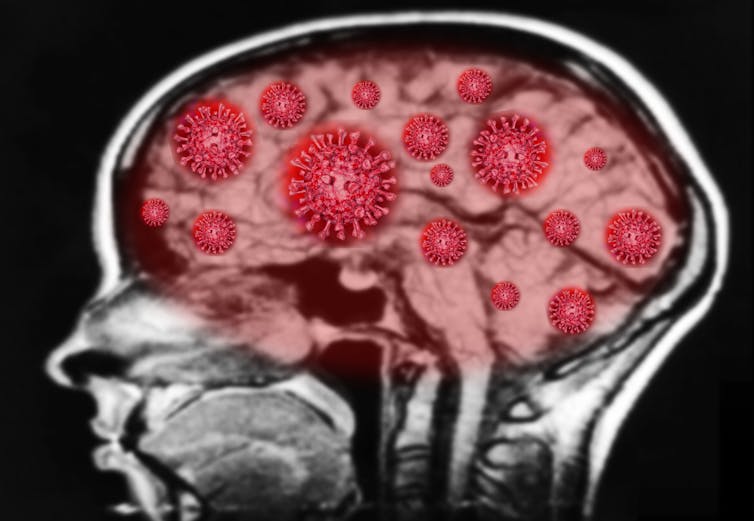
More and more studies are revealing the cognitive effects of COVID-19. Amornrat Phuchom / Getty Images

Natalie C. Tronson, University of Michigan

Of all frightening ways that the SARS-COV-2 virus affects the body, one of the more insidious is the effect of COVID-19 on the brain.

It is now clear that many patients suffering from COVID-19 exhibit neurological symptoms, from loss of smell, to delirium, to an increased risk of stroke. There are also longer-lasting consequences for the brain, including myalgic encephalomyelitis /chronic fatigue syndrome and Guillain-Barre syndrome.

These effects may be caused by direct viral infection of brain tissue. But growing evidence suggests additional indirect actions triggered via the virus’s infection of epithelial cells and the cardiovascular system, or through the immune system and inflammation, contribute to lasting neurological changes after COVID-19.

I am a neuroscientist specializing in how memories are formed, the role of immune cells in the brain and how memory is persistently disrupted after illness and immune activation. As I survey the emerging scientific literature, my question is: Will there be a COVID-19-related wave of memory deficits, cognitive decline and dementia cases in the future?

The immune system and the brain

Many of the symptoms we attribute to an infection are really due to the protective responses of the immune system. A runny nose during a cold is not a direct effect of the virus, but a result of the immune system’s response to the cold virus. This is also true when it comes to feeling sick. The general malaise, tiredness, fever and social withdrawal are caused by activation of specialized immune cells in the brain, called neuroimmune cells, and signals in the brain.

These changes in brain and behavior, although annoying for our everyday lives, are highly adaptive and immensely beneficial. By resting, you allow the energy-demanding immune response to do its thing. A fever makes the body less hospitable to viruses and increases the efficiency of the immune system. Social withdrawal may help decrease spread of the virus.

In addition to changing behavior and regulating physiological responses during illness, the specialized immune system in the brain also plays a number of other roles. It has recently become clear that the neuroimmune cells that sit at the connections between brain cells (synapses), which provide energy and minute quantities of inflammatory signals, are essential for normal memory formation.

Unfortunately, this also provides a way in which illnesses like COVID-19 can cause both acute neurological symptoms and long-lasting issues in the brain.

Microglia are specialized immune cells in the brain. In healthy states, they use their arms to test the environment. During an immune response, microglia change shape to engulf pathogens. But they can also damage neurons and their connections that store memory. JUAN GAERTNER/SCIENCE PHOTO LIBRARY / Getty Images

During illness and inflammation, the specialized immune cells in the brain become activated, spewing vast quantities of inflammatory signals, and modifying how they communicate with neurons. For one type of cell, microglia, this means changing shape, withdrawing the spindly arms and becoming blobby, mobile cells that envelop potential pathogens or cell debris in their path. But, in doing so, they also destroy and eat the neuronal connections that are so important for memory storage.

Another type of neuroimmune cell called an astrocyte, typically wraps around the connection between neurons during illness-evoked activation and dumps inflammatory signals on these junctions, effectively preventing the changes in connections between neurons that store memories.

Because COVID-19 involves a massive release of inflammatory signals, the impact of this disease on memory is particularly interesting to me. That is because there are both short-term effects on cognition (delirium), and the potential for long-lasting changes in memory, attention and cognition. There is also an increased risk for cognitive decline and dementia, including Alzheimer’s disease, during aging.

How does inflammation exert long-lasting effects on memory?

If activation of neuroimmune cells is limited to the duration of the illness, then how can inflammation cause long-lasting memory deficits or increase the risk of cognitive decline?

Both the brain and the immune system have specifically evolved to change as a consequence of experience, in order to neutralize danger and maximize survival. In the brain, changes in connections between neurons allows us to store memories and rapidly change behavior to escape threat, or seek food or social opportunities. The immune system has evolved to fine-tune the inflammatory response and antibody production against previously encountered pathogens.

Yet long-lasting changes in the brain after illness are also closely linked to increased risk for age-related cognitive decline and Alzheimer’s disease. The disruptive and destructive actions of neuroimmune cells and inflammatory signaling can permanently impair memory. This can occur through permanent damage to the neuronal connections or neurons themselves and also via more subtle changes in how neurons function.

The potential connection between COVID-19 and persistent effects on memory are based on observations of other illnesses. For example, many patients who recover from heart attack or bypass surgery report lasting cognitive deficits that become exaggerated during aging.

Another major illness with a similar cognitive complications is sepsis – multi-organ dysfunction triggered by inflammation. In animal models of these diseases, we also see impairments of memory, and changes in neuroimmune and neuronal function that persist weeks and months after illness.

[You’re too busy to read everything. We get it. That’s why we’ve got a weekly newsletter. Sign up for good Sunday reading. ]

Even mild inflammation, including chronic stress, are now recognized as risk factors for dementias and cognitive decline during aging.

In my own laboratory, I and my colleagues have also observed that even without bacterial or viral infection, triggering inflammatory signaling over a short-term period results in long-lasting changes in neuronal function in memory-related brain regions and memory impairments.

Does COVID-19 increase risk for cognitive decline?

It will be many years before we know whether the COVID-19 infection causes an increased risk for cognitive decline or Alzheimer’s disease. But this risk may be decreased or mitigated through prevention and treatment of COVID-19.

Prevention and treatment both rely on the ability to decrease the severity and duration of illness and inflammation. Intriguingly, very new research suggests that common vaccines, including the flu shot and pneumonia vaccines, may reduce risk for Alzheimer’s.

Additionally, several emerging treatments for COVID-19 are drugs that suppress excessive immune activation and inflammatory state. Potentially, these treatments will also reduce the impact of inflammation on the brain, and decrease the impact on long-term brain health.

COVID-19 will continue to impact health and well-being long after the pandemic is over. As such, it will be critical to continue to assess the effects of COVID-19 illness in vulnerability to later cognitive decline and dementias.

In doing so, researchers will likely gain critical new insight into the role of inflammation across the life-span in age-related cognitive decline. This will aid in the development of more effective strategies for prevention and treatment of these debilitating illnesses.The Conversation

Natalie C. Tronson, Associate Professor of Psychology, University of Michigan

This article is republished from The Conversation under a Creative Commons license. Read the original article.

================================================================
Alecto, Megaera, and Tisiphone, it was stupid and willfully ignorant voter who got us into the mess we are in. And in many cases it’s those same stupid and willfully ignorant voters who are daring the virus to infect them – and then going around infecting others, including some who are not stupid or willfully ignorant, but get into their path. If the virus can manage to get into patients’ brains, it will cause even more stupidity, as well as ignorance (through memory loss) which may not be willful, but is still damaging. How on earth are we going to deal with that? We need you. Desperately.

The Furies and I will be back.

Share
Aug 012020
 

The monologue was not available this week. Here are three clips which were available.


Kerry Washington – I’m not sure whether liberals are concerned with not being offended. Not being killed is more like it. That’s not directed at the ACLU, but at Bill’s take on it. I think Kerry gets it. If George Bush’s attending John Lewis’s funeral can reach even one bigoted Republican, God bless it.


Jim Carrey – The name of the book is “Memoirs and Misinformation” – in case Jim never lets Bill say it.


New Rule – Bollocks. If body size were as simple as Bill wants to make it, there would be no body size problem.  It isn’t.


Share

Everyday Erinyes #226

 Posted by at 9:00 am  Politics
Aug 012020
 

Experts in autocracies have pointed out that it is, unfortunately, easy to slip into normalizing the tyrant, hence it is important to hang on to outrage. These incidents which seem to call for the efforts of the Greek Furies (Erinyes) to come and deal with them will, I hope, help with that. As a reminder, though no one really knows how many there were supposed to be, the three names we have are Alecto, Megaera, and Tisiphone. These roughly translate as “unceasing,” “grudging,” and “vengeful destruction.”

I had read about this, and you probably have too. But just a sentence or two, noting how clearly unconstitutional it is. So I welcomed the opportunity to learn more details.

(Note on copyright:  ProPublica does not include copyrighted pictures under Creative Commons.  But Court Orders are matters of public record, so I have reporoduced those, circling the “new” iformation.)
================================================================

“Defendant Shall Not Attend Protests”: In Portland, Getting Out of Jail Requires Relinquishing Constitutional Rights

ProPublica is a Pulitzer Prize-winning investigative newsroom. Sign up for The Big Story newsletter to receive stories like this one in your inbox.

Federal authorities are using a new tactic in their battle against protesters in Portland, Oregon: arrest them on offenses as minor as “failing to obey” an order to get off a sidewalk on federal property — and then tell them they can’t protest anymore as a condition for release from jail.

Legal experts describe the move as a blatant violation of the constitutional right to free assembly, but at least 12 protesters arrested in recent weeks have been specifically barred from attending protests or demonstrations as they await trials on federal misdemeanor charges.

“Defendant may not attend any other protests, rallies, assemblies or public gathering in the state of Oregon,” states one “Order Setting Conditions of Release” for an accused protester, alongside other conditions such as appearing for court dates. The orders are signed by federal magistrate judges.

For other defendants, the restricted area is limited to Portland, where clashes between protesters and federal troops have grown increasingly violent in recent weeks. In at least two cases, there are no geographic restrictions; one release document instructs, “Do not participate in any protests, demonstrations, rallies, assemblies while this case is pending.”

Protesters who have agreed to stay away from further demonstrations say they felt forced to accept those terms to get out of jail.


“Those terms were given to me after being in a holding cell after 14 hours,” Bailey Dreibelbis, who was charged July 24 with “failing to obey a lawful order,” told ProPublica. “It was pretty cut-and-dried, just, ‘These are your conditions for [getting out] of here.’

“If I didn’t take it, I would still be in holding. It wasn’t really an option, in my eyes.”

It could not be learned who drafted the orders barring the protesters from joining further demonstrations. The documents reviewed by ProPublica were signed by a federal magistrate in Portland. Magistrates have broad authority to set the terms of release for anyone accused of a crime. They typically receive recommendations from U.S. Pretrial Services, an arm of the U.S. Courts, which can gather input from prosecutors and others involved in the case. ProPublica identified several instances in which the protest ban was added to the conditions of release document when it was drafted, before it was given to the judge. It remained unclear whether the limits on protesting were initiated by Justice Department officials or the magistrates hearing the cases.

Constitutional lawyers said conditioning release from jail on a promise to stop joining protests were overly broad and almost certainly a violation of the First Amendment right to free assembly.

“The government has a very heavy burden when it comes to restrictions on protest rights and on assembly,” noted Jameel Jaffer of Columbia University’s Knight First Amendment Institute. “It’s much easier for the government to meet that burden where it has individualized information about a threat. So for example, they know that a particular person is planning to carry out some unlawful activity at a particular protest.”


Over the past week, the federal government has sharply increased the number of protesters it’s charging with federal crimes — often for petty offenses that are classified as federal misdemeanors only because they occur on federal property. Court documents reviewed by ProPublica show that over a third of the protesters are charged with “failing to obey a lawful order,” which 14 protesters were charged with between July 21 and July 24 alone.

The office of the U.S. attorney for Oregon, Billy J. Williams, did not respond to ProPublica’s questions about who was making charging decisions. In a recent interview with The Oregonian, Williams urged local citizens to demand that “violent extremists” who have attempted to break through the fence outside the federal courthouse leave. “Until that happens, we’re going to do what we need to do to protect federal property.”

Craig Gabriel, an assistant U.S. attorney who works for Williams, insisted the office understood and respected the right to protest racial injustice. “People are angry. Very large crowds are gathering, expressing deep and legitimate anger with police and the justice system,” Gabriel told The Oregonian. “We wholeheartedly support the community’s constitutionally protected rights to assemble together in large, even rowdy protests and engage in peaceful and civil disobedience.”

Gabriel did not mention the written restrictions against protest that have been made a condition of release for some of those arrested.

Several protesters who were let go on July 23 had bans against demonstrating added by hand on their release documents by Magistrate Judge John V. Acosta, who signed off on them, a review by ProPublica found. Acosta’s office did not respond to ProPublica’s questions.

For those released on July 24, the restriction was added to the original typed document, also signed by Acosta. One protester arrested and released earlier in the month had his conditions of release modified at his arraignment on July 24. The modified order, signed by Acosta, added a protest ban not previously included.

Three of the 15 protesters charged on July 27, in orders signed by Magistrate Judge Jolie A. Russo, also had explicit protest restrictions added to their release terms. (One release order has not yet been posted to the federal courts database.) Russo’s office did not reply to ProPublica’s questions.

“I don’t see that as constitutionally defensible,” Jaffer said. And I find it difficult to believe that any judge would uphold it.”

The ACLU’s Somil Trivedi said, “Release conditions should be related to public safety or flight” — in other words, the risk that the defendant will abscond. “This is neither.” He described the handwritten addition of a protest ban to a release document as “sort of hilariously unconstitutional.”

Publicly, the Trump administration has claimed that it has no problem with the protests that erupted in Portland and other American cities in response to the May 25 death of George Floyd, a Black man, in police custody in Minneapolis. The administration said it launched Operation Diligent Valor in July with a massive deployment of federal officers merely to protect federal property from “violent extremists.”

Geoffrey Stone of the University of Chicago Law School said that imposing a protest ban as a release condition undermines the distinction between protected protest and criminal activity. “Even if they’re right that these people did, in fact, step beyond the bounds of the First Amendment and do something illegal, that doesn’t mean you can then restrict their First Amendment right.”

In many cases, the charges leveled at Portland protesters are closely tied to their presence at the protest — and not to any violent acts.

Eighteen of the 50 protesters charged in Portland are accused only of minor offenses under Title 40, Section 1315, of the U.S. Code. That law criminalizes certain behavior (like “failure to obey a lawful order,” as well as “disorderly conduct”) when it happens on federal property or against people who are located on that property. In other words, it describes behavior that wouldn’t otherwise be a matter for a federal court.

Dreibelbis, like other protesters to whom ProPublica has spoken, said he was arrested for being on the sidewalk outside the federal courthouse. Because the federal government owns the land under the sidewalk, another protester (who spoke on the condition of anonymity to avoid influencing his upcoming trial) told ProPublica it’s “common knowledge” among protesters that the sidewalk is a no-go zone, and setting foot on it risks federal prosecution.

Dreibelbis told ProPublica he roller-skated into the protest, expecting to attend only briefly. He said he knelt on the sidewalk and was arrested by officers. (The charging document filed against Dreibelbis offers no arrest details.)

Section 1315 is the same law the Trump administration is using to justify initiating the federal show of force in Portland, which the administration has said it intends to employ in other cities where protests have raged since Floyd’s death.

The law allows the secretary of homeland security to supplement the Federal Protective Service, the relatively small agency partly responsible for federal building security, with law enforcement agents from the department’s other agencies (such as Customs and Border Protection).

Both President Donald Trump and his predecessor, Barack Obama, have invoked that part of the law in the past. But the use of that same law to file criminal charges appears to be novel. The Obama administration sent a “surge force” of 400 FPS agents, and a dozen CBP agents, to Baltimore in 2015, when the police killing of Freddie Gray sparked broad unrest, but no charges were filed under Section 1315 itself in that response.

In Portland, the federal government has relied on the FPS and U.S. Marshals to write affidavits used to charge protesters in federal court. But it has detailed other agencies on the protest front lines: DHS agencies cited in court complaints include CBP, through its BORTAC tactical unit; Immigration and Customs Enforcement’s investigations unit; DHS’ Office of Intelligence and Analysis, in addition to FPS. Complaints also cite the U.S. Marshals and the Bureau of Alcohol, Tobacco, Firearms and Explosives, which are Justice Department entities.

In the first weeks of the operation, the most common charge against protesters was assault of a federal officer — which, in some cases, counted as a crime on federal property because protesters on the streets were shining lasers at officers inside the courthouse. (DHS has claimed that some officers may permanently lose their vision, but as of July 24, the most serious injury detailed in federal charging documents was an agent who reported seeing spots in his eyes for 15 minutes after the laser attack.)

Over July 23 and 24, however, 10 of the 13 cases opened were charges only of “failing to obey a lawful order.” (One other defendant was charged with assaulting a U.S. Marshal while detained inside the courthouse — where she had been taken after an arrest for “failing to obey a lawful order.”)

Since then, almost all cases have accused protesters of assaulting a federal officer (generally a misdemeanor charge).

In many of the assault cases, files are thin and no details of the allegations have been posted, even for protesters charged as early as July 6. No case files identify an alleged victim — either by name or by the “unique identifier” on their uniforms. (DHS officials have claimed it’s unfair to describe the federal agents in Portland as “unidentified” because they clearly show identification.)


Some assault accusations charge protesters with throwing unidentified objects at officers in body armor, who were unharmed.

Even those defendants who aren’t explicitly barred from attending protests are unable to return to the epicenter of Portland’s unrest as a condition of their release. They are placed under a curfew (either from 8 p.m. to 6 a.m. or 10 p.m. to 6 a.m.) and told not to go within five blocks of the courthouse grounds except for court hearings.

Experts said that while restrictions of that sort are common, they’re still questionably constitutional. “Though ‘stay away’ orders from a place where a potential crime has been committed are generally standard,” the ACLU’s Trivedi said, “‘stay away’ orders from public places that are part of the public square are more questionable.” But he and others conceded that the government could make an argument that it was necessary to prevent further wrongdoing.

They saw no legitimate rationale for a blanket ban on protests.

“I suppose the government could argue, ‘You disobeyed a law enforcement officer at a protest, and we don’t trust you to not do it again,’” Trivedi said. But the release documents already instruct defendants that they are not allowed to break any laws while awaiting trial.

“If they want to say ‘don’t break a law again,’ they’ve already said that,” Trivedi told ProPublica. “Beyond that, the only part that’s left would be not letting you exercise your First Amendment right.”

Driebelbis, for his part, must now watch the protests proceed without him. “I work across the water from the protests, and I can see it every” night, he told ProPublica. “I’m protesting from this side.”

He hastened to clarify that he didn’t mean he was attending a protest in violation of the court order. “Not protesting! There’s no protesting going on in the party of one. But I am there in spirit.”


================================================================
Alecto, Megaera, and Tisiphone, as Masha Gessen (and others) have said, we cannot trust to institutions to save us – not even the Constitution. That’s why public servants of all kinds swear to defend it, rather than the other way around. (No expiration date on that oath, BTW.)

The Furies and I will be back.

UPDATE: “Grace” has been released from detention.

Share

Everyday Erinyes #225

 Posted by at 9:40 am  Politics
Jul 252020
 

Experts in autocracies have pointed out that it is, unfortunately, easy to slip into normalizing the tyrant, hence it is important to hang on to outrage. These incidents which seem to call for the efforts of the Greek Furies (Erinyes) to come and deal with them will, I hope, help with that. As a reminder, though no one really knows how many there were supposed to be, the three names we have are Alecto, Megaera, and Tisiphone. These roughly translate as “unceasing,” “grudging,” and “vengeful destruction.”

Most of us have probably seen the story about the Michigan teenager (14 IIRC – oh, wait, 15, at least now) who was placed into juvenile detention because she failed to complete her virtual homework. That was in mid-May. Most of us also probably thought that was an over-reaction – and possibly an over-reach – on the part of the courts. I certainly feel it was an over-reaction. But it was not an over-reach. And it was not because of skin color alone, though that was a factor. The key word in all the stories is “probation.” She was on probation. Most people have heard of it but are not familiar with the details of how it works.

At some point in time, the young lady was convicted of some offense which resulted in her being put on probation. Note that I do not claim that she did it (it’s briefly described in the article), nor do I claim that a “white” child in the same circumstances would have been convicted – that is where the skin color comes in. But the result was to put her into probational status.

All societies, including ours, have a social contract – there are things which are “done” and things which are “not done.” None of these things are in any statute books – it’s purely a matter of people agreeing. Of course, people don’t always agree – and it can get comical – but there’s no reason for a court of law to get involved. Failure to do homework would ordinarily be in social contract territory.

But if a person is on probation, there are behaviors normally covered by the social contract which can now come under the territory of probation, and which can therefore violate not just the social contract, but also the conditions of probation. And not all of those actions and inactions are always written down in the terms of probation. The courts have leeway to determine what constitutes a violation of probation. And a violation of probation can put a probationer right (back) into detention. Regardless of skin color, gender, or other social status. And that is what happened to “Grace.”

The young lady has petitioned to be released from detention, and that is what this story is about. I present it without further comment.
================================================================

Judge Won’t Free Michigan Teenager Sent to Juvenile Detention After Not Doing Online Schoolwork

ProPublica Illinois is an independent, nonprofit newsroom that produces investigative journalism with moral force. Sign up for The ProPublica Illinois newsletter for weekly updates.

PONTIAC, Mich. — A Michigan family court judge on Monday denied a motion to release a teenager who has been held at a juvenile facility since mid-May for violating probation after not doing her online schoolwork, saying the girl will benefit from ongoing treatment there.

“I think you are exactly where you are supposed to be,” the presiding judge of the Oakland County Family Court Division, Mary Ellen Brennan, told the 15-year-old. “You are blooming there, but there is more work to be done.”

The decision came despite an argument from the attorneys of the teenager, Grace*, that the therapy and educational support she receives at the facility are inadequate and a statement by the prosecutor that his office supported her release. Caseworkers for the court and Children’s Village, where she is being held, testified she should be kept at the facility until she completes the monthslong program.


After the hearing, Grace and her mother, Charisse, embraced for more than a minute, the first time they have had physical contact since May 14 because of COVID-19 restrictions. They sobbed audibly through their masks before leaving the courtroom separately.

During the two-hour hearing at the Oakland County court, Brennan also mounted a defense of her initial decision in May to place Grace in detention for the probation violation, devoting about 45 minutes to recounting the troubled relationship between the girl and her mother.

Brennan began by speaking directly to the girl, saying she wanted to ensure the information was on the record: “This morning for you, respectfully, it is going to get worse before it gets better. Because I am about to go over all the crap, all the negative, all the prior attempts at helping. I am going through it all.”

The case, which has drawn national scrutiny, was detailed in a ProPublica Illinois investigation co-published last week with the Detroit Free Press and Bridge Magazine. It has sparked several protests outside the courthouse, and members of Congress, state lawmakers and Birmingham Public Schools board members have called for Grace’s release. The Michigan Supreme Court’s oversight agency has opened a review of the procedures in the cases.

Monday’s hearing came after Grace’s new attorney, Jonathan Biernat, filed a motion Thursday asking the court to review the case and send her home.

Brennan limited discussion to Grace’s “progress and engagement” in the treatment program. She denied Grace’s attorneys’ attempts to discuss her original decision to detain the teenager for the probation violation and would not allow testimony from Grace’s special education teacher.

The prosecutor’s office has until Friday to respond to Biernat’s motion to reconsider the ruling on the probation violation, and Brennan said she will then issue a written opinion.

Grace was a high school sophomore in Birmingham Public Schools when she was charged with assault and theft last year, for incidents in which she bit her mother’s finger and pulled her hair and stole another student’s cellphone.


She was placed on probation in mid-April and, among other requirements, was to complete her schoolwork. Grace, who has ADHD and receives special education services, struggled with the transition to online learning and fell behind when Groves High School stopped in-person learning because of COVID-19. Her probation officer filed a violation against her on May 5, two weeks into the probation.

On May 14, Brennan found Grace guilty of violating probation for “failure to submit any schoolwork and getting up for school.” She ordered her detained, concluding Grace was a “threat to (the) community” based on the prior charges of assault and theft. Grace was placed in secure detention at Children’s Village, in suburban Detroit, for about three weeks and then transferred to a residential treatment program within the facility.

The decision to detain Grace came while the state was operating under an order from Gov. Gretchen Whitmer to eliminate any form of detention or residential placement unless a young person posed a “substantial and immediate safety risk to others.”

At Monday’s hearing, Grace’s case coordinator at Children’s Village and the judge, reading from the caseworker’s report, said the girl has behaved well and has been engaged with the treatment program. She has met all the goals, was the “star resident” one week this month and is currently at the second of five stages in the program. Each stage takes about a month to complete, the case coordinator said, and she recommended that Grace complete the program. That would take another three and a half months, she said.

The court caseworker also recommended that Grace stay in the program. “They have made significant progress,” the caseworker, Ashley Bishop, said. “In speaking with mom, she reports they have been able to communicate much better, (Grace) is more self-aware, she is more serious, she is more thoughtful.”

“When I read this report, this is as good as it gets. … This is excellent. She is on point, she is doing well, she is engaged,” Brennan said. She later said, “The worst thing I can do is say you are doing great, now let’s get you home and watch the whole thing blow up.”

But Grace, speaking to the judge, said her good behavior indicated she was ready to go home. “I know I can control myself. … That altercation should not be defining who I should be now,” she said, adding: “I can be respectful. I can be obedient. I feel like that is being completely disregarded, no offense.”

She and her attorney argued she has been “deprived” of education and therapy. She has between 30 and 60 minutes of individual therapy twice a month and has had three joint sessions with her mother. Before being detained, she was meeting with a therapist twice weekly in addition to family therapy and academic tutoring, Grace and her mother have said.

“I believe placement in my home with the same, consistent therapy that I was getting beforehand, and love and support that will always be around me, will be a benefit for myself, my mom, my family and my community,” Grace said.

For school, Grace has been provided packets of material from the local district, which she said have been inadequate. “I am getting behind in my actual schooling while here. The schooling here is beneath my level of education,” she said. “And I know you may not seem to think this is a punishment, but in my heart, I feel the aching and the loss as if it were a punishment.”


For the first segment of the hearing, Brennan detailed Grace’s contentious relationship with her mother, during what she referred to as “the crazy years,” citing police records and child welfare reports mostly from 2017 and 2018. The reports describe Grace yelling, pushing, punching and biting her mother, and her mother’s inability to control her daughter, the judge said. She also mentioned Grace’s mental health treatment and troubles at school, including her theft of school technology, as well as social services support to help resolve conflicts between the mother and daughter.

The ProPublica investigation cited the police reports and other records about Grace’s behavior, including that she entered a court diversion program in 2018, at her mother’s request, for “incorrigibility.” At that time, Grace agreed to participate in counseling and not use electronic devices.

However, in filing the probation violation, the probation officer, who did not appear in court Monday, only cited incomplete schoolwork. She said Charisse reported that her daughter was not doing work, though the mother has said she spoke out of frustration. Charisse subsequently has said her daughter needed time to adjust to remote learning.

Brennan, who is running for reelection, said on Monday she had not felt it was safe to send Grace home after the probation violation because of the “numerous incidents of domestic violence,” and she didn’t want to put them in a “hot box” together when families generally were staying at home during the pandemic.

“She was not detained because she didn’t turn her homework in,” Brennan said at one point during the hearing, taking a long pause to look out at the courtroom. “She was detained because I found her to be a threat of harm to her mother based on everything I knew.”

At the original probation violation hearing in May, Grace’s mother testified that her daughter had not caused her any physical harm during the probation period. Grace said at Monday’s hearing that there had been no physical altercations between the two after the original assault charge in November and there is no police record of any.

In issuing the decision, Brennan said she wanted the girl to succeed, urging her to “give yourself a chance to follow through and finish something.”

She also cited the teenager’s work with a program at Children’s Village to prepare shelter dogs for adoption. “I want you to finish. The dogs want you to finish. Truly,” she said.

Biernat, Grace’s attorney, said after the hearing that he plans to appeal the decision. “We want her back at home with her mother,” he said.

As Grace and her mother hugged before saying goodbye, Charisse told her to “stay strong.”

With her head on her mother’s shoulder, Grace replied: “I can’t.”

ProPublica is using middle names for the teenager and her mother to protect their identities.


================================================================
Alecto, Megaera, and Tisiphone, I promised no further comment, and I’ll stick to that. I’ll just say anything you can do to lead this story toward a happy ending will be appreciated deeply.

The Furies and I will be back.

Share
Jul 232020
 

Here are four “acts” from Sam’s show, plus a parting thought.

Deniers, Dimwits, etc. Part I

Texas, Florida, yes, they are indeed the poster children. Could one call it a catch-22 that Democratic governors who ask for help don’t get any from this regime just because, whereas Republican governors can get whatever they want, but they don’t want anything?

Deniers, Dimwits, etc. Part II

Georgia, Oklahoma, Arizona – all just as bad if not worse, but lower in population so lower in numbers – at least for now. May I throw in a picture which is worth a thousand or so words?

Masha – (Whom we should have listened to in 2016)

Voter turnout is tough to get, always, because people don’t see how much every vote matters in the ocean of votes. And there are otherwise intelligent people who don’t think the vote is the strongest way to bring about change (I’m looking at you, Noam.) What I think they are forgetting is how quickly and effectively change achieved through movements and activism can be UNdone if it isn’t supported at the ballot box. Can I attempt an analogy? Sitting around and breathing may not be the most powerful way to live a full life. Lifelong learning, exercise, love of family and friends are all more powerful in making one feel one has a life. But if you don’t also breathe, all those other things kind of lose their power.

Sam’s Shed – Mister Wives

Cool. Of course I’m old fashioned.

Those are the four acts she promised, but she also had a parting thought –

RESIST!

Share

Everyday Erinyes #224

 Posted by at 9:00 am  Politics
Jul 182020
 

Experts in autocracies have pointed out that it is, unfortunately, easy to slip into normalizing the tyrant, hence it is important to hang on to outrage. These incidents which seem to call for the efforts of the Greek Furies (Erinyes) to come and deal with them will, I hope, help with that. As a reminder, though no one really knows how many there were supposed to be, the three names we have are Alecto, Megaera, and Tisiphone. These roughly translate as “unceasing,” “grudging,” and “vengeful destruction.”

I was looking around for what to address this week, and then Nameless kind of made up my mind for me. It’s scary. And there’s not much a single activist can do about it. But at the very least it may help us be more understanding of people working in the medical field – all of whom at this point are people overworking in the medical field. No one who is being served by them, or in contact with them in any way, needs to do or say anything to add to their stress.
================================================================

Hospitals Are Suddenly Short of Young Doctors — Because of Trump’s Visa Ban

ProPublica is a Pulitzer Prize-winning investigative newsroom. Sign up for The Big Story newsletter to receive stories like this one in your inbox.

As hospitals across the United States brace for a difficult six months — with the first wave of the coronavirus pandemic still raging and concerns about a second wave in the fall — some are acutely short-staffed because of an ill-timed change to immigration policy and its inconsistent implementation.

A proclamation issued by President Donald Trump on June 22, barring the entry of most immigrants on work visas, came right as hospitals were expecting a new class of medical residents. Hundreds of young doctors were unable to start their residencies on time.

Trump’s order included the H1-B visa for highly skilled workers, which is used by some practicing doctors abroad who get U.S. residency slots. The proclamation stated that doctors “involved with the provision of medical care to individuals who have contracted COVID-19 and are currently hospitalized” should be exempt from the ban, but it delegated the issuing of guidance to the departments of State and Homeland Security. That guidance has been slow and inconsistent.


Many consulates started approving doctors’ visas on Thursday, after ProPublica asked the State Department about the delay. Others say they’re still awaiting guidance.

At hospitals where many incoming residents are visa holders, even a delay of a few weeks in arriving in the U.S. creates a staffing crisis. Doctors and administrators are afraid that the repercussions will last for the rest of the year — leaving them overworked and ill-prepared even before a second wave of the virus hits.

ProPublica has heard from 10 would-be medical residents stuck abroad because of H1-B visa issues. Six of them had gotten emergency consulate appointments for visa approval, but when they arrived for meetings they were told their visas could not be approved. Three were still waiting on DHS approval for their visas, a necessary step before a visa gets a consulate stamp. One resident had application approval but was denied an emergency consulate interview appointment because of the ban. All were destined for hospital positions treating COVID-19 patients.

The State Department told ProPublica on Tuesday that it, “in conjunction with the Department of Homeland Security and interagency partners, is establishing and implementing procedures” for the visa ban, and that it “has communicated and will continue to communicate implementation procedures” to consulates abroad.

On Thursday, the State Department’swebsite posted guidance, spelling out that doctors treating COVID-19 patients were exempt from the ban. On that day, many of the residents ProPublica spoke to said they had suddenly received visa approvals. “A quite remarkable turnaround, given that I received a rejection email three days ago,” one said. In at least five countries, however, consulates were still not processing doctors’ visas.

The Committee of Interns and Residents, an affiliate of the Service Employees International Union, has heard from over 250 interns stuck abroad. Over 150 of them are on H-1B visas.. (The others are on visas that weren’t covered in Trump’s ban, but can’t get approval because their consulates are still closed due to the pandemic.) Union president Jessica Edwards pointed out to ProPublica that while that number may sound small, each intern is responsible for the care of thousands of patients.

As of 2017, there were 2,532 medical residents on H1-B visas, according to the Journal of the American Medical Association — though the Trump administration’s continued restrictions to legal immigration may have made it less appealing for hospitals to sponsor visas in the last few years. But the impact on hospitals is highly concentrated in the less-prestigious hospitals that tend to rely on residents from overseas.

At one New York City hospital serving low-income residents, nearly half the incoming class is still stuck abroad, multiple sources confirmed to ProPublica. One hospital in a large Midwestern city told ProPublica that “roughly half” of its first-year doctors started on time. In the Deep South, a region now overwhelmed by COVID-19 cases, a doctor who was set to start told ProPublica he was among 10 residents still awaiting visa approval as of early July. All hospitals and doctors spoke to ProPublica on the condition of anonymity because they worried about jeopardizing their visa applications.

ProPublica has also spoken to more-experienced doctors facing the same issue — including an infectious-disease specialist blocked from starting a job in an area of the Western U.S. where COVID-19 cases are rising.


When there aren’t enough incoming residents to replace departing third-year residents, staffing crunches result.

At the New York City hospital, a doctor told ProPublica that after only 10 days of short-staffing, one resident had called in sick from exhaustion. The doctor recounted a recent shift in which there had only been two junior residents on call, compared with the typical six. Even by having residents work individually instead of in teams of two, they couldn’t keep up with new patient admissions.

“The patients had to just stay there waiting in the (emergency department) for the residents to finish their first admission, in order to see them,” the doctor said. “When the shift was over, I logged into the computer and I would see notes written at 10 p.m., 11 p.m. And these residents are expected to go home and then come back again at 6:30 a.m.”

Even at hospitals with decreasing COVID-19 caseloads, short-staffing is a bigger problem than it was in pre-pandemic times. Some hospitals are seeing a “surge of non-COVID patients” who were unable to get care for chronic conditions like heart disease during lockdown and are now deteriorating, a doctor at a short-staffed hospital told ProPublica. And because protocols prevent doctors from switching back and forth between COVID-19 and non-COVID-19 patients, the hospital needs to keep more doctors on-call to maintain staffing levels in both wards.

“If someone is getting acutely ill, who will see them?” a hospital administrator told ProPublica. “I’ve got my poor residents running around trying to make sure everyone is seen in a timely manner. And residents are great, but they can only be in one place at one time.”

Some of these problems will be fixed as residents receive delayed visa approvals and are able to come. But it will take weeks, if not months, to successfully onboard them. The Midwestern hospital anticipates that arriving residents may not be able to start until mid-August. In the meantime, they’re understaffing services and using fourth-year medical students in place of residents.

Hospitals are used to a summertime efficiency gap, as new interns learn the ropes. This year, it could persist into fall — when a second wave of coronavirus infections is expected.

“I’m really worried that in three months,” said the medical administrator, “we’re going to have a bunch of residents who are just exhausted and just getting into the worst part of the fall, flu and COVID season.”

These doctors already had to push themselves through the first wave of COVID-19 this spring. Furthermore, at hospitals hardest hit by the visa ban, the residents picking up the slack are often themselves H1-B visa holders whose futures are now uncertain. Trump’s ban didn’t revoke visas for anyone currently in the U.S., but if they leave the country — which they will have to do if they change jobs — their ability to return is unclear. Some of the doctors interviewed by ProPublica were living in the U.S. before the pandemic and returned home partly to get visa approval for their new jobs. One doctor ended up stuck in India while her husband was unable to travel there from the U.S.


Another doctor from India, now working in the U.S., told ProPublica: “My parents, they’re (in India) by themselves, and both of them are about 70. At some point, probably, they will catch the infection.” If that happens, the doctor plans to leave the U.S. to care for them — “and if I don’t come back, I don’t come back. At this point, I really don’t care.”

The feeling that the U.S. doesn’t value them is compounded among residents who’ve already lived through the first wave of COVID-19 and who are now facing overwork and visa uncertainty. Some said other countries are making it easier for doctors to immigrate, while the U.S. leaves them in limbo.

“We feel underappreciated for what we’re doing,” the New York City resident said. “And what else can you do, more than sacrificing your life?”

Tightly regimented residency schedules can be tricky for H1-B visa holders even in the best cases. Doctors find out in mid-March if they are “matched” with a U.S. hospital, where they’ll be expected to start at the beginning of July. DHS often takes longer than that to approve H1-B applications. Employers can pay for expedited processing to guarantee a decision within five days — but DHS shut down its expedited processing on March 22 because of COVID-19 and didn’t reopen it until June 8.

Shortly afterward, Trump issued his proclamation banning entries on many visa types, including the H1-B.

Most people coming to the U.S. for residencies arrive on a different kind of visa, the J-1, and aren’t covered by Trump’s ban, though some have had issues getting consulate appointments because of the COVID-19 pandemic. But doctors do identical work regardless of their visa types. If anything, doctors with H1-Bs are more qualified than those with J-1s, since they’re required to have completed all three phases of the taxing U.S. Medical Licensing Exam before starting residencies. Residents with H1-B visas were practicing doctors in their home countries, working alongside new medical-school grads from the U.S.

An earlier immigration ban targeting permanent immigrants, which passed in March, contained a broad medical worker exemption. When rumors of a work-visa ban started swirling in late spring, immigration lawyers and hospitals expected it would include the same language. Instead, the June proclamation mentioned only doctors working with hospitalized COVID-19 patients.


Every resident who spoke with ProPublica had provided evidence to the U.S. government that they met that description. Some were told by consular officers that they were probably exempt. But until they received State Department guidance, they had to place their visas in “administrative processing” — an indefinite holding pattern.

ProPublica saw an image of a form given to one visa applicant informing them of a hold. The form is typically used to request more information from the applicant. In this case, though, a consular officer had modified the form to say that processing would not begin until “implementation procedures” for the visa-ban exemption had been provided.

Doctors in limbo have formed WhatsApp groups to share information and support, but the dialogue has shown inconsistencies in the ban’s implementation. Some consulates, such as those in Serbia, Russia and the United Arab Emirates, have approved doctors’ H1-B visas as exempt. Asked about the discrepancy, the State Department told ProPublica: “Applicants who believe they qualify for an exemption from Presidential Proclamation 10052 should check the website of the closest U.S. Embassy or Consulate regarding the current status of services. How appointment systems are managed can vary depending on the consular section.”

One applicant who reached out to the State Department for assistance received an email reply from an employee on July 10. The employee said that as far as they knew, the Office for Consular Affairs had given guidance to consulates and embassies to process visas that were exempt from the ban. (The agency declined to comment on that email.)

On Thursday, that applicant received a second email from the same employee. Guidance had been slow in coming, the employee admitted, but it had finally come through.

But some countries still haven’t changed their practices. One doctor stuck abroad told ProPublica they’d sent a follow-up email to the consulate on Thursday morning. “He gave me the same reply,” the doctor said, “that they are still waiting for guidance from Department of State.”


================================================================
 Alecto, Megaera, and Tisiphone, as hard as it is to get people who really don’t care to do the right thing. I hope you can light soe fires at the State Department.  A shortage of doctors is never good, but at a time like now, it is unthinkable.

And it’s it’s easy to be thoughtlessly exasperated.  It happened to me just yesterday morning.  I had four calls withing a half hour from the same clinic in Pueblo (about 30-35 miles to the south).  The last one I picked up, and it was a fax tone (I can’t get faxes on the line I use for voice calls but have a separate fax number.)  I went to their website and used a contact form to tell them this, and added “I want it to stop.  Now.”  After reading Nameless’s article, I realized I could have been gentler.  Even just leaving off the “Now.” would have been better.  Please put on your Eumenides hats and help us all to think just a lttle more before we speak – or even email.  Thanks.

The Furies and I will be back.
================================================================

Share