
Meidas Touch – Hawley
Now This News – Interracial Marriage – hanky alert
Really American – on Tucker Carlson
ARPB End note 2:
Puppet Regime – Laugh? Or cry?
Cole and Marmalade – Cat Logic
Beau on Republican math


Meidas Touch – Hawley
Now This News – Interracial Marriage – hanky alert
Really American – on Tucker Carlson
ARPB End note 2:
Puppet Regime – Laugh? Or cry?
Cole and Marmalade – Cat Logic
Beau on Republican math

This is all there is today.
Rewind – Best of Kamala Harris
The Lincoln Project – The “New” Republican Party –
Meidas Touch Podcast with Malcolm Nance – “Vanilla Isis”
Really American – Flori-duh. Glenn talks more slowly and uses more logic on his own show (Justice Matters) but they’re kind of long.
Justice Matters – See, I told you Glenn could talk more calmly. Of course, that kind of makes it longer. Still under 10 minutes, though.
Beau on Biden Response to Texas
Meidas Touch (podcast)
Now This News – No comment.
Really American – We all know this by now, but the “shock” is kind of fun.
“End notes” to “The Alt-Right Playbook” I haven’t seen enough yet to decide whether I should intersperse them orlistthem separately when I make the compendium … so that will be delayed somewhat. End note 1:
After the first meeting, and before they got used to each other, Cole and Marmalade did this.
Beau – Teaching and learning history – the Scooby-Doo method.
Don Winslow Films – anther lie from Lindsey
Really American – Ron Johnson – OMG
Now This News – Florida – Hey, I canfeel where they are coming from – but they are still wrong (not that Florida’s government officials have any moral high ground here. They don’t.)
Now This News – Fighting back against substandard medical care based on race.
Robert Reich – Unrigging the GOP’s Minority Rule
Jesse Dollmore – This is long and a bit repetetive, but it is also the first I have heard of any suggestion – at least any sworn suggestion – that the Secret Service was involved in the January 6 insurrection.
Beau – Forecasting for the GOP with at least one interesting takeaway
The Lincoln Project is finding time for Cruz
Meidas Touch – Voting Rights – and we all know why.
The Damage Report – Why is it cold if there’s global warming? for dummies
The Alt-Right Playbook – I Hate Mondays. This is the last in the series to date. However, the site has a couple of other series which may be worth starting.
SNL Cold Open
Beau – Texas and tough guys…
Meidas Touch – podcast – Miles Taylor (no CC)
MSNBC – Well, we said we needed another FDR.
Not a video but a Tweet for the ages
How come @BetoORourke and @AOC work to raise money for struggling Texans, many of whom didn’t vote for Beto and think AOC is a she-witch, doesn’t count as a UNITY story?
How come the media isn’t spinning it that way? How come “unity” can only mean “giving the GOP what it wants”?
— Elie Mystal (@ElieNYC) February 19, 2021
Orange Acres Episode 3
Founders Sing – they are ON IT.
Beau on Deb Haaland – He makes good points, but I think he’s missing the one that may be the most important – she’s Native American (and a woman). The QOP won’t tolerate that.

Experts in autocracies have pointed out that it is, unfortunately, easy to slip into normalizing the tyrant, hence it is important to hang on to outrage. These incidents which seem to call for the efforts of the Greek Furies (Erinyes) to come and deal with them will, I hope, help with that. As a reminder, though no one really knows how many there were supposed to be, the three names we have are Alecto, Megaera, and Tisiphone. These roughly translate as “unceasing,” “grudging,” and “vengeful destruction.”
As I’ve been saying, I have a number of articles saved regarding how white supremacy thinks, when it increases, how it expresses itself, and so on – and especially, what to do about it. I hope to get to all of them eventually. This is not one of them – but it is about accountability, which, like democracy, is not threatened.
The United States is not the first nation to have established an impeachment process. Neither are we the first nation to learn that, as a process to achieve accountability – well, let’s just say it is far from perfect. Here’s a little history so that we can consider similarities and differences.
================================================================
Eliga Gould, University of New Hampshire
Impeachment was developed in medieval England as a way to discipline the king’s ministers and other high officials. The framers of the U.S. Constitution took that idea and applied it to presidents, judges and other federal leaders.
That tool was in use, and in question, during the second impeachment trial of Donald Trump. Republicans raised questions about both the constitutionality and the overall purpose of impeachment proceedings against a person who no longer holds office.
Democrats responded that the framers expected impeachment to be available as a way to deliver consequences to a former official, and that refusing to convict Trump could open the door to future presidential abuses of power.
An impeachment case that was active in Britain while the framers were writing the Constitution in Philadelphia helped inform the new American government structure. But the outcome of that case – and that of another impeachment trial a decade later – signaled the end of impeachment’s usefulness in Britain, though the British system of government offered another way to hold officials accountable.
During the 17th century, the English Parliament used impeachment repeatedly against the royal favorites of King Charles I. One, Thomas Wentworth, Earl of Strafford, went to the gallows in 1641 for subverting the laws and attempting to raise an Irish army to subdue the king’s opponents in England. Although kings couldn’t be impeached, Parliament eventually tried King Charles I for treason too, sentencing him to death by public beheading on Jan. 30, 1649.
A century later, impeachment no longer carried a risk of execution, but in 1786 the House of Commons launched what would become the most famous – and longest – impeachment trial in British history.
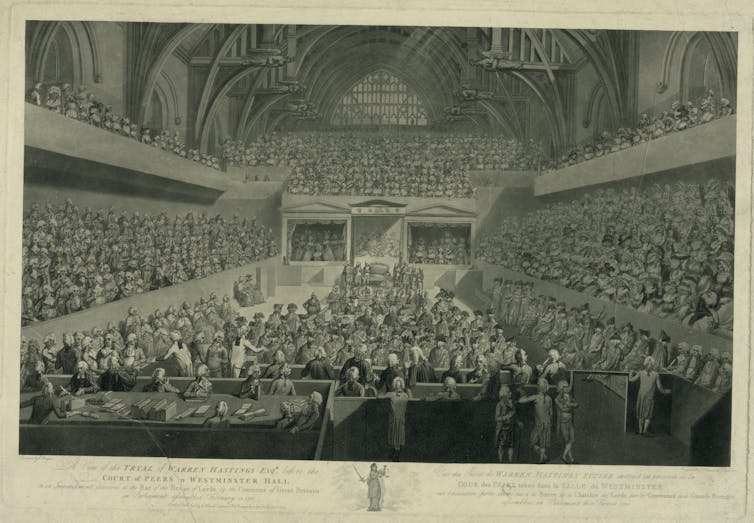
The lower house of Parliament, the House of Commons, impeached Warren Hastings, who had retired as governor-general of British India and was back in England, for corruption and mismanagement. That action provides a direct answer to one current legal question: The charges were based on what Hastings had done in India, making clear that a former official could be impeached and tried, even though he was no longer in office.
Future U.S. president John Adams, who was in London at the time, predicted in a letter to fellow founder John Jay that although Hastings deserved to be convicted, the proceedings would likely end with his acquittal. Nevertheless, Adams and Jay were among those who supported the new U.S. Constitution, whose drafters in 1787 included impeachment, even though that method of accountability was close to disappearing from Britain.
The trial of Hastings, in Parliament’s upper house, the House of Lords, didn’t actually begin until 1788, and took seven years to conclude. The prosecution included Edmund Burke, one of the most gifted orators of the age. Eventually, though, the House of Lords proved Adams right, acquitting Hastings in 1795.
This stunning loss could have been the death knell for impeachment in Great Britain, but Hastings was not the last British political figure to be impeached. That dubious honor goes to Henry Dundas, Lord Melville, Scottish first lord of the admiralty, who was charged in 1806 with misappropriating public money. Dundas was widely assumed to be guilty, but, as with Hastings, the House of Lords voted to acquit.
These examples showed that impeachment, even when the accused government official had done the things that he was accused of doing, was a blunt, cumbersome weapon. With both Hastings and Dundas, the House of Commons was willing to act, but the House of Lords – which was (and is) not an elected body and therefore less responsive to popular opinion – refused to go along. As a tool for checking the actions of ministers and other political appointees, impeachment no longer worked, and it fell out of use.
The decline of impeachment in Britain coincided with the rise of another, more effective process by which high officials there could be held accountable.
British prime ministers answer to Parliament, doing so literally during the now-weekly question time in the House of Commons. Leaders who for whatever reason lose the support of a simple majority in the lower house, including through a vote of no confidence, can be forced to resign. The last time a British prime minister lost a vote of no confidence was in 1979, when the minority Labour government of James Callaghan was defeated.
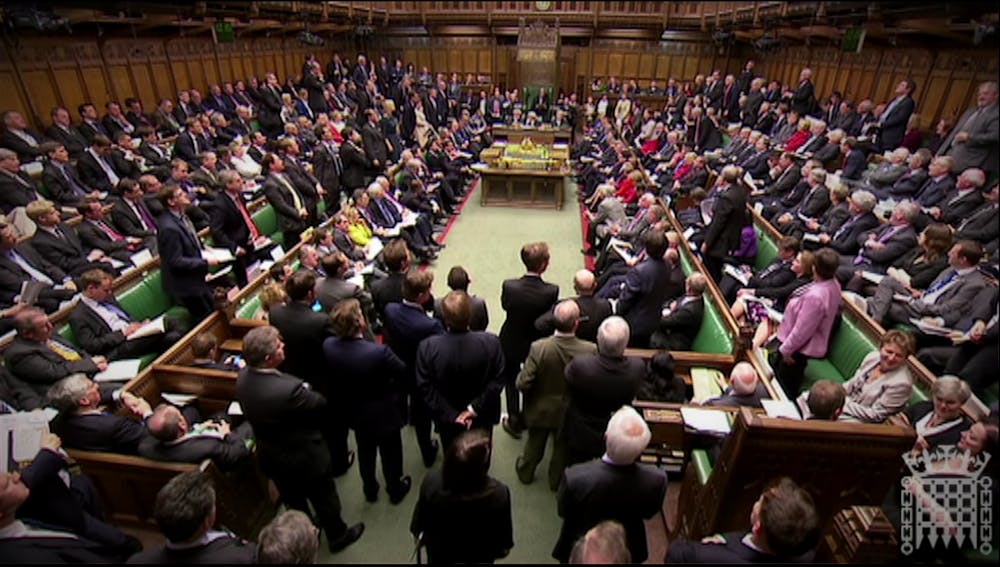
If a prime minister receives a vote of no confidence, there is an alternative to resignation: call an election for a new Parliament, which is what Callaghan did, and let the people decide whether the current government gets to stay or has to go. If the prime minister’s party loses, he or she is generally out, and the leader of the party with the new majority takes over. In 1979, the defeat of Callaghan and the Labour Party paved the way for the Conservative government of Margaret Thatcher, Britain’s first female prime minister.
This provides an immediate course of action for those who oppose a British government for any reason, including allegations of official wrongdoing, and delivers a rapid decision.
[Like what you’ve read? Want more? Sign up for The Conversation’s daily newsletter.]
In the United States, by contrast, a president can be accused of corruption or even sedition but face no real consequences, so long as one more than a third of the Senate declines to convict.
Now that Trump has been acquitted, then the Constitution’s bulwark against presidential malfeasance could become yet another mechanism of minority government.
If impeachment is rendered useless in the U.S., as it was in Britain two centuries ago, the Constitution does offer another remedy: Section 3 of the 14th Amendment.
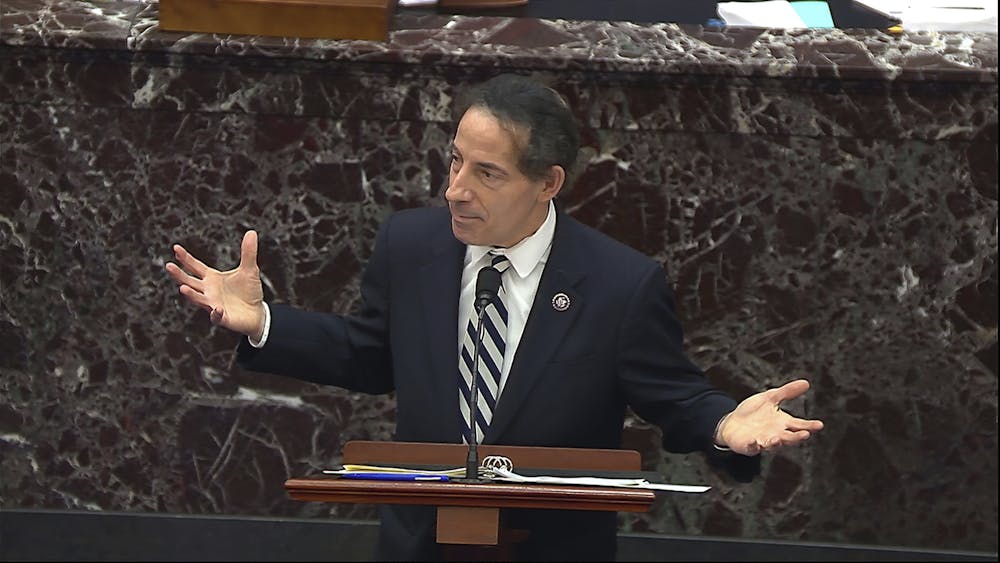
Originally intended to prevent former Confederates from returning to power after the Civil War, Section 3 bars people who have “engaged in insurrection or rebellion” against the U.S. from serving in state or federal governments, including in Congress or as president or vice president.
The language in the amendment could justify barring Trump from future office – and the resolution to do so may require only a majority vote in both houses of Congress, though enforcement would likely also need a ruling from a judge.
Eliga Gould, Professor of History, University of New Hampshire
This article is republished from The Conversation under a Creative Commons license. Read the original article.
================================================================
Alecto, Megaera, and Tisiphone, I don’t think it requires a whole lot of logic, or imagination, to see that instituting the option of a vote of no confidence (or the equivalent) would not work well here. I think the most obvious reason is that, in those nations which use it, there are at least three active political parties, so that it is impossible to govern without forming some kind of coalition with someone. Here, a vote of no confidence would be essentially the same as a recall election. And, if you have ever lived through one of those, you know how dangerous those can be. And particularly with no consistent media delivering facts.
Further, a vote of no confidence, like impeachment, is a political tool. What we need today (and would have benefitted from having for the last four years) is a legal tool. The decision that no sitting president can be prosecuted for crimes is based on one legal opinion almost fifty years old. Some of us thought it wrong at the time. Many thought it wrong during the events of the last four years. Yet it is held as sacrosanct.
I am not a lawyer nor a legislator myself. But might Congress not consider writing and passing a law along the lines that no one in the Federal Government, elected or appointed, can be considered immune from prosecution for any Federal crime, or any State crime committed under that State’s jurisdiction, even while in office? Because that’s what we have needed, and I guarantee we will need it again. (Actually, we need it already. I’m confident Nameless will concur and have a suggestion.)
The Furies and I will be back.
