Meidas Touch – Carol Leonnig on the January 6th Commission: If We Don’t Investigate, “It’s Going to Happen Again”
MSNBC Nicole Wallace on potential Manhattan prosecutions
Now This News – No surprises here.
Thom Hartmann – Crime and the GOP
Now This News – I have a new hero.
Orange Acres Episode 8
Beau – This is only one point which can (and absolutely should) be made about statistics. It’s not as easy to spot as onfusing correlation with causation, but it’s equally important.
Experts in autocracies have pointed out that it is, unfortunately, easy to slip into normalizing the tyrant, hence it is important to hang on to outrage. These incidents which seem to call for the efforts of the Greek Furies (Erinyes) to come and deal with them will, I hope, help with that. As a reminder, though no one really knows how many there were supposed to be, the three names we have are Alecto, Megaera, and Tisiphone. These roughly translate as “unceasing,” “grudging,” and “vengeful destruction.”
As the climate continues to change without regard to stupid humans who continue to do things which will accelerate that change ans, if we don’t stop, ensure out own extenction, those of us who can see what it going on have to be more determined, and smarter, at coming up with ways to stop and, if possible, even reverse the damage already done. As ideas go, this one seems to hold promise.
================================================================
Using captured CO₂ in everyday products could help fight climate change, but will consumers want them?
Consumer decisions could play a critical role in dealing with climate change. A study gauging perceptions was published May 13, 2021. FotographiaBasica via Getty Images
Would you drink carbonated beverages made with carbon dioxide captured from the smokestack of a factory or power plant?
How would you feel if that captured carbon dioxide were in your child’s toys, or in the concrete under your house?
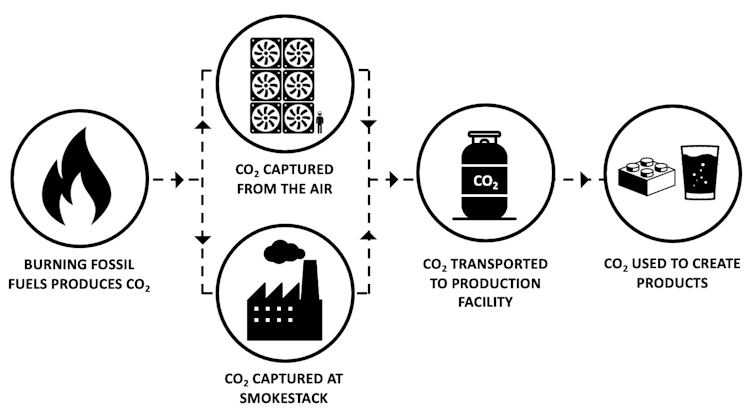
The technology to capture climate-warming carbon dioxide emissions from smokestacks, and even from the air around us, already exists; so too does the technology to use this carbon dioxide to make products like plastics, concrete, carbonated drinks and even fuel for aircraft and automobiles.
That combination – known as carbon capture and utilization – could take up billions of tons of carbon dioxide emissions if the technologies were adopted across a range of sectors worldwide.
That’s why technologies that can reuse carbon dioxide to avoid fossil fuel use – or even better, lock it away in long-lived products like cement – are essential.
The key to carbon capture and utilitization’s potential is that these products have economic value. That value can give companies the incentive to deploy the technology at the global scale necessary to slow climate change.
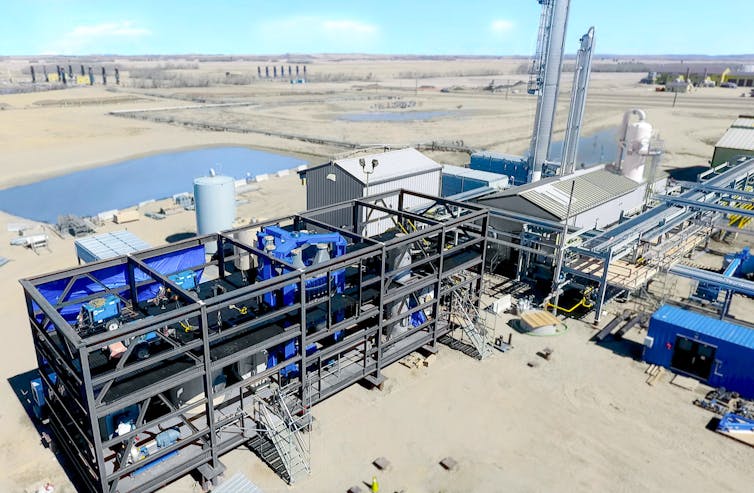
Carbon capture technology is used to stop emissions at the source, particularly in industries like steel and cement production that have high emissions. Svante
Carbon capture technology itself isn’t new. Initially, captured carbon dioxide was used to force oil and gas out of old wells. Once emissions are captured, typically from an industrial smokestack via a complex chemical filter, they can be pumped deep underground and stored in depleted oil reservoirs or porous rock formations. That keeps the carbon dioxide from reaching the atmosphere, where it can contribute to climate change.
How do people feel about carbon dioxide-based products?
For many products made with captured carbon dioxide, success will depend on whether the public accepts them.
Two of us recently conducted one of the first large-scale studies to examine public perception of carbon dioxide-based products in the U.S. to find out. We asked over 2,000 survey participants if they would be willing to consume or use various carbon dioxide-based products, including carbonated beverages, plastic food storage containers, furniture made with foam or plastic, and shatterproof glass.
We found that most people knew little about carbon capture and use. However, 69% were open to the idea after learning how it worked and how it helped reduce the emissions contributing to climate change.
Participants in the survey were shown illustrations explaining carbon dixoide-based products. Lauren Lutzke/University of Southern California
There was one exception when we asked about different types of products people might be willing to use: Fewer people – only 56% – were open to the idea of using captured carbon dioxide in carbonated beverages.
Safety was a concern for many people in the survey. One-third didn’t know if these products might pose a health risk, and others thought they would. It’s important to understand that products made with captured carbon dioxide are subject to the same safety regulations as traditional materials used in food and consumer products. This includes filtering out unwanted pollutants in the flue gas before using the carbon dioxide in carbonated beverages or plastics.
When carbon dioxide is used as a raw material, it becomes chemically stable once it is used to create a product, meaning carbon dixoide used to create plastic will not turn back into a gas on its own.
What people may not realize is that the majority of carbon dioxide currently used nationwide is already a fossil fuel byproduct from the steam-methane reforming process. This carbon dioxide is used widely for purposes that include making dry ice, performing certain medical procedures and carbonating your favorite soda.
Overall, we found that people were open to using these products, and that trend crossed all ages, levels of education and political ideologies.
Carbon capture and use already has bipartisan support in Washington, and the Department of Energy is funding research in carbon management. Bipartisan consumer support could quickly expand its use, creating another way to keep carbon emissions out of the air.
Recently, Unilever and partners piloted replacing fossil-based ethanol with carbon dioxide-based ethanol for manufacturing laundry detergent, significantly reducing the associated ethanol emissions. Both are cost-competitive methods to capture and use carbon dioxide, and they demonstrate why carbon capture and use could be the most market-friendly way to remove carbon dioxide on a large scale.
How innovators can improve public perception
Some emerging technologies could help address the perceived risks of ingesting carbon captured from industrial emissions.
The most important steps may be educating the public about the process and the value of carbon dioxide-based products. Companies can alleviate concerns by being open about how they use carbon dioxide, why their products are safe and the benefits they hold for the climate.
================================================================ Alecto, Megaera, and Tisiphone, frankly, capturing CO₂ sounds pretty good to me, and I particularly like the ability to actually make it useful in things like multiple-use plastics. I love glass, but I’m such a klutz that most of the time I’m afraid to use it (my inner cat likes to knock things off of surfaces whether I want to or not.) Actually, shatter-proof glass sounds good too (but they’ll mostly want that for windshields, and windows onfloors above ground level. I expect.) I wold even be willing to try it in carbonated beverages. But one person does not a market make. We’ll have to see how it works in real life.Anyone know any entrepreneurs who might be interested?
Good Morning! This is the second day of fill-ins this time around. If you missed WWWendy’s post which started the fill-ins, this link should take you right to it (possibky a couple of seconds for it to jump down the page.)
In Lona’s reply to WWWendy’s news yesterday. she suggested opening an updaye page every so that there is aplace for all of us to easily check in case WWWendy has had a chance to post. I did that while he was moving, y’all may remember, and I trust it helped WWWendy – I know it helped us.
I’ll be happy to continue that … unless WWWendy woulf like to be an author and make update posts herelf? Not every day mecessarily, but when there is news? I know TC already taught you how to do that using his credentials, and I could give you your own credentials in a New York minute if you would be willing.
Cartoo –
Blast from a little different ast – “Bohemian Rhapsody” with the Hampton String Quartet
Glenn Kirschner – more on grand juries (I think I can figure out why “23”)
Meidas Touch – One more with Charlie Sykes
The Lincoln Project – mot, IMO, their best
Lawrence and Lawrence on MSNBC
Now This News – another everyday hero.
Rob Rogers work in progress
Yes, I know it’s a commercial. Humor me to the end,
Beau – “Let’s talk about ex-cons, self-doubt, and organizing….” is actually for one (anonymous) person – so powerfully that I needed a hanky … and I think it has stuff anyone can learn from
The first two ids are from two weeks ago ane one week ago respectively – I skipped the second (an msy also have skipped the first), but since they are part of a series, I thought I’d better play catchup.
“Not Being At Home”
Episode 1