Yesterday was fairly quiet. I organized my morning meds for the next two weeks (which I should have done Saturday … but that’s why I keep an extra) and I’ll organize the evening meds today (which I should have done Saturday, but that’s why I keep two extras.)
Crooks and Liars – Biden White House Won’t Assert Executive Privilege To Help Donald Trump
Quote – This was the greatest threat to our democracy since the Civil War and we need answers. Let’s see where this goes….with the subpoenas flying fast, I suspect we will get our answers about Executive Privilege pretty quickly, especially when they start wanting to talk to Donald Trump and his kids directly. Click through for what details exist. IANAL, but those who are point out that (a) he can claim executive privilege regarding what happened during his administration, and (b) though he can claim it, it is not automatic, as some things are not subject to it, and that is not his decision to make.
AP News – In redistricting, big say for big cities in DC power balance
Quote – Robust growth in the liberal strongholds of New York and metropolitan Chicago are poised to give Democrats an edge as their political maps are redrawn to adjust for changes in population over the past decade. While both New York and Illinois are losing congressional seats, their urban booms mean the newly drawn districts are likely to favor Democrats, adding to the party’s national total and making up for probable losses elsewhere. Click through for more information. I certainly hope this analysis is on point. (I have hopes for my state as well, but those are unrelted to this.)
Experts in autocracies have pointed out that it is, unfortunately, easy to slip into normalizing the tyrant, hence it is important to hang on to outrage. These incidents which seem to call for the efforts of the Greek Furies (Erinyes) to come and deal with them will, I hope, help with that. As a reminder, though no one really knows how many there were supposed to be, the three names we have are Alecto, Megaera, and Tisiphone. These roughly translate as “unceasing,” “grudging,” and “vengeful destruction.”
Colleen’s and my fire seasons are ending or over, but Lona’s are just starting. However, this article, being, as it is, about preparation – and that specifically for an aspect of fires that most people, at least here, don’t think about – should be a good one to think about at any season.
================================================================
Firebrands: How to protect your home from wildfires’ windblown flaming debris
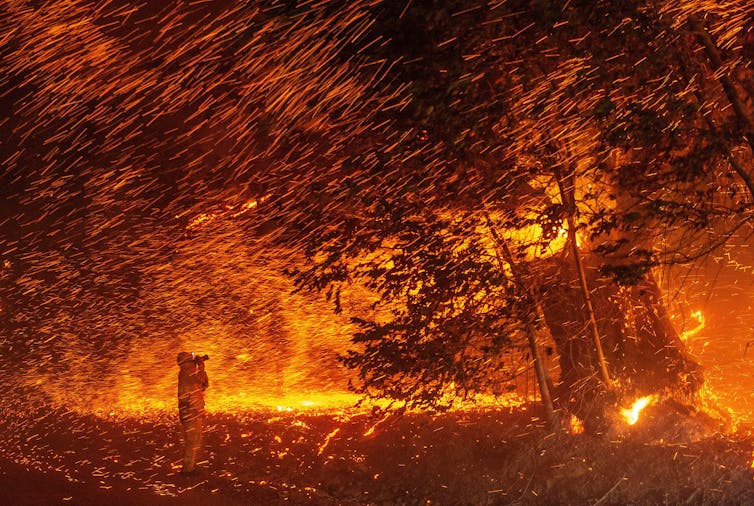
As firefighters tried to protect homes near Lake Tahoe from one of California’s largest fires on record, they battled, windblown embers that kept sparking new small fires, some well away from the fire line.
Those embers, also known as firebrands, were a powerful and dangerous reminder that protecting homes is about more than avoiding a wall of flames.
Firebrands are pieces of flaming material that break off from burning vegetation or structures and are transported through the air. They particularly become a problem when heat and drought dry out grasses and trees and the wind picks up. Homes and other structures are at higher risk when they have dry fuel, such as leaves, needles or wood chips, on the structure or nearby.
That risk, and how it can easily be overlooked, crystallized for me in September 2020 when my parents were put on notice to prepare to evacuate as a fire neared their home in Oregon. I have studied wildfires for years, particularly how they spread through firebrands. Yet this threat made it real.
What protecting a home looks like
I was not concerned about a wall of flames reaching my parents’ home – they had a lush and green yard that was unlikely to ignite. Instead, what concerned me was whether my parents were prepared for ignition by firebrands.
Firebrands can travel over a mile by the wind and can be a major cause of spreading fires. In the Tahoe region, for example, firefighters couldn’t just focus on the main fire line in summer 2021 – they also had to patrol for spot fires.
At my parents’ home and several of their neighbors’, I used a leaf blower to clear potential ignition sources. I removed dried leaves in gutters and needles in valleys of roofs, and watered the dry mulch near houses.
I asked myself, if a lighted match or matches were dropped at a location, could they start a fire? If so, the potential fuel needed to be removed. In every home that I visited, I found locations where firebrands could potentially ignite flammable materials, despite the homeowners’ best preparations.
What surprised me at the time was how little time people applied to preparing for firebrands, despite going to great lengths to protect their homes by watering the grounds. What I realized was that my parents and their neighbors, like many of us, envisioned protecting homes as stopping a wall of flames from reaching their homes. They did not appreciate that in some cases the greater threat could blow in by the wind.
Three steps to firebrand-started fires
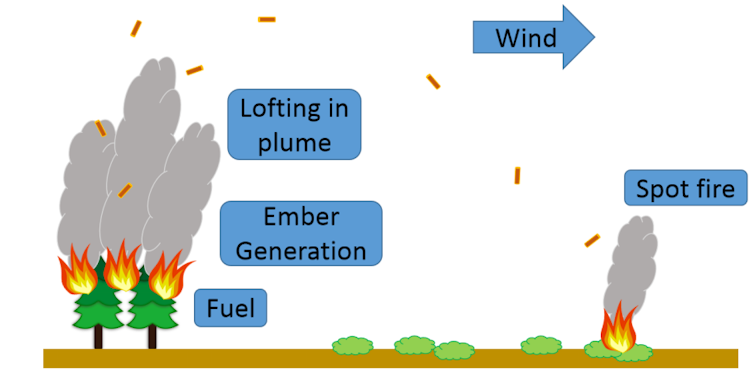
Fire scientists talk about spot fires as occurring in three steps: how firebrands are generated, how they are carried by the wind and how they land and ignite fuel. Fire scientists, including those from my research group, are actively studying each of these steps to be able to better predict and ultimately reduce the risks to communities from firebrands.
Firebrands are generated from burning vegetation orstructures. Sizes of the firebrands can vary, but can be as small as several millimeters square.
Firebrands can come from burning pieces of bark, branches, cones or needles if the source is wildfires. For urban fires, firebrands can come from roofing, siding, particle boards or other flammable materials.
Over the past two decades, efforts studying generation of firebrands have often focused on quantifying the number of firebrands that land at particular locations as trees or other vegetation burns. More recently, researchers are working to estimate the total number of firebrands that are released when objects burn.
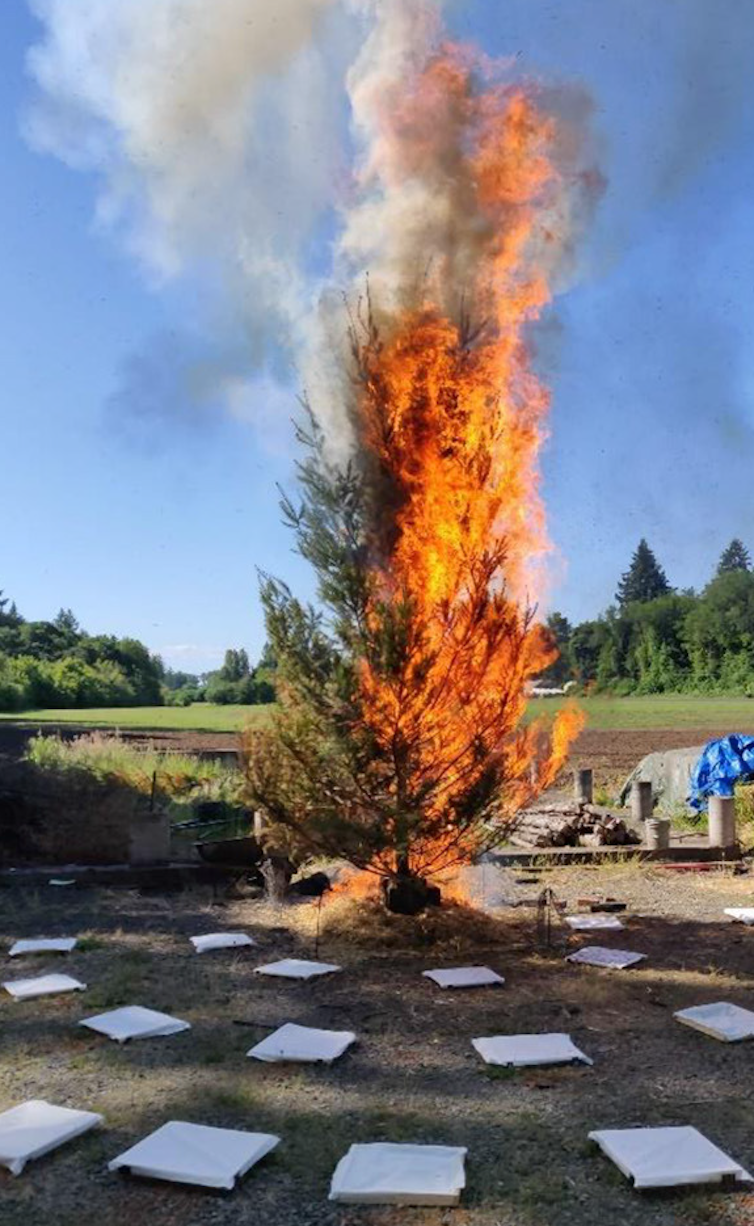
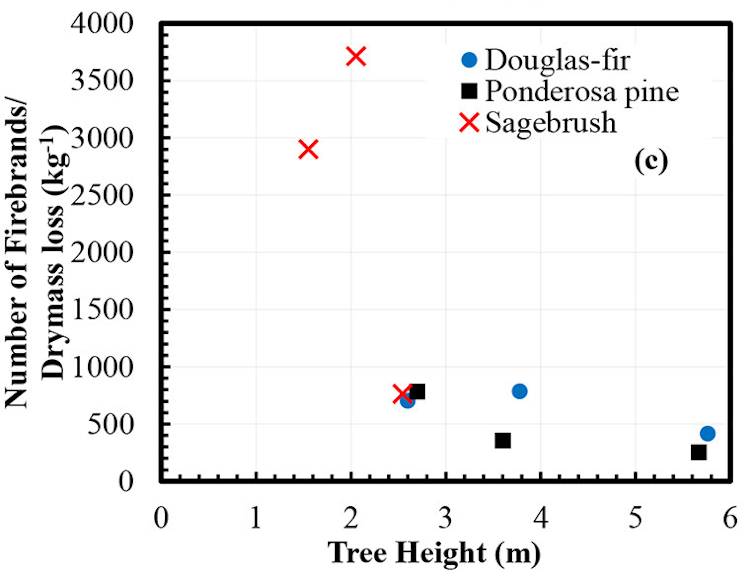
To estimate how many firebrands a fire generates, we set fire-resistant fabric squares around burning trees and shrubs, such as Douglas fir and sagebrush, and collected the firebrands that landed. By determining the total number of firebrands per unit of mass of the tree or shrub that burns, we can incorporate data into computer models to estimate the total number of firebrands released in a fire and where they spread. Ultimately, we hope thesemodels can be used to better understand risks associated with wild or urban fires.
Many research efforts have focused on developing models that capture the physics of how firebrands are transported or where firebrands are most likely to land. The nature of the burning of firebrands as they are being transported is an important factor. Firebrands can be flaming or smoldering. Both can cause new fires.
The third step is ignition of fuels – like fencing, mulch and needles – after firebrands land. Researchers are investigatingthe heating potential or temperature of firebrands. Understanding this information is critical for implementing building codes and standards and best practices to better protect homes. We’re also working to better understand which characteristics of the fuelsdetermine whether they ignite.
In experiments, burning sagebrush sent off significantly more firebrands per kilometer of mass than Douglas fir and ponderosa pine trees. Adusumilli, Chaplen and Blunck, 2021, CC BY
How can homeowners reduce the risk?
So what can homeowners do to protect themselves from the risk of spot fires?
First, start with shifting your mindset about preparation to not if, but when a fire will occur nearby. I will admit that, as a homeowner who lives near a forest, I allow pine needles and leaves to accumulate on my roof. I make the excuse that I will have time to prepare in an actual fire. Yet, as I consider preparing for “when a fire” will be near me, rather than “if,” I feel more of a sense of urgency and responsibility.
Second, people in fire-prone areas need to educate themselves about potential ignition sources. Note that locations that are fire-prone are expanding. My parents’ home hadn’t been threatened by fires in the 30 years they had lived there – until 2020. One resource when figuring out how to audit a home’s risk is the National Fire Protection Association.
Certainly, at a minimum people to need to remove flammable material from on or near homes. In addition, they should consider ignition sources from structures such as decks and ensure that firebrands cannot be pulled into homes through ventilation ducts or other methods. Putting screens on windows and over ventilation ducts, using 1/8-inch holes, can be a simple, low-cost and highly effective way to stop firebrands from entering a house.
Third, consistently act to monitor and eliminate ignition sources, such as needles or leaves, that can gradually accumulate with time. Often it takes little effort to remove the debris, but it requires constant monitoring and prioritizing removal.
[Over 100,000 readers rely on The Conversation’s newsletter to understand the world.Sign up today.]
Certainly taking steps to educate, audit and then remove ignition sources from firebrands will not stop all fires from spreading to homes. But these steps will save many homes and help to reduce the risk to fire responders and communities.
================================================================
AMT, this discussion is not so much aimed at firies as it is at those they protect – but that is a huge help. Anyone in any helping profession knows that half the battle is getting the client at least out of the way – and cooperating is even better. I’d say this is one to pass on to anyone in a fire-prone area, and to save – not exactly until fire season – but unti enough before it starts to begins setting up precautions.
Incidentally – if you always thought od a “firebrand as a person, yeah – this is where that metaphor comes from. “Loose cannon” is similar.
Yesterday, the opera was Pelleas et Melisande by Debussy. The libretto is symbolists, so Debussy was a good choice to complse it. I decided to make one last stab for this year at a cotton knitting project, and started on it. I may end up postponing finishing it until next year, but I hope I can finish the fron panel at least, which is based on the idea of a “Log Cabin” quilt block. The back, collar, cuffs, and hem are plain.
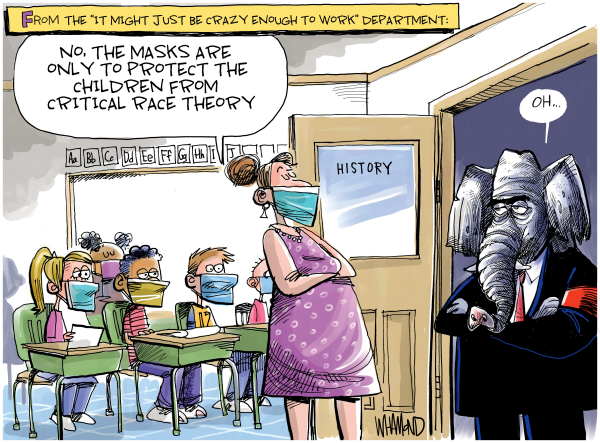
Cartoon –
Short Takes –
The Hill – Executive privilege fight poses hurdles for Trump
Quote – “For example a former president’s privilege claim is deemed much stronger if the current president supports it,” she added. “We’ve never been in a situation where there was a prior claim that was not supported by the incumbent, because presidents, when it comes to their turn to be the former president, they want to be able to do that same thing.” Click through. To be pellucidly clear, he can claim executive privilege for any douments prio to noon on Jan. 20 But it isn’t a matter of claim and have. Some things are not subject to executive privilege. Like crimes. Someone other than he must look at the documents and determine whether they are subject to executive privilege or not (and most, if not all, won’t be.) And, of course, for anything after noon January 20, executive privilege cannot even be claimed. And President Biden has publicly stated he will not claim or support executive privilege for Trump**. Snicker.
Reuters – Germans vote in close election to decide Merkel successor
Quote – After a domestic-focused election campaign, Berlin’s allies in Europe and beyond may have to wait for months before they can see whether the new German government is ready to engage on foreign issues to the extent they would like. The splintered political landscape means a three-way coalition is likely. Final opinion polls gave the Social Democrats a narrow lead, but the conservatives have reduced the gap in recent days and many voters were still undecided. Click through for details. We knew she was retiring – and now it’s here. She helped us survive Trump** as much as anyone outside could. I wish her the best in her retirement, as well as a worthy successor.
https://apnews.com/article/joe-biden-india-mumbai-narendra-modi-da976c8f8aa7ca02c2193b56c3408a08 AP News – Mystery solved: Biden gets proof of family ties to India
Quote – “And although we never admitted it … I’ve found out that there was a Capt. George Biden who was a captain in the East India Tea Company in India,” Biden said. He appeared to be referring to the British East India Company, a commercial power for centuries that controlled trade in colonized India and parts of southeast Asia. Biden, who frequently talks of his Irish ancestry, quipped that the British connection was “hard for an Irishman to admit.” Biden, who has told versions of the anecdote to Indian audiences before, said Capt. Biden “apparently stayed and married an Indian woman” but he’d never been able to nail down further details. Click through for story (though not complete genealogy.) Nikke Haley and Bobby Jindal, eat your hearts out.
Yesterday was another day with the portable heater on. I guess that’s the new normal, so I’ll have to find something else to talk about. Hopefully something less whiney.
Cartoon –
Short Takes –
The Hill – CDC panel authorizes COVID-19 vaccine boosters for high-risk people, those over 65
Quote – The CDC Advisory Committee on Immunization Practices (ACIP) voted 15-0 to recommend a booster dose for Americans age 65 and older and people in long term care facilities. ACIP also fully recommended giving a single booster dose to people between the ages of 50 and 64 with certain high-risk conditions, by a vote of 13-2. The panel did not define what the qualifying underlying conditions are, but the CDC is expected to make that determination. Click through – but some questions are not even being addressed. For instance, if your initial course was Moderna, should you be getting a Pfizer booster? Also, How long should you wait? An article in The Atlantic included a wide range of estimate – just about in the middle was eight months from the first shot. For me, that’s next year. But for those of you who got the first jab in February, that’s coming right up. I’d like to hear something official.
Mother Jones – Inside the Private Facebook Groups Where Anti-Vaxxers Plot to Get Religious Exemptions
Quote – Medical exemptions can be hard to come by—they require a documented diagnosis of one of the very few conditions that prevents someone from getting vaccinated. Religious exemptions are easier: They rarely require proof that an employee belongs to an organized religious group that opposes vaccines. (Few faiths do.) Rather, the onus of explaining the religious beliefs is left to the individual—and the employer must then decide whether the belief they describe is sincere, explained Poonam Lakhani, an employment attorney with the Prinz Law Firm in Chicago. “That’s a really difficult line for the employer to walk.” Click through for story. If they would mask up (with N95 or stronger) and take dailt rapid CoViD tests (which are actually more uncomfortable than the vaccine), or else stay in quarantine, they could go unvaccinted for all I care. But they won’t. Free-dumb.
Washington National Cathedral – Reimagining the Confederate Windows
Quote – Washington National Cathedral today announced that it will replace its former stained-glass windows featuring Confederate iconography, removed in 2017, with racial-justice themed windows created by world-renowned artist Kerry James Marshall, described by The New Yorker as “a virtuoso of landscape, portraiture, still-life, history painting, and other genres of the Western canon.” The Cathedral’s commission represents Marshall’s first time working with stained-glass as a medium, and the windows are expected to be his first permanent public exhibition anywhere in the country. Click through for more. I googled his work and I think his style is a natural for stained glass. It appears to be based more on shape than on line. There has also been a poem commissioned for this project.
Yesterday, it was (IMO) cold again. I turned on my portable heater. Eventually it warmed up some. If the forecast holds, it’ll be perfect for my drive on October 1, but the forecasts haven’t been holding that long as a rule. I can only hope.
Cartoon –
Short Takes –
HuffPost – The Senate May Actually Produce A Bipartisan Violence Against Women Act Bill
Quote – Senate and White House aides involved in months of negotiations on a VAWA reauthorization bill tell HuffPost that despite the relative silence on the subject, they’re feeling optimistic about unveiling bipartisan legislation ― and soon. “We are encouraged by the progress in the Senate and are looking forward to a bipartisan bill being introduced this fall,” said a White House official familiar with talks on a VAWA bill. Click through for the story. I’m not holding my breath, but I am somewhat hopeful.
The Hill – Debt ceiling fight pits corporate America against Republicans
Quote – The debt ceiling battle on Capitol Hill is pitting corporate America against congressional Republicans in a test for business groups that have historically aligned with GOP lawmakers on economic issues. Senate Republican leaders are digging in on their opposition to raising or suspending the debt limit, prompting sharp warnings from lobbying groups that represent some of the biggest U.S. corporations. Click through for details. Republicans may kowtow to bug business … but apparently there’s not one in a hundred who actualy understands how business works. But I guess that shouldn’t be surprising.
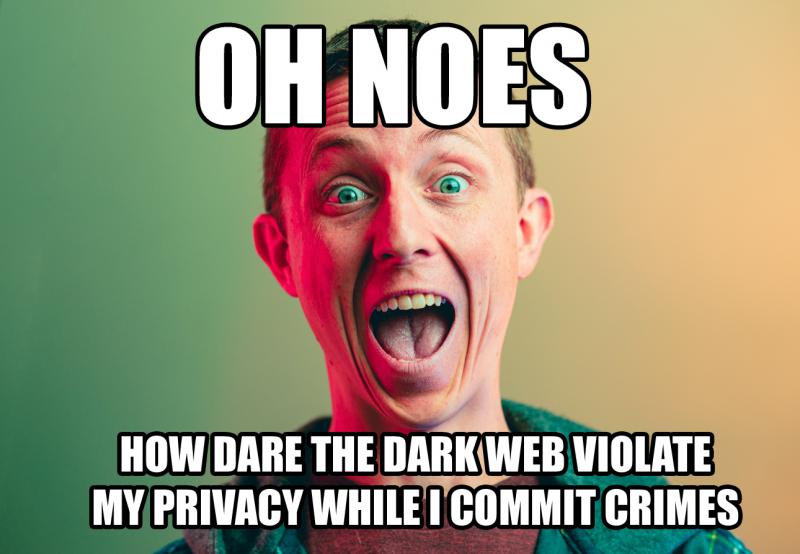
Crooks and Liars – ‘Epik Hack’ Is Right Wing’s Worst Nightmare
Quote – “It’s massive. It may be the biggest domain-style leak I’ve seen and, as an extremism researcher, it’s certainly the most interesting,” said Megan Squire, a computer science professor at Elon University who studies right-wing extremism. “It’s an embarrassment of riches — stress on the embarrassment.” Click through for the story to this point. I assume no one here wants (I certainly don’t) to track any of this down personally and get any of these sites into their browser history, but if you do, Twitter is the place to start looking.