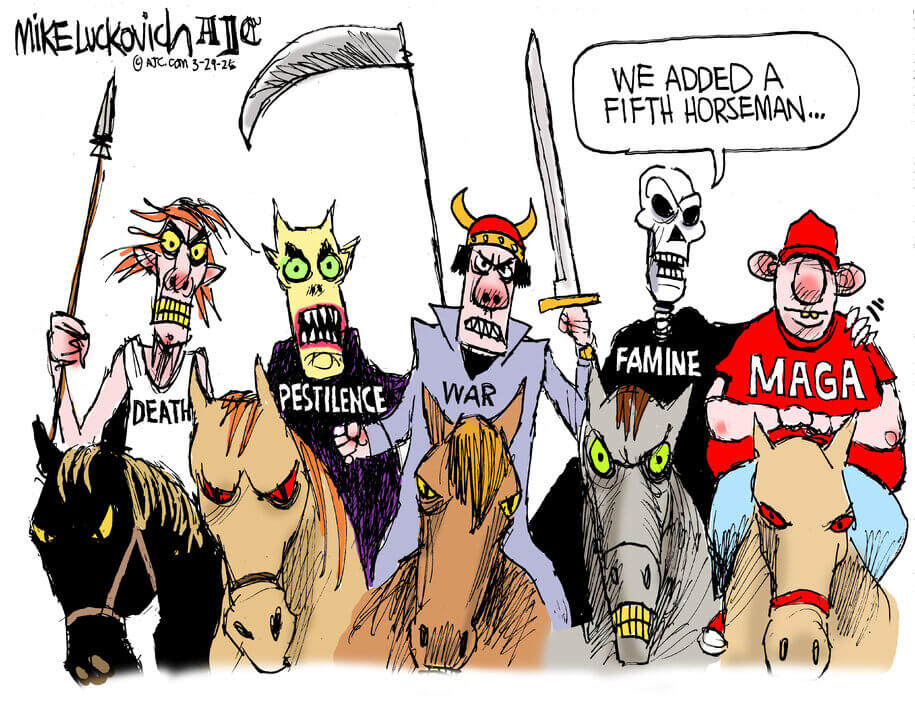
lYesterday, Public Citizen revisited a lawsuit they already won to ask SCOTUS to enforce the settlement, “which, again, the USPS agreed to and which requires it to prioritize the timely delivery of election mail to all voters without exception.” This of course was a reaponse to the Apricot Antichrist’s attempt to weaponize USPS by turning it into voter police. It could get interesting.Also, Malcolm quoted Pete Hegseth as saying “We’re negotiating with bombs. That’s what we do.” (As a veteran, this just makes my stomach churn.)
Archived from Huff Post, not because of a paywall, but because their cookie policy is so convoluted – and time consuming to navigate, and confusing – that I had no idea what I’d be getting you into with the original link. I strongly suspect that the person who has the very worst case of TDS in the world is Trump**(*) – although there are cases to be made for Marco Rubio, Todd Blanche, Pete Hegseth, and others.
I am guessing (and that’s all it is – a guess) that reasers here either do not trade stocks – or, if they do, do so through a trusted financial advisor and may not pay much attention to individual stocks [that would be me – with only a small 401(k) which I mostly only look at when it’s MRD time, though I have been following it periodically thtough the war, and it’s been very stable.) But this is an IPO which even I can see is different – though I could not even come close to explaining it as Robert Reich can. If you do trade, whether first hand or seconf hand, caveat emptor.
This is the Part 2 I promised – but unfortunately it’s for paid subscribers only, and archiving won’t get around that with Substack (I tried.) So we only get the summary of Part 1.
I want to address the International Criminal Court at the Hague (not to be confused with the International Court of Justice – also at The Hague, which is more like a civil court to settle disputes between nations. An international criminal court was proposed as early as 1919, but it took until 2000 for a treaty establishing it to be finalized and signed. We, the United States, signed it in 2000, but never ratified it, and in 2002, when the Rome Statute was passed and submitted for ratification (which 125 nations have done, then or since), this is what the United States said:
“This is to inform you, in connection with the Rome Statute of the International Criminal Court adopted on July 17, 1998, that the United States does not intend to become a party to the treaty. Accordingly, the United States has no legal obligations arising from its signature on December 31, 2000. The United States requests that its intention not to become a party, as expressed in this letter, be reflected in the depositary’s status lists relating to this treaty.”
Sounds like Dick Cheney wrote it, doesn’t it. So we are not a member state. I didn’t have time to verify this, but I think a US citizen can be tried in the court, but cannot be arrested on US soil – or the soil of any other non-member state. I also did not have time to look up all the member states, though I did notice that the UK is (and thought of a golf course in Scotland.) We are still a member of the UN and therefore subject to the Mandela Rules, which lay out rules for treating prisoners, which among other provisions specify that, when outside the prison, fot instance, while in court, prisoner be allowed to wear their own clothes. We don’t always require that, but I expect the ICC does,.
Experts in autocracies have pointed out that it is, unfortunately, easy to slip into normalizing the tyrant, hence it is important to hang on to outrage. These incidents which seem to call for the efforts of the Greek Furies (Erinyes) to come and deal with them will, I hope, help with that. As a reminder, though no one really knows how many there were supposed to be, the three names we have are Alecto, Megaera, and Tisiphone. These roughly translate as “unceasing,” “grudging,” and “vengeful destruction.”
Today’s article is a bit old also, but in a week when The Conversation is featuring, among others, an article on why there are many other math constants which deserve their own day because why should pi have all the recognition, I believe this is a bit more important. Back in the day, before Democrats owned civil rights, there were more than a few Democrats who were not unwilling to weaponize government, and I don’t doubt some can be found today, because no one is perfect, and that goes exponentially for groups. But it is Republicans, who have invented a Subcommittee in the House on the “Weaponzation of Government,” who are the current masters of it – and have been for some time.
==============================================================
The weaponization of the federal government has a long history
This story is a forgotten sequel to the Watergate break-in. No one has ever proved that President Nixon ordered burglars to photograph documents and plant listening devices at the headquarters of the Democratic National Committee, known as the DNC.
But Nixon himself created proof that he abused his presidential authority to go after the DNC with the investigative powers of the Internal Revenue Service. He captured this high crime on tape less than two months after the Watergate burglars’ arrests.
‘Can’t we investigate people?’
“Are we looking over the financial contributors of the Democratic National Committee?” Nixon asked his chief of staff on Aug. 3, 1972. “Are we running their income tax returns? Or is the Justice Department checking to see whether or not there’s any antitrust suits? Do we have anything going on any of these things?”
“Not as far as I know,” said H.R. “Bob” Haldeman.
“We have all this power and we aren’t using it. Now, what the Christ is the matter?” Nixon asked.
President Richard Nixon walks with his assistant H.R. Haldeman from the Executive Office Building to the White House for a Cabinet meeting in December 1969. AP photo/file
“We’ve got a guy who’s a pluperfect bastard. He’s a loyalist – he’s a fanatic loyalist – in the IRS,” said John D. Ehrlichman, whose title was assistant to the president for domestic affairs and whose job was henchman.
“He’s with us, you mean?” Nixon asked.
“He’s our guy,” Ehrlichman said. “One Treasury secretary after another, starting with [David M.] Kennedy, [John B.] Connally, now [George P.] Shultz, has said, ‘Oh, Jesus, can’t you get this guy out of there? Can’t you just take him out? He’s making all kinds of trouble for us. He’s too partisan.’”
The president’s mood darkened. “Shultz is not long for this life, in my opinion, because he’s not being political enough,” Nixon said. “I don’t care how nice a guy is. I don’t care how good an economist he is. We can’t have this bullshit.” His frustration was growing. “Can’t we investigate people?” Nixon asked. “Is there anything we can do?”
“Yes,” Ehrlichman said.
“I would think that we could get some people with some guts in the second term, when we don’t care about repercussions,” Haldeman said.
Nixon wanted to do something immediately about the chairman of the Democratic National Committee, Larry O’Brien. O’Brien directed John F. Kennedy’s victorious presidential campaign in 1960 and Lyndon B. Johnson’s in 1964. “If you could dirty up O’Brien now, I think it might be a lot better than to wait until later,” Nixon said.
President Nixon, right, at a meeting with aide John D. Ehrlichman in 1972. AP photo
Abuse of power
Under pressure from the White House, the IRS subjected O’Brien to an audit during the 1972 presidential campaign. The audit found a “relatively small deficiency,” which O’Brien promptly paid. Treasury Secretary Shultz and IRS Commissioner Johnnie Walters told Ehrlichman there was nothing more they could do.
“I wanted them to turn up something and send him to jail before the election,” Ehrlichman later said. There are few purer expressions of authoritarianism than an attempt to jail the titular head of the opposition party during a campaign.
Shortly before Nixon resigned in 1974, the House Judiciary Committee cited his abuse of his power over the IRS in an article of impeachment.
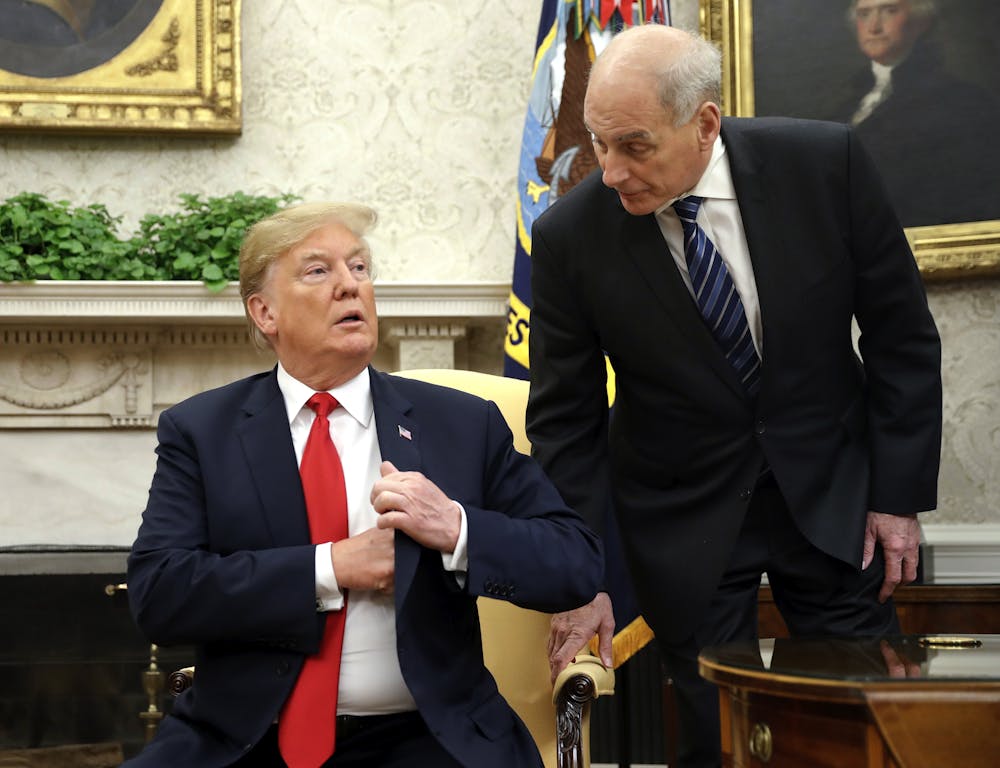
None of that stopped President Donald Trump from requesting IRS audits, according to his own former White House chief of staff, John Kelly.
“I would say, ‘It’s inappropriate, it’s illegal, it’s against their integrity, and the IRS knows what it’s doing, and it’s not a good idea,’” Kelly told The New York Times in November 2022.
White House Chief of Staff John Kelly, right, says that President Donald Trump wanted the IRS to conduct audits on people Trump had publicly attacked. AP Photo/Pablo Martinez Monsivais
Trump said the IRS should investigate two former FBI officials, Director James Comey and Deputy Director Andrew McCabe, Kelly said. Trump has publicly, and baselessly, accused Comey and McCabe of treason, a capital crime.
After Kelly left the White House, both Comey and McCabe were subjected to unusually intense IRS audits, the kind tax lawyers refer to as “an autopsy without the benefit of death,” New York Times reporter Michael S. Schmidt wrote. Through a spokeswoman, Trump denied any knowledge of the audits. A Trump spokeswoman also denied Kelly’s account.
If Kelly told the truth, then Donald Trump managed to weaponize the IRS more effectively than Richard Nixon. That’s a sentence that I, as the author of twobooks on Nixon’s worst abuses of power, found difficult to type.
Kelly has made exactly the kind of credible allegation that a “Select Subcommittee on Weaponization of the Federal Government” worthy of the name would investigate. Yet none of the Republicans who spoke before their party-line vote to establish the subcommittee expressed any interest in investigating government weaponization by politicians of their own party.
Congress has the power, even the obligation, to unearth and eliminate government weaponization. But if the subcommittee abuses its power for partisan ends, it will merely be an example of the problem it’s supposed to solve.
============================================================== Alecto, Megaera, and Tisiphone, while Nixon was pretty blatant about his desire and actions to weaponize the Federal Government, he also did not act alone. And he was clever – or whatever that was – enough to keep his involvelent mostly out of the public eye. Today’s Republicans are more obvious, and are enabled to be so by the brainwashing propaganda they are aware that their voters are being stuffed with – and sometimes are the creators of that propaganda. Most of us could probably cite many of the steps by which we got here – but the question is how do we get away from here? (And Echo answers, “How?”)