Yesterday, finallyLiam and Dad are home. I have my exterminator coming tomorrow, and next Tuesday I have lab work scheduled. Both are late enough in the day that I should not be late for either.
Sometimes we need a little history – sometimes for cautionary reasons, and sometimes for hope. This one, from Steve Schmidt, is a little bit of both.
I seriously doubt that anyone here even considered seeing this movie for a millisecond, but in case you know anyone who is thinking about it, here’s the antidote from Robert Reich. (I would note that the “deadpan face” to which one reviewer refers is probably deliberate in order to prevent or at least delay facial wrinkles.)
Heaven knows there are issues with inconsistency among the states when it comes to federal elections. But “nationalizing” now would lock all the crap ln and sll the fairness and freedom out. No. Just No (well, maybe Hell, No.)
Yesterday, Pro Publica published the names of the two agents who shot and killed Alex Pretti. And, Trinette was by, taking out my trash and recyclables, and to chat and make my day.
Chris Bowers makes a strong case here. I hope he is right. Maybe I should phrase that “I hope there are enough people in this regime with enough brains to figure this out, because the Apricot Antichrist is definitely not one.”
For a partial post (paid subscribers get the full one), this is extremely informative. It’s clear why lawyers line up to work with Adam, who is not a lawyer, but a journalist.
This is a wrap-up, but it contains things I missed (which shouldn’t surprise me – I’m just one person, after all), such as a reference to the list of judicial orders defied by DHS (96 just in January).
Yesterday was Holocaust Remembrance Day, which I missed putting up a visual for. I tried to feel bad about missing it, but the truth is, that under our current regime, to me every day is Holocaust Remembrance Day. Also, several emails informed me that Alexander Vindman is running for a Senate seat in Florida. (His twin Eugene represents Virginia’s 7th District already). This may not be the suicide mission it looks like at first glance, but it’s not a walk in the park either. I may have to sign up as a monthly donor.
This may be the sickest thing I’ve heard about from this regime which didn’t involve direct physical violence – yet. Eagle County is not as close to me as it looks on this map, since it is up in the mountains of which I am on the eastern edge, and while there are roads up there, there are no direct routes to just about anything. But it still feels too close.
From Common Dreams – When the Saffron Sauron started bombing fishing boats in the Caribbean, claiming that they were Venezuelan drug mules, I would have bet good money that at least some of them were not even Venezuelan, let alone drug mules. And I would have won. Two families in Trinidad are now suing us for wrongful death of their relatives in one of those bombings. And hoo boy, do they ever have lawyers. Human lives may be no more important that insects to this regime, but these insects had families which will sting him. I just wish the money that will change hands would come from MAGA billionaires and not from us taxpayers.
From Axios, this is an article about an essay written by an AI CEO who seems almost as worried as I am about the potential for misuse, whether due to human naivete or human corruption. The article links to the full essay, but I felt both needed to be archived for readability.
Yesterday, the first thing I did was check to see whether my Social Security had arrived. It had. So it’s replacement computer time. I’m still working on getting everything I will need either onto a portable hard drive or changed on the Net, Bu I can slow down a little. Incidentally, if you have ever wanted to say SOB (in full) in a different language, I have a few for you:
German Hündinsohn
French Fils de chienne
Italian Cagnafiglio
Greek skýla gios
Ukrainian сучий син (transliterated suchyy syn)
I know enough French, German, and Italian to be pretty sure those work. But my Greek is classical. That’s a transliteration. And my Ukrainian is non-existent, so that’s pure Google Translate. But I thought it would be really handy. (BTW in Italian “gn” and “gl” are pronounced “ny” and “ly” respectively. So, “canyafeelyio.”)
PolitiZoom‘s article speaks for itself. My personal feeling is that anyone who has a personal relationship with the Clementine Caligula should be barred from having any weapons of any kind for life. But that’s probably just me.
Yes, I know Ash Wednesday was yesterday. But I am very proud of my co-religionists for coming up with this, and it’s not too late. It’s never too late to do the right thing.
Several sources of mine have referred to this article from the Atlantic (which I just got around to) in regard to Elon Musk (AKA Dork Vader). I only knew of it as the drug with which Elijah McClain was overdosed with by paramedics – and which killed him. It was the sub-head of the article which grabbed me: “can make anyone feel like they rule the world.” For anyone who doesn’t know, Virgil is a recovering alcoholic (now about 38 years sober) and when we were engaged and first married, I went to a lot of AlAnon meetings, but also to a lot of open AA meetings with him. The latter included a lot of sharing of personal stories. I think everyone who has ever had a drink or two believes they know exactly what it feels like to be “high” on alcohol, and outside of an AA meeting, I don’t think I’ve ever heard anyone else actually describe their feelings in that condition. But if we think we know something, we may not listen as carefully when it is discussed. I speak from experience. It took me a couple of years to actually hear and process those stories. And they had this in common: every recovering alcoholic said that when they were drinking they felt “in control.” It’s not a big jump from feeling “in control” to feeling “like they rule the world.” Do I even need to say I have never felt anything remotely like that with alcohol? Because I certainly haven’t. If I had ever found anything which did give me that feeling, it would be extremely difficult for me to stop using it. Not that I have ever been looking!
Experts in autocracies have pointed out that it is, unfortunately, easy to slip into normalizing the tyrant, hence it is important to hang on to outrage. These incidents which seem to call for the efforts of the Greek Furies (Erinyes) to come and deal with them will, I hope, help with that. As a reminder, though no one really knows how many there were supposed to be, the three names we have are Alecto, Megaera, and Tisiphone. These roughly translate as “unceasing,” “grudging,” and “vengeful destruction.”
Heaven knows we have a Second Amendment problem in the United States. But the magnitude of our Second Amendment problem partly stems from, and also distracts from, the huge First Amendment problem we also have – which we have had for a long time, but which has been made painfully obvious by the rise of the internet and social media.
To put it bluntly, hate speech leads to violence, and wide availability of guns leads to that violence being gun violence. To paraphrase the reasoning attributed to Karl Popper, a society cannot be a tolerant society if it tolerates intolerance. It’s easy to say – but it’s extremely hard to legislate and regulate. That’s why I was immediately drawn to this article about what regulating social media need to look like.
Because we cannot afford THIS.
==============================================================
What social media regulation could look like: Think of pipelines, not utilities
As an economist who studies the regulation of utilities such as electricity, gas and water, I wonder what that regulation would look like. There are many regulatory models in use around the world, but few seem to fit the realities of social media. However, observing how these models work can provide valuable insights.
Families across the U.S. are suing social media companies over policies that they argue affected their children’s mental health.
Not really economic regulation
The central ideas behind economic regulation – safe, reliable service at fair and reasonable rates – have been around for centuries. The U.S. has a rich history of regulation since the turn of the 20th century.
The first federal economic regulator in the U.S. was the Interstate Commerce Commission, which was created by the Interstate Commerce Act of 1887. This law required railroads, which were growing dramatically and becoming a highly influential industry, to operate safely and fairly and to charge reasonable rates for service.
The Interstate Commerce Act reflected concerns that railroads – which were monopolies in the regions that they served and provided an essential service – could behave in any manner they chose and charge any price they wanted. This power threatened people who relied on rail service, such as farmers sending crops to market. Other industries, such as bus transportation and trucking, would later be subjected to similar regulation.
Individual social media companies don’t really fit this traditional mold of economic regulation. They are not monopolies, as we can see from people leaving Twitter and jumping to alternatives like Mastodon and Post.
While internet access is fast becoming an essential service in the information age, it’s debatable whether social media platforms provide essential services. And companies like Facebook and Twitter don’t directly charge people to use their platforms. So the traditional focus of economic regulation – fear of exorbitant rates – doesn’t apply.
Fairness and safety
In my view, a more relevant regulatory model for social media might be the way in which the U.S. regulates electricity grid and pipeline operations. These industries fall under the jurisdiction of the Federal Energy Regulatory Commission and state utility regulators. Like these networks, social media carries a commodity – here it’s information, instead of electricity, oil or gas – and the public’s primary concern is that companies like Meta and Twitter should do it safely and fairly.
In this context, regulation means establishing standards for safety and equity. If a company violates those standards, it faces fines. It sounds simple, but the practice is far more complicated.
First, establishing these standards requires a careful definition of the regulated company’s roles and responsibilities. For example, your local electric utility is responsible for delivering power safely to your home. Since social media companies continuously adapt to the needs and wants of their users, establishing these roles and responsibilities could prove challenging.
Texas attempted to do this in 2021 with HB 20, a law that barred social media companies from banning users based on their political views. Social media trade groups sued, arguing that the measure infringed upon their members’ First Amendment rights. A federal appellate court blocked the law, and the case is likely headed to the Supreme Court.
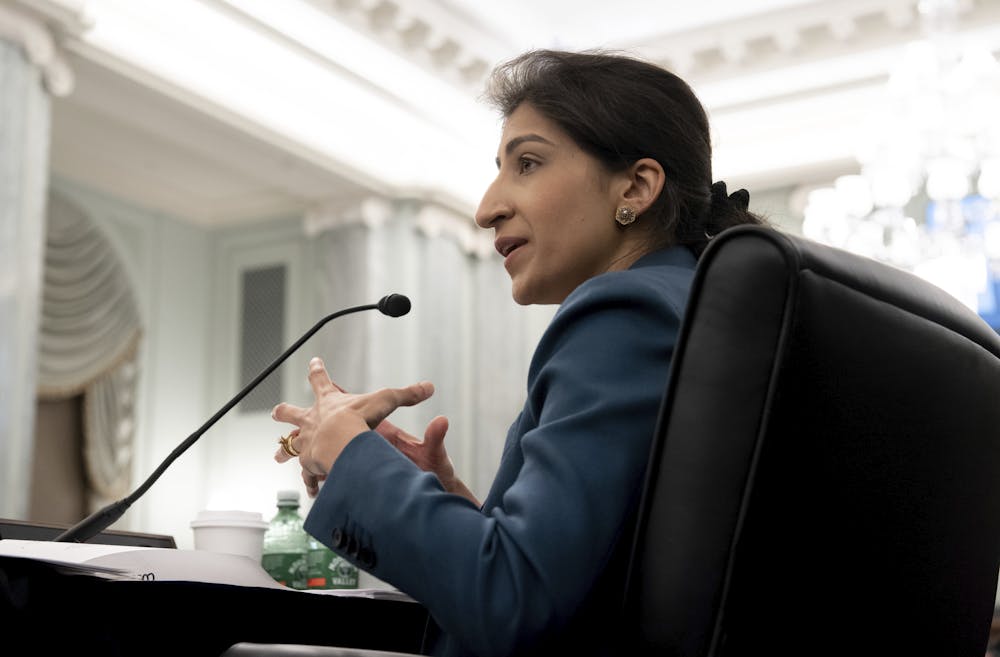
President Biden named Lina Khan, a prominent critic of Big Tech companies, as chair of the Federal Trade Commission in 2021. The agency investigates issues including antitrust violations, deceptive trade practices and data privacy lapses. AP Photo/Saul Loeb
Setting appropriate levels of fines is also complicated. Theoretically, regulators should try to set a fine commensurate with the damage to society from the infraction. From a practical standpoint, however, regulators treat fines as a deterrent. If the regulator never has to assess the fine, it means that companies are adhering to the established standards for safety and equity.
But laws often inhibit agencies from energetically policing target industries. For example, the Office of Enforcement at the Federal Energy Regulatory Commission is concerned with safety and security of U.S. energy markets. But under a 2005 law, the office can’t levy civil penalties higher than US$1 million per day. In comparison, the cost to customers of the California power crisis of 2000-2001, fueled partially by energy market manipulation, has been estimated at approximately $40 billion.
In 2022 the Office of Enforcement settled eight investigations of violations that occurred from 2017 to 2021 and levied a total of $55.5 million in penalties. In addition, it opened 21 new investigations. Clearly, the prospect of a fine from the regulator is not a sufficient deterrent in every instance.
From legislation to regulation
Congress writes the laws that create regulatory agencies and guide their actions, so that’s where any moves to regulate social media companies will start. Since these companies are controlled by some of the wealthiest people in the U.S., it’s likely that a law regulating social media would face legal challenges, potentially all the way to the Supreme Court. And the current Supreme Court has a strong pro-business record.
If a new law withstands legal challenges, a regulatory agency such as the Federal Communications Commission or the Federal Trade Commission, or perhaps a newly created agency, would have to write regulations establishing social media companies’ roles and responsibilities. In doing so, regulators would need to be mindful that changes in social preferences and tastes could render these roles moot.
Finally, the agency would have to create enforcement mechanisms, such as fines or other penalties. This would involve determining what kinds of actions are likely to deter social media companies from behaving in ways deemed harmful under the law.
In the time it would take to set up such a system, we can assume that social media companies would evolve quickly, so regulators would likely be assessing a moving target. As I see it, even if bipartisan support develops for regulating social media, it will be easier said than done.
============================================================== Alecto, Megaera, and Tisiphone, Heather Cox Richardson closed her Letter for December 14 with this: “[I]n June, the Supreme Court handed down the sweeping New York State Rifle & Pistol Association, Inc. v. Bruen decision requiring those trying to place restrictions on gun ownership to prove similar restrictions were in place when the Framers wrote the Constitution. Already, a Texas judge has struck down a rule preventing domestic abusers from possessing firearms on the grounds that domestic violence was permissible in the 1700s.” (Emphasis mine)
Originalism. If it isn’t checked, it will kill us all. And the founders would absolutely not have wanted it. They were not idiots – they knew that circumstances would change, and that government of, by, and for the people would need to change with them. They said so – including in the Constitution itself – if not, why would they have included in it a provision for amending it?
I do have one thought regarding the setting of the amounts of fines for non-compliance. Setting dollar amounts clearly doesn’t work – values change and fines simply become an accepted “cost of doing business.” We need to start settimg fines not as “no more than X dollars” but instead as “not greater than Z percent of the defendant’s total net worth,” or some other indicator. “Y percent of the degendant’s gross annual profits in the most recent year” might work.
Glenn Kirschner – Bannon Trial, Day 4: Steve Bannon gets his chance to tell his side of the story – and stays quiet
Meidas Touch – Jamie Raskin STUNS Republican with epic 2nd Amendment FACT-CHECK in real time
Meidas Touch – Jamie Raskin STUNS Republican with epic 2nd Amendment FACT-CHECK in real time
The Lincoln Project – Deleted
Senators Reach Agreement On Bills To Stop Candidates From Stealing Elections
Robert Reich – How Amazon, Starbucks, and Other Companies Fight Unions
Yesterday, of course, I read up on the latest shooting (at least it was the latest yesterday – by today, who knows.) I won’t be posting Biden’s speech because I am bettimg everupone has either already seen it or decided they can’t bear to. I won’t be posting Beto’s speech for about the same reasons (it is in two parts – before and after he got thrown out of abbott’s press conference.) I am posting some little-known Second Amendment history which needs to be known more sidely, along with what I think is a very powerful meme (both here) and a video with Fred Guttenberg in the Video Thread. And there’s this. (another detail about the incident is in the comments.) Also, I did manage to get my delivery order placed, though it took two browsers and about an hour of ding other things before I could get from finalizing the products to actually checking out. sometimes that happens. As long as I have something else to do, and don’t have to sit there screaming at the computer, I’m fine with that.
Cartoon –
Short Takes –
The Daily Beast – Justice Department Tells Agents They Must Step in to Stop ‘Excessive Force’
Quote – In the first update to its use-of-force policy after a string of killings by police in recent years, the Justice Department has ordered federal agents to step in to “prevent or stop” excessive force by other members of law enforcement, The Washington Post reports. The policy change, the first update to its use-of-force policy since 2004, was spelled out in a memo from Attorney General Merrick Garland that was sent to federal law-enforcement agents. Click through for quotes frpm the memo. My guess for why this took so long is that agents thought such corrective action might be (or be seen as) “hostile” – but IMO “parental” – is a better description.
Robert Reich – Why unions are coming to the new economy
Quote – A fifth reason is a new appreciation of the importance of power in driving wages, and the fraudulence of the economic idea that “you’re paid what you’re worth.” The old economic mainstay that people are paid what they are “worth” is finally revealing itself to be an ideology grounded in nothing but power. According to this old mythology, minimum wage workers aren’t “worth” more than the $7.25 an hour federal minimum many now receive. If they were worth more, they’d earn more. Any attempt to force employers to pay them more will only kill jobs. According to this same ideology, CEOs of big companies are “worth” their giant compensation packages, now averaging 350 times pay of the typical American worker. They must be worth it or they wouldn’t be paid so much. Any attempt to limit their pay is fruitless because their pay will only take some other form. Click through for the other four, and for a more complete explanation of this one. IMO there are practical reasons why no one will ever be paid exactly what he or she is “worth,” but we can definitey do better than we are now doing.
Letters from an American – May 24, 2022
Quote – There’s not a lot to go on about what the Framers meant, although in their day, to “bear arms” meant to be part of an organized militia. As the Tennessee Supreme Court wrote in 1840, “A man in the pursuit of deer, elk, and buffaloes might carry his rifle every day for forty years, and yet it would never be said of him that he had borne arms; much less could it be said that a private citizen bears arms because he has a dirk or pistol concealed under his clothes, or a spear in a cane.” Click through for more history. I haven’t subscribed to this blog for very long, so this history is new to me. It is a history that everyone should learn. All of it. (BTW today’s video thread includes a short conversation with Fred Guttenberg and Nicole Wallace.)