Yesterday, The radio opera was Puccini’s “Tosca,” set in Italy around 1814-1815, when Bonaparte had been exiled to Elba, but was fighting his way back, and the populists still thought he was a constitutional populist who would save them (boy, were they wrong. But the viewer kind of needs to side with them because the other side is worse.) Mario, the romantic lead, gets tortured (off stage) and executed (on stage.) These summer operas are not broadcast live; they are recorded during performance, and this performance is even older than last summer – it’s from 2022 (from China). And WFMT will have had no idea how timely this choice would be. Off to see Virgil now – will check in upon return.
Yesterday, the radio opera was Verdi’s “La Traviata,” one of my favorites. It was recorded in China (normal for this time of the year) and all the singers were Chinese except the title character, who was born in Russia but now lives in Italy. That casting sits well with me – it reminds me of the “little red dress” production designed by Willy Decker, which was so controversial and which I didn’t expect to like, but fell in love with. Both productions make visible how much of an outsider Violetta is – and accordingly, how doomed she is – from the very first note. This one does so more subtly. The “little red dress” production hit the audience in the face with it, and never stopped hitting. That was about ten years ago, and many critics are still ranting about what a disaster they thought it was. I beg to differ. But yesterday’s production was vocally perfect – as almost all productions are, despite the difficulty of the music. I’ve only ever heard one that wasn’t, and that was only in one scene, but it was an important one, and even then, it wasn’t that either of the singers was bad, only that the blend between their voices wasn’t there. But I digress. Here are the good news:
Yesterday, the radio opera was Bizet’s “Carmen.” I expect everyone has heard something from it at some point, including people who have never been within miles of an opera house. The Toreador Song is probably the piece most likely to be known by name, though the Gypsy dance in Act 2 is also very catchy. Even fluent French speakers may miss the straight-out-of-Pete-Hegseth lines in the Toreador song: “Some men are soldiers, some are toreros. What’s the diffrence who we are? We all love a fight!” Carmen is the opera know better than any other, except maybe La Boheme, and that would be at most a tie. When I was studying music after leaving the USMC, the college I was studying at staged it, and I played first chair second violin (not well – some of it is tough.) That consitutes really getting to know an opera the hard way.
I’m going to let the good news speak for itself again, and continue running through the alphabet for my links. (Some you may need to turn sound on.) If the song is a rerun, I apologize.
Yesterday, the radio opera was Giuseppe Verdi’s “Luisa Miller” – one of his early successes which made masterpieces like Il Trovatore, La Traviata, Rigoletto and more possible. It reminds me of La Gioconda, in that both have a character who has the hots for the heroine (who is in love with someone else) and is so resentfl at being turned down that he destroys pretty much everyone else in the cast. Verdi named this character “Wurm,” so you know right up front just who he is. (Come to think of it, “Andes Chenier” has one of those too.) Off to see Virgil now – will of course check in upon return.
Yesterday, the radio opera was the one which is part of what is possibly the oldest operatic pun. Let me explain. Richard Wagner managed to get on a friendly basis with the mad King Ludwig of Bavaria – the one who built Neuschwanstein Castle (which is a story in itself.) He also funded the building of Wagner’s new opera house, called the Festspielhaus – a coined word which entered the language to mean any theater built for opera and/or other large musical events. In the early 1900s, one critic started calling the New York Metropolitan Opera House “Das Faustspielhaus” – because it put on Gounod’s “Faust” so often. I think everyone knows the soul-selling-to the devil story, which isn’t pretty, although the music is. I haven’t seen or heard it since CoViD (when the Met was free-streaming and put up a production in which Faust was a nuclear physicist in the 1940s and 50s.) There’s a lot about it to like. I won’t list all the catchy arias, duets, and ensembles, it would take too long. And all the good news stories speak for themselves, so I won’t comment on them
Yesterday, the radio opera was Pelléas and Mélisande by Debussy = the only opera he ever finished. The plot is basically Tristan und Isolde without the love potion, and so steeped in turn-of-the-20th-century symbolism that it’s tricky to follow – a listener just needs to go with the flow. The libretto is from a play by Maurice Maeterlink – who was pissed off that his girl freind was not cast as Mélisande ay the premiere that he didn’t see it until agfter Debussy died, at which time he said, “In this affair I was entirely wrong and he was a thousand times right.” As a listener/viewer, I would say this quote from Wikipedia nails it: “The deliberate vagueness of the story is paralleled by the elusiveness of Debussy’s music.” Off to see Virgil now. Will check in upon return.
Archived from abc news because theirs only stay up for a while and I need to spread them out to avoid running short.
I am impressed. I did know that birds – particylarly columbids (which includes pigeons) and corvids (crows and ravens), but a bird knowing, first, the it needs oxygen, and second, that it could get some from the right humans, andthird, that these were the right humans -that’s quite a feat.
From GOODGOODGOOD. Just look at all the volunteers it took to make this happen.
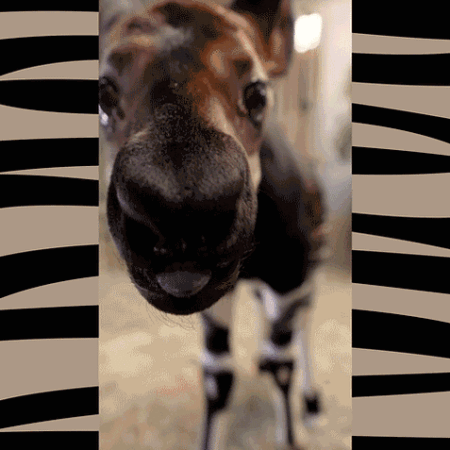
Here’s a link to the GIF at the bottom, since it isn’t GIFing: https://martiniambassador.substack.com/p/baby-okapi-is-okie-dokie
Yesterday,the radio opera was “L’Eliser d’Amore” (“The Love Potion) by Gaetano Donizetti. It’s a comedy, and not just because it has a happy ending. It premiered in 1832 abd kas kiterakky never been out of the repertory. Normally, I’m not crazy about productions which change the time or the country an opera is set in – because there’s always something that doesn’t fit the history and/or culture of the new setting) – but, years ago (so many years that I was not yet married) a production was televised set in the 1860’s in the American southwest in the 1860s – and it was spooky how well it fit. The southwest did not have peasants – but it did have cowboys. And it had traveling snale oil salesmen. And there was a war on. (And of course, a young woman who owns a farm or a ranch could be just about anywhere, any time.) Since then, I have never heard it without remembering that production. (And it didn’t hurt that the tenor was very easy on the eyes.)
I would never have thought of this, but I’m glad someone did. (I did think of taking bayyet to address balance issues – and it worked – but didn’t last because I didn’t keep it up. Marine bases didn’t have barres installed then – and I’d be very surprised if they do even now.)
This chick is lucky to be a penguin – it it were an animal which could be cuddled gy humans, it would be cuddled within an inch of its life, it’s so adorable. (No disrespect is meant by calling it “it” – penguins cannot be gendered by humans visually, and it needs to be old enough for a blood test to check its DNA, and it isn’t yet.)
This is long for a Sunday, and it’s also not yet actual good news but potential good news. But, having spent a couple of years as a regular visitor to a couple where the wife had advanced Parkinson’s, it hits home to me.
Yesterday, the radio opera was La Nozze de Figaro – usually translated as “The Marriage of Figaro” – but I think it should be “The Wedding of Figaro.” There is a difference. But after 240 years – and with the original French play using “Le mariage…”, I guess we’re stuck with it. It does always take me back to when Virgil and I got married – by a JP with no one but him and us present – a friend was asking me beforehand about our plans, and when I told her, she said, “Oh, I get it – you don’t want a wedding, you want a marriage.” I couldn’t have put it better. My parents did the same thing, and if my father hadn’t died so young, I’m confident their marriage would have lasted at least as long as ours. Off to see Virgil now. Will check in upon return
66 billion is one heck of a lot of trees. And what we might br ablr to learn from them could be amazing.
I have never thought that rodeos had any positive aspecta. Well, I stand corrected. (or to be accurate, sit corrected.)
I certainly found this one heartwarming. (and it is on loop – though it’s long for ABC – it’s not repetetive. I’m in awe of the work that was required to put it together.