Apr 192022
 

Glenn Kirschner – Stephen Miller Testifies to J6 Panel: How might he have criminal exposure? Let us count the ways.

The Lincoln Project – Abbott’s Wall –

Voice of America – Ukraine Refuses to Surrender Besieged Mariupol to Russian Forces

Thom Hartmann – Will SCOTUS Turn America Into A Theocracy?

Parody Peojrct – THE BANANA REPUBLICAN VOTE NO SONG

Beau – Let’s talk about Patrick Lyoya in Grand Rapids….

Share
Apr 162022
 

Yesterday. after putting as much as possible for the blog together, I looked at another free knitting pattern I had found – this one for a crutch cover. I have a coulple of pairs of critches. I never use more than one at a time (I probably should touch wood when I say that) and when I use one, it isn’t always for pain – sometimes – most times –  it’s for balance. Years ago I got a couple of sets (underarm pad and hand pad) in leopard skin patterns, one natural colors and one shocking pink; but they do need laundering, and I thought it would be nice to have some spares. The pattern calls for a cast-on technique I can always use more practice on, and it also calls for brioche stitch (like stocknette but the odd and the even columns are different colors.) I’m not experimenting with brioche stitch yet – instead, I’m using novelty yarn scraps instead of plan yarn for texture. The designer is known on the internet by the name “The Wooly Kraken,” which gave me a smile.

Cartoon

Short Takes –

Daily Beast – RNC Flounces Out of Presidential Debates Commission With Unanimous Vote
Quote – In a Thursday statement that announced the unanimous vote, RNC Chairwoman Ronna McDaniel said, “We are going to find newer, better debate platforms to ensure that future nominees are not forced to go through the biased CPD in order to make the case for the American people.”
Click through for details.  Reality may have a liberal bias – and, if so, it’s about the only thinkg that does. Certainly the media and the CPD don’t.

NBC News THINK – Why Good Friday is a warning against far-right Christian nationalism
Quote – Yet while Trump’s authoritarian MAGA movement has become all but synonymous with white evangelical Christianity, it does not speak for most Christians in the U.S., who are sick of seeing our faith hijacked for hateful political agendas.
Click through if a Scriptural condemnation of “white evangelical Christianity” woould be useful to you. Lord Acton’s famous quote doesn’t go far enough. One does not need to have power to be corrupted by it. Wanting power is more than enough to corrupt.

Crooks and Liars – James Carville Has Had It With Democratic Whiners
Quote – If you’re a Democrat, I don’t care what you are with gender, race, if you don’t see that and you are not outraged, and it doesn’t make you want to vote, I can’t do anything for you! You’re just a whiny, complaining person…. If we can’t stand in there for Joe Biden and talk about the great things he’s done, then we don’t deserve to win this election in 2022.
Click through for full opinion.  Not that anyone here is guilty, necessarily. But this is the same thing we saw in 2016. It didn’t turn out well.

Food For Thought:

Share
Apr 152022
 

Yesterday I overslept – the only surpise there is that it didn’t happen sooner after the weekend. But at least I had gotten pretty well caught up the previous day, so I was able to keep up.

Cartoon

Short Takes –

Why ‘bad’ ads appear on ‘good’ websites – a computer scientist explains
Quote – Programmatic advertising is a powerful tool that allows advertisers to target and reach people on a huge range of websites. As a doctoral student in computer science, I study how malicious online advertisers take advantage of this system and use online ads to spread scams or malware to millions of people. This means that online advertising companies have a big responsibility to prevent harmful ads from reaching users, but they sometimes fall short.
Click through for more detailed explanation, I used to see people in comments complaining about site advertising (and assuming everyone else was seeing what they were seeing) on a daily basis Nowadays I don’t. But the problem is still real – in fact worse, because not it has infested newsletters (from large sites which use a mail service to send them out.) Not that anyone here ever does … but never click on an ad in a newsletter, even from a trusted site.

Dr. Seuss’ Banned Anti-War ‘The Butter Battle Book’ Is Now a Netflix Kids’ Show
Quote – Written in 1984, The Butter Battle Book centered around the war between an orange race called Zooks and a blue race called Yooks. Their countries were divided by a wall over a disagreement on which was the right way to butter bread: Yooks preferred them butter-side up while the Zooks preferred butter-side down. Given the time of the book’s publication, The Butter Battle Book was considered a direct commentary on the Cold War. Seuss unapologetically delved into exploring the consequences of nationalism and the nature of war via the military-industrial complex. Most of the book focused on a heated arms race that got so deadly, it ended with a dour, open-ended conclusion.
Click through for synopsis of original, synopsis of adaptation, and a trailer (plus a link to a John Olver video torching Ted Cruz ove Dr. Seuss which is probably not new.) Theodor Geisel was not a perfect person … but his propensity for making people think (which too many people don’t like) was a great gift.

truthout (OpEd) – Republicans Refuse to Name Courthouse After Black Judge in Overtly Racist Move
Quote – Hatchett retired from the court in 1999 and went into private practice. He passed away last year at age 88, a widely praised and highly admired jurist. “Joe Hatchett is a person who lives and has lived by the ethical precepts which have historically guided the conduct of truly great judges and lawyers of our past and present,” said former American Bar Association (ABA) President Chesterfield Smith when Hatchett was awarded the Florida Supreme Court Historical Society’s Lifetime Achievement Award. “Joe Hatchett to me exemplifies what is best in an American judge, one who is sometimes lonely, but one who never shirks standing alone.”
Click through for full opinion. Yes, this is truthout, and yes, truthout is pretty far left. Bu there’s only one phrase in it I could conceivably disagree with, and that because it is too kind to Republicans. See what you think.

Food For Thought:

Share
Apr 142022
 

Yesterday was another pretty quiet day. It was cold, and there was some snow, but I do have a working heater in place (as opposed to last week, when the one I had died), so i was just fine.

Cartoon 14 0414Cartoon.jpg

Short Takes –

Daily Beast – Why Putin Is Itching to Get His Hands on This Ex-American Banker
Quote – [Bill] Browder, a financier who had once been the largest foreign investor in Russia, had long been a thorn in Moscow’s side before he was detained that day in May 2018. Years earlier, Browder had discovered that many of the companies he had invested in were being robbed by oligarchs and corrupt officials. Unwilling to let this fraud go unchallenged, Browder, as detailed in his 2015 bestseller Red Notice, decided to fight back.
Click through for the gist of the story. I expect that Freezing Order is quite some book. Every group has its exceptions, even bankers (I don’t mean bank employees, who are generally good pwople; I’m thinkinfg of management when I make that generalization.)

New Mexico In Depth – Money for abandoned uranium mine cleanup spurs questions about design, jobs
Quote – Uranium mines are personal for Dariel Yazzie. Now head of the Navajo Nation’s Superfund program, Yazzie grew up near Monument Valley, Arizona, where the Vanadium Corporation of America started uranium operations in the 1940s. His childhood home sat a stone’s throw from piles of waste from uranium milling, known as tailings. His grandfather, Luke Yazzie, helped locate the first uranium deposits mined on the Navajo Nation. His father was a uranium miner, then worked for Peabody Coal mine. Yazzie, Diné, heard the family stories about the U.S. Environmental Protection Agency scanning his family’s home for radiation in 1974, when he was 4 years old, finding several high contamination readings.
Click through for details and anecdotes. Cleaning up after fossil fuels is bad enough … but cleaning up after uranium is worse.

Want to improve student achievement? Hire a Black principal.
Quote – Researchers have found that principals of color yield multiple benefits for students of color. A University of Minnesota study published in January about the impact of Black women principals in secondary schools linked Black principals and higher math achievement for students. Black men make up a slight majority of Black secondary school principals, but the researchers suggest that Black women in these roles have a positive effect on student achievement and teacher investment in schools.
Click through for evidence. I don’t know that this would work in every school district, but in those where it wouldm it would do so like a champion.

Food For Thought:
Not a picture today, but a short quote from an email from Faithful America. Anyone not in the Christian faith tradition, please take this as confirmation of what you already know: far too many “Christians” don’t act Christian.

During Holy Week, the church remembers the final days of Christ’s earthly life and ministry. But we often forget just what it was that Jesus did to anger the religious and political authorities in the first place:

“Then Jesus entered the temple and drove out all who were selling and buying in the temple, and he overturned the tables of the money-changers… He said to them, ‘It is written, ‘My house shall be called a house of prayer;’ but you are making it a den of robbers.'”

If we’re serious about following Jesus, we need to start flipping more tables ourselves.

Share
Mar 272022
 

Experts in autocracies have pointed out that it is, unfortunately, easy to slip into normalizing the tyrant, hence it is important to hang on to outrage. These incidents which seem to call for the efforts of the Greek Furies (Erinyes) to come and deal with them will, I hope, help with that. As a reminder, though no one really knows how many there were supposed to be, the three names we have are Alecto, Megaera, and Tisiphone. These roughly translate as “unceasing,” “grudging,” and “vengeful destruction.”

I wanted to share this article because – even before the invasion of Ukraine started, we were hearing things like “I’d rather be Russian than a Democrat,” and now we are hearing “I prefer Putin’s Christian values to Joe Bifen’s values.” And, frankly. that scares the Republication out of me. It doesn’t seem to be scaring many people, and that scares me too. So I have been trying to be alert for anything I could find on the topic
==============================================================

Why is Russia’s church backing Putin’s war? Church-state history gives a clue

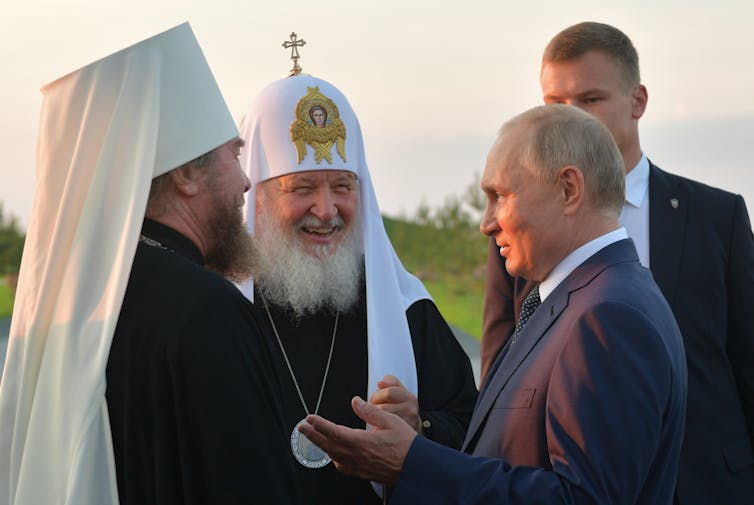
Vladimir Putin speaks to Russian Orthodox Church Patriarch Kirill (center) in Samolva, Russia, on Sept. 11, 2021.
Alexei Druzhinin/Pool Photo via AP

Scott Kenworthy, Miami University

Since Russia’s invasion of Ukraine, the leader of the Russian Orthodox Church has defended Russia’s actions and blamed the conflict on the West.

Patriarch Kirill’s support for the invasion of a country where millions of people belong to his own church has led critics to conclude that Orthodox leadership has become little more than an arm of the state – and that this is the role it usually plays.

The reality is much more complicated. The relationship between Russian church and state has undergone profound historical transformations, not least in the past century – a focus of my work as a scholar of Eastern Orthodoxy. The church’s current support for the Kremlin is not inevitable or predestined, but a deliberate decision that needs to be understood.

Soviet shifts

For centuries, leaders in Byzantium and Russia prized the idea of church and state working harmoniously together in “symphony” – unlike their more competitive relationships in some Western countries.

In the early 1700s, however, Czar Peter the Great instituted reforms for greater control of the church – part of his attempts to make Russia more like Protestant Europe.

Churchmen grew to resent the state’s interference. They did not defend the monarchy in its final hour during the February Revolution of 1917, hoping it would lead to a “free church in a free state.”

The Bolsheviks who seized power, however, embraced a militant atheism that sought to secularize society completely. They regarded the church as a threat because of its ties to the old regime. Attacks on the church proceeded from legal measures like confiscating property to executing clergy suspected of supporting the counterrevolution.

Patriarch Tikhon, head of the Church during the Revolution, criticized Bolshevik assaults on the Church, but his successor, Metropolitan Bishop Sergy, made a declaration of loyalty to the Soviet Union in 1927. Persecution of religion only intensified, however, with repression reaching a peak during the Great Terror of 1937-1938, when tens of thousands of clergy and ordinary believers were simply executed or sent to the Gulag. By the end of the 1930s, the Russian Orthodox Church had nearly been destroyed.

The Nazi invasion brought a dramatic reversal. Josef Stalin needed popular support to defeat Germany and allowed churches to reopen. But his successor, Nikita Khrushchev, reinvigorated the anti-religious campaign at the end of the 1950s, and for the rest of the Soviet period, the church was tightly controlled and marginalized.

Kirill’s campaigns

The dissolution of the Soviet Union brought yet another complete reversal. The church was suddenly free, yet facing enormous challenges after decades of suppression. With the collapse of Soviet ideology, Russian society seemed set adrift. Church leaders sought to reclaim it, but faced stiff competition from new forces, especially Western consumer culture and American evangelical missionaries.

A priest offers Communion to a woman wearing a kerchief.
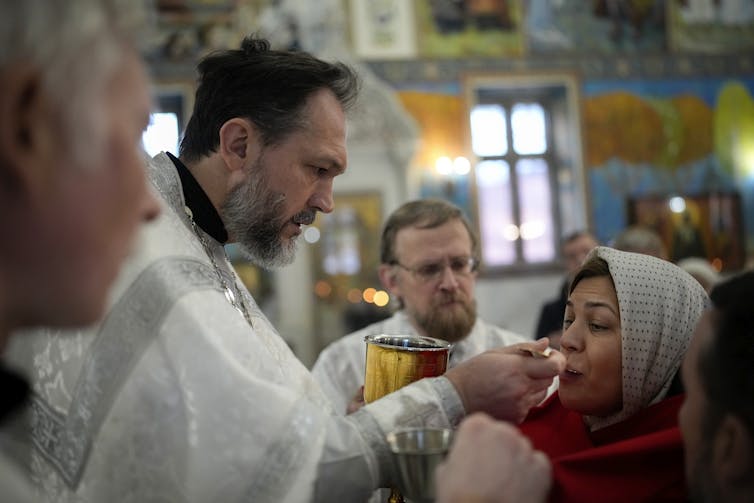
A Russian Orthodox Church priest leads a service at the Church of the Annunciation of the Blessed Virgin in Sokolniki in Moscow on Feb. 15, 2022.
AP Photo/Alexander Zemlianichenko

The first post-Soviet head of the church, Patriarch Aleksy II, maintained his distance from politicians. Initially, they were not very responsive to the church’s goals – including Vladimir Putin in his first two terms between 2000 and 2008. Yet in more recent years, the president has embraced Russian Orthodoxy as a cornerstone of post-Soviet identity, and relations between church and state leadership have changed significantly since Kirill became patriarch in 2009. He quickly succeeded in securing the return of church property from the state, religious instruction in public schools and military chaplains in the armed forces.

Kirill has also promoted an influential critique of Western liberalism, consumerism and individualism, contrasted with Russian “traditional values.” This idea argues that human rights are not universal, but a product of Western culture, especially when extended to LGBTQ people. The patriarch also helped develop the idea of the “Russian world”: a soft power ideology that promotes Russian civilization, ties to Russian-speakers around the world, and greater Russian influence on Ukraine and Belarus.

Although 70%-75% of Russians consider themselves Orthodox, only a small percentage are active in church life. Kirill has sought to “re-church” society by asserting that Russian Orthodoxy is central to Russian identity, patriotism and cohesion – and a strong Russian state. He has also created a highly centralized church bureaucracy that mirrors Putin’s and stifles dissenting voices.

Growing closer

A key turning point came in 2011-2012, starting with massive protests against electoral fraud and Putin’s decision to run for a third term.

Kirill initially called for the government to dialogue with protesters, but later offered unqualified support for Putin and referred to stability and prosperity during his first two terms as a “miracle of God,” in contrast to the tumultuous 1990s.

In 2012, Pussy Riot, a feminist punk group, staged a protest in a Moscow cathedral to criticize Kirill’s support for Putin – yet the episode actually pushed church and state closer together. Putin portrayed Pussy Riot and the opposition as aligned with decadent Western values, and himself as the defender of Russian morality, including Orthodoxy. A 2013 law banning dissemination of gay “propaganda” to minors, which was supported by the church, was part of this campaign to marginalize dissent.

Putin successfully won reelection, and Kirill’s ideology has been linked to Putin’s ever since.

Three women behind a glass panel look out at a courtroom.
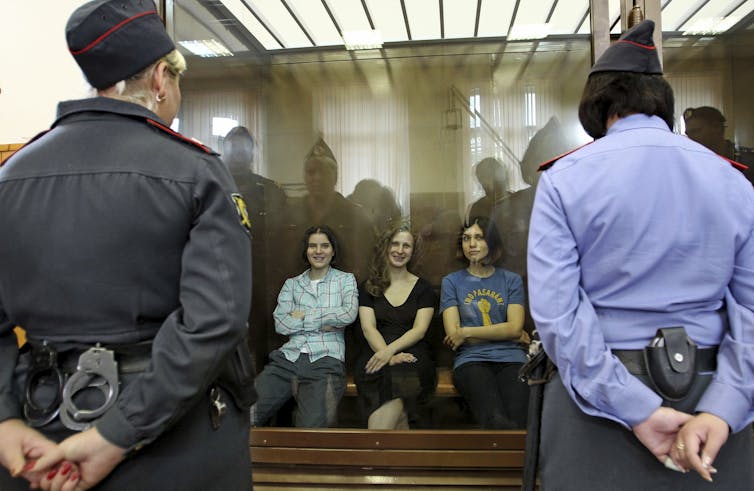
Members of the feminist punk group Pussy Riot sit in a glass cage at a courtroom in Moscow in 2012. The women were charged with hooliganism connected to religious hatred.
AP Photo/Mikhail Metzel

Russia’s annexation of Crimea and the eruption of conflict in the Donbas in 2014 also had an enormous impact on the Russian Orthodox Church.

Ukraine’s Orthodox churches remained under the Moscow Patriarchate’s authority after the collapse of the Soviet Union. Indeed, about 30% of the Russian Orthodox Church’s parishes were actually in Ukraine.

The conflict in Crimea and eastern Ukraine, however, intensified Ukrainians’ calls for an independent Orthodox church. Patriarch Bartholomew, the spiritual head of Orthodox Christianity, granted that independence in 2019. Moscow not only refused to recognize the new church, but also severed relations with Constantinople, threatening a broader schism.

Orthodox Christians in Ukraine were divided over which church to follow, deepening Russia’s cultural anxieties about “losing” Ukraine to the West.

High-stakes gamble

Kirill’s close alliance with the Putin regime has had some clear payoffs. Orthodoxy has become one of the central pillars of Putin’s image of national identity. Moreover, the “culture wars” discourse of “traditional values” has attracted international supporters, including conservative evangelicals in the United States.

But Kirill does not represent the entirety of the Russian Orthodox Church any more than Putin represents the entirety of Russia. The patriarch’s positions have alienated some of his own flock, and his support for the invasion of Ukraine will likely split some of his support abroad. Christian leaders around the world are calling upon Kirill to pressure the government to stop the war.

The patriarch has alienated the Ukrainian flock that remained loyal to the Moscow Patriarchate. Leaders of that church have condemned Russia’s attack and appealed to Kirill to intervene with Putin.

A broader rift is clearly brewing: A number of Ukrainian Orthodox bishops have already stopped commemorating Kirill during their services. If Kirill supported Russia’s actions as a way to preserve the unity of the church, the opposite outcome seems likely.The Conversation

Scott Kenworthy, Professor of Comparative Religion, Miami University

This article is republished from The Conversation under a Creative Commons license. Read the original article.

==============================================================
Alecto, Megaera, and Tisiphone, there you have it. Any church which promotes ?traditional values” (which I put in quotes because they all fling that phrase about, never addressing “Whose tradition?” “How can you consider oppressing people to be a value” and many other related questions) will always be susceptible to becoming affiliated with autocracy. We have seen this in the Taliban. We have seen this in evangelical Christianity. And now we are seeing it in Russian Orthodoxy. For all of those groups, be they Muslim, Evangelical Christian, or Orthodox Christian, there are many others around the world who are Muslims, western Christians, and Eastern Christians who are horrified that these people who claim to profess the same faith practice it so horrifyingly.

I am not opposed to tradition, But I am opposed to confusing “traditional” with “godly.” I am reminded of the story of the little girl who was watching her mother cut off both ends of the Easter ham before putting it in the ovem, and who asked why. “My mother always did it that way,” was the response. The next time the little girl saw her grandmother, she asked the same question and go the same answer. Finally the little girl was able to speak with her great-grandmother and ask the question again. “When your Great-Grandfather and I were first married, we didn’t have a lot, and our roasting pan was very small. The ham would not fit in it without trimming the ends off.”

I cannot see a partcle of difference between these affiliations of convenience with religion and autocracy, and many others have already seen, spoken about, and written about evangelical Christianity vis-a-vis the Taliban. But I don’t see anyone but me saying that we now have a third example in Russia (and a fourth one in Israel would not surprise me, but I have no evidence for that.) There are many, many examples throughout recorded history as well. That is one history I really, really do not want to repeat.

The Furies and I will be back.


Share
 Comments Off on Everyday Erinyes #311  Tagged with:
Oct 142021
 

Yesterday, I watched my Governor’s live press conference on COViD in Colorado. He was accompanied by two doctors, a family practitioner and a pediatricition who is something of an authority in Pediatric epidemiology. The latter said something I really want to share: that, given the transmissibility of the Delta varient, if one is not vaccinated, it is not a question of whether he or she will contract the disease, but when. That may not sway as many people as it should, but it may reach a few.

Cartoon –

Short Takes –

The Conversation – What is the Synod of Bishops? A Catholic priest and theologian explains
Quote – The topic? How the church can learn to rely more fully on this kind of consultation-and-discussion process – how it can become more “synodal” in its governance. Throughout the centuries, the Roman Catholic Church has held many gatherings called “synods” – but seldom one this sweeping in its potential consequences…. In part, it is designed to make church governance more open and inclusive of all its members.
Click through if you like. Pope Francis, like me, is old enough to rememner Pope John XXIII and Vatican II – and that much of the progress Vatican II made has been rescinded. This looks like he is trying to accomplish something which cnnot be rescinded so easily.

Wonkette – Why Were Capitol Police So Unprepared For The January 6 MAGA CHUD Invasion?
Quote – A former senior official in the US Capitol Police just released a scathing letter to Congress that places blaming squarely on the heads of Assistant Capitol Police Chief Yogananda Pittman and acting Assistant Chief Sean Gallagher. The anonymous official accuses Pittman and Gallagher of ignoring an intelligence report they received on December 21 that specifically warned about a potential riot at the Capitol. It was reportedly similar to intel the FBI provided the department on January 5, which according to the Gregorian calendar is prior to January 6.
Click through for story and video footage. The reason is pretty much what you’d think, and pretty much the same as with 9/11 – failure to pass on intelligence. This article is not in Wonkette’s signature style, but is pretty well straight.

Law and Crime – Murder Defendant in 2014 Killing Asks Trial Judge to Officiate Wedding
Quote – To be fair, both marriage and criminal trials are transformative life events. But one Pennsylvania murder defendant has gone so far as to ask his trial judge to officiate his wedding, according to The Associated Press…. “We’ll take care of it next week,” the judge said in court. He did not say no…. Prosecutors offered no objections.
Click through for details. If you like “you just can’t make this stuff up” stories, Law and Crime was on fire yesterday, and most of them should still be on the front page today.

Food for Thought –

Share
Oct 102021
 

Experts in autocracies have pointed out that it is, unfortunately, easy to slip into normalizing the tyrant, hence it is important to hang on to outrage. These incidents which seem to call for the efforts of the Greek Furies (Erinyes) to come and deal with them will, I hope, help with that. As a reminder, though no one really knows how many there were supposed to be, the three names we have are Alecto, Megaera, and Tisiphone. These roughly translate as “unceasing,” “grudging,” and “vengeful destruction.”

This story is spine-chilling, and I feared I would not be able to share it here, because it is a joint project of ProPublica and the Texas Tribune. When I looked closer, I did find a link, which has very specific guidlelines. One guideline is that I cannot republish any illustrations or photos – sorry about that. At the site it has some good ones. Several links will take you there, but the most obvious is probably the one in the single sentence in the next paragraph – which is present per the guidelines.

This story was originally published by ProPublica.
================================================================

“God’s Will Is Being Thwarted.” Even in Solid Republican Counties, Hard-Liners Seek More Partisan Control of Elections.

by Jeremy Schwartz, ProPublica and The Texas Tribune

ProPublica is a Pulitzer Prize-winning investigative newsroom. Sign up for The Big Story newsletter to receive stories like this one in your inbox.

HOOD COUNTY, Texas — Michele Carew would seem an unlikely target of Donald Trump loyalists who have fixated their fury on the notion that the 2020 election was stolen from the former president.

The nonpartisan elections administrator in the staunchly Republican Hood County, just an hour southwest of Fort Worth, oversaw an election in which Trump got some 81% of the vote. It was among the former president’s larger margins of victory in Texas, which also went for him.

Yet over the past 10 months, Carew’s work has come under persistent attack from hard-line Republicans. They allege disloyalty and liberal bias at the root of her actions, from the time she denied a reporter with the fervently pro-Trump network One America News entrance to a training that was not open to the public to accusations, disputed by the Texas secretary of state’s office, that she is violating state law by using electronic machines that randomly number ballots.

Viewing her decisions as a litmus test of her loyalty to the Republican Party, they have demanded that Carew be fired or her position abolished and her duties transferred to an elected county clerk who has used social media to promote baseless allegations of widespread election fraud.

Republican politicians and conspiracy theorists continue to cast doubt on the election process across the country, particularly in areas where President Joe Biden won. They have demanded audits in states like Arizona, where the results of a Republican-led review in Maricopa County confirmed Biden’s victory. They have also moved to restrict voting in multiple states, including Texas, which passed sweeping legislation that has already drawn lawsuits alleging the disenfranchisement of vulnerable voters.

Last week, Trump issued a public letter demanding an audit in Texas. Hours later, the Texas secretary of state’s office announced that it had begun a “comprehensive forensic audit” in four of the state’s largest counties: Dallas, Harris, Tarrant and Collin. Biden won three of the four.

But Hood County stands out nationally and within Texas because it offers a rare view into the virulent distrust and unyielding political pressure facing elections administrators even in communities that Trump safely won. The county also represents the escalation of a wider push to replace independent administrators with more actively partisan election officials, said David Kimball, a professor of political science at the University of Missouri-St. Louis.

“Going back to the 2020 election, by and large, we saw election officials at the state and local level stand up to and resist efforts by Trump supporters to overturn the results,” said Kimball, who is also a ballot design and voting equipment expert at the Massachusetts Institute of Technology Election Lab. “And now this seems to me like part of the next move: Remove officials and put in somebody else who’s more to their liking.”

Kimball said such efforts can be dangerous given the power of elections administrators to control the number and location of polling places, the use of mail-in ballots and compliance with state and federal laws. In Mesa County, Colorado, for example, elected County Clerk Tina Peters, who has fueled the false narrative that Trump’s victory was stolen, allowed an unauthorized individual to copy the hard drives of voting machines, according to a lawsuit against Peters filed by the Colorado secretary of state’s office. Sensitive security information, including passwords, later appeared on far-right media sites and on social media, the lawsuit states. Peters’ attorney has denied that she did anything wrong.

Carew’s case is particularly troublesome because it “smells of political bullying” and reflects a wider rift in Texas among different factions of the GOP that has grown more pronounced since the election, said Carlos Cascos, a Republican who served as secretary of state for two years under Gov. Greg Abbott before leaving in 2017.

“They’re in power, they get somewhat cocky and they start eating their own. That’s what I’m seeing happening with the Texas GOP,” said Cascos, who this year helped form the Texas Republican Initiative, a group that was created to combat intraparty attacks led by former GOP Chairman Allen West, who is now running for governor.

Similar fissures have cropped up in Hood County, where far-right conservatives who preach allegiance to Trump have split with more establishment-aligned Republicans in demanding that Carew’s duties be placed under elected County Clerk Katie Lang, who has espoused Trump’s stolen-election theory. Lang made national headlines in 2015 after refusing to issue a marriage license to a gay couple following the U.S. Supreme Court’s landmark decision legalizing same-sex marriage.

She frequently shares “Stop the Steal” and “Impeach Biden” memes and videos, including those produced by Blue Shark Media, a popular local far-right Facebook and YouTube show that has claimed the presidential election was stolen, vigorously opposed mask mandates and repeatedly called for Carew’s ouster. The show’s founder is Mike Lang, her husband, who as a former state representative chaired the hard-right House Freedom Caucus.

Aside from saying that she would abide by the Constitution, Katie Lang declined to talk with ProPublica and The Texas Tribune about how she would approach elections management if given the role. Mike Lang did not respond to a request for comment.

The attacks have confounded Carew, 47, whose job is nonpartisan, but who has voted in Republican primaries for the past 11 years, according to public records.

Stress now invades her sleep, waking her up at night as her mind replays the barrage of accusations against her, she said in a recent interview.

“I had no idea what I was getting into.”

“God’s Will Is Being Thwarted”

The heart of the argument against Carew is as basic as the way she numbers voter ballots.

Hood County represents a growing number of areas that have begun shifting from electronic-only machines to more secure hybrid models, which provide paper ballots and are intended to help guard against fraud. A new state law requires all counties to move to voting systems that produce paper ballots by 2026. Like many elections officials in the state’s largest counties, including nearby Tarrant and Dallas, Carew uses the machines to randomly number ballots in accordance with guidance from the Texas secretary of state.

But critics such as Laura Pressley, a self-proclaimed elections expert and favorite of hard-line Republicans in the county, accuse Carew of purposefully ignoring an obscure provision of state law that calls for paper ballots to be consecutively numbered starting with one. Pressley argues that ballots cannot be audited without such numbering, enabling the possibility of election fraud. She has stopped short of claiming any wrongdoing in Carew’s handling of the 2020 election.

“Our elections are the representation of free will, and if we can’t trust that our free will is being represented legally and accurately, then God’s will is being thwarted,” Pressley, a failed Austin City Council candidate turned critic of electronic voting machines, told county commissioners in April. Dave Eagle, a county commissioner and critic of Carew’s, invited Pressley to speak at the meeting.

The push for consecutive numbering has become so potent in Hood County that commissioners in May asked Texas Attorney General Ken Paxton to weigh in on the dispute.

The pending decision could put Paxton, a Trump supporter who unsuccessfully sued to overturn presidential election results in battleground states, at odds with the Republican-led secretary of state’s office. The office has defended Carew, arguing in a July letter to Paxton that electronic voting systems must number ballots randomly so as not to violate privacy rights. It also has said that the consecutive numbering provision was intended for paper ballots, not electronic voting machines.

As state and local officials battle over how to number ballots in Hood County, experts worry that Texas’ constitutional numbering requirement is outdated and doesn’t reflect a broader shift toward protecting voter privacy.

J. Alex Halderman, an election security expert at the University of Michigan, said that over the years states have outlawed the numbering of ballots, adding that “Texas’ policy is at the other extreme.”

Colorado law explicitly states that paper ballots cannot be marked in any way that allows for voter identification. Numbering of Election Day ballots is not allowed in Illinois or North Carolina, and election laws in states including Alabama, Arizona, Mississippi and New York don’t call for the numbering of ballots.

“Where I really worry is for voters who feel socially vulnerable for one reason or another, because they are themselves members of minority groups or are in the political minority,” Halderman said. “They are going to be the ones most worried that, ‘Oh gosh, the people running the election can figure out how I voted,’ and that can deter people from voting at all or being less likely to cast a dissenting vote.”

The law dates back to a time when legislators believed that numbering ballots and voter lists would allow for easy identification and help to catch fraud. Over the years, the law was challenged by candidates who worried that it could dissuade voters from participating in elections; by 1947, the League of Women Voters was pushing for a secret ballot in Texas.

“The Texas system originally was devised so that, in case of an election contest, any voter’s ballot could be identified and the court could determine whether it had been changed,” stated a 1947 McAllen Monitor editorial supporting the shift toward more privacy at the ballot box. “But this precaution is so little needed in contrast to the far more prevalent danger of checking up on timid voters that the cure has done more harm than the original malady.”

Since then, historians have pointed to the numbering system as a facilitator of election fraud. Douglas Clouatre wrote in his book “Presidential Upsets: Dark Horses, Underdogs, and Corrupt Bargains” that George Parr, a longtime political boss in South Texas, used numbered ballots, in combination with poll lists, to identify and bribe voters to choose Democratic candidates and reject Republican ballots. Parr’s scheme is credited with helping John F. Kennedy win Texas in 1960.

Seven election experts and administrators told ProPublica and the Tribune that consecutively numbering ballots is out of step with best practices in election security and is not required to conduct effective election audits.

“In an audit you’re counting the ballots in a particular precinct to see if they match the totals that you’ve already got, and so the order of the ballots doesn’t matter as long as you are counting all of them,” said Kimball, the ballot design expert.

“Injecting Chaos”

A 14-year veteran of county elections administration, Carew left a job in Aransas County on the Gulf Coast to be closer to her ailing parents, children and growing grandchildren in north Texas.

Having grown up in Weatherford, just 25 miles away, Carew said she was proud to be running elections in Hood County. She had garnered nothing but praise from Republican leaders in Aransas County who tapped her in 2015 to be their first elections administrator.

“I can’t imagine anyone not giving anything but A-plus as a grade. She’s that good,” Ric Young, the Aransas County Republican Party chair, said in an interview. “People have to realize her credentials are impeccable and she knows what she is doing.”

More than four decades ago, Texas lawmakers passed a measure allowing counties to create an independent administrator position. Aimed at insulating elections administrators from political pressures, the law calls for them to be appointed by a bipartisan elections commission rather than by county commissioners. Elected officials are prohibited from directing the activities of administrators.

In proposing the legislation, lawmakers said the move was a step toward professionalizing elections, but they made such a switch voluntary. Of the state’s 254 counties, about half — which make up roughly 80% of registered voters — have appointed an independent elections administrator. The others are run by elected local officials, usually county clerks, who are also expected to avoid partisanship.

“There has been a consistent trend in Texas to move toward the fairer, less politicized administration of elections,” said Jeremi Suri, a history professor at the University of Texas at Austin. “In the last year, we are starting to see people try to reverse that in ways that are discouraging.”

Across the country, elections officials are increasingly feeling pressure to prioritize partisan interests over a fair democratic elections process, according to a June study issued by the nonpartisan Brennan Center for Justice and the Bipartisan Policy Center. The study, which interviewed more than three dozen elections administrators, found that 78% believe misinformation and disinformation spread on social media has made their jobs harder, with more than half saying the position has become more dangerous.

In a September news release announcing a lawsuit challenging Texas’ new elections law, the Brennan Center pointed to the negative effects it would have on elections administrators. In direct opposition to measures that made voting easier in Houston, the state’s largest city, legislators banned drive-thru polling places and 24-hour voting across the state. They also banned the unsolicited distribution of applications for mail-in ballots to eligible voters, such as the elderly, and created new criminal penalties for election workers accused of interfering with expanded powers given to poll watchers.

“These new penalties are one example of a troubling new trend of state laws that target election officials and poll workers,” the statement said. “Laws like these rub salt in the wounds of election workers, many of whom faced unprecedented threats and intimidation last year for simply doing their jobs.”

Texas’ new voting restrictions, a recent push by GOP activists to seize control of local party precincts and efforts to delegitimize the elections process in places like Hood County could have a greater chilling effect that drives out a generation of independent elections administrators, said David Becker, executive director of the Center for Election Innovation and Research, a nonprofit that seeks to increase voter participation and improve the efficiency of elections administration.

“This is an incredible delegitimization of American democracy when it comes right down to it,” said Becker, a former Department of Justice lawyer who helped oversee voting rights enforcement under presidents Bill Clinton and George W. Bush. “It is a security threat that is injecting chaos and partisanship and doubt into our election system.”

Carew entered Hood County in the summer of 2020, when Trump was already raising the specter of election fraud. Deep-seated divisions among the local Republican Party had already started to form with the selection of the next elections administrator.

A five-person commission that hires and fires elections administrators in the county was split between Carew and another candidate, Zach Maxwell, who had previously served as chief of staff to Mike Lang. According to his resume, Maxwell had never been employed by a county election office, but Katie Lang, who sits on the commission, said she believed he was committed to elections and praised his work ethic.

Republican County Judge Ron Massingill argued that the county needed someone with experience to deal with an expected “turbulent” presidential election. He eventually sided with the Hood County Democratic chair and the Republican county tax assessor in a 3-2 vote to hire Carew in August 2020, making him a target of hard-line party leaders who have framed the decision as a betrayal.

In one of her first presentations to the commissioners court a month before the election, Carew asked them to approve a $29,000 grant from the Center for Tech and Civic Life for items that included election supplies, voter education material and mail-in voting support. She told them that the grant gave elections officials discretion when using the money.

Eagle, an artisanal cheesemaker and former Tea Party leader, questioned the more than $350 million the nonprofit organization had received from Facebook founder Mark Zuckerberg and his wife, Priscilla Chan, saying the social media company had stifled conservative voices on its platform.

“This is just one more assault, in my opinion, by the progressive left to completely destroy this election cycle,” Eagle said during the meeting. He argued that by giving to nonprofits, private donors were attempting to sway local elections in favor of Democrats, and pointed to a lawsuit seeking to prevent counties from accepting such grants. The suit was later dismissed after a U.S. district judge refused to issue a temporary restraining order blocking the grants.

Hood County commissioners voted against the grant, which was accepted by 101 other Texas counties, including 85 that voted for Trump. Texas Republican lawmakers have since passed legislation that would require written consent from the secretary of state’s office for private grants exceeding $1,000 to election departments, arguing that they seek to tilt the balance of elections in favor of Democrats.

Days after the November election, Blue Shark Media alleged voter fraud in the national election and said voters should not accept the results. Mike Lang, the former state representative, and his co-hosts praised local elected officials, including Eagle, Katie Lang and Constable John Shirley, a former high-ranking member of the far-right paramilitary Oath Keepers, for attending a “Stop the Steal” rally in front of the county courthouse.

“Those are your GOP Republicans that they’re for Trump, they want Trump in there. They’re not part of the establishment that are like, ‘Oh, no, Trump’s not going to win,’” Lang said during a show posted on Nov. 8.

He did not raise concerns about the management of the local election. But since then, the show has repeatedly attacked Carew, even resurfacing her failed request for the nonprofit grant and calling it nothing more than an attempt to draw unsolicited mail-in ballots.

“We need to not only look at who we elect, but we need to look at who our elected officials hire,” Lang said during a show that month.

Calls for Carew’s Ouster

The demands for Carew’s ouster have grown so vigorous that critics have threatened political action against Massingill, the county judge, for his support of the elections administrator.

Massingill, who is quick to point out that he is a recipient of Trump’s Order of Merit for loyalty and service to the Republican Party, said the attacks on Carew from his own party are unwarranted.

“I don’t think it is fair. I really don’t. She is following the law,” Massingill said in an interview. “We want somebody in that office that is neutral and unbiased. We can’t have the Democratic Party or the Green Party or the Republican Party telling her how to run the election.”

Days before an April commissioners court meeting, Blue Shark Media aired an episode calling for Carew’s removal. The show had spent months criticizing Carew for a host of perceived slights, including her connection to the League of Women Voters, which honored Hood County and 53 others for their “outstanding” election website. Critics in the county have argued that the voter education and advocacy group is biased because it called for Trump’s removal from office after the Jan. 6 attack on the Capitol.

In another example that Carew was not ideologically pure, the show’s hosts pointed to a report that she had denied Christina Bobb, a former Trump administration official who works for One America News, access to a private training held at a conference of the Texas Association of Elections Administrators. Dominion Voting Systems, one of the country’s largest election system vendors, filed a defamation lawsuit against the network and Bobb in August, alleging “false and manufactured stories about election fraud.” The lawsuit stated that Bobb crossed “journalism ethical lines” by raising money through a nonprofit to fund a partisan review of its voting machines in Arizona’s Maricopa County. Bobb and OAN did not respond to requests for comment.

In a two-and-a-half minute report that aired in March, Bobb said that she was able to attend the first day of the conference after identifying herself as a member of the public.

On the second day, Carew, then the president of the state association, barred Bobb, saying she attempted to attend an elections certification training that was not open to the public or to members of the media. Carew said Bobb failed to inform organizers that she was a reporter. She said the Katy-based National Association of Election Officials, which puts on the training that costs several hundred dollars to attend, asked her not to allow Bobb inside.

“She was dishonest with us as to who she was with,” Carew said.

But for Mike Lang, the incident was further evidence of Carew’s bias.

“The fact is that Michele Carew, the president of the association, kicked her out, and is that election integrity and transparency? Not a bit,” he said during a Blue Shark show in April.

Two months later, Blue Shark obtained an application that Carew submitted for a position in Travis County. The application, they said, suggested that Carew was committing fraud because she stated that she was still working for Aransas County.

“How can you have any type of integrity or honesty when you can’t fill out an employment application?” Mike Lang asked on a June 21 show as he displayed portions of the application.

Carew, who said she applied for the job after months of attacks in Hood County, told ProPublica and the Tribune that she mistakenly submitted an older version of her standardized employment application. She said she was shocked to learn that critics had gone as far as to track down the application.

“Let’s have a commission meeting and let’s find another elections administrator,” Lang said during the June show in which he demanded that Massingill take action against Carew.

Despite concerns from some Republican precinct chairs about a lack of evidence, the Hood County Republican Party Executive Committee in July passed a resolution threatening a social media campaign against Massingill if he didn’t convene the county’s elections commission to discuss Carew’s termination.

“The resolution makes several big claims, but only uses hearsay to back them up,” Mark Shackelford, a precinct chair, wrote in internal Hood County GOP emails obtained by ProPublica and the Tribune. Shackelford later told ProPublica and the Tribune that he believed that without more robust evidence the resolution would be perceived as sour grapes within the county. “And it was,” he told ProPublica and the Texas Tribune in an email.

When Massingill refused, Katie Lang, the vice chair of the elections commission, stepped in and called a meeting. Aside from opponents, the meeting drew poll workers, election judges and former officials in Aransas County who defended Carew.

In the end, the elections commission voted 3-2 not to terminate Carew, marking the same split as when it hired her to be the elections administrator. David Fischer, Hood County’s GOP chairman who along with Lang voted to fire Carew, said the vote had not ended the effort against her.

The next step, Fischer said during the meeting, should be for the commissioners court to schedule a vote to dissolve the office and place elections under Lang. The move would make the office more accountable to the county’s majority Republican voters, said Fischer, who declined an interview request.

Commissioners have not said whether they plan to abolish the position.

In the meantime, Eagle and Pressley have continued their claims that Carew is flouting the law. In August, the pair addressed City Council members in Granbury, the largest city in Hood County, where Eagle advised them against contracting with Carew for its November 2021 election.

Instead, Eagle told officials, the city should hire a private company to run its election.

“I Felt Alone”

Carew has struggled to withstand the personal attacks and the accusations that she violated the law. She worries she has grown less trusting and more cynical.

“I felt alone to tell you the truth,” she said in an interview. “The worst part was being dragged through the mud over something they don’t know what they’re talking about.”

Carew said she has tried to find solace in discussions with other elections administrators, the only people who really know what she has been going through.

She feels as if she’s somehow let them down. That her experience in Hood County has overshadowed more than a decade of service as an elections manager. And she worries that she will only be known for the claims lodged at her by those trying to remove her from the role.

But Carew is sure of one thing. She has already told her husband that Hood County will be her last elections administrator position.

“I don’t feel like I am the same person I was a year ago,” Carew said. “This county has ruined me.”


================================================================
Alecto, Megaera, and Tisiphone, I’m sorry, but these people are not Christians, nor are they sane. If God’s will is being thearted in Texas or anywhere else, they are the ones doing the thwarting. If any one of them, or any one nuclear family of them, were to be dropped down into a sane city anywhere in the world, it would not be long before they were committed (assuming any sane city anywhere in the world has any mental hospitals left.) But – there are so many of them where they are – they reinforce each other. I don’t really care how we got here, unless knowing that will help us get out of here. But I really, really want out of here. Can you ladies help?

The Furies and I will be back.

Share
Jul 112021
 

Experts in autocracies have pointed out that it is, unfortunately, easy to slip into normalizing the tyrant, hence it is important to hang on to outrage. These incidents which seem to call for the efforts of the Greek Furies (Erinyes) to come and deal with them will, I hope, help with that. As a reminder, though no one really knows how many there were supposed to be, the three names we have are Alecto, Megaera, and Tisiphone. These roughly translate as “unceasing,” “grudging,” and “vengeful destruction.”

This article presents material of importance – and it is presented in such a way that I don’t have to think too much about being confident it is good information and sharing it accordingly. That’s a very good thing when I have just lost essentially three days of preparation time. See what you think about it.
================================================================

Science denial: Why it happens and 5 things you can do about it

Are you open to new ideas and willing to change your mind?
Klaus Vedfelt/DigitalVision via Getty Images

Barbara K. Hofer, Middlebury and Gale Sinatra, University of Southern California

Science denial became deadly in 2020. Many political leaders failed to support what scientists knew to be effective prevention measures. Over the course of the pandemic, people died from COVID-19 still believing it did not exist.

Science denial is not new, of course. But it is more important than ever to understand why some people deny, doubt or resist scientific explanations – and what can be done to overcome these barriers to accepting science.

In our book “Science Denial: Why It Happens and What to Do About It,” we offer ways for you to understand and combat the problem. As two research psychologists, we know that everyone is susceptible to forms of it. Most importantly, we know there are solutions.

Here’s our advice on how to confront five psychological challenges that can lead to science denial.

Challenge #1: Social identity

People are social beings and tend to align with those who hold similar beliefs and values. Social media amplify alliances. You’re likely to see more of what you already agree with and fewer alternative points of view. People live in information filter bubbles created by powerful algorithms. When those in your social circle share misinformation, you are more likely to believe it and share it. Misinformation multiplies and science denial grows.

two seated men in discussion
Can you find common ground to connect on?
LinkedIn Sales Solutions/Unsplash, CC BY

Action #1: Each person has multiple social identities. One of us talked with a climate change denier and discovered he was also a grandparent. He opened up when thinking about his grandchildren’s future, and the conversation turned to economic concerns, the root of his denial. Or maybe someone is vaccine-hesitant because so are mothers in her child’s play group, but she is also a caring person, concerned about immunocompromised children.

We have found it effective to listen to others’ concerns and try to find common ground. Someone you connect with is more persuasive than those with whom you share less in common. When one identity is blocking acceptance of the science, leverage a second identity to make a connection.

Challenge #2: Mental shortcuts

Everyone’s busy, and it would be exhausting to be vigilant deep thinkers all the time. You see an article online with a clickbait headline such as “Eat Chocolate and Live Longer” and you share it, because you assume it is true, want it to be or think it is ridiculous.

Action #2: Instead of sharing that article on how GMOs are unhealthy, learn to slow down and monitor the quick, intuitive responses that psychologist Daniel Kahneman calls System 1 thinking. Instead turn on the rational, analytical mind of System 2 and ask yourself, how do I know this is true? Is it plausible? Why do I think it is true? Then do some fact-checking. Learn to not immediately accept information you already believe, which is called confirmation bias.

Challenge #3: Beliefs on how and what you know

Everyone has ideas about what they think knowledge is, where it comes from and whom to trust. Some people think dualistically: There’s always a clear right and wrong. But scientists view tentativeness as a hallmark of their discipline. Some people may not understand that scientific claims will change as more evidence is gathered, so they may be distrustful of how public health policy shifted around COVID-19.

Journalists who present “both sides” of settled scientific agreements can unknowingly persuade readers that the science is more uncertain than it actually is, turning balance into bias. Only 57% of Americans surveyed accept that climate change is caused by human activity, compared with 97% of climate scientists, and only 55% think that scientists are certain that climate change is happening.

man with book looking off into distance
How did you come to know what you know?
ridvan_celik/E+ via Getty Images

Action #3: Recognize that other people (or possibly even you) may be operating with misguided beliefs about science. You can help them adopt what philosopher of science Lee McIntyre calls a scientific attitude, an openness to seeking new evidence and a willingness to change one’s mind.

Recognize that very few individuals rely on a single authority for knowledge and expertise. Vaccine hesitancy, for example, has been successfully countered by doctors who persuasively contradict erroneous beliefs, as well as by friends who explain why they changed their own minds. Clergy can step forward, for example, and some have offered places of worship as vaccination hubs.

Challenge #4: Motivated reasoning

You might not think that how you interpret a simple graph could depend on your political views. But when people were asked to look at the same charts depicting either housing costs or the rise in carbon dioxide in the atmosphere over time, interpretations differed by political affiliation. Conservatives were more likely than progressives to misinterpret the graph when it depicted a rise in CO2 than when it displayed housing costs. When people reason not just by examining facts, but with an unconscious bias to come to a preferred conclusion, their reasoning will be flawed.

Action #4: Maybe you think that eating food from genetically modified organisms is harmful to your health, but have you really examined the evidence? Look at articles with both pro and con information, evaluate the source of that information, and be open to the evidence leaning one way or the other. If you give yourself the time to think and reason, you can short-circuit your own motivated reasoning and open your mind to new information.

Challenge #5: Emotions and attitudes

When Pluto got demoted to a dwarf planet, many children and some adults responded with anger and opposition. Emotions and attitudes are linked. Reactions to hearing that humans influence the climate can range from anger (if you do not believe it) to frustration (if you are concerned you may need to change your lifestyle) to anxiety and hopelessness (if you accept it is happening but think it’s too late to fix things). How you feel about climate mitigation or GMO labeling aligns with whether you are for or against these policies.

Action #5: Recognize the role of emotions in decision-making about science. If you react strongly to a story about stem cells used to develop Parkinson’s treatments, ask yourself if you are overly hopeful because you have a relative in early stages of the disease. Or are you rejecting a possibly lifesaving treatment because of your emotions?

Feelings shouldn’t (and can’t) be put in a box separate from how you think about science. Rather, it’s important to understand and recognize that emotions are fully integrated ways of thinking and learning about science. Ask yourself if your attitude toward a science topic is based on your emotions and, if so, give yourself some time to think and reason as well as feel about the issue.

[You’re smart and curious about the world. So are The Conversation’s authors and editors. You can read us daily by subscribing to our newsletter.]

Everyone can be susceptible to these five psychological challenges that can lead to science denial, doubt and resistance. Being aware of these challenges is the first step toward taking action to meet them.The Conversation

Barbara K. Hofer, Professor of Psychology Emerita, Middlebury and Gale Sinatra, Professor of Education and Psychology, University of Southern California

This article is republished from The Conversation under a Creative Commons license. Read the original article.

================================================================
Alecto, Megaera, and Tisiphone, the synod of the Lutheran Church in which I was raised (the Missouri Synod) was, heaven knows, narrow minded enough in many ways (unlike, for instance, the ELCA, which is quite progressivee), but somehow I managed to learn growing up that God no longer speaks directly as he did in and through the Bible, and a big part of why not is that, having discovered science and the scientific method, we are now able to make our own discoveries about his wonderful creation, and no longer need to be spoon-fed, like children, with visions such as St. Peter’s vision in Acts 10 (a vision which, if correctly interpreted, OUGHT to inform all Christians that LGBTQIA people are just fine, thanks, and are not any kind of junk.) Sadly, that’s not the message that science deniers are getting today from their churches, parents, even teachers. Of course that’s not the whole problem, but it definitely contributes. If you ladies, or anyone reading this, have any suggestions on how to deal with that, I’m listening.

The Furies and I will be back – on our new day.

Share