It’s a lazy painful day, here in the CatBox. I was confused about the day I had requested the Methadone increase. It was today not, yesterday, so I was in severe pain all day WWWendy is coming to give me a shower this morning. I dis mot Republicate again. Please pray for stable Republication and a smooth transition to the new meds dose.
Jig Zone Puzzle:
Today’s took me 5:32 (average 5:20). To do it, click here. How did you do?
Cartoon:
Short Take:
From YouTube (a blast from the past): John Denver & Cass Elliot – Leaving On A Jet Plane
It’s a busy and painful weekend here in the CatBox. Everyone loved the feast, especially Oh and Shit. The other residents thoroughly enjoyed them. On the downside, spending several hours in my chair was far more than my back could handle. We took pictures, and I shall share them with you after they have been approved by Ivy Court. Please pray for Republication and pain relief.
Jig Zone Puzzle:
Today’s took me 5:42 (average 4:41). To do it, click here. How did you do?
Cartoon:
A typical Republican!
Short Take:
From YouTube (a blast from the past): Gordon Lightfoot – If You Could Read My Mind
Glenn Kirschner – Implications of Greenberg’s Guilty Plea. One thing this suggests to me is that he may also be able to give them other witnesses to minimize his need to testify in person.
Meidas Touch – Rick Wilson on personalities
A new project is coming – The Franklin Project – here’s the beginning.
Ring of Fire – Yes, this is funny. But also sad.
The Red Dot (Trailer)
Beau on the 1033 program. We don’t hear the saying much any more “You can’t legislate morality” (and maybe we should.) But maybe we should also add “You can’t legislate intentions.”
cat
Experts in autocracies have pointed out that it is, unfortunately, easy to slip into normalizing the tyrant, hence it is important to hang on to outrage. These incidents which seem to call for the efforts of the Greek Furies (Erinyes) to come and deal with them will, I hope, help with that. As a reminder, though no one really knows how many there were supposed to be, the three names we have are Alecto, Megaera, and Tisiphone. These roughly translate as “unceasing,” “grudging,” and “vengeful destruction.”
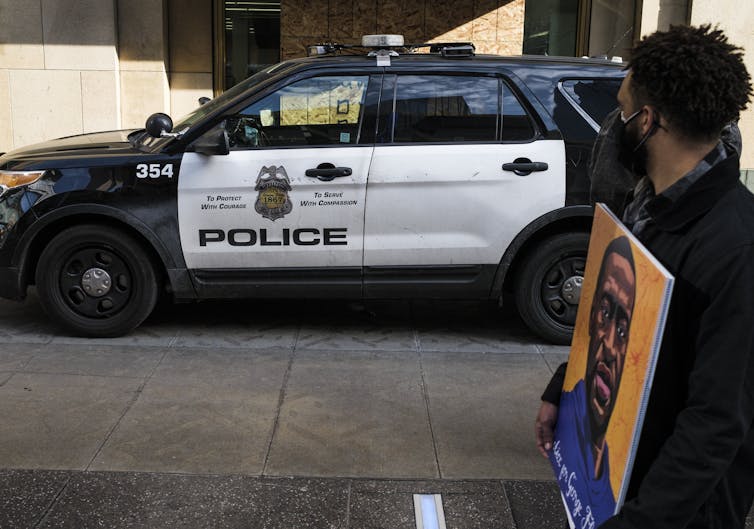
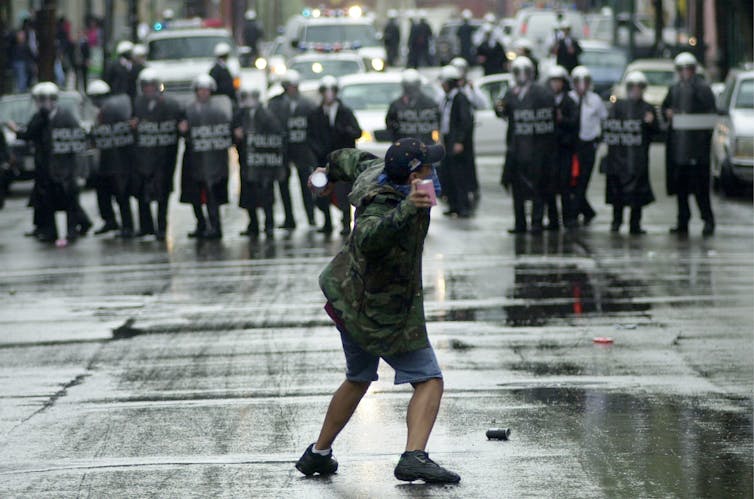
One can hardly read or watch the news for more than a few days without being reminded that the United States is till a contry which has huge problems with its policing. Even communities which have attempted reforms, sometimes sweeping reforms, have seen less improvement thatn they expected. However, it appears when there is strong involvement by community members in the reforms, the results can be less disappointing … and can also be fine tuned more easil;y. These two experts, one an ex-cop, analyze some data.
================================================================
American cities have long struggled to reform their police – but isolated success stories suggest community and officer buy-in might be key
As America continues to grapple with racism and police killings, federal action over police reform has stalled in Congress. But at the state level there is movement and steps toward reform are underway in many U.S. cities, including Philadelphia; Oakland, California; and Portland, Oregon.
It’s too soon to expect substantial improvement from these recently proposed remedies.
But as scholars of criminal justice – one a former police officer of 10 years – we know America has been here before. From Ferguson to Baltimore and Oakland to Chicago, numerous city police departments have undergone transformation efforts following controversial police killings. But these and other reform movements haven’t lived up to their promises.
Resisting change
After the shooting death in Missouri of unarmed teen Michael Brown in 2014, police in Ferguson agreed to a reform program that included anti-bias training and an agreement to end stop, search and arrest practices that discriminate on the basis of race.
Commentators have pointed to a resistance to change among officers and an inability to garner community buy-in as reasons for the slowdown in progress in Baltimore.
Part of the problem, as seen with Baltimore, is that federal intervention does not appear to guarantee lasting change. Research shows that Department of Justice regulations aimed at reform only slightly reduce police misconduct. There is also no evidence that national efforts targeting the use of force alone mitigate police killings.
Community-led reform
One beacon of hope is the Cincinnati Police Department. Twenty years ago, residents in Cincinnati experienced events similar to what many cities have faced in more recent years. An unarmed Black man, Timothy Thomas, was shot dead by officers in 2001, sparking widespread unrest. It led Cincinnati to enter into a different model of reform: a collaborative agreement.
Touted by former U.S. Attorney General Loretta Lynch as a national model for community-led police reform, the collaborative agreement saw the police department, civic government, police unions and local civil rights groups act in partnership for a reform program backed by court supervision.
The resulting changes to use-of-force policies, a focus on community-based solutions to crime, and robust oversight brought about improved policing. A 2009 Rand evaluation of the collaborative agreement found it resulted in a reduction in crime, positive changes in citizens’ attitudes toward police and fewer racially biased traffic stops. There were also fewer use-of-force incidents and officer and arrestee injuries under the collaborative agreement.
But it isn’t perfect. Cincinnati’s Black residents continue to be disproportionately arrested – likely owing to the concentration of crime, service calls and police deployments in predominantly Black neighborhoods. Figures from 2018 show Black Cincinnati residents were roughly three times as likely to be arrested as their white counterparts.
Cincinnati’s collaborative agreement contained a number of elements that experts say are needed if police reforms are to be successful: strong leadership, flexible, goal-oriented approaches, effective oversight and externally regulated transparency.
Moreover, it depended on police officials’ ability to cultivate community investment and overcome resistance from police officers and police unions.
Community confidence is critical to police reform and community safety. When citizens view police as legitimate and trustworthy, they are more likely to report crimes, cooperate during police investigations, comply with directives and work with police to find solutions to crime.
Beyond collaboration
Efforts like that in Cincinnati that put community engagement at the heart of police reforms undoubtedly are strides in the right direction. But they can go only so far. A noticeable shortcoming in most police reform programs is a focus on what is the right thing to do during confrontations with the public, rather than on trying to avert those situations in the first place.
Fatal police shootings often happen during police stops and arrests – situations that carry increased risks of citizen resistance and violent police response.
Scaling back low-level enforcement, such as arrests for vagrancy and loitering – much of which has little public safety advantage – and having police partner with civilian responders for mental health, homelessness and drug-related calls, could mean fewer opportunities for violent police encounters.
Some departments have begun to change their enforcement policies along these lines. The Gwinnett County Police Department in Georgia, for example, stopped making arrests and issuing citations for misdemeanor marijuana possession.
A 2018 study of traffic stops in Fayetteville, North Carolina, found that redirecting enforcement away from minor infractions – such as broken taillights and expired tags – toward the more serious violations of speeding and running traffic lights resulted in reduced crime and a narrowed racial gap in stops and searches.
Devoting less time to policing such activity would also free up officers’ time to devote to such endeavors as analyzing crime trends, conducting wellness checks on elderly residents and mentoring community youth. I (Thaddeus Johnson) felt this as a police officer on the street, and I see it as a criminal justice scholar now.
The examples of Cincinnati, Ferguson and Baltimore show that getting community buy-in is crucial if attempts to improve policing are to be successful. We believe that evaluating officers’ performance and rewarding them based on community-oriented activities – rather than just the number of stops and arrests – could foster the support necessary for lasting reform.
================================================================ Alecto, Megaera, and Tisiphone., it may be just a thought, but I strongly feel that the biggest thing which is not being addressed here is the personalities of individual officers. In my opinion, we – federal, states, counties, and municipalities need to be doing extreme vetting of officers, and not only (and this is going to make me very unpopular) at hiring,, but also for purposes of retention. Vetting for group affiliation will not be that effective until and unless we can get it established that a group is not necessarily a terrorist organization because its name spooks Republicans, of course. But there are in existence numerous psychological tests which can pick up on attitudes pretty solidly; we just need to get them to tell us what we want to know. Many businesses already use these. You ladies could certainly help in getting them to be accepted.
The recent cyberattack on the Colonial Pipeline is a wakeup call in more ways than one. Not just about the lack of cybersecurity in our infrastructure, not just about how vulnerable we are to malicious hackers, but also how we really need to wean ourselves off fossil fuels.
As soon as news of the attack got out, demand for gas spiked, as people topped off and hoarded, making the situation worse. (Putting gasoline in plastic bags? Stupid and foolish – as well as illegal. What’s wrong with a Jerry can?) Prices jumped at many stations, sometimes enough to constitute price gouging. People are probably rethinking travel plans, since this affects airplane fuel as well. Public transit looks a little more attractive.
Some people may recall the gas pinch in 2008 after Hurricanes Gustav and Ike damaged refineries on the Gulf Coast. Drivers waited in line for hours; occasionally, fisticuffs broke out. People followed tanker trucks like ducklings. 911 operators got sick of people calling to ask where they could find gas.
The shutdown of the Colonial pipeline and resulting fuel pinch will have wide-reaching consequences. It supplies 45% of the Southeast’s gasoline and aviation fuel, which means that other shortages are looming. Lack of fuel hurts commercial transportation, which means many goods will be in short supply. As the hoary old saw says, if you bought it, a truck brought it. Even locally made goods contain materials transported from somewhere else.
If we got all of our energy from renewable sources, hackers would be less of a concern. Imagine if our homes and businesses were all solar and/or wind powered. Decentralized energy is far less vulnerable to evildoers than a single pipeline supplying a hefty portion of the petrol for a region.
Meanwhile, we need to improve the cybersecurity of our infrastructure. Ransomware attacks are particularly nasty because nearly always the victim has the choice of ponying up or losing vital data and computer systems. Colonial Pipeline has, reportedly, paid the ransom to the DarkSide crime ring, which will just encourage other cybercriminals to make similar attacks. Also, countries that harbor cyberterrorists and do not crack down on these villains need to be held accountable.
In the short run, we need to shore up our infrastructure against assaults such as the one loosed on Colonial Pipeline. In the long run, we need to kiss oil and other limited, unrenewable energy sources good-bye. President Biden’s Green New Deal will set us on that path.
It’s a tired, painful day here in the CatBox. Yesterday, WWWendy and I did some computer work and the excessive heat (82° F) kept me from getting decent rest. Today we are having our special BBQ ribs feast for the residents, the staff, ‘Oh’, and ‘Shit’. Sunday they are increasing my Methadone another 10%. I insisted on waiting until after the feast, so I don’t sleep through it. Please pray that both the feast and the methadone increase is successful.
Jig Zone Puzzle:
Today’s took me 6:28 (average 6:32). To do it, click here. How did you do?
Cartoons:
Short Take:
From YouTube (a blast from the past): John Denver – Sunshine On My Shoulders (Audio)