Joanne Dixon

Everyday Erinyes #170

 Posted by at 7:39 am  Politics
Jun 152019
 

Experts in autocracies have pointed out that it is, unfortunately, easy to slip into normalizing the tyrant, hence it is important to hang on to outrage. These incidents which seem to call for the efforts of the Greek Furies (Erinyes) to come and deal with them will, I hope, help with that. As a reminder, though no one really knows how many there were supposed to be, the three names we have are Alecto, Megaera, and Tisiphone. These roughly translate as “unceasing,” “grudging,” and “vengeful destruction.”

NEWS FLASH: It seems that people are human, and humans are not perfect. (In other news, life isn’t always fair.)

Therefore, if you want to accomplish something good, something that will bring true improvement into people’s lives, you should probably put some time into considering what could possibly go wrong. And not just to cut things going wrong off at the pass, either. But also to establish appropriate responses to the results of things going wrong – because, as a corollary to Murphy’s Law states, “If anything can go wrong, it will.”

The State of New Mexico (like probably every level of government anywhere in the United States, and that just for starters) wants to minimize and/or eliminate child abuse. Therefore, the State has a child abuse hotline and a mandatory reporting requirement – also like everyone else. But there does seem to be one little loose end (which I can’t compare to everyone else because I don’t really know each law):

A knowingly false report of child abuse is illegal, and many states impose strict penalties against any person who files such a report. In New Mexico, failure to report a case of child abuse is a misdemeanor punishable by a year in jail and a fine of $1,000. But filing a false report effectively carries no punishment whatsoever.

Parents, attorneys, advocates and CYFD employees agree that such malicious reports by school personnel are widespread, both here in New Mexico and across the country.

Searchlight New Mexico is a non-partisan, nonprofit news organization dedicated to investigative and public service journalism in the interest of the people of New Mexico. Searchlight launched an investigation into abuse of the abuse line, in the course of which it spoke with 28 parents who had personal stories to tell of false reports made about them to the New Mexico Children, Youth & Families Department (CYFD).

Gail Stewart is an attorney in Albuquerque, whose focus is not on false CYFD reports, but it is on helping children with disabilities and their parents, so she has run across false reports many times. Her take on false report is simple: “the root of it is a prejudice against children with disabilities.”

Christy Cartwright in Carrizozo has five children, of whom at least three have some kind of disability or difference leading to issues at school which caused her to address those issues with the school.

When 16-year-old Carlos became the target of homophobic bullying, the parents demanded that the school put an end to it. When a special education teacher drove Marcus, who has schizophrenia and autism, up into the mountains and left him to wander lost and alone for hours, Cartwright went ballistic. When Ashley, an 8th grader at Carrizozo Middle School, struggled for two years without a legally required update to her individualized education plan, the parents complained. Loudly.

(Christy in the middle, Marcus in the purple.)

Christy openly describes herself as a “pain in the ass” to school administration, because she won’t leave them alone until – and unless – they do their jobs. Then,

[W]hen a state investigator showed up at Christy Cartwright’s doorstep in January, the mother of five was horrified to learn that an employee of Carrizozo Municipal Schools had reported her for child abuse….

Then, less than a month later, another investigator from the New Mexico Children, Youth & Families Department came knocking — this time with two new reports filed by an anonymous school employee.

The first report accused Cartwright of abusing her grandson — who earlier that year had moved to Texas. The second said that Cartwright’s kids had missed more than two consecutive weeks of school: a clear case of educational neglect. It also accused her and her partner, Harold Burch, of giving the children marijuana, suggested the parents were high on meth, and charged them with “brain washing the children to say they are bullied at school.”

Two months later, CYFD sent Cartwright an official letter concluding that all allegations made by the school were baseless. The state tossed out the case

So, she was vindicated. But there is no way to give her – and her family – back that two months of their lives. And, with no system in place to track and prosecute false reports, there is not even any way to hold the monsters who would make such false reports against innocent people accountable.

Cindy and her partner Harold Burch were driven to request that a police officer sit in any time either or both of them spoke with a school official. This resulted in some body cam recordings which show a school principal acting very Republican indeed. I’m not going to quote any of that because I’d have to re-read it multiple times while editing, and I have to watch my blood pressure. You can find it in my source article, though.

Law enforcement has taken, and is taking, a pretty much hands-off position on any action which might discourage false reports – because any such action might also discourage valid reports. In a way, this argument is similar to the issue of whether or not there should be a question about citizenship on the census. While the answers might be interesting, we have done without that information for a long, long time – and it will certainly make enough people nervous enough to result in significant undercounts – and that will seriously harm our country.

however, it shouldn’t require a lawsuit, or even constant nagging – to get a school to produce a legally required individualized education plan for a special needs student either.  Or to prevent a teacher from playing “Hansel and Gretel” with your kids.

Alecto, Megaera, and Tisiphone, you are all smart cookies. Perhaps you can get together with advocates and activists and help them to design and write provisions for a model tracking system, which will work, but not be intimidating to those in a position to make valid reports. Such a model would provide a service, not only to New Mexico, but to the entire country.

The Furies and I will be back.

Cross posted to Care2 HERE.

Share

Everyday Erinyes #169

 Posted by at 7:09 am  Politics
Jun 082019
 

Experts in autocracies have pointed out that it is, unfortunately, easy to slip into normalizing the tyrant, hence it is important to hang on to outrage. These incidents which seem to call for the efforts of the Greek Furies (Erinyes) to come and deal with them will, I hope, help with that. As a reminder, though no one really knows how many there were supposed to be, the three names we have are Alecto, Megaera, and Tisiphone. These roughly translate as “unceasing,” “grudging,” and “vengeful destruction.”

This story is not a new one in any sense. The events it discusses go back over a hundred and fifty years, The article itself was first published three years ago. The Spiritual Healing Run which commemorates the events takes place at Thanksgiving time, so even that is six months out of date (or early for this year. And we are not yet at the anniversary, and if we were, it would be tht 155th  But, in a week in which we are commemorating the 75th anniversary of D-Day, and, on the other hand, being appalled by a – person – bearing the title of President of the United States who thinks that pardoning war criminals is a good idea, I thought it would feel very timely.

========================================================

Remembering the US soldiers who refused orders to murder Native Americans at Sand Creek

Billy J. Stratton, University of Denver

Every Thanksgiving weekend for the past 18 years, Arapaho and Cheyenne youth lead a 180-mile relay from the Sand Creek Massacre National Historic Site to Denver.

The annual Sand Creek Massacre Spiritual Healing Run opens at the site of the Sand Creek Massacre near Eads, Colorado, with a sunrise ceremony honoring some 200 Arapaho and Cheyenne people who lost their lives in the infamous massacre. This brutal assault was carried out by Colonel John Chivington on Nov. 29, 1864.

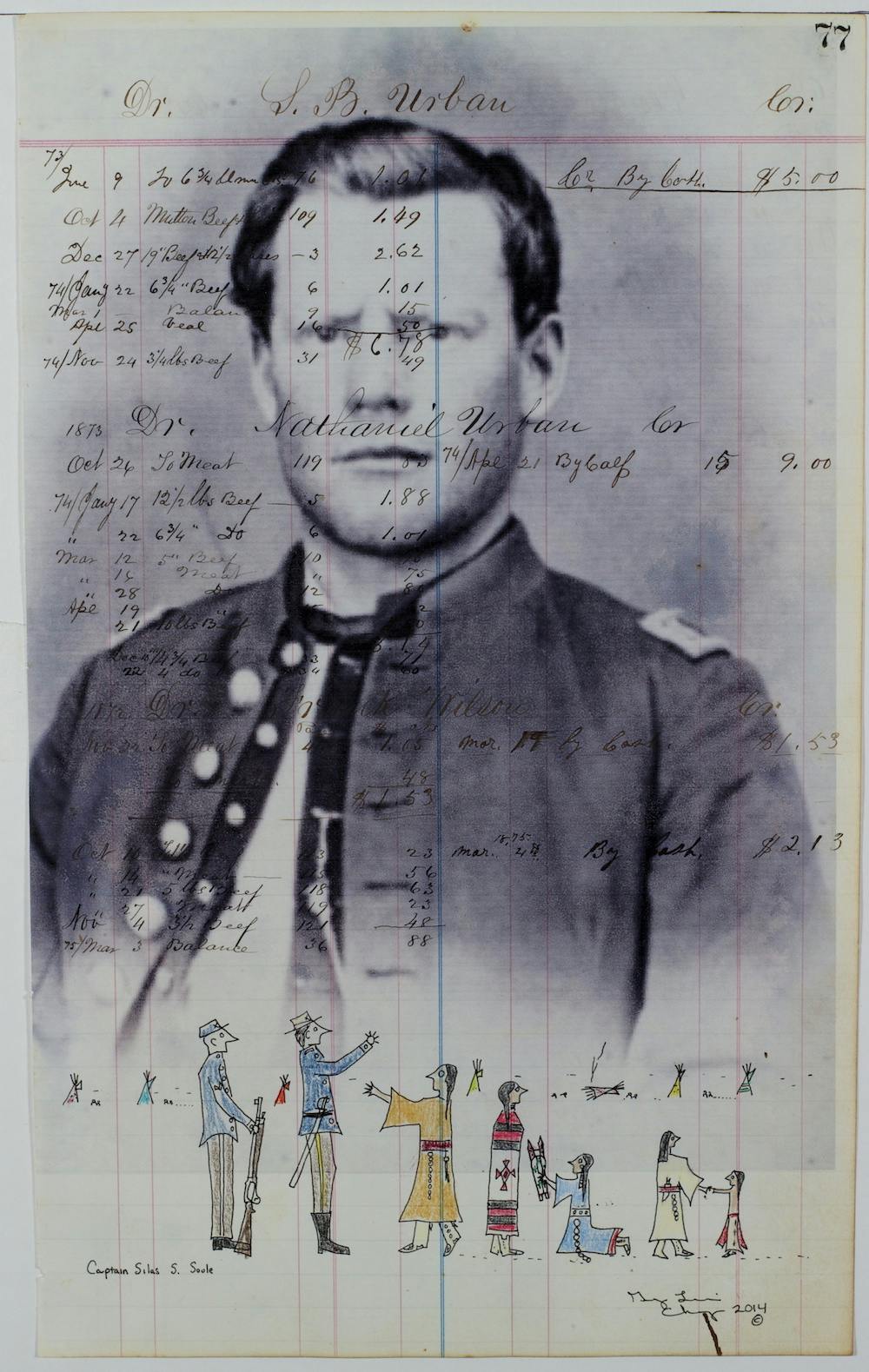
While the Sand Creek massacre has been the subject of numerous books, much less attention has been given to two heroes of this horrific event: U.S. soldiers Captain Silas Soule and Lt. Joseph Cramer.

Ledger art of Captain Silas S. Soule by George Levi (2014).
Courtesy of George Levi, Author provided

These were men who rejected the violence and genocide inherent in the “conquest of the West.” They did so by personally refusing to take part in the murder of peaceful people, while ordering the men under their command to stand down. Their example breaks the conventional frontier narrative that has come to define the clash between Colonial settlers and Native peoples as one of civilization versus savagery.

This is a theme I’ve previously addressed as a scholar in the fields of American Indian studies and Colonial history, both in my book on the Indian captivity narrative genre, “Buried in Shades of Night,” and more recently in writings on Sand Creek.

The letters of Soule and Cramer

Soule’s noble act of compassion at Sand Creek is humbly conveyed in a letter to his mother included in the Denver Public Library Western History Collections: “I was present at a Massacre of three hundred Indians mostly women and children… It was a horrable scene and I would not let my Company fire.”

Refusing to participate, Soule and the men of Company D of the First Colorado, along with Cramer of Company K, bore witness to the incomprehensible. Chivington’s attack soon descended into a frenzy of killing and mutilation, with soldiers taking scalps and other grisly trophies from the bodies of the dead. Soule was a devoted abolitionist and one dedicated to the rights of all people. He stayed true to his convictions in the face of insults and even a threat of hanging from Chivington the night before at Fort Lyon.

In the following weeks, Soule and Cramer wrote letters to Major Edward “Ned” Wyncoop, the previous commander at Fort Lyon who had dealt fairly with the Cheyenne and Arapaho. Both harshly condemned the massacre and the soldiers who carried it out. Soule’s letter details a meeting among officers on the eve of the attack in which he fervently condemned Chivington’s plans asserting “that any man who would take part in the murders, knowing the circumstances as we did, was a low lived cowardly son of a bitch.”

Describing the attack to Wynkoop, Soule wrote, “I refused to fire and swore that none but a coward would.” His letter goes on to describe the soldiers as “a perfect mob.”

This account is verified by Cramer’s letter. Detailing his own objections to Chivington, whom he describes as coming “like a thief in the dark,” Cramer had stated that he “thought it murder to jump them friendly Indians.” To this charge, Chivington had replied, “Damn any man or men who are in sympathy with them.”

In Soule’s account, he writes, “I tell you Ned it was hard to see little children on their knees have their brains beat out by men professing to be civilized.”

While few Americans – especially those living outside of Colorado – may know their names, Soule and Cramer are honored and revered by the descendants of the people they tried to save. According to David F. Halaas, former Colorado state historian and current historical consultant to the Northern Cheyenne, without their courage in disobeying Chivington’s orders and keeping their men from the massacre, “the descendants probably wouldn’t be around today,” and there would be no one to tell the stories.

The horrific descriptions of Soule and Cramer prompted several official inquiries into the atrocity. Both men also testified before an Army commission in Colorado as witnesses. While the officers and soldiers responsible escaped punishment, their testimony brought widespread condemnation upon Chivington, who defended the massacre for the rest of his life.

These investigations also ended the political career of the Colorado territorial governor, John Evans, who had issued two proclamations calling for violence against Native people of the plains, and for organizing the 3rd Colorado Cavalry Regiment in which Chivington was placed in command.

Sites of reverence and healing

The Cheyenne and Arapaho will return to Denver this year to honor their ancestors and remember Soule’s and Cramer’s conscience and humanity. This will be done through an offering of prayers and blessings, along with the performance of honor songs.

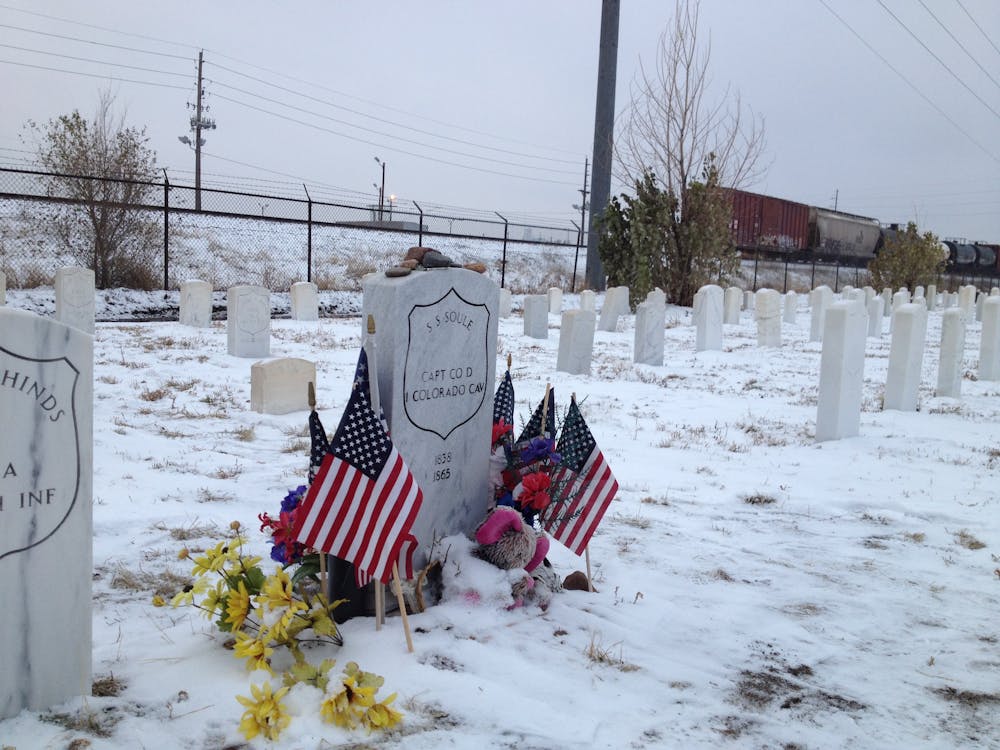
Soule’s grave.
Billy J. Stratton, Author provided

On the third and final day of the healing run, they will gather for a sunrise ceremony at Soule’s flower-adorned grave at Denver’s Riverside Cemetery. The participants will then continue on to 15th and Lawrence Street in downtown Denver. There, a plaque is mounted on the side of an office building at the place where Soule was murdered on April 23, 1865. His death, for which no one was ever brought to justice, occurred only two months after he testified against Chivington before the Army commission.

Over the last few decades, Soule’s grave and place of death have been transformed into sacred sites of remembrance within a violent and traumatic frontier past.

The catastrophe of the Sand Creek Massacre is recognized by historians as among the most infamous events in the annals of the American West. Even now, it is the only massacre of Native people recognized as such by the U.S. government, with the land itself preserved as a national historic site for learning and reflection.

In Cheyenne and Arapaho stories, this event remains an ever-present trauma and persists as part of their cultural memory. In addition, it encapsulates the stark moment of betrayal against their ancestors and the theft of their lands.

The story of Soule’s and Cramer’s actions and their courage to say “no” to the killing of peaceful people at Sand Creek is an important chapter of U.S. history. I maintain that it is people like Soule and Cramer who truly deserve to be remembered through monuments and memorials, and can be a source for a different kind of historical understanding: one based not on abstract notions of justice and right, but upon the courage and integrity it takes to breathe life into those virtues.

On the 153nd anniversary of the Sand Creek Massacre, as we honor the memory of those who died at Sand Creek, may we also be inspired by the heroic actions of these two American soldiers.The Conversation

Billy J. Stratton, Professor of American Literature and Culture; Native American Studies, University of Denver

This article is republished from The Conversation under a Creative Commons license. Read the original article.

========================================================

Alecto, Megaera, and Tisiphone, in your Eumenides hats, help us remember this story of courage and self sacrifice, and how difficult it can be to do the right thing.

The Furies and I will be back.

Cross posted to Care2 HERE.

Share

Everyday Erinyes #168

 Posted by at 8:59 am  Politics
Jun 012019
 

Experts in autocracies have pointed out that it is, unfortunately, easy to slip into normalizing the tyrant, hence it is important to hang on to outrage. These incidents which seem to call for the efforts of the Greek Furies (Erinyes) to come and deal with them will, I hope, help with that. As a reminder, though no one really knows how many there were supposed to be, the three names we have are Alecto, Megaera, and Tisiphone. These roughly translate as “unceasing,” “grudging,” and “vengeful destruction.”

When David and Barbara Mikkelson got divorced, I admit I was concerned about the future of Snopes dot com. David had founded it in 1994, but Barbara had been doing most of the writing, and apparently, most of the fact checking. But, as it turned out, there was actually no cause for concern.

When the site was founded, it was mostly focused on fact-checking urban legends. I always felt it was scrupulously honest, using such gradations as “Partly True” and “Mostly False” in addition to the obvious “True” and “False,” and thus giving at a glance a more accurate picture of reality than most.

After the dust had settled from all the changes, and now that it is actually owned by an entity called “Snopes Media Group” – although David is still there – and has added staff substantially:

Now our team of researchers, writers, developers, and support staff is probably greater than you can fit in a large passenger van, although we haven’t scientifically tested that yet.

it has become a force to be reckoned with.

My attention was drawn to it recently by an article (“diary”) in Daily Kos which cited a “must-read” article at Snopes. I would say the Snopes article is indeed a must-read for anyone who wants to be familiar with the details of how Facebook (along with other social media) is being used, not just to spread misinformation, but to make it so ingrained in the minds of those who fall for it, that it becomes almost impossible to communicate the truth.

This article, by Alex Kasprak (everything is by-lined at Snopes; no one hides behind anonymity, and all sources are linked), reports on a two-month-long investigation Alex did into

a small group of radical evangelical Christians that re-purposed Facebook pages and PACs to build a coordinated, pro-Trump network that spreads hate and conspiracy theories.

The page names imply groups, and the names put together imply diverse groups – at least, sort of diverse. But all the pages – Alex found 24 and suspects there may be more – can be tied to one person. That person is Kelly Monroe Kullberg. Kullberg is neither black nor Jewish, despite both of those groups showing up in some of the group names. Another group which turns up is women – and I’m sad to sad that apparently Kelly is a woman, though she doesn’t appear to be a “senior” (another group) and I doubt she’s a veteran (another group), although that, alas, is not impossible.

Watch the GIF to see a string of group names. The GIF is from all of those pages, and more.

Snopes refers to this collection of pages as “the Kullberg network,” and also found that there is one prominent GOP donor (there may be more, but they found one) funding (and possibly exploiting) the network. That donor is William Millis, a fundraiser and board member for the 2016 Presidential campaign of Ben Carson.

Facebook’s terms of use forbid “coordinated inauthentic behavior.”

Why is this important?

  • The network serves to influence public opinion by presenting the views of a small group of activists as representative of a much broader swath of the American populace.
  • Their strategy amplifies and offers a veil of legitimacy to hatred and conspiracy theories.
  • In spite of these strategies awash in misinformation, the pages within the network have attracted the financial backing of well-heeled political donors who exploit these pages and groups to disguise the origin of political Facebook ads. 

Alecto, Megaera, and Tisiphone., the good news is that you don’t need to do anything. An update from Snopes states that all 24 of the pages they identified as being in the Kullberg network have been taken down. It’s true that Facebook has not directly responded to any of Snopes’ requests for comment. It’s also true that there may be more pages in the network than Snopes was able to identify. It’s also true that there are other “networks” out there preaching the same hate. But I don’t know enough to send you after any of them. And Snopes seems to be doing a pretty good job.

My original link to the investigation was to the summary article. If anyone wants to dig deeper into the subject, the full background is HERE.

The Furies and I will be back.

Cross posted to Care2 HERE.

Share

Everyday Erinyes #167

 Posted by at 12:56 pm  Politics
May 252019
 

Experts in autocracies have pointed out that it is, unfortunately, easy to slip into normalizing the tyrant, hence it is important to hang on to outrage. These incidents which seem to call for the efforts of the Greek Furies (Erinyes) to come and deal with them will, I hope, help with that. As a reminder, though no one really knows how many there were supposed to be, the three names we have are Alecto, Megaera, and Tisiphone. These roughly translate as “unceasing,” “grudging,” and “vengeful destruction.”

Imagine the following scenario:

The guy in charge of directing regulatory policy on chemicals for a huge conglomerate is given a top position at the Environmental Protection Agency (EPA). Once there, he participates in sidelining a long-awaited study on a suspected carcinogenic chemical produced by his former employer—and only recuses himself from the matter after the fact.

All this is allowable under current federal ethics guidelines because several companies—not just the former employer—produce the chemical in question.

Yes. That happened.

I could highlight some words in that quote to underline the contradictions in behavior it demonstrates. But everyone here is smart enough to pick that up. I will just observe that presumably the only thing missing from his recusal was the sentence “My work here is done.”

There are two issues here, it seems to me. The obvious one is the formaldehyde. Most of us may remember formaldehyde from high school biology classes. Many of us probably went home with headaches after those lab sessions. Some of may have also developed a headache or other symptoms if we spent any amount of time in a fabric store, since formaldehyde is an ingredient in the sizing used on new fabrics. The World Health Organization, as well as some divisions of our Department of Health and Human Services, consider it a “known carcinogen.” Our EPA, however, calls it only a “probable” carcinogen.

Did Mr. Dunlap deal with formaldehyde in his eight years and four months working for the Koch brothers, where his title was “Director, Policy & Regulatory Affairs“? Almost certainly. As Koch’s “lead and subject matter expert with a primary focus on … chemicals and chemical management,” he had to be aware of industry groups working to prevent the government from linking formaldehyde to cancer. Particularly since Georgia Pacific, a Koch corporation, is one of the largest producers of formaldehyde.

As the number two administrator of the EPA’s main science office, Mr. Dunlap took place in the process which sidelined – halted – an EPA study on formaldehyde which had been progressing for almost twenty years.

After that, he recused.

And there’s the other issue. There was no requirement for him to recuse in the current ethics rules. Sure, he had worked for an employer manufacturing formaldehyde. But there are other companies in the United States producing formaldehyde. Therefore, he was not required to recuse.

What kind of “ethics” is represented in that provision? It sounds like saying that there is no ethics violation in Traitor Tot steering foreign diplomats and anyone who has business with the administration to stay in Trump branded hotels, because, well, after all, there ARE other hotels. Oh, wait.

Well, I doubt we’ll see any correction of this in ethics guidelines any time soon.

I know this is short, but I’m going to just stop now, except for one disclaimer: the Koch brothers are so morally schizophrenic that they also donate, through the Charles Koch Institute, to the Project on Government Oversight, my major source for this information. There is a lot more, including an additional link to House testimony regarding Executive Branch conflicts of interest. But I have stated the two main points.

Alecto, Megaera, and Tisiphone, I know it’s like beating your heads against stone walls, but I wish you strength. And luck. You’ll need both.

The Furies and I will be back.

Cross posted to Care2 HERE.

Share

Everyday Erinyes #166

 Posted by at 7:14 am  Politics
May 182019
 

Experts in autocracies have pointed out that it is, unfortunately, easy to slip into normalizing the tyrant, hence it is important to hang on to outrage. These incidents which seem to call for the efforts of the Greek Furies (Erinyes) to come and deal with them will, I hope, help with that. As a reminder, though no one really knows how many there were supposed to be, the three names we have are Alecto, Megaera, and Tisiphone. These roughly translate as “unceasing,” “grudging,” and “vengeful destruction.”

In all of the United States, there is one chain of addiction treatment centers which is publicly traded. (Hazelden, for instance, is pretty large, including as it does publishing, which reaches all over the world, and it has the issues institutions have when they get big. But it is and always has been non-profit. Publicly traded is different.)

AAC logo

This publicly traded chain is called American Addiction Centers. It is headquartered in Brentood, TN. If you go to its main website (it has over a hundred, in order to maximize appearance in search results), you will have to know just where to look to find out that it is publicly traded. (Incidentally, is a publicly traded company really allowed to use dot org for its site?) If you click on “About Us” in the banner and read all the fine print, you will find a sub-category called “Investor Relations.” You won’t see anything about that on the home page, nor, probably, under any of the other categories listed across the banner.

The article in Mother Jones which drew my attention to this chain was entitled “America’s Only Publicly Traded Addiction Treatment Chain Makes Millions Off Patients. What Could Go Wrong?” The subtitle indicates that “Mother Jones spent five months investigating deaths at American Addiction Centers.”

Cody Arbuckle

The company has roughly 1500 beds in California,Nevada, Florida, Colorado, Texas, Virginia, Mississippi, Utah, Louisiana, New Jersey. The facilities in the Las Vegas area comprise about 300 of those. It was in one of them, “Solutions,” that Cody Arbuckle died at the age of 23, of an overdose of Imodium (loperamide HCl), which apparently, if you take enough of it, can get you high. He was newly admitted and was supposed to be tightly supervised while going through withdrawal, but was left unattended for several hours instead.

Mother Jones finds irony in the fact that his death occurred just about two months after the chain’s CEO gave an investor presentation in New York City:

On a spring morning in 2017, in a Grand Hyatt ballroom in midtown Manhattan, Michael Cartwright took the stage and talked about growth. “There’s no great brand out there—Nike, whatever you consider a great brand out there today—that doesn’t have a great sales and marketing platform,” he told the audience of health care investors and executives attending a UBS-sponsored confab. That’s why, Cartwright said, his company—American Addiction Centers, the nation’s only publicly traded addiction treatment chain—had built a thriving marketing machine.

And it was vast. Some 65 sales reps marketed AAC’s services to therapists, DUI

Michael Cartwright, CEO of AAC

attorneys, and doctors. The company operated more than 100 websites, ensuring AAC showed up frequently in search results. “If you type in ‘heroin addiction’ or ‘methamphetamine addiction,’” Cartwright, AAC’s CEO, told his audience, “you’re probably going to come across one of our websites.” Each month, roughly 30,000 calls came in to AAC’s call center in Nashville, where, he said, “we have 100 sales reps answering the phone every day.” AAC had dozens of facilities across eight states, including high-end residential centers, outpatient programs, and sober-living housing. According to Cartwright’s slides, the average residential client brought in more than $22,000 in revenue. 

The Las Vegas facilities have seen multiple deaths besides Cody. There was Connor Jackson, 25, a suicide. Joseph N., 25, unknown causes (in his sleep.) April Leeming, 33, also unknown causes (but she was known to have a seizure disorder, and was unmonitored for nine hours.)

Yet another death, this one in California, was mentioned in Mother Jones, but described in more detail by ABC news in Florida – AAC runs a facility in Tampa Bay, and that facility has issues of its own, which made the death and lawsuit in California local news to ABC Tampa Bay.

The deceased, Shaun Reyna, was admitted delusional and hallucinating. He was assigned a room to himself. There were razor blades in the room. Twenty hours after admission Shaun Reyna was dead. He had cut himself multiple times with his razor, and he bled out.

The attorney for the Reyna family, Jude Basile, who obtained for them a $7 million dollar judgment, is of course appalled at the lack of supervision, but seems equally appalled by the chain’s marketing practices:

They were negligent in how they marketed and brought people in… These people took calls from their mass marketing program and were paid a commission and had sales quotas…. American Addiction Centers pressured sales people to sell by any means possible and fired them if they failed to meet sales quotas. 

That is indeed how call centers operate. In most cases, however, it is a matter of life or death only to the employees who can’t meet the quotas. That isn’t so in this industry, which IMO makes the call center marketing model more than usually abhorrent. Attorney Basile added:

“Unfortunately, I think government regulation and oversight is lagging in this industry that has developed over night.”

Amen, Mr. Basile. Amen.

Oh, and the stock prices? After peaking in 2015, when the company had been publicly traded for about a year, at $46.60, it has now dropped to under $2.00. In spite of closing facilities (I’m not sure which ones, or even if they followed through on that announced intention, frankly.)

Alecto, Megaera, and Tisiphone, I’m afraid we will get no Federal regulation with the current regime in the White House. But you can start to help build public opinion on the subject. So please do.

The Furies and I will be back.

Cross posted to Care2 HERE.

Share

Everyday Erinyes #165

 Posted by at 1:05 pm  Politics
May 112019
 

Experts in autocracies have pointed out that it is, unfortunately, easy to slip into normalizing the tyrant, hence it is important to hang on to outrage. These incidents which seem to call for the efforts of the Greek Furies (Erinyes) to come and deal with them will, I hope, help with that. As a reminder, though no one really knows how many there were supposed to be, the three names we have are Alecto, Megaera, and Tisiphone. These roughly translate as “unceasing,” “grudging,” and “vengeful destruction.”

This weekend is a rough one for me, as it’s not only a long-drive weekend, but I also have not completely recovered from a couple of minor injuries  (I am improving … just not as fast as when I was 23). So I was gratified to discover a story which will truly interest the Furies on a site which uses a Creative Commons license, allowing me to reprint it with certain restrictions (one of which is no pictures from the site, so any picture which have crept in are from elsewhere.)

Pediatrician Who Treated Immigrant Children Describes Pattern of Lapses in Medical Care in Shelters

by Michael Grabell, ProPublica

Inside a weathered green group home in southern New Jersey, Yosary grew weaker and weaker. She felt tired all the time, and when she got out of bed in the morning, she sometimes became so dizzy she needed to lie back down. Bruises started appearing all over her body. She craved ice, chewing cups of it whenever she could.

For months, the slender 15-year-old, who’d fled Honduras with her 2-year-old son, had been reporting her symptoms to the shelter’s staff. But they dismissed her pleas for help, she said: She was dizzy because she’d just stood up too fast. Her bruises? She probably bumped into something and didn’t remember. Chewing ice was a bad habit she needed to break.

By the time someone finally took her to one of the shelter’s pediatricians last summer, Yosary was in such bad shape she had to be hooked up to an IV at a local hospital. The pediatrician, Elana Levites-Agababa, recognized the telltale signs of severe anemia, which, untreated, could have resulted in heart failure and damage to other organs. The staff should have known — the teen’s history of anemia was documented in the shelter’s records.

“I was devastated by the care she got,” Levites-Agababa said. “Her hospitalization could likely have been prevented if she had been brought in when she first started raising concerns that she needed to see a doctor.”

For Levites-Agababa, a pediatrician for CAMcare, it was another alarming lapse. For months, she’d been noticing a lax attitude about the medical needs of children at the federally funded immigrant youth shelters run by the Center for Family Services, a nonprofit based in Camden, New Jersey. So, she decided to review the charts of the 90 CFS patients the community health center had seen.

Children, including infants, were showing up as many as 10 weeks late for their booster vaccines, increasing their risk of contracting infectious diseases, she said. There were an unusual number of no-shows and cancellations, even though nearly all the health center’s clinics are within a half-hour of the shelters. And the shelters routinely failed to schedule the prescribed follow-up appointments after emergency room visits, psychiatric admissions and hospitalizations.

She reported her findings to CAMcare, which had been hired by CFS to provide medical care for its immigrant youth, many of whom crossed the U.S.-Mexico border, seeking asylum. But as months passed and the situation didn’t improve, Levites-Agababa escalated her concerns, filing complaints earlier this year with the federal Office of Refugee Resettlement and authorities in New Jersey, which separately regulate the shelters.

While she awaited a response, Levites-Agababa said the medical office received a troubling new request: CFS wanted doctors’ approval to physically restrain kids in its care.

“They feel no obligation to provide appropriate care to the kids or follow any recommendations by a medical provider,” said Levites-Agababa, who has worked at CAMcare since 2015. “And that’s demonstrated over and over again to the point where it interferes with our ability to practice medicine.”

CFS denied wrongdoing but declined to answer specific questions.

“The program’s main objective is the safety and wellbeing of all of the children under our care,” Eileen Henderson, the chief operating officer, said in an email. “CFS continues to work with the Office of Refugee Resettlement and our medical providers to ensure that the children receive proper medical treatment in accordance with our directives from ORR.”

The care of immigrant children in U.S. custody has faced intense scrutiny over the past year as thousands of sexual abuse allegations and reports of personal enrichment by some nonprofit operators have raised questions about the federal government’s ability to monitor its network of about 100 shelters.

Now, a surge of families and unaccompanied children at the border is testing the system as never before. The U.S. Department of Health and Human Services was already scrambling to find new places to house immigrant kids after policies by the administration of President Donald Trump resulted in more children being housed for longer periods. Trump’s recent ousting of his top immigration officials is expected to herald even harsher policies — and possibly a ramped-up effort to separate children from their families.

There were 13,500 children in shelters as of the end of February, more than five times as many as there were two years ago. On Wednesday, Trump requested congressional funding to nearly double the number of beds.

The medical care for these new arrivals became a focus in December, when two ill children died in Customs and Border Protection custody near the border. But unlike those children, Yosary, who asked that only her first name be used, developed her symptoms long after crossing the border. She and the other children Levites-Agababa saw were in a place that was supposed to be safe, staffed by youth care workers trained to recognize medical symptoms and overseen by federal and state agencies responsible for health and social services.

ORR declined a request to interview its medical staff. The agency said that after investigating Levites-Agababa’s complaint, it temporarily suspended CFS from receiving new kids until problems were addressed. But it didn’t say when the suspension happened, how long it lasted or what CFS did to fix the problems.

ORR also wouldn’t say how many complaints about medical care it has received but said that “physicians and nurses who have medical-related concerns often reach out” to staff to discuss and resolve them.

The lapses documented by Levites-Agababa raise critical questions about the patchwork of state regulations that ORR relies on to monitor the shelters, which range from tiny group homes to 2,000-bed facilities and are often tucked in small towns and remote locations. Recently, a 16-year-old boy died shortly after arriving at an ORR shelter in Texas.

Levites-Agababa’s concerns were recently substantiated by New Jersey regulators, who found numerous failures in CFS’ care of immigrant children. But despite the violations, the state agency lacks the ability to fine the shelter operator or remove kids from its care.

Levites-Agababa said she fears she could be fired for speaking out but agreed to go public in hopes of drawing attention to the care of children in the shelters.

CAMcare did not return calls for comment.

With access to children’s health records strictly limited, it’s hard to tell if the problems Levites-Agababa reported are isolated or emblematic of more widespread issues. A review last year of the Yolo County Juvenile Detention Facility in California found similar problems with immigrant teens’ access to medical care, including a failure “to follow up on serious injuries” and long waits for urgent medical needs.

Concerns over such lapses have prompted the HHS inspector general to conduct a nationwide review of the medical and mental health care provided in the youth shelters.

The American Academy of Pediatrics has expressed serious concern about the mental health consequences of detaining children, noting that even short periods can cause psychological trauma and carry lifelong consequences. The AAP doesn’t consider shelters a form of detention and its policy statement doesn’t address the impact of long-term stays in ORR shelters. The shelters were designed as community-based alternatives to detention but are now holding children for longer amounts of time.

Levites-Agababa said her experience has led her to believe that pediatricians should take a firmer stand. She compared it to when doctors started refusing to participate in lethal injections, deciding that their role in relieving suffering was outweighed by the harm of aiding execution. Levites-Agababa said she similarly believes that providing medical care to immigrant kids does not outweigh the traumatic effects of being held in a shelter.

“They are using us as a medical rubber stamp to keep these kids detained,” she said. “And by us participating in this without objection, we’re allowing for the detention of thousands and thousands of kids to continue.”

Who monitors the care of immigrant children in shelters — and how vigilantly they do it — depends a lot on where the children end up.

All shelters must follow ORR rules, but the agency leans heavily on the states to license the facilities and ensure the children’s safety. And that has resulted in a haphazard set of standards.

In Texas, the shelters are considered residential child care centers and must follow stringent regulations set by child welfare officials. In Arizona, the shelters are deemed behavioral health facilities, with a more limited set of rules that hinder state inspections.

In New Jersey, child welfare officials, who normally oversee facilities with children, are prevented by statute from inspecting the immigrant youth shelters because they’re not funded by the state, said Tammori Petty, spokeswoman for the New Jersey Department of Community Affairs.

Instead, the ORR facilities are licensed as emergency homeless shelters and inspected by the department’s Bureau of Rooming and Boarding House Standards. The rules permit children to live in the shelters as long as they’re part of a family. In the case of immigrant children, Petty said, the department decided that ORR qualifies because it provides custodial care to the children.

The bureaucratic restriction makes for an interesting juxtaposition. CFS’ immigrant youth shelters — which can’t be overseen by child welfare — are known as the Juntos program, the Spanish word for “together.” In contrast, the center’s crisis program for American teens, simply called the Together shelter, is regulated by the state’s child welfare agency.

“I’m concerned about the lack of state oversight, that these shelters are not being licensed by any state agency that looks into child care,” said Farrin Anello, senior staff attorney with the American Civil Liberties Union of New Jersey.

Under a federal court settlement, the shelters are required to provide routine medical care and emergency services, including a medical exam, immunizations and screening for infectious diseases within 48 hours of admission.

ORR’s guidelines further require shelter workers to observe children for signs of illness and to respond to nonemergency requests for medical attention within 24 to 48 hours. The shelters must notify ORR within four hours of an emergency room visit, review hospital discharge plans and follow doctors’ treatment recommendations.

But while ORR has the power to remove kids from shelters and cut off funding, it’s also desperate for beds, and any major reduction in capacity could create a crisis. Those conflicting priorities are why child advocates say state oversight is important.

The care delivered by the shelters has become more critical as their role has evolved. Originally, the shelters were viewed as short-term way stations where children would stay while the government located and vetted relatives who could care for them while their asylum cases were reviewed. But under the Trump administration, the average stay grew to three months last fall.

The New Jersey shelters have largely existed in obscurity even as last summer’s family separation crisis cast a spotlight on the government’s network of facilities, which have received $5 billion since rising numbers of unaccompanied minors started arriving in 2014.

CFS, which has provided social services in Camden and southern New Jersey for nearly 100 years, opened its first shelter for unaccompanied minors in 2017. It has since received nearly $11 million in federal funds. One group home behind a church in Burlington houses 20 kids ages 13 and 17. Another in Woodbury is designated for up to 10 teen mothers who cross the border with their children. The program was recently approved to open a third shelter near Atlantic City later this year.

A review of inspection records shows that before Levites-Agababa’s complaint, the Bureau of Rooming and Boarding House Standards had cited the shelters for relatively minor violations: a loose toilet, a shower fixture that needed repair, a reminder to conduct monthly fire drills. Once last fall, it cited CFS for operating its Burlington shelter with an expired licensed and fire certificate. But the Department of Community Affairs later said the bureau simply hadn’t mailed the new license in time for the inspection.

New Jersey’s regulations for emergency homeless shelters contain little in regard to child welfare. The shelters must provide three meals a day, refer residents to medical care, report child abuse to the Department of Children and Families and have an undefined “sufficient number of competent staff” on-site to supervise the premises.

Police reports obtained by ProPublica show a few incidents that would typically draw additional scrutiny from regulators. In November, a 16-year-old boy ran away from the Burlington shelter. And last April, police responded to a report that a male staff member had made inappropriate comments and touched a girl while conducting an assessment in a closed office.

In other states, similar incidents have resulted in citations for failure to maintain supervision and proper boundaries around children. But the New Jersey inspection reports don’t mention any of these incidents.

Nor did the inspections address any medical issues. Department of Community Affairs officials insist they never received Levites-Agababa’s complaint. But after a referral of medical neglect by the Department of Children and Families, where Levites-Agababa had also complained, and several calls from ProPublica, an inspector visited the shelter in late March and found a number of violations.

CFS had failed to ensure that staff were properly trained to monitor changes in residents’ behavior, the inspector concluded. It had failed to ensure that staff understood how to handle emergencies. It had failed to arrange medical care after a resident developed a condition that required attention. It had failed to investigate and maintain records of incidents involving child endangerment. And it had failed to report child abuse and mistreatment to the state’s child welfare agency.

The “facility must exercise care in handling and documenting emergencies, including referring residents for medical care or other emergency services and maintaining records of any special medical needs or conditions, the prescribed regimen to be followed and the name and phone numbers of medical doctors to contact” in an emergency, the report said.

The Department of Community Affairs later said CFS had in fact submitted the child abuse report, attributing it to a paperwork mix-up at the bureau.

Still, while the bureau has OK’d CFS’ plan to fix the violations, it doesn’t have many other options. The only enforcement tool the bureau has at its disposal is to revoke the shelters’ licenses, which it has no plans to do.

The consequence of that? Instead of being regulated as homeless shelters, the facilities would be regulated as hotels according to New Jersey law. Under the state’s hotel statute, there are no rules regarding the care of children.

After arriving at Cooper University Hospital in Camden, Yosary received the first of what would be several iron infusions. Lying in the hospital bed, separated from her toddler and far from other family members who’d fled with her from Honduras, Yosary thought of her mother, who died of cancer when Yosary was very young.

“I was really scared,” she recalled. “I was thinking, I don’t want to die.”

Yosary had come to the United States last March to seek asylum. In Honduras, she said, she had been raped when she was 12 and became pregnant with her son. After the family reported the attack, she said, they began receiving a series of threats. The lines between the local gang and the police and military in her city seemed increasingly blurry.

As the child got older, Yosary said, her attacker started lingering near her house, and she feared her son would be kidnapped.

So Yosary decided to flee with several members of her family, carrying her toddler by foot, by truck and finally by inflatable raft across the Rio Grande. After finding Border Patrol agents, she was taken to a processing station, where she was separated from the rest of her family and sent with her son to CFS’ mother-and-children’s home in New Jersey.

The first few months she felt fine, she said. But by late spring, she started feeling dizzy and sleepy all the time, and she noticed the bruises popping up on her legs and arms.

“I told them several times,” she said. “But they wouldn’t take me seriously.”

Yosary began to feel trapped inside the shelter. There were only three other girls with their babies there, she said. And they were rarely allowed out of the home even to get fresh air. Her only connections to the outside world were two brief calls a week with family members in the same precarious immigration situation.

Finally, there was a meeting at the home that included outside staff members. Yosary told one of them about the bruises.

But even in the doctor’s office and hospital, Yosary said, CFS staff wouldn’t let her talk to the doctor alone. “There was always somebody with me,” she said.

Levites-Agababa said this was a recurring problem with patients in the program, and she worried that it might make kids afraid to be forthcoming about their care in the shelter.

“When I insisted that chaperones leave the exam room so I could talk to the kid alone, they refused to leave and insisted it was policy,” she said.

After a few days, Yosary was discharged from the hospital with instructions to get another IV treatment. But CFS failed to inform CAMcare about the treatment, according to Levites-Agababa’s complaint.

The failure to schedule follow-up visits and heed doctors’ recommendations to see specialists or get lab tests or radiological studies became routine, said Levites-Agababa, who confronted CFS staff over the lapses.

At first, she said, shelter staff told her that ORR wouldn’t approve them, but she later learned that CFS hadn’t even submitted some of the orders.

A nurse at CAMcare, who asked not be identified, echoed Levites-Agababa’s concerns. “There were many appointments I had that got declined or they no-showed,” the nurse said. Another CAMcare doctor said that she was aware of the issues but didn’t have enough information to speak about them.

In some cases, Levites-Agababa said, the mothers of the babies actually had vaccination records from their home countries, but shelter staff failed to bring the paperwork to the initial medical exam.

“The poor teenage mom has painstakingly traveled through numerous countries and protected [the vaccination record] to bring it with the kid,” she said, “and they don’t even bring it to the visit?”

Yosary, who has since settled in Alabama with her older sister, said she couldn’t forget her five months in the shelter and wanted to speak up to help other girls there.

“I hope they don’t have to go through what I went through,” she said, her curly-headed toddler resting against her, “because being locked in that place, it was horrible.”

Even now, she said, she is reminded of the lack of concern about her well-being. According to ORR’s rules, upon release, shelters are supposed to give unaccompanied minors a copy of their medical records.

Yosary’s sister, who didn’t want her name used to protect the family, took out a thick manila envelope containing the records for Yosary and her son. While some pages are printed clearly, page after page are illegible.

“They told me these are the papers from the school, from the hospital, from everything,” Yosary said. But the printer had apparently run out of ink. “You couldn’t even read it,” she said. “One of the papers even looked blank.”

Back in New Jersey, Levites-Agababa said she worries about “what’s happening systemically throughout the United States in all these countless other homes” and whether other doctors will be emboldened to complain. “I just don’t know who else could raise this concern to the public or to ORR.”

Yosary and her sister said they’re glad Levites-Agababa decided to speak up.

“Nobody from the shelter is going to report anything,” said Yosary’s sister, who also stayed in a federal youth shelter when she arrived.

“I wouldn’t have done it because I’m an immigrant here,” Yosary said.

“And,” her sister added, “she doesn’t know the rules or the laws.”

Alecto, Megaera, and Tisiphone, you know what to do. (And anything additional you can do to recognize this heroic pediatrician would not hurt.)

The Furies and I will be back.

Cross posted to Care2 HERE.

Share

Everyday Erinyes #164

 Posted by at 12:06 pm  Politics
May 042019
 

Experts in autocracies have pointed out that it is, unfortunately, easy to slip into normalizing the tyrant, hence it is important to hang on to outrage. These incidents which seem to call for the efforts of the Greek Furies (Erinyes) to come and deal with them will, I hope, help with that. As a reminder, though no one really knows how many there were supposed to be, the three names we have are Alecto, Megaera, and Tisiphone. These roughly translate as “unceasing,” “grudging,” and “vengeful destruction.”

If I ever get to the point where I can’t do this any more, the Erinyes will not need to miss a beat. All they will need to do is get themselves an email account and sign up for two newsletters: the ones from In the Public Interest and the Project on Government Oversight. The former comes out on Mondays, and contains brief summaries of and links to articles regarding what is happening in the world of privatization throughout the United States, at all governmental levels. The latter comes out on Saturday and contains summaries of and links to articles regarding general stupidity and cupidity in the Unites States Federal government.

For instance, this week POGO features 14 articles in news outlets throughout the country (including one on its own site) which touch on its mission. One of these, from Lawfare, addresses the relationship between organized crime and our national security – particularly transnational organized crime, and specifically narcotrafficking organizations. Sadly, such organizations are finding it both easy and cheap to buy Border Control agents.

A former Border Patrol agent, Robert Hall, was sentenced on March 8 in the Southern District of Texas to 112 months in prison for accepting bribes from a drug trafficking organization and facilitating the smuggling of drugs across the U.S.-Mexico border. Hall assisted the trafficking organization for 10 years, between 2004 and 2014, providing the locations of unmanned border gates, the keys to locked border gates, and Customs and Border Protection (CBP) radios. In return, he received cash payments of $50,000….

Hall is the latest in a string of CBP agents to be arrested for corruption in recent years. Through a Freedom of Information Act request, the Project on Government Oversight found that, through April 2018, 13 CBP agents had been charged with corruption-related crimes since the beginning of the Trump administration. Although this problem is not unique to the current administration, the inspector general for the Department of Homeland Security noted while testifying to Congress in 2017 that “historically, [his office] has seen large increases in allegations of misconduct against [Department of Homeland Security] personnel after rapid hiring surges.” Considering that trend, the Trump administration’s continued emphasis on hiring border security personnel suggests that Hall’s case may not be the last of its kind.

If they can buy such valuable services so cheap (on average, roughly $400 a month – chump change for a druglord), I should say Hall will definitely NOT be the last.

POGO’s own article concerns JASON. You’ve heard of Jason and the Argonauts? Well, this concerns JASON and the Bureaucrats. JASON is not an acronym (although some have been humorously proposed: “July August September October November” and “Junior Achievement, Somewhat Older Now,” for examples) but a name assigned in honor of that Jason guy who sailed the Argo. JASON

is a low-profile group of physicists and other patriotic eggheads that has quietly whispered wisdom into the Defense Department’s ear for the past 60 years. While the group’s focus is the military’s use of science and technology, it also investigates climate change and other non-military topics.

Since 1959, Jasons (as the members call themselves)

give up their summers to conduct serious studies for the nation, and take no public credit for it (no one acknowledges their JASON membership except for [Russell] Hemley, who is the group’s chair, and Vice-Chair Ellen Williams, a professor specializing in chemistry and nanotechnology at the University of Maryland). “They’re doing vital work for the country, instead of enhancing their own career with public research.”

If the group were being founded today, it would probably be named something like “The Defense Whisperers” or “The Pentagon Whisperers.” It would be difficult to overestimate the national security benefits JASON has provided over the years by applying the brakes to some of the DoD’s most hubris-filled ideas.

So naturally, in this administration, the Pentagon wants to cancel its contract. Well, the contract has been renewed, for now, but there are still those who want it gone.

In the Public Interest (ITPI) is another watchdog group; rather than focusing on the Federal government, it takes on privatization moves at every government level – including internationally. These people get the point – privatization is essentially just a scheme to funnel public funds directly to private investors, and always ends up costing more money that public works and getting less for that money. ITPI’s weekly roundup tends to have many more articles than POGO’s. but they are presented in such a way as to make what you are looking for easy to find – first divided by categories (as, education, infrastructure, etc.) and within those categories by the government level being addressed (as, national, state (by name), etc.)

The current roundup includes an article, listed and linked under “education,” which bears the added weight of addressing why privatization is wrong on principle.

West Virginia teacher Katie Endicott from Mingo County—which Trump won in 2016 with more than three-quarters of the vote—didn’t pull any punches. “It’s infuriating that people would try to profit off us: Privatization would give millions of dollars to elites and it would create even more haves and have not.”

Using the rash of recent teachers’ strikes (many of which were precipitated by abuses by charter schools,” the author makes to overarching point that

The [most] important question is: Will outsourcing take decision making power away from the public? … [W]hen charter schools are allowed to replace neighborhood schools, they threaten the democracy that makes public education truly public…. It’s time to see privatization for what it is: An all-out attack on democratic decision making.

Well said.

Alecto, Megaera, and Tisiphone, it might just not be a bad idea to get that email account and sign up for the subscriptions I mentioned. But, for now, here are three issues for you to address. Go give ’em hell.

The Furies and I will be back.

Cross posted to Care2 HERE.

Share

Everyday Erinyes #163

 Posted by at 11:40 am  Politics
Apr 202019
 

Experts in autocracies have pointed out that it is, unfortunately, easy to slip into normalizing the tyrant, hence it is important to hang on to outrage. These incidents which seem to call for the efforts of the Greek Furies (Erinyes) to come and deal with them will, I hope, help with that. As a reminder, though no one really knows how many there were supposed to be, the three names we have are Alecto, Megaera, and Tisiphone. These roughly translate as “unceasing,” “grudging,” and “vengeful destruction.”

How many agencies, or parts, or divisions of our government were actually mandated by name in the Constitution – the original Constitution, not by amendment? Well, certainly NOT the Department of Defense (or, as it used to be, the War Department) – if there was one thing our founders did NOT want, and said so very clearly and repeatedly, it was a standing army. Actually, off the top of my head, I can only think of four – The Legislative Branch, the Executive Branch, the Judicial Branch, and the Postal Service.

In fact, our Post Office predates the Constitution. Exchange of information was at first spotty in the Colonies. In 1710, Parliament extended the English postal system to the Colonies. And then – not immediately, but eventually – came talk of revolution, and the Continental Congress.

If you were considering gaining independence from a mother country, and the mother country was none too pleased about it, would you want to entrust your messaging to the postal service belonging to the mother country? Neither did our founding fathers, who, in the second Continental Congress in 1775 (July 26 to be precise), created the Unites States Post Office, appointing Benjamin Franklin postmaster (later succeeded by William Goddard.)

The official post office was created in 1792 as the Post Office Department (USPOD). It was based on the Constitutional authority empowering Congress “To establish post offices and post roads”. The 1792 law provided for a greatly expanded postal network, and served editors by charging newspapers an extremely low rate. The law guaranteed the sanctity of personal correspondence, and provided the entire country with low-cost access to information on public affairs, while establishing a right to personal privacy.

I don’t want to go into the entire history, much of which is not relevant to our current issues. For instance, it’s interesting, but not earthshaking, that postage stamps did not exist anywhere in the world until the 1840’s, with our first ones being issued in 1847. However, there are a couple of legislative actions which have brought us to our current precarious state. The first was the Postal Reorganization Act of 1970 (during Nixon’s presidency).

The Act replaced the cabinet-level Post Office Department with a new federal agency, the United States Postal Service, and took effect on July 1, 1971.

This was not, in my opinion, a good idea, but, by itself, it was not crippling. The Postal Accountability and Enhancement Act of 2006 (during the GW Bush presidency), however, was, and was intended to be, crippling.

You may know people who sometimes rant about how the USPS is always losing money because it is so mismanaged and it needs to be privatized. It’s true that the USPS runs in the red, but it has nothing to do with mismanagement. It has to do with the requirement imposed by the PAEA, which

requires the Postal Service, unlike any other government agency, to pay $5.5 billion a year into a health fund for its future retirees. The majority of the agency’s losses since 2007, about $32 billion, result from the health funding requirement, financial documents show.

This is not only “unlike any other government agency,” but also unlike any private corporation or unincorporated business on the face of the earth. It creates an impossible burden. More than all (and I’ll explain that) of the USPS’s red ink is due to this requirement. By this I mean that, if one takes those payments out of the equation, the USPS has been running at a PROFIT since 2006. For instance,

In 2016, the USPS had its fifth straight annual operating loss, in the amount of $5.59 billion, of which $5.8 billion was the accrual of unpaid mandatory retiree health payments.

In other words, without the prepayment requirement, the USPS in 2016 would have seen a SURPLUS of $210 million.

Incidentally, the USPS is NOT funded by our tax dollars, of which it receives $0.

Perhaps you are thinking that the USPS is, or is becoming, obsolete dut to the communications capabilities of the World Wide Web. Not so, for multiple reasons, just one of which is that, though the Internet may have decreased the necessity to send physical letters, it has hugely increased the necessity to send physical packages. I can see that dramatically in my own life, depending, as I do, on on-line ordering to compensate for my mobility issues. Yet another reason is privacy. The Internet is notorious for being a threat to privacy. Need I say more?

As Representative Bill Pascrell Jr. (D-NJ) points out in Washington Monthly,

[J]ust as Congress put the Postal Service on its current dangerous trajectory, so can Congress put it on a sustainable path, bringing our cherished institution back to full health. In fact, I believe we can go even further. With its massive infrastructure network, post offices could revolutionize how the American people perform a variety of essential tasks, from voting to paying taxes to banking. Tapping into this network has the potential to revitalize both the Postal Service and our democracy. Instead of discussing how to cut the post office, we should be talking about how to expand it.

We won’t let the postal eagle be replaced by the vulture

What stands in the way of talking about expanding it? Mostly, the “white noise” (pun intended) generated by the Individual 1 in the White house and his following of deplorables, both in and out of government. But unfortunately this noise itself has now turned to attacking out Postal Service. We cannot afford to lose it.

Elizabeth Warren has proposed bringing back Postal Banking. Rep. Pascrell makes a strong case for that. This alone will not save our postal service, but it is a start, it is a fairly easy case to make, and it can’t hurt.

AMT, help us to pay attention to this issue among all the cacophony generated by the current regime, and spur us to contact our own representatives in Congress to encourage them to action. It might also help to check out the agencies and groups invested in saving the Postal Service through “A Grand Alliance,” and support them as best we can.

The Furies and I will be back.

Cross posted to Care2 HERE.

Share