Joanne Dixon

Everyday Erinyes #178

 Posted by at 8:24 am  Politics
Aug 102019
 

Experts in autocracies have pointed out that it is, unfortunately, easy to slip into normalizing the tyrant, hence it is important to hang on to outrage. These incidents which seem to call for the efforts of the Greek Furies (Erinyes) to come and deal with them will, I hope, help with that. As a reminder, though no one really knows how many there were supposed to be, the three names we have are Alecto, Megaera, and Tisiphone. These roughly translate as “unceasing,” “grudging,” and “vengeful destruction.”

I think all of us are aware that the FBI is knowledgeable about the threat posed by white nationalist domestic terrorism. After all, it has been issuing statements and warnings; the director, Christopher Wray, has been on TV talking about it (as TC posted just last Tuesday); and statistics are being pushed out. But what is the FBI actually DOING about domestic terrorism? Well, it turns out, that’s not such an easy question to answer.
==================================================================

The FBI Told Congress Domestic Terror Investigations Led to 90 Recent Arrests. It Wouldn’t Show Us Records of Even One.

ProPublica is a Pulitzer Prize-winning investigative newsroom. Sign up for The Big Story newsletter to receive stories like this one in your inbox.

On July 23, FBI Director Christopher Wray told the Senate Judiciary Committee that federal investigations of domestic terrorism had led to some 100 arrests in the last nine months. While the FBI quickly announced that the number was 90, not 100, the basic message appeared unchanged: The FBI was actively investigating and prosecuting domestic terrorists.

The 90 arrests have been cited countless times since last weekend’s killing of 22 people in El Paso, Texas, by a man suspected of harboring racist views of immigrants. To find out more, we contacted the FBI on Monday, asking who had been arrested, as well as where and when, and what the allegations were in each case.

Four days later, we have been given next to no information about them.

Our first inquiry on Monday was straightforward: We asked for basic information about each of the 90 arrests, which we assumed had all been publicly announced.

An FBI spokeswoman wrote back: “We would not be able to provide you with a comprehensive list of these press releases. As there is no federal domestic terrorism statute so DT subjects are charged under other federal, state, and local charges.”

We understood that those arrested for committing or intending to commit violent acts on American soil are typically prosecuted for an assortment of crimes — murder, say, or illegal possession of firearms — not domestic terrorism, for which there’s no federal charge. The 90 people who were supposedly arrested might have been ultimately prosecuted by local authorities.

But it seemed clear from Wray’s statements that the FBI had done the work of determining which of the cases involving, as the spokeswoman put it, “other federal, state and local charges” involved elements of domestic terror. There had been a formal count. Wray had testified as much.

We wrote to the FBI again: “Thank you for getting back to me this fast and for your answer. I am a bit confused though: The number of DT arrests I was referring to originally comes from the FBI Director and was later clarified by a FBI spokesperson. So where would that number come from? I would be happy if you could clarify this point?”

The spokeswoman responded: “What do you mean? We clarified the number, it’s a comprehensive list of press releases that I’m saying we’re unable to provide.”

The spokeswoman, saying she was speaking “on background,” and thus not to be identified, later suggested that we go on the Department of Justice’s public affairs website and “see what pops up.”

So we did. When we typed in domestic terrorism arrests for the past nine months, five cases came up. But only one of the cases actually involved an American arrested for seeking to harm others in the U.S. — Cesar Sayoc, the man recently sentenced to 20 years for mailing 16 explosive devices to a variety of current and former government officials and the philanthropist George Soros.

Obviously, that was far short of the cases Wray had referenced. It also seemed odd that the FBI would suggest this approach to searching since it had to have done a more comprehensive compilation to equip its director with the numbers he gave the Senate Judiciary Committee.

We tried again: “Thanks for your reply! What I mean is: you clarified the number, so despite DT subjects being charged under ‘other federal, state, and local charges,’ as you wrote, the FBI obviously has information about all these cases. And this is what I’ve been originally asking for. So I would be glad if you could give me the following information about as many of the 90 arrests as possible: who was arrested, where, when and what the allegations were. If you are unable to provide this information or a comprehensive list of press releases I would like to know why.”

On the phone, she again cited the figure of 90 arrests, adding, “These are people that the FBI arrested as a result of a domestic terrorism investigation.”

But she also repeated that the bureau couldn’t give us any information, even press releases, about these arrests. “In their arrests they may not be characterized as domestic terrorists depending on how those arrests were made in the locality, in the state … so it’s just not something the FBI is able to publicly provide,” she said.

Yahoo News on Thursday published what it said was a document detailing the 2018 domestic terrorism arrests involving white supremacists, something the article said Democrats on the Senate Judiciary Committee had been unsuccessfully seeking from the Department of Justice.

“This map reflects 32 domestic terrorist attacks, disrupted plots, threats of violence, and weapons stockpiling by individuals with a radical political or social agenda who lack direction or influence from foreign terrorist organizations in 2018,” the document cited in the Yahoo article stated. The document, the article said, had been produced by New Jersey’s Office of Homeland Security Preparedness.

Late on Thursday, we tried to make things simpler with the FBI in hopes of getting some kind of firm answer: If the FBI could not quickly list the arrests stemming from domestic terrorism investigations, could it say how many such investigations had been carried out in 2019?

The spokeswoman did not respond to the request.

The entire exchange left us increasingly perplexed. The FBI had clearly been proud of its record in making arrests of possible domestic terrorists. Wray had testified that the bureau took the threat “extremely seriously.” The country was eager to be reassured in the aftermath of the killings in El Paso. Why wouldn’t the FBI be able to quickly cite its array of successes?

We asked the FBI if it could send us any of the press releases of the cases Wray had referenced specifically at the hearing. Once again, the spokeswoman demurred.

Filed under:


==================================================================

Alecto, Megaera, and Tisiphone, I do understand that the FBI needs to maintain a high level of secrecy in order to protect its ongoing investigations. I think we all understand that. But it doesn’t appear that the questions being asked by ProPublica are about ongoing investigations, but rather about arrests which have been made, and which, if justified, should become public record in the form of charges and prosecutions and maybe sometimes even plea deals. Perhaps there is something I’m missing here.

The Furies and I will be back.

Cross posted to Care2 HERE.

Share

Everyday Erinyes #177

 Posted by at 8:19 am  Politics
Aug 032019
 

Experts in autocracies have pointed out that it is, unfortunately, easy to slip into normalizing the tyrant, hence it is important to hang on to outrage. These incidents which seem to call for the efforts of the Greek Furies (Erinyes) to come and deal with them will, I hope, help with that. As a reminder, though no one really knows how many there were supposed to be, the three names we have are Alecto, Megaera, and Tisiphone. These roughly translate as “unceasing,” “grudging,” and “vengeful destruction.”

Serious as the problem is of Americans being resistant to vaccinate their children, I haven’t previously asked the Erinyes to weigh in on it. That’s because, serious as it is, I found it somewhat amorphous – difficult to know what to do or how to approach. However, Timothy Callaghan and Matt Motta tie this issue to all other issues on a way that really got my attention, and will probably get yours too. More on that point after the article.
==================================================================

Conspiracy theories and fear of needles contribute to vaccine hesitancy for many parents

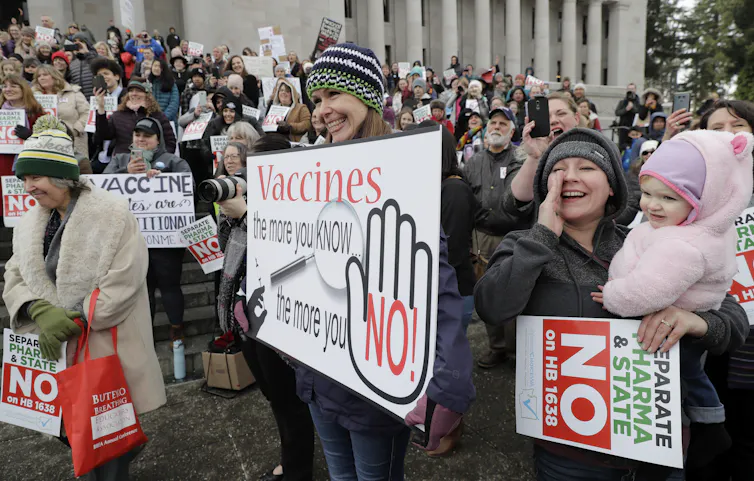
Anti-vaccine protesters at a rally.
Ted S. Warren/AP Photo

Timothy Callaghan, Texas A&M University and Matt Motta, Oklahoma State University

Over 1,160 cases of measles have been confirmed in the U.S. in 2019. That is more measles cases in just seven months than any full year this decade, and, more problematically, more than all U.S. measles cases from 2010-2013 and 2015-2017 combined.

Lawmakers in some states, such as Washington and New York, are already stepping in to combat the outbreak by eliminating certain exemptions from vaccination. We will soon know whether these new policies produce higher vaccination rates.

However, a fundamental question remains: Why are some parents – despite the scientific community’s conclusions that childhood vaccines are safe – putting their children at risk by not vaccinating them in the first place? Public health experts and health behavior scholars like us have been trying to solve this mystery for years.

Why don’t some parents vaccinate?

Religious beliefs or barriers to accessing health services certainly explain the actions of some, but these factors do not explain the behavior of most parents who choose not to vaccinate. Instead, recent academic research
suggests that most parents who display vaccine hesitancy – by either refusing to vaccinate their children or delaying vaccination past recommended vaccine schedules – do so because of misinformation about vaccine safety, their political ideology, the influence of social media, and other factors like economic circumstances and trust.

As important as these factors are, we wondered if the behavior of vaccine-hesitant parents might also have deeper, psychological origins. For that reason, in a new paper published in Social Science and Medicine, we analyzed the possibility that parental decisions to delay vaccinating children could be driven by three underlying psychological factors: conspiratorial thinking, needle sensitivity and moral purity.

Facts don’t matter when people don’t trust them

People with conspiratorial styles of thinking tend to believe that the government, businesses and other powerful actors conspire to influence a wide range of social and political events in the world around us. They don’t necessarily believe any one particular conspiracy theory – such as the belief that NASA faked the Moon landing, or that someone other than Lee Harvey Oswald killed President John F. Kennedy. Still, because many conspiracy theories involve collusion between powerful actors, these people are more likely than the typical American to belief in conspiracy theories generally.

Given the variety of conspiracy theories surrounding vaccine safety, including disproven theories that vaccines cause autism or that pharmaceutical companies are hiding the dangers of vaccines, we wanted to test whether parents with tendencies toward conspiratorial styles of thought may be more likely to delay vaccinating their children because they have internalized these conspiracies.

Needle fear and vaccine behavior

In addition, we also wanted to see whether parents who are afraid of or are otherwise averse to needles themselves – what psychologists call “needle sensitivity” – are less likely to vaccinate their children when they are supposed to. Prior research suggests that as many as 24% of adults have a fear of needles and that up to 90% of 15-18 month old children and 45% of children aged 4 to 6 are seriously distressed by injections.

Given these statistics, we wanted to see whether some parental decisions not to vaccinate weren’t necessarily because they thought vaccines were dangerous, but because the parents were afraid of needles and didn’t want to put their children through something that causes them so much distress.

The role of bodily sanctity

Finally, we wanted to test whether a notion called moral purity – an aversion to actions that violate bodily sanctity – might also explain parental anti-vax behavior.

Individuals with high levels of moral purity try to avoid experiences that induce disgust, violate sanctity or corrupt the body. While vaccines are widely regarded as safe, we, like some other scholars studying related topics, hypothesized that some might see the injection of the disease antigens found in vaccines as a violation of the body’s purity that should be avoided in their children.

Psychological predictors of parental vaccine behavior

Parents cite many reasons for not vaccinating their children.
karelnoppe/shutterstock.com

To test our hypotheses, we asked more than 4,000 American parents in a September 2018 survey about the vaccination decisions they made for their children and why they made those decisions. Specifically, we asked parents if they had ever delayed vaccinating their children, if they had only vaccinated their children because they had to for school, if they had chosen their child’s doctor based on their willingness to delay vaccinating, and if they would be willing to relocate their families so their child could attend a school that does not require vaccination.

Before asking these questions, we also gave survey respondents a series of questions designed to measure conspiratorial thinking, needle sensitivity and moral purity, as well as standard demographic questions.

In support of our expectations, we found that parents with high levels of conspiratorial thinking were 15% more likely to report delaying their children’s vaccinations. They were also 11% more likely to report having chosen their doctors based on their willingness to delay, 25% more likely to report only vaccinating their children so they can enroll in school, and 18% more likely to claim that they would be willing to relocate to a new school district.

We also found that parents’ psychological dispositions toward needles influenced reported anti-vaccination behavior. Parents in our study with high levels of sensitivity toward needles were between 14-16% more likely to engage in the each of the delay behaviors included in our study. This would suggest that if needle-free vaccine delivery mechanisms were more widespread, we might get many of these children their vaccines on time. Inconsistent with our predictions, we found no evidence that parents’ beliefs in moral purity altered their vaccine decision-making for their children, broadly speaking.

A difficult process

Our research suggests that anti-vaccine attitudes have deeply grounded psychological origins, which may be quite difficult to change. Consequently, our work identifies an important challenge for medical professionals, health departments and scientists: How can they convince vaccine hesitant parents to vaccinate their children, when it is unlikely that they’ll be able to make parents stop fearing needles, or to stop endorsing a conspiratorial way of thinking?

One possibility is to present information about vaccines to parents strategically, using the psychological factors identified here as important determinants of anti-vaccine behavior as a guide. For example, if we know that parents who are prone to thinking in conspiratorial ways are less likely to want to vaccinate their children, efforts to encourage childhood vaccination may be more successful if we avoid making mention of scientific studies, which parents might see as motivated by ulterior motives, or tying information to health departments (which these parents might find untrustworthy).

Figuring out which communication strategies are most effective for different audiences is something academics and science communicators still need to test. We hope, however, that our work offers a useful starting point for doing precisely this.

[ Like what you’ve read? Want more? Sign up for The Conversation’s daily newsletter. ]The Conversation

Timothy Callaghan, Assistant Professor, Texas A&M University School of Public Health, Texas A&M University and Matt Motta, Assistant Professor of Political Science, Oklahoma State University

This article is republished from The Conversation under a Creative Commons license. Read the original article.

==================================================================

This simple statement is so much bigger than just vaccinations – important though those are. It speaks to everything that is wrong with our nation, indeed with the world, particularly today.

Alecto, Megaera, and Tisiphone, if you can come up with a solution, or even one or more partial solutions, to this, you will save the world. That’s the bottom line.

The Furies and I will be back.

Cross posted to Care2 HERE.

Share

Everyday Erinyes #176

 Posted by at 7:42 am  Politics
Jul 272019
 

Experts in autocracies have pointed out that it is, unfortunately, easy to slip into normalizing the tyrant, hence it is important to hang on to outrage. These incidents which seem to call for the efforts of the Greek Furies (Erinyes) to come and deal with them will, I hope, help with that. As a reminder, though no one really knows how many there were supposed to be, the three names we have are Alecto, Megaera, and Tisiphone. These roughly translate as “unceasing,” “grudging,” and “vengeful destruction.”

I’ve written about Jeffrey Sterling before, back in 2016, along with other whistleblowers. I had planned this for last week, but it’s really more appropriate for today, since it’s now closer to National Whistleblowers Day, which comes up again on July 30 – if Cheetolini signs it (and if he doesn’t, we can celebrate anyway.) Jeffrey is on my radar now because he has a book coming out in October, and Roots Action has sent out an email announcing it. It includes a new essay from him. His essays are always thought provoking, even if one doesn’t always agree with every point. (The last one, for intance, discussed a scene in King Lear – and how the best human being in it is a character who has one line before Regan stabs him, killing him. Jeffrey is not the first person to notice that, but he wrote well about it.)

His newest essay touches on what the Supreme Court is doing, including one case in which Justice Thomas wrote a very strange opinion- an opinion which really ought to interest the Furies. But I’ll let Jeffrey speak:
==================================================================
There is so much to talk about, but recently there have been some developments that reminded me of not only the idealism of law in this country I had when I was in law school, but also the ugly truth of the law when I was persecuted by it. When I was in the desolation of prison, I found it quite interesting how my fellow inmates were so acutely aware of the machinations of the Supreme Court. I thought it somewhat sad that a direct impact like incarceration was what encouraged a person to pay attention to the decisions of the highest court of the land. But, that is typical of people outside prison walls as well, isn’t it? Most Americans pay little attention to the day’s issues unless and until there is either a direct or perceived impact. The latest round of decisions from the highest court reminds me of the dangers of not paying attention to decisions of the Supreme Court.

This most recent Supreme Court term has been surprising in many ways. I was genuinely surprised when the court struck down the Trump administration’s attempt to put a citizenship question on the census, and genuinely saddened when the Court refused to see the obvious implications to the constitutional doctrine of the separation of church and state by allowing a giant cross to remain on public land as well as refusing to address partisan gerrymandering. Reading over those decisions, it seems apparent to me that basing an administration policy on outright, unsupported bias is frowned upon by the Court, but plain as day government support of religious favoritism and political/racial shenanigans which interfere with the sacred right to vote, are issues the highest court of the land does not see as counter to the principles of the Constitution.

In law school, I learned that The Constitution is supposed to protect the people from the government, but increasingly with political appointments, dogmatic inclinations, it is being used as a tool to protect the government from the people. Stagnating the principles of the highest law of the land is akin to killing a document that was meant to be a living, evolving protection for the people….

This raises the question, who are Supreme Court judges accountable to? Certainly no reasonable application of the law can withstand the political leanings which usually result in decisions that show a propensity to arbitrarily mold the law to an issue as opposed to fitting an alleged act to the law. Seems many on this current Supreme Court are accountable to nothing but their own politically inspired and beholden whims and shortsightedness. Take for example the ravings of Justice Clarence Thomas. This term, his true self has sprung up loud and clear, particularly in some of his dissents. In particular, in one case, Thomas felt the obvious racist actions by a prosecutor against a black defendant were “blameless.” Astonishingly, he was not alone in that dissent. Dissenting opinions may not seem all important, but I remember in law school one of my favorite professors routinely encouraged his students to review dissenting opinions as a way of gaining better insight on the majority opinion and also to provide a snapshot of a particular justice or justices and what direction the court could potentially take. History has shown that dissent, particularly on the Supreme Court, can eventually turn into the majority. I’m not sure, given the current propensities of the Court, whether that is a good or bad eventuality.

I do believe judges, and particularly Supreme Court justices, have to be held accountable for their decisions. The confirmation process is nothing more than a litmus test of political support, not inquiry on the fitness of a person to sit on the highest court of the land. A start could be abolishing lifetime appointments and voting in elected officials who are more interested in the sanctity of the law as opposed to their dogmatic and political ambitions which do more to divide the country than to unify it.

Given the obvious ambivalence of the Supreme Court, I hope more attention will be given to their decisions. I fear the implications of not doing so. Like my fellow inmates, when you’ve waited until the last minute to be hopeful for a good outcome, most times it is too late.
==================================================================
Alecto, Megaera, and Tisiphone, I suppose it’s past praying for to expect Justice Thomas to wake up and smell the coffee. But I hope you will still keep an eye on him – and on the Court as a whole.

The Furies and I will be back.

Cross posted to Care2 HERE.
Share

Everyday Erinyes #175

 Posted by at 11:27 am  Politics
Jul 202019
 

Experts in autocracies have pointed out that it is, unfortunately, easy to slip into normalizing the tyrant, hence it is important to hang on to outrage. These incidents which seem to call for the efforts of the Greek Furies (Erinyes) to come and deal with them will, I hope, help with that. As a reminder, though no one really knows how many there were supposed to be, the three names we have are Alecto, Megaera, and Tisiphone. These roughly translate as “unceasing,” “grudging,” and “vengeful destruction.”

I have something else (partly) written, but it will keep. I fell into a story this morning which is important, and licensed under a Creative Commons Attribution-Share Alike 3.0 License, so it can be quoted.

Incidentally, I have been predicting since the 1980’s that the US would be seeing a dumbing down of citizens due in part to children being exposed to “stuff.” Of course there are many other contributors, such as exponentially increased home schooling for all the wrong reasons (yes, there are some good reasons, but that’s not what we’re seeing, and in any case, good reasons would not account for the numbers), and yes, there are many people who grew up in the eighties and since, and who are growing up now, who are pretty clearly not impaired, but with so many Americans, there is clearly something going on. Naturally, Republicans not only don’t mind the existing conditions, but want to worsen them (I assume to ensure a steady supply of Republican voters.)
==================================================================
Published on
Friday, July 19, 2019
by Common Dreams

‘A Total Disgrace’: Outrage as Trump EPA Says It Won’t Ban Pesticide Linked to Brain Damage in Children

“The EPA is endangering the lives of children to protect pesticide industry profits.”

by Jake Johnson, staff writer

In a move environmentalists denounced as yet another case of the Trump administration putting industry profits over public health, the Environmental Protection Agency announced on Thursday that it will not ban chlorpyrifos, a pesticide linked to brain damage in children.

“By allowing chlorpyrifos to stay in our fruits and vegetables, Trump’s EPA is breaking the law and neglecting the overwhelming scientific evidence that this pesticide harms children’s brains,” Patti Goldman, attorney with Earthjustice said in a statement. “It is a tragedy that this administration sides with corporations instead of children’s health.”

EPA chief Andrew Wheeler’s decision to reject a petition by environmental groups calling for a ban on the neurotoxic chemical ignores the assessments of his agency’s own scientists, said Tiffany Finck-Haynes, pesticides and pollinators program manager for Friends of the Earth.

“The EPA’s refusal to ban chlorpyrifos ignores decades of science showing that this pesticide has irrevocable effects on human health and the environment,” said Finck-Haynes. “The EPA is endangering the lives of children to protect pesticide industry profits.”

Chlorpyrifos has been banned for household use since 2000, but the pesticide is still used by farmers on “more than 50 fruit, nut, cereal, and vegetable crops,” according to the New York Times.

“In 2016,” the Times reported, “more than 640,000 acres were treated with chlorpyrifos in California alone.”

The Obama administration in 2015 proposed banning use of the pesticide on food crops, but former EPA administrator Scott Pruitt authorized its continued use in 2017.

“This is a total disgrace,” Rep. Mike Levin (D-Calif.) tweeted in response to the EPA’s decision on Thursday.

Finck-Haynes of Friends of the Earth said that as the federal government continues to work on behalf of chemical interests, states must take immediate action to protect the public and the environment.

“While the federal government refuses to act, we urge states to step in, ban chlorpyrifos, and demonstrate that they will safeguard public health and the environment,” said Finck-Haynes. “We call on [New York] Governor [Andrew] Cuomo to sign the chlorpyrifos ban bill sitting on his desk and protect New Yorkers from this toxic pesticide.”

In a statement on Thursday, the Natural Resources Defense Council (NRDC) highlighted the Trump administration’s ties to Dow Chemical, the largest producer of chlorpyrifos in the United States.

“The relationship between President Trump and Dow Chemical… has been called into question,” the group said. “Among other things, the chemical manufacturing giant reportedly donated $1 million for Trump’s inauguration, and its CEO previously played a chief advisory role to the president, heading up his now defunct American Manufacturing Council.”

Erik Olson, senior director of health and food at NRDC, said the effort to achieve a ban on chlorpyrifos will continue.

“Until EPA gets this stuff out of our fields and off our food,” said Olson, “this fight is not over.”
==================================================================
Alecto, Megaera, and Tisiphone, I despair of the current national regime. But maybe you could help the states pass legislation of their own. Some are already doing so, but more are needed.

The Furies and I will be back.

Cross posted to Care2 HERE.

Share

Everyday Erinyes #174

 Posted by at 8:08 am  Politics
Jul 132019
 

Experts in autocracies have pointed out that it is, unfortunately, easy to slip into normalizing the tyrant, hence it is important to hang on to outrage. These incidents which seem to call for the efforts of the Greek Furies (Erinyes) to come and deal with them will, I hope, help with that. As a reminder, though no one really knows how many there were supposed to be, the three names we have are Alecto, Megaera, and Tisiphone. These roughly translate as “unceasing,” “grudging,” and “vengeful destruction.”

I suspect that everyone who read it remembers the article in which I asked the Furies to take on facial recognition technology, since it was fairly scary. If so, you are not the only ones scared. The people of Detroit, and, in particular, the people of color of Detroit, are pretty nervous at this point.

Let me start with the background that Detroit already uses facial recognition technology on over 500 traffic lights. What is now being considered is to employ facial recognition technology in neighborhood policing, specifically in violent crimes (after the fact), or in cases when terrorism is suspected. “After the fact” as used here means

The chief said facial recognition technology is only used after-the-fact, when police have already identified a suspect on video. A still image of that suspect would be fed into the software and compared with police mugshots and pictures in the Michigan Secretary of State database, and on social media. 

The chief also compared the use of the technology to the use of a police sketch.

“That [recognition by the technology] by itself is not good enough,” he said. “This is no different from a sketch, which police have used for years. It’s a tool we use to get violent suspects off the streets. Is there a chance you may arrest the wrong person? Yes. But it won’t be used as the sole evidence against someone.” 

If you have read as many news stories as I have where innocent people of color have been falsely stopped because they “fit a profile,” many of which stops ended in tragedy, you might be tempted to say that facial recognition technology could hardly do a worse job than humans can on this point. But you would be wrong. there have been tests in which facial recognition technology was unable to identify Oprah Winfrey and Michelle Obama. Apparently the technology can say, “All those people look alike” as well as a human can, or maybe even better.

As a demonstration – and this is NOT intended to excuse anyone; on the contrary, it is to show how much MORE responsibility we have to take care when something is difficult to see – here is a small part of a screen shot from a “hidden object” game, where one is supposed to find objects more or less hidden in plain sight. Within this screen shot there is a silhouette of a common swift (the bird shown in the smaller cut). I am not going to swear it is in the same position as the smaller picture, because I never did succeed in seeing it. But a hint allowed me to click on it (after I took the screen shot), so I know it is there. Bottom line, it is just harder to see things when there is not a lot of contrast in the lighting, and apparently, this also applies to recognition technology. But that is ALL THE MORE reason why no one should ever rush into its use. San Francisco – hardly an enemy of technology in general – has outlawed its use in law enforcement for exactly this reason.

Back in Michigan, the state legislature there is considering a five-year moratorium on the use of facial recognition technology – the bill was introduced to the state house Wednesday by a Democratic representative from Detroit. I don’t know whether he failed to mention the bill to the police chief and police commissioners, or whether they decided to try to get their new technology in place before the bill could go into effect. But it would seem to me that Thursday, then, was not the best time to consider that technology. It would seem instead a good time to postpone such discussion, so as not to commit to wasting money on a program which might have to be scrapped. But maybe that’s just me.

Well, me and Commissioner Willie Butler, elected from District 6 in Detroit. He attempted three times to ask questions of the chair on behalf of his constituents (many of whom were present, wearing masks, to protest the technology – not that all the protesters were from his distract of course), and the third time the Chair ordered him removed.

He was in fact physically removed by police officers, and, out of the meeting room, was arrested, handcuffed, and taken to jail. (I hope Trump doesn’t see this … but I kind of wish Congress would.) He was released Friday morning on bail, posted by another Commissioner. So we are now up to just me, Commissioner Butler, the Commissioner who bailed him out, and a substantial number of protesters.

My head hurts.

Alecto, Megaera, and Tisiphone, I already asked you in March to look into facial recognition technology and the ways it is being used and misused. I now reiterate that, but I also suggest that there is something to find in Detroit that goes beyond disagreements on technology, if they are willing to lock up a, for heaven’s sake, a police commissioner who disapproves of its use.

The Furies and I will be back.

Cross posted to Care2 HERE.

Share

Everyday Erinyes #173

 Posted by at 9:09 am  Politics
Jul 062019
 

Experts in autocracies have pointed out that it is, unfortunately, easy to slip into normalizing the tyrant, hence it is important to hang on to outrage. These incidents which seem to call for the efforts of the Greek Furies (Erinyes) to come and deal with them will, I hope, help with that. As a reminder, though no one really knows how many there were supposed to be, the three names we have are Alecto, Megaera, and Tisiphone. These roughly translate as “unceasing,” “grudging,” and “vengeful destruction.”

With so much of our national attention focused on the concentration camps at our southern border, I thought the time might be right to look at a scholarly view on all kinds of civil rights issues faced by Mexicans in the United States. So I thought I’d share this report by David FitzGerald, Angela Y. McClain, and Gustavo López. I do want to point out that the study population comprised people who were born in Mexico and are now living in the United States. That includes documented immigrants, undocumented immigrants, citizens of the US, and non-citizens of the US, who were born in Mexico. It does not include anyone from Central or South America other than Mexico, though it may not be unreasonable to conclude that those persons may experience similar treatment.

================================================================

Mexicans in US routinely confront legal abuse, racial profiling, ICE targeting and other civil rights violations

The civil rights of 11.3 million Mexican nationals who live in the US are routinely violated, according to a comprehensive new report on U.S. immigration enforcement since 2009.
AP Photo/Matt York

David FitzGerald, University of California San Diego; Angela Y. McClean, University of California San Diego, and Gustavo López, University of California San Diego

Officially, the Constitution of the United States gives everyone on U.S. soil equal protection under the law – regardless of nationality or legal status.

But, as recent stories of the neglectful treatment of migrant children in government detention centers demonstrate, these civil rights are not always granted to immigrants.

We are scholars focused on U.S.-Mexico migration. Our report on the enforcement of U.S. immigration law under presidents Barack Obama and Donald Trump, presented in February to Mexico’s National Human Rights Commission, documented pervasive and systematic civil rights violations against Mexicans living in the United States.

Some of the abuses we documented – which include racial profiling, discriminatory treatment and due process violations – result from the Trump administration’s anti-immigration policies. Others began much earlier, under Obama or well before.

All paint a troubling picture about the rule of law in the United States and the challenges facing America’s largest immigrant group.

Discrimination and deportation

An estimated 11.3 million people born in Mexico now live in the United States – 3% of the total U.S. population.

About 5 million of them are unauthorized immigrants, meaning Mexicans make up just under half of the 10.5 million undocumented immigrants in the country. The other 6.3 million Mexicans in the U.S. are either lawful permanent residents or dual nationals who are naturalized U.S. citizens.

Based on these figures, we found, Immigration and Customs Enforcement – or ICE, the agency that carries out the nation’s immigration laws – arrests Mexican immigrants at levels that are disproportionate to their share of the unauthorized immigrant population.

Roughly 70% of immigrants deported from the U.S. interior in 2015 were Mexican, the most recent year that such detailed deportation data are available.

Another 550,000 young Mexican American “Dreamers” – immigrants who were brought to the U.S. unlawfully as children – became subject to deportation when Trump in September 2017 rescinded the Deferred Action for Childhood Arrivals program, which gave them temporary protection from deportation.

Not all deportations violate immigrants’ civil rights. The Immigration and Nationality Act says immigrants may be deported for violating a long list of criminal and administrative laws.

But evidence suggests that Mexicans and other Latinos are sometimes targeted for arrest based on their race or ethnicity.

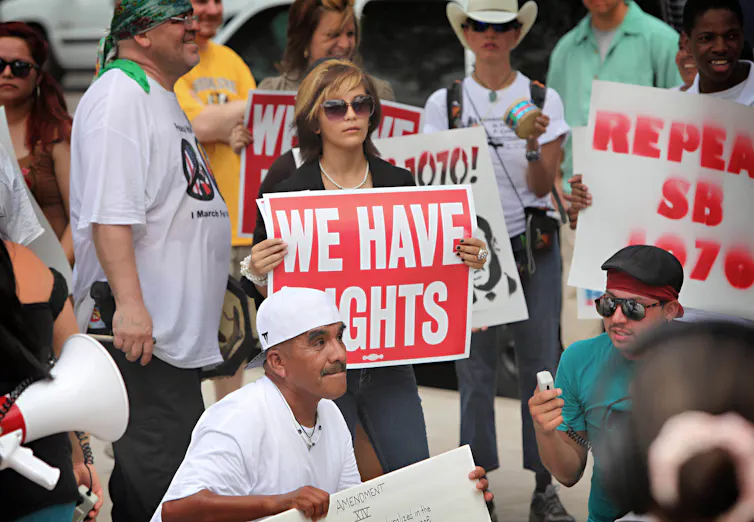
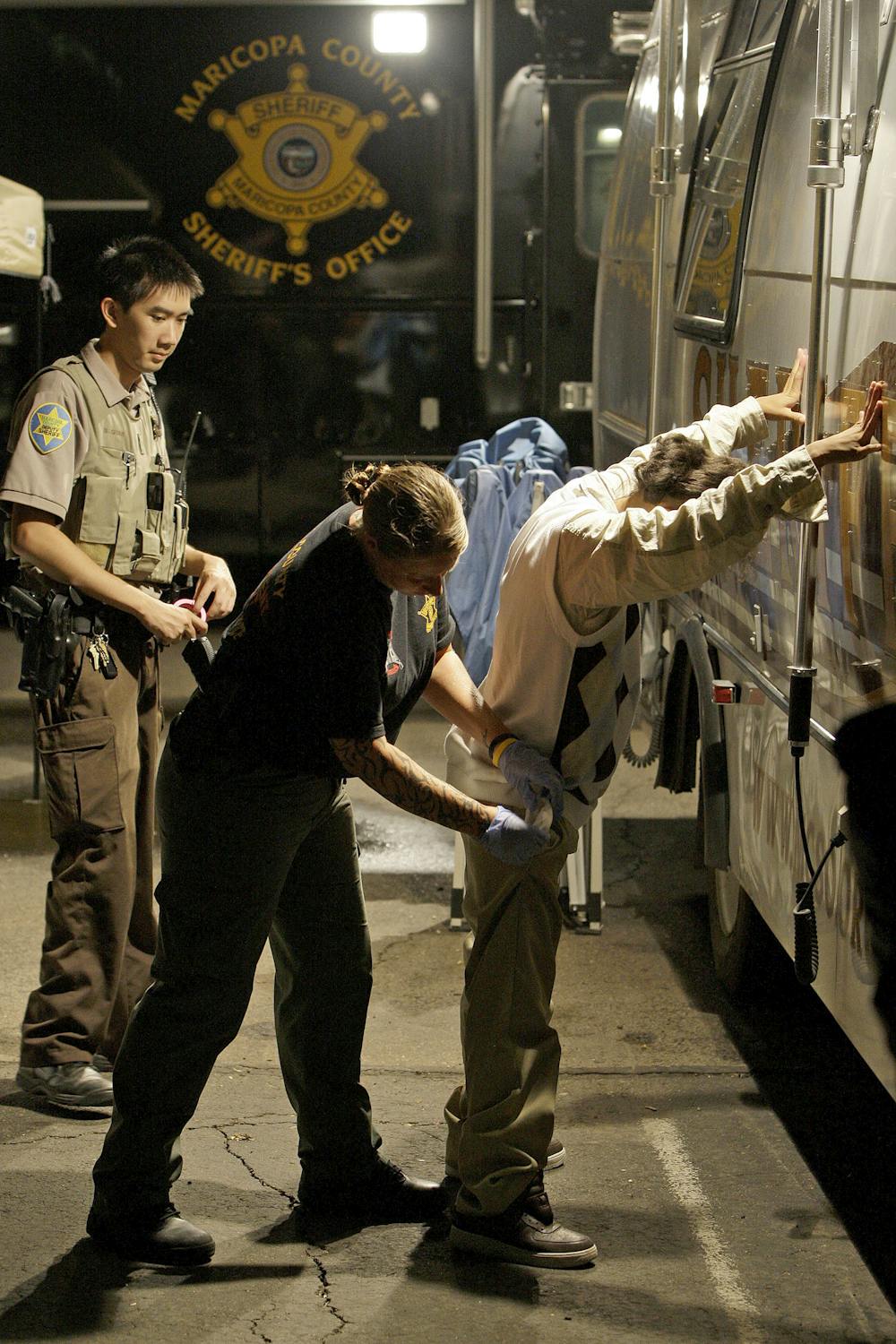
In 2013 a federal judge ruled that police in Maricopa County, Arizona, were racial profiling Latinos in traffic stops that targeted immigrants.
AP Photo/Ross D. Franklin

In 2014, independent monitors at a Customs and Border Protection checkpoint in Arivaca, Arizona, just north of the U.S.-Mexico border, found that vehicle occupants who appeared to be Latino were 26 times more likely to be asked to show identification than white-looking vehicle occupants, who are frequently waved through the checkpoint.

And in 2012, a U.S. Department of Justice investigation in Alamance County, North Carolina, found that the sheriff had instructed deputies to “go out there and get me some of those taco eaters” by targeting Latinos in traffic stops and other law enforcement activities.

The DOJ concluded that the county demonstrated an “egregious pattern of racial profiling” – a violation of the 14th Amendment, which guarantees everyone equal protection under the law.

Family separation

Mexicans in the United States have seen their constitutional rights violated in other ways.

The most egregious example was the forced separation of families found to have crossed the border illegally.

Under this Trump administration policy, which began in April 2018, at least 2,654 migrant children – and perhaps thousands more – were taken from their parents and held in government custody while their parents were criminally prosecuted for crossing the border unlawfully.

Thirty of the children known to have been separated from their families were Mexican; the rest were from Central America. Poor record-keeping has made it difficult for all of them to be reunited with their families before their parents’ deportation.

Together, these actions violate the constitutional rights to legal due process, equal protection and, according to the Southern District of California, the right of parents to determine the care for their children.

“The liberty interest identified in the Fifth Amendment provides a right to family integrity or to familial association,” wrote Judge Dana M. Sabraw in a June 2018 ruling.

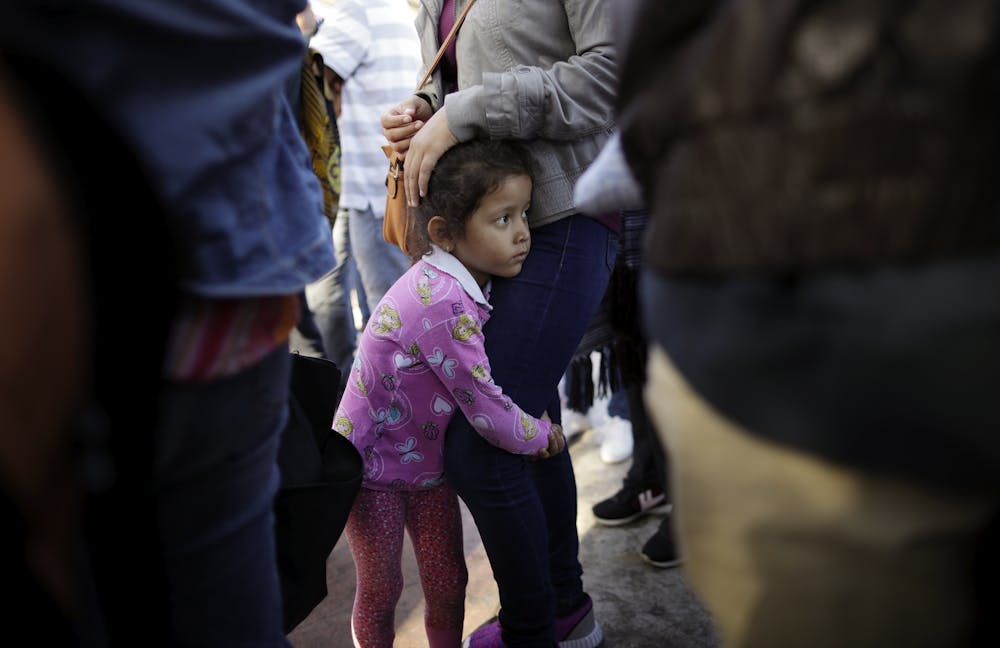
A child from Guerrero, Mexico, clings to her mother as the family waits in Tijuana to apply for asylum in the U.S., June 13, 2018.
AP Photo/Gregory Bull

More routine civil rights violations happen to Mexicans in the U.S. every day, our report found.

Though children born in the U.S. are entitled by law to American citizenship regardless of their parents’ immigration status, hundreds of undocumented Mexican women in Texas have been denied birth certificates for their U.S.-born children since 2013, according to a lawsuit filed by parents. In 2016, Texas settled the lawsuit and agreed to expand the types of documents immigrants can use to prove their identity.

And in both Arizona and Texas, so-called “show me your papers” laws allow police to demand identification from anyone they have a “reasonable suspicion” may be undocumented, which may lead to discriminatory targeting of Latinos.

Once in government detention, surveys conducted in Mexico of recently deported immigrants show, Mexican deportees are often badly treated.

On average, in 2016 and 2017, about half of all recently deported Mexicans reported having no access to medical services or a bathroom while in government custody. One-third reported experiencing extreme heat or cold.

Mexicans are not alone in their negative experiences at border patrol facilities.

A recent report by the Office of Inspector General found unsafe and unsanitary conditions at several U.S. immigrant detention centers, and immigration lawyers found food shortages at some migrant children’s shelters.

A climate of fear

While Mexicans in the United States have faced biased law enforcement and discrimination for many decades, their treatment appears to have worsened since President Trump took office in 2017 with an openly anti-Mexican agenda.

A survey of Mexicans recently deported from the United States found that the number of people who reported experiencing verbal abuse or physical assault during their time in the U.S. increased 47% between 2016 and 2017.

The number of hate crimes against Latinos reported to the FBI also rose 24% in 2017 compared to 2016 – increasing from 344 incidents to 427.

Mexico is concerned about its citizens in the United States.

In March, President Andrés Manuel López Obrador and foreign minister Marcelo Ebrard announced it would provide more consular services online to increase the reach of Mexico’s 50 brick-and-mortar consulates in the U.S. and provide more legal training to consulate officials.

To support Mexicans in the U.S. with deportation and other immigration cases, the Mexican government will also strengthen its official ties with U.S.-based legal aid providers.

In theory, Mexico shouldn’t have to scramble to defend the rights of its citizens in the U.S. because the U.S. Constitution would. But, in practice, the civil rights of immigrants are simply not always guaranteed.

[ Like what you’ve read? Want more? Sign up for The Conversation’s daily newsletter. ]The Conversation

David FitzGerald, Theodore E. Gildred Chair in U.S.-Mexican Relations, Professor of Sociology, and Co-Director of the Center for Comparative Immigration Studies, University of California San Diego; Angela Y. McClean, Ph.D. Candidate in Sociology, Fellow and Graduate Researcher at Center for Comparative Immigration Studies, University of California San Diego, and Gustavo López, Graduate Researcher at Center for Comparative Immigration Studies, University of California San Diego

This article is republished from The Conversation under a Creative Commons license. Read the original article.

===============================================================

Alecto, Megaera, and Tisiphone, clearly this pattern of civil abuse has been building for a long time, and is not going to go away overnight. But you can still help us to recognize and call it out when we see it, as well as to applaud anyone who is trying to make things better … like those quinceañeras who are using their fiestas to promote voter registration.

The Furies and I will be back.

Cross posted to Care2 HERE.

Share

Everyday Erinyes #172

 Posted by at 9:07 am  Politics
Jun 292019
 

Experts in autocracies have pointed out that it is, unfortunately, easy to slip into normalizing the tyrant, hence it is important to hang on to outrage. These incidents which seem to call for the efforts of the Greek Furies (Erinyes) to come and deal with them will, I hope, help with that. As a reminder, though no one really knows how many there were supposed to be, the three names we have are Alecto, Megaera, and Tisiphone. These roughly translate as “unceasing,” “grudging,” and “vengeful destruction.”

Some days – some weeks – it seems as though the headlines in the mainstream media are being written by the Onion, or maybe by Andy Borowitz. These things just CAN’T really be happening, can they?

Well, sadly, yes.

Take, for example, this one –

Pregnant woman indicted for manslaughter after she is shot in the stomach by another woman

Here is, not the whole story, but a more detailed summary by Walter Einenkel:

27-year-old Alabama resident Marshae Jones was taken into custody after a Jefferson County grand jury indicted her on manslaughter charges. The charges stemmed from an incident between Jones and another woman, 23-year-old Ebony Jemison, in December of 2018. According to reports, the two women got into a fight that ended with Jemison reportedly shooting Jones. Jones, who was pregnant at the time, survived but miscarried her pregnancy. Initially, authorities tried to indict Jemison on manslaughter charges in the death of the unborn fetus. However, after a jury failed to indict her, authorities turned around and charged Jones.

Pleasant Grove police Lt. Danny Reid told reporters that “It was the mother of the child who initiated and continued the fight which resulted in the death of her own unborn baby,” saying that the fetus was the only real victim of the whole event. “She had no choice in being brought unnecessarily into a fight where she was relying on her mother for protection.” (emphasis mine)

Yes, you read that correctly.

A woman shot another woman, who was pregnant. The pregnant woman subsequently miscarried.

A grand jury refused to indict the woman who fired the shot.

However, a grand jury (I don’t know whether the same or another) had no difficulty indicting the woman who was shot.

Is this insane? Or am I insane?

Wlter Einenkel, a staff member at Daily Kos, is of course concerned about this case, but also about the legal precedent which is being set:

There is also a very real and disturbing legal precedent being set. Does this mean that once a woman is determined to be pregnant, she can be indicted of manslaughter or murder if she has a soft cheese, a glass of wine, or doesn’t have the prenatal bloodwork telling her she has gestational diabetes, resulting in a miscarriage? While not the norm, there are enough woman who do not realize they are even pregnant for long stretches of time that a television series once existed telling those stories. If any of those women had happened to miscarry, would they have been considered perpetrators of “negligent homicide?”

Anyone besides me having a flashback to Lindy Chamberlain?

Meanwhile, over in Tennessee, there’s this headline –

Low-Wage Workers Are Being Sued for Unpaid Medical Bills by a Nonprofit Christian Hospital That Employs Them

In case you don’t immediately wrap your head around that (There’s a lot to take in), here’s one example:

This year, a Methodist Le Bonheur Healthcare housekeeper left her job just three hours into her shift and caught a bus to Shelby County General Sessions Court.

Wearing her black and gray uniform, she had a different kind of appointment with her employer: The hospital was suing her for unpaid medical bills.

In 2017, the nonprofit hospital system based in Memphis sued the woman for the cost of hospital stays to treat chronic abdominal pain she experienced before the hospital hired her.

She now owes Methodist more than $23,000, including around $5,800 in attorney’s fees.

It’s surreal, she said, to be sued by the organization that pays her $12.25 an hour. “You know how much you pay me. And the money you’re paying, I can’t live on,” said the housekeeper, who asked that her name not be used for fear that the hospital would fire her for talking to a reporter.

So, OK, granted that this employee’s medical expenses in question were incurred before she started working for the hospital in question (does HR have a policy of hiring people who owe them, in order to know where to find them in order to keep them in court? Seriously, in just about the last five years the hospital has filed over 8,300 lawsuits against patients – not all employees, but many were.) But another thing is, that the insurance provided to employees requires them to seek health care only through their employer, which has the least generous assistance program of any hospital in the area.

An expert in hospital billing practices said that if the hospital is suing a fair number of its own employees, it’s time to look both at the insurance provided to workers and the pay scale.

“One would hope that if this is an action being taken against a significant amount of employees, the hospital would look at the insurance they provide workers,” said Mark Rukavina, an expert in nonprofit hospitals and a manager at Community Catalyst, a health care advocacy organization.

“One would hope” – well, chalk up hope along with thoughts and prayers as things that don’t work, at least not without assistance from action.

Oh, and did I mention that this particular hospital happens to own a licensed collection agency? Hmmmmm.

Alecto, Megaera, and Tisiphone, please help us to realize that, as strange as the world, and in particular our nation, is becoming today, things like these are still not normal. And help us to do something about them.

The Furies and I will be back.

Cross posted to Care2 HERE.

Share

Everyday Erinyes #171

 Posted by at 2:35 pm  Politics
Jun 222019
 

Experts in autocracies have pointed out that it is, unfortunately, easy to slip into normalizing the tyrant, hence it is important to hang on to outrage. These incidents which seem to call for the efforts of the Greek Furies (Erinyes) to come and deal with them will, I hope, help with that. As a reminder, though no one really knows how many there were supposed to be, the three names we have are Alecto, Megaera, and Tisiphone. These roughly translate as “unceasing,” “grudging,” and “vengeful destruction.”

Since Juneteenth was this week, and I forgot to recognize it, and others have said they weren’t aware of it, I thought it might be a good time to do a little back story on it, and this article from The Conversation does a pretty good job with explaining why it matters – and how African-American independence is tied to the criminal justice system
=============================================================

Juneteenth: Freedom’s promise is still denied to thousands of blacks unable to make bail

Black men occupy a disproportionate share of prison cells in the U.S.
sakhorn/Shutterstock.com

Matthew Larson, Wayne State University

June 19 marks Juneteenth, a celebration of the de facto end of slavery in the United States.

For hundreds of thousands of African-Americans stuck in pretrial detention – accused but not convicted of a crime, and unable to leave because of bail – that promise remains unfulfilled. And coming immediately after Father’s Day, it’s also a reminder of the loss associated with the forced separation of families.

On a very personal level, I know how this separation feels. Every Father’s Day since 2011, I’ve been reminded of the unexpected death of my dad at the age of 48. But also on a professional level, as a criminologist who has been researching mass incarceration for the past decade, I understand the disproportionate impact it’s had on African-Americans, destabilizing black families in the process.

Blacks behind bars

Juneteenth is a celebration of African-Americans’ triumph over slavery and access to freedom in the U.S., which occurred in Galveston, Texas, in June of 1865, over two and a half years after President Lincoln’s Emancipation Proclamation.

While Juneteenth is a momentous day in U.S. history, it is important to appreciate that the civil rights and liberties promised to African-Americans have yet to be fully realized. As legal scholar Michelle Alexander forcefully explains, this is a consequence of Jim Crow laws and the proliferation of incarceration that began in the 1970s, including the increase of people placed in pretrial detention and other criminal justice policies.

There are 2.3 million people currently incarcerated in American prisons and jails – including those not convicted of any crime. Black people comprise 40 percent of them, even though they represent just 13 percent of the U.S. population.

Protesters march through Harlem in the March for Justice.
Rainmaker Photo/MediaPunch/IPX

Not yet guilty but not free

More troubling is the number of incarcerated individuals currently held in jail for crimes of which they have not yet been convicted.

The Prison Policy Initiative, a nonpartisan think tank that focuses on mass incarceration, has reported that over a half million citizens are languishing in pretrial detention. And like most criminal justice outcomes, the burden of this disproportionately falls on minorities, especially black men and women.

In local jails alone, over 300,000 people are awaiting trial for property, drug or public order crimes. And again, these disproportionately black defendants are confined and separated from their families, friends and jobs simply because they lack the means to post cash bail – the only reason they can’t get out.

Toll on families

It should be no surprise, then, that 1 in 9 black children now has a parent behind bars, compared with the national rate of 1 in 28.

And many of these children are at an increased likelihood of experiencing physical and mental health issues, academic struggles and a range of other behavioral problems. Children of incarcerated mothers are also at heightened odds of ending up in foster care and being exposed to other traumas.

Being the partner of an incarcerated individual is another often stressful experience that also falls disproportionately on black citizens, particularly women.

Some good news

The good news is that such injustices are receiving growing attention nationwide.

Just City, a nonprofit organization working to reduce the harms of the criminal justice system, has campaigned to raise funds and promote awareness of its Memphis Community Bail Fund project for Father’s Day – in part because nearly half a million of the black men behind bars are dads.

The aim of the project is to provide both financial and legal support for defendants lacking resources to independently secure their pretrial release, with the goal of the campaign being the release of jailed fathers so that they could be with their kids for the holiday.

Bail funds similar to Just City’s have proliferated throughout the U.S.

On one hand, the multiplication of these organizations is encouraging and reason for optimism. On the other, their growth is another reminder that many of the freedoms celebrated on Juneteenth remain unrealized.

A long road continues

In cities like Detroit, where 1 in 7 adult males is under some form of correctional control in some communities, it is a monumental task to make sense of the short- and long-term impacts of incarceration for black families.

Children suffer. Parents struggle. Relationships deteriorate. And as a result, so too do so many African-American communities. Lost wages matter to families, but they also matter to communities. The lower tax base that results makes it more difficult for struggling public institutions, like schools, to progress. And with such a large share of individuals removed from some communities due to incarceration, and branded as felons upon their release, these communities lose potential voters and the political capital they carry. They are too often disenfranchised and stripped of their full power and potential.

Juneteenth celebrates the freedom of black Americans and the long, hard road they were forced to traverse to gain that freedom. But as criminologists like me have maintained time and again, the U.S. criminal justice system remains biased, albeit implicitly, against them.The Conversation

Matthew Larson, Assistant Professor of Criminal Justice, Wayne State University

This article is republished from The Conversation under a Creative Commons license. Read the original article.

==============================================================
Alecto, Megaera, and Tisiphone, please join activists in helping to equalize our criminal justice system so the free people can actually live in freedom.

And for all of us who want to share the Juneteenth message with people we know who may never have heard of it, let alone know anything about it, here’s a video – three minutes long – which may help to make it more easily sharable.

The Furies and I will be back.

Cross posted to Care2 HERE.

Share