Republicans for the Rule of Law (it’s also on Twitter)
Meidas Touch
John Pavlovitz – he doesn’t use the phrase “the bottom line” but that’s a fair description.
Trae on the Republican Terrorism Boogaloo
From Crooks & Liars – the brother of a woman killed in insurrection wants 25th Amendment
Not a video but a stunning Tweet to Hawley
It's Orwellian, just not in the way you think. George Orwell took a bullet in the neck fighting fascists in Spain because he hated them so much. Canceling fascists was his thing. So yeah, this is Orwellian. https://t.co/3b6oBWp4V2
This video is not political, but it is an example of what can be done wirh AI and photoshop, and is thus worth seeing. It’s 10+ minutes,but you don’t need to get all the way through to get creeped out by watching someone almpst 2000 years dead blinking.
Experts in autocracies have pointed out that it is, unfortunately, easy to slip into normalizing the tyrant, hence it is important to hang on to outrage. These incidents which seem to call for the efforts of the Greek Furies (Erinyes) to come and deal with them will, I hope, help with that. As a reminder, though no one really knows how many there were supposed to be, the three names we have are Alecto, Megaera, and Tisiphone. These roughly translate as “unceasing,” “grudging,” and “vengeful destruction.”
I’ve been doing these for a long time – closing in on five years – and, at least for me, it has not been difficult to hang on to outrage. In fact, I’ve often found it a challenge to hang on to anything else. But, as this article points out, the events of this week have created an environment in which, going forward, it will be at least equally necessary to hold on to our vigilance – to our vision, to or “nose,” to our gut feelings, or however you perceive danger. We are not out of the woods yet.
================================================================
‘Once you engage in political violence, it becomes easier to do it again’ – an expert on political violence reflects on events at the Capitol
Editor’s note: Ore Koren is a scholar of civil conflict and political violence. Before the November 2020 election, he wrote a story for The Conversation about the likelihood of election-related violence in the U.S. So we went back to him on Wednesday, while what some are calling an insurrection unfolded at the U.S. Capitol, to ask him for some perspective on the event. This transcript has been edited for length and clarity.
Q: You’re a scholar of political violence. What were you thinking as you watched what’s happened at the U.S. Capitol?
Koren: First of all, I felt pretty stunned. I think that’s a natural response to this. This is a new situation; it shows the power of misinformation and stuff that we’re not really good at dealing with.
My research focuses on organized political violence, which often happens in places where the state does not have much power to prevent violence, where the economy is underdeveloped, where democratic institutions are weak, and where there is a history of organized violence. And usually when we see events at this magnitude, they are accompanied by many casualties, which thankfully was not the case today.
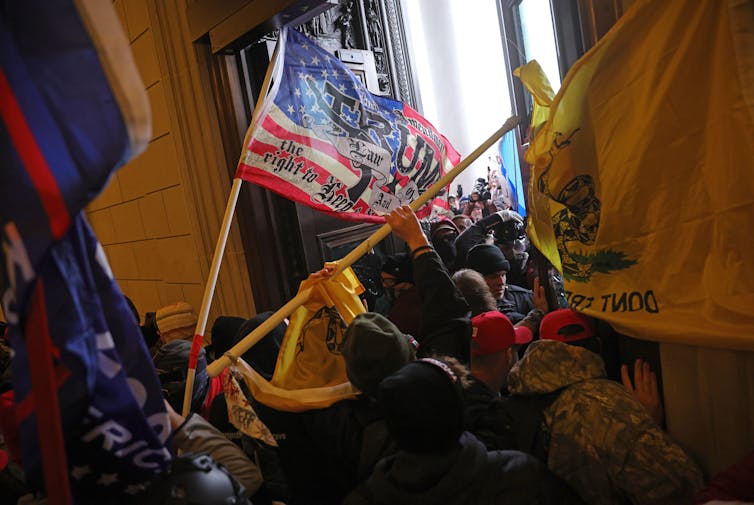
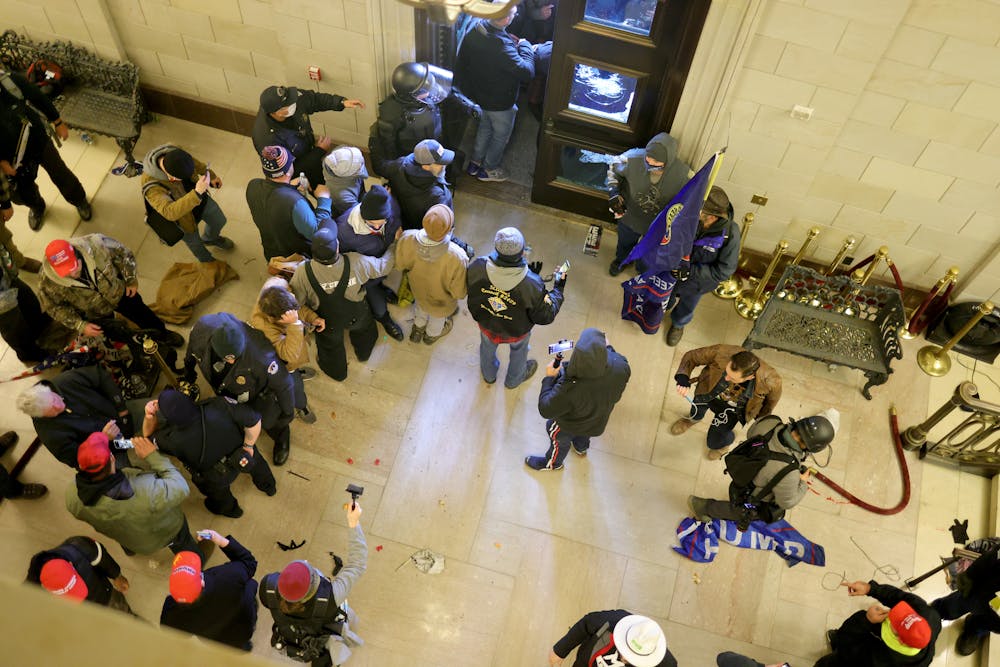
What happened at the Capitol, from what I can tell, was a messy riot where people lashed out at the heart of American democracy, but it remains unclear how organized an effort this was.
Still, it is kind of shocking. We have the biggest economy in the world. Based on what we see in the research, weak economic performance is a strong predictor of organized political violence. The people marching on the Capitol have much more to lose than to gain from this, and to me that’s puzzling.
With an incumbent who has been advocating for a strong law-and-order agenda, many people did not expect this. In a country with a strong domestic security apparatus, militias and vigilantes hurt rather than help in promoting the rule of law.
What separates the U.S. and other advanced and militarily capable democracies from other countries where deadly election violence happens is the ability to wage an effective state response and very quickly implement the rule of law, cracking down on both the perpetrators and any groups they might be affiliated with.
One example of a very effective state response was in Michigan, where the militias plotting to kidnap the state’s governor were quickly apprehended by federal authorities.
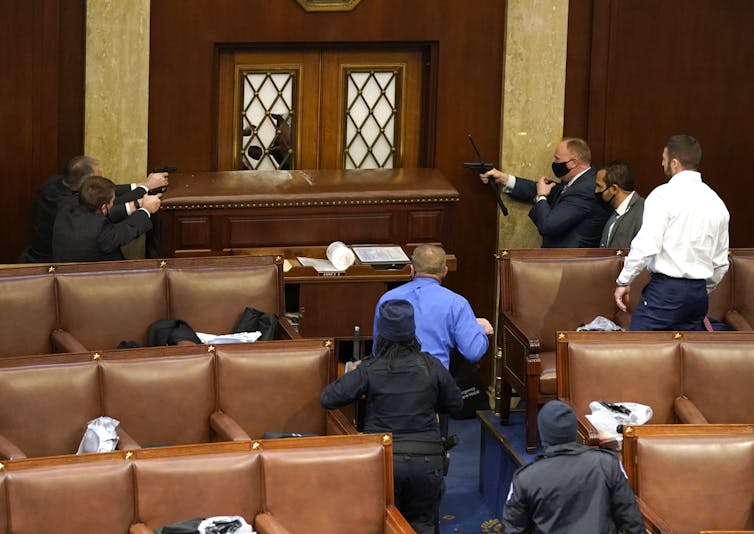
U.S. Capitol police officers point their guns at a door that was vandalized in the House chamber during a joint session of Congress on Wednesday in Washington, D.C. Drew Angerer/Getty Images News via Getty Images
Q: How does this compare with political violence in countries you’ve studied?
Koren: Compared to other countries, I’m hoping it won’t get to that threshold of being more extreme. A lot of violence actually happens when a party refuses to give away power or a party blames the other for cheating. Well, that’s kind of what we saw happening here, right, one party was blaming the other for cheating. Only here, we had lots of evidence to the contrary, and we had legal and institutional ways of verifying any cheating or lack thereof.
In the U.S., most of the election challenges happened through formal legal channels. The main problem in places where we see violence happen is because they don’t have these kinds of institutions to deal with this, courts, all those things that our legal system can handle. But in countries where such institutions are weak, the state can’t handle that, and can’t address election challenges through a peaceful process. In this case, we see many political leaders, and not only angry citizens, saying those political institutions are not valid.
Also, in other countries, those engaging in such violence are often pro-government militias, but these are not pro-government militias we’re seeing here; as we saw today, they are actively opposing the police.
Q: But what you’ve got in the U.S. is a group of people who actually don’t believe that those institutions handled this, that it’s all corrupt, that it’s all fake and not real and cheating and plots happened. And we’ve had a president saying that.
Koren: Well, you have the president saying he was cheated, but going through the legal channels. The president didn’t just go and say, “OK, let’s go charge the Capitol,” although Wednesday morning’s speech could definitely be interpreted as instigating something like this. Until now, his rhetoric could be considered more about mobilizing support, and trying to create enough reasonable doubt that could then be used to pressure the results through formal channels.
But we do have a very unpredictable incumbent pushing the legal envelope during the worst pandemic in a century. What we’re seeing today, I think, has a lot more to do with his unpredictability and things we can’t account for in models we use to study political violence events. It’s been more than two months since the election and we didn’t see any serious violence until now, but as the legal options closed, the situation became more problematic. We don’t often see election-related violence months after an election.
Q: What do you think this means for the stability of the U.S. government or U.S. elections?
Koren: I’m not an election expert, but it’s a bad precedent. We don’t have a recent history of election violence and, now we can say we do have it, and that’s not a good thing.
What hugely contributed to all of this is misinformation. People mobilized based on a conspiracy with no evidence. I think this is a major problem that has to be addressed – I don’t know how. But it is really crucial to address the underlying problem – that people believe in what they feel is real, not what is real.
Once you engage in political violence, it becomes easier to do it again. But if there’s an effective state response to these events, then it can help strengthen those institutions.
So, I think a lot of people will be saying, look, this is all going to have long-term negative implications. But there’s also a possibility that this can actually help in the long run by showing the grave consequences of manipulating democratic institutions for political gain. Again, it depends on how the state and politicians and security and everybody responds to this. But having a history of political violence is a pretty strong predictor of future violence.
I think it’s really important for federal authorities to show their ability to tackle this. When it comes down to it, the government must show that it can protect American democracy, through force if necessary.
================================================================ Alecto, Megaera, and Tisiphone, Professor Koren says, “In a country with a strong domestic security apparatus, militias and vigilantes hurt rather than help in promoting the rule of law.” this article does not back that up with evidence, but if someone who has studied this subject as he has says this, you can bet he’s able to back it up. And, if that’s the case, what does that say about the Second Amendment? I do not believe that even the dumbest of out Founders was dumb enough not to realize that as true once there was sufficient evidence.
Interestingly, as you may already have heard from “The Petition Site” (formerly Care2), my old college is doing study on guns and people’s opinions about them. Anyone can participate. Here’s the link.
Rev. Warnock was Congressman John Lewis’s pastor. Ossoff was Lewis’s intern. And somewhere, somehow both near and far, I have to think that Rep. Lewis is saying, “Well done.”
Katie Couric’s personal channel – interview with Mary Trump – who warned us about today and is now warning us again.
long – but profound.
Not actually a video (rather, a podcast) but it’s Al Frenken on electing Presidents.
Beau did an almost-an-hour-and-a-half podcast on the coup (and forgot to set up CC for it,) I’m not going to post anything that long, but here’s the link
The questions being asked were coming in so fast he could not keep up with them, to this podcast is very much less organized than his usual.
Keith – Had he not posted yesterday, I would be worried he had dropped dead.
This will be a short one because I didn’t get yesterday’s posted (clicked the wron button, I guess. I’ll probably make up for it tomorrow.
Robert Reich “Sedition”
Trumpty Dumpty Cycle Episode 19 “Twinkle Twinkle”
While it’s not what I would call a great news day, the news out of Georgia is good enough to justify some celebration – here’s my contribution:
Harty John Field Suite #1 “Polka”
GEORGIA – Really American – the CC is truly weird (English, but nothing to do with what’s being said)
GEORGIA – Meidas Touch
Don Winslow Films
I mentioned this ad to Lona in a reply to a comment of hers the other day (on Erinyes), and was going to post it yesterday, but it took me longer to find than I expected.
Parody NYC Farewell to Trump* from Colbert show
Keith – from yesterday – this is the one I was expecting but didn’t want to wait yoo long for.