
Joanne Dixon

Everyday Erinyes #349

 Posted by at 3:25 pm  Politics
Dec 182022
 

Experts in autocracies have pointed out that it is, unfortunately, easy to slip into normalizing the tyrant, hence it is important to hang on to outrage. These incidents which seem to call for the efforts of the Greek Furies (Erinyes) to come and deal with them will, I hope, help with that. As a reminder, though no one really knows how many there were supposed to be, the three names we have are Alecto, Megaera, and Tisiphone. These roughly translate as “unceasing,” “grudging,” and “vengeful destruction.”

Heaven knows we have a Second Amendment problem in the United States. But the magnitude of our Second Amendment problem partly stems from, and also distracts from, the huge First Amendment problem we also have – which we have had for a long time, but which has been made painfully obvious by the rise of the internet and social media.

To put it bluntly, hate speech leads to violence, and wide availability of guns leads to that violence being gun violence. To paraphrase the reasoning attributed to Karl Popper, a society cannot be a tolerant society if it tolerates intolerance. It’s easy to say – but it’s extremely hard to legislate and regulate. That’s why I was immediately drawn to this article about what regulating social media need to look like.

Because we cannot afford THIS.
==============================================================

What social media regulation could look like: Think of pipelines, not utilities
Is the law coming for Twitter, Meta and other social media outlets?
new look casting/iStock via Getty Images

Theodore J. Kury, University of Florida

Elon Musk’s takeover of Twitter, and his controversial statements and decisions as its owner, have fueled a new wave of calls for regulating social media companies. Elected officials and policy scholars have argued for years that companies like Twitter and Facebook – now Meta – have immense power over public discussions and can use that power to elevate some views and suppress others. Critics also accuse the companies of failing to protect users’ personal data and downplaying harmful impacts of using social media.

As an economist who studies the regulation of utilities such as electricity, gas and water, I wonder what that regulation would look like. There are many regulatory models in use around the world, but few seem to fit the realities of social media. However, observing how these models work can provide valuable insights.

Families across the U.S. are suing social media companies over policies that they argue affected their children’s mental health.

Not really economic regulation

The central ideas behind economic regulation – safe, reliable service at fair and reasonable rates – have been around for centuries. The U.S. has a rich history of regulation since the turn of the 20th century.

The first federal economic regulator in the U.S. was the Interstate Commerce Commission, which was created by the Interstate Commerce Act of 1887. This law required railroads, which were growing dramatically and becoming a highly influential industry, to operate safely and fairly and to charge reasonable rates for service.

The Interstate Commerce Act reflected concerns that railroads – which were monopolies in the regions that they served and provided an essential service – could behave in any manner they chose and charge any price they wanted. This power threatened people who relied on rail service, such as farmers sending crops to market. Other industries, such as bus transportation and trucking, would later be subjected to similar regulation.

Individual social media companies don’t really fit this traditional mold of economic regulation. They are not monopolies, as we can see from people leaving Twitter and jumping to alternatives like Mastodon and Post.

While internet access is fast becoming an essential service in the information age, it’s debatable whether social media platforms provide essential services. And companies like Facebook and Twitter don’t directly charge people to use their platforms. So the traditional focus of economic regulation – fear of exorbitant rates – doesn’t apply.

Fairness and safety

In my view, a more relevant regulatory model for social media might be the way in which the U.S. regulates electricity grid and pipeline operations. These industries fall under the jurisdiction of the Federal Energy Regulatory Commission and state utility regulators. Like these networks, social media carries a commodity – here it’s information, instead of electricity, oil or gas – and the public’s primary concern is that companies like Meta and Twitter should do it safely and fairly.

In this context, regulation means establishing standards for safety and equity. If a company violates those standards, it faces fines. It sounds simple, but the practice is far more complicated.

First, establishing these standards requires a careful definition of the regulated company’s roles and responsibilities. For example, your local electric utility is responsible for delivering power safely to your home. Since social media companies continuously adapt to the needs and wants of their users, establishing these roles and responsibilities could prove challenging.

Texas attempted to do this in 2021 with HB 20, a law that barred social media companies from banning users based on their political views. Social media trade groups sued, arguing that the measure infringed upon their members’ First Amendment rights. A federal appellate court blocked the law, and the case is likely headed to the Supreme Court.
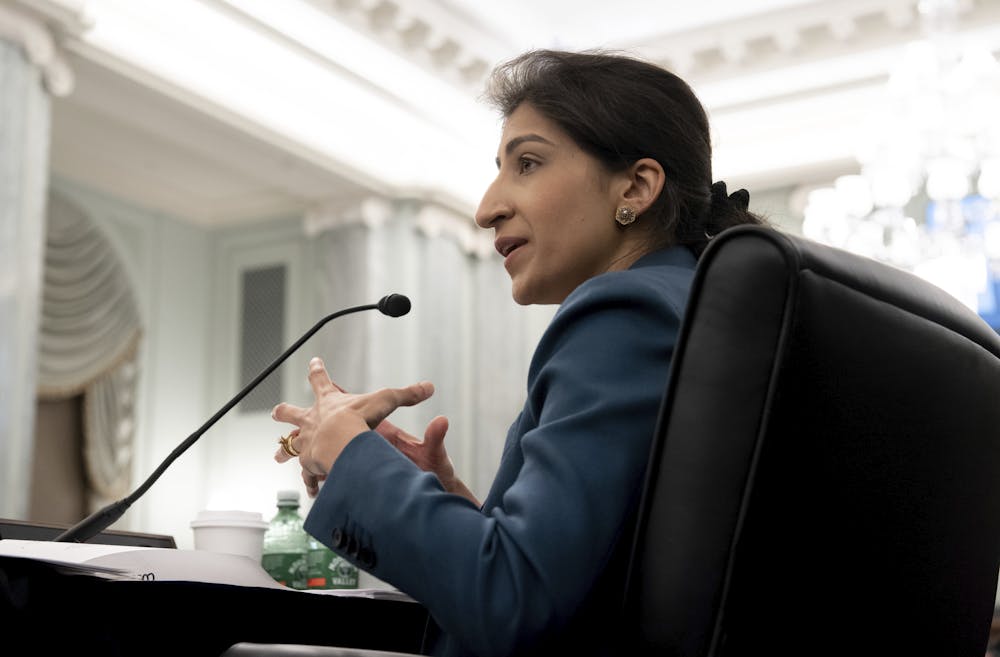
A woman in a suit testifies before a congressional committee.
President Biden named Lina Khan, a prominent critic of Big Tech companies, as chair of the Federal Trade Commission in 2021. The agency investigates issues including antitrust violations, deceptive trade practices and data privacy lapses.
AP Photo/Saul Loeb

Setting appropriate levels of fines is also complicated. Theoretically, regulators should try to set a fine commensurate with the damage to society from the infraction. From a practical standpoint, however, regulators treat fines as a deterrent. If the regulator never has to assess the fine, it means that companies are adhering to the established standards for safety and equity.

But laws often inhibit agencies from energetically policing target industries. For example, the Office of Enforcement at the Federal Energy Regulatory Commission is concerned with safety and security of U.S. energy markets. But under a 2005 law, the office can’t levy civil penalties higher than US$1 million per day. In comparison, the cost to customers of the California power crisis of 2000-2001, fueled partially by energy market manipulation, has been estimated at approximately $40 billion.

In 2022 the Office of Enforcement settled eight investigations of violations that occurred from 2017 to 2021 and levied a total of $55.5 million in penalties. In addition, it opened 21 new investigations. Clearly, the prospect of a fine from the regulator is not a sufficient deterrent in every instance.

From legislation to regulation

Congress writes the laws that create regulatory agencies and guide their actions, so that’s where any moves to regulate social media companies will start. Since these companies are controlled by some of the wealthiest people in the U.S., it’s likely that a law regulating social media would face legal challenges, potentially all the way to the Supreme Court. And the current Supreme Court has a strong pro-business record.

If a new law withstands legal challenges, a regulatory agency such as the Federal Communications Commission or the Federal Trade Commission, or perhaps a newly created agency, would have to write regulations establishing social media companies’ roles and responsibilities. In doing so, regulators would need to be mindful that changes in social preferences and tastes could render these roles moot.

Finally, the agency would have to create enforcement mechanisms, such as fines or other penalties. This would involve determining what kinds of actions are likely to deter social media companies from behaving in ways deemed harmful under the law.

In the time it would take to set up such a system, we can assume that social media companies would evolve quickly, so regulators would likely be assessing a moving target. As I see it, even if bipartisan support develops for regulating social media, it will be easier said than done.The Conversation

Theodore J. Kury, Director of Energy Studies, University of Florida

This article is republished from The Conversation under a Creative Commons license. Read the original article.

==============================================================
Alecto, Megaera, and Tisiphone, Heather Cox Richardson closed her Letter for December 14 with this: “[I]n June, the Supreme Court handed down the sweeping New York State Rifle & Pistol Association, Inc. v. Bruen decision requiring those trying to place restrictions on gun ownership to prove similar restrictions were in place when the Framers wrote the Constitution. Already, a Texas judge has struck down a rule preventing domestic abusers from possessing firearms on the grounds that domestic violence was permissible in the 1700s.” (Emphasis mine)

Originalism. If it isn’t checked, it will kill us all. And the founders would absolutely not have wanted it. They were not idiots – they knew that circumstances would change, and that government of, by, and for the people would need to change with them. They said so – including in the Constitution itself – if not, why would they have included in it a provision for amending it?

I do have one thought regarding the setting of the amounts of fines for non-compliance. Setting dollar amounts clearly doesn’t work – values change and fines simply become an accepted “cost of doing business.” We need to start settimg fines not as “no more than X dollars” but instead as “not greater than Z percent of the defendant’s total net worth,” or some other indicator. “Y percent of the degendant’s gross annual profits in the most recent year” might work.

The Furies and I will be back.

Share
Dec 182022
 

Glenn Kirschner – Mark Meadows: NC voter fraud; contempt of Congress; treasonous text messages. Is he above the law?

Tim Ryan – Last Speech to Congress ( Steve Schmidt)

Ojeda Live – Marjorie Sinks to a NEW LOW (WRT the Fourteenth, Section 3 does not address how it is to be determined that someone has engaged in insurrection. At the time the amendment was ratified, it was obvious – it was participation in the Confederate Army. I do get it that Congress, and also Secretaries of State, to want something like a Court verdict before expelling anyone, or striking anyone off the ballot. I don’t like it, but I do get it.)

Liberal Redneck – On the Absence of Empathy

Couple Rescues Baby Sparrow And Turns Their Living Room Into A Habitat

Beau – Let’s talk about Trump, Whelan, and Bout….

Share
Dec 182022
 

Yesterday, the radio opera was “Rigoletto” by Verdi. It’s pretty well known, and I’ve written about it here before. Din I mention it’s based on a play by Victor Hugo? I know I’ve mentioned many operas are based on his works. (In the late 19th-early 20th century it was David Belasco. But Puccini, though he set a couple of Belasco’s, did’t so much look at the author – he’d go to see plays in languages he didn’t know, and if he could follow the plot anyway, he’d consider the property. That’s one reason why his operas were immediate classics – it was a very effective way to choose properties which had deep and broad appeal.) “Rigoletto” was the second operea of which I ever owned a complete recording, and yes, that was on vinyl, and yes, I still have it.I didn’t buy it – it was a parting gift from the enlisted Marines whose boss I was at my forst duty station, and I’ll never forget their kindness – particularly the kin=dness of the corporal who volunteered to find out what opera I wouls like without letting on that was why he wanted to know. He was just about the last person I would have suspected of that, and his patinence at my rambling – it must have been a real challenge for his wife, also a corporal in the office, not to break out in giggles. Today, I’ll be seeing Virgil. Of course I will pass on all greetings to him, and will post a comment here when I get back.

Cartoon

Short Takes –

Robert Reich – When will the GOP reach the anti-Trump tipping point?
Quote – When will the GOP finally reach its anti-Trump tipping point — when a majority of Republican lawmakers disavow him? Again and again, it looks like the tipping point is near but the GOP remains under Trump’s thumb…. [per Mitt Romney: “He’s got such a strong base of, I don’t know, 30% or 40 % of the Republican voters, or maybe more, it’s going to be hard to knock him off as our nominee.”
Click through for his thoughts – I’m pretty sure he (and therefore Mitt) are right. And that brain-dead base doesn’t care about anything that actually matters. This trading card fiasco may chip away at the base, but I’m not holding my breath for a major reversal.

Left Jabs – SCOTUS is Developing a Taste for Chaos
Quote – State-v.-state lawsuits are already starting to fly, and the legal positions are already being hardened. Interstate cooperation — a crucial component of daily life — is already fraught, and could at any time turn ugly. It’s almost as if chaos were the point. The six “conservative” justices — they’re conserving very little these days — are pushing everything in the direction of chaos. Whatever the democratic institution they’re invited to tear down, they seem willing to go there. Like they’re remaking the legal system in the image of Ginni Thomas.
Click through for full opinion. TomCat called the Court “SCROTUS” (R for Republican, and pun intended) since Roberts became Chirf Justice – And now it’s far beyond that. I’m not expecting the outcome of this particular case to be quite as bad as “Left Jabs” thinks, but I can’t think it will be good either.

Psyche – Heartbreak is more than a metaphor. Are you at risk?
Quote – But how much medical truth is there to ‘heartbreak’? This was a not a question that was taken particularly seriously – not until an unusual syndrome began appearing in Japanese hospitals in the 1990s. In X-rays, doctors saw the hearts of traumatised patients changing shape. They resembled takotsubo, the small clay pots used in Japan to catch octopus. The story of Takotsubo syndrome, and how it got its name, is the story of how heartbreak became more than a metaphor.
Click through for details. There is plenty of ancedotal evidence, through the centuries, for this. But the imaging results – showin two clearly different ways the hear can actually reshape itself under stress and/or grief – not to mention the preavalence of each differing by gender and age – that’s amazing.

Food For Thought

Share
Dec 172022
 

Political Voices Network – Joyce Vance: There’s Now a Serious Path for Jack Smith & DOJ to Make a Charge on Trump. Here’s How..

The Gateway Pundit – If you haven’t already seen or read about tis, you are going to have difficulty believing your eyes.

Parody Project – Prison Cells

Picky Kitten Refuses To Give Up His Bottle

Beau – Let’s talk about Libya, the US, and Pan Am….

height=”506″ />

Share
Dec 172022
 

Yesterday was Beethoven’s birthday – although, in Eurpoe in his day, no one kept a record of birthdays. Most records were not kept by the state but by the church, and those recorded baptisms, not birthdays (if you are into genealogy you probably knew that.) We assume his birthday was the 16th because he was baptized on the 17th, and it was normal to baptize babies as soon as possible, usually on the day after the birth. Of course we could be wrong. But it’s such a long-established tradition now it would be a shame to have to change it. He would be 252, in case anyone cares. And there was no snow Thursday night (not that I expected any.) Tomorrow, I’ll be going to see Virgil, and yes, I will pass on all the greetings, and thank you very much for them. Last week I mentioned how tickled he was to get a card from my “frosted sister” and I should follow up by sharing that, when I sent her a note of thanks, she reaponded, “I couldn’t forget my brother-in-law at Christmas.”

Cartoon

Short Takes –

The 19th – The hate hasn’t stopped, Club Q shooting survivors tell House lawmakers
Colorado Public Radio – Club Q co-owner and shooting survivors testified at Congress about the tragedy and rising anti-LGBTQ hate
Quote 1 – Matthew Haynes, founding co-owner of Club Q in Colorado Springs, says he’s witnessed several kinds of anti-LGBTQ+ hate in the wake of the mass shooting there last month that left five people dead. There’s visceral hate, which he says the club, a longtime queer community space, has received through hundreds of vitriol-filled emails and letters since the shooting took place. Then there’s the “subtle hate” — which he identifies as legislation and leaders not respecting LGBTQ+ people or families, and in Republicans who did not vote for the just-signed Respect for Marriage Act.
Quote 2 – “To the politicians and activists who accuse LGBTQ people of grooming children and being abusers: Shame on you,” [Michael Anderson] said…. His testimony was part of a hearing on the rise of anti-LGBTQ violence convened by Rep. Carolyn Maloney of New York, who chairs the committee. She said the Club Q attack is part of a broader trend of violence and intimidation across the country that includes the rise in anti-LGBTQ laws in state houses and in Congress.
Click through to one or both for more imformation.Once again I am combining two stories because they are the same, but for different audences. The first was written for a target audience of women and minorities, including LGBTQIA+, and the second for Colorado residents regardless of identity. Both can be painful to read … but I’m grateful for the Oversight Committee under Carolyn Maloney for holding the hearings, despite pushback from the GOP.

The Daily Beast – Discipline Crackdown Freaks Out Parents in Florida Schools
Quote – Two weeks ago, Brevard County, Florida, Sheriff Wayne Ivey stood at a podium set in front of the local jail and its barbed-wire fences and suggested that children were not sufficiently terrified of getting in trouble at school. “They know they’re not going to be given after-school detention, they’re not going to be suspended,” Ivey, whose school-based officers carry long guns, declared. “They’re not going to be expelled or, like in the old days, they’re not gonna have the cheeks of their ass torn off for not doing right in class.” The statement—made alongside newly installed far-right school board chair Matt Susin—ushered into public view a simmering conflict over safety and student discipline at one of the larger districts in the country.
Click through for details. I’d freakout too – even just as a citizen, not a parent. Actually, no matter where you live in the US, there is potential for adults who were damaged by this distrct as kids to move into your neighborhood. (I have no idea whether this sheriff is any relation to the Governor of Alabama.)

Food For Thought

Share
Dec 162022
 

Glenn Kirschner – Special Counsel Jack Smith RAMPS UP criminal investigation of Donald Trump’s crimes

Meidas Touch – Texas Paul REACTS to Marjorie Taylor Greene talking to Young Republicans about Dildos (from the cussing pond – bleeped)

MSNBC – Jan. 6 Committee To Hold Public Meeting On Dec. 19

Rocky Mountain Mike – Trump In Jail Rock (full transcript at YouTube)

People Rescue A Mama Osprey After She Gets Attacked

Beau – Let’s talk about Trump not being in contempt….

Share
Dec 162022
 

Yesterday, I pretty much didn’t do anything. Didn’t even have any profound thoughts. I did notice that Weather Underground thinks I may get some snow tonight, but it’s only a maybe, and even if it happens, there shouldn’t be very much. I did work on some cartoons a bit.

Cartoon

Short Takes –

Robert Reich – The Fed is Dead
Quote – The Fed [met Tuesday. Wednesday], presumably, it will [have raised] interest rates again in its continuing attempt to stem inflation by slowing the economy. But the Fed’s rate hikes aren’t working. Despite seven straight increases in just nine months, totaling a whopping 4.25 percentage points — a pace not seen since the Fed’s inflation fight in the 1980s — price increases are still hovering near four-decade highs. The Consumer Price Index measure climbed 7.1 percent in November compared to a year earlier. The Fed’s rate hikes are slowing the economy, but not prices. Why not?
Click through for full facts. We have Robert Reich, and we have Paul Krugman, and both know what they are talking about. I cannot grasp why Democrats aren’t paying attention.

Mediaite – Rachel Maddow’s Podcast ‘Ultra’ is Headed to Hollywood as Steven Spielberg Acquires Film Rights
Quote – The show has consistently been among the top ten podcasts on Apple, in the weeks since its premiere. Now, it’s in the hands of Spielberg. Although the Hollywood legend is not set to direct the film, he will produce the movie adaptation alongside Bridge of Spies producer Kristie Macosko Krieger. According to Deadline, the talks to purchase film rights to the podcast became a bidding war in recent months with Maddow taking meetings with high-level Hollywood execs in an attempt to find the show, which she wrote and hosted, a perfect home.
Click through for details. I am tickled about this. Withe Spielbergs’s name (and I expect him to do a great job), this story will reach many people who would never otherwise even know it existed. I can’t wait to see who gets cast for Coughlin

Food For Thought

Share
Dec 152022
 

Glenn Kirschner missed another day (I hope he’s alright), and I can’t find him on Political VOices Netwrok either. So here is Lawrence with Neal Katyal, who aregued the right side of Moore v Harper before SCOTUS last week.

The Lincoln Project – Marjorie Taylor Greene Says The Quiet Part Out Loud

Meidas Touch – Top Democrat [Ted Lieu] FACT-CHECKS Republicans on their Vile and Deranged Conspiracy Theories (repetetive, but not terribly long)

Parody Project – Ambrose

Woman Rescues A Very Angry, Growly Feral Kitten And Earns Her Love

Beau – Let’s talk about Republicans assessing Biden….

Share