Nov 262021
 

Yesterday was, of course, Thanksgiving Day in the United States. I hope everyone had a wonderful day whether or not you are in the United States. Tomorrow, I will be going to see Virgil. I think I’m ready.

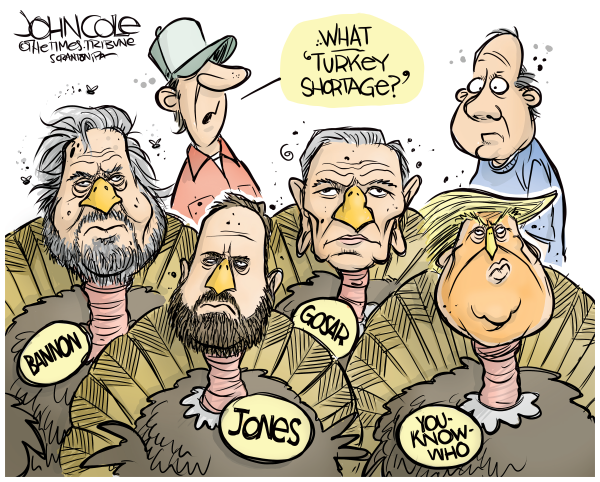
Cartoon –

Short Takes –

The New Yorker – Could One Shot Kill the Flu?
Quote – For decades, scientists have dreamed of what some call a “universal” flu vaccine—one that could target many strains of the virus. A universal vaccine would save countless lives not just this year but every year; as those numbers add up, it would become one of the greatest medical breakthroughs in history. Until recently, it’s been beyond the reach of molecular biology. But new technologies are extending our abilities, and researchers are learning how to see through the flu’s disguises. Without knowing it, we’re living on the cusp of a remarkable scientific achievement. One of the world’s longest pandemics could soon be coming to an end.
Click through for complications. It’s not a certainty – but it is a possibiity -and that is progress. If you re paywalled out, feel free to email me and I’ll send a pdf.

Crooks and Liars – Justice For Ahmaud Arbery: ALL 3 Defendants Found GUILTY
Quote – The jury was not representative of the community, with 11 white and only 1 Black member, which was a concern that even the judge raised. They deliberated for roughly 10 hours and there was concern that this could be a Kyle Rittenhouse or George Zimmerman repeat. But JUSTICE PREVAILED.
Click through for details. I put up a tag Wednesday when this was announced, but I wanted to featureit also. It’s important.

The New Yorker – Peng Shuai and the High Stakes of Business in China
Quote – The post was up for about ten minutes before the state’s well-oiled machinery of censorship kicked into gear and took it down. Comments on Peng’s account were locked. Screenshots of her sixteen-hundred-word post, which were spreading, were scrubbed. Her name disappeared from Internet searches. Emojis and words related to the case did, too. For a while, even the word “tennis” was blocked. Behind the state’s erasure of Peng’s presence on the Chinese Internet was another urgent and troubling question: What would happen to her?
Click through for the story which is not at all simple. I never expected to be looking to “The Sporting Scene” for a short take, but pf coourse, she’s not the first sports woman, and will not be the last, whose life clashes in some way with authoritarian leadership.

Food for Thought –

Share
Nov 122021
 

COP26 Day 12 | It’s finally crunch time


Euronews Green delivers a Special COP26 email to my mailbox every day during the two weeks it is running (01-12 November 2021). I’ll publish it in its entirety for those who are interested. This is the ninth in the series.


Today’s takeaway

COP26 was due to wrap at 7pm CET today but there is still no white smoke for a final agreement as this newsletter goes to publication. If the almost 200 countries involved in the talks are unable to strike a deal this evening, it is likely COP26 will go into overtime.

A new draft decision published early this morning appeared to water down the language from the previous text calling to end all use of coal and phase out fossil fuel subsidies completely. While the change has sparked criticism from climate activists, some conceded that the draft text at least had the merit of retaining a mention to fossil fuels for the first time in decades of UN climate talks.

The draft cover deal has also retained a core request for countries to set more ambitious climate targets next year. But this request appears to use weaker language than the previous draft, saying the upgraded pledges should take into account “different national circumstances.”

On the positive side, many observers find the new text stronger on climate finance. “We’ve moved from richer nations largely ignoring the pleas of developing countries for promised finance to tackle climate change, to the start of recognition that their calls should be met,” said Greenpeace chief Jennifer Morgan.

“A small number of key issues remain which require our urgent collective attention,” said COP26 chairman Alok Sharma this afternoon as he urged “a final injection of can-do spirit” to deliver on an ambitious climate deal.

Looking ahead, Egypt and the United Arab Emirates will host the next COPs in 2022 and 2023 respectively, following announcements in Glasgow yesterday. An Egyptian official said the North African country would hold the next climate talks “on behalf of Africa.”

In case you weren’t able to follow along on Thursday, here are five key takeaways from Day 11.


At a glance

Latest draft of COP26 deal ‘waters down’ language on ending coal use

The change in wording suggests a shift away from unconditional demands that some fossil fuel exporting nations have objected to.
Read more

What is ecocide and why is it so important that we enshrine it into law?

Ecocide can literally be translated as “home-kill,” making clear its violence and absurdity. It refers to the destruction humans knowingly do to the environment, from deforestation to ocean plastic pollution. So why is it legal?
Read more

Meet the filmmaker who swapped a London flat for an off-grid boat

In the third episode of Euronews Green’s new video series Low Impact Living, we speak with adventurer and filmmaker James Levelle about being a ‘river nomad’.
Read more


Social exclusive

Share
Nov 112021
 

COP26 Day 11 | ‘Not there yet’


Euronews Green delivers a Special COP26 email to my mailbox every day during the two weeks it is running (01-12 November 2021). I’ll publish it in its entirety for those who are interested. This is the eighth in the series.


Today’s takeaway

Waves of tentative optimism were sweeping through COP26 today after the US and China announced a bilateral deal to redouble their climate efforts.

The joint statement issued by Washington and Beijing called for “enhanced climate action in the 2020s”, including a new, stronger emission cuts target in 2025 and a pledge by China to follow the US lead in slashing methane emissions.

UN Secretary-General Antonio Guterres and others hailed it as “an important step in the right direction.” But some analysts thought the deal “lacked meat” on concrete commitments besides those on methane.

Whether or not this spirit of cooperation will be reflected in the final agreement of COP26 is another story. Difficult negotiations involving almost 200 countries continued in Glasgow after a draft cover deal was released yesterday.

“We’re not there yet. There is still much more work to be done,” said COP26 chairman Alok Sharma as he briefed delegates on the progress of the talks, urging another “gear shift” in the final hours of the summit.

The UK presidency said it planned on publishing the next draft of the cover deal overnight, with a new meeting of ministers planned for tomorrow morning.

COP26 is due to end on Friday evening, but an extension has not been ruled out.

In other news, Denmark and Costa Rica launched an ambitious alliance today to phase out coal and gas. Six full members, France, Greenland, Ireland, Quebec, Sweden and Wales also joined the group known as the ‘Beyond Oil and Gas Alliance‘.

Campaigners hailed the move as a “turning point” while urging more countries to join.

“The creation of this alliance puts to shame claims of climate leadership among countries like the United Kingdom, Norway, the United States, and Canada, all of which have yet to answer this simple question: Where is your plan to stop producing the fossil fuels that are driving the climate crisis?” asked Romain Ioualalen of Oil Change International.

In case you weren’t able to follow along on Wednesday, here are five takeaways from Day 10.

Some additional bad and good news

Deforestation in Australia: a wanton assault on wildlife – in pictures

More than 100 nations including Australia have signed up to stop or reverse deforestation by 2030. The pact, hailed as one of the main achievements of COP26, put the spotlight on an issue that combines carbon emissions and threatened species. These images reveal some of the shocking impacts of deforestation.

(From: The Canopy, Greenpeace Australia Pacific)


At a glance

Major European countries pledge to phase out oil and gas

A “first of its kind” alliance of governments has committed to phasing out the production of oil and gas. Led by Costa Rica and Denmark, the Beyond Oil and Gas Alliance (BOGA) saw six members join.
Read more

Local councils trusted more than world leaders on climate, poll finds

British people trust local councils more than the government when it comes to taking action on climate change, a new survey has revealed.
Read more

Frustrated doctor diagnoses woman with ‘climate change’ in world first

A Canadian woman has become the first patient in the world to be diagnosed as suffering from ‘climate change’, after she developed breathing difficulties following a historic heatwave. But what are her symptoms?
Read more


Social exclusive

Share
Nov 102021
 

COP26 Day 10 | The beginning of the end


Euronews Green delivers a Special COP26 email to my mailbox every day during the two weeks it is running (01-12 November 2021). I’ll publish it in its entirety for those who are interested. This is the seventh in the series.


Today’s takeaway

COP26 entered a new phase of negotiations on Wednesday after a first draft of the summit’s final decision was circulated early this morning.

​​The seven-page document urges countries to strengthen their climate plans by the end of next year and, for the first time, calls for the phasing out of coal and fossil fuel subsidies.

This draft text isn’t the end of the story yet in Glasgow but it marks the beginning of the end for the summit.

Diplomats from the nearly 200 countries represented at COP26 have now begun to negotiate the text hoping to strike a final deal before proceedings are meant to come to a close on Friday.

But the draft deal has had mixed reviews so far – especially from climate activists. A Greenpeace executive compared it to a “polite request that countries maybe, possibly, do more next year.” That’s “not good enough,” she said.

The COP26 Chairman expects a “near-final text to be published overnight,” as negotiations continue.

Meanwhile, UK Prime Minister Boris Johnson made the trip to Glasgow to press negotiators to find a compromise. “We know what needs to be done but we just need the courage to get on and do it,” he said.

Today was also Transport Day at COP26 and there was a raft of announcements about zero-emissions vehicles.

A group of countries and companies signed a pledge to switch to emissions-free cars by 2040 and by no later than 2035 in leading auto markets.

Critics pointed out that large countries including the US, Germany, China and Japan stayed out of the deal, along with some of the world’s biggest car manufacturers.

The International Energy Agency says that 60 per cent of new car sales need to be battery-electric by 2030 and internal combustion engine cars need to be phased out by 2035 to keep below 1.5C. Many believe this pledge is not ambitious enough to achieve that.

If you weren’t able to follow along on Tuesday, here are five takeaways from COP26 Gender Day.

Some additional bad news

Australia among nations trying to soften COP26 declaration

Australia has joined a coalition of countries working to water down a key proposal from the Glasgow climate summit which would pressure the Morrison government to overturn its opposition to a more ambitious 2030 emissions reductions target. (From: The Canopy, Greenpeace Australia Pacific)

Some additional good news

‘Existential crisis’: United States and China stun COP26 with joint climate change pact

China and the United States have made a shock joint statement at the Glasgow climate talks, declaring climate change to be an existential crisis demanding co-operation between the superpowers.
(From: The Canopy, Greenpeace Australia Pacific)


At a glance

UPDATED: First draft of COP26 climate deal is released

The seven-page document is the first version of the agreement that will outline how countries plan to cut emissions and keep global warming below 1.5°C.
So what does it say?
Read more

Meet the climate group who have published a guide on how to sue Shell – and win

Their victory was the first judgement where a multinational corporation was held responsible for its contribution to climate change.
Read more

This cheeky 12-year-old activist is the perfect antidote to COP26 doom and gloom

Francisco Vera is not your ordinary kid. The Colombian primary school student is among the foremost climate activists at COP26, where he is calling for world leaders to include young people in the ongoing talks and negotiations.
Read more


Social exclusive

Share
Nov 092021
 

COP 26 Day 9 | ‘Climate change is sexist’


Euronews Green delivers a Special COP26 email to my mailbox every day during the two weeks it is running (01-12 November 2021). I’ll publish it in its entirety for those who are interested. This is the sixth in the series.


Today’s takeaway

On Gender Day, COP26 turned its focus to the disproportionate climate impacts suffered by women and girls across the world.

“Climate change is sexist,” a US government official put it on Tuesday. 80 per cent of people displaced by climate change are women and children, according to UNFCC.

“But women and girls are also leading efforts to tackle climate change in communities around the world,” said COP26 chairman Alok Sharma as he outlined pledges for gender-responsive climate finance.

The puppet of a 10-year-old Syrian girl known as Little Amal made the journey to Glasgow to “represent all girls who could not be here,” at COP26, said Samoan activist Brianna Fruean as she opened the Gender Day lead event with Amal.

Meanwhile, the hard work on the summit’s cover decision continued in negotiation rooms. The UK presidency said it will publish a first draft of the summit’s final decision overnight. New texts have been tabled on time frames, transparency, finance and adaptation so far.

“We still have a mountain to climb,” warned Sharma as the clock ticked to strike a deal that will help limit global warming to 1.5 degrees Celsius.

New forecasts released on Tuesday suggest the world is still far off that number. Think tank Climate Action Tracker said current climate policies put us on track to a scary 2.7 degrees Celsius warming – or 2.4 C if all governments met their 2030 targets.

If you weren’t able to follow along on Monday, here are five takeaways from Day 8.


At a glance

Five reasons climate change affects women more than men

Women and girls experience violence and a lack of access to education as a direct result of the climate crisis.

Read more

What is land inequality and how does it threaten women?

Land inequality is directly threatening 1.4 billion of the world’s poorest people including women, according to a recent report.
Read more

COP26: Why has a speech by Tuvalu’s Foreign Minister gone viral?

Tuvalu’s Foreign Minister Simon Kofe spoke to Euronews after a video of his speech at COP26 showing him standing knee-deep in seawater took the internet by storm.
Read more


Social exclusive

Share
Nov 032021
 

COP 26 Day 3 | Who’s paying for it?


Euronews Green delivers a Special COP26 email to my mailbox every day during the two weeks it is running (01-12 November 2021). I’ll publish it in its entirety for those who are interested. This is the second in the series.


Today’s takeaway

With world leaders gone and their big speeches delivered, COP26 negotiators turned their focus to money on Tuesday.

Cash pledges from both governments and the private sector poured in as COP26 Finance Day wrapped up.

The UK presidency said that wealthy countries would deliver on their promise to provide $100 billion a year (€86 billion) to finance climate-related projects in the developing world, after failing to meet the initial 2020 target.

And in one of today’s most discussed announcements, the world’s largest financial players pledged a massive $130 trillion (​​€112 trillion) of private capital to decarbonise the economy, while the UK vowed to become “the world’s first net-zero aligned financial centre.”

But climate activists were calling for scrutiny of investors’ motives, warning that the same financial players who profited from fossil fuels were now posing as green champions.

If you weren’t able to follow along on Tuesday, here are the six key takeaways from day 2 of COP26.


At a glance

Don’t blame the climate crisis on India and China, campaigners urge

The Indian Prime Minister’s announcement that the country will reach net zero emissions by 2070 has been met with mixed reactions from COP-watchers. But environmental campaigners say it is “deeply unfair” to blame middle-income countries for the climate crisis.
Read more

What is the ‘carbon budget’, the latest term coming out of COP26 talks?

“Carbon budgets” is one of the most-often mentioned terms at the COP26 talks in Glasgow, but many are wondering who set them and what role they play in fighting climate change.
Read more

These countries are forcing banks to reveal their climate impact

New Zealand has introduced a new law that forces its financial institutions to disclose their climate impact. These other countries have already taken similar steps
Read more


Social exclusive

Share
Nov 022021
 

COP 26 Day 2 | Time for action


Euronews Green delivers a Special COP26 email to my mailbox every day during the two weeks it is running (01-12 November 2021). I’ll publish it in its entirety for those who are interested. This is the first in the series.


Today’s takeaway

The second day of COP26 signalled time for action after an opening marked by “doomsday” rhetoric.

Several major deals were announced on Tuesday as the World Leader’s Summit wrapped up.

More than 100 countries, including EU nations, pledged to curb methane emissions by 30 per cent by 2030. The potent greenhouse gas is responsible for an estimated 30 per cent of global warming since the industrial revolution according to European Commission President Ursula von der Leyen.

In another landmark deal, more than 100 world leaders committed to ending deforestation by 2030. The majority of countries home to the Amazon Rainforest – including Brazil – have signed the agreement.

Pledges for cash flowed too, both from governments and the private sector. The Bezos Earth Fund promised $2 billion (€1.72 billion) to tackle climate change through landscape restoration and the transformation of agricultural systems.

But despite the good news, climate activists warned this might not be enough to keep global warming below 1.5C. Some pointed to accountability problems with world leaders’ commitments, while others said they fell short of previous goals.

Meanwhile, the British presidency faced criticism about accessibility and inclusiveness at the conference. Civil society groups have complained of “unprecedented restrictions” to negotiations, while an Israeli minister using a wheelchair was unable to access the summit yesterday.

If you weren’t able to follow along on Monday, here are the 5 key takeaways from day 1 of COP26.


At a glance

Ending deforestation by 2030: Landmark deal or rerun of past failures?

The first major deal of COP26 was signed today as more than 100 world leaders committed to ending
deforestation by 2030. But critics have highlighted a lack of accountability with this new measure.
Read more

Over 100 countries sign pledge to cut methane emissions

More than 100 countries*, including EU nations, have announced a new plan to curb methane emissions by 30%. But climate activists say this won’t be enough to keep global warming below 1.5C.
Read more

* Australia snubs methane reduction pledge at COP26 climate change conference
Nearly 90 countries have joined a US- and EU-led effort to slash emissions of methane by 30 per cent by 2030 from 2020 levels at COP26. Among the signatories is Brazil, one of the five biggest emitters of methane. The other four – Australia, China, Russia and India – have not signed up. (From Greenpeace Australia Pacific)

Faces of COP26: Meet the ex-corporate consultant fighting for her son’s future

Throughout COP26, we’re profiling some interesting people we meet here in Glasgow. Today, we interview Abigail, a former management consultant who has joined Extinction Rebellion protest group.
Read more

Share
Oct 282021
 

It’s been over a year since I posted under this heading and I always edited the text I based the article upon to prevent Politics Plus from getting into copyright trouble. This time, however, I thought the full text was too important to cut down and to be honest I didn’t have the time to do all the editing either.

So I’ve copied the full editorial of Euronews’ The Briefing. As yet there’s no link for this article to Euronews, probably because it is still in the very early hours of the morning in Europe.

COP26 is not about saving the planet. It’s about saving civilisation 

By Euronews Brussels bureau

All eyes are on Glasgow.

World leaders are days away from descending upon the Scottish city to attend the 2021 United Nations Climate Change Conference (COP26). As global temperatures quickly approach the 1.5°C threshold above pre-industrial levels, the window for opportunity to fight climate change is desperately closing.

For the next two weeks, negotiators will discuss how to transform our industries, energy systems, financial institutions, food chains, means of transport, urban areas and even societal structures. Do we still have time left to save the planet?

“The planet has been around for four and a half billion years. She was perfectly happy before we ever got here, and she will be perfectly happy if we’re idiots enough to pull the ejector seat and leave.”

These are the blunt words of Christiana Figueres, one of the main architects behind the 2015 Paris Agreement. The deal is today considered a monumental achievement but its rulebook still requires further fleshing out – one of the main objectives of COP26.

“This is truly not about saving the planet – it’s about saving something that is incredibly unique in the evolution of the planet,” Figureres told our colleagues from Euronews Green.

“A very, very short time period – 12,000 years – has allowed for the human species to flourish, and build the ‘civilisation’ that we have now,” she said. “If there’s anything that we want to rescue from that, then we have to be able to get back to a stable environment.”

After 15 years representing Costa Rica, Figueres was made the UN climate secretary in July 2010. Her appointment came in the wake of the failed Copenhagen Summit (COP15), where talks had fallen apart without any meaningful commitments. Figueres spent the next few years reviving negotiations, eventually paving the way for COP21 in 2015, when the legally-binding Paris Accord was adopted by 196 parties.

“[It] was not an agreement by consensus,” explains Figueres, “[it] was an agreement by unanimous decision, which has never happened before in the UN. It was the one agreement that was unanimous, and they all decided that they would go to net-zero by 2050.”

Activists have frequently criticised the Paris text for its alleged lack of ambition: its core goal is to keep global warming below 2°C, ideally 1.5°C, in line with pre-industrial levels. Science today indicates the effects of 2°C will be already catastrophic.

“I think the Paris Agreement is still out there on the horizon as being incredibly ambitious because it [does] three things: It establishes the finish line, which is net-zero by 2050. It establishes the fact that there are very different starting points for each country, and each country will travel differently at a different speed. And then to establish the 2°C, with an aspirational 1.5°C. It’s actually quite futuristic!”

The upcoming COP26 is the next major diplomatic milestone in meeting the Paris goals and – as August’s IPCC report clearly laid out – we’re a long way off target. Having worked in diplomacy for many years, Figueres is closely familiar with the challenges that negotiators will face in Glasgow but still advises patience and positivity.

“It’s precisely because of reports like [the IPCC one]. Precisely because of the melting of the ice in Greenland. Precisely because of all the destruction that we have seen this summer that we have to stay stubborn and optimistic,” she says, expressing “anger” at her own generation’s idleness.

“Our inability and our stubbornness of not engaging in climate action in a timely fashion is what has brought us here today. No longer facing climate change, but facing a climate emergency – climate chaos!”

The situation has turned so critical, so frantic and urgent, that many of us are losing hope. Reading the news, one tends to believe our leaders will never have the courage to rise to the occasion and take the decisive action that is needed to curb emissions.

In an emotional moment of the interview, Figueres explained how much she can relate to that feeling of cynicism and hopelessness. In her view, there’s a bus coming towards our children, and we have no choice but to throw ourselves in front of it.

“We basically have two options. Either we can sit back and say ‘okay, well… you know we’re too late.’ Or we can say ‘oh my gosh, we’re totally running out of time and we have to stand up!’” she says.

“And in my book, we don’t have any other option.”

Share