Glenn Kirschner – Judge Chutkan imposes gag order on Donald Trump in DC case to protect witnesses and others.
The Lincoln Project – The Choice is Clear
Thom Hartmann – This Army Aims to Stop Americans From Voting
Patrick Fitzgerald – Jackson (Johnny Cash Song Parody ft Donald Trump, Merrick Garland, and Jack Smith) [The song on which this parody is based, which was a hit for Johnny Cash and June Carter, was not a love song but a marital duel. It was loosely based on “Who’s Afraid of Virginia Woolf.” If you llook up the lyrics, or watch a Cash/Carter video of “Jackson” you may find this even funnier)]
Guy Shows his Rescue Pittie the Wonders of Fall for the Very First Time
Beau – Let’s talk about much ado about $6 billion….
Yesterday, it was still cool – a high of 73F. It’s supposed to be warmer today, but still only in the high 80s. Also yesterday, Andrew Weissman said this on MSNBC: “The exact words because this is the provision that the court has to find to release someone on bail in Georgia, is that the defendant poses no risk of intimidating witnesses.” The reference is to the specific lehal language used in the Georgia criminal code. Federally and in most states, the burden of proof is on the government, but Georgia is different. I can tell you this caused a virtual party at Democratic Underground, with a plethora of jokes of various degreess of taste. And also yesterday – last night, really – after 9 p.m. my time – an alert came in that Trump** and 18 others had been indicted by a grand jury in Georgia. (I had heard earlier that they didn’t keep a 5:00 quitting time, but sent everyone to dinner and then re-convened into the night.) The alert didn’t name the 18 others, nor were they listed in the linked story at the time, but Axios usually develops these stories, so they may (or may not) be there now.
Cartoon –
Short Takes –
CNN – Exclusive: Georgia prosecutors have messages showing Trump’s team is behind voting system breach
Quote – Investigators in the Georgia criminal probe have long suspected the breach was not an organic effort sprung from sympathetic Trump supporters in rural and heavily Republican Coffee County – a county Trump won by nearly 70% of the vote. They have gathered evidence indicating it was a top-down push by Trump’s team to access sensitive voting software, according to people familiar with the situation. Trump allies attempted to access voting systems after the 2020 election as part of the broader push to produce evidence that could back up the former president’s baseless claims of widespread fraud. Click through for details. The nitty-gritty details of evidence are almost never anywhere near as much fun as the sweeping descriptions of the crime. But in order to prove stuff- prosecutors must dig through them.
Daily Kos (MargaretPOA) – Of Course Republicans are Angry. They Have Been Out Gamed… AGAIN.
Quote – As usual, Republicans acted on the assumption that Democrats would behave as dishonestly and unethically as they, themselves and so would never in a million years appoint a Special Counsel, even though the Democrats are as aware as anybody else that there is no evidence of wrongdoing because there was no wrongdoing. Republicans thought that they were safe to loudly and publicly demand a Special Counsel because they would never get one because they, themselves would never grant that if their positions were flipped. The fact that Republicans have long used a partisan DOJ to do their dirty work means that they can’t imagine an independent DOJ. Click through for all the reasons – the quote is the first one. I like it because we all know it’s so, but it’s said so concisely and still in enough detail to be satisfying.
Yesterday, the radio opera was “La Sonnambula,” by Vincenzo Bellini. Bellini, along with Donizetti was at the top of composers working in the bel canto style, and this is an opera full of beautiful ornaments, and beloved by both Maria Callas and Joan Sutherland – both of whom had ranges which included solid low ranges, which is the kind of singer for whom the star role was written (when it’s sung by those who basically just sing soprano, some of the low notes are adjusted a bit.) I’m not familiar with the soprano in this production, which was recorded in Liège, Belgium; the only name I recognize is that of René Barbera, whom I heard in Santa Fe years ago – maybe as many as ten years ago. The story is easier to wrap your head around if you can get into the frame of mind at the time – sleepwalking? What’s that? The plot turns on the heroine sleepwalking into and collapsing in the hotel room of a man not her fiancé, being found there by her fiancé’s jealous ex-fiamcée, and almost losing him as a result. But it does end happily. A phrase from this opera is the epitaph of Bellini, who died young: “Oh, lovely flower, I did not think that you would fade so fast” (but in Italian.) Off to see Virgil now, will let y’all know when I get back.
Cartoon –
Short Takes –
SPLC – Florida sets up formerly incarcerated people to vote, then arrests them
Quote – [John Boyd Rivers] was among 41 formerly incarcerated people, also known as returning citizens, who were arrested in 2022 and 2023 for voter fraud in Florida following the 2020 election. Nearly half took plea deals, fearful of facing the unknown of a jury trial and guilty verdict. To date, only Rivers and one other have been tried in court. He drew a split verdict: not guilty of knowingly registering to vote while ineligible but guilty of willful, fraudulent voting. Click through for story. Administrative incompetence is one thing. A deliberate set-up is quite another. As always, the cruelty is the point.
Robert Reich – Donald Trump, Samuel Bankman-Fried, and the rule of law
Quote – A prominent billionaire is arrested on criminal charges. At his arraignment, the presiding judge releases him pending trial on condition he not to try to influence potential witnesses and orders him not to speak with the media about the pending trial. He repeatedly violates the order. Eventually, the judge has had enough. He revokes bail and orders him jailed pending trial. I’m not referring to Donald J. Trump…. No, the person I’m referring to is Sam Bankman-Fried, the founder of the collapsed cryptocurrency exchange FTX. Bankman-Fried — whose wealth had soared to $28 billion before the collapse — had been under house arrest at his parents’ home in Palo Alto, California since his arrest in December on fraud charges stemming from FTX’s implosion. Click through for full article. Yes, I realize if Trump** is put into pre-trial detention, there will likely be some violence. And I’m in favor of preparing for that as much as necessary to minimize the damage. I’m not in favor of just letting it go. Letting it go would be neither just nor prudent.
Yesterday, I promised that if I found out anything more about what the heck is going on in Russia I would share. There is no consensus, but I’m going to refer you to two links – Heather Cox Richardson, who spends a few paragraphs on it from an historian’s viewpoint before changing the subject, and the other a video from Beau. Be aware you do NOT have to watch the video to get the content. If you click on the three dots to the right of the Share and Save buttons, you will be offered the opportunity to view a transcript. It won’t be perfect, but it will give you a solid idea. Bottom line is this isn’t over, and no one knows what is next. But we can’t rule out an opportunity to see “Swan Lake” (which is traditionally performed for a regime change.)
Cartoon –
Short Takes –
SPLC – Advocates Register Voters after Supreme Court Victory over Gerrymandering
Quote – “I’m gonna go out on a ledge and say over 90% of our students were not registered to vote,” [Monica] Clarke said. “It was this huge wakeup call for me and others who were working with me. We were kind of shocked, kind of scared, kind of surprised – all of the above – and not just that they weren’t registered, but they didn’t even want to register. They had such a negative view of voter registration, of voting, of the government and police.” That was when she became an activist for voting rights, growing the university’s voter registration service into a mission unto itself. And, as the nation notes the 10th anniversary of the Shelby decision this weekend, Clarke sees the same forces that created the need for the Voting Rights Act still threatening people of color. Click through for article. My BFF, who is black, has worked for the election department (and believe me, she votes) but has troble getting her young adult sons to regiter, so I get it. I don’t like it, but i get it. Maybe the FFT would help?
The Warning – Steve Schmidt – What is No Labels doing?
Quote – No labels lacks basic transparency around its donors, motives and strategy. They are purposely opaque. For example, they decry the imminence of a Biden-Trump rematch as unacceptable without ever being clear whether they measure Biden as similarly unacceptable as Trump. Why the mystery? Would they abandon their plans if Gretchen Whitmer or Gavin Newsom were the Democratic nominee? What exactly is the basis of the emergency? Is it Trump running again? Is it Trump winning again? Is the effort built around the belief that Biden can’t beat Trump? Perhaps the premise is that Biden is fueling demand for Trump? Does No Labels view Biden and Trump as equivalent figures, men, leaders and threats? Shouldn’t they say, or perhaps more importantly, shouldn’t someone ask? Click through for article. I have said it before, and I will keep saying it whenever I needto, for as long as I need to: NEVER TRUST ANYONE WHO WILL NOT TELL YOU WHERE THEY STAND. I get it that many people are tired of labels (mostly because crooks and liars have achieved that end by design.) I get it that left and right do not fully describe posotions (although if you add up and down to that mix, the result comes much, much closer.) But the very name “No Labels” screams “I will not tell you who I am.”
Washington Post (no paywall) – He wanted to pet dogs for his 100th birthday. Hundreds lined up.
Quote – “We live in a nice little community, and I thought I could get some of my neighbors and friends to come,” said Alison Moore, adding that she planned for her father to sit outside her home with a banner and assemble a small line of dogs for him to admire and cuddle. Human treats and dog treats would be served…. “I was shocked,” said Alison Moore, explaining that some people drove more than 10 miles to attend the celebration. Click through. I had planned to stop at two, but my cousin sent me this link – and I felt I had to share
Experts in autocracies have pointed out that it is, unfortunately, easy to slip into normalizing the tyrant, hence it is important to hang on to outrage. These incidents which seem to call for the efforts of the Greek Furies (Erinyes) to come and deal with them will, I hope, help with that. As a reminder, though no one really knows how many there were supposed to be, the three names we have are Alecto, Megaera, and Tisiphone. These roughly translate as “unceasing,” “grudging,” and “vengeful destruction.”
Sometimes those who are the most engaged in political activism can also be the most naive. I don’t know how otherwse to explain how those of us who have been working on civil rights, civil liberties, and voting rights since the 50’s, and gained so much, have also lost so much. Did we fail to watch our backs? Did we miss the signs? Or did we see the signs, but were unsure of how to respond? Now it appears we need to do it all over again – or our kids and grandkids do, those of uswho have any. We and/or they will need to come up with better plans for how to keep what has been won. I know, it sounds tiring. I feel exhausted myself. But it’s that or slide into fascism.
==============================================================
Civil rights legislation sparked powerful backlash that’s still shaping American politics
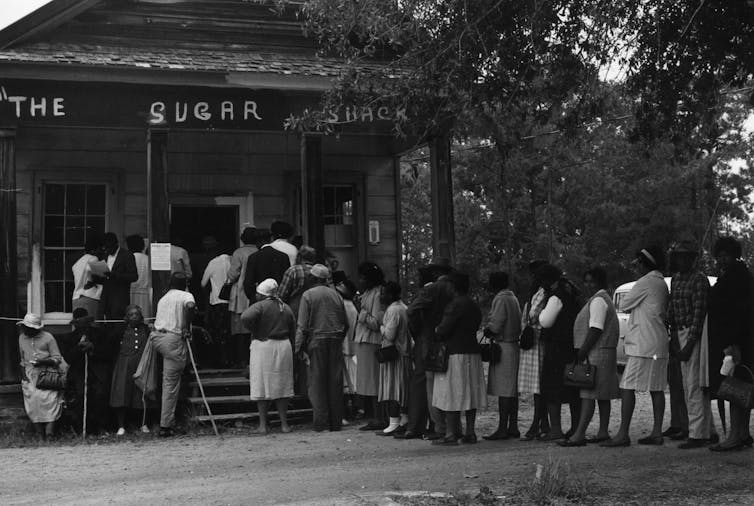
A group of voters lining up outside the polling station, a small Sugar Shack store, on May 3, 1966, in Peachtree, Ala., after the Voting Rights Act was passed the previous year. MPI/Getty Images
For nearly 60 years, conservatives have been trying to gut the Voting Rights Act of 1965, the crowning achievement of the civil rights movement. As a scholar of American voting rights, I believe their long game is finally bearing fruit.
In that case, the court struck down a portion of the Voting Rights Act that supervised elections in areas with a history of disenfranchisement.
The Supreme Court is currently considering a case, Merrill v. Milligan, that might gut what remains of the act after Shelby.
Conservative legal strategists want the court to say that Alabama – where African Americans make up approximately one-quarter of the population, still live in concentrated and segregated communities and yet have only one majority-Black voting district out of seven state districts – should not consider race when drawing district boundaries.
These challenges to minority voting rights didn’t emerge overnight. The Shelby and Merrill cases are the culmination of a decadeslong conservative legal strategy designed to roll back the political gains of the civil rights movement itself.
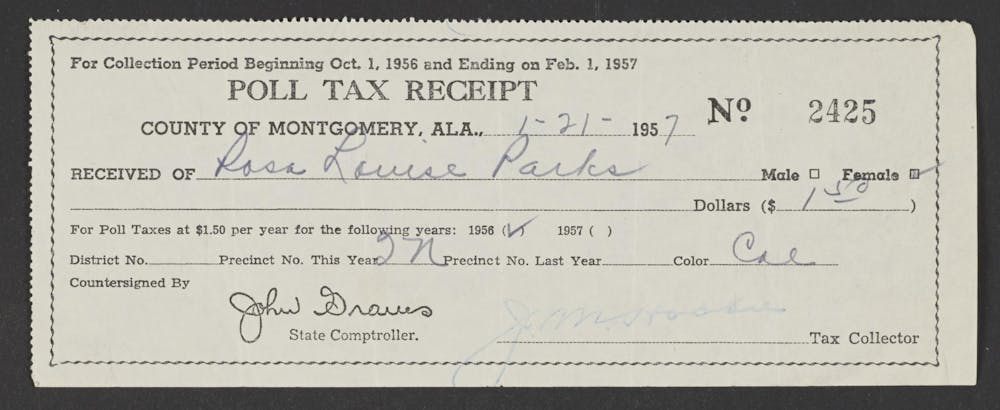
A number of Southern states had a poll tax that was aimed at preventing by Black people, many of whom couldn’t afford to pay it. This is a receipt for a $1.50 poll tax paid in 1957 by Rosa Parks. Library of Congress, Rosa Parks Papers
Victory – and more bigotry
The realization of civil and voting rights laws during the 1960s is often portrayed as a victory over racism. The rights revolution actually gave rise to more bigotry.
The Voting Rights Act criminalized the use of discriminatory tests and devices, including literacy tests and grandfather clauses that exempted white people from the same tests that stopped Black people from voting. It also required federal supervision of certain local Southern elections and barred these jurisdictions from making electoral changes without explicit approval from Washington.
In fact, the VRA worked so well that it gave rise to another seismic political shift: White voters left the Democratic Party in record numbers.
As Washington protected Black voting rights, this emerging Republican majority capitalized on fears of an interracial democracy. Conservatives resolved to turn the South Republican by associating minority rights with white oppression.
In 1981, conservative political consultant and GOP strategist Lee Atwater recognized that Republicans might exploit these fears. He argued:
“You start out in 1954 by saying, “Nigger, nigger, nigger.” By 1968 you can’t say “nigger” – that hurts you, backfires. So you say stuff like, uh, forced busing, states’ rights, and all that stuff, and you’re getting so abstract. Now, you’re talking about cutting taxes, and all these things you’re talking about are totally economic things and a byproduct of them is, blacks get hurt worse than whites.“
‘Retard civil rights enforcement’
It wasn’t just Southerners who aimed to undo the revolution enabled by the Voting Rights Act.
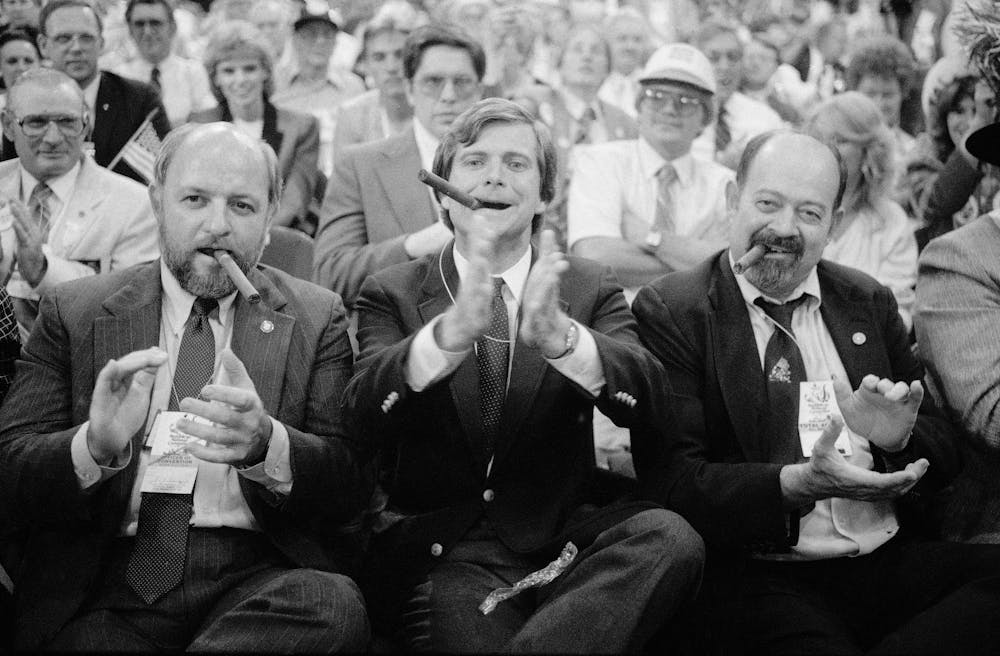
Conservative political consultant and GOP strategist Lee Atwater, center, at the GOP National Convention in Dallas, Aug. 23, 1984, recognized that Republicans might capitalize on white people’s fears of rising Black political power. AP Photo/Ed Kolenovsky
Reagan’s administration, according to voting rights expert Jesse Rhodes, used executive and congressional control to reorganize the Civil Rights Division of the Justice Department and the Supreme Court.
The objective?
To undermine how Washington enforced the Voting Rights Act – without appearing explicitly racist.
One of the Reagan administration’s strategies was to associate minority voting rights with so-called reverse discrimination. They argued that laws privileging minorities discriminated against white voters.
Undoing progress
Here’s the background to that strategy:
The years following 1965 were characterized by the dilution of Black Southerners’ voting power. Realizing that they couldn’t keep African Americans from voting, Southerners and segregationists resolved to weaken votes once they’d been cast. They gerrymandered districts and used other means that would dilute minority voting power.
Conservatives during the early 1980s had become increasingly alarmed by the Supreme Court’s and Department of Justice’s preference for drawing racial district boundaries to give minorities more influence in elections in such ”majority-minority districts.“ These districts aimed to guarantee that minorities could elect candidates of their choice free from machinations such as vote dilution.
With little regard for vote dilution itself, conservative politicians and their strategists argued that majority-minority districts discriminated against whites because they privileged, like affirmative action policies, equality of outcomes in elections rather than equal opportunity to participate.
Edward Blum, a longtime conservative legal activist, has brought and won many cases at the Supreme Court rolling back civil rights gains. Chip Somodevilla/Getty Images
By the 1990s, conservatives replaced federal officials who might protect the Voting Rights Act. In time, these developments, and growing conservatism within the courts, prompted conservative litigation that continues to shape civil rights laws.
A tidal wave of anti-civil rights litigation, led by a well-funded man, Edward Blum, flooded the court system. Blum sought to undermine the Voting Rights Act’s supervision of local elections and undo racial quotas in higher education and employment.
These cases, at their core, attacked the rights revolution of the 1960s – or rights that privilege minorities. The argument?
These protections are obsolete because Jim Crow segregation, especially its overt violence and sanctioned segregation, is dead.
New claim, old game
Nearly 30 years of Republican or divided control of Congress and, to a lesser degree, the executive office gave rise to increasingly conservative Supreme Court nominations that have not just turned the court red; they all but ensured favorable outcomes for conservative litigation.
These include the Shelby and Merrill cases and, more recently, litigation that seeks to remove racial considerations from college admissions.
In the Shelby case, the court held that the unprecedented number of African Americans in Alabama – and national – politics meant not merely that racism was gone, it meant that the Voting Rights Act is no longer relevant.
In fact, the rise of voter fraud allegations and contested election results is a new iteration of old, and ostensibly less violent, racism.
The Voting Rights Act was not only effective; Washington was also, initially, committed to its implementation. The political will to maintain minority voting rights has struggled to keep pace with the continuity of racist trends in American politics.
The work of protecting minority voting rights remains unfinished.
============================================================== Alecto, Megaera, and Tisiphone, what wouldn’t I give to see you, in your most terrifying appearance, swoop into the House and carry off Jim Jordan (and others, but if I started naming all the names we’d be here all week.) I know that’s not going to happen. But it does seem it will take something about that drastic, and at least that effective, to make any inroads. But it felt like that in the 50’s too. Maybe I’m just getting too old.
Yesterday, when I got to the computer (yes, later than usual) I had 105 emails in my inbox. I deleted, as quickly as I could,, all that were not subscriptions … and had 20 left. That’s actually not too bad – usually I have around 80, plus or minus, and end up with just about 20, plus or minus. So the volume was not all that alarming. The content, however, was another matter. Heather Cox Richardson’s Monday night letter (which as always I read this morning – even when it comes befroe mifnight, it generally comes after I leave the computer for the day), for instance, the statement of a Trump** stooge that if there was not s definite result tonight, “it’s going to look very suspicious.” Well, yes it is, to the ignorant – whether or not their ignorance is voluntary. Besides the delays in every election, which are unavoidable and not at all suspicous, a judge in Cobb County, GA recently ordered that a substantial number of voters who had applied for and not eeceived absentee ballots (now that actually does look suspicious) must be provided with replacement ballots and given unto November 14th to get them in (which is only fair.) And, even more disturbingly, the leader of the Wagner Group (the privately owned military company), who is a Russian oligarch, publicly took credit for interefering in US elections on a grand scale, both in 2016 and continuing, and with no intention to stop. Regardless of the truth (or lack of it) of that statement, it has a good chance of inspiring violence in people already radicalized. Well, at this point, we have done all we can (unless you are one of those Cobb County Georgia voters who got stiffed), and all we can do is brace ourselves.
Cartoon – 09 Bonaparte RTL
Short Takes –
Democratic Underground – Biden Stops Mid-Speech
Quote – Amid a crowd of hundreds watching President Joe Biden speak at a North County campaign event for Rep. Mike Levin on Thursday, Jared Smith and his handwritten sign stood out. It read: “Thank you for having a stutter.” About 20 minutes into the speech, President Biden noticed it, but couldn’t read it. Click through for full (short) story. The poster provides a source, but I thought this was so sweet – and so telling – just as it was that I went with the DU post.
The New Yorker – Why Facts Don’t Change Our Minds
Quote – Even after the evidence “for their beliefs has been totally refuted, people fail to make appropriate revisions in those beliefs,” the researchers noted. In this case, the failure was “particularly impressive,” since two data points would never have been enough information to generalize from. The Stanford studies became famous. Coming from a group of academics in the nineteen-seventies, the contention that people can’t think straight was shocking. Click through for article. Not exactly news, and kind of discouraging, but something we all need to come to terms with. Except – have you ever changed your mind on a political issue, or an issue of faith? Not necessarily religious faith, but just something you strongly believed was true? I have – I wouldn’t say many times, but definitely not just once, on a variety of issues. It has tended for me to be gradual, and to require thought and analysis, and in the end generally it comes down to the fact that the belief I am discarding as erroneous has come into conflict with something else I believe more strongly. Sometimes newly learned facts have been involved – but not always.