
Everyday Erinyes #307

 Posted by at 11:31 am  Politics
Feb 272022
 

Experts in autocracies have pointed out that it is, unfortunately, easy to slip into normalizing the tyrant, hence it is important to hang on to outrage. These incidents which seem to call for the efforts of the Greek Furies (Erinyes) to come and deal with them will, I hope, help with that. As a reminder, though no one really knows how many there were supposed to be, the three names we have are Alecto, Megaera, and Tisiphone. These roughly translate as “unceasing,” “grudging,” and “vengeful destruction.”

Since it’s still Black History month for one more day, I thought we might enjoy an article about a Black (or more accurately biracial) author who latched on to the vogue for “Uncle Remus”-like stories and characters, and jumped into the genre to make such subtle fun of the white people that they didn’t even get it. His name was Charles Chesnutt, and the character he created was called “Uncle Julius.” If you click on the link attached on the title “The Conjur Woman,” the name of an 1899 collection of Uncle Julius stories, it will bring you to the Gutenberg Project’s free download of the entire book plus an appendix of three more stories and another, non-fiction, book on Superstition and Folklore. (I created a shortcut to it for myself, and also made a custom icon for it, derived from the cover picture on one of its editions [not the first edition, whose cover is noce, but too dark for an icon], which I will gladly share if anyone wants it.)

I have only read one story so far. That’s enough to observe that the “local color” dialect is thick indeed, and that the white narrator, from Ohio, is pompous (as was the fashion of the day) and also pretty well taken in. The humor is subtle but definitely there. The n-word is used by Uncle Julus but not by any white character, and in such a way as to read like more exploitation of white gullibility, which may hep prevent cringing. Chesnutt did know what he was doing.
==============================================================

How a Black writer in 19th-century America used humor to combat white supremacy
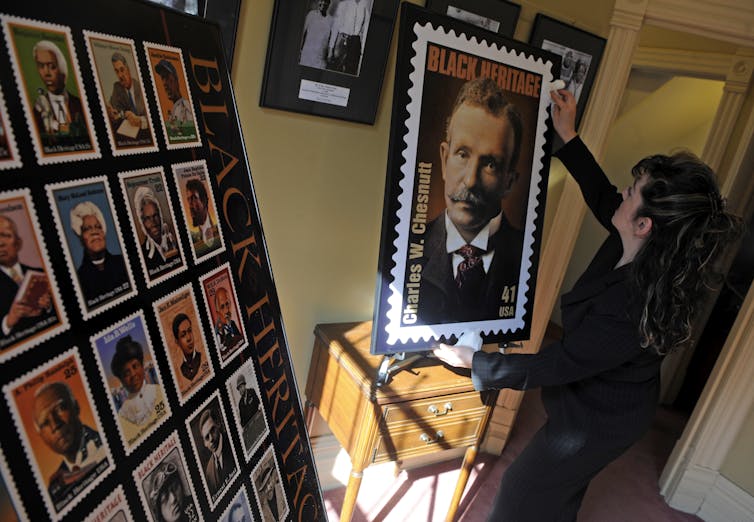
Charles Chesnutt was one of the first widely read Black fiction writers in the U.S.
RJ Sangosti/The Denver Post via Getty Images

Rodney Taylor, University of South Carolina

Any writer has to struggle with the dilemma of staying true to their vision or giving editors and readers what they want. A number of factors might influence the latter: the market, trends and sensibilities.

But in the decades after the Civil War, Black writers looking to faithfully depict the horrors of slavery had to contend with readers whose worldviews were colored by racism, as well as an entire swath of the country eager to paper over the past.

Charles Chesnutt was one of those writers. Forced to work with skeptical editors and within the confines of popular forms, Chesnutt nonetheless worked to shine a light on the legacy of slavery.

His 1899 collection of stories, “The Conjure Woman,” took place on a Southern plantation and sold well. At first glance, the stories seemed to mimic other books set in the South written in a style called “local color,” which focuses on regional characters, dialects and customs.

But Chesnutt had actually written a subversive counternarrative, using humor to poke holes in the nostalgic myths of the South and expose the contradictions of a racist society.

Rewriting the past

After the Civil War, there was a concerted effort to portray the South as a pastoral place possessed with a culture of honor. Slavery, meanwhile, had been a nurturing, even benevolent, institution.

These beliefs bled into the era’s fiction, with white authors such as Thomas Nelson Page and Joel Chandler Harris writing stories that sentimentalized and softened the complex histories of the past.
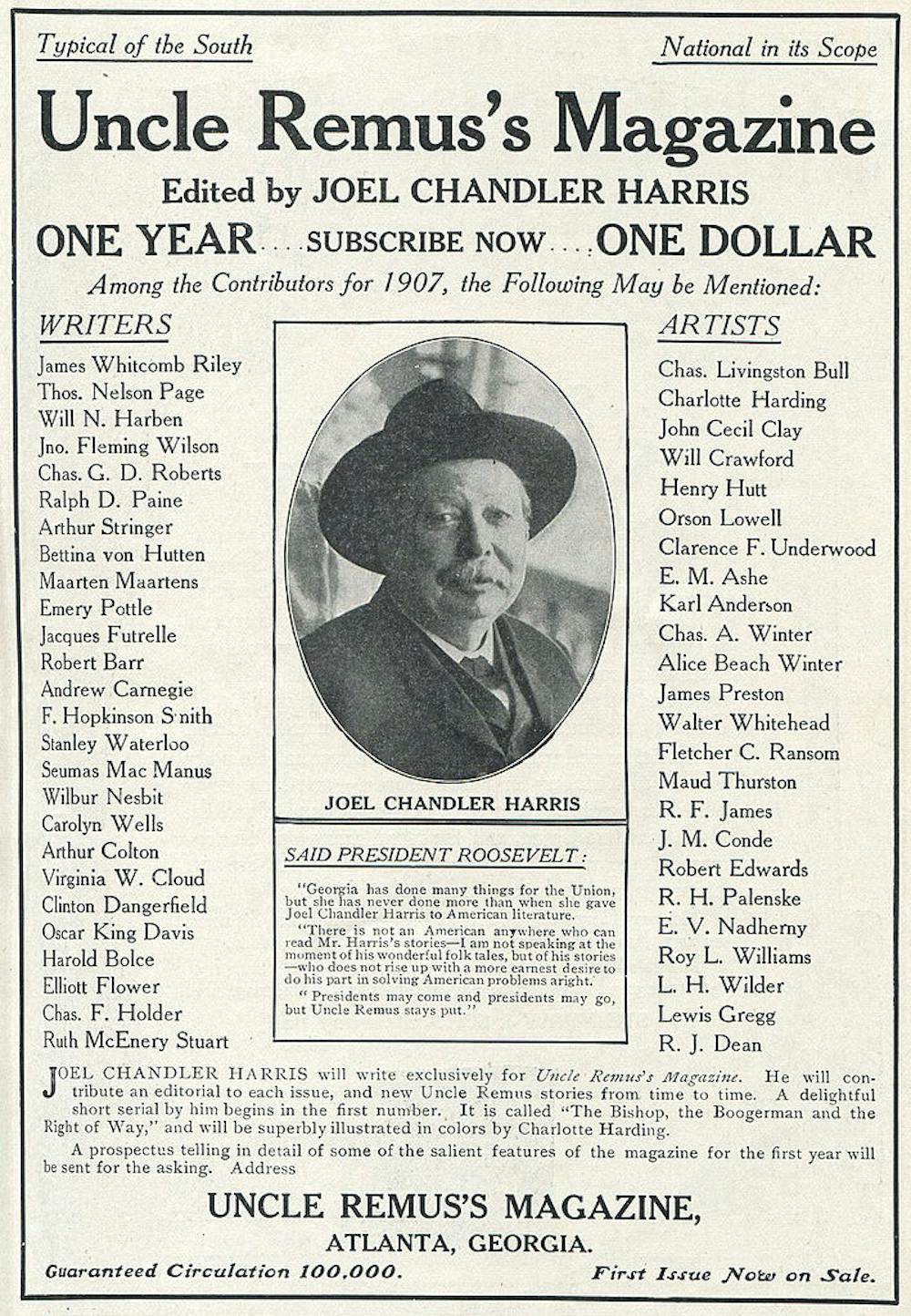
Broadsheet with portrait of man.
Writer and editor Joel Chandler Harris published a magazine named for his famous character Uncle Remus.
Jay Paull/Getty Images

Many of these stories feature a formerly enslaved older male who’s given the affectionate moniker “Uncle.” These characters tended to describe the Civil War as an affront on the Southern way of life, while presenting the South and its landed gentry as heroic.

In “A Story of the War,” for example, Harris introduces the character Uncle Remus, who recounts the time his master went away to fight the Civil War. Overcome with concern for the man who enslaved him, Uncle Remus follows him and witnesses a Northern soldier preparing to shoot him. In a moment of panic, Remus shoots the Northerner, wounding him.

“A Story of the War,” like most Southern local color tales, appealed to readers invested in the Lost Cause of the Old South, a revisionist ideology that depicts the creation of the Confederate States and cause of the Civil War as just and heroic.

Historian Fred Bailey notes that stories like Page’s and Harris’ were “hailed by the South’s upper-classes,” while associations like the United Daughters of the Confederacy routinely read from these works at their meetings.

Chesnutt’s revisionist humor

At first glance, it would seem Chesnutt, who was mixed-race and could have easily passed for white, was merely working within the dominant literary form of his time and fashioning stories geared to a white audience.

Like his white contemporaries, Chesnutt, in “The Conjure Woman,” includes a character who’s an “uncle” living on the abandoned plantation where he once toiled.

But Chesnutt, as literary historian Dickson Bruce points out in his 2005 essay “Confronting the Crisis: African American Narratives,” used the setting of the plantation to present a more authentic representation of slavery.
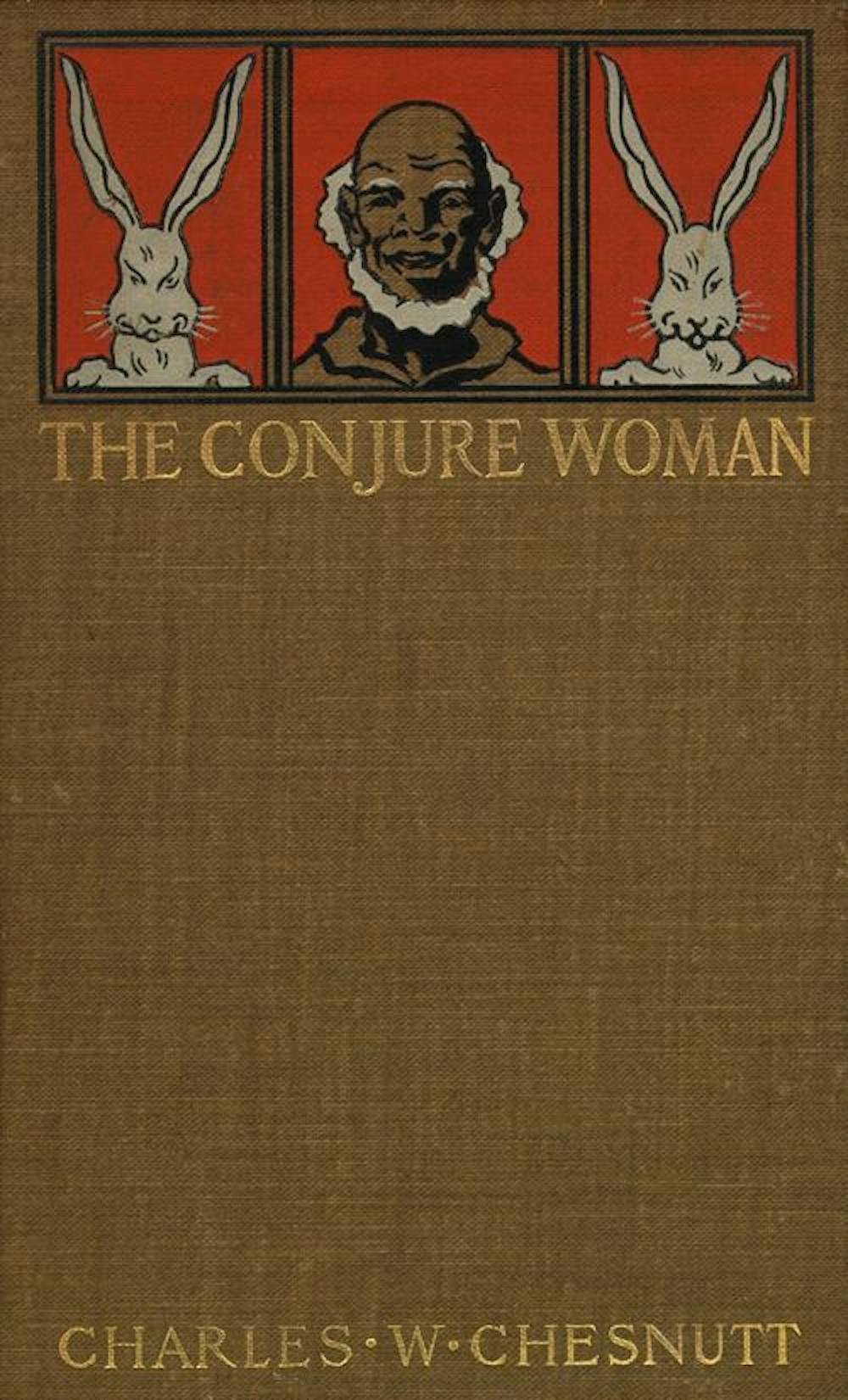
Book cover with elderly Black man and two rabbits.
The first edition cover of Charles Chesnutt’s ‘The Conjure Woman.’
Documenting the American South

Uncle Julius, who appears in each of the collection’s stories, isn’t nostalgic for some bygone era. Instead, he reflects on his own life and seeks to show the humanity of the enslaved. He uses his ability as a raconteur to cleverly swindle a white carpetbagger who bought the plantation Julius lived on during his bondage and after the Civil War. The stories are descriptive, corrective – and, most importantly, funny.

While Chesnutt’s tales explicitly engage with the hard history of slavery, each of the stories ends on a lighter note, with Uncle Julius often getting what he wants. Throughout the collection, he parodies the conventions of Southern fiction – whether refuting racist tropes or showing the cruelty of the ruling class – subtly poking fun at a culture enveloped by the fog of nostalgia.

Bound by form

At the same time, Chesnutt felt as if he couldn’t simply write broadsides against myths like the Lost Cause. In order to be published, Black writers needed to appeal to the sensibilities of white readers and the demands of editors.

For example, Uncle Julius spoke in a Black dialect that sounded similar to those of the uncles authored by white writers. This didn’t come easily for Chesnutt. In one letter to his editor, Chesnutt described writing in this dialect as a “despairing task.”

Nonetheless, he avoided completely pandering to mainstream expectations of how Black characters should be portrayed.

He rejected the emergent historiography of Reconstruction that refused to recognize the agency of African Americans, and despite working within the form, Chesnutt didn’t present Julius as a buffoon who was happy to serve the whites in his midst.

Even though his stories didn’t overtly denounce racism, Chesnutt hoped they might still chip away at prejudice:

“But the subtle almost indefinable feeling of repulsion toward the negro, which is common to most Americans – and easily enough accounted for, cannot be stormed and taken by assault; the garrison will not capitulate: so their position must be mined, and we will find ourselves in their midst before they think it.”

Humor opens doors

Chesnutt is far from the only Black artist asked to make compromises. Poet Langston Hughes had a falling out with his patron, Charlotte Osgood Mason, who viewed African Americans as a link to the species’ primitive past and wanted his work to be devoid of political progressivism.

As Hughes wrote in his 1940 autobiography, “The Big Sea,” “I was only an American Negro – who had loved the surface of Africa and the rhythms of Africa – but I was not Africa. I was Chicago and Kansas City and Broadway and Harlem. And I was not what she wanted me to be.”

In Chesnutt, I also see ties to contemporary Black comedians who center their humor around race.

During the third season of “Chappelle’s Show,” Dave Chappelle famously suffered from an existential crisis because the comedian wasn’t sure how people were responding to his humor. In a 2006 interview with Oprah Winfrey, he explained how, when filming a sketch in blackface, “someone on the set, that was white, laughed in such a way – I know the difference of people laughing with me and laughing at me. And it was the first time I’d ever gotten a laugh that I was uncomfortable with.”

Shortly after, Chappelle quit the show.
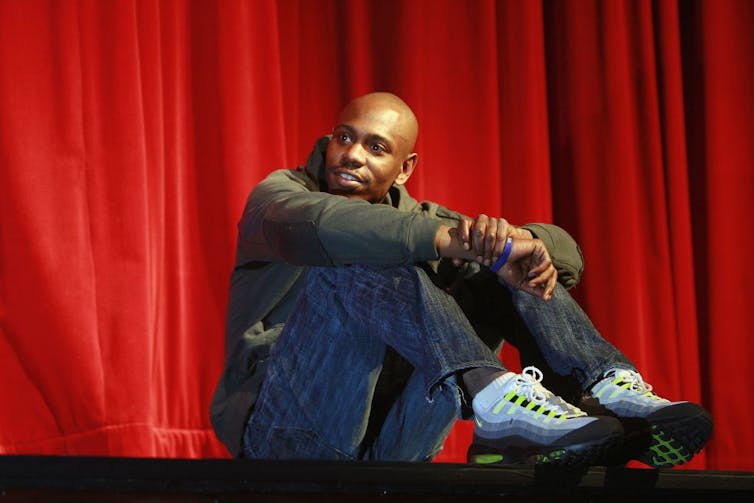
Man sitting on stage in front of red curtain.
Comedian Dave Chappelle struggled over whether the audience was laughing with him or at him.
Riccardo Savi/Getty Images

While Chesnutt was certainly not the first African American artist to use humor to depict the horrors of slavery, he was one of the first to reach the American mainstream.

The humor disarms readers, helping them cross a psychological threshold and enter a space where a more nuanced conversation about the history of the country can take place.

[Get the best of The Conversation, every weekend. Sign up for our weekly newsletter.]The Conversation

Rodney Taylor, Postdoctoral Fellow in African American Studies, University of South Carolina

This article is republished from The Conversation under a Creative Commons license. Read the original article.

==============================================================
AMT, I find it nice to be able to read what the man actually wrote, and not just what some scholar, however knowledgeable, says about him. It will take me a while to get through all on it – but after reading one story, I for one want more.

The Furies and I will be back.

Share
Feb 222022
 

Today is Twos-day: whether you write it 2/22/2022 or 22/2/2022 or 2022/2/22, it’s more twos than we can expect to see for 200 years (and I for one do not expect to be around.) And, to top it off, it’s also Tuesday. And, yesterday, it was a slow news day. So I just posted two short takes (and two videos on that thread) and took the rest of the day off. If Ukraine explodes, it will have to wait until Wednesday. (Not that you won’t hear about it elsewhere.)

Cartoon –

Short Takes –

The Nib – Breathless
Quote – When I moved to Calcutta for college, the second largest and one of the most poluted cities in India, I could not see the stars any more. And I could not breathe. One night I stayed up coughing till the sun rose. The following week I was diagnosed with asthma.
Click through for graphic article. I have been somewhat vaguely aware of how much fighting climate change as an individual depends on having money and health and other privilege. But this brings it home in ways no other medium has done for me.

Black History Month – The New Yorker – Henry Louis Gates Jr.
Quote – Perhaps his most important and lasting role has been as a teacher and an institution builder. Gates arrived at Harvard in 1991, and he swiftly recruited an extraordinary concentration of Black scholarship—William Julius Wilson, Cornel West, Lawrence D. Bobo, Evelyn Brooks Higginbotham, Suzanne Blier, and others—all while reinvigorating the W. E. B. Du Bois Research Institute, which is now part of the Hutchins Center. Gates proved a dynamo of both intellectual energy and fund-raising finesse.
Click through for full interview. Skip is sometimes called “the Black Ken Burns,” and certainly no one has any better right to tht title. But he is also so much more.

Food For Thought:

Share
Feb 212022
 

Glenn Kirschner – NY Judge Slams Trump, Don Jr. & Ivanka, Orders Them to Sit for Deposition in AG James’ Investigation

Meidas Touch (Lost Debate) – Here are the 19 LEGAL CASES against Trump! (I think theremay be a misuunderstanding of the term “corpus delicti” here.)

Rebel HQ – U.S. Intelligence Accuses Conservative Website Of Secretly Helping Putin

Farron Balanced – Sidney Powell Sues Verizon To Keep Her Communications Hidden From Investigators

Armageddon Update – Super Bowl LVI

John Fugelsang – Caffeinated – Bribe Back Better

Beau – Let’s talk about San Francisco, DNA, and the rest of the country…. (This DA is Chesa Boudin, who is facing a recall election. I posted about this earlier and I was upset then and am even more upset now. He could use more help from ethical people)

Share
Feb 202022
 

Glenn Kirschner – With Trump Losing on All Fronts, When Will Indictments Come? Balancing Frustration with Patience

Meidas Touch – Trump Is Guilty

Farron Balanced – How Did The MyPillow Guy Become Leader Of The Right Wing Crazies

MSNBC – Data Shows Odd Clusters Of Florida Voters Switching To Republican Party

PBS News – hanky alert – Yo-Yo Ma and Gabby Giffords perform ‘Sound of Silence’ to honor lives lost to gun violence

Puppet Regime – Putin’s President’s Day Advice

Beau – Let’s talk about the Superbowl, Star Trek and timelessness….

Share
Feb 192022
 

Yesterday, I watched Ari Melber  Claire McKaskill, and a third person discuss a judge calling Trump’s lawyers arguments Humpty-Dumpty-esque for over 14 minutes – and NOT ONE of them mentioned what the judge must have meant by that. It’s clearly a reference (and they did mention Alice in Wonderland) to Through the Looking Glas where Humpty Dumpty said, “When I use a word, it means just what I choose it to mean, neither more nor less.” As Alice pointed out, it doesn’t work that way (though he was not convinced and babblrd on about how he was paying them to do his bidding.) It’s quite a conversation – and it is exactly like Trump** and Trump** lawyers. But they all seemed to think the judge was alluding to Humpty Dumpty’s fall. I think not. Anyway, I also got my groceries in and mostly put away. The frozen and refrigerated stuff immediately, of course, but the rest could wait longer (for me to be rested between trips.) I didn’t receive everything – but at least there were no substitutions.

Cartoon –

Short Takes –

Mother Jones – My Family Lost Our Farm During Japanese Incarceration. I Went Searching for What Remains.
Quote – The anti-Japanese sentiment that allowed for such a drastic action to take place did not spring up suddenly after Pearl Harbor, but had been simmering for decades, stoked by white labor and business groups resentful of Japanese workers and farmers. Japanese Americans who were forced off their land lost property worth an estimated $3.7 billion in today’s dollars, and $7.7 billion worth of income.
Click through.  Today is the day. The eightieth anniversary of that executive order. And, yes, it was racism, but specifically the fear aspect of racism. Who benefits from keeping people in fear? Certainly not the people who are terrified.

HuffPost – Child Poverty Spiked After Tax Credit Expired, Early Research Suggests
Quote – Democrats failed to extend a credit late last year, due to the opposition of Sen. Joe Manchin (D-W.Va.). The last monthly check was paid out to parents on Dec. 15. After this tax season, the credit will return to its previous $2,000 level and parents with no income will no longer be eligible. Manchin told colleagues and constituents he thought parents wasted the money on drugs. Though he avoided taking a clear public position on the policy, he suggested it should have a “work requirement.”
Click through for details/ I would file this under “No shit, Sherlock.” And it really frosts me when people, especially in the media, say “Congress” when what they should be saying is “Republicans” (and, in this case, a DINO.)

CBS News – Ryan Speedo Green: From juvenile delinquency to opera stardom
Quote – As a 12-year-old in Virginia, Ryan Speedo Green was the author of an impressive rap sheet. He was so violent he was banished to a class for delinquents. And when he couldn’t be contained there, he was sent to a juvenile lockup. Those who knew the boy with the unusual name, could see that the child was writing a tragedy. Now, as a man, tragedy has become the dominant theme in his life, but in a way that no one could have imagined.
Click through for bio. Or, if you’re in a hurry, click here for this video from September 28, 2016, the night before he opened the season at the Met (hanky alert). I just didn’t want to ley the month go by without sharing this remarkable story.

Food For Thought:

Share
Feb 082022
 

Yesterday, I confes I pretty well laid back all day.  I did get a few things accomplished – but very litte.  I hope I can get moving today.

Cartoon:

Short Takes –

Mississippi Free Press – Black FedEx Driver Says White Men Chased, Shot At Him During Deliveries
Quote – [His attorney, Carlos] Moore compared the incident to the shooting death of Ahmaud Arbery, a Black man who was jogging when three white men, including a father and son, pursued and killed him in Glynn County, Ga., in 2020. “It’s just sad that it happens. It seems to be a copycat duo copying off the Ahmaud Arbery case. …. They saw this man was a Black man, and they just hauled off and shot at him multiple times, at least the younger son did. The older guy tried to entrap him. They were working concertedly to try to entrap and kill this man. I mean, they shot at him several times. It’s amazing that he survived.”
Click through for details. Not that the details are all that unique. As Lona said, we’re so tired of racism, but the GQP will never be tirned of it.

Crooks and Liars – Clarence Thomas Must Resign: Ron DeSantis Regular Contact Edition
Quote: But now American Oversight has obtained evidence that Justice Thomas is in regular, direct contact with Florida’s MAGA governor, Ron DeSantis. In a pitch to his scheduling office in June, 2021, Ginni Thomas requested DeSantis’ attendance at one of her “coalition” meetings, saying:  “Gov. DeSantis will be acquainted with me, as I video-interviewed him for a Leader series with Daily Caller years ago when he served in Congress, saw him at a state dinner in the Trump White House and my husband has been in contact with him too on various things of late.”
Click thrugh. This is what happens when a nation takes it for granted the its Supreme Court Justices will not be out-and-out gangsters, because the mostly haven’t been. But now they are. And our hands are tied. Unless we can get a strong majority in both Houses and the Presidency, the future is looking bleak.

The Nib – Black and Red (The History of Black Socialism)
Quote – Throughout 1919, more than four million workers went on strike. Big business came up with a plan it would use for decades… To divide workers along RACE. That same year, race riots broke out across 25 cities in what would become known as THE RED SUMMER.
Click through for full graphic article. The Nib is a “cartoon” site, but so much of what they do I just can’t call a cartoon.

Food For Thought:

Share
Feb 052022
 

Yesterday, I got the emails down to under 1700. I also found a way to increase how many I can delete at a time, so one more day may possibly do it. After that, I need to deal with some notofications and updates, but not all that many. So there is a light at the end of the tunnel.

Cartoon –

Short Takes –

CNN – Arizona Republican House speaker effectively dooms GOP bill to allow state legislature to reject election results
Quote – The speaker assigns all new bills to a committee for consideration before they can have full House votes, a choice that often has a great effect on a measure’s chance of success. But on Tuesday, Bowers took the unprecedented step of ordering all 12 House committees to consider the elections bill, virtually ensuring it will never reach the floor.
Click through for more. I have to say this is creative – and Democrats should pay attention. This is a technique which could be useful.

Two stories – one subject.
NBC News – A black man in Michigan tried to deposit checks at his bank. The manager called police.
MSN/WaPo – A Black doctor says she was refused service at a bank because of her race: ‘I felt like a criminal’
Click thrugh for individual details. Different states, different genders, different dollar amounts, but the same story. Either or both would be a great argument for restoring Postal Banking … if we had a sane Postmaster General. (My understading is Republicans in the Senate are dragging their feet on confirming nominees to the Board of Governors.) Meanwhile, I’d recommend Credit Unions. That’s not a guarantee, however.

The Conversation – Biden sending more troops to Eastern Europe – 3 key issues behind the decision
The Issues – 1. Does Biden have the authority to do this?
2. Have other U.S. presidents done something similar?
3. Why is Biden sending more troops to Europe?
Click through for all three discussions. I’m not a foreign policy expert, so fairly open-ended discussions like this are helpful to me.

Food For Thought:

Share
Feb 032022
 

Glenn Kirschner – Trump Pushes Protests, Promises Pardons During Texas Rally: Reveals his Fear Indictments are Near

American Bridge – Co-Chair Cecile Richards: Biden making historic SCOTUS pick

Meidas Touch – Nikki Fried BLASTS Ron DeSantis for HIDING TESTS as Omicron surged

The Lincoln Project – Vote While It Counts

politicsrus – Our Future Needs Strong Public Schools

Radio DJ Drives An Hour Every Day For Months To Gain This Wild Pittie’s Trust

Beau – Let’s talk about fake electors and real subpoenas….

Share