
Everyday Erinyes #307

 Posted by at 11:31 am  Politics
Feb 272022
 

Experts in autocracies have pointed out that it is, unfortunately, easy to slip into normalizing the tyrant, hence it is important to hang on to outrage. These incidents which seem to call for the efforts of the Greek Furies (Erinyes) to come and deal with them will, I hope, help with that. As a reminder, though no one really knows how many there were supposed to be, the three names we have are Alecto, Megaera, and Tisiphone. These roughly translate as “unceasing,” “grudging,” and “vengeful destruction.”

Since it’s still Black History month for one more day, I thought we might enjoy an article about a Black (or more accurately biracial) author who latched on to the vogue for “Uncle Remus”-like stories and characters, and jumped into the genre to make such subtle fun of the white people that they didn’t even get it. His name was Charles Chesnutt, and the character he created was called “Uncle Julius.” If you click on the link attached on the title “The Conjur Woman,” the name of an 1899 collection of Uncle Julius stories, it will bring you to the Gutenberg Project’s free download of the entire book plus an appendix of three more stories and another, non-fiction, book on Superstition and Folklore. (I created a shortcut to it for myself, and also made a custom icon for it, derived from the cover picture on one of its editions [not the first edition, whose cover is noce, but too dark for an icon], which I will gladly share if anyone wants it.)

I have only read one story so far. That’s enough to observe that the “local color” dialect is thick indeed, and that the white narrator, from Ohio, is pompous (as was the fashion of the day) and also pretty well taken in. The humor is subtle but definitely there. The n-word is used by Uncle Julus but not by any white character, and in such a way as to read like more exploitation of white gullibility, which may hep prevent cringing. Chesnutt did know what he was doing.
==============================================================

How a Black writer in 19th-century America used humor to combat white supremacy
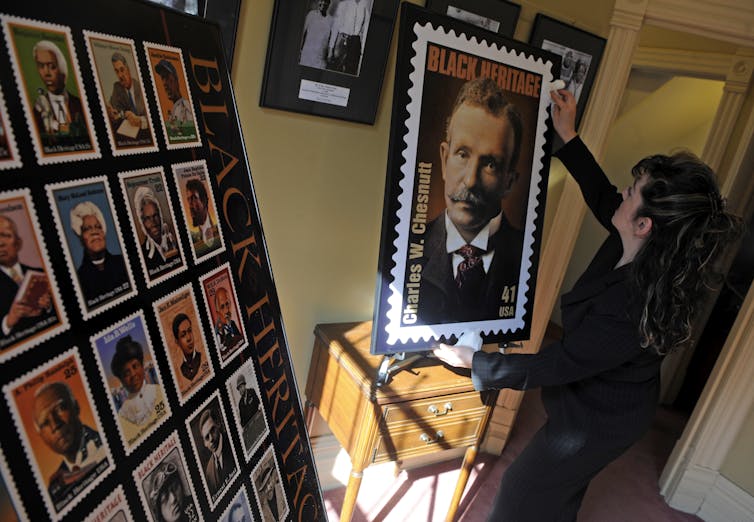
Charles Chesnutt was one of the first widely read Black fiction writers in the U.S.
RJ Sangosti/The Denver Post via Getty Images

Rodney Taylor, University of South Carolina

Any writer has to struggle with the dilemma of staying true to their vision or giving editors and readers what they want. A number of factors might influence the latter: the market, trends and sensibilities.

But in the decades after the Civil War, Black writers looking to faithfully depict the horrors of slavery had to contend with readers whose worldviews were colored by racism, as well as an entire swath of the country eager to paper over the past.

Charles Chesnutt was one of those writers. Forced to work with skeptical editors and within the confines of popular forms, Chesnutt nonetheless worked to shine a light on the legacy of slavery.

His 1899 collection of stories, “The Conjure Woman,” took place on a Southern plantation and sold well. At first glance, the stories seemed to mimic other books set in the South written in a style called “local color,” which focuses on regional characters, dialects and customs.

But Chesnutt had actually written a subversive counternarrative, using humor to poke holes in the nostalgic myths of the South and expose the contradictions of a racist society.

Rewriting the past

After the Civil War, there was a concerted effort to portray the South as a pastoral place possessed with a culture of honor. Slavery, meanwhile, had been a nurturing, even benevolent, institution.

These beliefs bled into the era’s fiction, with white authors such as Thomas Nelson Page and Joel Chandler Harris writing stories that sentimentalized and softened the complex histories of the past.
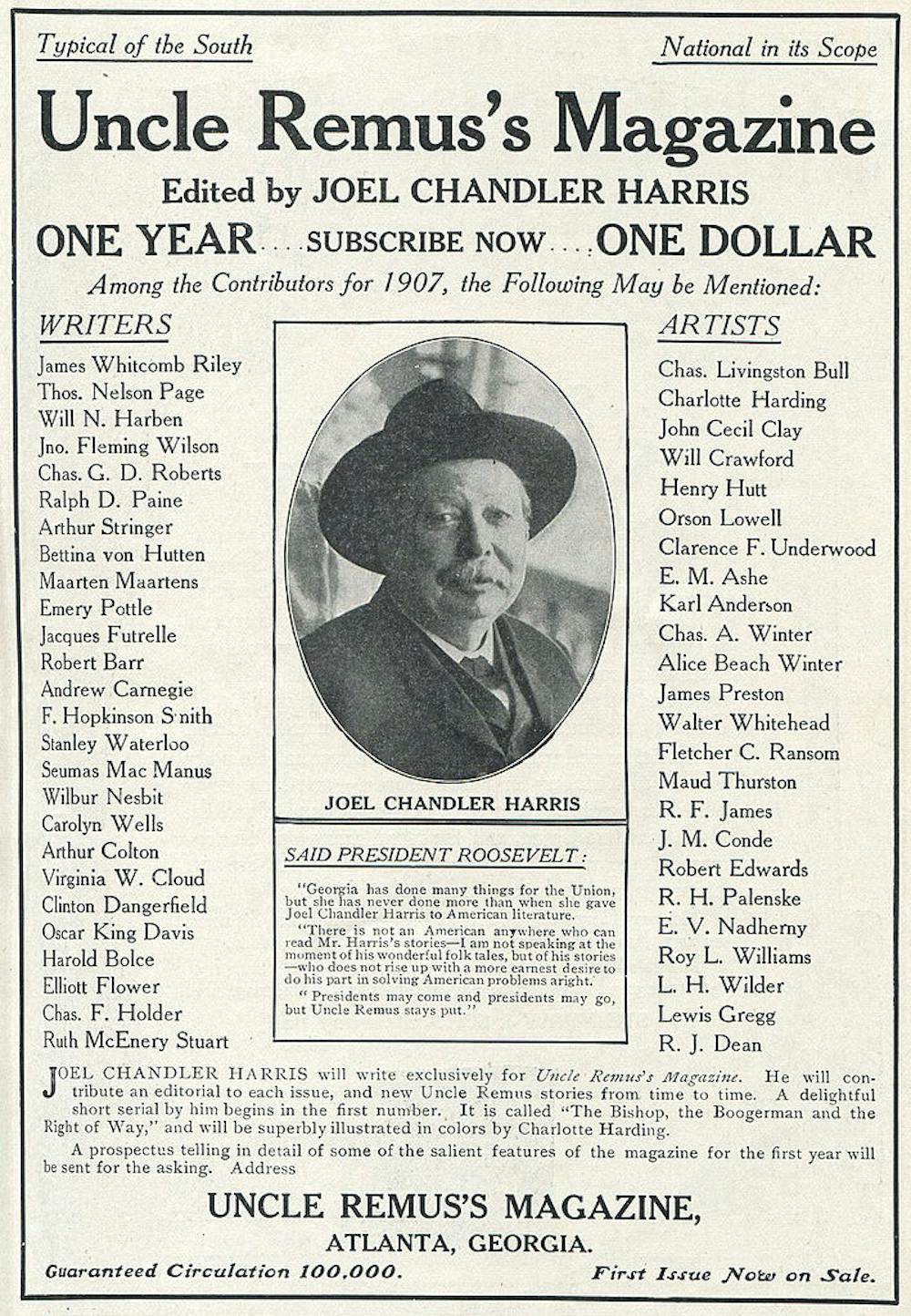
Broadsheet with portrait of man.
Writer and editor Joel Chandler Harris published a magazine named for his famous character Uncle Remus.
Jay Paull/Getty Images

Many of these stories feature a formerly enslaved older male who’s given the affectionate moniker “Uncle.” These characters tended to describe the Civil War as an affront on the Southern way of life, while presenting the South and its landed gentry as heroic.

In “A Story of the War,” for example, Harris introduces the character Uncle Remus, who recounts the time his master went away to fight the Civil War. Overcome with concern for the man who enslaved him, Uncle Remus follows him and witnesses a Northern soldier preparing to shoot him. In a moment of panic, Remus shoots the Northerner, wounding him.

“A Story of the War,” like most Southern local color tales, appealed to readers invested in the Lost Cause of the Old South, a revisionist ideology that depicts the creation of the Confederate States and cause of the Civil War as just and heroic.

Historian Fred Bailey notes that stories like Page’s and Harris’ were “hailed by the South’s upper-classes,” while associations like the United Daughters of the Confederacy routinely read from these works at their meetings.

Chesnutt’s revisionist humor

At first glance, it would seem Chesnutt, who was mixed-race and could have easily passed for white, was merely working within the dominant literary form of his time and fashioning stories geared to a white audience.

Like his white contemporaries, Chesnutt, in “The Conjure Woman,” includes a character who’s an “uncle” living on the abandoned plantation where he once toiled.

But Chesnutt, as literary historian Dickson Bruce points out in his 2005 essay “Confronting the Crisis: African American Narratives,” used the setting of the plantation to present a more authentic representation of slavery.
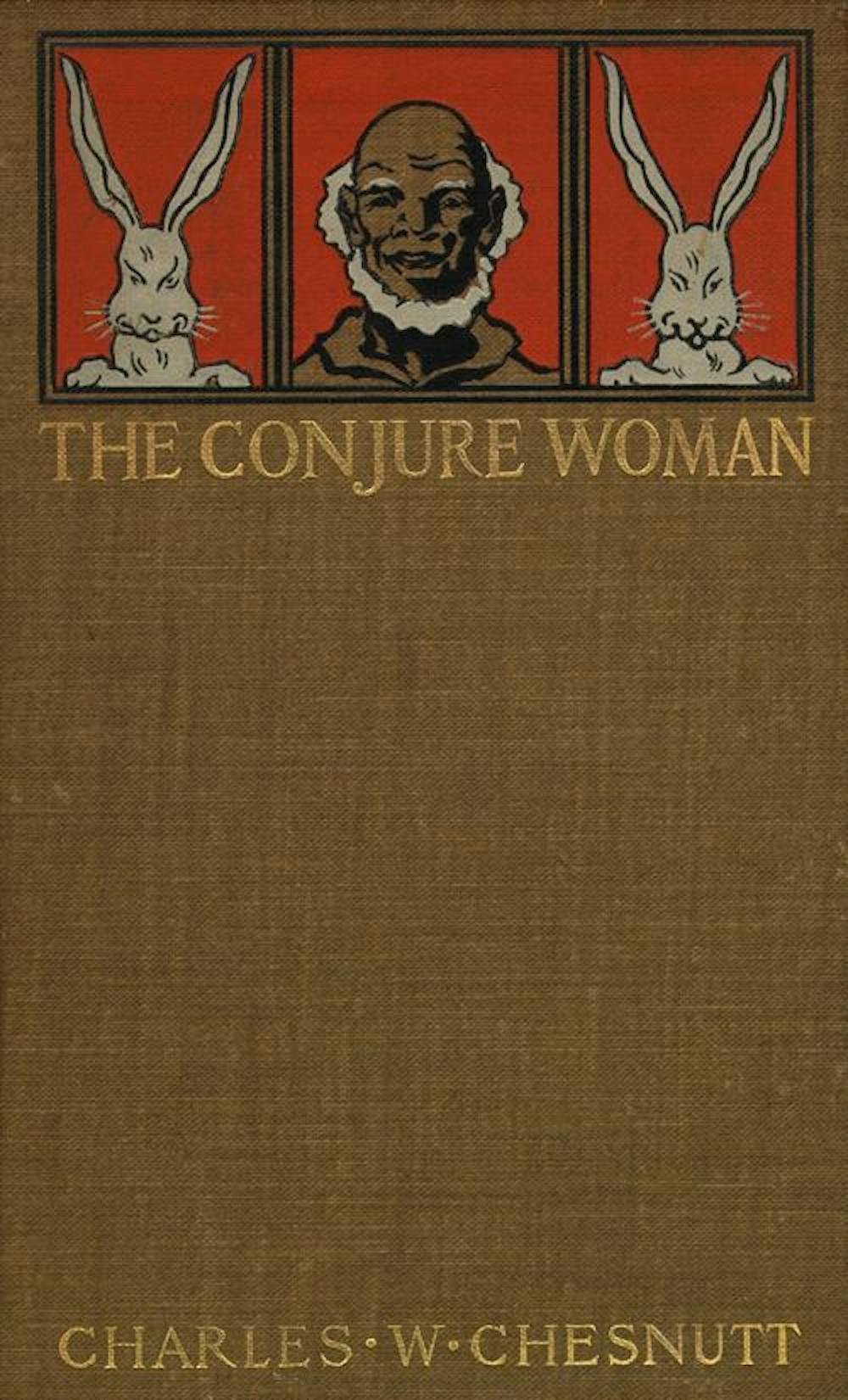
Book cover with elderly Black man and two rabbits.
The first edition cover of Charles Chesnutt’s ‘The Conjure Woman.’
Documenting the American South

Uncle Julius, who appears in each of the collection’s stories, isn’t nostalgic for some bygone era. Instead, he reflects on his own life and seeks to show the humanity of the enslaved. He uses his ability as a raconteur to cleverly swindle a white carpetbagger who bought the plantation Julius lived on during his bondage and after the Civil War. The stories are descriptive, corrective – and, most importantly, funny.

While Chesnutt’s tales explicitly engage with the hard history of slavery, each of the stories ends on a lighter note, with Uncle Julius often getting what he wants. Throughout the collection, he parodies the conventions of Southern fiction – whether refuting racist tropes or showing the cruelty of the ruling class – subtly poking fun at a culture enveloped by the fog of nostalgia.

Bound by form

At the same time, Chesnutt felt as if he couldn’t simply write broadsides against myths like the Lost Cause. In order to be published, Black writers needed to appeal to the sensibilities of white readers and the demands of editors.

For example, Uncle Julius spoke in a Black dialect that sounded similar to those of the uncles authored by white writers. This didn’t come easily for Chesnutt. In one letter to his editor, Chesnutt described writing in this dialect as a “despairing task.”

Nonetheless, he avoided completely pandering to mainstream expectations of how Black characters should be portrayed.

He rejected the emergent historiography of Reconstruction that refused to recognize the agency of African Americans, and despite working within the form, Chesnutt didn’t present Julius as a buffoon who was happy to serve the whites in his midst.

Even though his stories didn’t overtly denounce racism, Chesnutt hoped they might still chip away at prejudice:

“But the subtle almost indefinable feeling of repulsion toward the negro, which is common to most Americans – and easily enough accounted for, cannot be stormed and taken by assault; the garrison will not capitulate: so their position must be mined, and we will find ourselves in their midst before they think it.”

Humor opens doors

Chesnutt is far from the only Black artist asked to make compromises. Poet Langston Hughes had a falling out with his patron, Charlotte Osgood Mason, who viewed African Americans as a link to the species’ primitive past and wanted his work to be devoid of political progressivism.

As Hughes wrote in his 1940 autobiography, “The Big Sea,” “I was only an American Negro – who had loved the surface of Africa and the rhythms of Africa – but I was not Africa. I was Chicago and Kansas City and Broadway and Harlem. And I was not what she wanted me to be.”

In Chesnutt, I also see ties to contemporary Black comedians who center their humor around race.

During the third season of “Chappelle’s Show,” Dave Chappelle famously suffered from an existential crisis because the comedian wasn’t sure how people were responding to his humor. In a 2006 interview with Oprah Winfrey, he explained how, when filming a sketch in blackface, “someone on the set, that was white, laughed in such a way – I know the difference of people laughing with me and laughing at me. And it was the first time I’d ever gotten a laugh that I was uncomfortable with.”

Shortly after, Chappelle quit the show.
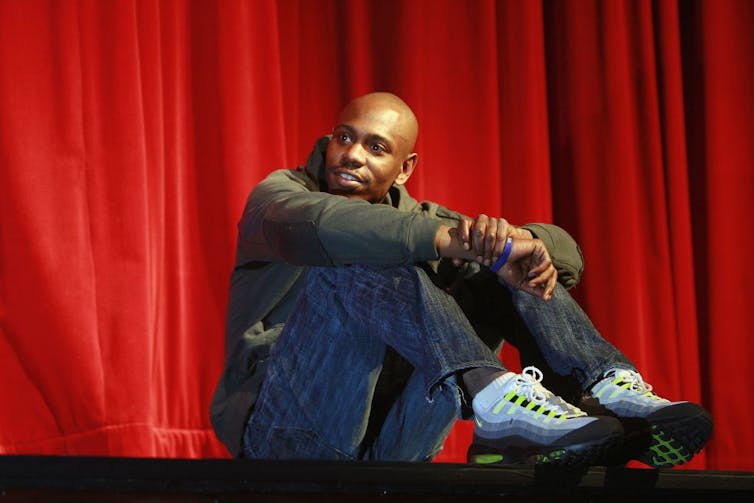
Man sitting on stage in front of red curtain.
Comedian Dave Chappelle struggled over whether the audience was laughing with him or at him.
Riccardo Savi/Getty Images

While Chesnutt was certainly not the first African American artist to use humor to depict the horrors of slavery, he was one of the first to reach the American mainstream.

The humor disarms readers, helping them cross a psychological threshold and enter a space where a more nuanced conversation about the history of the country can take place.

[Get the best of The Conversation, every weekend. Sign up for our weekly newsletter.]The Conversation

Rodney Taylor, Postdoctoral Fellow in African American Studies, University of South Carolina

This article is republished from The Conversation under a Creative Commons license. Read the original article.

==============================================================
AMT, I find it nice to be able to read what the man actually wrote, and not just what some scholar, however knowledgeable, says about him. It will take me a while to get through all on it – but after reading one story, I for one want more.

The Furies and I will be back.

Share
Feb 272022
 

Yesterday, the opera broadcast was a collection of performances by Black artists throughout the Met’s history – as far back as 1952 (For perspective, Brown v. Board of Education was decided in 1954). There were some real rarities – both some voices and some arias I had never heard before, and even more I had not heard for decades (and then not in those roles.) It was exhilarating and humbling. I had not slept well … but I didn’t want to miss it and I’m so glad I didn’t.

Cartoon –

Short Takes –

Good News Network – Sound Waves Convert Stem Cells Into Bone in Regenerative Breakthrough
Quote – In a new study, the RMIT research team showed stem cells treated with high-frequency sound waves turned into bone cells quickly and efficiently. Importantly, the treatment was effective on multiple types of cells including fat-derived stem cells, which are far less painful to extract from a patient.
Click through for more. This is not finalized but it certainly is hopeful.

Crooks and Liars – Resistance: Texas DAs Balk At Greg Abbott’s Anti-Trans Order
Quote – Harris County Attorney Christian Menefee made clear in a statement Tuesday that his office “will not participate in these bad faith political games” and will not be prosecuting any healthcare professionals or families referred by the DFPS.
Click through for details. This is awfully nice to see.

Black History – CPR – Interview: Denver historian recalls the impact U.S. presidents have had on Black Americans
Quote (spoiler) – Dukakis: Is there an American president that you think did the most to change life for Black people in this country or can you not name someone in particular? Scott: Without a doubt, it was LBJ. Johnson is the only president that directed most of his administration to try to right the wrongs that went against Black people all these years.
Click through for interview (you can also listen to it at this link). I’m almost out of month, and there is so much more to tell.

Food For Thought:

Share
Feb 262022
 

Yesterday, our high temperature got up to 28°F. I stayed indoors … and moved my space heater a little closer.  I also worked on cartoons for March (I picked out all the subjects but did’t start work on anny.).  I shouldn’t have tto do as many as I did for February, although  I expect to have to bump some perfectly good ones as events occur.

Cartoon –

Short Takes –

PolitiZoom – Biden Has Had This Ukraine Crisis In Hand For Almost A Year
Quote – Over the last few weeks you’ve asked yourself, How the hell is Biden beating Putin to the punch every single time? Simple. Because for almost a year now, Biden has already known what Putin has been planning, and has kept his and has kept his largest, closest NATO allies in the loop. And under curtain of darkness, they have gotten the other NATO members brought up to date as to Putin’s plans.
Click through for full story. Now THAT’s a leader. (“Murfster35” used to write at Daily Kos but moved to PolitiZoom to support Ursula.)

Letters from an American – February 24, 2022
Quote – Representative Elise Stefanik (R-NY), who took over for Representative Liz Cheney (R-WY) when the House Republicans stripped her of her position as the third most powerful House Republican, tweeted that “Joe Biden is unfit to serve as Commander-in-Chief. He has consistently given into [sic] Putin’s demands and shown nothing but weakness.” This is simply an extraordinary statement for a lawmaker to issue at a time when a president is rallying the global community to stop an invasion of another democracy, but she is not alone.
Click through. Obviously there’s lots more, but a list of prominent traitors is always handy.

Black History (in the making) – PRESIDENT BIDEN NOMINATES KETANJI BROWN JACKSON TO SERVE ON THE U.S. SUPREME COURT
Quote – Since Justice Stephen Breyer announced his retirement, President Biden has conducted a rigorous process to identify his replacement. President Biden sought a candidate with exceptional credentials, unimpeachable character, and unwavering dedication to the rule of law. And the President sought an individual who is committed to equal justice under the law and who understands the profound impact that the Supreme Court’s decisions have on the lives of the American people. That is why the President nominated Judge Ketanji Brown Jackson to serve as the next Justice on the Supreme Court. Judge Jackson is one of our nation’s brightest legal minds and has an unusual breadth of experience in our legal system, giving her the perspective to be an exceptional Justice.
Click through for the story direct from the horse’s mouth, as the saying goes.

Food For Thought:

Share
Feb 252022
 

Yesterday, The sun came out and the snow started to melt. It’s already somewhat warmer inside, though not back to what I had gotten used to. But that will come. Also yesterday, before sawn here, Putin invaded Ukraine.

Cartoon –

Short Takes –

I am not qualified to write helpfully about the events in Ukraine (about the tonly thing I consider myself qualified to say is that Putin’sRepublican Party is a bunch of traitors, who should all be interned.) Someone who is qualified to do that reporting is Beau of the Fifth Column (whose videos I put in the video thread regularly.) He is not a veteran, but has been a defense contractor in war zones – the kind of looker-on who really does see more of the game than the players – and has supplemented that knowledge with specialized reading and study. I cannot possibly do justice to his Ukraine reporting in the video thread, where I limit any given source to one video per day, while he puts up two videos every day, three yesterday, and I would not be surprised if he went to three a day every day while this is going on. So I am just putting a link here to his YouTube page – not the home page but the one that just has all the videos in reverse chronological order. You will get solid news from hom as well as guidance how to dig in further, if such is available. Even if he does go to three videos daily, in usually under a half our a day you can get a lot of clarity.  Click through and save or bookmark.

Wonkette – Neo-Nazi Plan To Destroy US Power Grid Foiled By Lost Phone
Quote – In this case, they themselves were the terrorists they provided material support to, along with several juveniles they had recruited online, as the three men intended to attack regional power substations for the purpose of causing civil unrest and perhaps “the next Great Depression,” which they imagined would lead to a race war or provide an opportunity for white leaders to rise up…. And they would have gotten away with it too, were it not for the many times they had been stopped by law enforcement and the fact that one of the juveniles they recruited to help them lost their phone.
Click through for full story. I’d say “unbelievable,” but sadly, it’s all too believable there would be people this stupid.

Black History – National Women’s Health Network – 4 Astounding Facts About the First Black Woman Doctor in the US
Quote – 1. Rebecca’s undeniable talent and the need created by the Civil War earned her a place in medical school. Crumpler was able to start at the New England Female Medical College for two reasons. First, she’d worked for five years as a nurse, and had developed such a strong reputation that she won a competitive scholarship as well as the personal recommendation of all the doctors who she worked with.
Click through for the other three. (You may want a barf bag for #3. But the photo is beautiful.)

Food For Thought:

Share
Feb 222022
 

Today is Twos-day: whether you write it 2/22/2022 or 22/2/2022 or 2022/2/22, it’s more twos than we can expect to see for 200 years (and I for one do not expect to be around.) And, to top it off, it’s also Tuesday. And, yesterday, it was a slow news day. So I just posted two short takes (and two videos on that thread) and took the rest of the day off. If Ukraine explodes, it will have to wait until Wednesday. (Not that you won’t hear about it elsewhere.)

Cartoon –

Short Takes –

The Nib – Breathless
Quote – When I moved to Calcutta for college, the second largest and one of the most poluted cities in India, I could not see the stars any more. And I could not breathe. One night I stayed up coughing till the sun rose. The following week I was diagnosed with asthma.
Click through for graphic article. I have been somewhat vaguely aware of how much fighting climate change as an individual depends on having money and health and other privilege. But this brings it home in ways no other medium has done for me.

Black History Month – The New Yorker – Henry Louis Gates Jr.
Quote – Perhaps his most important and lasting role has been as a teacher and an institution builder. Gates arrived at Harvard in 1991, and he swiftly recruited an extraordinary concentration of Black scholarship—William Julius Wilson, Cornel West, Lawrence D. Bobo, Evelyn Brooks Higginbotham, Suzanne Blier, and others—all while reinvigorating the W. E. B. Du Bois Research Institute, which is now part of the Hutchins Center. Gates proved a dynamo of both intellectual energy and fund-raising finesse.
Click through for full interview. Skip is sometimes called “the Black Ken Burns,” and certainly no one has any better right to tht title. But he is also so much more.

Food For Thought:

Share
Feb 212022
 
Yesterday, I worked on cutting my hair – not for appearance particularly, but to prevent it from landing in my eyes, or (in soe ways worse) in my mouth. I made progress … but it’s still a work in progress.

Cartoon –

Short Takes –

engadget – QAnon founder may have been identified thanks to machine learning
Quote – With help from machine learning software, computer scientists may have unmasked the identity of Q, the founder of the QAnon movement. In a sprawling report published on Saturday, The New York Times shared the findings of two independent teams of forensic linguists who claim they’ve identified Paul Furber, a South African software developer who was one of the first to draw attention to the conspiracy theory, as the original writer behind Q. They say Arizona congressional candidate Ron Watkins also wrote under the pseudonym.
Click through for more. This story made the New York Times, but I didn’t have a gift link to read it there. This was the best I could find.

The Conversation – Physics abd psychology of cats – an (improbable) conversation
Quote – We’ve had cats as pets for, like, 14,000 years. And in 14,000 years, the cats have told us that they want to live with us, and that they would like a comfortable bed, and they want food, and they want us to snuggle with them. In other words, the cats have really communicated all of their interests and needs such that we’re running around doing whatever they have in mind. So they’re doing a very good job.
Click through. You may remember I mentioned that a webinar was scheduled with the IgNobel Prize paople on this subject. It was held, and it was taped in full. And a snippet of it has been transcribed here, with a link to the full video (with CC).

Black History – Wikipedia – Bessie Coleman
Quote – She was the first African-American woman and first Native American to hold a pilot license. She earned her license from the Fédération Aéronautique Internationale on June 15, 1921, and was the first Black person to earn an international pilot’s license…. She then became a high-profile pilot in notoriously dangerous air shows in the United States. She was popularly known as Queen Bess and Brave Bessie, and hoped to start a school for African-American fliers. Coleman died in a plane crash in 1926. Her pioneering role was an inspiration to early pilots and to the African-American and Native American communities.
Click thrugh for article. These days, Earhart gets all the attention as a pioneering aviatrix, yet Coleman actually preceded her. (And Earhart did not have to travel to France – twice – to get her flight instruction.) In their own day, during the overlap of their careers, they were about equally prominent.

Food For Thought:

Share
Feb 202022
 

Yesterday, the opera radio broadcast was “Boris Godunov” by Mussorgsky. The title role is for basses what the role of “Norma” is for sopranos – the pinnacle which everyone wants to reach but few can. Having just written about Ryan Speedo Green, and notoced that one of his teachers said his voive is still growing and will be growing for years, I wondered whether one day he would sing this. He was actually in this production in a supporting role. That gave me a smile.

Cartoon –

Short Takes –

Crooks and Liars – ‘Freedom Convoy’ Leader Pat King Arrested While On Facebook Live
Quote – He was told he was being arrested for counselling to commit the offence of mischief, counselling to obstruct police and counselling to commit the offence of disobeying a court order. King told the officer he would like to call his lawyer. “I have the right to a lawyer?” he asked, to which the police officer responded: “Of course you do.”
Click through. Police in the United States should watch this to learn how it’s supposed to be done. (And I love Canada’s use of he term “counselling” where we would say “inciting.’

Letters from an American – February 18, 2022
Friday is supposed to be a slow news day, but Heather cites four stpries, any one of which could be fron page news:
1. Yes, there was classified information in the documents Trump** took to Mar-a-Lago. And that’s not all.
2. Fake special counselJohn Durham alleges that RWNJ frenzy caused by hs reporting is not his problem.
3. In addition to the Humpty Dumpty – 1984 lawsuits, another Judge (Amir P. Mehta) declined to dismiss three other lawsuits against Trump** et al filed by member do Congress for conspiring to obstruct them in the performance of their duties.
Finally, President Biden’s address on Ukraine prompted political scientist (and journalist) David Rothkopf to point out that, in this address, Biden was speaking as the leader of the free world – and that ““It has been a long time since a U.S. president filled that role.” Sadly, the speech also made it clear that the president is pretty sure Russia will attack Ukraine.
Click through for details. Her letters are long-ish, but this one is unusually juicy.

Black History – Wikipedia – James Armistead Lafayette
Quote – In 1781, after getting his enslaver’s consent, Armistead volunteered to join the army under Lafayette. Lafayette utilized Armistead as a spy, with the latter posing as a runaway slave. Armistead joined the camp of Brigadier General Benedict Arnold, the turncoat who was leading some British forces in the area. Pretending to be a spy for them allowed Armistead to gain Arnold’s confidence to the extent that Arnold used him to guide British troops through local roads. After Arnold departed north in the spring of 1781, James went to the camp of Lord Charles Cornwallis and continued his work. He moved frequently between British camps where the officers would speak openly about their strategies in front of him.
Click through for everything we know about him. I wish it were more. I would have loved to quote the entire sections on “Emancipation” and “Later Life” but then it would not have been a short take. At least he was appreciated in his lifetime.

Food For Thought:

Share
Feb 192022
 

Yesterday, I watched Ari Melber  Claire McKaskill, and a third person discuss a judge calling Trump’s lawyers arguments Humpty-Dumpty-esque for over 14 minutes – and NOT ONE of them mentioned what the judge must have meant by that. It’s clearly a reference (and they did mention Alice in Wonderland) to Through the Looking Glas where Humpty Dumpty said, “When I use a word, it means just what I choose it to mean, neither more nor less.” As Alice pointed out, it doesn’t work that way (though he was not convinced and babblrd on about how he was paying them to do his bidding.) It’s quite a conversation – and it is exactly like Trump** and Trump** lawyers. But they all seemed to think the judge was alluding to Humpty Dumpty’s fall. I think not. Anyway, I also got my groceries in and mostly put away. The frozen and refrigerated stuff immediately, of course, but the rest could wait longer (for me to be rested between trips.) I didn’t receive everything – but at least there were no substitutions.

Cartoon –

Short Takes –

Mother Jones – My Family Lost Our Farm During Japanese Incarceration. I Went Searching for What Remains.
Quote – The anti-Japanese sentiment that allowed for such a drastic action to take place did not spring up suddenly after Pearl Harbor, but had been simmering for decades, stoked by white labor and business groups resentful of Japanese workers and farmers. Japanese Americans who were forced off their land lost property worth an estimated $3.7 billion in today’s dollars, and $7.7 billion worth of income.
Click through.  Today is the day. The eightieth anniversary of that executive order. And, yes, it was racism, but specifically the fear aspect of racism. Who benefits from keeping people in fear? Certainly not the people who are terrified.

HuffPost – Child Poverty Spiked After Tax Credit Expired, Early Research Suggests
Quote – Democrats failed to extend a credit late last year, due to the opposition of Sen. Joe Manchin (D-W.Va.). The last monthly check was paid out to parents on Dec. 15. After this tax season, the credit will return to its previous $2,000 level and parents with no income will no longer be eligible. Manchin told colleagues and constituents he thought parents wasted the money on drugs. Though he avoided taking a clear public position on the policy, he suggested it should have a “work requirement.”
Click through for details/ I would file this under “No shit, Sherlock.” And it really frosts me when people, especially in the media, say “Congress” when what they should be saying is “Republicans” (and, in this case, a DINO.)

CBS News – Ryan Speedo Green: From juvenile delinquency to opera stardom
Quote – As a 12-year-old in Virginia, Ryan Speedo Green was the author of an impressive rap sheet. He was so violent he was banished to a class for delinquents. And when he couldn’t be contained there, he was sent to a juvenile lockup. Those who knew the boy with the unusual name, could see that the child was writing a tragedy. Now, as a man, tragedy has become the dominant theme in his life, but in a way that no one could have imagined.
Click through for bio. Or, if you’re in a hurry, click here for this video from September 28, 2016, the night before he opened the season at the Met (hanky alert). I just didn’t want to ley the month go by without sharing this remarkable story.

Food For Thought:

Share