Glenn Kirschner – Trump sues J6 committee to keep from testifying. His lawsuit is bogus but his goal is delay. [Donald Trump** is a living, breathing, walking, talking “unwarranted intrusion upon the office of the Presidency.”]
MSNBC – Michael Cohen: “Donald Has A Fragile Ego So There’s Not A Diaper Big Enough For Him”
Robert Reich – What the Democrats Must Do If Republicans Take the House
John Fugelsang – Both Sides Do It! (/s)
Watch What Happens When A 14-Year-Old Dog Finally Leaves The Shelter
Beau – Let’s talk about CEOs “destroying the planet”….
Glenn Kirschner – Trump asserts he used DOJ/FBI to stop vote count in 2018 to help DeSantis become Florida governor
MSNBC – Rep. Adam Kinzinger: We Need To Make An Uncomfortable Alliance For Democracy. (It looks clear to me he is talking about “up and down” – authoritarianism vs. small-d democracy – not “left and right. That’s exactly why the alliance will be “uncomfortable.” But it wasn’t clear to people commenting where I saw the clip first. So I decided to mention it.)
Farron Balanced – Judge Won’t Let Struggling Conservative Outlet OAN Escape Defamation Lawsuit
Mrs. Betty Bowers – LIVE from Kari Lake’s Campaign Headquarters
People Rescue 700-Pound Moose From Railroad Tracks (I heard you. And with so many of my sources taking a breather, this appears to be a good time to add more rescue stories.)
Beau – Let’s talk about elephant, zebras, and drought….
Glenn Kirschner – This would have been the October recap – I’m using an interview with Lawrence instead.
The Lincoln Project – Denial
Meidas Touch – DOJ gives top Trump aide Kash Patel USE IMMUNITY and COMPELS his testimony on Trump CRIMES (Too long, but very explanatory of a rare situation)
Tim Ryan on Twitter
Pretty impressive to watch @TimRyan take a clearly stacked Fox audience from boo’s after he brought up January 6th—to loud applause after not backing down at all.
Experts in autocracies have pointed out that it is, unfortunately, easy to slip into normalizing the tyrant, hence it is important to hang on to outrage. These incidents which seem to call for the efforts of the Greek Furies (Erinyes) to come and deal with them will, I hope, help with that. As a reminder, though no one really knows how many there were supposed to be, the three names we have are Alecto, Megaera, and Tisiphone. These roughly translate as “unceasing,” “grudging,” and “vengeful destruction.”
Well, we did not start soon enough to try to reduce our production od carbon to slow or stop climate change. And even bringing our production of carbon to a complete standstill would now not be enough. So, now, scioence is looking at ways to pull carbon fron the air and store it somewhere else. Earlier this year, the Erinyes looked at working to incorporate carbon pulled from the air into products which people use anyway (such as concrete and carbonated beverages.) That’s creative, but it would not be enough. So other storge solutions are also being studied. One of them is the ocean (all the oceans).
Science tends to ask questions like “Could we?” Two educators, one from Arizona and the other from British Columbia, think we had better, before we jump into action, answer more questions like “Should we?”
==============================================================
Using the ocean to fight climate change raises serious environmental justice and technical questions
Heat waves, droughts and extreme weather are endangering people and ecosystems somewhere in the world almost every day. These extremes are exacerbated by climate change, driven primarily by increasing emissions of greenhouse gases that build up in the atmosphere and trap heat at the Earth’s surface.
With that in mind, researchers are exploring ways to pull carbon dioxide out of the atmosphere and lock it away – including using the ocean. But while these techniques might work, they raise serious technical, social and ethical questions, many of which have no clear answers yet.
We study climate change policy, sustainability and environmental justice. Before people start experimenting with the health of the ocean, there are several key questions to consider.
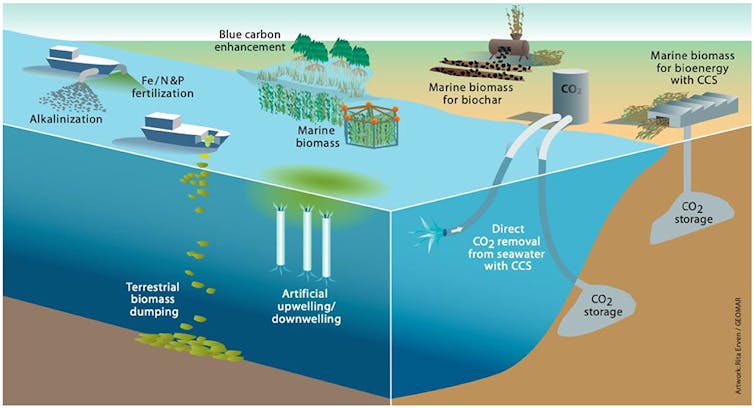
Ocean carbon dioxide removal is any action designed to use the ocean to remove even more carbon dioxide from the atmosphere than it already does and store it.
It spans a wide range of techniques – from increasing the amount and vitality of carbon dioxide-absorbing mangrove forests to using ocean fertilization to stimulate the growth of phytoplankton that absorb carbon dioxide to building pipelines that pump liquid carbon dioxide into formations under the seabed, where it can eventually solidify as carbonate rock.
There are other forms of carbon dioxide removal – planting trees, for example. But they require large amounts of land that is needed for other essential uses, such as agriculture.
The first crucial question is whether ocean carbon dioxide removal techniques could significantly reduce atmospheric carbon dioxide and store it long term, beyond what the ocean already does. Greenhouse gas emissions are still increasing globally, which means that ocean carbon dioxide removal would need to keep carbon dioxide out of the atmosphere for a long time, at least until greenhouse gas emissions have fallen.
Initial evidence suggests that some forms of ocean carbon dioxide removal, such as those that rely on short-lived biomass like kelp forests or phytoplankton, may not keep captured carbon stored for more than a few decades. That’s because most plant tissues are quickly recycled by decay or by sea creatures grazing on them.
In contrast, mechanisms that form minerals, like the interaction when carbon dioxide is pumped into basalt formations, or that alter the way seawater retains carbon dioxide, such as increasing its alkalinity, prevent carbon from escaping and are much more likely to keep it out of the atmosphere for hundreds or thousands of years.
Ecological risks and benefits
Another key question is what ecological benefits or risks accompany different ocean carbon dioxide removal approaches.
However, other options could introduce novel risks. For example, growing and then sinking large amounts of kelp or algae could bring in invasive species. Dissolving certain types of rock in the ocean could reduce ocean acidity. This would enhance the ocean’s ability to store carbon dioxide, but these rocks could also contain trace amounts of metals that could harm marine life, and these risks are not well understood.
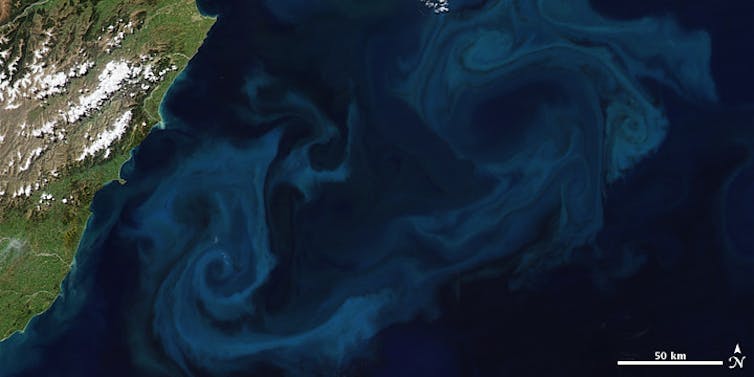
Phytoplankton can grow explosively over a few days or weeks. Ocean fertilization is designed to supercharge that process to capture carbon dioxide, but it can have harmful affects for other marine life. Robert Simmon and Jesse Allen/NOAA/MODIS
Each process could also release some greenhouse gases, reducing its overall effectiveness.
Interfering with nature is a social question
The ocean affects everyone on the planet, but not everyone will have the same relationship to it or the same opportunities to have their opinions heard.
Much of the global population lives near the ocean, and some interventions might impinge on places that support jobs and communities. For example, boosting algae growth could affect nearby wild fisheries or interfere with recreation. People and communities are going to evaluate these risks differently depending on how they are personally affected.
In addition, people’s trust in decision-makers often shapes their views of technologies. Some ways of using the ocean to remove carbon, such as those close to the shore, could be governed locally. It’s less clear how decisions about the high seas or deep ocean would be made, since these areas are not under the jurisdiction of any one country or global governing body.
Ocean carbon dioxide removal also raises a variety of ethical questions that do not have straightforward answers.
For example, it forces people to consider the relationship between humans and nonhumans. Are humans obliged to intervene to reduce the impact on the climate, or ought we avoid ocean interventions? Do people have the right to purposefully intervene in the ocean or not? Are there specific obligations that humans ought to recognize when considering such options?
Other ethical questions revolve around who makes decisions about ocean carbon dioxide removal and the consequences. For example, who should be involved in decision-making about the ocean? Could relying on ocean carbon dioxide removal reduce societies’ commitment to reducing emissions through other means, such as by reducing consumption, increasing efficiency and transforming energy systems?
Who pays?
Finally, ocean carbon dioxide removal could be very expensive.
For example, mining and then adding rocks to reduce the ocean’s acidity has been estimated to cost between US$60 and $200 per ton of carbon dioxide removed. To put that into context, the world produced more than 36 billion metric tons of carbon dioxide from energy alone in 2021.
Even macroalgae cultivation could be in the tens of billions of dollars if done at the scale likely necessary to have an impact.
These methods are more expensive than many actions that reduce emissions right now. For instance, using solar panels to avoid carbon emissions can range from saving money to a cost of $50 per ton of carbon dioxide, while actions like reducing methane emissions are even less expensive. But the harm from continued climate change has been estimated to be in the hundreds of billions annually in the United States alone.
These costs raise more questions. For example, how much debt is fair for future generations to carry, and how should the costs be distributed globally to fix a global problem?
Ocean carbon dioxide removal could become a useful method for keeping global warming in check, but it should not be seen as a silver bullet, especially since there isn’t an effective global system for making decisions about the ocean.
Sarah Cooley, a former research scientist at Woods Hole Oceanographic Institution and director of climate science at the Ocean Conservancy, contributed to this article.
==============================================================
AMT, I’d be very much in favor of establishing a “global governing body” to protect the “high seas and deep ocean” – and by extension, us. I think I would want such a body to be estalished through, or at the very lear with the cooperation of, both the United Nations and the International Court. I’d like for it to be formed and staffed with people who are extremely conscious of the relationships between species, and the effects they all have on each other. (For example, I think I could probably live without poisonous jellyfish. But I might be wrong, Their disappearance might have a huge effect on the disappearance of tuna. I would not like to have to live without tuna. I’d want this body to have, both as members and staff, people who are smarter than me about this.)
The authors do allude to the cost of doing nothing (they don’t use that term, but that’s what “the harm from continued climate chages” refers to.) But, other than saying there is currently no governing body over the oceans, they don’t go in that direction at all. I suspect that, had they attempted to do so, the rest of the article might have gotten lost in the discussion of those complexities. Perhaps you, dear Furies, can shed more light (with a minimum of heat) on this.
Glenn Kirschner – Trump-appointed Judge Carl Nichols refuses to send Steve Bannon to prison for his crimes (Glenn is correct that I can’t imagie a judge would do this for a person of color. But it could happene, ans has happened, for a poor white person with no prior convictions.)
Robert Reich – Why The Window To Prosecute Trump Is Closing (the title is misleading – other questions are answered, but not that one)
Thom Hartmann – Could Ancient Psychology Technique Win Elections For Democrats? [Abortion, Inflation, Insurrection?]
MSNBC – Justice Department Requesting Funds To Continue Jan. 6 Investigation
Ring of Fire – Republicans Introduce Legislation To Stop Government From Hiring Strippers For Kids
Beau – Let’s talk about snow crabs…. [and the cost of doing nothing]
Glenn Kirschner – What will J6 committee do if Trump defies subpoena? Rep Adam Kinzinger answers that question
Meidas Touch – Ron Johnson gets UTTERLY HUMILIATED with the MOST SAVAGE Response During Debate (Not sure you can humiliate someone who has no shame – but it’s short at least)
The Lincoln Project – Protecting The Capitol
Robert Reich – Election Deniers Could Pick the Next President Without You
Crooks and Liars – A Ukrainian Boy Laments Attack On His Playground (hanky alert)
Beau – Let’s talk about hybrid Abrams…. [nothing to do with Stacey]