
Experts in autocracies have pointed out that it is, unfortunately, easy to slip into normalizing the tyrant, hence it is important to hang on to outrage. These incidents which seem to call for the efforts of the Greek Furies (Erinyes) to come and deal with them will, I hope, help with that. As a reminder, though no one really knows how many there were supposed to be, the three names we have are Alecto, Megaera, and Tisiphone. These roughly translate as “unceasing,” “grudging,” and “vengeful destruction.”
I can’t say that there’s much, if anything, new in this article. It does juxtapose two issues of which we are only too well aware, and demonstrates that the two are actually more or less the same. Hopefully we can learn something from that.
==============================================================
Rising authoritarianism and worsening climate change share a fossil-fueled secret
Jabin Botsford/The Washington Post via Getty Images
Eve Darian-Smith, University of California, Irvine
Around the world, many countries are becoming less democratic. This backsliding on democracy and “creeping authoritarianism,” as the U.S. State Department puts it, is often supported by the same industries that are escalating climate change.
In my new book, “Global Burning: Rising Antidemocracy and the Climate Crisis,” I lay out connections between these industries and the politicians who are both stalling action on climate change and diminishing democracy.
It’s a dangerous shift, both for representative government and for the future climate.
Corporate capture of environmental politics
In democratic systems, elected leaders are expected to protect the public’s interests, including from exploitation by corporations. They do this primarily through policies designed to secure public goods, such as clean air and unpolluted water, or to protect human welfare, such as good working conditions and minimum wages. But in recent decades, this core democratic principle that prioritizes citizens over corporate profits has been aggressively undermined.
Today, it’s easy to find political leaders – on both the political right and left – working on behalf of corporations in energy, finance, agribusiness, technology, military and pharmaceutical sectors, and not always in the public interest. These multinational companies help fund their political careers and election campaigns to keep them in office.
In the U.S., this relationship was cemented by the Supreme Court’s 2010 decision in Citizens United. The decision allowed almost unlimited spending by corporations and wealthy donors to support the political candidates who best serve their interests. Data shows that candidates with the most outside funding usually win. This has led to increasing corporate influence on politicians and party policies.
When it comes to the political parties, it’s easy to find examples of campaign finance fueling political agendas.
In 1988, when NASA scientist James Hansen testified before a U.S. Senate committee about the greenhouse effect, both the Republican and Democratic parties took climate change seriously. But this attitude quickly diverged. Since the 1990s, the energy sector has heavily financed conservative candidates who have pushed its interests and helped to reduce regulations on the fossil fuel industry. This has enabled the expansion of fossil fuel production and escalated CO2 emissions to dangerous levels.
The industry’s power in shaping policy plays out in examples like the coalition of 19 Republican state attorneys general and coal companies suing to block the Environmental Protection Agency from regulating greenhouse gas emissions from power plants.
At the same time that the energy sector has sought to influence policies on climate change, it has also worked to undermine the public’s understanding of climate science. For instance, records show ExxonMobil participated in a widespread climate-science denial campaign for years, spending more than US$30 million on lobbyists, think tanks and researchers to promote climate-science skepticism. These efforts continue today. A 2019 report found the five largest oil companies had spent over $1 billion on misleading climate-related lobbying and branding campaigns over the previous three years.
The energy industry has in effect captured the democratic political process and prevented enactment of effective climate policies.
Corporate interests have also fueled a surge in well-financed antidemocratic leaders who are willing to stall and even dismantle existing climate policies and regulations. These political leaders’ tactics have escalated public health crises, and in some cases, human rights abuses.
Brazil, Australia and the US
Many deeply antidemocratic governments are tied to oil, gas and other extractive industries that are driving climate change, including Russia, Saudi Arabia, Iran, Iraq and China.
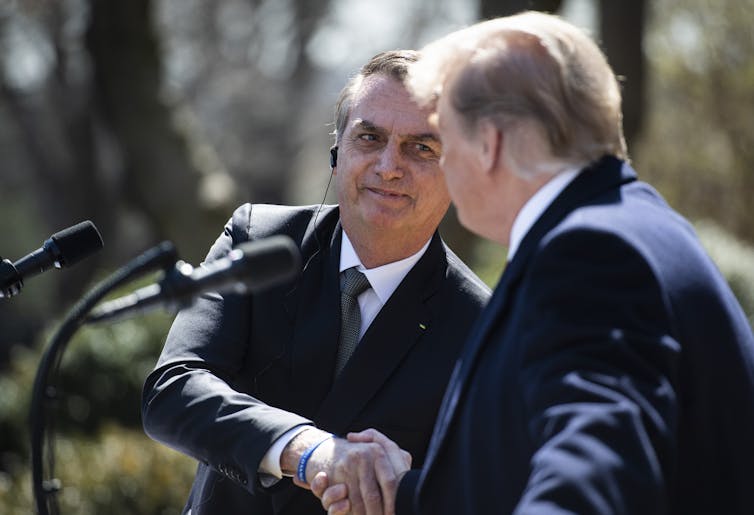
In “Global Burning,” I explore how three leaders of traditionally democratic countries – Jair Bolsonaro of Brazil, Scott Morrison of Australia and Donald Trump in the U.S. – came to power on anti-environment and nationalist platforms appealing to an extreme-right populist base and extractive corporations that are driving climate change. While the political landscape of each country is different, the three leaders have important commonalities.
Bolsonaro, Morrison and Trump all depend on extractive corporations to fund electoral campaigns and keep them in office or, in the case of Trump, get reelected.

Sergio Lima/AFP via Getty Images
For instance, Bolsonaro’s power depends on support from a powerful right-wing association of landowners and farmers called the União Democrática Ruralista, or UDR. This association reflects the interests of foreign investors and specifically the multibillion-dollar mining and agribusiness sectors. Bolsonaro promised that if elected in 2019, he would dismantle environmental protections and open, in the name of economic progress, industrial-scale soybean production and cattle grazing in the Amazon rainforest. Both contribute to climate change and deforestation in a fragile region considered crucial for keeping carbon out of the atmosphere.
Bolsonaro, Morrison and Trump are all openly skeptical of climate science. Not surprisingly, all have ignored, weakened or dismantled environmental protection regulations. In Brazil, that led to accelerated deforestation and large swaths of Amazon rainforest burning.
In Australia, Morrison’s government ignored widespread public and scientific opposition and opened the controversial Adani Carmichael mine, one of the largest coal mines in the world. The mine will impact public health and the climate and threatens the Great Barrier Reef as temperatures rise and ports are expanded along the coast.

AP Photo/Rick Rycroft
Trump withdrew the U.S. from the Paris climate agreement – a move opposed by a majority of Americans – rolled back over 100 laws meant to protect the environment and opened national parks to fossil fuel drilling and mining.
Notably, all three leaders have worked, sometimes together, against international efforts to stop climate change. At the United Nations climate talks in Spain in 2019, Costa Rica’s minister for environment and energy at the time, Carlos Manuel Rodriguez, blamed Brazil, Australia and the U.S. for blocking efforts to tackle climate injustice linked to global warming.
Brazil, Australia and the U.S. are not unique in these responses to climate change. Around the world, there have been similar convergences of antidemocratic leaders who are financed by extractive corporations and who implement anti-environment laws and policies that defend corporate profits. New to the current moment is that these leaders openly use state power against their own citizens to secure corporate land grabs to build dams, lay pipelines, dig mines and log forests.
For example, Trump supported the deployment of the National Guard to disperse Native Americans and environmental activists protesting the Dakota Access Pipeline, a project that he had personally been invested in. His administration also proposed harsher penalties for pipeline protesters that echoed legislation promoted by the American Legislative Exchange Council, whose members include lawmakers and lobbyists for the oil industry. Several Republican-led states enacted similar anti-protest laws.
Under Bolsonaro, Brazil has changed laws in ways that embolden land grabbers to push small farmers and Indigenous people off their land in the rainforest.
What can people do about it?
Fortunately, there is a lot that people can do to protect democracy and the climate.
Replacing fossil fuels with renewable energy and reducing the destruction of forests can cut greenhouse gas emissions. The biggest obstacles, a recent U.N. climate report noted, are national leaders who are unwilling to regulate fossil fuel corporations, reduce greenhouse gas emissions or plan for renewable energy production.
The path forward, as I see it, involves voters pushing back on the global trend toward authoritarianism, as Slovenia did in April 2022, and pushing forward on replacing fossil fuels with renewable energy. People can reclaim their democratic rights and vote out anti-environment governments whose power depends on prioritizing extractive capitalism over the best interests of their citizens and our collective humanity.
Eve Darian-Smith, Professor of Global and International Studies, University of California, Irvine
This article is republished from The Conversation under a Creative Commons license. Read the original article.
==============================================================
Alecto, Megaera, and Tisiphone, it really should not surprise anyone that climate change and authoritarianism are being backed by the same people – because, when your own greed is more impostant to you than other people’s lives – well, that is who you are. And, like any other problem, we won’t find solutions easily (or at all) if we are not honest and clear-sighted about what the issue is. For that reason, I would change the phrase “on both the political right and left” to something like “most generally on the political right, but with some notable and egregious examples on the left as well.” Not just my opinion – the graph a couple of paragraphs down shows the truth (and also that it is getting worse). But words should be accurate too.
The Furies and I will be back.


