Glenn Kirschner – Defendant Hodgkins Receives Lenient Sentence. How Will It Impact Other Insurrection Prosecutions?
Thom Hartmann – GOP Killing Kids & Grandma to Own the Libs?
politicsrus hasn’t posted for a while, but now has three up. First: Smart campaigning is here
politicsrus #2: Make John Happy – looks old, but we can’t take these Senators for granted. And we need to keep then
Now This News – Police Use Bag of Chips to Save Stabbing Victim’s Life
Puppet Regime – Putin Has a Solution for US Democracy
Beau – Let’s talk about Legos, being your own worst enemy, and the Block 19…. From what Beau says, it apears Lego just made the Legos, and the kits were the brainchildren of (and assembled by) someone else.
Here’s a personal opinion, with which anyone is welcome to disagree. I believe that the DOJ should research court records to determine the longest sentence that anyone has ever received for a conviction of a single count of possession if narijuana for persona l use Then, the sentence for Capitol rioters should all be at least one day longer then that. I’m pretty sure eight months doesn’t meet that criterion. It is, however, definitely better than nothing.
Cartoon –
Short Takes –
AP News – In step to shut Guantanamo, Biden transfers Moroccan home
Quote – Almost 800 detainees have passed through Guantanamo. Of the 39 remaining, 10 are eligible to be transferred out, 17 are eligible to go through the review process for possible transfer, another 10 are involved in the military commission process used to prosecute detainees and two have been convicted, a senior administration official said. The 10 eligible for transfer are from Yemen, Pakistan, Tunisia, Algeria and the United Arab Emirates.
About goddam time. Click though for story.
Reuters – France honours Rev. Jesse Jackson with the Legion d’Honneur
Quote – A political activist, minister, and former shadow U.S. senator for the District of Columbia representing the Democratic party, Jackson has been involved in civil rights activism since the 1960s, when he worked alongside Martin Luther King…. “From your earliest years, you were hungry for knowledge and justice, and you are a special friend of France, a brother for us,” Macron said in a solemn address at the Elysee palace. Click through for a little more, including photo.
The 19th – Senate Democrats take fight to protect voting rights to Georgia
Quote – Amy Klobuchar, the Democratic head of the Senate Rules Committee, which oversees federal elections along with the chamber’s day-to-day procedures, said the panel decided to convene its first field hearing in more than 20 years in Georgia because its legislature passed an “egregious” restrictive voting law earlier this year. “We cannot keep our heads in the ground, you’ve got to go out there and see exactly what’s happening,” Klobuchar told The 19th ahead of the hearing. Click through for details. It’s not guaranteed to work, but it is something. It can’t hurt.
Food for Thought:
There is a new book out about plants. The title is “This Is Your Mind on Plants.” The last name of the author is “Pollan.” Yes, you probably could make this up, but who would believe it?
Yesterday I managed to get off of the back of my lap long enough to fill my car’s gas tank, so that if I have to idle it for 20 or 30 minutes from time to time to make sure the battery stays charged, I won’t need to worry about running out. I was gobsmacked by the changes in the landscape since I last drove by the gas station I used – there used to be about a two-block-long strip mall and now there’s just tall grass. This is not the south, where if you park your car in the wrong place on Friday you can’t find it for the kudzu on Sunday – instead we are high desert – so it must have been gone for at least a few months.
Cartoon – 7/19 “pinkframe”
Short Takes – I don’t generally double up (and certainly not triple up) on sources on any given day … but this combination of stories was just too – colorful – to resist. Think of it as a break from serious news.
Yesterday I drafted and sent an emeil to the visiation staff to ask what I need to do to plan a visit. Yes, there are instructions on line, but they don’t answer everything. I don’t expect a reply until sometime Monday. I do know they can see a jpg file because in the past I’ve attached jpgs to express thanks and they’ve told me they can see them.
Cartoon –
Short Takes –
Reuters – Death toll rises to 170 in Germany and Belgium floods
Quote – German President Frank-Walter Steinmeier visited Erftstadt in the state of North Rhine-Westphalia, where the disaster killed at least 45 people. “We mourn with those that have lost friends, acquaintances, family members,” he said. “Their fate is ripping our hearts apart.” Steinmeier said it would take weeks before the full damage, expected to require several billions of euros in reconstruction funds, could be assessed. Click through for details, including video. well, there you have it. The US is not exceptonal. Every part of the world is sufferiung consequences.
APNews – Biden pledges appeal of ‘deeply disappointing’ DACA ruling
Quote – In his statement, Biden urged Congress to move forward with legislation to permanently protect those covered by the program. “Only Congress can ensure a permanent solution by granting a path to citizenship for Dreamers that will provide the certainty and stability that these young people need and deserve,” the president said. “I have repeatedly called on Congress to pass the American Dream and Promise Act, and I now renew that call with the greatest urgency,” he said. “It is my fervent hope that through reconciliation or other means, Congress will finally provide security to all Dreamers, who have lived too long in fear.” Click through for story. This is heartbreaking, and it shows – again – why it is so important to have qualified and humane judges in our courts.
Common Dreams – Florida-Based Doctor Arrested on Suspicion of Plotting Assassination of Haiti’s President
Quote – Haitian authorities said that 63-year-old Christian Emmanuel Sanon worked with a Miami-based private security firm to recruit the mercenaries who carried out the assassination last Wednesday. According to video footage of the scene, a group of heavily armed assailants posed as officials with the U.S. Drug Enforcement Agency as they moved in on Moïse’s private residence on the outskirts of Port-au-Prince. Click through for information and speculation. I’ve always maintained that some conspiracies are real. I must say this one boggles the mind.
Experts in autocracies have pointed out that it is, unfortunately, easy to slip into normalizing the tyrant, hence it is important to hang on to outrage. These incidents which seem to call for the efforts of the Greek Furies (Erinyes) to come and deal with them will, I hope, help with that. As a reminder, though no one really knows how many there were supposed to be, the three names we have are Alecto, Megaera, and Tisiphone. These roughly translate as “unceasing,” “grudging,” and “vengeful destruction.”
I had bookmarked an article on critical race theory as a possible source for the Furies, but on looking at it more closely, I found it too vague and generalized to be very effective – and, really, that’s as it should be. Critical race theory was designed to be studied in law school, after having completed a regular bachelor’s degree and pre-law, and while in pursuit of a Doctorate of Jurisprudence. It shouldn’t be possible to boil it down or make it crystal clear in a single short article. So I turned instead to the following article, which does address how children, including young children, can learn the darker sides of our actual history.
================================================================
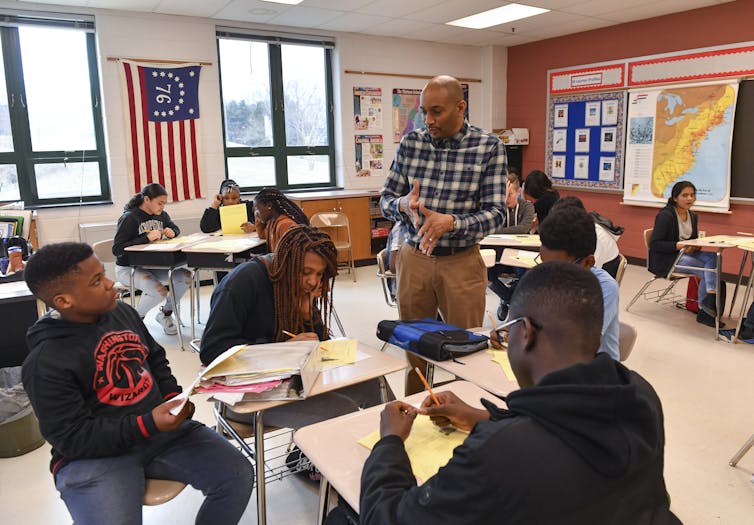
Here’s what I tell teachers about how to teach young students about slavery
This is how middle and high school teachers have told me they have felt over the past few years when it comes to teaching the troublesome topic of slavery.
Although I work with teachers in Massachusetts, their reaction to teaching about slavery is common among teachers throughout the U.S.
Fortunately, in recent years there have been a growing number of individuals who have weighed in with useful advice.
Some, such as history professors Hasan Kwame Jeffries and Kenneth Greenberg, have advocated for helping students see the ways in which enslaved people fought back against the brutality of slavery. Whether through a focus on the fight to maintain family and culture, resistance at work, running away, physical confrontation or revolt, students get a deeper understanding of slavery when the lessons include the various ways that enslaved people courageously fought against their bondage.
Heeding some of these recommendations, in my work with teachers we have sought to come up with lessons that students like Ailany Rivas, a junior at Claremont Academy in Worcester, Massachusetts, say have helped them to become “more informed and educated about the brutal history of slavery and its legacy.” These lessons that I have developed take a variety of approaches but are all rooted in taking a look at the realities of slavery using historical evidence.
Many students have echoed Ailany in feedback that I have collected from nine different classes where I have helped design lessons about slavery.
And the teachers whom I have worked with have all shared informally that they are now confident in taking on the challenge of teaching the complex history of slavery.
Much of this confidence, in my opinion, is due to four things that I believe are mandatory for any teacher who plans to deal with slavery.
1. Explore actual records
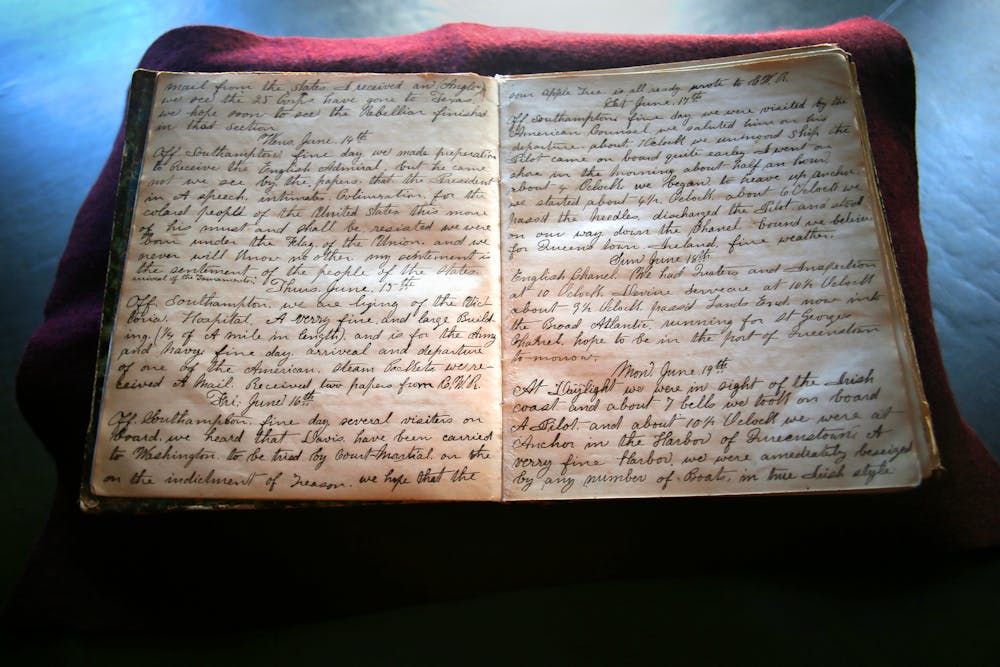
Few things shine the light on the harsh realities of slavery like historical documents. I’m talking about things such as plantation records, slave diaries and letters penned by plantation owners and their mistresses.
It also pays to examine wanted advertisements for runaway slaves. These ads provided details about those who managed to escape slavery. In some cases, the ads contain drawings of slaves.
These materials can help teachers guide students to better understand the historical context in which slavery existed. Educators may also wish to look at how people such as historian Cynthia Lynn Lyerly, who wrote a chapter in “Understanding and Teaching American Slavery,” have used historical documents to teach about slavery.
2. Examine historical arguments
In order to better understand different perspectives on slavery, it pays to examine historical arguments about how slavery developed, expanded and ended.
Students can read texts that were written by abolitionists like Frederick Douglass and pro-slavery advocates like George Fitzhugh.
They should wade through the newspaper advertisements that provided details about those who managed to escape slavery.
Looking at these different arguments will show students that history is filled with disagreement, debate and interpretations based on different goals.
For instance, in examining arguments about slavery, teachers can show students how early 20th-century historians like Ulrich Bonnell Phillips
sought to put forth ideas about kind masters and contented slaves, while others from the 1990s, such as John Hope Franklin, co-author of “Runaway Slaves: Rebels on the Plantation,” focused on how Black people resisted slavery.
Seeing these starkly different portrayals of slavery gives students a chance to examine how things such as choice, context, racism and bias might affect the way slavery is seen or viewed.
3. Highlight lived experiences
In my 11 years of teaching history, many students entered my classes with a great deal of misinformation about what life was like for those who lived under slavery. In pre-unit surveys, some stated that the enslaved worked only in the cotton fields and were not treated that badly. We know the historical records tell a different story. While many worked as field hands, there were others who were put into service as blacksmiths, carpenters, gunsmiths, maids and tailors.
To combat misconceptions like this, I advise teachers to use historical sources that feature details about the lived experiences of enslaved people.
For instance, teachers should have students read Harriet Jacobs’ memoir – “Incidents in the Life of a Slave Girl” – alongside diaries written by white plantation owners.
Ask students to examine various historical sources to gain a better understanding of how people lived through their bondage over time.
4. Consider the relevance
It is also crucial for teachers to consider the various ways in which slavery is relevant to the present with their students. I advise them to ask questions like: How has the history of slavery influenced the status of Black people in the United States today? Why are there so many movies about slavery?
We asked students to draw on what they had learned about slavery to consider and then share their perspectives about the historical accuracy, classroom appropriateness and relevance of a selected picture book. Students always have much to say about all three.
[Over 100,000 readers rely on The Conversation’s newsletter to understand the world.Sign up today.]
Teaching slavery has been and will continue to be challenging. To teachers who are asked or required to take on this challenge, the four things discussed above can serve as strong guideposts for creating lessons that should make the challenge easier to navigate.
================================================================ Alecto, Megaera, and Tisiphone, “there were others who were put into service as blacksmiths, carpenters, gunsmiths, maids and tailors.” Yeah. And artists and musicians and other fine craftspeople. If a slave could do something, an owner could find a way to exploit it. Regular viewers of Antiques Roadshow will recall episodes featuring slave-produced arts and crafts. Regular listeners of Performance Today (produced by American Public Media and often carried by NPR but can also be streamed free) will remember having heard about a piano-playing slave who toured and gave concerts, from which his master received every penny. Viewers of Finding Your Roots will have seen many a slave schedule, slave auction announcement, runaway slave advertisement, census record or inventory or probate list with no names.
The historical documents and other resources exist. Getting them into the hands of teachers and assisting them to use them effectively is another matter. May everything possible be done to make it happen.