Glenn Kirschner – NY Prosecutor Hoffinger Takes over Trump Case After Veteran Prosecutors Resign. Who is ADA Hoffinger (Meaning no disrespect, this sound to me like “set a thief to catch a thief.” Not that she will have necessarily participated in every dodge white collar criminals use or might use – but she will certainly be familiar with them)
Meidas Touch – Defeat Putin (Stand With Ukraine)
Lincoln Project – #PrimetimePropaganda (it didn’t take me long to get bihind with tht Lincoln Project again. They are on fire.)
Ring of Fire – National Guard Troops Furious About Being Used As Political Props Along Texas Border
MSNBC – Ukrainian President Zelenskyy Hailed As Hero For Democracy
Ukrainian National Anthem
Beau – Let’s talk about orders, tradition, and cops….
Yesterday, I managed to track down a prescription which needed to be renewed for another year, and thus needed a new number. I don’t have it in hand yet – but I have plenty of time, and told her I’d wait till she had 90 days in stock. So I can at least quit worrying about that one now.
Cartoon – 01 0301Cartoon.jpg
Short Takes –
Mother Jones – In 1871, Congress Crafted a Law to Break the Klan. Today, It’s Targeting Trump.
Quote – Since Trump came to and left office, the Klan Act has fueled a wide range of litigation, including three voter-suppression cases, a lawsuit against perpetrators of the deadly Unite the Right rally in Charlottesville in 2017, two over the highway assault in Texas, and seven cases against perpetrators of January 6. Some target Trump himself. Most recently, Ukraine expert Lt. Colonel Alexander Vindman sued Trump and three close associates under the Klan Act for reprisal and intimidation surrounding his testimony during Trump’s first impeachment. Click through for story and history.What might a January 6 law look like, if we could managa to get one passed?
The New Yorker – Russia’s Last Independent TV Channel Covers the Invasion of Ukraine
Quote – Dzyadko was bringing his audience up to date on antiwar protests. People in fifty-two cities across Russia had demonstrated against the invasion on Thursday. OVDInfo, an organization that tracks political persecution in the country, was reporting 1,960 people detained; most were facing fines, but several had been sentenced to jail time or were facing criminal prosecution. Authorities have blocked access to the OVDInfo site for Russian Internet users, and have branded the organization itself a “foreign agent.” To avoid a fine, Dzyadko had to mention that OVDInfo had been designated a “foreign agent.” TV Rain itself is also a “foreign agent”; Click through for more. Masha Gessen is the person whose advice inspired me to stert the “Everyday Erinyes” series – her quotation appears in each one. She is an authority on autocracy, and sadly, much of her knowledge is from personal experience. The Nib happens to have a graphic interview with her up also.
PolitiZoom – Furkids: Looking Out My Back Door
Quote – While I knew the song they chose, I never really knew the lyrics before the Furkids related them to me…. I asked them if they understood the lyrics and was told “Dat wus sum gud catnip dey had!” I decided not to pursue the subject any further as they were several little ones present. Click through for some pure (admittedly) escapism. The format is, you start the vodeo, and scroll down slowly following the lyrics and the pictures selected to accompany them. It goes fast. The only time-consuming part is the time it must have taken to put it all together. If you get through it and don’t at least smile even once … check your pulse.
Yesterday, I started the day with a whole lot more sleep than I did Saturday. So I had a little more time for personal stuff. Incidentally, I have posted before about Theater of War Productions and their work in healing PTSD of all kinds. They just announced that in March, Margaret Atwood (The Handlaidn’s Tale) will be taking part in one of their Zoom projects in March. Ms. Atwood generally prefers her work to speak for her and does not make public appearances very often, so if you ever wanted to see her and hear her voice, this is a rare chance. They plan to repeat the project multiple times, but of course they can’t guarantee the same cast. The production itself is readings from “Antigone,” selected by nurses, for nurses, and with a “chorus” of front line nurses, and the date is March 17th, the time is (EDT) 5-7 pm,and it is free. Also, CC is an option for alll of their productions (and I use it a lot.) Clicking on this link will not register you; it will simply take you to a page of more information. But you can click through from it to register. I always put these on my calendar – they do send you reminders but they do not overdo it and sometimes time slips away from me.
Cartoon –
Short Takes –
Letters from an American – February 26, 2022
Quote – The colors of the Ukrainian flag are lighting up buildings across North America and Europe and musical performances are beginning with the Ukrainian anthem. Protesters are marching and holding vigils for Ukraine. The answer of the soldier on Ukraine’s Snake Island to the Russian warship when it demanded that he and his 12 compatriots lay down their weapons became instantly iconic. He answered: “Russian warship: Go f**k yourself.” That defiance against what seemed initially to be an overwhelming military assault has given Ukraine a psychological edge over the Russians, some of whom seem bewildered at what they are doing in Ukraine. It has also offered hope that the rising authoritarianism in the world is not destined to destroy democracy, that authoritarians are not as strong as they have projected. Click through for full letter. The last thing I want to do is to imply that all is sunshine and roses. But I have to admit that this letter, when I read it early yesterday, gave me more hope than I have had since 2016. Not just because of the Ukrainians, who are inspiring, but because of the responses of the entire world. Even some of our sick, sick Republicans are shutting up a little.
Reuters – At the Ukrainian border, a mother brings a stranger’s children to safety(hanky alert)
Quote – The children’s Ukrainian mother was on her way from Italy to meet them and take them to safety, the father said. He gave [Nataliya] Ableyeva the mother’s mobile number, and said goodbye to his children, wrapped up against the cold in thick jackets and hats. Ableyeva had left her own two grown-up children behind in Ukraine. One a policeman, the other a nurse, neither could leave Ukraine under the mobilisation decree. She took the two small children by the hand and together they crossed the border. Click through for story and background The reporter tweeted the link with the caption: ” I have never cried while reporting. Until today.”
Black History – Wikipedia – Matthew A. Henson
Quote – Matthew Alexander Henson (August 8, 1866 – March 9, 1955) was an American explorer who accompanied Robert Peary on seven voyages to the Arctic over a period of nearly 23 years. They spent a total of 18 years on expeditions together…. Their first Arctic expedition together was in 1891–92. Henson served as a navigator and craftsman, and was known as Peary’s “first man”. Like Peary, he studied Inuit survival techniques. Click through for biohraphy. Most people our age, when Arctic exploration comes up, can at least recognize the name Robert Peary. Matthew Henson’s name should be equally familiar.
Food For Thought:
(More recent news suggests that some, maybe even all, may still be alive. MAY be. We can hope.)
Glenn Kirschner – NY Prosecutors Resign, Reportedly in Protest Over DA Bragg’s Concerns About Indicting Donald Trump
Lincoln Project – Today’s Republican Party (BARF BAG ALERT)
MSNBC – SCOTUS Nominee Ketanji Brown Jackson On Love Of Country And Constitution (Not everyone is going to like this … but it’s going to be tough for Rethugs to attack.)
Farron Balanced – Madison Cawthorn Wants To Kill Social Security To Force Seniors Back To Work
Brent Terhune is a comedian who imitates MAGAts so well people tend to think he is one. This is not that kind of video. This is real.
College Student Decides To Foster A Pregnant Dog Right Before Midterms
Beau – Let’s talk about what students can learn from Spartacus….
Experts in autocracies have pointed out that it is, unfortunately, easy to slip into normalizing the tyrant, hence it is important to hang on to outrage. These incidents which seem to call for the efforts of the Greek Furies (Erinyes) to come and deal with them will, I hope, help with that. As a reminder, though no one really knows how many there were supposed to be, the three names we have are Alecto, Megaera, and Tisiphone. These roughly translate as “unceasing,” “grudging,” and “vengeful destruction.”
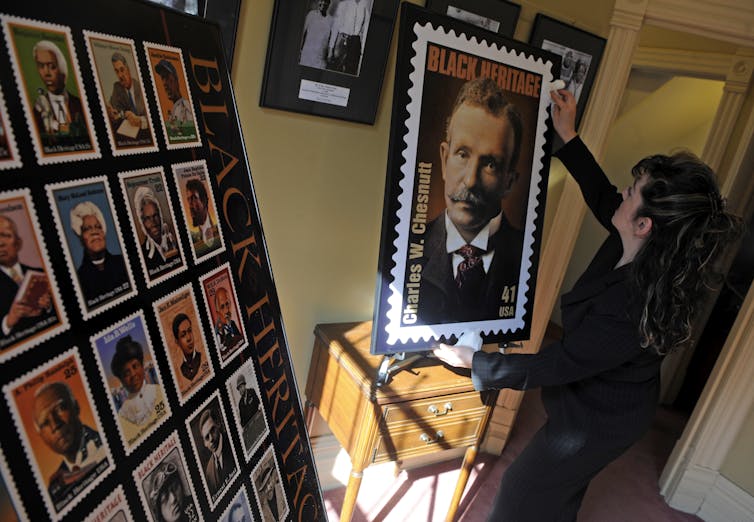
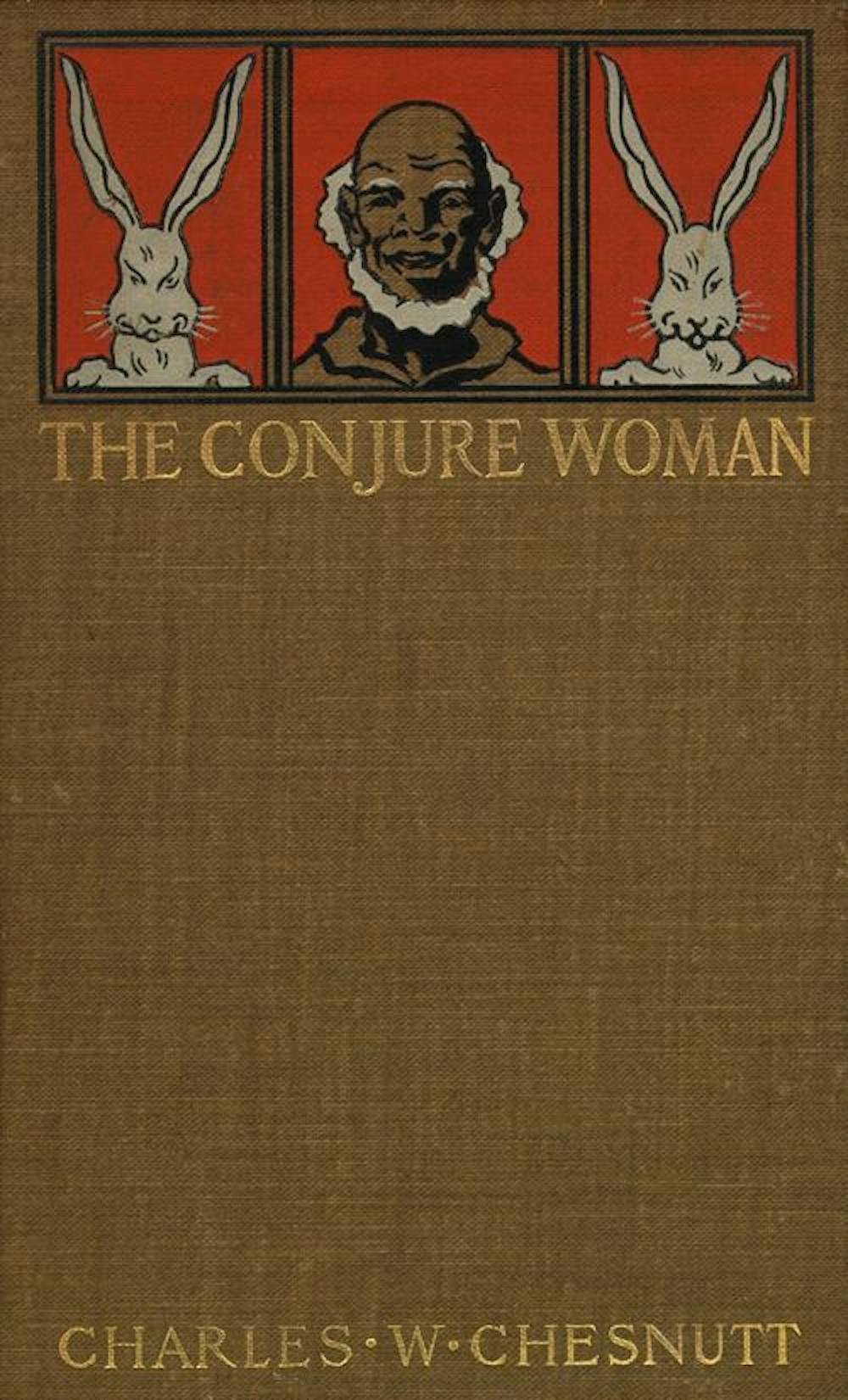
Since it’s still Black History month for one more day, I thought we might enjoy an article about a Black (or more accurately biracial) author who latched on to the vogue for “Uncle Remus”-like stories and characters, and jumped into the genre to make such subtle fun of the white people that they didn’t even get it. His name was Charles Chesnutt, and the character he created was called “Uncle Julius.” If you click on the link attached on the title “The Conjur Woman,” the name of an 1899 collection of Uncle Julius stories, it will bring you to the Gutenberg Project’s free download of the entire book plus an appendix of three more stories and another, non-fiction, book on Superstition and Folklore. (I created a shortcut to it for myself, and also made a custom icon for it, derived from the cover picture on one of its editions [not the first edition, whose cover is noce, but too dark for an icon], which I will gladly share if anyone wants it.)
I have only read one story so far. That’s enough to observe that the “local color” dialect is thick indeed, and that the white narrator, from Ohio, is pompous (as was the fashion of the day) and also pretty well taken in. The humor is subtle but definitely there. The n-word is used by Uncle Julus but not by any white character, and in such a way as to read like more exploitation of white gullibility, which may hep prevent cringing. Chesnutt did know what he was doing.
==============================================================
How a Black writer in 19th-century America used humor to combat white supremacy
Any writer has to struggle with the dilemma of staying true to their vision or giving editors and readers what they want. A number of factors might influence the latter: the market, trends and sensibilities.
But in the decades after the Civil War, Black writers looking to faithfully depict the horrors of slavery had to contend with readers whose worldviews were colored by racism, as well as an entire swath of the country eager to paper over the past.
Charles Chesnutt was one of those writers. Forced to work with skeptical editors and within the confines of popular forms, Chesnutt nonetheless worked to shine a light on the legacy of slavery.
His 1899 collection of stories, “The Conjure Woman,” took place on a Southern plantation and sold well. At first glance, the stories seemed to mimic other books set in the South written in a style called “local color,” which focuses on regional characters, dialects and customs.
But Chesnutt had actually written a subversive counternarrative, using humor to poke holes in the nostalgic myths of the South and expose the contradictions of a racist society.
Rewriting the past
After the Civil War, there was a concerted effort to portray the South as a pastoral place possessed with a culture of honor. Slavery, meanwhile, had been a nurturing, even benevolent, institution.
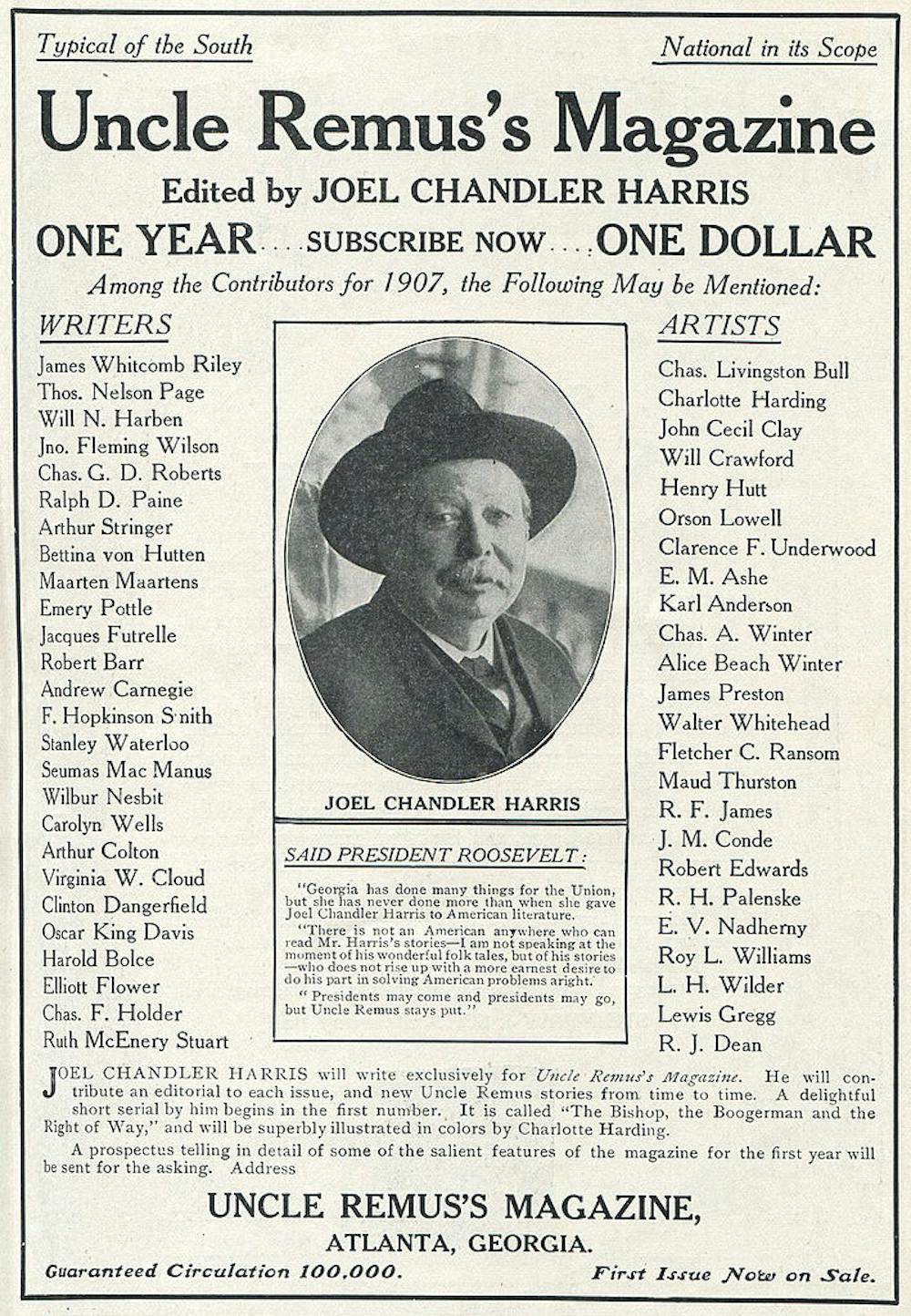
These beliefs bled into the era’s fiction, with white authors such as Thomas Nelson Page and Joel Chandler Harris writing stories that sentimentalized and softened the complex histories of the past.
Writer and editor Joel Chandler Harris published a magazine named for his famous character Uncle Remus. Jay Paull/Getty Images
Many of these stories feature a formerly enslaved older male who’s given the affectionate moniker “Uncle.” These characters tended to describe the Civil War as an affront on the Southern way of life, while presenting the South and its landed gentry as heroic.
In “A Story of the War,” for example, Harris introduces the character Uncle Remus, who recounts the time his master went away to fight the Civil War. Overcome with concern for the man who enslaved him, Uncle Remus follows him and witnesses a Northern soldier preparing to shoot him. In a moment of panic, Remus shoots the Northerner, wounding him.
“A Story of the War,” like most Southern local color tales, appealed to readers invested in the Lost Cause of the Old South, a revisionist ideology that depicts the creation of the Confederate States and cause of the Civil War as just and heroic.
Historian Fred Bailey notes that stories like Page’s and Harris’ were “hailed by the South’s upper-classes,” while associations like the United Daughters of the Confederacy routinely read from these works at their meetings.
Chesnutt’s revisionist humor
At first glance, it would seem Chesnutt, who was mixed-race and could have easily passed for white, was merely working within the dominant literary form of his time and fashioning stories geared to a white audience.
Like his white contemporaries, Chesnutt, in “The Conjure Woman,” includes a character who’s an “uncle” living on the abandoned plantation where he once toiled.
But Chesnutt, as literary historian Dickson Bruce points out in his 2005 essay “Confronting the Crisis: African American Narratives,” used the setting of the plantation to present a more authentic representation of slavery.
Uncle Julius, who appears in each of the collection’s stories, isn’t nostalgic for some bygone era. Instead, he reflects on his own life and seeks to show the humanity of the enslaved. He uses his ability as a raconteur to cleverly swindle a white carpetbagger who bought the plantation Julius lived on during his bondage and after the Civil War. The stories are descriptive, corrective – and, most importantly, funny.
While Chesnutt’s tales explicitly engage with the hard history of slavery, each of the stories ends on a lighter note, with Uncle Julius often getting what he wants. Throughout the collection, he parodies the conventions of Southern fiction – whether refuting racist tropes or showing the cruelty of the ruling class – subtly poking fun at a culture enveloped by the fog of nostalgia.
For example, Uncle Julius spoke in a Black dialect that sounded similar to those of the uncles authored by white writers. This didn’t come easily for Chesnutt. In one letter to his editor, Chesnutt described writing in this dialect as a “despairing task.”
Nonetheless, he avoided completely pandering to mainstream expectations of how Black characters should be portrayed.
He rejected the emergent historiography of Reconstruction that refused to recognize the agency of African Americans, and despite working within the form, Chesnutt didn’t present Julius as a buffoon who was happy to serve the whites in his midst.
“But the subtle almost indefinable feeling of repulsion toward the negro, which is common to most Americans – and easily enough accounted for, cannot be stormed and taken by assault; the garrison will not capitulate: so their position must be mined, and we will find ourselves in their midst before they think it.”
Humor opens doors
Chesnutt is far from the only Black artist asked to make compromises. Poet Langston Hughes had a falling out with his patron, Charlotte Osgood Mason, who viewed African Americans as a link to the species’ primitive past and wanted his work to be devoid of political progressivism.
As Hughes wrote in his 1940 autobiography, “The Big Sea,” “I was only an American Negro – who had loved the surface of Africa and the rhythms of Africa – but I was not Africa. I was Chicago and Kansas City and Broadway and Harlem. And I was not what she wanted me to be.”
In Chesnutt, I also see ties to contemporary Black comedians who center their humor around race.
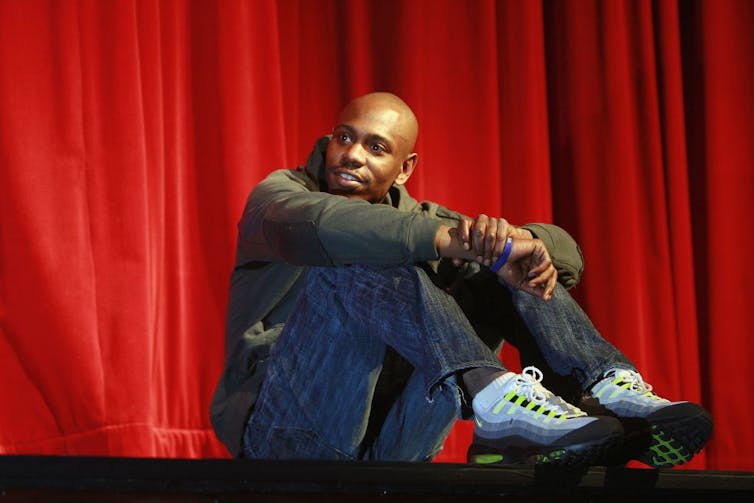
During the third season of “Chappelle’s Show,” Dave Chappelle famously suffered from an existential crisis because the comedian wasn’t sure how people were responding to his humor. In a 2006 interview with Oprah Winfrey, he explained how, when filming a sketch in blackface, “someone on the set, that was white, laughed in such a way – I know the difference of people laughing with me and laughing at me. And it was the first time I’d ever gotten a laugh that I was uncomfortable with.”
Shortly after, Chappelle quit the show.
Comedian Dave Chappelle struggled over whether the audience was laughing with him or at him. Riccardo Savi/Getty Images
While Chesnutt was certainly not the first African American artist to use humor to depict the horrors of slavery, he was one of the first to reach the American mainstream.
The humor disarms readers, helping them cross a psychological threshold and enter a space where a more nuanced conversation about the history of the country can take place.
==============================================================
AMT, I find it nice to be able to read what the man actually wrote, and not just what some scholar, however knowledgeable, says about him. It will take me a while to get through all on it – but after reading one story, I for one want more.
Yesterday, the opera broadcast was a collection of performances by Black artists throughout the Met’s history – as far back as 1952 (For perspective, Brown v. Board of Education was decided in 1954). There were some real rarities – both some voices and some arias I had never heard before, and even more I had not heard for decades (and then not in those roles.) It was exhilarating and humbling. I had not slept well … but I didn’t want to miss it and I’m so glad I didn’t.
Cartoon –
Short Takes –
Good News Network – Sound Waves Convert Stem Cells Into Bone in Regenerative Breakthrough
Quote – In a new study, the RMIT research team showed stem cells treated with high-frequency sound waves turned into bone cells quickly and efficiently. Importantly, the treatment was effective on multiple types of cells including fat-derived stem cells, which are far less painful to extract from a patient. Click through for more. This is not finalized but it certainly is hopeful.
Black History – CPR – Interview: Denver historian recalls the impact U.S. presidents have had on Black Americans
Quote (spoiler) – Dukakis: Is there an American president that you think did the most to change life for Black people in this country or can you not name someone in particular? Scott: Without a doubt, it was LBJ. Johnson is the only president that directed most of his administration to try to right the wrongs that went against Black people all these years. Click through for interview (you can also listen to it at this link). I’m almost out of month, and there is so much more to tell.
Food For Thought:
went and translated that zelensky selfie video from the streets of kyiv, just to know what he was actually saying in response to the russian reports that he had fled — so here it is for the rest of you, plus this music naturally felt right. enjoy. pic.twitter.com/JDLXtYAq5q
Glenn Kirschner – Trump’s Loss in Civil Court Case Provides Roadmap for DOJ to Follow in Criminal Prosecution of Trump
Meidas Touch – Anti-War Protests In Russia!!
Lincoln Project – Trump’s Loyalties (Theu posted a “Last Week” but are doing so much else so fast I had to omit it. I am also omitting the one in Russian with Russian CC.)
Farron Balanced – Florida Republicans To Force Teachers To ‘Out’ Children To Their Families
VoteVets – Lt. Col. (Ret.) Alexander Vindman Articulates What Must Happen Now That Russia Invaded Ukraine
WellRED Comedy – What California Does to Rednecks
Beau – Let’s talk about Republicans in Michigan and the Constitution….