Yesterday, I filed some health insurance claims, including for Part D premiums, and set up a recurring claim for the latter for the rest of the year. It’s revealing (to me) that I had not set up the recurring claim in December, which I normally do, but you may remember December was when the comment system crashed. But I would have expected to notice before April that I hadn’t done it. But I had other things going on each month. Anyway, it’s done now. Also yesterday, I heard from Carrie B that her granddaughter-in-law’s surgery is successful. Not, of course, pain free, but her medical team is working on pain magament, and her grandson is getting 2 weeks off of work whikle sha convalesces. She is so very grateful for everyone’s prayers and vibes. (She’s also pretty proud of her grandson. I told her, yes, that’s what a real man does – takes care of his family.)
Letters From An American – April 17, 2022
Quote – Today, political scientist and member of the Russian legislative body Vyacheslav Nikonov said, “in reality, we embody the forces of good…. The intellectual leap from committing war crimes to claiming to be on the side of good might be explained by an interview published in the New Statesman at the beginning of April. Speaking with former Portuguese secretary of state for European affairs Bruno Maçães, Sergey Karaganov, a former advisor to Russian president Vladimir Putin, predicted the end of the western democracies that have shaped the world since World War II. Dictators, he suggested, will take over. Democracy is failing and authoritarianism rising, Karaganov said, because of democracy’s bad moral foundations Click through for complete letter. It is absolutely true that evil, corrupt Republicans think, to a person, they they are good and we are evil. That is undeniable. How? How can that be? We need to know.
Yesterday, after a nice quiet Easter, my inbox kept filling up again after I’d empty it. It wasn’t as bad as it gets at the ends of months (and, even worse, quarters), but it was a smmall annoyance. Obviously, I sirvived (grin). I am still knitting crutch covers. It took me until the fifth one to finally optimize the casting on process … but I learned a lot from that, so it was well worth it.
Cartoon – 19 0419Cartoon.jpg
Short Takes –
The New Yorker [Jane Mayer] – The Slime Machine Targeting Dozens of Biden Nominees
Quote – [S]ince at least 1987, when President Ronald Reagan unsuccessfully nominated Robert Bork to be a Justice, the fights over Supreme Court nominees have been especially nasty. Yet the A.A.F.’s approach represents a new escalation in partisan warfare, and underscores the growing role that secret spending has played in deepening the polarization in Washington. Click through for details. Things just seem to get worse and worse sometimes.
POGO – Misconduct at CBP Runs Deep, and Congress Must Address this Systemic Problem
Quote – For years, officers and agents from Customs and Border Protection (CBP), the largest law enforcement agency in the country, have faced few consequences for mistreating migrants, even when their assaults were captured on film — even when they killed people. A new investigation from the Project On Government Oversight now shows that this lack of accountability has shielded some CBP agents from being held accountable for other unconscionable behavior as well. Click through for specifics. In the United States today, any group that does any policing should, sadly, be automatically suspect. That runs deep, and far too few peole are willing to even look at it, let alone do something about it.
Democratic Underground (demmiblue) – A Bowl for Ukraine
Quote – Not only that, he had over 20,000 orders for bowls and chopping boards, which, he calculated, would take him 32yrs to fulfil. And now the press were knocking at the door. It was a lot to take in for a wee lad of 12yrs…. But Gabriel was certain of one thing – he wanted to share the kindness. So instead of carving 20,000 bowls, he would carve just one special one – his #BowlForUkraine Click through for story. If you needed some hope after those first two … well, I did too.
Teri Kanefield – It’s Not About “Faith”
Quote – One point I keep making is that rule of law is difficult. It’s frustrating. It strives for fairness but isn’t always fair. Perfect fairness is not possible on Earth, where human beings are flawed, and there is constant pushback from those who prefer autocracy. This causes people to grow cynical and reject democracy. But the only real alternative is autocracy. “Confidence in democratic institutions” doesn’t mean “faith that we always get what we want” or “faith that courts will reach the right results.” Click through for full argument. I found this through “Crooks and Liars” blog roundup.
Federal Appeals Court Upholds Dismissal of Devin Nunes Defamation Claim Over 2019 CNN Report
Quote – Nunes had originally sued in federal court in Virginia, but a federal judge, citing concerns about “form shopping” and noting that there was “no logical connection between the events in this case and this district,” transferred the case to New York. Chief U.S. District Judge Laura Taylor Swain dismissed Nunes’ claim in February 2021. Swain found that California law should apply to Nunes’ case, since that is where he lived and would have presumably suffered the greatest damage to his reputation. In applying California law, Swain further found that Nunes had failed to meet the statutory requirement that a plaintiff alleging defamation must make a written demand for a retraction within a short period of time after publication. Nunes had not done so, and Swain determined that he could not maintain his claim. Click through for details. I’m sure Dairy Devin doesn’t think so , but I find this funny AF. “Musical states,” anyone?
Florida rejects 54 math textbooks over ‘prohibited topics’ including critical race theory
Quote – Florida’s education department has rejected 54 mathematics textbooks from next year’s school curriculum, citing alleged references to critical race theory among a range of reasoning for some of the rejections, officials announced. The department said in a news release Friday that some of the books had been rejected for failure to comply with the state’s content standards, Benchmarks for Excellent Student Thinking [Best], but that 21% of the books were disallowed “because they incorporate prohibited topics or unsolicited strategies, including CRT”. Click through for what little detail the state was willing to provde. Heaven knows what they think CRT is – but, whatever they think, it isn’t that.
Experts in autocracies have pointed out that it is, unfortunately, easy to slip into normalizing the tyrant, hence it is important to hang on to outrage. These incidents which seem to call for the efforts of the Greek Furies (Erinyes) to come and deal with them will, I hope, help with that. As a reminder, though no one really knows how many there were supposed to be, the three names we have are Alecto, Megaera, and Tisiphone. These roughly translate as “unceasing,” “grudging,” and “vengeful destruction.”
I don’t know whether the Erinyes are science geeks – but I suppose there’s no reason they might not be. Certainly it’s not unreasonable to suspect any person or group which is dedicated to truth and justice would be dedicated to science as well. But I know some of us are also interested in sceince as well as justice and truth, and this news, thoug it sounds small compared with what was previously accomplished, is still a big deal.
==============================================================
The Human Genome Project pieced together only 92% of the DNA – now scientists have finally filled in the remaining 8%
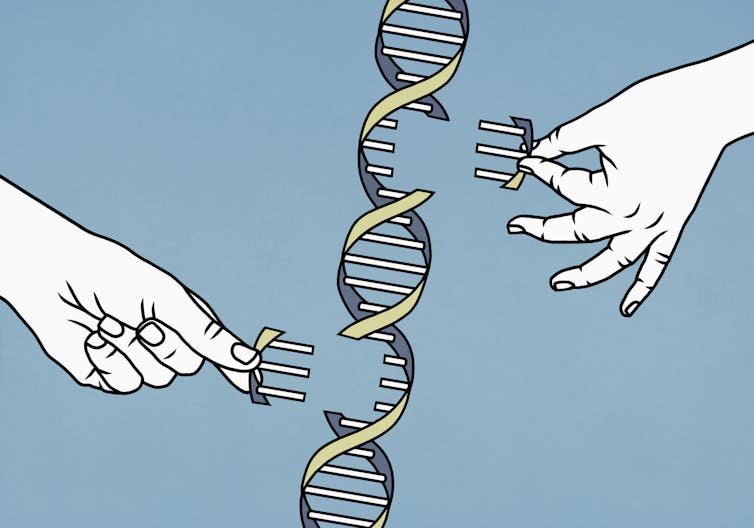
Over half of the human genome contains repetitive DNA sequences whose functions are still not fully understood. Malte Mueller/fStop via Getty Images
When the Human Genome Project announced that they had completed the first human genome in 2003, it was a momentous accomplishment – for the first time, the DNA blueprint of human life was unlocked. But it came with a catch – they weren’t actually able to put together all the genetic information in the genome. There were gaps: unfilled, often repetitive regions that were too confusing to piece together.
I am a genome biologist who studies repetitive DNA sequences and how they shape genomes throughout evolutionary history. I was part of the team that helped characterize the repeat sequences missing from the genome. And now, with a truly complete human genome, these uncovered repetitive regions are finally being explored in full for the first time.
The missing puzzle pieces
German botanist Hans Winkler coined the word “genome” in 1920, combining the word “gene” with the suffix “-ome,” meaning “complete set,” to describe the full DNA sequence contained within each cell. Researchers still use this word a century later to refer to the genetic material that makes up an organism.
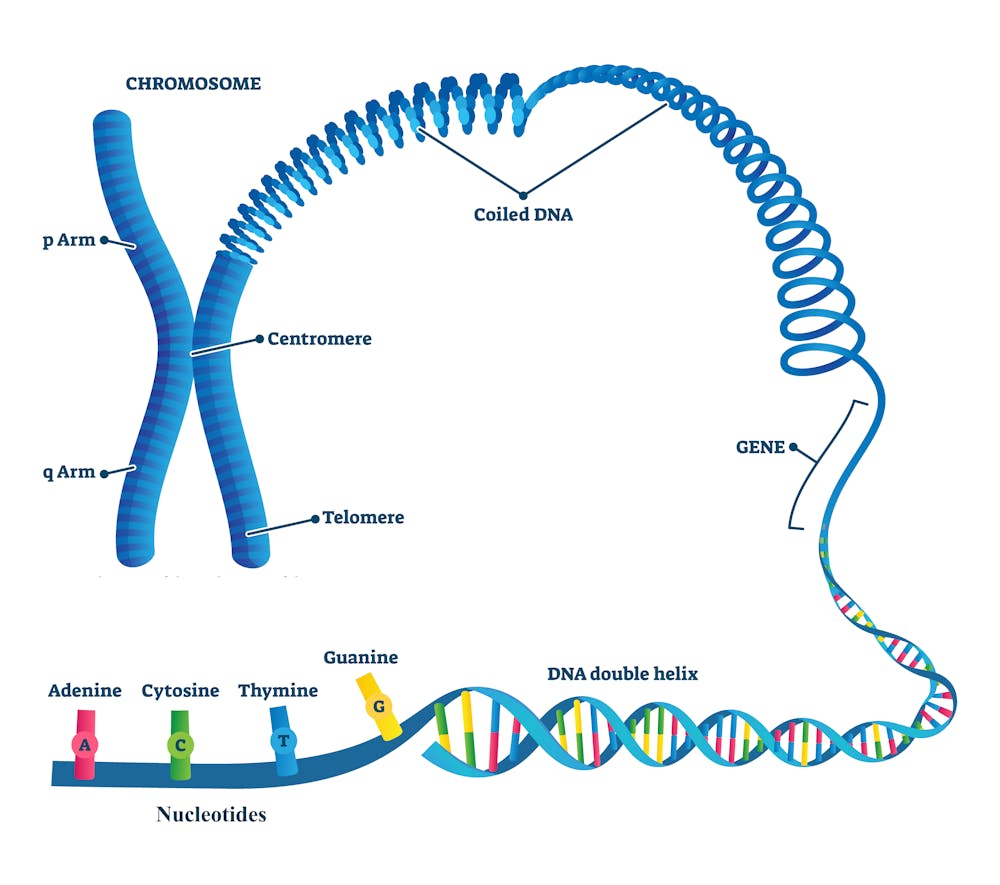
One way to describe what a genome looks like is to compare it to a reference book. In this analogy, a genome is an anthology containing the DNA instructions for life. It’s composed of a vast array of nucleotides (letters) that are packaged into chromosomes (chapters). Each chromosome contains genes (paragraphs) that are regions of DNA which code for the specific proteins that allow an organism to function.
Genetic material is made of DNA tightly packaged into chromosomes. Only select regions of the DNA in a genome contain genes coding for proteins. VectorMine/iStock via Getty Images Plus
While every living organism has a genome, the size of that genome varies from species to species. An elephant uses the same form of genetic information as the grass it eats and the bacteria in its gut. But no two genomes look exactly alike. Some are short, like the genome of the insect-dwelling bacteria Nasuia deltocephalinicola with just 137 genes across 112,000 nucleotides. Some, like the 149 billion nucleotides of the flowering plant Paris japonica, are so long that it’s difficult to get a sense of how many genes are contained within.
But genes as they’ve traditionally been understood – as stretches of DNA that code for proteins – are just a small part of an organism’s genome. In fact, they make up less than 2% of human DNA.
The human genome contains roughly 3 billion nucleotides and just under 20,000 protein-coding genes – an estimated 1% of the genome’s total length. The remaining 99% is non-coding DNA sequences that don’t produce proteins. Some are regulatory components that work as a switchboard to control how other genes work. Others are pseudogenes, or genomic relics that have lost their ability to function.
And over half of the human genome is repetitive, with multiple copies of near-identical sequences.
What is repetitive DNA?
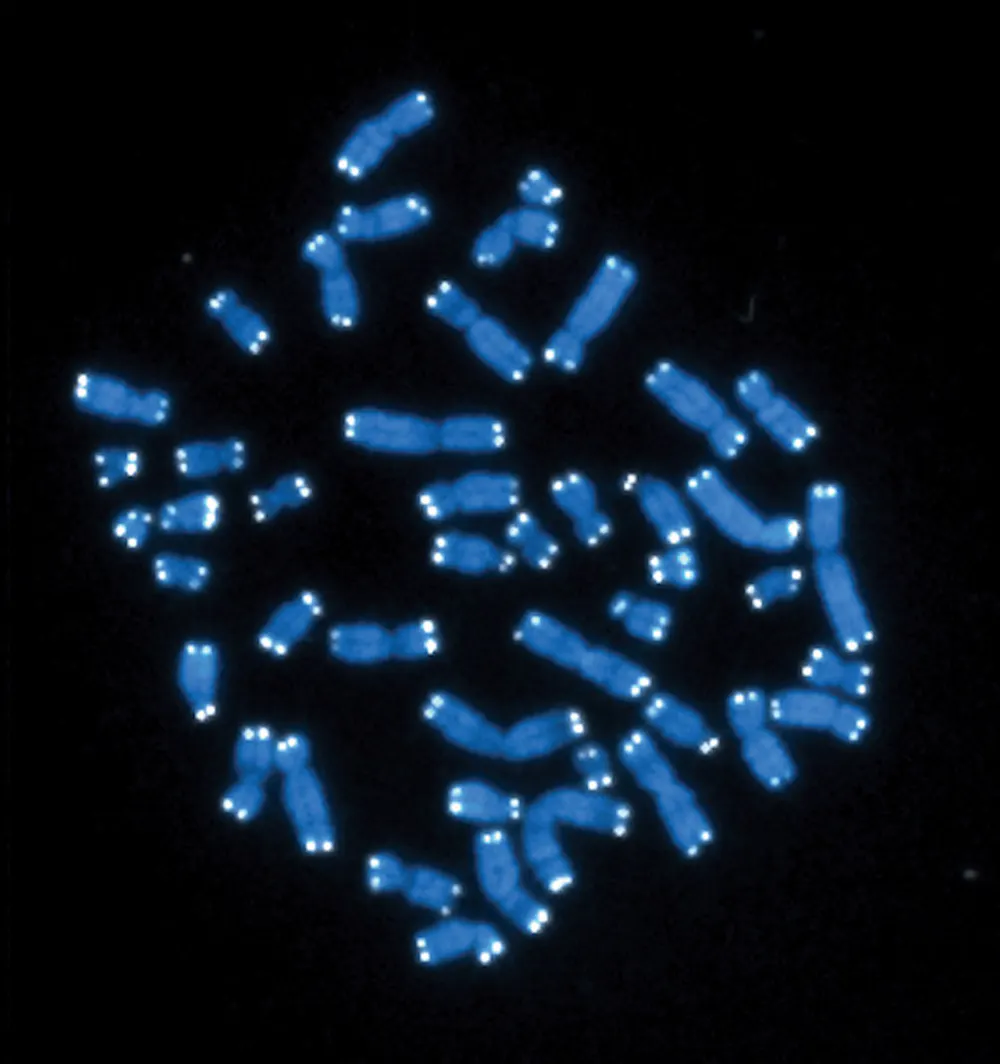
The simplest form of repetitive DNA are blocks of DNA repeated over and over in tandem called satellites. While how much satellite DNA a given genome has varies from person to person, they often cluster toward the ends of chromosomes in regions called telomeres. These regions protect chromosomes from degrading during DNA replication. They’re also found in the centromeres of chromosomes, a region that helps keep genetic information intact when cells divide.
Researchers still lack a clear understanding of all the functions of satellite DNA. But because satellite DNA forms unique patterns in each person, forensic biologists and genealogists use this genomic “fingerprint” to match crime scene samples and track ancestry. Over 50 genetic disorders are linked to variations in satellite DNA, including Huntington’s disease.
Satellite DNA tends to cluster toward the ends of chromosomes in their telomeres. Here, 46 human chromosomes are colored blue, with white telomeres. NIH Image Gallery/flickr, CC BY-NC
Another abundant type of repetitive DNA are transposable elements, or sequences that can move around the genome.
Some scientists have described them as selfish DNA because they can insert themselves anywhere in the genome, regardless of the consequences. As the human genome evolved, many transposable sequences collected mutations repressing their ability to move to avoid harmful interruptions. But some can likely still move about. For example, transposable element insertions are linked to a number of cases of hemophilia A, a genetic bleeding disorder.
Transposable DNA may be the reason why humans have a tailbone but no tail.
But transposable elements aren’t just disruptive. They can have regulatory functions that help control the expression of other DNA sequences. When they’re concentrated in centromeres, they may also help maintain the integrity of the genes fundamental to cell survival.
They can also contribute to evolution. Researchers recently found that the insertion of a transposable element into a gene important to development might be why some primates, including humans, no longer have tails. Chromosome rearrangements due to transposable elements are even linked to the genesis of new species like the gibbons of southeast Asia and the wallabies of Australia.
Completing the genomic puzzle
Until recently, many of these complex regions could be compared to the far side of the moon: known to exist, but unseen.
When the Human Genome Project first launched in 1990, technological limitations made it impossible to fully uncover repetitive regions in the genome. Available sequencing technology could only read about 500 nucleotides at a time, and these short fragments had to overlap one another in order to recreate the full sequence. Researchers used these overlapping segments to identify the next nucleotides in the sequence, incrementally extending the genome assembly one fragment at a time.
These repetitive gap regions were like putting together a 1,000-piece puzzle of an overcast sky: When every piece looks the same, how do you know where one cloud starts and another ends? With near-identical overlapping stretches in many spots, fully sequencing the genome by piecemeal became unfeasible. Millions of nucleotides remained hidden in the the first iteration of the human genome.
Since then, sequence patches have gradually filled in gaps of the human genome bit by bit. And in 2021, the Telomere-to-Telomere (T2T) Consortium, an international consortium of scientists working to complete a human genome assembly from end to end, announced that all remaining gaps were finally filled.
With the completion of the first human genome, researchers are now looking toward capturing the full diversity of humanity.
This was made possible by improved sequencing technology capable of reading longer sequences thousands of nucleotides in length. With more information to situate repetitive sequences within a larger picture, it became easier to identify their proper place in the genome. Like simplifying a 1,000-piece puzzle to a 100-piece puzzle, long-read sequences made it possible to assemble large repetitive regions for the first time.
With the increasing power of long-read DNA sequencing technology, geneticists are positioned to explore a new era of genomics, untangling complex repetitive sequences across populations and species for the first time. And a complete, gap-free human genome provides an invaluable resource for researchers to investigate repetitive regions that shape genetic structure and variation, species evolution and human health.
But one complete genome doesn’t capture it all. Efforts continue to create diverse genomic references that fully represent the human population and life on Earth. With more complete, “telomere-to-telomere” genome references, scientists’ understanding of the repetitive dark matter of DNA will become more clear.
============================================================== Alecto, Megaera, and Tisiphone, as technical as this information is, the article is jam-packed with analogies which make it much clearer. We have seen quantities of science which have increasingly demonstrated that we are more alike than we are different – and by “we,” science increasingly means not just humans and other humans, but humans and animals, even humans, animals, and plants. I am inclined to hope for more of the same, But I am even more inclined to hope that humans (and animals and plants as appropriate) can increasingly embrace our similarities and stop fretting so much about our differences, but instead, embracing them too. I’m sure that won’t happen spontaneously. And maybe that’s where you, ladies, can help us.
(Putting this before Glenn – because it was recorded before the verdict, and Glenn recorded after it)
Ring of Fire – MAGA Rioter Says Trump ‘Authorized’ The Attack On The Capitol
Glenn Kirschner – Insurrectionist Dustin Thompson Testifies he was following Trump”s Orders, Jury Finds Him Guilty
Meidas Touch – CAUGHT: Top Republicans Endorse Putin | #PutinsParty
MSNBC – What’s Behind The RNC’s Decision To Quit Presidential Debates
NJ Spotlight News- Creating Pysanky: The Unbelievable Art Behind Ukrainian Easter Eggs
This Is The Tiniest Baby Bunny In The World (of course you knew I had to)
Beau – Let’s talk about Russia’s long-term futures….
Yesterday, the opera was “Elektra,” by Richard Strauss, about one of the earliest and most dysfunctional families. They weren’t doing so badly until Paris met Helen, whose brother-in-law was Agamemnon (a much better general that Menelaus, Helen’t husband), who in irder to assure victory in Troy sacrificed one of his daughters, Iphegenia, for which his wife, Klytemnestra, (understandably) never forgave him. So in the ten years he was gone, she took a lover, Aegisth, and when he got back they mirdered him. This did not sit well with the children – Elektra, Chrysothemis, and their brother Orest (who had fled in fear for his own life), but Elektra and Chrysothemis did not feel competent to kill their mother and stepfather so they were stuck waiting for Orest to return. And here the opera begins. Chrysothemis really just wants a normal life; it is Elektra who is obsessed with revenge, and rants a lot to anyone who will listen, and to the gods. Eventually Orest does return and kills the guilty pair (off stage, thankfully), leading to Elektra’s final rant, a dance of victory. (Incidentally, the situation put Orest into a bind with the Furies – he was cursed if he killed his mother, but equally cursed if he failed to avenge his father’s murder. His trial by the gods is how the Furies got their other name of Eumenedes, and their other mission of resolving impossible situations. But that trial was after this opera ends.) Nina Stemme, who sang Elektra is probably the top dramatic soprano of today, as were Kirsten Flagstad and Birgit Nilsson before her. And a soprano really needs to be at the top to sing this part. But the rest of the cast cannot be slouches either. It also demands a fair amount from the audience – as do all Greek tragedies, whether spoken or sung. They weren’t intended as entertainment.
Cartoons
Short Takes –
Crooks and Liars – Russian Wife Laughingly Authorizes Her Husband To Rape Ukrainian Women
Quote – A conversation in which a woman invites a man to rape Ukrainian women was published by the Security Service of Ukraine on April 12. From the recording, it can be assumed that the published fragment is part of a longer dialogue. The man turned out to be Roman Bykovsky, a former conscript of the Russian Guard, and then a soldier of the 108th Guards Airborne Assault Regiment, which participated in the annexation of Crimea. It was here that he recently moved his family from Russia. Click through – if you have a barf bag. I am not making this up.
Daily Beast – FDA Grants Emergency Authorization to First COVID-19 Breath Test
Quote – The first breath test for the virus collects a sample in a manner similar to blowing up a balloon, and can be analyzed for results in under three minutes. “Today’s authorization is yet another example of the rapid innovation occurring with diagnostic tests for Covid-19,” Jeff Shuren, the director of the F.D.A.’s Center for Devices and Radiological Health, said in a statement. The company behind the test, InspectIR, reported that, in a study of just under 2,500 people, it could correctly detect a COVID-19 infection 91.2 percent of the time Click through for details. I just received my first shipment of four free tests (rapid, swab in the nose) which take about 15-20 minutes. I can handle the annoyance if necessary, but this is a great development for peole for whom the discomfort is a deal breaker.
Daily Kos (Marissa Higgins) – Watch openly gay Democrat tell anti-trans Republican colleague exactly what he needs to hear
Quote – [Mackey (D)]: “I recall a story you told. About your brother….And I remember you said that your b[r]other, or, rather, your mother called to tell you that your brother had some news that he was afraid to tell you…. And your brother wanted to tell you that he was gay, didn’t he?… Can I tell you, if I were your brother? I would have been afraid to tell you, too.” [Basye (R)] “Well, I’m sorry.” And that was meager remark was enough to let Mackey really unleash the heart of his argument. Click through for full argument. You might need a tissue.
Food For Thought: Peace
I think thr author would give me permission to republuish it. But I want to share it today, on Easter. And this is a short and easy-to-save link. (The picture is not of the author’s property, but it is of a place within the historic Onondaga territory.)