Yesterday, another update from Axios was interesting. You may remember that Lindsay Graham filed an emergency appeal of his subpoena to testify for Fani Willis’s grand jury, and Justice Clarence Thomas granted him a temporary stay. Subsequently, two othwer temporary stays were granted on emergency appeals – one by Justice Kagan (and I forget for whom that was), and more recently still, one by Chief Justice Roberts for Trump**. Even before the third stay, a legal expert pointed out that the granting of a temporary stay on an emergency appeal is normal, that the full court would have to concur in order for it to stand, and that that was extremely unlikely in both of the first two cases (and the third had not het happened.) Well, this update proved that expert correct in the case of Lindsay Graham. He has been told he must testify. Expect the second and third temporary stays to end up being just that – temporary. On a completely different toipc, if you watch TV or stream any news, you will probaby hear many pronunciations of the name “DePape.” But I note that the local police (who would be the ones who have actuallt spoken to him) are pronouncing it in three syllables, with the accent on the middle one. Sor of like “De-Poppy” (or “duh-Poppy.”) The inference is that they got that pronunciation from him, and that he knows how to pronounce his own name.
Cartoon –
Short Takes –
Popular Information – “What happens when you put ideologues in charge of a university”
Quote – “It looks like the right-wing fantasy of what happens when you put ideologues in charge of a university,” Colson told Popular Information. Colson was one of 33 employees, most tenured faculty, that were terminated from [Emporia State University in Kansas] last month. The firings were made possible through a state-wide policy change introduced in early 2021 by the Kansas Board of Regents (KBOR), the board that oversees Kansas’ public colleges and universities. The other five public universities in Kansas declined to violate the principles of tenure to cut costs. Click through for story. If I were thinking about going to college again (which I’m not – I have credentials I haven’t even used yet already), I would be seriously considering a HBCU just to avoid this crap.
The 19th Explains: How two Supreme Court cases could end affirmative action in colleges
Quote – Women represent about 60 percent of enrollment in universities and colleges around the country. Among Black students, women make up about 64 percent of bachelor’s degrees and 71 percent of master’s degrees. College-degree attainment for Latinas also outpaces Latinos. About 27 percent of Latinas have a college degree compared to about 21 percent of Latinos. As a result, any decision the Supreme Court makes on affirmative action will disproportionately impact women of color. Advocates for equity in education are concerned about what the upcoming decision could mean for groups of qualified students who are already underrepresented in the country’s most competitive schools. Click through for details. They are already hearing oral arguments on one, and you will not believe what Clarence Thomas asked an attorney to explain. Proof in the Video Thread, not in today’s but in tomorrow’s.
Food For Thought
Incidentally, “poll watcher” is, at least in Colorado, a legitimate term, But it’s nothing like what Republicans are doing. Ther are duplicate records of voters by name only on small papers with a hole punched in them. A poll watcher is entitled to look through those, make a few notes, then leave. There can be one from each party who visits each precinct (although one person might be a watcher for more than one precinct.) The purpose is so that parties can look far names missing of people who need assistance getting to the polls, and offer it – and not bother those who don’t need it. The watchers are not allowed to talk to anyone except the election staff, and any conversation they do have with staff may not interfere with the staff’s duties. Election staff are trained before the election as to what poll watchers may and may not do. In any election I have ever worked, I and the staff working with me have been conscientious to maintain good order.
I know I’ve been remiss about my Sound Off! postings, but I’ve had other cakes to bake what with an important election going on. After it is over, I hope that I will have more time to dedicate to writing my essays. So, without further ado, here is the latest.
What poses a greater danger to Democracy than terrorists, Islam, LGBTQ people, socialism, atheism, or people who douche-park? Christian Nationalism.
Christian Nationalism is based on the entirely mistaken notion that the United States was founded on Christian principles. The Founding Fathers may have been religious, but many of them were freethinking deists. They believed in a Higher Power, but did not adhere to any particular faith. Also, American colonists had witnessed how bad things can get when religion and government mix, in the old world and the new. Groups who fled religious persecution in Europe became the persecutors when they set up their own societies in North America.
The Founding Myth by Andrew Seidel completely destroys the claims of Christian Nationalists one by one. This book also shows that “Christian” law would be totally opposed to the Constitution and the spirit of this nation. It is a must-read.
The following quotes prove that the Founding Fathers did not in any way plan to set up the United States as a Christian nation:
“Christianity neither is, nor ever was a part of the common law.” – Thomas Jefferson
“All national institutions of churches, whether Jewish, Christian or Turkish, appear to me no other than human inventions set up to terrify and enslave mankind, and monopolize power and profit.” – Thomas Paine
“Christianity is the most perverted system that ever shone on man.” – Thomas Jefferson
“Religion and government will both exist in greater purity the less they are mixed together.” – James Madison
“During almost fifteen centuries has the legal establishment of Christianity been on trial. What have been its fruits? More or less in all places, pride and indolence in the clergy, ignorance and servility in the laity, in both, superstition, bigotry and persecution.” – James Madison
“The government of the United States is not in any sense founded on the Christian religion” – from the Treaty of Tripoli, signed by President George Washington
“The United States is not a Christian nation any more than it is a Jewish or [Muslim] nation.” – John Adams
“The civil rights of none shall be abridged on account of religious belief or worship, nor shall any national religion be established, nor shall the full and equal rights of conscience be in any manner, or on any pretext, infringed.” – James Madison
Christian Nationalists are trying to re-create something that never existed in the first place. They are not trying to return the USA to Christian values, they are trying to destroy the heart and soul of this nation. They are living in a fantasy world and working under a host of misconceptions.
If they gain power, their plans will be devastating to this country and its residents. All manner of people will face violent, vicious persecution: non-Christians, feminists, people of color, scientists, LGBTQ, and many, many more. Even many Christians will come under fire because they adhere to the “wrong” kind of Christianity. Human and civil rights will be abolished. The USA will become like those countries in the Middle East that are under the thumbs of Da’esh (aka ISIS, ISIL, Islamic State) or the Taliban. For Christian Nationalists, The Handmaid’s Tale and 1984 are guidebooks, not warnings.
Education will suffer as only schools that indoctrinate pupils with fundamentalist religion will be permitted. Dissent will be harshly punished – when people are absolutely convinced they are Right, any means of enforcing their will is acceptable. Racism, LGBTQ-phobia and sexism will become the law of the land. The horrors are far too numerous to list in one of my essays; indeed, entire books enumerate the likely results of a religious right takeover.
There is one way we can fight back, which is not only peaceful but legal: VOTE! Make sure all your kith and kin vote if they are registered. Volunteer to drive people to the polls. Make sure you do your homework about all candidates in all elections, and remember the down-ballot races – that is where extremists began their takeover. The 2022 midterm election could be the last chance we have to save our country.
Yesterday, I got an update from Axios that there are now Federal charges against David DePape (he had already been charged at the state level). This does not constitute double jeopardy because federal and state are separate “sovereigns.” This is a good sign. Also Faithful America (you mem remember they recently put up a web page against false peophets) now has a new page – 20 Resources to Resist Christian Nationalism. And, I’m sorry to say, even if we win the midterms in landslides, we are going to need every oone of those 20. Well, at least I gor=t confirmed to see Virgil this Sunday. I really like having the confirmation early.
Cartoon –
Short Takes –
Civil Discourse – In Praise of the Federal Judiciary
Quote – Judge Berman Jackson unflinchingly defined who the good guys are and who the bad guys are. That’s a line that has become blurred in public discourse as the former president and his supporters make claims about the people who overran the Capitol and engaged in violence that range from calling them tourists to insisting they were patriots exercising their rights. But today Mr. Head heard the truth from the bench about Officer Fanone, and it’s important for all of us to hear it too: “[Fanone] was protecting the very essence of democracy, the peaceful transfer of power after a democratic election. He was protecting America. That’s who Officer Fanone was. That’s what Officer Fanone was doing. You made choices over and over again to go after him and not disengage.” Click through for essay. Judge Berman Jackson is, sadly, not the entire Federal Judiciary (if only they were all at least as good as she), but she is certainly a fine representative of it. Her name has come up repeatedly this year, and always for something praiseworthy.
Project on Government Oversight – Study Shows POGO’s Oversight Trainings Increase Congressional Capacity
Quote – Designed for veterans and beginners alike, our monthly seminars feature lessons from some of the most accomplished current and former congressional oversight experts and practitioners, and provide opportunities for congressional staff to ask questions in an off-the-record environment. Although seminars are generally targeted toward committee staff, much of the information shared during these seminars is also helpful to staff in personal offices in their investigations. These nonpartisan training sessions are open to Hill staff regardless of party, chamber, or position, and we also welcome staffers from the Government Accountability Office and Congressional Research Service. These seminars feature current and former members of Congress or congressional staffers from both parties, and we do our best to get panelists from both the House and Senate. Click through for article. POGO is justifiably proud of their training program(s). It’s too bad that, if the GOP takes over, it will probably have to be scrapped.
Yesterday, the lead article in Colorado Public Radio news was that the state House Minority Leader (Republican) had died, suddenly and unexpectedly, at the age of 55. Nine days before the election. Cue conspiracy theories in 3… 2… 1…. When he took that office, he was described as “right in the middle,” which in today’s Republican party I would normally translate to “maybe halfway sane.” But according the the Speaker, the Marjority Leader, and the Governor, he was better than that. This is not good news. Also yesterday, it was announced that Bolsonaro LOST in Brazil. Com one, Americans – if Brazil can do it, we can too!
Experts in autocracies have pointed out that it is, unfortunately, easy to slip into normalizing the tyrant, hence it is important to hang on to outrage. These incidents which seem to call for the efforts of the Greek Furies (Erinyes) to come and deal with them will, I hope, help with that. As a reminder, though no one really knows how many there were supposed to be, the three names we have are Alecto, Megaera, and Tisiphone. These roughly translate as “unceasing,” “grudging,” and “vengeful destruction.”
Well, we did not start soon enough to try to reduce our production od carbon to slow or stop climate change. And even bringing our production of carbon to a complete standstill would now not be enough. So, now, scioence is looking at ways to pull carbon fron the air and store it somewhere else. Earlier this year, the Erinyes looked at working to incorporate carbon pulled from the air into products which people use anyway (such as concrete and carbonated beverages.) That’s creative, but it would not be enough. So other storge solutions are also being studied. One of them is the ocean (all the oceans).
Science tends to ask questions like “Could we?” Two educators, one from Arizona and the other from British Columbia, think we had better, before we jump into action, answer more questions like “Should we?”
==============================================================
Using the ocean to fight climate change raises serious environmental justice and technical questions
Heat waves, droughts and extreme weather are endangering people and ecosystems somewhere in the world almost every day. These extremes are exacerbated by climate change, driven primarily by increasing emissions of greenhouse gases that build up in the atmosphere and trap heat at the Earth’s surface.
With that in mind, researchers are exploring ways to pull carbon dioxide out of the atmosphere and lock it away – including using the ocean. But while these techniques might work, they raise serious technical, social and ethical questions, many of which have no clear answers yet.
We study climate change policy, sustainability and environmental justice. Before people start experimenting with the health of the ocean, there are several key questions to consider.
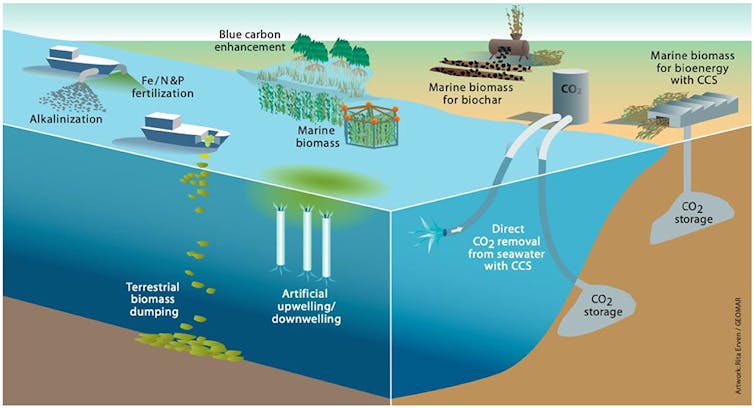
Ocean carbon dioxide removal is any action designed to use the ocean to remove even more carbon dioxide from the atmosphere than it already does and store it.
It spans a wide range of techniques – from increasing the amount and vitality of carbon dioxide-absorbing mangrove forests to using ocean fertilization to stimulate the growth of phytoplankton that absorb carbon dioxide to building pipelines that pump liquid carbon dioxide into formations under the seabed, where it can eventually solidify as carbonate rock.
There are other forms of carbon dioxide removal – planting trees, for example. But they require large amounts of land that is needed for other essential uses, such as agriculture.
The first crucial question is whether ocean carbon dioxide removal techniques could significantly reduce atmospheric carbon dioxide and store it long term, beyond what the ocean already does. Greenhouse gas emissions are still increasing globally, which means that ocean carbon dioxide removal would need to keep carbon dioxide out of the atmosphere for a long time, at least until greenhouse gas emissions have fallen.
Initial evidence suggests that some forms of ocean carbon dioxide removal, such as those that rely on short-lived biomass like kelp forests or phytoplankton, may not keep captured carbon stored for more than a few decades. That’s because most plant tissues are quickly recycled by decay or by sea creatures grazing on them.
In contrast, mechanisms that form minerals, like the interaction when carbon dioxide is pumped into basalt formations, or that alter the way seawater retains carbon dioxide, such as increasing its alkalinity, prevent carbon from escaping and are much more likely to keep it out of the atmosphere for hundreds or thousands of years.
Ecological risks and benefits
Another key question is what ecological benefits or risks accompany different ocean carbon dioxide removal approaches.
However, other options could introduce novel risks. For example, growing and then sinking large amounts of kelp or algae could bring in invasive species. Dissolving certain types of rock in the ocean could reduce ocean acidity. This would enhance the ocean’s ability to store carbon dioxide, but these rocks could also contain trace amounts of metals that could harm marine life, and these risks are not well understood.
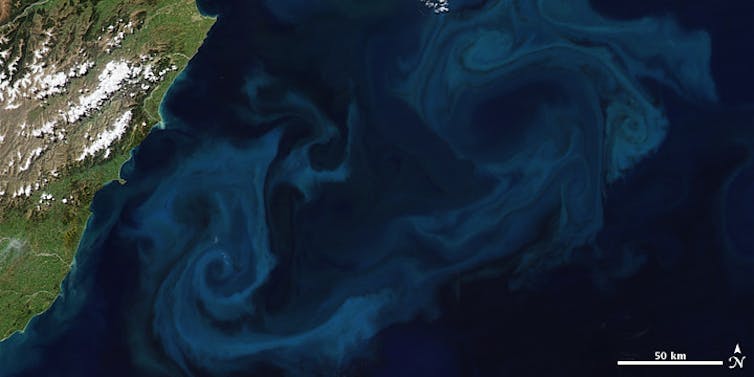
Phytoplankton can grow explosively over a few days or weeks. Ocean fertilization is designed to supercharge that process to capture carbon dioxide, but it can have harmful affects for other marine life. Robert Simmon and Jesse Allen/NOAA/MODIS
Each process could also release some greenhouse gases, reducing its overall effectiveness.
Interfering with nature is a social question
The ocean affects everyone on the planet, but not everyone will have the same relationship to it or the same opportunities to have their opinions heard.
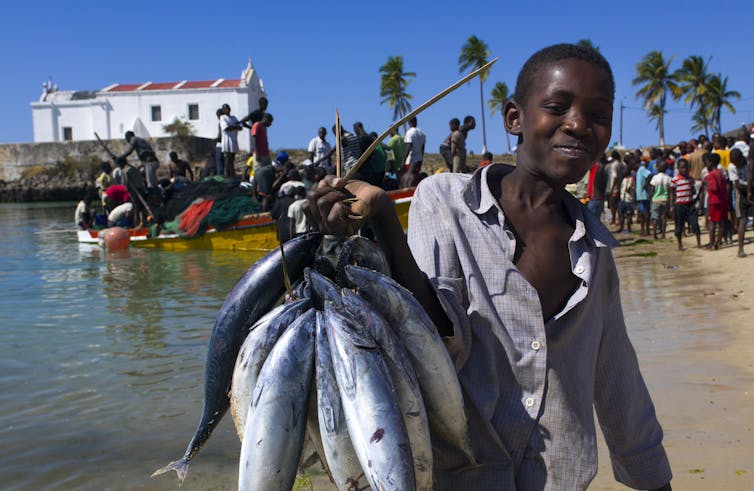
Much of the global population lives near the ocean, and some interventions might impinge on places that support jobs and communities. For example, boosting algae growth could affect nearby wild fisheries or interfere with recreation. People and communities are going to evaluate these risks differently depending on how they are personally affected.
In addition, people’s trust in decision-makers often shapes their views of technologies. Some ways of using the ocean to remove carbon, such as those close to the shore, could be governed locally. It’s less clear how decisions about the high seas or deep ocean would be made, since these areas are not under the jurisdiction of any one country or global governing body.
Ocean carbon dioxide removal also raises a variety of ethical questions that do not have straightforward answers.
For example, it forces people to consider the relationship between humans and nonhumans. Are humans obliged to intervene to reduce the impact on the climate, or ought we avoid ocean interventions? Do people have the right to purposefully intervene in the ocean or not? Are there specific obligations that humans ought to recognize when considering such options?
Other ethical questions revolve around who makes decisions about ocean carbon dioxide removal and the consequences. For example, who should be involved in decision-making about the ocean? Could relying on ocean carbon dioxide removal reduce societies’ commitment to reducing emissions through other means, such as by reducing consumption, increasing efficiency and transforming energy systems?
Who pays?
Finally, ocean carbon dioxide removal could be very expensive.
For example, mining and then adding rocks to reduce the ocean’s acidity has been estimated to cost between US$60 and $200 per ton of carbon dioxide removed. To put that into context, the world produced more than 36 billion metric tons of carbon dioxide from energy alone in 2021.
Even macroalgae cultivation could be in the tens of billions of dollars if done at the scale likely necessary to have an impact.
These methods are more expensive than many actions that reduce emissions right now. For instance, using solar panels to avoid carbon emissions can range from saving money to a cost of $50 per ton of carbon dioxide, while actions like reducing methane emissions are even less expensive. But the harm from continued climate change has been estimated to be in the hundreds of billions annually in the United States alone.
These costs raise more questions. For example, how much debt is fair for future generations to carry, and how should the costs be distributed globally to fix a global problem?
Ocean carbon dioxide removal could become a useful method for keeping global warming in check, but it should not be seen as a silver bullet, especially since there isn’t an effective global system for making decisions about the ocean.
Sarah Cooley, a former research scientist at Woods Hole Oceanographic Institution and director of climate science at the Ocean Conservancy, contributed to this article.
==============================================================
AMT, I’d be very much in favor of establishing a “global governing body” to protect the “high seas and deep ocean” – and by extension, us. I think I would want such a body to be estalished through, or at the very lear with the cooperation of, both the United Nations and the International Court. I’d like for it to be formed and staffed with people who are extremely conscious of the relationships between species, and the effects they all have on each other. (For example, I think I could probably live without poisonous jellyfish. But I might be wrong, Their disappearance might have a huge effect on the disappearance of tuna. I would not like to have to live without tuna. I’d want this body to have, both as members and staff, people who are smarter than me about this.)
The authors do allude to the cost of doing nothing (they don’t use that term, but that’s what “the harm from continued climate chages” refers to.) But, other than saying there is currently no governing body over the oceans, they don’t go in that direction at all. I suspect that, had they attempted to do so, the rest of the article might have gotten lost in the discussion of those complexities. Perhaps you, dear Furies, can shed more light (with a minimum of heat) on this.






 Nameless for the animation