Yesterday, I got the New Yorker’s Name Drop on the first clue (and the cheeky little respone they provide, whether you get the answer or not, said “Now go tell everyone you know.”) I don’t know that everyoe would get it on the first clue (I happen to be a huge fan), but there’s a lot of information scattered through the six clues, and I think most people would get it at some point. But thegood news is that Dianne Feinstein has announced she will not run again. Not that there won’t be a primary, but it looks like it will be between Katie Porter and Adam Schiff, and possibly Barbara Lee. Much as I hate the thought of losing any from the House,let alone all three, any of them would dramatically improve the Senate. Does anyone know whether the losers will be able to run for their House seat instead? That varies from state to state, and I’m not even 100% positive how it works in mine. Speaking of mine, another announcement today – Adam Frisch will take on Boebert again.
Cartoon –
Short Takes –
PolitiZoom – Ask Not For Whom The Bell Tolls, GOP. It Tolls For Thee
Quote – The next day he went into Rick Skeletor Scott’s backyard in Florida to spread the good word. And as people walked into the auditorium for the rally, there was a leaflet of Senator Scott’s 11 point plan on every seat. Biden almost gleefully led a Sing-Along-With-Mitch of the part that sunsetted Medicare and Social Security after 5 years Click through for full list. Considering the bubble in which MAGAts live, I don’t know how long these achievements are going to carry us, but it won’t hurt to take a small victory lap.
Politico [from 2019] – The Spy Case That Made Adam Schiff a Russia Hawk
Quote – This was no ordinary FBI surveillance operation: The “acquaintance” Grishin referred to was himself an FBI agent—a man who, out of greed, desperation, and spite, had begun an affair with Ogorodnikov and agreed to sell classified information to the Soviet government. Eventually, this man—Richard W. Miller, a 47-year-old Los Angeles-based counterintelligence agent on the Bureau’s Soviet squad—would become the first FBI agent ever convicted of espionage. And the man who would finally secure Miller’s conviction in 1990—after three trials over the course of six years—was a young U.S. attorney in Los Angeles: Adam Schiff. Click through for background. This is not news, but since Adam is running for the Senate, I thought some background wouldn’t hurt. I will also from time to time look at background on Katie, and if and when Barbara announces, on her as well.
You may have seen the “1957 vs 2007” list, which has made the Internet rounds and implies that life was better back in the mid-20th century than it is now. Yes, in some ways 1957 was better than 2007, or today – higher education was affordable, housing was affordable, gas was cheap, and one could support a household on one income. However, that list mysteriously ignores the amount of social progress we have made since 1957 – civil rights, women’s rights, LGBTQ rights, to say nothing of scientific progress. 1957 was a nice year to be alive in the USA, provided you were male, white and straight. If you were not all three of those, life was not necessarily a picnic.
Here are some scenarios that rebut the “good old days” nostalgia:
#1: Mr. Green, a Black man, walks into a restaurant.
1957: It’s for whites only. Mr. Green barely escapes the angry mob that chases him out.
Today: Mr. Green enjoys a nice dinner and leaves a generous tip.
#2: Two men go for a walk through a park.
1957: Other people assume they are gay. The pair are forced to flee for their lives.
Today: Two men enjoy a walk through a park. Some people assume they’re gay, but don’t give a rat’s behind.
#3: While eating out with his family, Mr. Jones suffers a heart attack.
1957: His wife has to beg the restaurant manager to use his phone to call the fire department. The ambulance rushes him to the hospital, but he dies.
Today: His wife whips out her mobile phone and mashes 911. Two other customers, who recently took a CPR course, keep Mr. Jones alive till the paramedics arrive. Mr. Jones recovers, makes some lifestyle changes, and lives long enough to see his grandchildren graduate high school. (He had good insurance, BTW; medical bills are another story to be told another day.)
#4: Suzie wants to be a scientist when she grows up.
1957: Her parents and teachers discourage her, even after she trots out examples such as Marie Curie and Annie Jump Cannon. She aces her science courses, but is refused membership in every science club she applies to. Despite great grades in school, she is turned down by every technical college and university. She winds up marrying an engineer because that is the closest she will ever get to her now shattered dream.
Today: Her parents give her science books and kits for her birthday and Christmas. She joins her school science club, aces her science classes, and comes in third in the state science competition. She matriculates at a prestigious engineering university, earns a Master’s, and gets a plummy job with a reputable research firm.
#5: William is autistic.
1957: He does poorly in school, where he is ruthlessly bullied. His parents put him in an institution.
Today: His teachers understand his difference. He does well in school, goes to college, gets a degree and a great job on graduation.
Yesterday, looking at the weather forecast (which I automatically do on my way to get the times of sunrise and sunset, but normally don’t pay a lot of attention), I had the thought that this could be am – intersting – week weatherwise. Fristly, they are taking about snow for tomorrow, starting tonight (we could possibly have a couple of inches by 7 pm.) It’s a bit clumsy to describe the graph, but it’s a broad strip covering ten days from left to right, with temperatiure aand sunlight at the top and precipitation at the bottom and everything else you can think of in between – pressure, wind speed, even wind direction, and more. You can move your cursor across it, and wherever you put it, you’ll see a top-to-bottom line of everything. If you want to know what the wind direction will be next Tuesday at noon, you can set a line at that day and time and it will tell you. In fact, it tells me way more than I want to know. The reason I bother with it is that it has thousands, mabe tens of thousands, of weaher stations, and you can select, not just the zip code, but the exact weather station you want to track. And in Colorado Springs, where uou can go through three seasons just driving from 80911 in the south to 80921 in the north, that is important to me. The weather station I use is maybe four blocks from my house. And while even with that kind of pin point data, though still not perfect, it’s amazing how close to reality it can be. But I digress – I was going to say that, after tomorow, we an expect several days of sun, and a weekend with highs in the 50’s, before getting hammered again a week from today. Not unusual. But it does feel unusual to have a good idea what to expect.
I also learned that at least soe classical musicians and commentatore, probably beginning at Juilliard, are no longer using the perk “accompanist.” Instead, they are saying “collaborativepianist.” Ilikethat. I’ve often thought accompanists do not get enough credit. I was fortunate enough to meet one once, Anne Epperson, who told me that her teachers all wanted her to become a concert pianist, but that she preferred making music in collaboration. If you are ever thinking of investing in a CD (or whatever format comes along) of a piece with a soloist and a pianist, and you have a choice, buy the one with Epperson. Also, apparently the State Department just issued a warning to any Americans in Russia to leave, and any not in Russia NOT to go there. While this is just common sense, I feel that bringing it up now probably means they know something we don’t.
Cartoon – 14 Oregon_map RTL + Valentine
Short Takes –
Capitol Hill Seattle BLog – Video shows East Precinct officers back down after bystanders step in over heavy response to Capitol Hill ‘shots fired’ 911 calls
Quote – The quickly formed and instantly tense standoff is an example of how fast a police response to a 911 report involving a gun can escalate and also shows how perceptions of police in a standoff situation have shifted after repeated incidents like the killing of Tyre Nichols…. According to East Precinct radio updates, police had been dispatched to the area after a 911 caller reported a gunshot and a second caller reported two shots along with somebody yelling, “Everybody is going to die.” But people at the scene told police there was no shooting and no gun — only a young person in a yellow sweater upset and suffering a crisis. Click through for details. This story is going on two weeks old now, but re-reading it, I am still struck at how new it is. And that it couldn’t have happened just anywhere. It needs more visibility – a LOT more visibility.
The Conversation – Diversity and moderation over tradition – why Democrats moved South Carolina to the start of the 2024 presidential campaign
Quote – As political scientists in South Carolina, we understand how important the state’s primary is to the Democratic Party. Working at the College of Charleston for over a decade, we have seen dozens of campaign visits and events by presidential hopefuls of both parties to our city and campus. Given our front-row seats, we wrote “First in South: Why South Carolina’s Presidential Primary Matters,” a book about South Carolina’s primary process. Published in 2020, it examines South Carolina’s demographic makeup, the state’s primary electorate and how it compares with each party’s typical national primary and caucus voter. What we learned was, on several key metrics, South Carolina voters are a better reflection of the demographic diversity and moderate stance on issues the party prioritizes than voters in Iowa and New Hampshire. Click through for rationale. Some are questioning spending money here, in a state we are never going to win (as if we arent already doing that in Iowa.) But remember, this is a primary we are talking about. Democrats in South Carolina are going to be good, strong Democrats with a good sense of what the nation actually needs. If we learn those lessons, and don’t forget them, I’m thinking our money will not be ill spent.
Food For Thought
I put this into a comment on Nameless’s recent MTG srticle, but I thought it too good for anyone to miss:
Yesterday, Virgil and I had a good visit, even without cards. He is still dreaming things and thinking they happened, but if he starts to tell me about one, he now often catches himself up and says, “Oh, never mind.” And he did remember a few things that actually did happen, such as when a former boss of mine (whom we both adores) died – doing what she loved – rock climbing in Mexico. We were the only table for a couple of hours, but then gradually five others received visits. A couple of them left before I did, but the other three were still there when I left – at just the right time to minimize the sunset hindering me. There are some windows in the room, and they face roughly west. Their light on the floor gradually moves as the sun does, and eventually starts climbing up the wall, and acts as a makeshift sundial. When the top corner reaches a certain height, it’s time to leave. (If there isn’t sun, it doesn’t make as much difference when I leave because the sun won’t distract me if it can’t be seen.) Congratulations to Nameless on his team’s win (even though it still has an insensitive mascot. ;-)) After I got back and started looking around, I realized that Ohio is having an environmental catastrophe after a train derailment – near East Palestine – and I hope Spy Kat isn’t anywhere near it. Spy, I see you’ve been by (thanks for the upvotes) and I hope that means you’re fine and not in danger. On a happier note, Stevie van Zandt sent Jamie Raskin a gift – check this out.
Cartoon –
Short Takes –
Civil Discourse – Who Weaponized the Federal Government?
Quote – Yes, this subcommittee was a product of the “compromise” a desperate Kevin McCarthy struck to get the votes he needed to win the speakership on the 15th ballot. That’s apparent. But we need to understand the purpose the members who negotiated for its existence had in mind for it. We’ve already established it’s not about responsible governance. It’s purely performative. The goal seems to be producing a series of video clips and social media posts that Republicans can use for gotcha, for campaigning, and to advance fake claims that will only serve to push the country further into two opposing camps. It’s about writing bumper stickers and own-the-libs punchlines. Look no further than the fact that Fox News didn’t carry the hearing live. It’s all about some 60-second clips where Jordan and friends will be free to harpoon Democrats in a fact-free environment. Click through for the details of her premise. While mostly obvious to us, it needs to be shouted from the rooftops. I do want to make one tiny correction – Stacey Plaskett of the Virgin Islands is not a Congresswoman but a delegate (USVI is not a state). She doesn’t have a vote on legislation. I presume she does on the committee, and in any case she has a voice – a strong one.
(New York magazine) The Cut – Misty Copeland on Becoming a Mom, Writing a Memoir, and Returning to the Stage
Quote – The self-doubt that comes with the responsibility of being the first, going onstage and performing these roles — Raven Wilkinson dealt with it herself, right before she left the Ballet Russe de Monte Carlo. She was being told by Nina Novak, who was the principal ballerina in the company, that her time pretty much was up. She was never going to be the White Swan. That’s just not a role for Black women. That was ingrained in us as Black women in the ballet world. So when I was given the opportunity to do Swan Lake, it was like this ancestral trauma that I’m bringing with me — this responsibility that if I don’t live up to these standards, what will that mean for future Black dancers taking on this role? Will they be given the opportunity, or will I be the reason not? All of these things were going through my head. Click through for the rest of today’s Black History moment. I’m not a huge ballet fan, but I do admire Misty, and I’ve missed hearing/reading about her. (The first FFT is the cover of the children’s book she wrote – and the second is tips on how to use that.)
Experts in autocracies have pointed out that it is, unfortunately, easy to slip into normalizing the tyrant, hence it is important to hang on to outrage. These incidents which seem to call for the efforts of the Greek Furies (Erinyes) to come and deal with them will, I hope, help with that. As a reminder, though no one really knows how many there were supposed to be, the three names we have are Alecto, Megaera, and Tisiphone. These roughly translate as “unceasing,” “grudging,” and “vengeful destruction.”
The Furies and I have a slightly more tranquil Black History month article today than we had last week – unless, I suppose, you live in Florida, where it’s not possible to use the words “Black History” and “tranquil” in the same sentence. But today is my day to see Virgil – and W.E.B. DuBois is certainly not unimportant. Incidentally, PBS has a series going this month, a documentary from Henry Louis Gates, Jr., called “The Making of Black America.” Check your local listings, and, if you are a Passport member, it is already streamable.
==============================================================
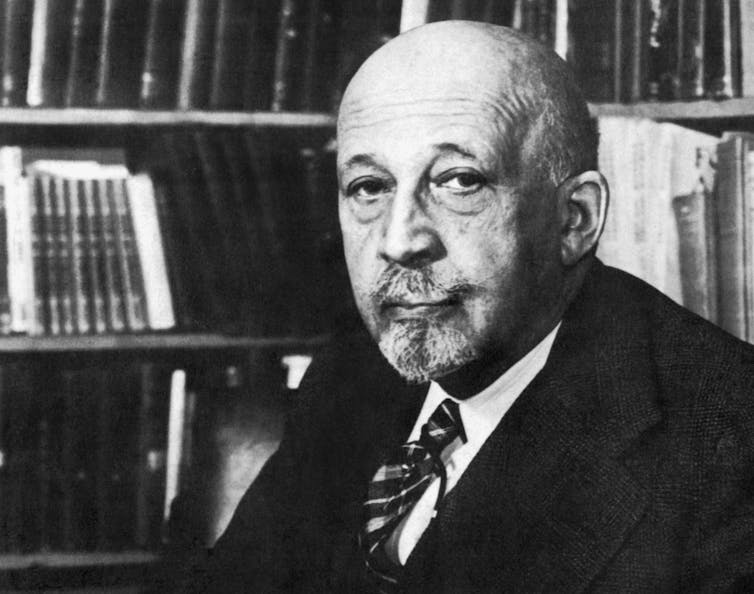
W.E.B. Du Bois, Black History Month and the importance of African American studies
The opening days of Black History Month 2023 have coincided with controversy about the teaching and broader meaning of African American studies.
On Feb. 1, 2023, the College Board released a revised curriculum for its newly developed Advanced Placement African American studies course.
Critics have accused the College Board of caving to political pressure stemming from conservative backlash and the decision of Florida Gov. Ron DeSantis to ban the course from public high schools in Florida because of what he characterized as its radical content and inclusion of topics such as critical race theory, reparations and the Black Lives Matter movement.
On Feb. 11, 1951, an article by the 82-year-old Black scholar-activist W.E.B. Du Bois titled “Negro History Week” appeared in the short-lived New York newspaper The Daily Compass.
As one of the founders of the NAACP in 1909 and the editor of its powerful magazine The Crisis, Du Bois is considered by historians and intellectuals from many academic disciplines as America’s preeminent thinker on race. His thoughts and opinions still carry weight throughout the world.
Du Bois’ words in that 1951 article are especially prescient today, offering a reminder about the importance of Black History Month and what is at stake in current conversations about African American studies.
Du Bois’ connection to and appreciation of Negro History Week grew during the late 1940s and throughout the 1950s. During this time, whether in public speeches or published articles, he never missed an opportunity to acknowledge the importance of Negro History Week.
In the Feb. 11, 1951, article, Du Bois reflected that his own contributions to Negro History Week “lay in my long effort as a historian and sociologist to make America and Negroes themselves aware of the significant facts of Negro history.”
Summarizing his work from his first book, “The Suppression of the African Slave-Trade,” published in 1896, through his magnum opus “Black Reconstruction in America,” published in 1935, Du Bois told readers of the Daily Compass piece that much of his career was spent trying “to correct the distortion of history in regard to Negro enfranchisement.”
By doing so, the nation would hopefully become, Du Bois wrote further, “conscious that this part of our citizenry were normal human beings who had served the nation credibly and were still being deprived of their credit by ignorant and prejudiced historians.”
In addition to championing Negro History Week, Du Bois applauded other Black scholars, like E. Franklin Frazier, Charles Johnson and Shirley Graham, who were “steadily attacking” the omissions and distortions of Black people in school textbooks.
Du Bois went on to chronicle the achievements of African Americans in science, religion, art, literature and the military, making clear that Black people had a history to be proud of.
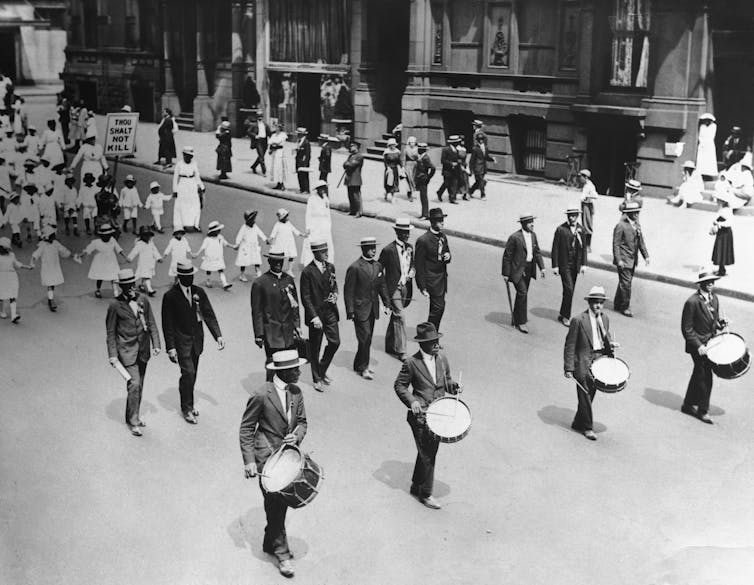
W.E.B. Du Bois, third from right in the second row, joins other marchers in New York protesting against racism on July 28, 1917. George Rinhart/Corbis via Getty Images
Du Bois, however, questioned what deeper meaning these achievements held to the issues facing Black people in the present.
“What now does Negro History Week stand for?” he asked in the 1951 article. “Shall American Negroes continue to learn to be ‘proud’ of themselves, or is there a higher broader aim for their research and study?”
“In other words,” he asserted, “as it becomes more universally known what Negroes contributed to America in the past, more must logically be said and taught concerning the future.”
The time had come, Du Bois believed, for African Americans to stop striving to be merely “the equal of white Americans.”
Black people needed to cease emulating the worst traits of America – flamboyance, individualism, greed and financial success at any cost – and support labor unions, Pan-Africanism and anti-colonial struggle.
He especially encouraged the systematic study of the imperial and economic roots of racism: “Here is a field for Negro History Week.”
Black history and Black struggle
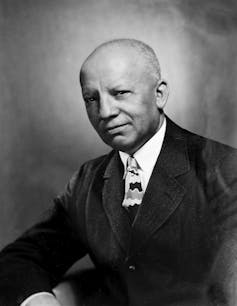
Looking ahead, Du Bois declared that if Negro History Week remained “true to the ideals of Carter Woodson” and followed “the logical development of the Negro Race in America,” it would not confine itself to the study of the past nor “boasting and vainglory over what we have accomplished.”
“It will not mistake wealth as the measure of America, nor big-business and noise as World Domination,” Du Bois wrote in his article.
Instead, Du Bois believed Negro History Week would “concentrate on study of the present,” “not be afraid of radical literature” and, above all else, advocate for peace and voice “eternal opposition against war between the white and colored peoples of the earth.”
Were he alive today, Du Bois would certainly have much to say about current debates around the teaching of African American history and the larger significance of African American studies. Du Bois died on Aug. 27, 1963, in Accra, Ghana.
But he left behind his clairvoyant words that remind us of the connections between African American studies and movements for Black liberation, along with how the teaching of African American history has always challenged racist and exclusionary narratives of the nation’s past.
Du Bois also reminds us that Black History Month is rooted in a legacy of activism and resistance, one that continues in the present.
============================================================== Alecto, Megaera, and Tisiphone, and readers, so far I have only seen the first hour of :”Making Black America,” but I have it bookmarked, and I will see it all before the end of the month. And I never feel bad about recommending “Skip” Gates sight unseen.