Oct 202009
 

The GOP will stop at nothing to disenfranchise American voters who are likely to oppose the GOP’s only success: No Millionaire Left Behind.

Vitter-DC Madam With the start of the 2010 census just a few months away, Senator David Vitter, a Republican of Louisiana, wants to cut off financing for the count unless the survey includes a question asking if the respondent is a United States citizen. Aides say he plans to submit an amendment to the census appropriation bill soon.

As required by law, the Census Bureau gave Congress the exact wording of the survey’s 10 questions in early April 2008 — more than 18 months ago. Changing it now to meet Mr. Vitter’s demand would delay the count, could skew the results and would certainly make it even harder to persuade minorities to participate.

It would also be hugely expensive. The Commerce Department says that redoing the survey would cost hundreds of millions of dollars: to rewrite and reprint hundreds of millions of census forms, to revise instructional and promotional material and to reprogram software and scanners.

2010CensusHand During debates in the Senate, Mr. Vitter said that his aim is to exclude noncitizens from population totals that are used to determine the number of Congressional representatives from each state. He is ignoring the fact that it is a settled matter of law that the Constitution requires the census to count everyone in the country, without regard to citizenship, and that those totals are used to determine the number of representatives.

(The Census Bureau already tracks the number of citizens and noncitizens through a separate survey.)

Adding a new question about citizenship would further ratchet up suspicions that the census is being used to target undocumented immigrants. That would discourage participation not only among people who are here illegally but also their families and friends who may be citizens and legal residents. That leads to an inaccurate count.

And since census numbers are also used to allocate federal aid, undercounting minorities shortchanges the cities and states where they live… [emphasis added]

Inserted from <NY Times>

This goes way beyond the allocation of federal aid, although I grant that depriving the needy is a high priority for the GOP.  But stealing power is a higher priority for them, and the census is the basis for the allocation of seats in the House and of electoral votes.  The Republicans demonized ACORN for the same reason.  They want to disenfranchise minorities who are more likely to vote for Democratic Candidates.

Share
Oct 202009
 

For the record, I do not smoke marijuana.  I used to decades ago, but that’s another article.  Several states have legalized marijuana for medical use, but federal law enforcement overrode state law and arrested medical providers and users.  The problem was especially severe in the eight years of the Bush/GOP regime, but no more.

medipot-states 

The Justice Department’s announcement that the feds will no longer crack down on medical marijuana sellers who follow state laws will surely cheer the liberal/libertarian axis that wants the government to take a more relaxed stance on drug laws. It should also please conservatives who champion states’ rights as the highest political ideal. But unlike most policies with such broad support, it might actually accomplish something.

The new memo, written by Deputy Attorney General David Ogden, urges district attorneys to defer to local marijuana laws rather than federal law, which prohibits all consumption and sales of the drug. The new policy is remarkably uncontroversial. Two-thirds of Americans think marijuana should be legal for medicinal purposes. Obama promised during his campaign to reduce crackdowns on dispensaries; opposition was minimal. Attorney General Eric Holder said in March that the crackdowns would stop and met with little objection. Monday’s memo simply made it official. "This is a very safe policy," says Bruce Mirken of the Marijuana Policy Project. "There’s no constituency for going after sick people."

On the one hand, the decision to defer to state laws means that existing local drug policies—however strict or lax—will remain in place. But on the other, many states take their cues from the federal government when it comes to drug policy. States could take the new policy as a tacit nod from Uncle Sam to go ahead and allow medical marijuana back home…

Inserted from <Slate>

I support this move, and I don’t understand why Republicans are so dead set against it.  Isn’t their opposition coming between patients and their doctors?  I think the GOP’s opposition to interfering with the doctor-patient relationship only applies when they use it as an excuse for some other view.

Share
Oct 192009
 

We cannot turn on the news without being bombarded with a plethora of issues, each critical to solve.  Sometimes in the maze of all these things, we lose track of what it is to be a progressive and where our first responsibility lies.

HomelessShelter The first night after she surrendered her house to foreclosure, Sheri West endured the darkness in her Hyundai sedan. She parked in her old driveway, with her flower-print dresses and hats piled in boxes on the back seat, and three cherished houseplants on the floor. She used her backyard as a restroom.The second night, she stayed with a friend, and so it continued for more than a year: Ms. West — mother of three grown children, grandmother to six and great-grandmother to one — passed months on the couches of friends and relatives, and in the front seat of her car.

But this fall, she exhausted all options. She had once owned and overseen a group home for homeless people. Now, she succumbed to that status herself, checking in to a shelter.

“No one could have told me that in a million years: I’d wake up in a homeless shelter,” she said. “I had a house for homeless people. Now, I’m homeless.”

Growing numbers of Americans who have lost houses to foreclosure are landing in homeless shelters, according to social service groups and a recent report by a coalition of housing advocates.

Only three years ago, foreclosure was rarely a factor in how people became homeless. But among the homeless people that social service agencies have helped over the last year, an average of 10 percent lost homes to foreclosure, according to “Foreclosure to Homelessness 2009,” a survey produced by the National Coalition for the Homeless and six other advocacy groups…

Inserted from <NY Times>

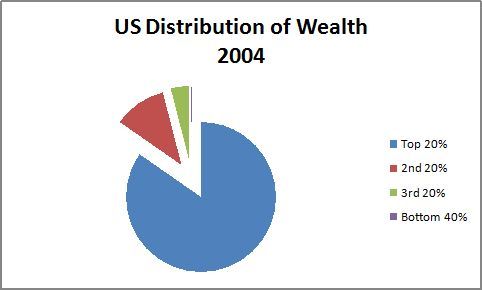
This woman’s tragic tale is one among millions.  The bottom 40% of Americans own 0.2% of the wealth.  The rich enjoy all the benefits of socialism, while the poor are stuck with free enterprise.  Crony capitalism amounts to nothing more than corporate plutocracy (Rule by the very rich through corporate control of government).  The plutocrats tell you that everyone in this country has an equal opportunity to become a success.  They point to examples of fabulously wealthy people from each generation as proof.  But these examples are only very rare exceptions to the rule that the more imbalanced a society’s distribution of wealth becomes, the less opportunity exists for all but the most favored classes.

As progressives, our first responsibility is to undo the inequity in our society so that common people have more opportunity for a better life.  That means meeting people at the point of their need.  At Crooks and Liars I found an excellent video from Bernie Sanders called The Gilded Age.  Here it is.


To view all the videos I have uploaded to YouTube, Click Here.

What are your thoughts on this?

Share

Public Option by Stealth?

 Posted by at 2:03 am  Politics
Oct 192009
 

News from the Senate, where Reid, Baucus, Dodd and Emanuel (representing Obama) are merging the various health care bills, the news remains bleak.

BaucusBill President Obama isn’t demanding that health care legislation include a government-run insurance option even though he believes it would best meet his reform goals, White House advisers said yesterday.

The White House and lawmakers are trying to blend five House and Senate committee versions of health care legislation into a bill that will pass both houses, where near unanimous GOP opposition was expected.

House Democrats are insisting that there be a public option in competition with the private insurance industry to drive down the cost of coverage. In the Senate, Republicans and some Democrats oppose the measure, meaning inclusion of the public option would foreclose winning the 60 votes needed to advance a bill.

Senior adviser Valerie Jarrett said Obama believes the public plan is still the “best possible choice,’’ but she said he’s not demanding it.

White House chief of staff Rahm Emanuel, who is deeply involved with Democrats in trying to merge the various committee proposals, also appeared to set aside the public option.

“It’s not the defining piece of health care. It’s whether we achieve both cost control, coverage, as well as the choice,’’ Emanuel said…

Inserted from <Boston Globe>

Emanuel is blowing smoke.  Without a public option, there will be neither cost containment nor choice.  However, one thing did come to mind that I had not previously considered.  If Obama were to demand a public option right now, the Republican reaction to whip up fear and disseminate disinformation would be so vehement that it would fill the news for several days, so he may be laying low.  He does have a history of that.  In the Illinois legislature he voted “present” on more than one progressive bill at the request of the bill’s sponsors in the hope that moderates would then vote for it.  He may plan to get a bill with no public option passed out of the Senate, have a public option put back in during the conference committee, and bring it back to the Senate for a final vote with the public option included.  Republicans would need 60 votes to remove it at that point.  I’m willing to give him the benefit of the doubt, unless and until he proves me wrong.

One think is clear.  A bill with no public option would be catastrophic for Democrats, as the CBO makes clear.

CBO From the start, the health-reform debate has been about money – who will get the best break and who may have to pay more. That is why the issue of the public option, a less expensive government-run insurance plan, has been so central to both the policy and political debates.

Indeed, if the Democrats abandon the public option for the sake of passing a bill like the one that came out of the Senate Finance Committee, they may be courting electoral disaster once voters grasp that they will have to wait years for the law to be implemented and then that it could lead to higher costs for much the same unpopular private insurance plans.

The public option offers the only means for a reform to be quickly implemented and to demonstrate a beneficial effect for the people by 2010 and 2012. It has the potential for reducing costs, especially for small businesses and individuals who are now being soaked by private insurers or denied coverage.

After assessing the five pieces of legislation that have cleared different committees of Congress, the non-partisan Congressional Budget Office found that the nation would get the most savings on health-care costs from a public option tied to Medicare rates. Such a version, which is included in two of the House bills, would save an estimated $110 billion over 10 years.

A more modest public option in another House bill, which de-links the rates from Medicare and would require negotiations with health-care providers, would save an estimated $25 billion, the CBO says. By contrast, the co-op idea in Sen. Max Baucus’s Finance Committee bill would cost $6 billion to set up and would garner few if any savings.

Since the co-op would offer minimal competition, the health-insurance industry doesn’t object to it but is dead set against the public option. The reason is obvious:  many of those projected savings would come out of the industry’s bottom line… [emphasis added]

Inserted from <Alternet>

The struggle is not over, but to have any chance of success, we need to hound our Senators and Representatives.  You can be sure that Big Insurance and their Republican collaborators have phone banks doing just that.  We need to stand up one person at a time.  To contact your legislators Click Here.

Share
Oct 182009
 

I think more Democrats weed to speak out on this.

asianmap During an interview with CNN’s John King, Sen. John Kerry argued that it would “irresponsible” to commit more troops to Afghanistan at a time when the legitimacy of the Afghanistan government is in doubt. Kerry’s comments came in the context of arguing that Obama shouldn’t be “cornered” into making a hasty decision:

It would be entirely irresponsible for the president of the United States to commit more troops to this country, when we don’t even have an election finished and know who the president is and what kind of government we’re working in with.

When our own commanding general tells us that a critical component of achieving our mission here is, in fact, good governance, and we’re living with a government that we know has to change and provide it, how could the president responsibly say, “Oh, they asked for more, sure — here they are”?

Watch it:

… [emphasis original]

Inserted from <Think Progress>

I agree with Kerry’s key contention.  Although the conflict in Afghanistan is still so small that it does not compare to Vietnam, we need to avoid making a similar mistake.  In Vietnam, we supported a series of virtual dictators, beginning with Diem instead of supporting populist leaders.  Karzai, a Unocal employee, was installed by the Bush/GOP regime.  The corruption that pervaded the recent election demonstrates that supporting him will only turn Afghanis more against us.

Share
Oct 182009
 

The rumblings from the Senate are not good.  It appears that the Nevada Leg Hound, Harry Reid has chosen to ignore the will of 65% of Americans and hump the GOP leg instead.

Dino Surprise!

Democratic aides say that Senate leaders working with the White House to meld the two bills are inclined to leave the public option out and to let supporters propose amendments to add it during floor debate.

Before I go any further, no, that’s not actually the main thrust of the article. And the main thrust is really interesting and you should go read it. But it’s an important part for my purposes today — the discussion of how procedure will effect the substantive outcome of this bill.

For those of you who don’t recognize this set up, it’s a familiar play. The bill comes to the floor with some particular deficiency, and the "deal" is that opponents are to be allowed a vote on an amendment that would correct it. But the catch is that the unanimous consent agreement under which the bill comes to the floor and the terms for debate are set requires a 60 vote threshold to pass that amendment.

Why would anybody agree to such an arrangement? It’s meant as a mechanism for bypassing the trouble and delay caused by a threatened filibuster, whether of the bill as a whole or of that particular amendment. Rather than go through the actual annoyance and time-wasting involved in a real filibuster, the leadership chooses to recognize the validity of the threat, and instead of dealing with the annoyance of filing for cloture and waiting a real filibuster out, the parties instead agree that they’ll require for passage of the bill or amendment the same 60 votes that would have been necessary for cloture.

This has the advantage of saving everyone some time and trouble without really requiring any more votes to pass the measure than would otherwise have been necessary. But it also has the effect of shielding those who claim they would filibuster from having to stand up and go on record as opposing cloture, not to mention actually conducting the filibuster — though that, too, has certainly become easier to do these days. That’s why I call this the "painless filibuster."… [emphasis added]

Inserted from <Daily Kos>

This article goes on to explain the painless filibuster in more depth.  It’s worth the read.

I explained here that putting the public option in the bill would require the Republicans to get 60 votes to remove it, something they cannot do.  Leaving it out of the bill requires the Democrats to get 60 votes to put it in.  Reid is taking the power the voters gave the Democratic Party in November and handing it to the Republicans.  Why on earth would he do that?  The answer seems clear to me.  He’s protecting DINO Democrats like BARF Baucus, enabling them to earn their 30 coins of silver from Big Insurance.  If this article is correct, these DINOs will ne able to join the GOP in filibustering just the public option, saving them from having to chose whether to filibuster the entire health care bill to earn their blood stained campaign contributions.

Share

Oregon Congressman Frustrated

 Posted by at 2:19 am  Politics
Oct 182009
 

Before I moved a little over three years ago, Earl used to be my Representative.  He’s a bit odd in his mannerisms, but he’s an authentic progressive who reflects the way a lot of us feel.

Earl Blumenauer Representative Earl Blumenauer should be experiencing the most fulfilling days of his more than 35 years in public service.

The liberal Democrat from Portland, Ore. — known for his bowties, his Trek bicycle and a pragmatic brand of progressivism — embraced Barack Obama’s presidential candidacy early in 2008 and campaigned hard alongside him, steadily gaining confidence that the young senator from Illinois was the ideal liberal remedy to eight years of conservative dominance.

Now political reality has set in, testing Mr. Blumenauer’s faith that Mr. Obama’s election and big Democratic majorities in Congress would yield quick advances in the progressive agenda.

Instead of forging ahead, Mr. Blumenauer, 61, finds himself fighting to retain one of the touchstones for liberals this year, a public insurance option in the health care overhaul, and is watching his hopes of curbing global warming grow cold in the Senate. Mr. Blumenauer, a seven-term congressman, is bracing for a tough vote on sending more troops to Afghanistan while he frets about the detention facility at Guantánamo Bay remaining open.

“It has been a hard landing for a lot of the people that I represent,” Mr. Blumenauer, referring to his largely liberal constituency, said as he assessed the first months of the Obama administration.

As health care legislation moves to the floor with other major issues close behind, the question for Mr. Blumenauer and those who share his ideology will be whether they relent on some of their core beliefs to support less satisfying compromises, despite being in what, on the surface, is a commanding political position.

“It is still something that I am struggling with,” he said.

Mr. Blumenauer is just one example of what might be called the Frustrated Left, a substantial caucus of Congressional Democrats who dreamed that Mr. Obama would usher in a new era of liberal problem-solving only to see Congress and the new administration collide with the old problems of partisanship, internal disagreement and the challenge of mustering 60 votes to get just about anything done in the Senate… [emphasis added]

Inserted from <NY Times>

The rest of this article is worth reading, because it describes the conflict he feels between sticking with what he knows is right and settling for less for fear he will get nothing.  Personally, I have decided that I would rather see no health care reform at all than delivering millions of mandated customers into the greedy claws of the virtually unregulated insurance industry.

Share
Oct 172009
 

Something is rotten in the state of America, and Obama needs to fix it.  Mark commented here that, when the subject turns to finance, people’s eyes roll back and their brains go dead.  I’m asking you to spend around fifteen minutes reading this and watching two videos.  You will come away with a much better understanding.  If you at all like me, you will come away angry.

Even as the economy continues to struggle, much of Wall Street is minting money — and looking forward again to hefty bonuses.
Many Americans wonder how this can possibly be. How can some banks be prospering so soon after a financial collapse, even as legions of people worry about losing their jobs and their homes?
It may come as a surprise that one of the most powerful forces driving the resurgence on Wall Street is not the banks but Washington. Many of the steps that policy makers took last year to stabilize the financial system — reducing interest rates to near zero, bolstering big banks with taxpayer money, guaranteeing billions of dollars of financial institutions’ debts — helped set the stage for this new era of Wall Street wealth.
Titans like Goldman Sachs and JPMorgan Chase are making fortunes in hot areas like trading stocks and bonds, rather than in the ho-hum business of lending people money. They also are profiting by taking risks that weaker rivals are unable or unwilling to shoulder — a benefit of less competition after the failure of some investment firms last year… [emphasis added]

Inserted from <NY Times>
How could this be?  Didn’t Congress pass TARP for the government to purchase toxic assets and thereby allow banks to lend money?  Dylan Rattigan explains how we got from there to here in terms even a child could understand.

Rachel Maddow and Elliot Spitzer also take on the same issue.

Barack Obama needs to become part of the solution here, but sorry as I am to admit it, he has become part of the problem, through his choice in appointments.  As long as Goldman Sachs owns the US Department of the Treasury, our economy will continue to socialize risk and privatize gain.  As I always put it, only the poor have to put up with free enterprise.  Only the rich get the benefits of socialism.
Has this helped you understand?
Are you angry?

Share