Yesterday, I got to visit with Virgil and we got to play cards – there was a brand new deck. It kind of made me chuckle – because it included, besides the 52 cards and 2 jokers, a 55th card with tips on authenticating the cards. (You can look it up if you’re cutious; it’s Motor Brand #976.) But they were brand new and sturdy, which helped in shuffling. The drive was fine both ways. On the way down, I could see that it was the northbound lanes where the bridge was missing, and on the way back up I could see that they had done a quick-and-dirty paving and paint job which made it driveable just fine. Since Interstates are a part of the Federal Highway system, I should probably drop a thank-you note to Pete Buttigieg. Just now I’m pretty tired, but I may feel better later. I also noted that the missing bridge (at mile marker 107) is between two exits (104 and 108) both of which can take one to the Pueblo West neighborhood – that would be a heck of a lot shorter detour than going through Cañon City if it comes to that. Also, Virgil returns all greetings.
Cartoon –
Short Takes –
SPLC – SPLC SUES LOUISIANA CITY ON BEHALF OF NAACP, CHALLENGING UNFAIR VOTING MAP
Quote – In Abbeville, as elsewhere, the makeup of voting maps can have a very tangible impact on the lives of voters. Local officials determine everything from whether a street is paved to how far someone has to travel to visit a park or playground – and how well maintained those public works might be. “There’s a complete difference or two different worlds in the city of Abbeville,” said Linda Cockrell, president of the Vermilion Parish NAACP chapter in Abbeville. “I was told that in the higher-up neighborhoods, city workers are in these neighborhoods at 3 or 4 o’clock in the morning washing down the roads, removing trash, and everything else.” Click through for details.The smaller the city, and the farther away from actual big cities it is, the truer that probably is too.
Civil Discourse – The Week Ahead
Quote – The most important pending question in Georgia is, when does the next trial get set, and will it include all of the remaining defendants? A September 14 scheduling order sheds a little light on that matter. It applies to all defendants other than Powell and Chesebro and orders the parties to complete initial discovery by October 6. We are well past that deadline. The Judge also gave the parties until December 1, just a bit more than a month away, to file all motions other than motions in limine. That means substantive motions…. The September order doesn’t set a hearing date for any of those motions. Presumably the Judge will set them once the motions are in…. Fani Willis could leave it up to the Judge to rule, but look for her to file a motion this week asking him to set that date. Remember, Willis was willing to try all of the defendants October 3. She’s ready to go. Click through for what to expect. Since Both Ken andd Sidney have accepted plea deals, the trial supposed to start today will look different from the one we initially expected.
Glenn has skipped two days in a row (which is partly why I am so late.) I am plugging in this movie, which they showed to high school kids in 1948! would they allow it today? It’s a bit over 7 minutes but there’s a lot in it.
The Lincoln Project – Joe Biden in Israel
Farron Balanced – Viewers Demand Farron Give An Update On His Pets
Patrick Fitzgerald – Royals (Kevin McCarthy / Puddles Pity Party / Postmodern Jukebox / Lorde Song Parody)
Senior Chihuahua Turns Into A Puppy Once He Finds The Perfect Family
Experts in autocracies have pointed out that it is, unfortunately, easy to slip into normalizing the tyrant, hence it is important to hang on to outrage. These incidents which seem to call for the efforts of the Greek Furies (Erinyes) to come and deal with them will, I hope, help with that. As a reminder, though no one really knows how many there were supposed to be, the three names we have are Alecto, Megaera, and Tisiphone. These roughly translate as “unceasing,” “grudging,” and “vengeful destruction.”
Having spent a lifetime (or most of one – I didn’t write to any legislators before I could write) at a minimum caring about how my nation was governed, and by whom, and how it should be governed, and expressinh those opinions I cared about, I am well aware that there are many different ways to do so, and that some are more effective than others. Petitions, for instance, can be more effective than individual letters since they represent so many people – provided, that is, that they are addressed to the appropriate person or persons to deal with the issue, and that they do in fact comprise consyituents of that person(s). It also helps if they do not contain any inaccuracies. But writing a personal letter to an individual who is in public office, or a candidate for such office, whether elected or appointed – that is a different matter altogether. It’s also much more difficult. Pitfalls are everywhere. Of course you want to send your communication to the appropriate person (To use an absurd example, you would not want to direct a letter regarding Medicare/Medicais to the Scretary of Transportation, not to the head of the Joint Chiefs of Staff. Thay is not in their purview.) But then you run up against spelling, grammar, making logical arguments, and of course avoideing any errors of fact. And, especially on a topic on which “alternate facts” are bouncing all over the internet and the media, it can become important to cite your sources, as the author here points out – and shows you how.
==============================================================
Contacting your legislator? Cite your sources – if you want them to listen to you
Suppose you have an issue you are really passionate about – taxes, gun control or some other important policy. You want to do more than vent on social media, so you decide to write an email, place a phone call or even draft a letter to your state legislator expressing your views.
As a citizen, I would praise your sense of civic responsibility and willingness to express your opinion. As a scholar, I would encourage your efforts – they’re more consequential than many people realize.
I teach communication and public policy at Michigan State University and study how constitutents’ communication with lawmakers affects public policy decisions.
In my previous research, I analyzed – with their permission – the efforts of coalitions working to get citizens to contact their lawmakers in support of major legislation in New Hampshire and Michigan. I conducted a rigorous evaluation of the types of contact constituents made, the messages they conveyed and the behavior of lawmakers both before and after receiving those communications.
The results showed that communications from constituents can have a large impact on how legislators vote. For example, emails from constituents encouraging policymakers to support smoke-free workplace bills in New Hampshire increased state legislators’ support on critical votes by an estimated 20 percentage points – a substantial effect.
In today’s polarized political environment, is it possible to get through to policymakers from the other side?
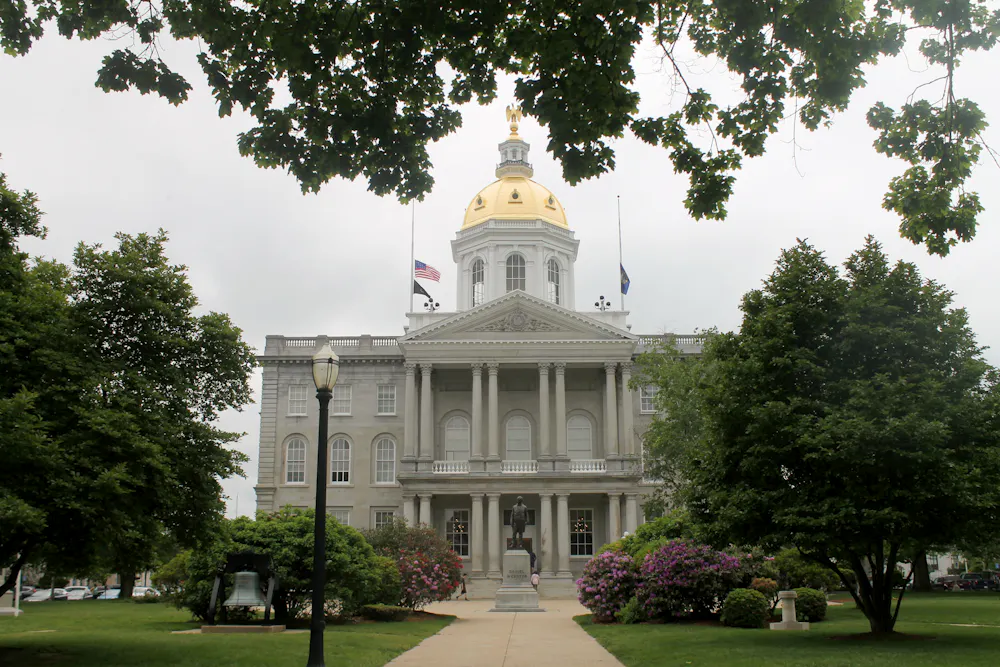
It is possible to get through to legislators who disagree with you. Here, the New Hampshire Statehouse. AP Photo/Holly Ramer, File
Discounting opposing views
Some work, including my own mentioned above, suggests that policymakers are responsive to communications from the public. But research has also shown that policymakers engage in what’s called biased reasoning, writing off communications from constituents who do not share their policy views.
For instance, political scientists Daniel Butler and Adam Dynes asked state and local policymakers in two online surveys to evaluate a hypothetical communication from a constituent. Policymakers were randomly assigned to evaluate a letter that either supported or opposed a controversial policy and then rated the hypothetical writer letter on various characteristics.
The authors found that policymakers rated hypothetical constituents who disagreed with them as less knowledgeable about the topic. This discounting of constituents who disagree on policy could explain why policymakers tend to have biasedperceptions of public opinion, believing the public’s attitudes to be more in line with their own positions than polling suggests.
Is there a way to prevent lawmakers from writing off constituents’ perspectives?
Do your research
In recent work with political communication scholars Hillary Shulman and Dustin Carnahan, I sought to develop strategies to limit policymakers’ discounting of constituents’ opinions.
We asked a national sample of elected local policymakers – among them city council members – to evaluate a hypothetical email writer randomly assigned to express support or opposition to raising the minimum wage. The survey was fielded by Civic Pulse, which specializes in samples of elected officials.
This study was similar to the Butler and Dynes study described above. But we added two randomly assigned conditions – what we called a “read” condition in which the writer expressed having “read a lot about” the topic, without any specific detail, or a “cite” condition in which the writer summarized and cited a study supporting their position.
We anticipated, based on research on biased reasoning, that providing clear evidence that the constituent is knowledgeable about the issue would prevent biased discounting of constituent opinion.
Policymakers in our study were asked to evaluate to what extent they thought that the constituent understood the issue, was representative of the community, and was sincere and held their position strongly, and whether they thought the communication was a form letter rather than a constituent-intitiated communication – and therefore presumably more likely to be written off.
How to not be written off
The results confirmed previous findings that policymakers indeed discount the opinions of constituents with whom they disagree. When policymakers read an email expressing an opinion that differed from their own on raising the minimum wage, the email writer was rated lower across all five dimensions.
However, if the email writer provided evidence that they knew about the issue – citing research supporting their position – policymakers were more likely to perceive that the email writer understood the issue. The effects of citing evidence are stronger than simply stating that one has read about the issue.
My own work suggests that a constituent expressing an opinion to an elected official can influence the official’s vote on the issue. But just writing to an official is no guarantee that the constituent will persuade the official or have the issue resolved in the way they prefer.
Our study is important in identifying a way constituents can avoid being written off.
We also found that there are no downsides to providing evidence supporting one’s position.
You might expect that when provided with unambiguous evidence that a disagreeing constituent understands the issue, policymakers might direct their efforts to discounting other constituent characteristics, rating the constituent as less sincere or less representative of the community.
We did not find any evidence that this happened. When faced with evidence that their constituent knows the issue well, policymakers are less likely to discount their opinions.
The practical results are clear: When communicating with a policymaker, especially one with whom you disagree, you want to stop them from discounting your opinion. One way to do this is by citing quality evidence to support your position.
While this advice seems straightforward, it did not appear in guides we surveyed created by citizen groups like the Sierra Club, ACLU or Christian Coalition.
When contacting a policymaker about an issue, be aware that they may discount your opinion if they disagree.
But note also that carefully crafted communications can convey your position without being written off – and could improve how accurately the policymaker understands public attitudes about public policies.
============================================================== Alecto, Megaera, and Tisiphone, if we could all live in districts which elect legislators of our own party, it might not be so important to learn the techniques the author offers – techniques of basic rhetoric, oral or written (and that’s not a bad thing.) I’m sure we’ve all heard and/or seen the expression “the facts speak for themselves.” And facts often do. But not always in a language that everyone can understand, or even hear. That’s pretty clear from the beliefs so many Americans hold about politics and government. Anything we can do to move the conversation in the direction of truth is not only a good thing, but a necessary thing.
Yesterday, the radio opera was “Attila,” by Giuseppe Verdi – it’s a very early opera. The libretto was based on a play, which was pretty well made up out of whole cloth. Attila lived in the 5th century BCE and flourished from the mid 430s to the early 450s, so nobody has a clue what his life was really like (no one could possibly have done everything attributed to him in one lifetime. In the Volsunga saga [under the name of “Atli”], for instance, he becomes the second husband of Siegfried’s second wife – yes, that Siegfried – the tenor in Wagner’s Ring cycle.). It’s a mish-mash of stock drama, someone believed dead who isn’t, accusations of betrayal aimed at the woman who just wants to kill the enemy, grand gestures and the like. The only distinctive plot twist is Attila’s dream that an old man tells him to leave Rome alone or he is doomed, and then when he gets to Rome, Pope Leo turns out to be the old man in his dream, which of course scares the bejeebus out of him. The aforementioned woman ends up getting to kill him. It’s all very patriotic in the context of Italy in the 19th century under the Austrian Empire, and audiences loved it, but it’s seldom performed today. But that doesn’t mean you can’t find recordings of it, including three with Samuel Ramey (The powerhouse bass starting in the 80’s who was able to get it performed because he had such star clout.) And hey, it’s Verdi. If he ever wrote anything that wasn’t worth a listen, it’s news to me. This production, from the Opera Festival of Chicago, seems to fluctuate between the 4th and the 21st centuries visually, but it inspired 372 photos, including the curtain calls. It took me a while to get through them – but I did end up with a pretty clear mental picture of the action. Well, enjoy the spooky stuff (and humor) in the short takes. Now, I’m off to visit Virgil – amazingly with no detours – but I might still be later than usual getting back. I will post when I am.
Cartoon – 22 dEs
Short Takes –
The Root – Here Are The Boogie Men (And Women) Of Black History
Quote – Halloween is right around the corner. And while the traditional goblins, ghouls, and monsters are plenty scary, this spooky season, we’re introducing you to some real horror. Meet the boogie men of Black history, a.k.a the men (and women) whose policies and actions have haunted Black Americans throughout time. And yes, Ronald Reagan is on there! Click through for full list and reasons. Sadly, Nathan Bedford Forrest is not on there. I find him creepier than anyone.
Wonkette (on Substack) – Make Me, Shub-Niggurath, Your House Speaker, Or Be Cast Into Death Beyond Death, Mortals.
Quote – LAUGH NOT, MORTAL! DO YOU HAVE A BETTER AND LESS-FATAL-TO-YOU IDEA? I THOUGHT NOT. ESTEEMED MEMBERS OF THE REPUBLICAN HOUSE CAUCUS, I UNDERSTAND I’M A FRESHMAN, AND THAT I ONLY OCCUPY THIS SEAT BECAUSE I CAST ITS DULY ELECTED REPRESENTATIVE INTO THE GAPING MAW OF MY OFFSPRING ITHAQUA THE WIND-WALKER TO SPEND AN ETERNITY DROWNING IN HIS BLACK ICHOR. SO YOU FEEL YOU DO NOT KNOW ME WELL ENOUGH TO ELECT ME TO SUCH AN IMPORTANT POSITION. AND ALSO YOU ARE COWERING IN TERROR. YOU ARE RIGHT TO COWER! FOR I AM SHUB-NIGGURATH, THE BLACK GOAT OF THE WOODS WITH A THOUSAND YOUNG, AND I HAVE ENOUGH TENTACLES TO SQUEEZE THE LIFE OF ALL 220 OF YOU OUT OF YOUR CORPOREAL BODIES AT THE SAME TIME. SORRY, I MEANT 219, SINCE ITHAQUA ATE WHATSHISNAME. Click through for what I hope is H.P. Lovecraft inspired (I’d hate to think he thought of this all by himself) satire. I don’t think Shub-Niggurath is intending to shout – it’s just that the Elder Gods pre-date lower-case letters by millennia so she doesn’t know how to use them. I could be wrong. I do understand the urge to shout at Republicans.
Yesterday, Lona put up a comment on the video thread for the 18th which included a video she hopes everyone hare will look at and read. I can’t link directly to the comment, as I used to be able to do in the old system, but I can link to the thread, so that you only need to scroll down and expand the comment. Between this and the short takes – I’m sorry I had to put up such a downer on a weekend. But it’s important – and it’s important to address this stuff right away before too many people get sucked in to the information silo.
Cartoon – 21 Nelson
Short Takes –
Protect Democracy – Poland just showed the world how democracy wins
Quote – At a gathering of pro-democracy organizations in 2017, a Polish opposition member of parliament named Agnieszka Pomaska was asked: “What’s your number one piece of advice for democracy advocates in the United States?” Poland has been at the front lines between democracy and authoritarianism, between freedom and repression — not just in the current era, but arguably throughout modern history. Pomaska’s response was simple: “Don’t let the pro-democracy coalition fracture.” On Sunday, Polish voters showed the world just how effective that strategy can be. Click through for details. Look, I would never say that, for instance, Hamas would never attack Israel or anything else Jewish for no reason at all. Nor would I ever say that Bibi’s government is desirable, or anything otjher than authoritarian and inhumane. But the timing of this war in the Midddle East looks to me designed to fracture the coalition. Just as attacks on Hillary, mostly made up and even the small errors far less important than Republican crime, were designed to fracture the coalition – and they succeeded. And, yes, there are people who are willing to kill for political theater if it strengthens their position or their base.
The 19th – What it takes to defend diversity
Quote – Just three years after the racial reckoning that made much of society examine the ongoing legacy and harm of systemic inequality, a parallel reckoning has also unfolded. It’s one driven by a sense of grievance from White American men, a movement that often co-opts women and even people of color, making them out to be victims of current efforts that are designed to right historic wrongs. Such efforts, Abrams told me, are part of a larger strategy to roll back attempts to make our country more free and fair for women and people of color. It’s the same playbook that dismantled voting and abortion rights, aimed at rolling back racial progress in institutions across the country. “The through line is that our progress as a nation, our economic uplift, our continued dominance, is predicated on full participation, and diversity, equity and inclusion is the roadmap to get us there,” Abrams said. “The threat of lawsuits, the threat of public castigation, the threat of being called out for doing right, is compelling some to retrench. That is dangerous.” Click through for article. We’ve seen this before. We’re seeing it again. And then things will get better for a while, and then we’ll see it again – those of us who are still around. I don’t know what it will take to make it go away forever, and maybe that’s not possible. I’m pretty sure it’s not possible to eliminate misogyny. It doesn’t appear to be hereditary (Exhibits A, B, and C Stephen Miller, Paul Gosar, RFK Jr), so selective breeding wouldn’t do it, even if that were feasible.