Yesterday, I pushed myself to take out some trash and recyclables. It was definitely time, and I’m glad it’s done, but it is tiring. So afterwards, I relaxed a little, by knitting a little and gaming a little.
Mediaite – Biden Gets His Best Polling News of 2022 From … Fox News?
Quote – FiveThirtyEight, which tracks the reliability of various pollsters, gives Fox News an A rating — making it one of the most credible in the field, according to the Nate Silver-founded site. So this number could be a sign that the tide is turning for the president. Still, the Fox News poll was not all sunshine and rainbows for the Biden team. The survey found that 60 percent of registered voters would pick “someone else,” if the election were held today. Click through. Inexplicable – but I’ll take it. Some good news is better than no good news.
The Guardian – Michael Flynn allies allegedly plotted to lean on Republicans to back vote audits
Quote – Stern, who runs the intelligence firm Tactical Rabbit and is a Republican vying for a Senate seat in Pennsylvania, in multiple interviews with the Guardian said two Flynn associates with the rightwing Patriot Caucus group enlisted his help in April in a scheme to seek potentially damaging information on two Republican members of Congress to prod them to back an audit of the 2020 vote that Joe Biden won. Click through for details. It’s not a bad bet that there is some dirt yo be gotten on a Republican – but, seriously, “Tactical Rabbit”? How could anyone trust intelligence which came out of a rabbit hole?
Experts in autocracies have pointed out that it is, unfortunately, easy to slip into normalizing the tyrant, hence it is important to hang on to outrage. These incidents which seem to call for the efforts of the Greek Furies (Erinyes) to come and deal with them will, I hope, help with that. As a reminder, though no one really knows how many there were supposed to be, the three names we have are Alecto, Megaera, and Tisiphone. These roughly translate as “unceasing,” “grudging,” and “vengeful destruction.”
Let’s face it – we have already gone so far with our abuse of resources that zero emissions is not going to be enough. We are going to need negative emissions if we are ever again going to have a planet capable of living on in even relative comfort. There are people working on ways to go about achiening that. This is the story of one possible method – direct air capture.
================================================================
Why we can’t reverse climate change with ‘negative emissions’ technologies
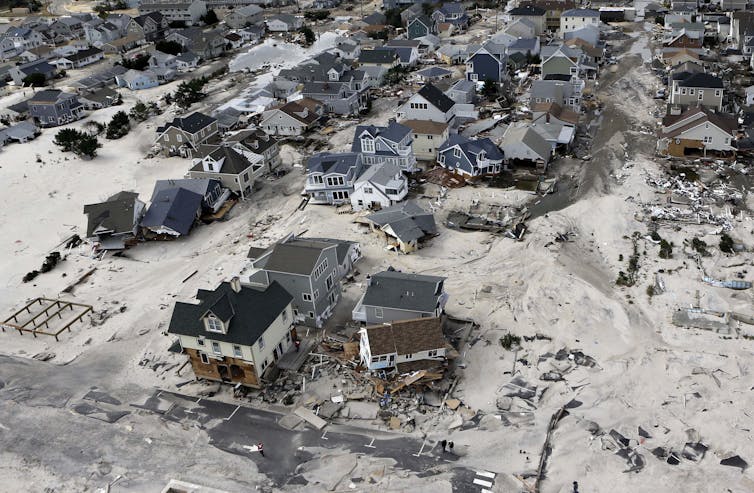
Without rapid and dramatic changes, the world will face a higher risk of extreme weather and other effects of climate change. AP Photo/Mike Groll
Featured prominently in the report is a discussion of a range of techniques for removing carbon dioxide from the air, called Carbon Dioxide Removal (CDR) technologies or negative emissions technologies (NETs). The IPCC said the world would need to rely significantly on these techniques to avoid increasing Earth’s temperatures above 1.5 degrees Celsius, or 2.7 degrees Fahrenheit, compared to pre-industrial levels.
Given that the level of greenhouse gases continues to rise and the world’s efforts at lowering emissions are falling way short of targets climate scientists recommend, what contribution we can expect from NETs is becoming a critical question. Can they actually work at a big enough scale?
What are negative emissions technologies?
There is a wide range of opinion on how big an impact these techniques can have in addressing climate change. I became involved in the debate because two of the most prominent negative emissions technologies involve CO2 capture and storage (CCS), a technology that I have been researching for almost 30 years.
Many NETs remove the CO2 from the atmosphere biologically through photosynthesis – the simplest example being afforestation, or planting more trees. Depending on the specific technique, the carbon removed from the atmosphere may end up in soils, vegetation, the ocean, deep geological formations, or even in rocks.
NETs vary on their cost, scale (how many tons they can potentially remove from the atmosphere), technological readiness, environmental impacts and effectiveness. Afforestation/reforestation is the only NET to have been deployed commercially though others have been tested at smaller scales. For example, there are a number of efforts to produce biochar, a charcoal made with plant matter that has a net negative carbon balance.
A recent academic paper discusses the “costs, potentials, and side-effects” of the various NETs. Afforestation/reforestation is one of the least expensive options, with a cost on the order of tens of dollars per ton of CO2, but the scope for carbon removal is small compared to other NETs.
On the other extreme is direct air capture, which covers a range of engineered systems meant to remove CO2 from the air. The costs of direct air capture, which has been tested at small scales, are on the order of hundreds of dollars or more per ton of CO2, but is on the high end in terms of the potential amount of CO2 that can be removed.
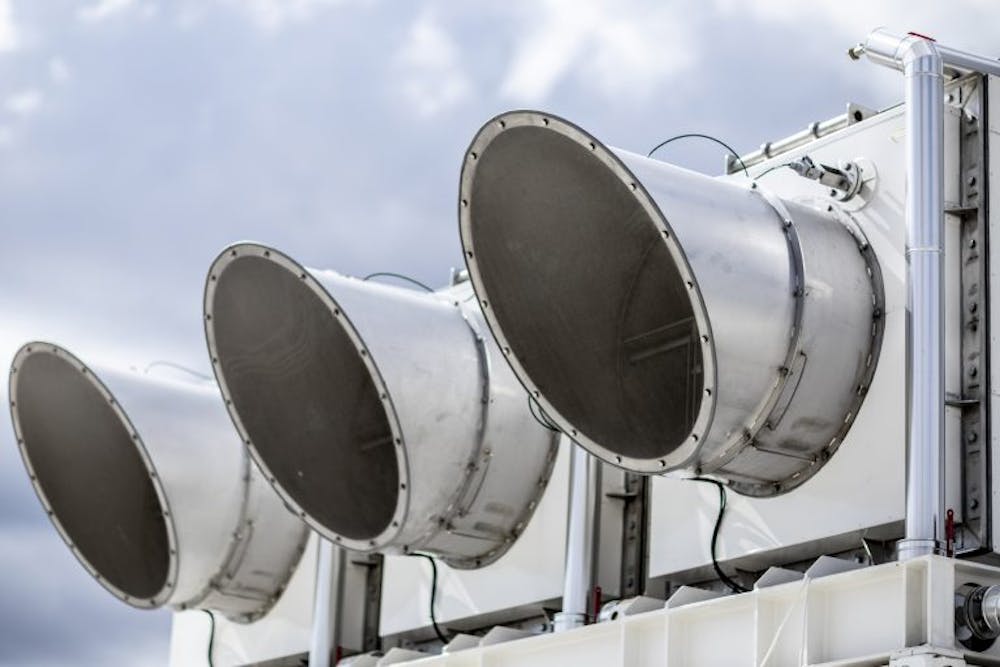
A handful of commercial companies are testing direct air capture technology,, which takes carbon dioxide out of the air. This project in Italy will use the CO2 to ultimately produce natural gas to power vehicles. Climeworks
In a 2014 IPCC report, a technology called bio-energy with carbon capture and storage (BECCS) received the most attention. This entails burning plant matter, or biomass, for energy and then collecting the CO2 emissions and pumping the gases underground. Its cost is high, but not excessive, in the range of US$100-200 per ton of CO2 removed.
The biggest constraint on the size of its deployment relates to the availability of “low-carbon” biomass. There are carbon emissions associated with the growing, harvesting, and transporting of biomass, as well as potential carbon emissions due to land-use changes – for example, if forests are cut down in favor of other forms of biomass. These emissions must all be kept to a minimum for biomass to be “low-carbon” and for the overall scheme to result in negative emissions. Potential “low-carbon” biomass includes switchgrass or loblolly pine, as opposed to say corn, which is currently turned into liquid fuels and acknowledged to have a high carbon footprint.
A 2017 study at the University of Michigan did a literature review of NETs. One the one hand, they showed that the literature was very bullish on NETs. It concluded these techniques could capture the equivalent of 37 gigatons (billion tons) of CO2 per year at a cost of below $70 per metric ton. For comparison, the world currently emits about 38 gigatons of CO2 a year.
However, I think this result should be taken with a large grain of salt, as they rated only one NET as established (afforestation/reforestation), three others as demonstrated (BECCS, biochar and modified agricultural practices), and the rest as speculative. In other words, these technologies have potential, but they have yet to be proven effective.
Other studies have a much harsher view of NETs. A study in Nature Climate Change from 2015 states, “There is no NET (or combination of NETs) currently available that could be implemented to meet the <2°C target without significant impact on either land, energy, water, nutrient, albedo or cost, and so ‘plan A’ must be to immediately and aggressively reduce GHG emissions.” In another study from 2016, researchers Kevin Anderson and Glen Peters concluded “Negative-emission technologies are not an insurance policy, but rather an unjust and high-stakes gamble. There is a real risk they will be unable to deliver on the scale of their promise.”
The bottom line is that NETs must be shown to work on a gigaton scale, at an affordable cost, and without serious environmental impacts. That has not happened yet. As seen from above, there is a wide range of opinion on whether this will ever happen.
Safety net?
A critical question is what role NETs can play, both from a policy and economic point of view, as we struggle to stabilize the mean global temperature at an acceptable level.
One potential role for NETs is as an offset. This means that the amount of CO2 removed from the atmosphere generates credits that offset emissions elsewhere. Using negative emissions this way can be a powerful policy or economic lever.
For example, with airline travel the best approach to net zero emissions may be to let that industry to continue to emit CO2, but offset those emissions using credits from NETs. Essentially those negative emissions are a way to compensate for the emissions from flying, which is expected to rely on fossil fuels for many years.
About 25 percent of our current carbon emissions can be classified as hard to mitigate. This offset model makes economic sense when the cost of negative emissions is less than the cost to cut emissions from the source itself. So if we can produce negative emissions from say BECCS at about $150 per ton of CO2, they can economically be used to offset emissions from aircraft that would cost several hundred dollars per ton CO2 to mitigate by changing how planes are fueled.
The economics of using NETs to correct an “overshoot” are very different.
We as a society seem unwilling to undertake sufficient efforts to reduce carbon emissions today at costs of tens of dollars per ton CO2 in order to keep enough CO2 out of the atmosphere to meet stabilization targets of 1.5 or 2 degrees Celsius. However, correcting an “overshoot” means we expect future generations to clean up our mess by removing CO2 from the atmosphere at costs of hundreds of dollars or more per ton CO2, which is what the future deployment of NETs may cost.
This makes no sense, economic or otherwise. If we are unwilling to use the relatively cheap mitigation technologies to lower carbon emissions available today, such as improved efficiency, increased renewables, or switching from coal to natural gas, what makes anyone think that future generations will use NETs, which are much, much more expensive?
That’s why I see the role of NETs as an offset being very sound, with some deployment already happening today and increased deployment expected in the future. By contrast, treating NETs as a way to compensate for breaking the carbon budget and overshooting stabilization targets is more hope than reality. The technical, economic and environmental barriers of NETs are very real. In formulating climate policy, I believe we cannot count on the future use of NETs to compensate for our failure to do enough mitigation today.
================================================================ Alecto, Megaera, and Tisiphone, in the Open Thread, I posted a story about IKEA buying land for afforestation. That’s a good thing. But forests alone are not going to do the trick. Neither will direct air capture alone do the trick. Even if the technology were advanced enough to handle the amount of carbon removal which is needed, you can’t get fruit, or nuts, or wood, or habitat for endangered species, from direct air capture. There are other negative emissions technologies being tested or developed, but, at this point, nothing works well enough to actually achieve enough benefit to save the world. Direct ait capture seems to be the most promising – but we are not where we need to be on it either. And ALL possible technologies should be investigated and considered.
Yesterday, the radio opera was “La Bohème,” quite possibly the most popular opera ever composed. Of course, that comes with disadvantages – an opera lover of my age has probably heard/seen it over a hundred times (particularly since it was the first opera I ever owned a complete recording of … 55 years ago.) But it still charms. Almost every line and every note tug at the heartstrings, because every character is sympathetic in one way or another, and every character has at least one moment in which you see (and/or hear) their pain. And, after that, I put away my grocery delivery. What a comedoen!
Cartoon –
Short Takes –
Robert Reich – The curse of financial entrepreneurship
Quote – A direct line runs from public anger over the bailout of Wall Street to the Occupy movement and the candidacy of Bernie Sanders, on the left; and to the Tea Party movement and the election of Donald Trump, on the right…. [I]n early 2016 in Michigan, Wisconsin, North Carolina, Ohio, and Iowa… I heard references to the bailout of Wall Street as proof that the economy was “rigged” against ordinary Americans, and that America needed a president who would champion average working people. Click through for more, including the podcast, if you would rather listen than read. If he mentions that part of the problem is that product entrepreneurs, when successful, become paper entrepreneurs, I missed it.
Good News Network – IKEA Buys Land Damaged by Hurricane in Florida to Plant Forests
Quote – If Ingka can keep the forests healthy and alive, in 40 years they will pull carbon out of the air equal to a certain percentage of the carbon placed into the atmosphere by IKEA’s operations, while providing valuable habitat to vulnerable species like the red-cockaded woodpecker, gopher tortoise, pine snakes, and dusky gopher frogs. Click through for details and a couple of other tidbits (if you read between the paragraphs). I grant this is somewhat self-serving, but it beats the heck out of no good news at all.
The New Yorker – Is Ginni Thomas a Threat to the Supreme Court?
Quote – “Virginia Thomas has direct access to Thomas’s clerks,” [Artemus] Ward said. Clarence Thomas is now the Court’s senior member, having served for thirty years, and Ward estimates that there are “something like a hundred and twenty people on that Listserv [of his current and former clerks].” In Ward’s view, they comprise “an élite right-wing commando movement.” Justice Thomas, he says, doesn’t post on the Listserv, but his wife “is advocating for things directly.” Ward added, “It’s unprecedented. I have never seen a Justice’s wife as involved.” Click through for full story. Jane Mayer is an actual investigative reporter, so this information should be solid.
Yesterday, Friday, I was still dragging some. But I managed to put in a grocery order to be delivered today. I hope there’s not too much missing.
Cartoon –
Short Takes –
The Daily Beast – Oath Keeper Returned to Capitol Morning After Riot to ‘Probe Defense Line,’ Prosecutors Say
Quote – In a court filing late Tuesday calling for Vallejo to be detained ahead of trial, prosecutors say he continued to plot against the federal government even after the violence of Jan. 6 ended. The next morning, he allegedly messaged other members of the group in a Signal chat: “We are going to probe their defense line right now 6 am they should let us in. We’ll see.” He and other members of a “quick reaction force” he led were apparently also prepared to wage battle in the city for weeks. Click through for details. This is another of those recently charged with “seditious conspiracy.” The “quick reaction forces” or QRFs – and, yes, that’s plural – there were somewhere between “several” and “many” – we will probably hear more about as time psses.
Democratic Underground (LENNY0229) – Dems Won Four Special Elections Last Week
Quote – We won special election in Maine for Maine House (suburban district that could have gone red), Massachusetts for Massachusetts House (a FLIP from Red to Blue – No Dem had held this seat since the mid 1800’s), Virginia for Virginia House, and Florida for U.S. House. Again, one of these was a FLIP and one (the one in my home state of Maine) could very welll have gone red. There were no guarantees. In ALL cases, the Dems won by BIG margins. Click through. Good news is always welcome, and he goes on to provide some analysis ans suggestions.
Politico – Read the never-issued Trump order that would have seized voting machines
Quote – It’s not clear who wrote either document. But the draft executive order is dated Dec. 16, 2020, and is consistent with proposals that lawyer Sidney Powell made to the then-president. On Dec. 18, 2020, Powell, former Trump national security adviser Michael Flynn, former Trump administration lawyer Emily Newman, and former Overstock.com CEO Patrick Byrne met with Trump in the Oval Office. In that meeting, Powell urged Trump to seize voting machines and to appointher as a special counsel to investigate the election, according to Axios. Click through to read the complete order, or just for more detail. This document (along with the draft of an unmade speech) is one of those from the National Archives being held until the Supreme Court ruled.
Yesterday, the day after my booster, I felt pretty good. A little drowsy. The injection site was a little (almost unnoticeably) sore, but it wasn’t hot or even warmer than the other arm. I waited until today to say anything, because I am such a delayed reactor – but if I were going to react, I would have felt something by then. So drowsiness is it – and that may not even be a reaction to the shot but from stress. I admit to being a worrywart.
Cartoon –
Short Takes –
HuffPost – Both DOJ And Jan. 6 Committee Closing In On Trump And His Family, New Filings Show
Quote – In a federal court filing Tuesday, lawyer Bilal Essayli said prosecutors asked his client, Jan. 6 defendant Brandon Straka, about his connections to Trump personally. “The government was focused on establishing an organized conspiracy between defendant, President Donald J. Trump, and allies of the former president, to disrupt the joint session of Congress on January 6,” Essayli wrote. Click through for more. This is where leaks come from (and I doubt the prosecutors will be pleased about it.)
Press Watch – Where are the interviews with regular Americans terrified for our democracy?
Quote – It’s all highly reminiscent of what amounted to a near-boycott of Biden-supporter coverage before the 2020 election. New York Times columnist Jamelle Bouie wrote in July 2019 that “anti-Trump voters are practically invisible in recent mainstream political coverage” – even though they represented the majority of Americans. It didn’t get any better in the ensuing 16 months. Click through for OpEd. Press Watch is a non-profit dedicated to keeping all of the media honest – or as honest as pissible. Someone at DU posted a link to and a quote from this article … and it really struck a chord. I have now subscribed to their newsletter.
The Daily Beast – Capitol Rioter’s Bail Revoked After Cops Find AR-15 in His Car During DUI Arrest
Quote – In his car, the cops found an AR-15, 60 rounds of ammunition, and combat fatigues. Conditions of his bail as he awaits trial for allegedly assaulting a police officer on Jan. 6 prohibited firearm possession, excessive drinking, and drug use, leading the Justice Department to request he be remanded into custody. Cick through for details, although the headline pretty much covers it. Outrageous as this is, it’s pretty much what one has to do to get bail revoked if one is white.